

Solution Manual for Financial Accounting: Tools for Business Decision-Making, Seventh Canadian Edition
- Accounting
- 1346 pages
- Shared May 2025
Solution Manual for Financial Accounting: Tools for Business Decision-Making, Seventh Canadian Edition simplifies dense textbook content into easily digestible explanations.
Preview 16 of 1346 pages
See the first 16 pages exactly as they appear in the document.
Page 1 Read page 1 as text
Kimmel, Weygandt, Kieso, Trenholm, Irvine, Burnley Financial Accounting, Seventh Canadian Edition Solutions Manual 1-1 Chapter 1 CHAPTER 1 THE PURPOSE AND USE OF FINANCIAL STATEMENTS LEARNING OBJECTIVES 1. Identify the uses and users of accounting information. 2. Describe the primary forms of business organization. 3. Explain the three main types of business activity. 4. Describe the purpose and content of each of the financial statements. SUMMARY OF QUESTIONS BY LEARNING OBJECTIVES AND BLOOM’S TAXONOMY Item LO BT Item LO BT Item LO BT Item LO BT Item LO BT Questions 1. 1 K 6. 2 C 11. 3 C 16. 4 K 21. 4 C 2. 1 C 7. 2 C 12. 3 C 17. 4 AP 22. 4 C 3. 1 K 8. 2 C 13. 3 C 18. 4 C 23. 4 K 4. 1 C 9. 2 C 14. 3 C 19. 4 K 5. 1 C 10. 2 K 15. 4 K 20. 4 C Brief Exercises 1. 1 C 3 . 3 C 5. 4 AP 7. 4 K 9. 4 C 2. 2 K 4 . 3 C 6. 4 AP 8. 4 K 10. 4 AN Exercises 1. 1 C 4. 3 C 7. 4 AN 10. 4 AP 13. 4 AP 2. 2 C 5. 4 K 8. 4 AN 11. 4 AP 14. 4 AN 3. 3 K 6. 4 AP 9. 4 AP 12. 4 AP Problems: Set A and B 1. 1 C 3 . 3 C 5. 4 AP 7. 4 AP 9. 4 AN 2. 2 C 4 . 4 K 6. 4 AN 8. 4 AN 10. 4 AN Cases 1. 4 AN 3. 4 AN 5. 4 AN 7. 1,2,3,4 C 2. 4 AN 4. 1,2 C 6. 1 E
Page 2 Page 3 Read page 3 as text
Kimmel, Weygandt, Kieso, Trenholm, Irvine, Burnley Financial Accounting, Seventh Canadian Edition Solutions Manual 1-2 Chapter 1 Legend : The following abbreviations will appear throughout the solution s manual file. LO Learning objective BT Bloom's Taxonomy K Knowledge C Comprehension AP Application AN Analysis S Synthesis E Evaluation Difficulty: Level of difficulty S Simple M Moderate C Complex Time: Estimated time to prepare in minutes AACSB Association to Advance Collegiate Schools of Business Communication Communication Ethics Ethics Analytic Analytic Tech. Technology Diversity Diversity Reflec. Thinking Reflective Thinking CPA CM CPA Canada Competency cpa-e001 Ethics Professional and Ethical Behaviour cpa-e002 PS and DM Problem-Solving and Decision-Making cpa-e003 Comm. Communication cpa-e004 Self-Mgt. Self-Management cpa-e005 Team & Lead Teamwork and Leadership cpa-t001 Reporting Financial Reporting cpa-t002 Stat. & Gov. Strategy and Governance cpa-t003 Mgt. Accounting Management Accounting cpa-t004 Audit Audit and Assurance cpa-t005 Finance Finance cpa-t006 Tax Taxation
Page 4 Read page 4 as text
Kimmel, Weygandt, Kieso, Trenholm, Irvine, Burnley Financial Accounting, Seventh Canadian Edition Solutions Manual 1-3 Chapter 1 ANSWERS TO QUESTIONS 1. Accounting is the information system that identifies and records the economic events of an organization, and then communicates them to a wide variety of interested users. LO 1 BT: K Difficulty: S TIME: 3 min. AACSB: None CPA: cpa-t001 CM: Reporting 2. (a) Internal users of accounting information work for the company and include finance directors, marketing managers, human resource personnel, production supervisors, and company officers. (b) Some external users may be individuals who are employees of the company but are not directly involved in managing the company. External users of accounting information generally do not work for the company. The primary external users are investors, lenders, and other creditors. Other external users include labour unions, customers, the Canada Revenue Agency (CRA), and securities commissions. LO 1 BT: C Difficulty: M TIME: 5 min. AACSB: None CPA: cpa-t001 CM: Reporting 3. Internal users may want the following questions answered: Is there enough cash to purchase a new piece of equipment? What price should we sell our product for to cover costs and to maximize net income? How many employees can we afford to hire this year? Which product line is the most profitable? How much of a pay raise can the company afford to give me? External users may want the following questions answered: Is the company earning enough to give me my required return on investment? Will the company be able to repay its debts as the debts come due? Will the company stay in business long enough to service the products I buy from it? LO 1 BT: K Difficulty: M TIME: 5 min. AACSB: None CPA: cpa-t001 CM: Reporting
Page 5 Read page 5 as text
Kimmel, Weygandt, Kieso, Trenholm, Irvine, Burnley Financial Accounting, Seventh Canadian Edition Solutions Manual 1-4 Chapter 1 4. Primary users of accounting information include investors, lenders, and creditors. These external users need to make decisions concerning their ongoing business relationship with the company. They need to be able to assess the company’s performance and financial health because they intend to start, continue, or discontinue having transactions with the company. Other decision makers who have specific needs for certain financial information, such as the amount of taxes paid by the company, are not considered primary users. LO 1 BT: C Difficulty: M TIME: 5 min. AACSB: None CPA: cpa-t001 CM: Reporting 5. Decision makers rely on financial statement information and expect the accounting information to have been prepared ethically. Without the expectation of ethical behaviour, the information presented in the financial statements would have no credibility for the users of the accounting information. Without credibility, financial statement information would be useless to financial statement users. LO 1 BT: C Difficulty: M TIME: 5 min. AACSB: None Ethics CPA: cpa-t001 CM: Reporting and Ethics 6. (a) Proprietorship: Proprietorships are easier to form (and dissolve) than other types of business organizations. They are not taxed as separate entities; rather, the proprietor pays personal income tax on the company’s net income. Depending on the circumstances, this may be an advantage or disadvantage. Disadvantages of a proprietorship include unlimited liability (proprietors are personally liable for all debts of the business) and difficulty in obtaining financing compared to other forms of organization. In addition, the life of the proprietorship is limited as it is dependent on the willingness and capability of the proprietor to continue operations. (b) Partnership: Partnerships are easier to form (and dissolve) than a corporation, although not as easy as a proprietorship. Similar to a proprietorship, partnerships are not taxed as separate entities. Instead, the partners pay personal income tax on their share of income. Depending on the circumstances this may be an advantage or disadvantage. Disadvantages of partnerships include unlimited liability (partners are jointly and severally liable for all debts of the business) and difficulty in obtaining financing compared to corporations. In addition, the life of a partnership can be limited depending on the terms of the partnership agreement and actions of the other partners.
Page 6 Read page 6 as text
Kimmel, Weygandt, Kieso, Trenholm, Irvine, Burnley Financial Accounting, Seventh Canadian Edition Solutions Manual 1-5 Chapter 1 6. (continued) (c) Private corporation: Advantages of a private corporation include limited liability (shareholders not being personally liable for corporate debts), indefinite life, and transferability of ownership. In many cases, depending on the size of the corporation, a creditor such as a bank will ask for a personal guarantee which will void the limited liability advantage. In addition, transferability of ownership may be limited since shares are not publicly traded. Disadvantages of a private corporation include increased government regulations and paperwork. The fact that corporations are taxed as a separate legal entity may be an advantage or a disadvantage. Corporations often receive more favourable income tax treatment than other forms of business organizations. As mentioned above, depending on the size of the corporation, many of the advantages of the corporate form are not available to a small private corporation. (d) Public corporation: The advantages of a public corporation include limited liability, indefinite life, and transferability of ownership. These features make it easier for publicly traded corporations to raise financing compared to other forms of business organizations. Corporations often receive more favourable income tax treatment than other forms of business organizations. Disadvantages include increased government regulations and paperwork. In addition, because the shares of public companies are listed and traded on Canadian or other exchanges such as the Toronto Stock Exchange (TSX), these corporations are required to distribute their financial statements to investors, lenders, creditors and other interested parties, and the general public. This requirement involves greater costs to the corporation. LO 2 BT: C Difficulty: M TIME: 20 min. AACSB: None CPA: cpa-t001, cpa-t006 CM: Reporting and Tax 7. While both public and private corporations enjoy many of the same advantages and disadvantages, one key difference is that public corporations list their shares for sale to the public on Canadian or other stock exchanges. In contrast, while private corporations issue shares, they do not make them available to the general public or trade them on public stock exchanges. Private corporations may also not enjoy the advantages of limited liability and ease of transfer of ownership that public corporations generally experience because of their size and distribution of shares. LO 2 BT: C Difficulty: M TIME: 5 min. AACSB: None CPA: cpa-t001 CM: Reporting
Page 7 Read page 7 as text
Kimmel, Weygandt, Kieso, Trenholm, Irvine, Burnley Financial Accounting, Seventh Canadian Edition Solutions Manual 1-6 Chapter 1 8. (a) Public corporations must apply International Financial Reporting Standards (IFRS). Private corporations can apply either IFRS or Accounting Standards for Private Enterprises (ASPE). (b) The information needs of users of public corporations and private corporations are different. Users of financial information of public corporations require more extensive disclosure. They may also be benefit from the enhanced comparability to global companies provided by international standards. Since private corporations tend to be smaller with easier access to company information, their users do not require as extensive reporting. LO 2 BT: C Difficulty: M TIME: 5 min. AACSB: None CPA: cpa-t001 CM: Reporting 9. A private company that has plans to grow significantly in the near future, and that wishes to have access to large amounts of capital obtained from external investors will want to go public. In order to go public, the company would be required to have several years of past financial statements prepared using IFRS. In addition, some businesses choose to follow IFRS in order to be able to compare their performance with businesses in the same industry that are public and whose financial information is readily available. LO 2 BT: C Difficulty: C TIME: 10 min. AACSB: None CPA: cpa-t001 CM: Reporting 10. The reporting entity concept means that economic activity of any business organization or economic entity is kept separate and distinct from the activities of the owner and all other economic entities. In the case of corporations such as The North West Company Inc., it also means that economic activities of related corporations that are owned or controlled by one corporation are consolidated. The results of these individual companies are also reported separately as separate economic entities. LO 2 BT: K Difficulty: M TIME: 5 min. AACSB: None CPA: cpa-t001 CM: Reporting 11. (a) Assets are what the company owns such as cash and equipment. (b) A liability is an amount the company owes such as accounts payable and income tax payable. (c) Shareholders’ equity represents the residual interest (assets less liabilities) of a company at a point in time and includes share capital and retained earnings, in addition to other possible components. (d) Revenues are an increase in a company’s economic resources from operating activities such as the sale of a product. (e) Expenses are the cost of assets that are consumed or services that are used in the process of generating revenues. Examples include cost of goods sold, rent expense, and salaries expense.
Page 8 Read page 8 as text
Kimmel, Weygandt, Kieso, Trenholm, Irvine, Burnley Financial Accounting, Seventh Canadian Edition Solutions Manual 1-7 Chapter 1 LO 3 BT: C Difficulty: M TIME: 10 min. AACSB: None CPA: cpa-t001 CM: Reporting 12. Operating activities are the activities that the organization undertakes to earn net income. They include the day-to-day activities that generate revenues and cause expenses to be incurred. In order to earn net income, a company must first purchase resources they need to operate. The purchase of these resources (assets) is considered to be an investing activity. Finally, the company must have sufficient funds to purchase assets and to operate. While some of the necessary cash will be generated from operations, often the company has to raise external funds by either issuing shares or borrowing money. Financing activities involve the activities undertaken by the company to raise cash externally. LO 3 BT: C Difficulty: M TIME: 10 min. AACSB: None CPA: cpa-t001 CM: Reporting 13. (a) Two examples of operating activities are revenue generated from providing auto repair services (an inflow of cash) and the expenses related to paying employee salaries (an outflow of cash). (b) Two examples of investing activities are the purchase of property, plant, and equipment, such as a building (an outflow of cash), and the sale of a long-term investment (an inflow of cash). (c) Two examples of financing activities for a corporation are borrowing money (debt), which is an inflow of cash, and declaring and paying dividends (equity), an outflow of cash LO 3 BT: C Difficulty: M TIME: 10 min. AACSB: None CPA: cpa-t001 CM: Reporting 14. Local companies providing services and therefore generating service revenue would include doctors, dentists, architects, engineers, law practices, and accountants. The names of these businesses would likely include the name of the practitioners or groups providing these services. Local companies providing sales revenue would include farms that provide produce or milk products and the retail stores selling the local produce to customers. LO 3 BT: C Difficulty: M TIME: 10 min. AACSB: None CPA: cpa-t001 CM: Reporting 15. A fiscal year is an accounting time period that is one year in length, but does not have to end on December 31. Corporations can select their fiscal year end based on when their operations are low or when inventory is low. Selecting a fiscal year end when operations are low provides more time for accounting staff to complete the year-end reporting requirements. If inventories are low, this simplifies the inventory count and minimizes the business disruption caused by counting the inventory. LO 4 BT: K Difficulty: S TIME: 5 min. AACSB: None CPA: cpa-t001 CM: Reporting
Page 9 Read page 9 as text
Kimmel, Weygandt, Kieso, Trenholm, Irvine, Burnley Financial Accounting, Seventh Canadian Edition Solutions Manual 1-8 Chapter 1 16. The internal accounting records do use exact figures. However, for presentation purposes, it is unlikely that the use of rounded figures would change a decision made by the users of the financial statements. As well, presenting the information in this manner makes the statements easier to read and analyze thereby increasing their utility to the users. Rounding the numbers to the nearest million does not have a material impact on decision-making using the financial statements. LO 4 BT: K Difficulty: S TIME: 5 min. AACSB: None CPA: cpa-t001 CM: Reporting 17. Assets = Liabilities + Shareholders’ Equity $793,795 = $436,183 + $357,612 (amounts are in thousands of dollars) LO 4 BT: AP Difficulty: M TIME: 5 min. AACSB: Analytic CPA: cpa-t001 CM: Reporting 18. A statement of changes in equity explains the changes in the components of shareholders’ equity, such as share capital and retained earnings. Examples of items that increase the components are issue of shares (increases share capital) and net income (increases retained earnings). Examples of items that decrease the components are repurchases of shares (decreases share capital) and payment of dividends (decrease retained earnings). LO 4 BT: C Difficulty: M TIME: 5 min. AACSB: None CPA: cpa-t001 CM: Reporting 19. (a) The primary purpose of the statement of cash flows is to provide financial information about the cash receipts (inflows) and cash payments (outflows) of a company for a specific period of time. (b) The three categories of the statement of cash flows are operating activities, investing activities, and financing activities. These categories represent the three principal types of business activities. LO 4 BT: K Difficulty: M TIME: 5 min. AACSB: None CPA: cpa-t001 CM: Reporting 20. The cash obtained from operating activities is not necessarily expected to be positive in the early years of a company’s life. If a business offers credit to its customers and needs to hold a significant amount of inventory to satisfy customer demands, a large amount of any cash obtained from selling goods will be tied up in accounts receivable and inventory. Creditors on the other hand will have little leniency on a new business when expecting to be paid. Consequently, the amount of cash from operating activities could very likely be negative. For investing activities, a negative cash outflow would also be expected as the business must invest in long-lived assets needed for operations. LO 4 BT: C Difficulty: C TIME: 10 min. AACSB: None CPA: cpa-t001 CM: Reporting
Page 10 Read page 10 as text
Kimmel, Weygandt, Kieso, Trenholm, Irvine, Burnley Financial Accounting, Seventh Canadian Edition Solutions Manual 1-9 Chapter 1 21. The statement of financial position is prepared as at a specific point in time because it shows what the business owns (its assets) and what it owes (its liabilities). These items are constantly changing. It is necessary to select one point in time at which to present them. The other statements (income statement, statement of changes in equity, and statement of cash flows) cover a period of time as they report activities and measure performance that takes place over time. LO 4 BT: C Difficulty: M TIME: 10 min. AACSB: None CPA: cpa-t001 CM: Reporting 22. (a) The income statement reports net income for the period. The net income figure from the income statement is shown on the statement of changes in equity as an addition to beginning retained earnings. If there is a loss it is deducted from beginning retained earnings. (b) The statement of changes in equity explains the change in the balances of the components of shareholders’ equity ( for example, common shares and retained earnings) from one period to the next. The ending balances are reported in the shareholders’ equity section of the statement of financial position. (c) The statement of cash flows explains the change in the cash balance from one period to the next. The ending balance of cash reported in the statement of cash flows agrees with the ending cash balance reported in the current assets section on the statement of financial position. LO 4 BT: C Difficulty: M TIME: 10 min. AACSB: None CPA: cpa-t001 CM: Reporting 23. (a) Companies using IFRS must report an income statement, statement of changes in equity, statement of financial position, and statement of cash flows. In addition, companies using IFRS may also need to prepare a statement of comprehensive income. (b) Companies using ASPE must report an income statement, statement of retained earnings, balance sheet, and a statement of cash flows. LO 4 BT: K Difficulty: S TIME: 10 min. AACSB: None CPA: cpa-t001 CM: Reporting
Page 11 Read page 11 as text
Kimmel, Weygandt, Kieso, Trenholm, Irvine, Burnley Financial Accounting, Seventh Canadian Edition Solutions Manual 1-10 Chapter 1 SOLUTIONS TO BRIEF EXERCISES BRIEF EXERCISE 1-1 (a) Type of Evaluation (b) Type of User Investor 5 External Marketing manager 4 Internal Creditor 1 External Chief financial officer 6 Internal Canada Revenue Agency 2 External Labour union 3 External LO 1 BT: C Difficulty: S TIME: 5 min. AACSB: None CPA: cpa-t001 CM: Reporting BRIEF EXERCISE 1-2 (a) 1 Proprietorship (b) 4 Private corporation (c) 3 Public corporation (d) 2 Partnership (e) 4 Private corporation LO 2 BT: K Difficulty: S TIME: 5 min. AACSB: None CPA: cpa-t001 CM: Reporting BRIEF EXERCISE 1-3 (a) F Inflow (b) O Inflow (c) I Inflow (d) F Outflow (e) F Inflow (f) F Outflow (g) O Outflow (h) I Outflow (i) O Outflow Note to instructors: As we will learn later in Chapter 13, companies reporting under IFRS have a choice in classifying dividends paid as an operating or financing activity. We have chosen to classify dividends paid as financing activities in this textbook. LO 3 BT: C Difficulty: M TIME: 5 min. AACSB: None CPA: cpa-t001 CM: Reporting
Page 12 Read page 12 as text
Kimmel, Weygandt, Kieso, Trenholm, Irvine, Burnley Financial Accounting, Seventh Canadian Edition Solutions Manual 1-11 Chapter 1 BRIEF EXERCISE 1-4 (a) (b) 1. O NE 2. F + 3. O - 4. O + 5. O - 6. I - LO 3 BT: C Difficulty: M TIME: 5 min. AACSB: None CPA: cpa-t001 CM: Reporting BRIEF EXERCISE 1-5 (a) Total assets = Total liabilities + Shareholders’ equity = $55,000 + $120,000 = $175,000 (Liabilities + Shareholders’ equity = Assets) (b) Total assets = Total liabilities + Shareholders’ equity (share capital + retained earnings) = $170,000 + ($100,000 + $90,000) = $360,000 (Liabilities + Shareholders’ equity = Assets) (c) Total liabilities = Total assets – Shareholders’ equity (share capital + retained earnings) = $150,000 – ($50,000 + $25,000) = $75,000 (Assets – Shareholder s’ equity = Liabilities) (d) Shareholders’ equity = Total assets – Total liabilities = $500,000 – ($500,000 ÷ 2) = $250,000 (Assets – Liabilities = Shareholders’ equity) LO 4 BT: AP Difficulty: M TIME: 10 min. AACSB: Analytic CPA: cpa-t001 CM: Reporting
Page 13 Read page 13 as text
Kimmel, Weygandt, Kieso, Trenholm, Irvine, Burnley Financial Accounting, Seventh Canadian Edition Solutions Manual 1-12 Chapter 1 BRIEF EXERCISE 1-6 Beginning of Year: Assets = Liabilities + Shareholders’ equity Beginning of Year: $720,000 = $42 0,000 + Shareholders’ equity Beginning of Year: Shareholders’ equit y = $300,000 (a) ($720,000 + $250,000) = ($420,000 – $80,000) + Shareholders’ equity Shareholders’ equity = $630,000 [(Assets ± Change in assets) – (Liabilities ± Change in liabilities) = Shareholders’ equity] (b) Assets = ($420,000 – $100,000) + ($300,000 + $90,000 + $125,000) Assets = $835,000 [(Liabilities ± Change in liabilities) + (Shareholders’ equity ± Change in shareholders’ equity) = Assets] (c) ($720,000 – $90,000) = Liabilities + ($300,000 + $120,000) Liabilities = $210,000 [(Assets ± Change in assets) – (Shareholders’ equity ± Change in shareholders’ equity) = Liabilities] LO 4 BT: AP Difficulty: C TIME: 10 min. AACSB: Analytic CPA: cpa-t001 CM: Reporting BRIEF EXERCISE 1-7 (a) IS (b) SFP (c) SCE (d) SCF (e) SFP (f) SCF (g) IS (h) SCE LO 4 BT: K Difficulty: S TIME: 5 min. AACSB: None CPA: cpa-t001 CM: Reporting
Page 14 Read page 14 as text
Kimmel, Weygandt, Kieso, Trenholm, Irvine, Burnley Financial Accounting, Seventh Canadian Edition Solutions Manual 1-13 Chapter 1 BRIEF EXERCISE 1-8 (a) L (b) A (c) L (d) L (e) A (f) A (g) A (h) SE (i) L (j) SE (k) A LO 4 BT: K Difficulty: S TIME: 5 min. AACSB: None CPA: cpa-t001 CM: Reporting BRIEF EXERCISE 1-9 Share Capital Retained Earnings Total Shareholders' Equity (a) Net income NE + + (b) Repayment of bank loan NE NE NE (c) Declared d ividends NE - - (d) Issue of common shares + NE + (e) Cash NE NE NE (f) Repurchase of common shares - NE - (g) Net l oss NE - - (h) Issue of long - term debt NE NE NE LO 4 BT: C Difficulty: C TIME: 10 min. AACSB: None CPA: cpa-t001 CM: Reporting
Page 15 Read page 15 as text
Kimmel, Weygandt, Kieso, Trenholm, Irvine, Burnley Financial Accounting, Seventh Canadian Edition Solutions Manual 1-14 Chapter 1 BRIEF EXERCISE 1-10 (a) (1) (2) (3) Common Shares Retained Earnings Total Shareholders' Equity Beginning balance $100,000 $475,000 $575,000 Issue additional shares 50,000 50,000 Net income 75,000 75,000 Dividends declared (15,000) (15,000) Ending balance $150,000 $535,000 $685,000 (b) (1) (2) (3) Common Shares Retained Earnings Total Shareholders' Equity Beginning balance $100,000 $475,000 $575,000 Issue additional shares 50,000 50,000 Net loss (75,000) (75,000) Ending balance $150,000 $400,000 $550,000 (Beginning equity ± Changes to equity = Ending equity) LO 4 BT: AN Difficulty: M TIME: 10 min. AACSB: Analytic CPA: cpa-t001 CM: Reporting
Page 16 Read page 16 as text
Kimmel, Weygandt, Kieso, Trenholm, Irvine, Burnley Financial Accounting, Seventh Canadian Edition Solutions Manual 1-15 Chapter 1 SOLUTIONS TO EXERCISES EXERCISE 1-1 (a) Chief Financial Officer – Does Facebook generate enough cash to expand its operations and purchase other businesses? Human Resource Manager – What is Facebook’s annual salary expense? (b) Creditor – Does Facebook have enough cash available to make its monthly debt payments? Investor – How much did Facebook pay in dividends last year? Other examples are also possible. LO 1 BT: C Difficulty: M TIME: 10 min. AACSB: None CPA: cpa-t001 CM: Reporting EXERCISE 1-2 Proprietorship Partnership Public Corporation Private Corporation 1. No personal liability F F T T 2. Owner(s) pay(s) personal income tax on company income T T F F 3. Generally easiest form of organization to raise capital F F T F 4. Ownership indicated by shares F F T T 5. Required to issue quarterly financial statements F F T F 6. Owned by one person T F F F 7. Limited life T T F F 8. Usually easiest form of organization to set up T F F F 9. Require d to use IFRS as its accounting standards F F T F 10. Shares are closely held F F F T LO 2 BT: C Difficulty: M TIME: 10 min. AACSB: None CPA: cpa-t001, cpa-t006 CM: Reporting and Tax
1330 more pages in the full document
Unlock it once and it stays in your library, ready to chat with or turn into flashcards.
Unlock the full documentMore Accounting study materials
See all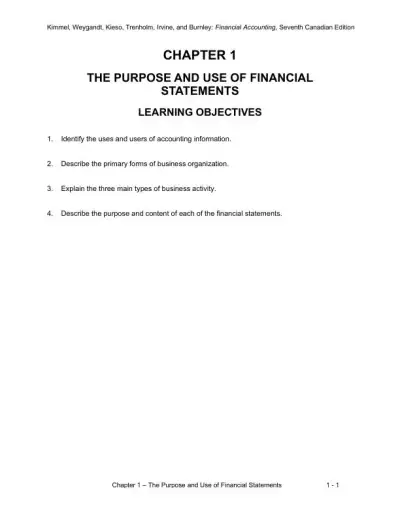 Class Notes
Class Notes for Financial Accounting: Tools for Business Decision-Making, Seventh Canadian Edition
Accounting
344 pagesMay 2025 Textbook Guides
Solution Manual for Financial Accounting, 3rd Edition
Accounting
1515 pagesMay 2025 Textbook Guides
Introduction to Financial Accounting, 11th Edition Solution Manual
Accounting
524 pages173downloadsFeb 2025 Textbook Guides
Solution Manual For International Accounting, 4th Edition
Accounting
309 pages161downloadsFeb 2025 Textbook Guides
Solution Manual For Managerial Accounting, 7th Edition
Accounting
361 pages159downloadsFeb 2025 Class Notes
Class Notes For Advanced Accounting, 4th Edition
Accounting
149 pages159downloadsFeb 2025 Textbook Guides
Financial Accounting 6th Canadian Edition Solution Manual
Accounting
867 pages156downloadsFeb 2025 Textbook Guides
Accounting Theory, 7th Edition Solution Manual
Accounting
325 pages153downloadsFeb 2025
Study this document with CramX
Once it is in your library, every tool can work from it.