

Test Bank For Intermediate Accounting: Volume 1, 11th Canadian Edition
- Accounting
- 624 pages
- Shared May 2025
Test Bank For Intermediate Accounting: Volume 1, 11th Canadian Edition simplifies complex topics with clear explanations, study strategies, and exam-focused practice.
Preview 16 of 624 pages
See the first 16 pages exactly as they appear in the document.
Page 1 Read page 1 as text
Copyright © 2016 John Wiley & Sons Canada, Ltd. Unauthorized copying, distribution, or transmission of this page is prohibited CHAPTER 13 NON - FINANCIAL AND CURRENT LIABILITIES CHAPTER STUDY OBJECTIVES 1. Understand the importance of non - financial and current liabilities from a business perspective. Cash flow management is a key control factor for most businesses. Taking advantage of supplier discounts for prompt payment is one step companies can take. Control of expenses and related accounts payable can improve the efficiency of a business, and can b e particularly important during economic downturns. 2. Define liabilities, distinguish financial liabilities from other liabilities, and identify how they are measured. Liabilities are defined as present obligations of an entity arising from past transactions or events that are settled through a transfer of economic resources in the future. They must be enforceable on the entity. Financial liabilities are a subset of liab ilities. They are contractual obligations to deliver cash or other financial assets to another party, or to exchange financial instruments with another party under conditions that are potentially unfavourable. Financial liabilities are initially recognized at fair value, and subsequently either at amortized cost or fair value. ASPE does not specify how non - financial liabilities are measured. However, unearned revenues are generally measured at the fair value of the goods or services to be delivered in the future, while others are measured at the best estimate of the resources needed to settle the obligation. Under IFRS, non - financial liabiliti es other than unearned revenues are measured at the best estimate of the amount the entity would rationally pay at the date of the statement of financial position to settle the present obligation. 3. Define current liabilities and identify and account for common types of current liabilities. Current liabilities are obligations that are payable within one year from the date of the statement of financial position or within the operating cycle if the cycle is longer than a year. IFRS also includes liabilities held for trading and any obligation w here the entity does not have an unconditional right to defer settlement beyond 12 months after the date of the statement of financial position. There are sever al types of current liabilities. The most common are accounts and notes payable, and payroll - related obligations. 4. Identify and account for the major types of employee - related liabilities. Employee - related liabilities include (1) payroll deductions, (2) compensated absences, and (3) profit - sharing and bonus agreements. Payroll deductions are amounts that are withheld from employees and result in an obligation to the government or other party . The employer’s matching contributions are also included in this obligation. Compensated absences earned by employees are company obligations that are recognized as employees earn a n entitlement to them, as long as they can be reasonably measured. Bonuses based on income are accrued as an expense and liability as the income is earned.
Page 2 Page 3 Read page 3 as text
Test Bank for Intermediate Accounting, Elev enth Canadian Edition Copyright © 2016 John Wiley & Sons Canada, Ltd. Unauthorized copying, distribution, or transmission of this page is prohibited 13 - 2 5. Explain the recognition, measurement, and disclosure requirements for decommissioning and restoration obligations. A decommissioning, restoration, or asset retirement obligation (ARO) is an estimate of the costs a company is obliged to incur when it retires certain assets. It is recorded as a liability and is usually long - term in nature. Under ASPE, only legal obligati ons are recognized. They are measured at the best estimate of the cost to settle them at the date of the statement of financial position, and the associated cost is included as part of the cost of property, plant, and equipment. Under IFRS, both legal and constructive obligations are recognized. They are measured at the amount the entity would rationally pay to be relieved of the obligation, and are capitalized as part of PP&E or to inventory, if due to production activities. Over time, the liability is increased for the time value of money and the asset costs are amortized to expense. Entities disclose information about the nature of the obl igation and how it is measured, with more disclosures required under IFRS than ASPE. 6. Explain the issues and account for unearned revenues. When an entity receives proceeds in advance or for multiple deliverables, unearned revenue is recognized to the extent the entity has not yet performed. This is measured at the fair value of the remaining goods or services that will be delivered. When cost s remain to be incurred in revenue transactions where the revenue is considered earned and has been recognized, estimated liabilities and expenses are recognized at the best estimate of the applicati on of the matching concept. 7. Explain the issues and account for product guarantees and other customer program obligations. Historically, an expense approach has been used to account for the outstanding liability, but some recent standards have moved toward the revenue approach. Under the expense approach, the outstanding liability is measured at the cost of the economic resources needed to meet the obligation. The assumption is that along with the liability that is required to be recognized at the rep orting date, the associated expense needs to be measured and matched with the revenues of the period. Under the revenue approach, the outstanding liability is measured at the value of the obligation. The proceeds received for any goods or services yet to b e delivered or performed are considered to be unearned at the point of sale. Until the revenue is earned, the obligation — the liability — is reported at its sales or fair value. The liability is then reduced as the revenue is earned. 8. Explain and account for contingencies and uncertain commitments, and identify the accounting and reporting requirements for guarantees and commitments. Under existing standards, a loss is accrued and a liability recognized if (1) information that is available before the issuance of the financial statements shows that it is likely (or more likely than not under IFRS) that a liability has been incurred at t he date of the financial statements, and (2) the loss amount can be reasonably estimated (under IFRS, it would be a rare situation where this could not be done). An alternative approach likely to be required in new standards being developed by the IASB is described in the Looking Ahead section of the chapter. Guarantees in general are accounted for similarly to contingencies. Commitments, or contractual obligations, do not usually result in a liability at the date of the statement of financial position. Information about specific types of outstanding commitment s is reported at the date of the statement of financial position.
Page 4 Read page 4 as text
Non - Financial and Current Liabilities Copyright © 2016 John Wiley & Sons Canada, Ltd. Unauthorized copying, distribution, or transmission of this page is prohibite d 13 - 3 9. Indicate how non - financial and current liabilities are presented and analyzed. Current liability accounts are commonly presented as the first classification in the liability section of the statement of financial position, although under IFRS, a common presentation is to present current assets and liabilities at the bottom of the stat ement. Within the current liability section, the accounts may be listed in order of their maturity or in order of their liquidation preference. IFRS requires information abou t and reconciliations of any provisions. Additional information is provided so that there is enough to meet the requirement of full disclosure. Information about unrecognized loss contingencies is reported in notes to the financial statements, including th eir nature and estimates of possible losses. Commitments at year end that are significant in size, risk, or time are disclosed in the notes to the financial statements, with significantly more information required under IFRS. Three common ratios used to an alyze liquidity are the current, acid - test, and days payables outstanding ratios. 10 . Identify differences in accounting between IFRS and ASPE and what changes are expected in the near future. Private enterprise and international standards are substantially the same. However, there are some classification differences. ASPE does not address “provisions,” and there are differences related to which decommissioning and restoration liabilities are re cognized and how the costs are capitalized, and how the probability and measurement criteria are applied to contingencies. In addition, requires considerably more disclosure. Looking ahead, revisions to the existing standards are being proposed by the IASB and FASB that will likely be applied, at least in part, under CICA Handbook , Part II in the future. The major changes relate to the recognition and measurement standards for non - financial liabilities.
Page 5 Read page 5 as text
Test Bank for Intermediate Accounting, Elev enth Canadian Edition Copyright © 2016 John Wiley & Sons Canada, Ltd. Unauthorized copying, distribution, or transmission of this page is prohibited 13 - 4 M ULTIPLE CHOICE — Conceptual Answer No. Description c 1. Essential characteristics of liabilities c 2 . Constructive obligation b 3 . Recognition and accounting for financial liabilities a 4. Classification of notes payable d 5 . Zero - interest - bearing notes c 6 . Refinancing of long - term debts b 7 . Identify item that is not a current liability. c 8 . Identify the current liability. d 9 . Classification of stock dividends distributable a 10 . Goods and Services Tax b 11 . Identify current liability. c 12 . Accounting for GST a 13 . Provincial Sales Tax b 14 . Corporation income tax a 15 . Knowledge of accounts payable d 1 6 . Current liabilities in general - determine false statement c 1 7 . Determine employer’s payroll costs b 1 8 . Accumulating rights to benefits c 1 9 . Accrual of liability for compensated absences b 20 . Non - accumulating rights to benefits d 2 1 . Methods of calculating employee bonuses c 2 2 . Definition of a provision d 2 3 . Recognition of an asset retirement obligation c 2 4 . Recognition of an asset retirement obligation a 2 5 . Recording accretion expense for ARO c 2 6 . Revenue approach for product guarantees d 2 7 . Determine false statement regarding warranties b 2 8 . Accounting for premiums and coupons d 29 . IFRS re customer loyalty programs c 30 . Recognition of contingencies (ASPE) a 31 . Recognition of contingencies (IFRS) d 3 2 . Accrual of contingent liability c 3 3 . Disclosure of commitments d 34 . Determine range of loss accrual. d 3 5 . Acid - test ratio elements c 3 6 . Days payable outstanding elements b 3 7 . Essential characteristics of liabilities c 3 8 . Proposed amendments regarding provisions and contingencies
Page 6 Read page 6 as text
Non - Financial and Current Liabilities Copyright © 2016 John Wiley & Sons Canada, Ltd. Unauthorized copying, distribution, or transmission of this page is prohibite d 13 - 5 M ULTIPLE CHOICE — Computational Answer No. Description b 3 9 . Adjusting entry for zero - interest - bearing note d 40 . Journal entry for payment of interest - bearing note b 41 . Determine amount of short - term debt to be reported. d 4 2 . Determine amount of short - term debt to be reported. b 4 3 . Calculate accounts receivable including sales taxes. c 4 4 . Calculate cost of purchase for own use. d 4 5 . Payment of GST c 4 6 . Adjusting entry for corporate income tax d 47 . Determine amount of short - term debt to be reported. c 48 . Calculate accrued interest payable. c 49 . Calculate HST collected. b 50 . Calculate payroll tax expense. b 51 . Calculate vacation pay expense to be reported. c 52 . Calculate accrued vacation pay liability. b 53 . Calculate net pay. a 54 . Calculate accrued salaries payable. b 55 . Accrual of payroll taxes d 56 . Entry for asset retirement obligation b 5 7 . Entry for asset retirement obligation accretion b 58 . Calculate asset retirement obligation. c 5 9 . Adjusting entry for unearned revenue b 6 0 . Determine current and long - term portions of debt. a 61 . Expense approach to warranty a 62 . Revenue approach to warranty c 63 . Calculate warranty liability (expense approach). a 64 . Calculate liability for unredeemed coupons. b 6 5 . Calculate unearned service contract revenue. c 66 . Calculate liability from unredeemed trading stamps. b 67 . Determine amount to accrue as a loss contingency. d 68 . Determine amount to accrue as a gain contingency. c 69 . Calculate quick (acid - test) ratio. d 70 . Calculate current ratio. a 71 . Calculate days payables outstanding.
Page 7 Read page 7 as text
Test Bank for Intermediate Accounting, Elev enth Canadian Edition Copyright © 2016 John Wiley & Sons Canada, Ltd. Unauthorized copying, distribution, or transmission of this page is prohibited 13 - 6 EXERCISES Item Description E13 - 72 Notes payable E13 - 73 Sales taxes E13 - 74 Payroll entries E13 - 75 Compensated absences E13 - 76 Asset retirement obligation E13 - 77 Premiums E13 - 78 Premiums E13 - 79 Contingent liabilities PROBLEMS Item Description P13 - 80 Common types of current liabilities P13 - 81 Accounts and notes payable P13 - 82 Refinancing of short - term debt P13 - 83 Employee - related liabilities P13 - 84 Asset retirement obligation P13 - 85 Premiums P13 - 86 Warranties P13 - 87 Unredeemed coupons P13 - 88 Contingences
Page 8 Read page 8 as text
Non - Financial and Current Liabilities Copyright © 2016 John Wiley & Sons Canada, Ltd. Unauthorized copying, distribution, or transmission of this page is prohibite d 13 - 7 MULTIPLE CHOICE — Conceptual 1. According to the existing IFRS and the CICA Handbook Part II guidelines, which of the following is NOT an essential characteristic of a liability? a) It embodies a duty or responsibility. b) The transaction or event that obliges the entity has occurred. c) The obligation is enforceable on the other party . d) The entity has little or no discretion to avoid the duty. Answer: c Difficulty: Easy Learning Objective: Defi ne liabilities, distinguish financial liabilities from other liabilities, and identify how they are measured . Section Reference: Recognition a nd Measurement CPA: Financial Reporting Bloomcode: Knowledge 2 . A constructive obligation arises when a) the entity is legally obligated to honour the obligation. b) the entity makes an unconditional promise to pay money in the future. c) past or present company practice reveals the entity acknowledges a potential economic burden. d) the entity has a conditional obligation which becomes unconditional if an uncertain future event occurs. Answer: c Difficulty: Easy Learning Objective: Defi ne liabilities, distinguish financial liabilities from other liabilities, and identify how they are measured . Section Reference: Recognition a nd Measurement CPA: Financial Reporting Bloomcode: Comprehension 3 . Which of the following statements is NOT true about recognition and subsequent accounting for financial liabilities? a) They are initially recognized at their fair value. b) After acquisition, they continue to be accounted for at fair value. c) After acquisition, they are generally accounted for at amortized cost. d) Short - term liabilities, such as accounts payable, are usually recorded at their maturity value. Answer: b Difficulty: Medium Learning Objective: Defi ne liabilities, distinguish financial liabilities from other liabilities, and identify how they are measured . Section Reference: Recognition a nd Measurement CPA: Financial Reporting
Page 9 Read page 9 as text
Test Bank for Intermediate Accounting, Elev enth Canadian Edition Copyright © 2016 John Wiley & Sons Canada, Ltd. Unauthorized copying, distribution, or transmission of this page is prohibited 13 - 8 Bloomcode: Knowledge 4. Among Oslo Corp. ’s short - term obligations, on its most recent statement of financial position date, are notes payable totalling $250,000 with the Provincial Bank. These are 90 - day notes, renewable for another 90 - day period. These notes should be classified on Oslo’s state ment of financial position as a) current liabilities. b) deferred charges. c) long - term liabilities. d) shareholders’ equity. Answer: a Difficulty: Medium Learning Objective: Defi ne current liabilities and identify and account for common types of current liabilities . Section Reference: Common Current Liabilities CPA: Financial Reporting Bloomcode: Application 5 . Regarding zero - interest - bearing notes, a) they do not have an interest component. b) the debtor receives the future value of the note and pays back the present value. c) any interest is never recognized until the note is repaid. d) the debtor receives the present value of the note and pays back the future value. Answer: d Difficulty: Medium Learning Objective: Defi ne current liabilities and identify and account for common types of current liabilities . Section Reference: Common Current Liabilities CPA: Financial Reporting Bloomcode: Knowledge 6 . Under IFRS, even if the entity plans to refinance long - term debt, the current portion must be reported as a current liability UNLESS a) long - term financing has been completed after the statement of financial position date, but before the financial statements are released. b) management intends to refinance the debt on a long - term basis. c) at statement of financial position date, the entity expects to refinance under an existing agreement for at least a year, and the decision is solely at its discretion. d) management intends to discharge the debt by issuing shares. Answer: c Difficulty: Medium Learning Objective: Defi ne current liabilities and identify and account for common types of current liabilities .
Page 10 Read page 10 as text
Non - Financial and Current Liabilities Copyright © 2016 John Wiley & Sons Canada, Ltd. Unauthorized copying, distribution, or transmission of this page is prohibite d 13 - 9 Section Reference: Common Current Liabilities CPA: Financial Reporting Bloomcode: Knowledge 7 . Which of the following should NOT be included in the current liabilities section of the statement of financial position? a) trade accounts payable b) current portion of long - term debt to be retired by non - current assets c) short - term zero - interest - bearing notes payable d) a liability due on demand (callable debt) Answer: b Difficulty: Easy Learning Objective: Defi ne current liabilities and identify and account for common types of current liabilities . Section Reference: Common Current Liabilities CPA: Financial Reporting Bloomcode: Comprehension 8 . Which of the following is a current liability? a) preferred dividends in arrears b) stock dividends distributable c) preferred cash dividends payable d) stock splits Answer: c Difficulty: Easy Learning Objective: Defi ne current liabilities and identify and account for common types of current liabilities . Section Reference: Common Current Liabilities CPA: Financial Reporting Bloomcode: Knowledge 9 . Stock dividends distributable should be classified on the a) income statement as an expense. b) statement of financial position as an asset. c) statement of financial position as a liability. d) statement of financial position as an item of shareholders' equity. Answer: d Difficulty: Easy Learning Objective: Defi ne current liabilities and identify and account for common types of current liabilities . Section Reference: Common Current Liabilities CPA: Financial Reporting Bloomcode: Knowledge
Page 11 Read page 11 as text
Test Bank for Intermediate Accounting, Elev enth Canadian Edition Copyright © 2016 John Wiley & Sons Canada, Ltd. Unauthorized copying, distribution, or transmission of this page is prohibited 13 - 10 1 0 . Goods and Services Tax (GST) a) is a value added tax. b) is a sales tax charged by each province on all taxable goods. c) in some provinces, is an income tax. d) must be collected by all businesses in Canada. Answer: a Difficulty: Easy Learning Objective: Defi ne current liabilities and identify and account for common types of current liabilities . Section Reference: Common Current Liabilities CPA: Financial Reporting Bloomcode: Knowledge 1 1 . Which of the following may be classified as a current liability? a) stock dividends distributable b) accounts receivable credit balances c) losses expected to be incurred within the next twelve months in excess of the company's insurance coverage d) tenant’s rent deposit not returnable unt il the end of a long - term lease Answer: b Difficulty: Medium Learning Objective: Defi ne current liabilities and identify and account for common types of current liabilities . Section Reference: Common Current Liabilities CPA: Financial Reporting Bloomcode: Comprehension 1 2 . Accounting for GST includes a) crediting GST Payable to record GST paid on inventory for resale. b) crediting GST Rec eiv able to record GST collected from customers. c) debiting GST Rec eiv able to record GST paid to suppliers. d) debiting GST Payable to record GST collected from customers. Answer: c Difficulty: Medium Learning Objective: Defi ne current liabilities and identify and account for common types of current liabilities . Section Reference: Common Current Liabilities CPA: Financial Reporting Bloomcode: Knowledge 1 3 . Regarding Provincial Sales Tax (PST) ,
Page 12 Read page 12 as text
Non - Financial and Current Liabilities Copyright © 2016 John Wiley & Sons Canada, Ltd. Unauthorized copying, distribution, or transmission of this page is prohibite d 13 - 11 a) t he purchaser includes any PST paid in the cost of the goods or services. b) a ll PST paid is recorded in a “PST Expense” account. c) a ll PST paid is recorded in a “PST Recoverable” account. d) f or statement of financial position presentation, a PST registrant “nets” any PST paid against any PST collected from customers. Answer: a Difficulty: Easy Learning Objective: Defi ne current liabilities and identify and account for common types of current liabilities . Section Reference: Common Current Liabilities CPA: Financial Reporting Bloomcode: Knowledge 1 4 . Corporation income taxes payable a) must always be approved by an external auditor. b) are reviewed and approved by Canada Revenue Agency (CRA). c) also apply to proprietorships and partnerships. d) are always the same under GAAP and Canadian tax laws. Answer: b Difficulty: Easy Learning Objective: Defi ne current liabilities and identify and account for common types of current liabilities . Section Reference: Common Current Liabilities CPA: Financial Reporting Bloomcode: Knowledge 15 . Which of the following is generally associated with current liabilities classified as accounts payable? Periodic Payment Secured of Interest by Collateral a) No No b) No Yes c) Yes No d) Yes Yes Answer: d Difficulty: Medium Learning Objective: Defi ne current liabilities and identify and account for common types of current liabilities . Section Reference: Common Current Liabilities CPA: Financial Reporting Bloomcode: Knowledge Feedback: A ccounts payable generally are zero - interest - bearing and unsecured.
Page 13 Read page 13 as text
Test Bank for Intermediate Accounting, Elev enth Canadian Edition Copyright © 2016 John Wiley & Sons Canada, Ltd. Unauthorized copying, distribution, or transmission of this page is prohibited 13 - 12 1 6 . Which of the following statements is FALSE? a) Under IFRS, a company may exclude a short - term obligation from current liabilities if, at statement of financial position date, the entity expects to refinance under an existing agreement for at least a year, and the decision is solely at its discretion. b) Cash dividends should be recorded as a liability when they are declared by the board of directors. c) Under the cash basis method, warranty costs are charged to expense as they are paid. d) Federal income taxes withheld from employees' payroll cheques should be recorded as a long - term liability. Answer: d Difficulty: Medium Learning Objective: Defi ne current liabilities and identify and account for common types of current liabilities . Section Reference: Common Current Liabilities Learning Objective: Identify and account for the major types of employee - related liabilities . Section Reference: Employee - Related Liabilities Learning Objective: Explain the issues and account for product guarantees and other customer program obligations . Section Reference: Product Guarantees and Customer Programs CPA: Financial Reporting Bloomcode: Comprehension 1 7 . Which of the following are included in the employer's “Payroll Tax Expense”? a) e mployee income tax deducted, emp loyer portion of CPP/QPP and EI b) e mployer portion of CPP/QPP and EI, union dues c) e mployer portion of CPP/QPP and EI only d) e mployer portion of EI, union dues, and employee income tax d educted Answer: c Difficulty: Medium Learning Objective: Identify and account for the major types of employee - related liabilities . Section Reference: Employee - Related Liabilities CPA: Financial Reporting Bloomcode: Knowledge 1 8 . Accumulating rights to benefits (for employees) a) are rarely mandated by provincial labour law. b) include vested rights that do not depend on the employee’s continued service. c) are rights that do not accrue with employee service. d) are not accrued as an expense in the period earned. Answer: b Difficulty: Medium Learning Objective: Identify and account for the major types of employee - related liabilities . Section Reference: Employee - Related Liabilities CPA: Financial Reporting
Page 14 Read page 14 as text
Non - Financial and Current Liabilities Copyright © 2016 John Wiley & Sons Canada, Ltd. Unauthorized copying, distribution, or transmission of this page is prohibite d 13 - 13 Bloomcode: Knowledge 1 9 . A liability for compensated absences such as vacations, for which it is expected that employees will be paid, should a) be accrued during the period when the compensated time is expected to be used by employees. b) be accrued during the period following vesting. c) be accrued during the period when earned. d) not be accrued unless a written contractual obligation exists. Answer: c Difficulty: Medium Learning Objective: Identify and account for the major types of employee - related liabilities . Section Reference: Employee - Related Liabilities CPA: Financial Reporting Bloomcode: Knowledge 20 . Non - accumulating rights to benefits, such as parental leave, are generally accounted for by a) the full accrual method. b) the event accrual method. c) the cash method. d) financial statement note disclosure only. Answer: b Difficulty: Medium Learning Objective: Identify and account for the major types of employee - related liabilities . Section Reference: Employee - Related Liabilities CPA: Financial Reporting Bloomcode: Knowledge 2 1 . Which of the following is generally NOT used as a basis for calculating bonuses or profit - sharing amounts? a) a percentage of t he employees’ regular pay rates b) the company’s pre - tax income c) productivity increases d) gross sales Answer: d Difficulty: Medium Learning Objective: Identify and account for the major types of employee - related liabilities . Section Reference: Employee - Related Liabilities CPA: Financial Reporting Bloomcode: Knowledge 2 2 . Under IFRS, a provision is
Page 15 Read page 15 as text
Test Bank for Intermediate Accounting, Elev enth Canadian Edition Copyright © 2016 John Wiley & Sons Canada, Ltd. Unauthorized copying, distribution, or transmission of this page is prohibited 13 - 14 a) a special fund set aside to pay long - term debt. b) unearned revenue. c) a liability of uncertain timing or amount. d) an allowance f or future dividends to be paid. Answer: c Difficulty: Medium Learning Objective: Explain the recognition, measurement, and disclosure requirements for decommissioning and restoration obligations . Section Reference: Decommissioning and Restoration Obligations CPA: Financial Reporting Bloomcode: Knowledge 2 3 . At the time of recognition of an asset retirement obligation, the present value should be a) recorded as a separate long - term asset and as an asset retirement obligation. b) expensed and recorded as an asset retirement obligation. c) expensed to “Asset Retirement Expense” in the period actually paid. d) added to the related asset cost and recorded as an asset retirement obligation. Answer: d Difficulty: Medium Learning Objective: Explain the recognition, measurement, and disclosure requirements for decommissioning and restoration obligations . Section Reference: Decommissioning and Restoration Obligations CPA: Financial Reporting Bloomcode: Knowledge 2 4 . Under ASPE, an asset retirement obligation should be recognized when a) an asset is impaired and is available for sale. b) operation of an asset has resulted in an additional obligation such as the cost of cleaning up an oil spill. c) there is a legal obligation to restore the site of the asset at the end of its useful life. d) the company has an obligation to purchase a long - lived asset. Answer: c Difficulty: Easy Learning Objective: Explain the recognition, measurement, and disclosure requirements for decommissioning and restoration obligations . Section Reference: Decommissioning and Restoration Obligations CPA: Financial Reporting Bloomcode: Knowledge 2 5 . Which of the following statements is INCORRECT regarding the recording of the related increase or accretion in the carrying amount of an asset retirement obligation (ARO)? a) Under ASPE, it is recognized as interest expense. b) Under ASPE, it is recognized as an operating expense (but not as interest expense).
Page 16 Read page 16 as text
Non - Financial and Current Liabilities Copyright © 2016 John Wiley & Sons Canada, Ltd. Unauthorized copying, distribution, or transmission of this page is prohibite d 13 - 15 c) Under IFRS, it is recognized as a borrowing cost. d) The amount should be calculated using the same discount (interest rate) as was used to calculate the initial present value of the ARO. Answer: a Difficulty: Medium Learning Objective: Explain the recognition, measurement, and disclosure requirements for decommissioning and restoration obligations . Section Reference: Decommissioning and Restoration Obligations CPA: Financial Reporting Bloomcode: Knowledge 2 6 . Using the revenue approach of accounting for product guarantees and warranty obligations a) the liability is measured at the estimated cost of meeting the obligation. b) there is no effect on future income. c) the liability is measured at the value of the services to be provided. d) the liability is measured at the value of the services to be provided, but there is no effect on future income. Answer: c Difficulty: Medium Learning Objective: Explain the issues and account for product guarantees and other customer program obligations . Section Reference: Product Guarantees and Customer Programs CPA: Financial Reporting Bloomcode: Comprehension 2 7 . Which of the following statements is INCORRECT concerning warranties? a) Using the expense approach, the warranty is provided with the product or service with no additional fee. b) Where warranty costs are immaterial or when the warranty period is quite short, the warranty costs may be accounted for using the cash basis. c) Using the revenue approach, the warranty is a separate deliverable from the related product or service. d) The revenue approach must be used for income tax purposes. Answer: d Difficulty: Medium Learning Objective: Explain the issues and account for product guarantees and other customer program obligations . Section Reference: Product Guarantees and Customer Programs CPA: Financial Reporting Bloomcode: Comprehension 2 8 . The current (commonly used) accounting treatment for premiums and coupons requires that the costs should
608 more pages in the full document
Unlock it once and it stays in your library, ready to chat with or turn into flashcards.
Unlock the full documentMore Accounting study materials
See all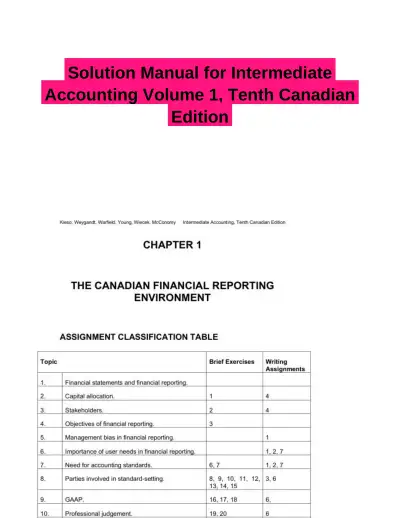 Textbook Guides
Solution Manual for Intermediate Accounting Volume 1, Tenth Canadian Edition
Accounting
1551 pagesMay 2025 Textbook Guides
Introduction to Financial Accounting, 11th Edition Solution Manual
Accounting
524 pages173downloadsFeb 2025 Textbook Guides
Solution Manual For International Accounting, 4th Edition
Accounting
309 pages161downloadsFeb 2025 Textbook Guides
Solution Manual For Managerial Accounting, 7th Edition
Accounting
361 pages159downloadsFeb 2025 Class Notes
Class Notes For Advanced Accounting, 4th Edition
Accounting
149 pages159downloadsFeb 2025 Textbook Guides
Financial Accounting 6th Canadian Edition Solution Manual
Accounting
867 pages156downloadsFeb 2025 Textbook Guides
Accounting Theory, 7th Edition Solution Manual
Accounting
325 pages153downloadsFeb 2025 Textbook Guides
Financial Accounting, 9th Edition Solution Manual
Accounting
1024 pages134downloadsFeb 2025
Study this document with CramX
Once it is in your library, every tool can work from it.