

Test Bank For Managerial Accounting, 13th Edition
- Accounting
- 3737 pages
- Shared May 2025
Need to sharpen your exam skills? Test Bank For Managerial Accounting, 13th Edition provides answers to tough questions, helping you excel.
Preview 16 of 3737 pages
See the first 16 pages exactly as they appear in the document.
Page 1 Read page 1 as text
Chapter 001, Managerial Accounting and the Business Environmen t 1 - 1 Question Type Difficulty LO1: Role of management accountants LO2: Lean Production, TOC, Six Sigma LO3: Ethics Professional Exam Adapted ID Origin CMA/CPA origin 1 T/F M x 5/e: 1 - 7 Authors 2 T/F M x EN: 11/2/05, B E.N. 3 T/F E x EN: 11/2/05, G E.N. 4 T/F E x EN: 11/2/05, J E.N. 5 T/F M x EN: 11/2/05, O E.N. 6 T/F M x New,6/23/95,AJ E.N. 7 T/F M x EN: 11/2/05, Q E.N. 8 T/F M x EN: 11/2/05, U E.N. 9 T/F M x EN: 11/2/05, AA E.N. 10 T/F M x EN: 11/2/05, AC E.N. 11 T/F E x New,6/19/08,BB E.N. 12 T/F M x New,6/23/95,AR E.N. 13 T/F M x New,6/18/07,AA E.N. 14 Conceptual M/C M x 5/e: 1 - 25 Authors 15 Conceptual M/C E x 3/e: 1 - 6 Authors 16 Conceptual M/C E x 11/e: ATB 1 - 11 Antoinette Clegg 17 Conceptual M/C E x 11/e: ATB 1 - 16 Antoinette Clegg 18 Conceptual M/C E x EN: 11/2/2006, B E.N. 19 Conceptual M/C E x EN: 11/2/2006, E E.N. 20 Conceptual M/C M x 11/e: ATB 1 - 35 Antoinette Clegg 21 Conceptual M/C E x 8/e:ATB1 - 21 David Keyes 22 Conceptual M/C E x 11/e: ATB 1 - 21 Antoinette Clegg 23 Conceptual M/C M x EN: 11/2/2006, I E.N. 24 Conceptual M/C M x EN: 11/2/2006, P E.N. 25 Conceptual M/C H x 7/e: 1 - 51 Authors
Page 2 Page 3 Read page 3 as text
Chapter 001, Managerial Accounting and the Business Environmen t 1 - 2 True / False Questions 1. The controller occupies a staff position in an organization. True False 2. A strategy is a game plan that enables a company to attract customers by mimicking what successful competitors do. True False 3. Customer value propositions tend to fall into three broad categories – theory of constraints, six sigma, and enterprise risk management. True False 4. Companies that choose an operational excellence strategy are in essence saying to their customers, "Choose us because we can deliver products and services faster, more conveniently, and at a lower price than our competitors." True False 5. A value chain consists of the major subassemblies that add value to a product. True False 6. Efforts designed to increase the rate of output should generally be applied to non - constraint work stations. True False 7. The lean thinking model focuses on reducing defects to as close to zero as possible. True False
Page 4 Read page 4 as text
Chapter 001, Managerial Accounting and the Business Environmen t 1 - 3 8. Six Sigma is a process improvement method that targets a system's constraint for process improvement. True False 9. The Sarbanes - Oxley Act of 2002 was intended to protect the interests of those who invest in publicly traded companies by ensuring that their original investments could be recovered in case of fraud. True False 10. Enterprise risk management involves replacing risky investments with investments in low - risk government securities. True False 11. Corporate social responsibility refers to the moral obligation of all corporations to make substantial monetary contributions to charitable causes. True False 12. The Statement of Ethical Professional Practice promulgated by the Institute of Management Accountants specifically states, among other things, that management accountants have a responsibility to inform responsible journalists of any wrongdoing they uncover in the organization. True False 13. The Institute of Management Accountants' Statement of Ethical Professional Practice specifically states, among other things, that management accountants have a responsibility to keep information confidential except when disclosure is authorized or legally required. True False
Page 5 Read page 5 as text
Chapter 001, Managerial Accounting and the Business Environmen t 1 - 4 Multiple Choice Questions 14. Which of the following persons would occupy a line position in a department store? I. Sales manager II. Manager, furniture department III. Manager, advertising department IV. Manager, personnel department A. Only I B. Only I and II C. Only I, II, III D. I, II, III, IV 15. The controller occupies: A. a line position. B. a staff position. C. neither a line nor a staff position, since the accounting department must be independent. D. both a line and a staff position. 16. Decentralization refers to: A. reporting for the company as a whole. B. focusing reporting on parts of the company. C. the delegation of decision - making authority throughout an organization. D. differences in organizations. 17. _________________ is an example of a staff position. A. Sales manager for a manufacturer B. President of a merchandising company C. Store manager for Best Buy D. Human resource manager for a community college
Page 6 Read page 6 as text
Chapter 001, Managerial Accounting and the Business Environmen t 1 - 5 18. Which of the following is NOT one of the three major customer value propositions discussed in the text? A. customer intimacy B. operational excellence C. zero defects D. product leadership 19. Which of the following is NOT one of the five steps in the lean thinking model discussed in the text? A. Create a pull system that responds to customer orders. B. Automate the business process. C. Identify the business process that delivers value. D. Organize work arrangements around the flow of the business process. 20. Which of the following statements is TRUE concerning the CMA? A. To earn the CMA, an examination must be passed. B. Experience in the accounting field is not necessary to earn the CMA. C. Compliance with the Institute of Management Accountants' Statement of Ethical Professional Practice is not necessary to earn the CMA. D. Both B and C above. 21. Dorra Corporation manufactures lawnmowers in five work stations. Dorra's weekly demand is 5,000 mowers but Dorra can only produce 4,200. According to the theory of constraints, to increase production output Dorra would benefit the most by concentrating improvement efforts on the: A. first work station. B. last work station. C. largest work station. D. fastest work station. E. slowest work station.
Page 7 Read page 7 as text
Chapter 001, Managerial Accounting and the Business Environmen t 1 - 6 22. Inventories consisting of units of product that are only partially complete are called _______________. A. finished goods B. raw materials C. work in process D. none of these 23. One of the steps in the lean thinking model is to organize work arrangements around the flow of the business process. This is often accomplished by: A. automating the business process. B. implementing an enterprise system. C. instituting a six sigma program. D. creating a manufacturing cell. 24. The Sarbanes - Oxley Act of 2002 contains all of the following provisions EXCEPT: A. A CFO must be a CPA or CMA. B. The audit committee of the board of directors of a company must hire, compensate, and terminate the public accounting firm that audits the company's financial reports. C. Severe penalties are established for altering or destroying documents that may eventually be used in an official proceeding. D. Both the CEO and CFO must certify in writing that their company's financial statements and accompanying disclosures fairly represent the results of operations. 25. The Institute of Management Accountants' Statement of Ethical Professional Practice states that when faced with significant ethical issues, management accountants should first: A. discuss such problems with the immediate superior except when it appears that the superior is involved. B. clarify relevant concepts by confidential discussion with an objective advisor to obtain an understanding of possible courses of action. C. follow the established policies of the organization bearing on the resolution of such conflict. D. submit an informative memorandum describing the ethical issue to an appropriate representative of the organization and resign if no action is taken as a result of the memorandum.
Page 8 Read page 8 as text
Chapter 001, Managerial Accounting and the Business Environment Key 1 - 7 True / False Questions 1. The controller occupies a staff position in an organization. TRUE AACSB: Reflective Thinking AICPA BB: Critical Thinking AICPA FN: Measurement Learning Objective: 1 Level: Medium 2. A strategy is a game plan that enables a company to attract customers by mimicking what successful competitors do. FALSE AACSB: Reflective Thinking AICPA BB: Critical Thinking AICPA FN: Measurement Learning Objective: 1 Level: Medium 3. Customer value propositions tend to fall into three broad categories – theory of constraints, six sigma, and enterprise risk management. FALSE AACSB: Reflective Thinking AICPA BB: Critical Thinking AICPA FN: Measurement Learning Objective: 1 Level: Easy 4. Companies that choose an operational excellence strategy are in essence saying to their customers, "Choose us because we can deliver products and services faster, more conveniently, and at a lower price than our competitors." TRUE AACSB: Reflective Thinking AICPA BB: Critical Thinking AICPA FN: Measurement Learning Objective: 1 Level: Easy
Page 9 Read page 9 as text
Chapter 001, Managerial Accounting and the Business Environment Key 1 - 8 5. A value chain consists of the major subassemblies that add value to a product. FALSE AACSB: Reflective Thinking AICPA BB: Critical Thinking AICPA FN: Measurement Learning Objective: 1 Level: Medium 6. Efforts designed to increase the rate of output should generally be applied to non - constraint work stations. FALSE AACSB: Reflective Thinking AICPA BB: Critical Thinking AICPA FN: Measurement Learning Objective: 2 Level: Medium 7. The lean thinking model focuses on reducing defects to as close to zero as possible. FALSE AACSB: Reflective Thinking AICPA BB: Critical Thinking AICPA FN: Measurement Learning Objective: 2 Level: Medium 8. Six Sigma is a process improvement method that targets a system's constraint for process improvement. FALSE AACSB: Reflective Thinking AICPA BB: Critical Thinking AICPA FN: Measurement Learning Objective: 2 Level: Medium
Page 10 Read page 10 as text
Chapter 001, Managerial Accounting and the Business Environment Key 1 - 9 9. The Sarbanes - Oxley Act of 2002 was intended to protect the interests of those who invest in publicly traded companies by ensuring that their original investments could be recovered in case of fraud. FALSE AACSB: Reflective Thinking AICPA BB: Critical Thinking AICPA FN: Measurement Learning Objective: 2 Level: Medium 10. Enterprise risk management involves replacing risky investments with investments in low - risk government securities. FALSE AACSB: Reflective Thinking AICPA BB: Critical Thinking AICPA FN: Measurement Learning Objective: 2 Level: Medium 11. Corporate social responsibility refers to the moral obligation of all corporations to make substantial monetary contributions to charitable causes. FALSE AACSB: Reflective Thinking AICPA BB: Critical Thinking AICPA FN: Measurement Learning Objective: 2 Level: Easy 12. The Statement of Ethical Professional Practice promulgated by the Institute of Management Accountants specifically states, among other things, that management accountants have a responsibility to inform responsible journalists of any wrongdoing they uncover in the organization. FALSE AACSB: Reflective Thinking AICPA BB: Critical Thinking AICPA FN: Measurement Learning Objective: 3 Level: Medium
Page 11 Read page 11 as text
Chapter 001, Managerial Accounting and the Business Environment Key 1 - 10 13. The Institute of Management Accountants' Statement of Ethical Professional Practice specifically states, among other things, that management accountants have a responsibility to keep information confidential except when disclosure is authorized or legally required. TRUE AACSB: Reflective Thinking AICPA BB: Critical Thinking AICPA FN: Measurement Learning Objective: 3 Level: Medium Multiple Choice Questions 14. Which of the following persons would occupy a line position in a department store? I. Sales manager II. Manager, furniture department III. Manager, advertising department IV. Manager, personnel department A. Only I B. Only I and II C. Only I, II, III D. I, II, III, IV AACSB: Reflective Thinking AICPA BB: Critical Thinking AICPA FN: Measurement Learning Objective: 2 Level: Medium 15. The controller occupies: A. a line position. B. a staff position. C. neither a line nor a staff position, since the accounting department must be independent. D. both a line and a staff position. AACSB: Reflective Thinking AICPA BB: Critical Thinking AICPA FN: Measurement Learning Objective: 2 Level: Easy
Page 12 Read page 12 as text
Chapter 001, Managerial Accounting and the Business Environment Key 1 - 11 16. Decentralization refers to: A. reporting for the company as a whole. B. focusing reporting on parts of the company. C. the delegation of decision - making authority throughout an organization. D. differences in organizations. AACSB: Reflective Thinking AICPA BB: Critical Thinking AICPA FN: Measurement Learning Objective: 2 Level: Easy 17. _________________ is an example of a staff position. A. Sales manager for a manufacturer B. President of a merchandising company C. Store manager for Best Buy D. Human resource manager for a community college AACSB: Reflective Thinking AICPA BB: Critical Thinking AICPA FN: Measurement Learning Objective: 2 Level: Easy 18. Which of the following is NOT one of the three major customer value propositions discussed in the text? A. customer intimacy B. operational excellence C. zero defects D. product leadership AACSB: Reflective Thinking AICPA BB: Critical Thinking AICPA FN: Measurement Learning Objective: 2 Level: Easy
Page 13 Read page 13 as text
Chapter 001, Managerial Accounting and the Business Environment Key 1 - 12 19. Which of the following is NOT one of the five steps in the lean thinking model discussed in the text? A. Create a pull system that responds to customer orders. B. Automate the business process. C. Identify the business process that delivers value. D. Organize work arrangements around the flow of the business process. AACSB: Reflective Thinking AICPA BB: Critical Thinking AICPA FN: Measurement Learning Objective: 2 Level: Easy 20. Which of the following statements is TRUE concerning the CMA? A. To earn the CMA, an examination must be passed. B. Experience in the accounting field is not necessary to earn the CMA. C. Compliance with the Institute of Management Accountants' Statement of Ethical Professional Practice is not necessary to earn the CMA. D. Both B and C above. AACSB: Reflective Thinking AICPA BB: Critical Thinking AICPA FN: Measurement Learning Objective: 2 Level: Medium 21. Dorra Corporation manufactures lawnmowers in five work stations. Dorra's weekly demand is 5,000 mowers but Dorra can only produce 4,200. According to the theory of constraints, to increase production output Dorra would benefit the most by concentrating improvement efforts on the: A. first work station. B. last work station. C. largest work station. D. fastest work station. E. slowest work station. AACSB: Reflective Thinking AICPA BB: Critical Thinking AICPA FN: Measurement Learning Objective: 3 Level: Easy
Page 14 Read page 14 as text
Chapter 001, Managerial Accounting and the Business Environment Key 1 - 13 22. Inventories consisting of units of product that are only partially complete are called _______________. A. finished goods B. raw materials C. work in process D. none of these AACSB: Reflective Thinking AICPA BB: Critical Thinking AICPA FN: Measurement Learning Objective: 3 Level: Easy 23. One of the steps in the lean thinking model is to organize work arrangements around the flow of the business process. This is often accomplished by: A. automating the business process. B. implementing an enterprise system. C. instituting a six sigma program. D. creating a manufacturing cell. AACSB: Reflective Thinking AICPA BB: Critical Thinking AICPA FN: Measurement Learning Objective: 3 Level: Medium 24. The Sarbanes - Oxley Act of 2002 contains all of the following provisions EXCEPT: A. A CFO must be a CPA or CMA. B. The audit committee of the board of directors of a company must hire, compensate, and terminate the public accounting firm that audits the company's financial reports. C. Severe penalties are established for altering or destroying documents that may eventually be used in an official proceeding. D. Both the CEO and CFO must certify in writing that their company's financial statements and accompanying disclosures fairly represent the results of operations. AACSB: Reflective Thinking AICPA BB: Critical Thinking AICPA FN: Measurement Learning Objective: 3 Level: Medium
Page 15 Read page 15 as text
Chapter 001, Managerial Accounting and the Business Environment Key 1 - 14 25. The Institute of Management Accountants' Statement of Ethical Professional Practice states that when faced with significant ethical issues, management accountants should first: A. discuss such problems with the immediate superior except when it appears that the superior is involved. B. clarify relevant concepts by confidential discussion with an objective advisor to obtain an understanding of possible courses of action. C. follow the established policies of the organization bearing on the resolution of such conflict. D. submit an informative memorandum describing the ethical issue to an appropriate representative of the organization and resign if no action is taken as a result of the memorandum. AACSB: Reflective Thinking AICPA BB: Critical Thinking AICPA FN: Measurement Learning Objective: 4 Level: Hard
Page 16 Read page 16 as text
Appendix 2A, Further Classification of Labor Costs 2A - 1 Question Type Difficulty LO1: Mangerial vs financial accounting LO2: DM, DL, Manuf overhead LO3: Period and product costs LO4: Income statement LO5: Schedule of cost of goods manufactured LO6: Variable and fixed costs LO7: Direct and indirect costs LO8: Decision - making cost classifications LO9: Labor cost classifications (App 2A) LO10: Classification of quality costs (App2B) LO11: Quality cost report (App 2B) Professional Exam Adapted ID Origin CMA/CPA origin 1 T/F E x 8/e:ATB2 - 10 David Keyes 2 T/F E x 4/e:40 Authors 3 Conceptual M/C M x 5/e: 2 - 46 Authors 4 M/C M x 2/e: 2 - MC6 Authors 5 M/C M x 5/e: 2 - 24 Authors 6 M/C M x 1/e: Exam#1 - II8 Authors 2A - 1 7 - 10 Multipart M/C M x 8/3/2004 Multi MC X3 E.N. 2A - 2 11 - 14 Multipart M/C M x 8/3/2004 Multi MC Y3 E.N. 15 Problem E x 8/4/2004 Problem I2 E.N. 16 Problem E x 8/4/2204 Problem J3 E.N. 17 Problem M x 8/4/2004 Problem K3 E.N. 18 Problem M x 8/4/2004 Problem L3 E.N.
3721 more pages in the full document
Unlock it once and it stays in your library, ready to chat with or turn into flashcards.
Unlock the full documentMore Accounting study materials
See all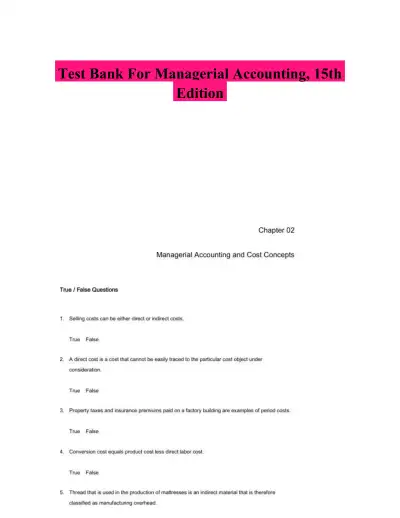 Exam Guides
Test Bank For Managerial Accounting, 15th Edition
Accounting
5449 pagesMay 2025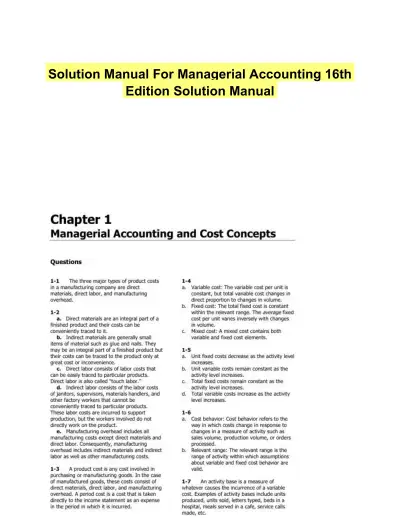 Textbook Guides
Solution Manual For Managerial Accounting 16th Edition Solution Manual
Accounting
1166 pagesMay 2025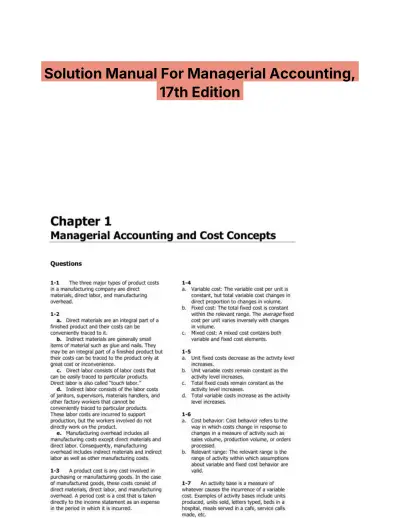 Textbook Guides
Solution Manual For Managerial Accounting, 17th Edition
Accounting
1224 pagesMay 2025 Textbook Guides
Introduction to Financial Accounting, 11th Edition Solution Manual
Accounting
524 pages173downloadsFeb 2025 Textbook Guides
Solution Manual For International Accounting, 4th Edition
Accounting
309 pages161downloadsFeb 2025 Textbook Guides
Solution Manual For Managerial Accounting, 7th Edition
Accounting
361 pages159downloadsFeb 2025 Class Notes
Class Notes For Advanced Accounting, 4th Edition
Accounting
149 pages159downloadsFeb 2025 Textbook Guides
Financial Accounting 6th Canadian Edition Solution Manual
Accounting
867 pages156downloadsFeb 2025
Study this document with CramX
Once it is in your library, every tool can work from it.