

Principles of Fraud Examination 4th Edition Test Bank
- Auditing
- 94 pages
- Shared May 2025
Prepare with confidence using Principles of Fraud Examination 4th Edition Test Bank, covering essential concepts, sample questions, and expert insights.
Preview 16 of 94 pages
See the first 16 pages exactly as they appear in the document.
Page 1 Read page 1 as text
Chapter 1 – Introduction 1. Which of the following best describes the objective of a fraud examination? a. To m ake recommendations to management about how to prevent fraud b. To d etermine whether financial statements are free of misstatements due to fraud c. To e xpress an opinion on the guilt or innocence of a suspect d. To d etermine whether a crime has been committed, and if so, who is responsible 2. Which of the following is not a part of the fraud theory approach? a. Analyze available data . b. Develop “what - if ” scenarios . c. Identify who committed the fraud . d. Refine the hypothesis . 3. Once sufficient predication has been established , what is the first step a fraud examiner following the fraud theory approach should take? a. Create a hypothesis . b. Analyze data . c. Interview witnesses . d. Interview the suspect . 4. The discipline of fraud examination includes all of the following except: a. Writing investigative reports b. Determining the guilt of the suspect c. Testifying to findings d. Interviewing witnesses 5. Fraud examination differs from auditing in that fraud examination is : a. Recurring b . Adversarial c. General in scope d. All of the above 6. Predication, although important, is not required in a fraud examination. a. True b. False 7. In a fraud examination, evidence is usually gathered in a manner that moves from general to specific. a. True b. False
Page 2 Page 3 Read page 3 as text
8. Which of the following is the correct order for a fraud examiner to interview witnesses? a. Corroborative witnesses, neutral third - parties, co - conspirators, suspect b. Suspect, co - conspirators, corroborative witnesses, neutral third - parties c. Neutral third - parties, corroborative witnesses, co - conspirators, suspect d. Suspect, corroborative witnesses, co - conspirators, neutral third - parties 9. In order to prove that fraud occurred , four elements must be pr esent . Which of the following is not one of those elements ? a. A material false statement b. Knowledge that the statement was false c. Reliance on the false statement by the victim d. Intent to cause the victim damages 10. The basic tenet of Edwin Sutherland’s theory of differential association is that crime is passed on genetically; that is, the offspring of criminals commit crimes because their parents did. a. True b. False 11. Who developed t he Fraud Scale ? a. Joseph T. Wells b. W. Steve Albrecht c. Richard C. Hollinger d. Donald R. Cressey 12. Which of the following is not one of the legs of the F raud Triangle ? a. Situational environment b. Perceived non - sharable financial need c. Perceived opportunity d. Rationalization 13. According to Cressey, the perceived opportunity to commit fraud consists of two elements: general information and technical skill. a. True b. False 14. In a study by Steve Albrecht, Marshall Romney, and Keith Howe, participants were asked to rank personal characteristics as motivating factors that contributed to fraud. The highest ranked factor was: a. Undue family or peer pressure b. Lack of recognition of job performance c. Living beyond one’s means d. Lack of appreciation by management
Page 4 Read page 4 as text
15. In a study by Steve Albrecht, Marshall Romney, and Keith Howe, participants were asked to rank characteristics of the organizational environment that contributed to fraud. The highest ranked factor was: a. Lack of clear lines of authority b. Inadequate attention to detail c. Lack of an internal audit function d. Placing too much trust in key employees 16. Research in the Hollinger - Clark study suggests that the best way to deter employee theft is by : a. Increasing sanctions imposed on occupational fraudsters b. Increasing the perception of detection c. Strengthening internal controls d. Communicating the organization’s fraud policies to employees 17. According to the results of the Hollinger - Clark study, employees steal primarily because of: a. Job d issatisfaction b. Greed c. Informal organizational structures d. Economic pressures 18. In the 20 12 Report to the Nation s on Occupational Fraud and Abuse , the category that committed the smallest percentage of occupational fraud was : a. Managers b. Employees c. Owners /Executives d. External parties 19. In the 20 12 Report to the Nation s on Occupational Fraud and Abuse , the median loss in schemes committed by males wa s higher than the median loss in schemes committed by femal es. a. True b. False 20. In the 20 12 Report to the Nation s on Occupational Fraud and Abuse , most frauds were initially detected during an external audit . a. True b. False 21. In the 20 12 Report to the Nation s on Occupational Fraud and Abuse , financial statement fraud had a higher median loss than asset misappropriation and corruption schemes . a. True b. False
Page 5 Read page 5 as text
22. In the 20 12 Report to the Nation s on Occupational Fraud and Abuse , most perpetrators of fraud had been previously charged with or convicted of a fraud - related offense . a. True b. False 23. Joe l Baker, a customer of ABC Electronics, stole a box containing computer games while the sales associa te waited on another customer. Which of the following could Jo e l be charged wit h ? a. Larceny b. Embezzlement c. Fraud d. All of the above 24. While conducting a routine internal audit, Sally Franks overheard one of the company’s purchasing agent s bragging about receiving a substantial discount on a new SUV from the company’s supplier of fleet cars . Is there sufficient predication to initiate a fraud examination? a. Yes b. No 25. When Jill Michaels, an assistant to the director of procurement, moved into her new home, she used the company’s flat bed truck to move her furnishings on an afternoon when her boss was out of town. Which of the following best describes Michael ’ s act ? a. Fraud b. Abuse c. Embezzlement d. Larceny 26. Eddie Dolan is the manager of shipping and receiving and has been working at the UFA Company for twenty years . He rarely calls in sick and gets good p erformance reviews every year. For the past year, his wife’s company , ABC Co., has been in serious financial trouble . ABC Co. likely will not be able to make the payroll for next mon th and may have to close down. Which leg of the Fraud Triangle best applies to Dolan’s situation? a. Motive b. Perceived opportunity c. Rationalization d. Non - sharable financial need
Page 6 Read page 6 as text
27. Alice Durant works in the accounts payable department for the BC G roup. She recently found out that Della Granger , another A/P clerk, received a bigger raise than she did, even though Durant has been with the company longer and frequently has to correct Granger’s errors . Which leg of the Fraud Triangle best applies to Durant’s situation? a. Motive b. Perceived opportunity c. Rationalization d. Non - sharable financial need 28. Arthur Baxter, a manager in records retention for SWC Company , has ordered seven laptop computers for his department, even though he only has five employees. In addition to each laptop, he ordered extra copies of several software programs . When the equipment arrives, Baxter sends one of the extra laptops to his son who is a freshman at Eastern University and sells three of the original software packages to friends. Wh ich of the following offenses could Baxter be charged with? a. Larceny b. Embezzlement c. Conversion d. All of the above 29. Richard Moore is the controller for Ajax Company. Recently , he suffered several large losses at the race track, causing him to incur enormous personal debts. Which type of non - sharable financial problem best describes Richard’s situation? a. Business reversal b. Physical isolation c. Violation of ascribed obligations d. Status gaining 30. Samantha Lewis, CFE , is conducting an investigation into possible skimming of the accounts receivable at South wes t Paint and Supply Co. If Lewis plans to interview all of the following parties, who m should she interview first? a. Marie Riley , the primary suspect b. Jose Rodriguez, an accounts receivable clerk who filled in for Riley while she was on vacation c. Sean Miles, a regular customer of the company , whose complaint about his account balance prompted the investigation d. Thomas Banks, Riley’s supervisor, who is suspected of helping Riley cover up the fraud in exchange for a portion of the proceeds
Page 7 Read page 7 as text
- 1 - Chapter 2 – Skimming 1. ____________________ is the theft of cash from a victim entity prior to its entry in an accounting system. a. A fictitious disbursement b. Skimming c. Larceny d. Conversion 2. To a fraudster, t he principle advantage of skimming is the difficulty with which the scheme is detected. a. True b. False 3. Peggy Booth is the bookkeeper for an equipment rental company. After recording the cash sales and preparing the bank deposit, she takes $200 dollars from the total. This is an example of a skimming scheme. a. True b. False 4. In the Fraud Tree, asset misappropriations are broken down into cash and non - cash schemes . Which of the following is not considered a misappropriation of cash? a. Larceny b. Skimming c. Concealed expenses d. Fraudulent disbursements 5. M ethod s of skimming sales include which of the following ? a. Conducting unauthorized sales after hours b. Rigging the cash register so that the sale is not recorded c. Posting a sale for less than the amount collected d. All of the above 6. Skimming can be either an on - book scheme or an off - book scheme , depending on whether cash or a check is stolen. a. True b. False 7. Which of the following procedures would not be useful in preventing and detecting sales skimming scheme s ? a. Comparing register tapes to the cash drawer and investigating discrepancies b. Summarizing the net sales by employee and extracting the top employees with low sales c. Installing video cameras at cash entry points d. Offering discounts to customers who do not get receipts for their purchases
Page 8 Read page 8 as text
- 2 - 8. To cover up a skimming scheme in which the employee takes cash from the register, the employee must make a voided sale in order for the register to balance. a. True b. False 9. Which of the following techniques is not used to conceal sales skimming schemes? a. Lapping b. Inventory padding c. Destroy ing records of transaction d. Record ing false voids 10. The cus tomer service department at JNC, Inc. has been receiving phone calls from customers for whom there is no record. This is a red flag of what type of scheme? a. Receivables skimming b. Shell company c. Unrecorded sales d. None of the above 11. Skimming receivables is generally more difficult to conceal than skimming sales. a. True b. False 12. The concealment of receivables skimming can be difficult because: a. The audit trail must be destroyed. b. The incoming payments are expected. c. Inventory must be padded to conceal shrinkage. d. All of the above 13. Receivables skimming can be concealed through: a. Lapping b. Force balancing c. Document destruction d. All of the above 14. A meth od of concealing receivables skimming by crediting one account while abstracting money from a different account is known as: a. Account substitution b. Kiting c. Lapping d. Plugging 15. P rocedures that can be used to prevent and/or detect receivables skimming include which of the following ? a. Reconciling the bank statement regularly b. Mandating that employees take annual vacations c. Performing a trend analysis on the aging of customer accounts d. All of the above
Page 9 Read page 9 as text
- 3 - 16. Mandating supervisory approval f or write - offs or discounts can help prevent receivables skimmin g schemes. a. True b. False 17. Which of the following computer audit tests can be used to detect skimming schemes ? a. Summarizing by employee the difference between the cash receipt report and the sales register system b. Identifying unique journal entries to the cash account c. Join ing the customer statement report file to the accounts receivable and review ing for balance differences d. Extracting invoices paid by cash 18. Computing the percentage of assigned time to unassigned time for employees is one method to detect an employee skimming scheme. a. True b. False 19. Asset misappropriations are broken down into two categories: cash schemes and non - cash schemes. According to the 20 12 Report to the Nation s on Occupational Fraud and Abuse , cash schemes are much more common than non - cash schemes. a. True b. False 20. According to the 20 12 Report to the Nation s on Occupational Fraud and Abuse , skimming schemes are both the most common and the most costly type of cash misappropriation scheme . a. True b. False 21. George Albert was a property manager for a large apartment complex while he was going to college. One of his duties was to collect rent from the tenants. If rent was paid after the third of the month, a late fee was tacked on to the amount due. When a tenant paid his rent late, George would backdate the payment , record and re mit only the rent portion to his employers , and pocket the late fee. This is an example of what type of fraud? a. Larceny b. Sales skimming c. Fraudulent write - offs d. Plugging 22. Anne Mullens is the bookkeeper for DWG Refrigeration Repair. One afternoon while she was preparing the bank deposit, a customer came in to the office and paid his account in full with a $57 check. Rather than adding the check to the deposit, Anne pocketed $57 cash from the previously recorded amount and included the customer’s check in the money to be taken to the bank. What type of scheme did Anne commit? a. Larceny
Page 10 Read page 10 as text
- 4 - b. Kiting c. Skimming d. Currency balancing 23. Sue Meyers was an accounts receivable clerk f or an insurance broker. When premium payments were received, she would steal the check of every tenth customer and cash it at a liquor store . To conceal her scheme, she would credit the account of the customer that she stole from with a payment that was received f rom another customer’s account. This is an example of: a. Force balancing b. Lapping c. Understating sales d. A forged endorsement scheme 24. Jason Herman works part - time as a retail clerk at a local bookstore. One night wh ile his manager wa s out of town, Jason decide d to keep the store open for a few extra hours. He reset the cash registers at the normal closing time, but continue d making sales. Two hours later, when he close d for the night, he reset the registers again, removing all evidence that any extra transactions had been made, and pocketed the money from the after - hours sales. What kind of scheme did Jason commit? a. Register disbursement b. Force balancing c. Receivables skimming d. Unrecorded sales 25. Myra Manning , CFE , wa s hired to investigate some suspicious activity at Arizona Medical Supply after one of the company’s largest customers complained several times that its account statements do not reflect all the payments it has made. While examining the accounts receivable activity, Myra notice d a significant rise in the volume of overdue accounts during the last 6 months. What type of scheme might this situation indicate ? a. Cash larceny b. Shell company c. Receivables skimming d. False refunds 26. In one of the case studies in the textbook, Brian Lee, a top - notch plastic surgeon, collected payments from his patients without giving a cut to the clinic where he practiced. How was his fraud discovered? a. Through a routine audit of the clinic’s records b. Through a n anonymous tip to the clinic c. By accident d. None of the above 27. In one of the case studies in the textbook, Brian Lee, a top - notch plastic surgeon, collected payments from his patients without giving a cut to the clinic where he practiced. What was his motivation for committing the fraud? a. He needed to repay his student loan .
Page 11 Read page 11 as text
- 5 - b. He was greedy . c. He felt that the clinic was taking too much of a cut from his income. d. He wanted to use the proceeds to fund his “doctors without borders” practice . 28. In one of the case studies in the textbook, Brian Lee, a top - notch plastic surgeon, collected payments from his patients without giving a cut to the clinic where he practiced. How was he punished? a. He was convicted of grand larceny and sentenced to probation . b. He was sued in civil court for the amount of the loss . c. He was terminated from the practice and was required to make full restitution in lieu of prosecution . d. He was allowed to continue to practice at the clinic but was required to make full restitution . 29. In one of the case studies in the textbook, Stefan Winkler was the controller for a beve rage company in south Florida. Money was collected by either the delivery dr ivers who brought in the cash and checks from their route customers (route deposits), or by credit customers who mailed in their payments (office deposits). Winkler stole cash from the route deposits and made up for it by using che cks from the office deposits. How did Winkler conceal his crime ? a. He a ltered electronic files b. He s tole cash receipt journals, copies of customer checks, and deposit slips c. He r emoved his personnel file d. All of the above 30. In one of the case studies in the textbook, Stefan Winkler was the controller for a beverage company in south Florida. Money was collected by either the delivery drivers who brought in the cash and checks from their route customers (route deposits), or by credit customers who mailed in their payments (office deposits). Winkler stole cash from the route deposits and made up for it by using checks from the office deposits. Which of the following red flags were present that could have alerted the company to the fraud? a. Missing deposit slips b. Customer complaints c. Winkler never took vacations d. All of the above
Page 12 Read page 12 as text
- 1 - Chapter 3 – Cash Larceny Schemes 1. Cash misappropriations are divided into two broad groups: fraudulent disbursements schemes and cash receipts schemes. a. True b. False 2. The two categories of cash receipts schemes are: a. Lapping and skimming b. Lapping and cash larceny c. Cash larceny and skimming d. Skimming and billing schemes 3. What is the primary difference between c ash larceny and skimming ? a. Cash larceny is an on - book scheme ; skimming is an off - book scheme. b. Cash larceny is an off - book scheme ; skimming is an on - book scheme. c. Cash la rceny is a disbursement scheme; skimming is a cash receipts scheme. d. Cash larceny involves cash only ; skimming can involve either cash or checks. 4. Skimming involves the theft of money that has already appeared on a victim’s books, while cash larceny involves stealing money before it has been recorded. a. True b. False 5. Where do most larceny schemes involving cash occur? a. In the accounting department b. In the mailroom c. At the point of sale d. At off - site locations 6. Larceny schemes are generally more difficult to detect than skimming schemes. a. True b. False 7. Which of the following methods can be used to conceal a larceny scheme that occurred at the point of sale? a. Falsifying the cash count b. Destroying the register tape c. Stealing from another employee’s register d. All of the above 8. If discrepancies are found between the sales records and the cash on hand, which of the following schemes might be occurring? a. Cash larceny at the point of sale b. Cash larceny from the deposit c. Fraudulent disbursements d. Sales skimming
Page 13 Read page 13 as text
- 2 - 9. The central weakness of a cash larceny scheme is the resulting imbalance in the organization’s accounting records. a. True b. False 10. To prevent cash larceny through falsification of cash counts, an independent employee should verify the cash count in each register or cash box at the end of each shift. a. True b. False 11. M ethod s for concealing larceny of receivables include which of the following ? a. Lapping b. Stolen statements c . Reversing entries d. All of the above 12. Deposit lapping is considered an off - book scheme. a. True b. False 13. All of the following are ways a fraudster might conceal cash larceny from the deposit except: a. Posting missing money as “deposits in transit” b. Deposit lapping c. Falsifying the bank copy of the deposit slip d. Destroying customer statements 14. The most important factor in preventing cash larceny from the deposit is: a. Separating the duties of the deposit function b. Having two employee s deliver the deposit to the bank c. Having a visible management presence in the mailroom d. None of the above 15. Which of the following antifraud controls can help prevent and detect cash larceny from the deposit? a. Having two copies of the bank statement delivered to different persons in an organization b. Comparing the bank authenticated deposit slip with the general ledger posting of the day’s receipts c. Preparing the deposit slip to show each individual check and money order along with currency receipts d. All of the above
Page 14 Read page 14 as text
- 3 - 16. Which of the following computer audit tests would be the least useful in detect ing a cash larceny scheme? a. Summarizing the difference between the cash receipt report and the sales register system by employee b. Summarizing the top sales producers by employee c. Summarizing discounts, returns, and cash receipt adjustments by employee d. Reviewing all unique journal entries in the cash accounts 17. Running a report that summarizes user access for the sales, accounts receivable, cash receipt, and general ledger systems during non - business hours might identify a cash larceny scheme. a. True b. False 18. According to the 20 12 Report to the Nation s on Occupational Fraud and Abuse , cash larceny schemes had the largest median loss of all cash misappropriations. a. True b. False 19. According to the 20 12 Report to the Nation s on Occupational Fraud and Abuse , cash larceny schemes were the least common form of cash misappropriation s . a. True b. False 20. Jan Ashley worked for the R& S Department Store as a sales associate in the fine linens department. As she would give change back to a customer for cash sales, she would also pull out a $10 bill and slip it in her pocket. She concealed her scheme by issuing one false refund at the end of her shift for the total amount she stole that day. This is an example of what type of scheme ? a. Sales skimming b. Larceny at the point of sale c. Lapping d. Larceny at the deposit 21. Dorothy McNally stole $232 from the company deposit while on the way to the bank. She can conceal the theft by recording the missing amount on the bank reconciliation as a(n) : a. Deposit in transit b. Outstanding check c. Credit memo d. None of the above 22. Jeff Lewis is an accounts receivable clerk for FTB Indu stries. As customers pay off their balance s, Lewis posts the payments but pocket s the money. He can conceal his theft by: a. Making unsupported entries for the amount stolen b. Adjusting the account with a discount
Page 15 Read page 15 as text
- 4 - c. Destroying the records d. A ll of the above 23. Mel Turner, the runner for a small bookstore, had a bad habit of helping himself to cash from the deposit on the way to the bank. He covered his tracks by substituting a check from the next day’s deposit for the amount he stole from the previous day ’s deposit . This is an example of what type of concealment? a. Deposi ts in transit b. Deposit lapping c. Force balanc ing d. None of the above 24. Victor Jackson, CFE , was hired by BRS Carpet and Tile to investigate possible cash larceny at the point of sale. Which of the following red flags should he look for? a. Large differences between sales records and cash on hand b. Unusual journal entries to the cash accounts c. A large number of small differences between sales records and cash on hand d. All of the above 25. Danielle Boyle, CFE , was hired to investigate some suspicious activity in the accounts receivable department at Red Technologies. While examining the company’s accounting records, she noticed several payments posted to customers ’ accounts that were later reversed with journal entries to “courtesy discounts . ” What type of scheme might this situation indicate? a. Receivables skimming b. Deposit lapping c. Cash larceny of receivables d. Shell company 26. In one of the case studies in the textbook, Laura Grove was the head teller at a bank in Tenn essee. As the head teller, she had the authority to open the night deposit ory along with another teller. For security reasons, each teller only had half of the combination to the vault . In the end, Grove opened the vault and stole two deposit bags worth approximately $16,000. Which of the following r ed flag s made the investigators suspect Laura? a. The security system showed that she was the last one to leave the bank on the day before the bags were stolen . b. She broke out in a rash when she was interviewed . c. During the interview she made a point of mentioning that the other teller had been having financial problems . d. All of the above 27. In one of the case studies in the tex t book, Laura Grove was the head teller at a bank in Tennessee. As the head teller, she had the authority to open the night deposit ory along with another teller. For security reasons, each teller only had half of the combination to the vault . In the end, Grove opened the vault and stole two deposit bag s worth approximately $16,000. How was she ultimately caught?
Page 16 Read page 16 as text
- 5 - a. She broke down and confessed to the investigators during a routine interview of all tellers . b. Her husband found the bank’s money and turned her in . c. The bank found some of the checks in the dumpster near her house with her fingerprints on them . d. None of the above 28. In one of the case studies in the textbook, Laura Grove was the head teller at a bank in Tennessee. As the head teller, she had the authority to open the night deposit ory along with another teller. For security reasons, each teller only had half of the combination to the vault . In the end, Grove opened the vault and stole two deposit bags worth approximately $16,000. How was the case settled? a. She paid the bank back in lieu of prosecution . b. She was prosecuted and sentenced to eighteen months in jail . c. She was dismissed and signed a promissory note to repay the money . d. She was prosecuted but received probation in lieu of prison time . 29. In one of the case studies in the textbook, Bill Gurado was a branch manager for a consumer - loan finance company in New Orleans who decided to help himself to the daily deposits. Instead of depositing the money into the company’s bank account, he deposited the mone y in to his own personal account. How was Gurado’s fraud discovered? a. He suspected he was on the verge of being caught, called the company’s president , and confessed that he had taken the money . b. The auditors found it during a sur prise audit of the branch Gurado managed. c. His assistant suspected him and reported him to the company’s audit committee . d. A customer called to complain about receiving an overdue notice . 30. In one of the case studies in the textbook, Bill Gurado was a branch manager for a consumer - loan finance company in New Orleans who decided to help himself to the daily deposits. Instead of depositing the money into the company’s bank account, he deposited the mone y to his own personal account. How was the case settled? a. The company pursued civil action for the repayment of the stolen funds . b. Gurado was terminated and he immediately paid back the money . c. Gurado was convicted of grand theft and schem ing to defraud , and he was placed on probation . d. Gurado was placed on deferred adjudication and required to make restitution .
78 more pages in the full document
Unlock it once and it stays in your library, ready to chat with or turn into flashcards.
Unlock the full documentMore Auditing study materials
See all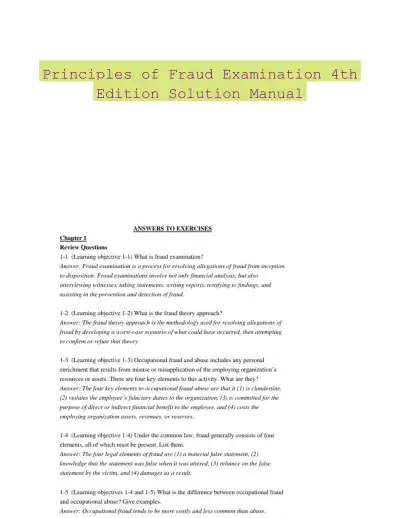 Textbook Guides
Principles of Fraud Examination 4th Edition Solution Manual
Auditing
88 pagesMay 2025 Exam Guides
Test Bank for Auditing: A Practical Approach with Data Analytics, 2nd Edition (Chapters 1-15)
Auditing
453 pages135downloadsFeb 2025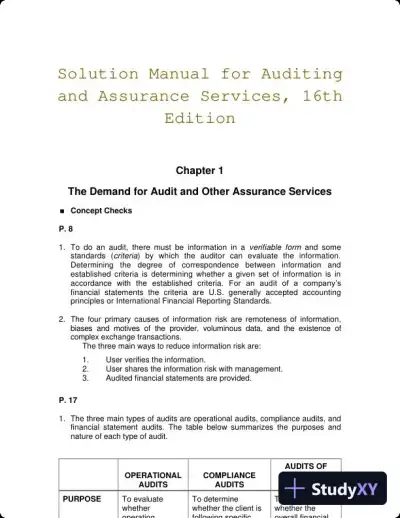 Textbook Guides
Solution Manual for Auditing and Assurance Services, 16th Edition
Auditing
616 pages103downloadsFeb 2025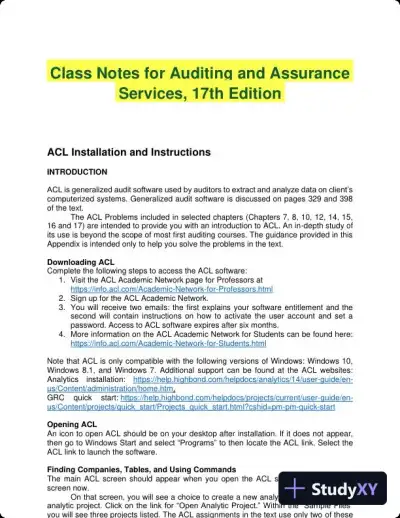 Class Notes
Lecture Notes for Auditing and Assurance Services, 17th Edition
Auditing
277 pages78downloadsFeb 2025 Textbook Guides
Solution Manual for Auditing Cases: An Interactive Learning Approach, 5th Edition
Auditing
457 pages51downloadsFeb 2025 Textbook Guides
Auditing: An International Approach Seventh Canadian Edition Solution Manual
Auditing
439 pages49downloadsFeb 2025 Exam Guides
Test Bank for Fraud Examination, 6th Edition
Auditing
485 pages38downloadsFeb 2025 Class Notes
Lecture Notes For Auditing: A Practical Approach with Data Analytics, 1st Edition
Auditing
185 pagesMay 2025
Study this document with CramX
Once it is in your library, every tool can work from it.