

Solution Manual For Experiments in Biochemistry: A Hands-on Approach, 2nd Edition
- Biochemistry
- 170 pages
- Shared May 2025
Solve your textbook questions faster and more accurately with Solution Manual For Experiments in Biochemistry: A Hands-on Approach, 2nd Edition, a reliable guide for every chapter.
Preview 16 of 170 pages
See the first 16 pages exactly as they appear in the document.
Page 1 Read page 1 as text
i Manual for Experiments in Biochemistry: A Hands On Approach Shawn O. Farrell and Lynn E. Taylor Colorado State University
Page 2 Page 3 Read page 3 as text
ii Table of Contents Preface ....................................................................................................................... iii Technical Support...................................................................................................... iv Background Information from Textbooks ................................................................. v General Lab Equipment............................................................................................. vi Experiment 1 -- Use of pipettors ............................................................................... 1 Experiment 2 -- Preparation of Buffers ..................................................................... 7 Experiment 3 -- Beer's Law and Standard Curves .................................................... 14 Experiment 3a -- Protein Concentration of LDH Fractions ...................................... 20 Experiment 4 -- Purification of LDH (short version) ................................................ 25 Experiment 4a -- Purification of LDH (comprehensive version) .............................. 33 Experiment 5 -- Separation and Identification of Amino Acids ............................... 42 Experiment 5a -- Purification of LDH with Ion Exchange Chromatography ........... 49 Experiment 6 -- Affinity Chromatography of LDH .................................................. 57 Experiment 6a – Affinity Chromatography of LDH ................................................. 61 Experiment 7 -- Gel Filtration Chromatography ....................................................... 69 Experiment 7a -- Gel Filtration Chromatography of LDH........................................ 74 Experiment 8 -- Enzyme Kinetics of Tyrosinase ...................................................... 82 Experiment 8a -- Enzyme Kinetics of LDH .............................................................. 89 Experiment 9 -- Native Gel Separation of LDH Isozymes (short version) ............... 96 Experiment 9a -- Native Gel Separation of LDH Isozymes (comprehensive) .......... 101 Experiment 9b -- SDS-Polyacrylamide Gel Electrophoresis (short)......................... 106 Experiment 9c -- SDS-Polyacrylamide Gel Electrophoresis (comprehensive)......... 112 Experiment 10 -- Western Blots of Serum Proteins .................................................. 119 Experiment 10a -- Western Blot of LDH .................................................................. 127 Experiment 11 -- Analysis of DNA Restriction Fragments ...................................... 134 Experiment 12 -- Cloning and Expression of Barracuda LDH ................................. 141 Experiment 13 -- Polymerase Chain Reaction .......................................................... 158
Page 4 Read page 4 as text
iii Preface This manual is designed to aid the laboratory instructor in preparing for, supervising, and analyzing experiments in Experimental Biochemistry: A Hands On Approach. The text was written with the idea of its application to a wide variety of biochemistry lab courses. Whether your course is for non-majors and meets only once a week for 3 hours, or is a more intensive course requiring several meetings, you should be able to find the appropriate length and intensity of experiments. Many of the experiments are suitable for a survey course and can stand alone. For those interested in a comprehensive approach, there are groups of experiments that do make an integrated package. Many of the techniques used offer both types of experiment. For example, chapter 7 involves gel filtration chromatography. Experiment 7 is a stand alone experiment involving estimating the molecular weight of myoglobin with Sephadex G-75. Experiment 7a is part of the comprehensive purification of lactate dehydrogenase and uses gel filtration on Sephadex G-150 or Sephacryl S-200 as the final purification step. Each chapter of this manual corresponds to the same chapter in Experiments in Biochemistry and includes the following: Estimated time required by competent and prepared students Materials needed for the experiment and sources when necessary Hints for the preparation of reagents and equipment, and pitfalls to avoid Suggestions for disposal and clean up of experiments Sample data the students are likely to see and answers to the end of experiment calculations Answers to the additional problem sets. We hope that armed with this manual you will find the implementation of the experiments straight forward. If you ever have trouble, please feel free to contact the author (see Tech Support).
Page 5 Read page 5 as text
iv Technical Support I have been teaching two levels of biochemistry lab at Colorado State University for the past 18 years. One is a survey course for non-majors and the other is a comprehensive course for majors. My position is pure teaching, so I have devoted much time to the perfection of these experiments. If you have any questions about how to implement any of these experiments, how to prepare the reagents, where to get the reagents and equipment, how to optimize the time you have with your course, or what might have gone wrong, please feel free to contact me. I am available by phone or e-mail. I would also appreciate any feedback you give me that would make the labs run smoother. Thank-you and I look forward to hearing from you. Dr. Shawn O. Farrell USA Cycling 1 Olympic Plaza Colorado Springs, CO 80909 719-866-3364 sfarrell@usacycling.org
Page 6 Read page 6 as text
v Background Information from Textbooks No biochemistry laboratory can stand alone without a supporting lecture class to give the students the background material. We have attempted to include material in our chapters that is specific to laboratory techniques. For background material of a broader nature, we suggest one of the following textbooks -- Biochemistry by Mary K. Campbell and Shawn O. Farrell or Biochemistry by R.H. Garrett and C.M. Grisham. Of course, any basic biochemistry book would also do. Below you will find information about the relevant chapters of the fifth edition of Campbell and Farrell's Biochemistry and the third edition of Garrett and Grisham's Biochemistry . Experiments in Biochemistry Campbell (5th edition) Garrett and Grisham (3rd edition) Chapter 2 Chapter 2 Chapter 2 Chapter 3 Chapter 5 Chapter 4 Chapters 4,5, 6 Chapters 5,6,13 Chapter 5 Chapter 3 Chapters 4,5 Chapter 6 Chapter 5 Chapter 5 Chapter 7 Chapter 5 Chapter 5 Chapter 8 Chapter 6,7 Chapters 13,14 Chapter 9 Chapter 5,13 Chapter 5 Chapter 10 Chapter 12 Chapter 11 Chapter 13 Chapter 12 Chapter 12 Chapter 13 Chapter 12 Chapter 13 Chapter 13 Chapter 12
Page 7 Read page 7 as text
vi General Lab Equipment The following chapters contain lists of equipment required for each experiment. There are certain items that are assumed to be available for all labs, and these will not be mentioned specifically in the chapters. These items include the following: Kimwipes gloves Pasteur pipets (long and short) pipet tips (all sizes) Parafilm paper towels soap vortexers weigh boats ice buckets microcentrifuge tubes The quantities listed are for each experiment performed. Thus, if you have students work alone, that would be per student. These are the quantities that I have used. Sometimes they are overkill, but I prefer to err on the side of making too much of the cheaper chemicals so that I don't have to make them again later.
Page 8 Read page 8 as text
1 Chapter 1 -- Biochemistry Boot Camp Experiment 1 -- Use of Pipettors Time Required This brief experiment should take no more than 30 minutes, usually less if there is ample equipment. Materials Required P-100 or P-200 pipetmen (Rainin, Integrapette, Eppendorf) P-1000 pipetmen Top loading balances or others with a sensitivity of at least 0.01g Deionized water Hints for Preparation and Implementation If equipment is limiting, students can stagger which part they start first to better share the pipetmen. Be sure to give a prelab lecture about how to use a pipettor. Many students, including grad students, have never received any formal training in this. This lab, though brief, will establish the quality of results that will be seen for the rest of the semester. Make sure that students identify poorly calibrated pipets. If a student thinks that their pipettor draws up a low volume, make sure the pipet tips are on tight, the pipet is set to the correct volume, and that the lower barrel of the pipettor is screwed on tight. The latter is a common problem with Eppendorf pipettors. Waste Disposal None Answers to Prelab Questions 1. What is the useable range of a P-1000 Pipetman? 100 to 1000 L
Page 9 Read page 9 as text
2 2. What is the difference between accuracy and precision? Accuracy is the relationship between the number you read and the true value. In other words, if you try to pipet 1 mL and you actually pipet 0.99 mL, then the pipetting was accurate. Its error was only 1%. Precision is how reproducible the numbers are, so if you try to pipet 1 mL five times and you pipet 0.70, 0.70, 0.70, 0.70, and 0.70, then your pipetting was very precise although it was also very inaccurate. 3. What should 100 L of water weigh? Since water weighs 1 g/mL, the weight would be calculated thusly: 1 g/mL x 0.1 mL = 0.1 g 4. What should 1000 L of water weigh? The answer is 1 g, since 1000 L is the same as 1 mL. Sample Data and Analysis of Results Part A -- Precision of P-100 or P-200 pipettors 1. Record the weight you measured for the three trials of 100 L: Weight #1 (x 1 ) 0.09 Weight #2 (x 2 ) 0.09 Weight #3 (x 3 ) 0.11 2. Average the three weights. Average of three trials: 0.097 3. Calculate the % error between the average of the three trials and the true value. % error = │ 0.097 - 0.100 g │ x 100 = 3 % 0.1 g 4. Calculate the mean deviation for the three trials: mean deviation = │ x i - x avg │ = 3 [-(0.09-0.097)+-(0.09-0.097)+(0.11-0.097)]/3 = 0.009
Page 10 Read page 10 as text
3 Part B -- Precision of P-1000 pipettors 1. Record the weight you measured for the three trials of 1000 L: Weight #1 (x 1 ) 0.99 Weight #2 (x 2 ) 1.05 Weight #3 (x 3 ) 0.97 2. Average the three weights. Average of three trials: 1.00 3. Calculate the % error between the average of the three trials and the true value: % error = │ avg. weight - 1.00 g │ x 100 = 0 1.00 g 4. Calculate the mean deviation for the three trials: mean deviation = │ x i - x avg │ = 3 [-(0.99-1.00)+(1.05-1.00)+-(0.97-1.00)]/3 = 0.03 5. Record the weight you measured for the three trials of 100 L using the P- 1000: Weight #1 (x 1 ) 0.09 Weight #2 (x 2 ) 0.08 Weight #3 (x 3 ) 0.12 6. Average the three weights. Average of three trials: 0.10 7. Calculate the % error between the average of the three trials and the true value: % error = │ avg. weight - 0.10 g │ x 100 = 0 0.10 g
Page 11 Read page 11 as text
4 8. Calculate the mean deviation for the three trials: mean deviation = │ x i - x avg │ = 3 [-(0.09-0.10)+-(0.08-1.00)+ (0.12-0.10)]/3 = 0.02 Part C – Pipettors in the Lab 1. Which of the two pipettors you used was the more accurate? The % error is the measure of the accuracy of a pipetman. From the data presented, the P-1000 would appear to be the more accurate, since it had the smallest % error. 2. Which of the two pipettors you used was the more precise? This is the trickier question. If you just look at the mean deviations, it appears that the P-1000 has the larger mean deviation of 0.02 when compared to the 0.009 of the P- 100, when both were used to pipet 100 L. However, one must bear in mind that the total weight expected is also important. For the pipetting of 1000 L, if you calculated a % mean deviation by dividing by the expected weight and multiplying by 100, the P-1000 would, once again, have the smaller number. 3. What are the take-home messages from this exercise? Take your pick from any of the following: There are different types of pipetmen that you must learn to use. Pipetmen are precise in the hands of a trained user, but not necessarily accurate. The accuracy of a pipet should be checked frequently. It is easy to check the accuracy and precision by doing a water weight test. Pipetmen have a range outside of which they are not accurate. You should learn what the correct volume of solution looks like in a pipet tip. Others that you can think of. 4. Without checking the accuracy of a given Pipetman, would you predict that it is better to use a P-200 or P-1000 to pipet 100 μL? Why? It is generally better to use a liquid transfer device closer to its maximum volume, so using the P-200 would be better.
Page 12 Read page 12 as text
5 5. Is a Pipetman more like a serological pipet or a Mohr pipet? Why? It is more like a serological pipet, as you expel the liquid completely out of it all the way to the tip. 6. If you are trying to pipet an unknown liquid with a Pipetman and the liquid keeps running out of the tip before you can transfer it, what are two possible reasons for this? What can you do to remedy the situation? One reason might be that the tip is not on tightly. In that case, just tighten the tip. Another might be that the liquid is an organic solvent, which might have a very low surface tension. To remedy that, draw up the liquid into the tip and then expel it. Then draw up the solution again. It usually will hold in the tip the second time after pre-wetting the tip. 7. How do you make 200 mL of a 0.1 M solution of a substance that has a molecular weight of 121.1 g/mol? You need 0.2 liters of a 0.1 mole/liter solution or 0.02 moles of the solute. If the MW is 121.1 g/mol, you need 0.02 x 121.1 or 2.4 grams of solute. Thus, you weigh 2.4 grams of solute into a vessel and bring the volume up to 200 mL. 8. If you take 10 mL of the solution you made in Question 7, add 90 mL of water, mix, and then take 5 mL of the mixture and bring it to 25 mL, what will be the concentration of the final solution in molar, millimolar, and micromolar? The first dilution is a 10 to 1, since you start with 10 mL and end with 100 mL. The second dilution is a 5 to 1, since you took 5 mL and brought the volume to 25. Thus, the total dilution factor is 50 to 1. Since you started with 0.l M, the final concentration in molar is 0.1/50 or 0.002 M. this is 2 mM and 2000 μM. Answers to Additional Problem Set 1. How many grams of solid NaOH are required to prepare 200 mL of a 0.05 M solution? 0.4 g 2. What would be the concentration from Problem 1 expressed in % w/v? 0.2 % w/v 3. How many mL of 5M NaCl are required to prepare 1500 mL of 0.002 M NaCl? 0.6 mL
Page 13 Read page 13 as text
6 4. What would be the concentration of the diluted solution from Problem 3 expressed in mM, M, and nM? 2 mM, 2000 M, 2 x 10 6 nM 5. A solution contains 15 g of CaCl 2 in a total volume of 190 mL. Express the concentration in terms of g/L, % w/v, M, and mM. 79 g/L, 7.9 % w/v, 0.71 M, 710 mM 6. Given stock solutions of glucose (1M), Asparagine (100 mM) and NaH 2 PO 4 (50 mM), how much of each solution would you need to prepare 500 mL of a reagent which contains 0.05 M glucose, 10 mM Asparagine and 2 mM NaH 2 PO 4 ? 25 mL glucose, 50 mL Asparagine, 20 mL sodium phosphate 7. Calculate the number of millimoles in 500 mg of each of the following amino acids: alanine (MW = 89), leucine (131), tryptophan (204), cysteine (121), and glutamic acid (147). 5.6 mmol Ala, 3.8 mmol Leu, 2.5 mmol Trp, 4.1 mmol Cys, 3.4 mmol Glu 8. What molarity of HCl is needed so that 5 mL diluted to 300 mL will yield 0.2 M? 12 M 9. How much 0.2 M HCl can be made from 5.0 mL of 12.0 M HCl solution? 300 mL 10. What weight of glucose is required to prepare 2 L of a 5% w/v solution? 100 g 11. How many mL of an 8.56% solution can be prepared from 42.8 g of sucrose? 500 mL 12. How many mL of CHCl 3 are needed to prepare a 2.5% v/v solution in 500 mL of methanol? 12.5 mL 13. If a 250 mL solution of ethanol in water is prepared with 4 mL of absolute ethanol, what is the concentration of ethanol in % v/v? 1.6 % v/v
Page 14 Read page 14 as text
7 Chapter 2 – Acids, Bases, and Buffers Experiment 2 – Preparation of Buffers Time Required 1.5 to 2 hours if there is no equipment constraint. Materials Required pH meters, preferably digital NaOH, 1 M 15 mL HCl, 1 M 15 mL NaAcetate 1 g CAPS “ HEPES “ Na 2 HPO 4 “ Tricine “ TRIS “ NaCitrate “ NaH 2 PO 4 unknowns,0.1 M, pH 5.6 5 ml NaH 2 PO 4 unknowns,0.1 M, pH 7 “ NaH 2 PO 4 unknowns,0.1 M, pH 8 “ Sources for key ingredients None of the chemicals used for this experiment need to be particularly pure. Use the cheapest source you can find. For the buffer compounds, it does not matter if you use the acid form or the basic form, as the students will adjust the pH anyway when making up the buffer. Sigma and VWR offer good sources of these compounds. For convenience, the Sigma materials are listed below: Compound Catalog # Price (2004) Acetate (sodium salt) Sigma 24,124 - 5 $64.30 per Kg CAPS Sigma C 2632 $243 per Kg Citrate (sodium salt) Sigma C 3674 $27.60 per Kg HEPES (sodium salt) Sigma H 7006 $216.50 per 500 g Tricine Sigma T 0377 $86 per 250 g TRIS (Trizma base) Sigma T 1503 $84 per Kg
Page 15 Read page 15 as text
8 Hints for Preparation and Implementation This is a fast lab that usually only slows down due to the logistics of acquiring the materials and using the balances and pH meters. Make sure all available pH meters and balances are ready to go. Dispense the dry buffer powders so that there are several locations or several containers students can use to avoid a big line of students waiting to get started. Dispense unknowns in large test tubes with about 10 mL each. Waste Disposal All unknowns can be dumped down the sink at the week’s end. Save the HCl and NaOH for future labs. Discard or save dry buffers depending on quality and quantity. Answers to Prelab Questions 1 . Calculate the weight of buffer you would use to make the buffer for part A for the six possibilities: 0.1 mol/liter x 0.1 liters = 0.01 moles. You need 0.01 moles of the buffer. Moles x MW = grams. Acetate 136.1 g/mol x 0.01 mol = 1.36 g CAPS 221.3 g/mol x 0.01 mol = 2.21 g Citrate 294.1 g/mol x 0.01 mol = 2.94 g HEPES 238.3 g/mol x 0.01 mol = 2.38 g Phosphate 142.0 g/mol x 0.01 mol = 1.42 g Tricine 179.2 g/mol x 0.01 mol = 1.79 g TRIS 121.1 g/mol x 0.01 mol = 1.21 g 2. If we give you HEPES in the basic form and ask you to make a buffer of pH 8.0, will you add HCl or NaOH to adjust the pH? Why? Calculate what would be the initial pH of a solution of HEPES base. Using the formula: pH = (pKa + 14 + log[base])/2 = (7.55 + 14 + log[0.1])/2 = 10.28 We can see that the pH will be more basic than the desired 8.0. Therefore, we will have to add acid. In general, anytime you make up a buffer in its basic form, you will need to add acid to get to a useable buffer pH. This question could be answered philosophically as well. A buffer always needs to be a combination of the acid and basic form of the buffer. If we start with just the basic form of a buffer, we will always need to create the acidic form, so we would need to add HCl.
Page 16 Read page 16 as text
9 Sample Data and Analysis of Results Data Part A Buffer #1: phosphate grams: 1.42 Original pH: 5.4 Buffer #2: Tricine grams: 1.79 Original pH: 10.2 Part B Buffer #1 pH of 0.1 M 8.10 pH of 0.01 M 8.40 pH of 0.001 M 8.75 Buffer #2 pH of 0.1 M 8.10 pH of 0.01 M 7.99 pH of 0.001 M 7.95 Part C Distilled water pH: 5-9 (depending on water source and cleanliness of beakers Unknown # 21 pH: 7.0 Unknown # 36 pH: 5.6 Part D Buffer chosen: Tricine pH: 8.10 pKa: 8.15 Acid or base added: NaOH pH after adding acid or base: 8.18 pH of 50 mL of water: 7.0 pH after adding acid or base: 12.0 Calculations 1. (a)What is the ratio of A - /HA in your buffer after you adjusted its pH to the required value? This will depend on which buffer you used and at what pH. A good buffer was defined as one with a pH that was at most 1 pH unit away from the pKa.
154 more pages in the full document
Unlock it once and it stays in your library, ready to chat with or turn into flashcards.
Unlock the full documentMore Biochemistry study materials
See all Exam Guides
Test Bank For Advanced Nutrition and Human Metabolism 7th Edition Test Bank
Biochemistry
266 pages145downloadsFeb 2025 Exam Guides
Test Bank For Principles Of Biochemistry, 4th Edition
Biochemistry
362 pages61downloadsFeb 2025 Solved Assignments
Kami Export Biological Molecules POGIL
Biochemistry
5 pagesJun 2025 Textbook Guides
Introduction To General, Organic And Biochemistry, 11th Edition Solution Manual
Biochemistry
250 pagesMay 2025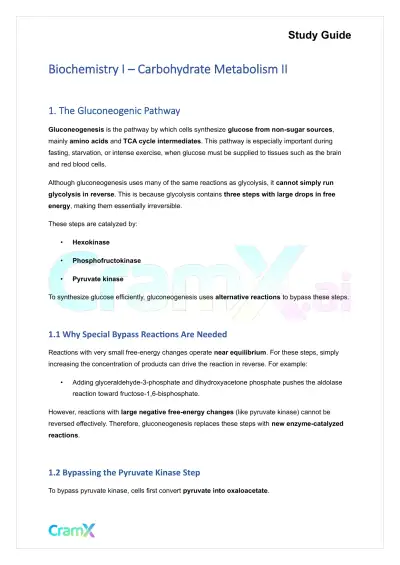 Quick Guides
Biochemistry I - Carbohydrate Metabolism II
Biochemistry
25 pagesMar 2026 Past Exams
BIOD171 Biochemistry Final Exam With Answers (29 Solved Questions)
Biochemistry
7 pagesMay 2025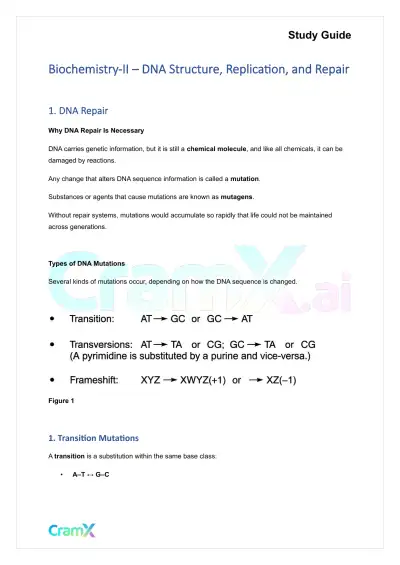 Quick Guides
Biochemistry-II - DNA Structure, Replication, and Repair
Biochemistry
36 pagesMar 2026 Textbook Guides
Lehninger Principles of Biochemistry Sixth Edition Solution Manual
Biochemistry
320 pagesMay 2025
Study this document with CramX
Once it is in your library, every tool can work from it.