

Solution Manual For Laboratory Experiments for Introduction to General, Organic and Biochemistry, 8th Edition
- Biochemistry
- 247 pages
- Shared May 2025
Solution Manual For Laboratory Experiments for Introduction to General, Organic and Biochemistry, 8th Edition is here to help you with textbook problems, offering clear solutions and helpful explanations.
Preview 16 of 247 pages
See the first 16 pages exactly as they appear in the document.
Page 1 Read page 1 as text
Experiment 1 This may be a student’s first experience in the laboratory. Therefore, the instructor should demonstrate all the techniques used in this laboratory. Show how a Bunsen burner is lit, with a match or a gas striker, and how the flame is adjusted by control of the gas valve and air vents. This is a relatively simple laboratory for students to work. Most of the common equipment used in the laboratory are introduced here. For many this might be the first time some of the glassware will be encountered. For the instructor, patience is in order since the lack of familiarity of the student with the laboratory ware often creates problems. Take the graduated cylinder, for example. Since it is tall, it is easily knocked over, and although laboratory glassware is reasonably durable, it will shatter and could cause severe cuts. Remind students not to pick up broken glass with the fingers but to use the dustpan and brush. Broken glass should be discarded in a waste container specifically for glass. While there is little danger in this laboratory of eye damage, nevertheless, it is essential that the rules of the laboratory be followed: safety glasses are to be worn at all times in the laboratory. The thermometers in this laboratory are made of glass and must be handled properly. A thermometer is not a stirring rod and must not be used as such. If a student wants to bring the fluid level in the thermometer down, remind him/her to use cold water from the tap. The laboratory thermometer is not a clinical thermometer and does not require that it be shaken down! Waving the thermometer usually results in it hitting a bench top and breaking. Some of these thermometers contain mercury; the breakage of a thermometer with resultant spillage of mercury must be cleaned up quickly. Mercury is toxic, especially as a vapor. The instructor should be notified immediately for proper clean up. No mercury should be left freely about anywhere. Mercury can be collected with commercial collectors or by a homemade suction apparatus. Connect a side-arm suction filter flask to a water aspirator. The flask is fitted with a one-hole rubber stopper with a small section of glass tubing inserted into the hole. Rubber tubing connects the glass tube to a Pasteur pipet. When the water is turned on, the spheres of mercury will be sucked into the pipet and then into the suction flask. The recovered mercury can be stored under water. Balances should be handled with care; electronic top-loading balances are sensitive and lose calibration easily. Demonstrate proper use of the balance. Emphasize that no chemical should be weighed directly on the pan; use either weighing paper or a suitable container. Also hot objects should not be put on the pan. Proper care requires that all weights be returned to zero. The difference between precision and accuracy can be easily demonstrated. Use two balances, one that has been zeroed and calibrated, a second not zeroed and uncalibrated. Repeated weighings of the same object of known weight on the two balances will show high precision (high reproducibility in the clustering of the weights) for each of the two balances but not the same accuracy (agreement with the known weight).
Page 2 Page 3 Read page 3 as text
name section date partner grade 1 E X P E R I M E N T 1 Pre-Lab Questions 1. In the design of a Bunsen burner, explain the purpose of a. the gas control valve Manipulation of this valve controls the flow of gas b. and the air vents. Manipulation of these vents controls the mixing of air with gas; allows the control of flame temperature. 2. Why is a luminous yellow flame often ‘‘smoky’’? Lack of sufficient air causes incomplete burning of the gas and produces soot. 3. A student wanted 20.000 g of a salt. Which balance should the student use in order to obtain the most accurate quantity: a platform triple beam balance, a single pan, triple beam balance, or a top-loading balance? Explain your answer. The top-loading balance enables you to weigh to the nearest 0.001 g. 4. Explain the difference between precision and accuracy? Precision determines the reproducibility of a measurement; accuracy is a measure of how closely the value determined agrees with a known or accepted value. 5. Solve the following problems and record the answers to the proper number of significant figures. a. 21.65 - 3.2= 18.5 b. 4.01 ÷ (4.583 + 2.108)= 0.599 c. 6.15 ÷ 1.2 = 5.1 d. 2.26 x 21.43= 48.4 2
Page 4 Read page 4 as text
name section date partner grade 1 E X P E R I M E N T 1 Report Sheet Bunsen burner 1. What is the color of the flame when the air vents are closed? Yellow 2. Did anything happen to the surface of the Pyrex test tube in this flame? Soot collected on the test tube 3. What happens to the flame size when the gas control valve is turned? The flame changes in size 4. Describe the effect on the flame as the air vents were opened. The flame looses the yellow color and becomes blue Length 1. Length 27.5 cm Width 21.5 cm 2. Length 275 mm 0.275 m Width 215 mm 0.215 m 3. Area 591 cm 2 (Show calculations) 27.5 x 21.5= 591.25= 591 275 x 215= 59125= 59100 59100 m 3
Page 5 Read page 5 as text
Volume 1. Erlenmeyer flask 49.5 mL 0.0495 L 2. Beaker 42.0 mL 0.0420 L 3. Error in volume: Erlen meyer flask 0.5 mL 1% % Beaker 2.0 mL 5.0% % Error in volume Total volume % Error = x 100 ( Show your calculations ) (0.5/50) x 100=1% (2.0/40) x 100= 5.0% 4. Graduated cylinder Mass O b ject Balance Pla t form Sing l e Pan, Triple B e am Top Load i ng g m g g mg g m g Qua r ter 5.8 5800 5.61 5610 5.613 5613 Test tube (100 13 mm) 8.1 8100 7.92 7920 7.872 7872 125 - m L Er l enmey e r flask 77.1 77100 76.95 76950 76.948 76948 Temperature 8 C 8 F K Room temp e rature 22.5 7 2.5 295.7 Ice water 0.5 32.9 273.7 Boi l ing water 99.5 211.1 372.7 How well do your thermometer readings agree with the accepted values for the freezing point and boiling point of water? Express any discrepancy as a deviation in degrees. Freezing Point: + 0.5 degrees Celsius Boiling Point: -0.5 degrees Celsius 4
Page 6 Read page 6 as text
Post-Lab Questions 1. How does a student need to adjust the Bunsen burner in order to change a luminous yellow flame into a nonluminous blue flame? Open the air vents at the bottom of the burner barrel; more air assures complete combustion. 2. What causes the luminescence in the cooler, yellow flame? Unburned small particles of carbon, soot, causes the luminescence. 3. A student needed exactly 45.3 mL of a solution. What piece of glassware should that student use? Justify your choice. The graduated cylinder has gradations in 0.1 mL and would give the more accurate measure. 3. The diagram below is of a nonluminous Bunsen flame. Indicate the approximate region of the hottest part of the flame. The tip of the inner blue cone is the hottest part of the flame. 5. Two students weighed a 125-mL beaker that had a mass of 80.562 g on a calibrated top-loading balance. Each student used their own top-loading balance, recorded three mass readings for the beaker, and then determined the average. Below are the results: Student A Student B 80.560 80.400 80.555 79.551 80.565 81.729 Average: 80.560 80.560 a. Find the averages. b. Which set of results matches the known mass of the beaker? Both sets agree well with the known weight of the beaker . c. Which set of results is more precise? Student A has a balance that gives more precise results; the weights are more reproducible d. Which student has the more reliable balance? Student A has a more reliable balance 5
Page 7 Read page 7 as text
6. A student measured the dimensions of a table and recorded the length as 103.50 cm and the width as 73.75 cm. According to the student’s calculator, the area is 7633.125 cm 2 . What should the student report? Explain your answer. The answer is good to only 4 significant figures. The answer is 7633 cm square. 7. John has a mass of 115 kg. Sally has a mass of 115 lb. Who is the heavier of the two? Show your calculations to justify your answer. 115 kg x 2.20 lb/kg=253lb. John is heavier 8. At 20,320 ft., Mount McKinley in Alaska is the highest peak in North America. Express the height in meters (m) and kilometers (km) to the correct number of significant figures. Show your work. 20,320 ft x 30.48 cm/ft x 1 m/100 cm x 1 km/100m = 6.194 km 20,320 ft x 30.48 cm/ft x 1 m/100 cm = 6194 m 9. A 16.95 g sample of sugar was added to a glass with a mass of 8.3 oz. What is the combined mass of the glass and the sample in ounces (oz.), grams (g), and milligrams (mg)? Show your work and express your answers to the correct number of significant figures. 8.3 oz. x 28.35 g/oz. = 235.3 g or 240 g to 2 sig. fig. 16.95 g + 235.3 g= 252.3 g or 16.95g +240 g= 257 g if you follow sig. fig. rules 257 g x 1000 mg/g= 257,000 mg 16.95 g x 1 oz./28.35g= 0.5979 oz. 8.3 oz. + 0.5979 oz. = 8.8979 oz. = 8.9 oz. to 2 sig. fig. 6
Page 8 Read page 8 as text
Experiment 2 This laboratory provides a bit of fun for the student; the student will use the experiment in the locker to solve a puzzle. Each will be given unknowns of various kinds and asked to find out the identities by taking suitable measurements. Thus, using precision, accuracy, and significant figures in their measurements, each unknown can be identified. (Eureka!) In the use of balances, again remind students not to weigh directly on the pan, but to use a container or weighing paper. In the case of the unknown metal, provide suitable containers for their recovery. For the other unknowns, waste containers should be provided. Nothing should be discarded into the sink. Reading the volume in a graduated cylinder requires lining up of the eye with the m eniscus. Demonstrate the proper technique for doing this. It may be the student’s first encounter with the Spectroline pipet filler. It would be best to go through the way it works, particularly in the suction phase of its use. If the tip of the pipet is not immersed far enough into the liquid to be pipetted, the force of the suction might cause the liquid to be drawn up into the Spectroline pipet filler’s body; these liquids will cause the inside to deteriorate. In addition, the liquids in the pipet filler will contaminate the next liquid to be pipetted, and so this situation should be avoided.
Page 9 Read page 9 as text
name section date partner grade 2 E X P E R I M E N T 2 Pre-Lab Questions 1. How does an intensive property differ from an extensive property? Give an example of an intensive property and of an extensive property. The intensive property does not depend on the quantity of the substance: density. An extensive properly depends on the quantity of the substance: mass. 2. In order to calculate the density of a solid or liquid sample, what measurements are needed? You need a mass measurement and a volume measurement. 3. The volume of a fixed mass of a liquid sample increases as the temperature rises from 20 to 40 8 C. Does the density increase, decrease, or stay the same? Explain your answer. As the temperature rises, there is a change in the volume, the volume gets larger. As a result, the density will decrease. (mass/volume= density) Remember, there is no change in the mass; the only factor changing is the volume (you are dividing by a bigger number as the volume increases with increasing temperature). 4.A solid block of exactly 100.0 cm 3 has a mass of 153.6 g. Determine its density. Will the block sink or float on water? 153.6g/100.0 cc = 1.53 g/cc. This density is greater than the density of water, so it will sink. 5. A salvage operator recovered coins believed to be gold. A sample had a mass of 129.6 g and had a volume of 15.3 cm 3 . Were the coins gold (d = 19.3 g/cm 3 ) or just yellow brass (d = 8.47 g/cm 3 )? Show your work. 129.6 g/15.3 cc = 8.47 g/cc Too bad, the metal is brass. 8
Page 10 Read page 10 as text
name section date partner grade 2 E X P E R I M E N T 2 Report Sheet Report all measurements and calculations to the correct number of significant figures. Density of a regular-shaped object Trial 1 Trial 2 Unknown code number 1 (wood block) 1. Length 20.8 cm 20.8 cm Width 5.3 cm 5.3 cm Height 2. Volume (L W H) 3. Mass 4. Density: (3)/(2) Average density of block 4.4 cm 485 cm 3 287.57 g 0.593 g/cm 3 4.4 cm 485 cm 3 287.62 g 0.593 g/cm 3 0.593 g/cm 3 Density of an irregular-shaped object Trial 1 Trial 2 Unknown code number 2 (Al shot) 5. Mass of metal sample 5.232 g 6.702 g 6. Initial volume of water 14.90 mL 16.80 mL 7. Final volume of water 8. Volume of metal: (7) (6) 9. Density of metal: (5)/(8) 16.80 mL 1.90 mL 2.75 g/mL 19.30 mL 2.50 mL 2.68 g/mL Average density of metal 2.72 g/mL 10. Identity of unknown metal Aluminum 9
Page 11 Read page 11 as text
Densi t y of water Tri a l 1 Trial 2 11. Temperature of water 22.0 8 C 22.0 8 C 12. Mass of 50-mL beaker 26.264 g 26.257 g Volume of water 10.00 mL 10.00 mL 13. Mass of beaker and water 14. Mass of water: (13) (12) 15. Density of water: (14)/10.00 mL 36.143 g 9.879 g 0.9879 g/mL 36.176 g 9.919 g 0.9919 g/mL 16. Average density of water 0.998 g/mL Density found in literature 0.998 g/mL Density of an unknown liquid Trial 1 Trial 2 Unknown code number 3 (ethyl alcohol) 17. Temperature of unknown liquid 22.0 8 C 22.0 8 C 18. Mass of 50-mL beaker 26.810 g 26.960 g Volume of liquid 10.00 mL 10.00 mL 19. Mass of beaker and liquid 20. Mass of liquid: (19) (18) 21. Density of liquid: (20)/10.00 mL 34.671 g 7.861 g 0.7861 g/mL 34.842 g 7.882 g 0.7882 g/mL Average density of unknown liquid 0.7872 g/mL 22. Identity of unknown liquid Ethyl alcohol 10
Page 12 Read page 12 as text
Post-Lab Questions 1. In determining the density of olive oil (see Table 2.2), one student took exactly 25.00 mL and found the mass to be 22.95 g. A second student took exactly 50.00 mL and found the mass to be 45.90 g. Will each student arrive at the same value for the density? Do each calculation and explain the result. 22.95 g/25.00 mL = 0.918 g/mL 45.90 g/50.00 mL = 0.918 g.mL Each student will arrive at the same value for the density because density is an intrinsic property; the ratio of mass to volume is the same . 2 . Hexane has a density of 0.659 g/mL. How many milliliters (mL) would a student need to pour in order to get 49.5 g of hexane? Show your work. If density = mass/volume then volume = mass/density or mL = g/g/mL = g x mL/g 49.5 g/0.659 g/mL = 75.1 mL 3. In the density determination of a liquid, it was necessary to use the volumetric pipet properly. A student needed to deliver exactly 50.0 mL of a liquid. How will the quantity of liquid be affected by the situations described below, and how will the density determination be affected? a. A dirty pipet is used and droplets of liquid adhered to the inner walls of the pipet. Density determined decreases. The measured mass of the liquid delivered would be less than it should be (droplets remain in the piper), but the volume is still assumed to be 50.0 mL. b. The student did not allow sufficient time for all the liquid to empty from the pipet. Density determined decreases. The mass measured would be less (not everything has been transferred) but the volume is still assumed to be 50.0 mL. c. The student allowed all the liquid to drain and then blew out the small amount from the tip. Density determined increases. The mass measured would be greater since more liquid has been delivered than allowed for by calibration, but the volume is still assumed to be 50.0 mL. d. Air bubbles were not removed from the pipet before delivering the liquid. Density determined decreases. The mass measure would be less (air took up space of the liquid), but the volume is still assumed to be 50.0 mL e. At the mark on the pipet, the student read the upper edge of the meniscus and not the lowest point on the curve. Density determined decreases. The mass measured would be less since less than 50.0 mL would be delivered, but the volume is still assumed to be 50.0 mL. 11
Page 13 Read page 13 as text
Experiment 3 In this experiment students get to use a Bunsen burner to heat various mixtures. Remind students by means of a demonstration the workings of a Bunsen burner. The instructor should check to make sure that the ring clamp is secured tightly to the ring stand and set at the proper height above the flame. All heating should be done with a wire gauze under the beaker. A major source of error occurs in the gravity filtration of the stand. Remind the students to be careful and patient in the transfer. With the rubber policeman as an aid, all the sand can be transferred from the filter paper to the second beaker. Again care and patience will result in all of the sand being transferred. The evaporation of water needs to be carefully done. As the salt-water solution reaches dryness, the residual salt will spatter; the student must be prepared to pull away the Bunsen burner to reduce the heat when this occurs in order to minimize losses from solid flying out of the beaker. This also applies to drying of the sand; as the water evaporates from the sand, trapped vapor will cause spattering. Both the salt and the sand must be water free in order for the calculations to be meaningful. The dry salt will appear as a cake; the dry sand should be freely flowing when poured. Provide a waste container to collect the used naphthalene. Sand and dried salt can be disposed in solid waste containers.
Page 14 Read page 14 as text
name section date partner grade 3 E X P E R I M E N T 3 Pre-Lab Questions 1. I make my cup of coffee in the morning by pouring boiling water over ground-up coffee beans held in a special piece of paper and by collecting the brown liquid that comes through. Which techniques of the five described in the Background section is used in the preparation of the drink? Extraction is used . 2. I like my coffee sweet, so I add a tablespoon of sugar to my cup of coffee and the solid disappears. What makes up the ‘‘cup of coffee’’ now? Is this a mixture? It is a mixture of dissolved sugar and extracted substances from the coffee bean. 3. What is taking place during the process of sublimation? How is this process different from evaporation? Sublimination is a process that involves heating a solid until its molecules pass directly from the solid phase into the gaseous phase. Evaporation involves molecules in the liquid phase escaping into the gaseous phase. 4 . Are any of the techniques described in the Background section a chemical state change? Explain your answer. No chemical state changes are involved, only physical state changes. This is because no chemical bonds have been broken. 13
Page 15 Read page 15 as text
name section date partner grade 3 E X P E R I M E N T 3 Report Sheet 1. Mass of beaker 1 67.565 g 2. Mass of beaker 1 and mixture 68.730 g 3. Mass of mixture: (2) (1) 1.165 g 4. Mass of naphthalene collected 0.095 g 5. a. Mass of beaker 1 and solid after sublimation 68.616 g b. Mass of naphthalene by difference: (2) (5a) 0.114 g 6. Mass of beaker 2 67.959 g 7. Mass of beaker 2 and NaCl 68.530 g 8. Mass of NaCl: (7) (6) 0.571 g 9. Mass of beaker 3 55.765 g 10. Mass of beaker 3 and sand 56.231 g 11. Mass of sand: (10) (9) 0.466 g Calculations 12. Mass of recovered solids: (5b) + (8) + (11) 1.151 g 13. Percentage yield (percentage of solids recovered): % ¼ [(12)/(3)] 100 98.80 % 14. Percentage of naphthalene: % ¼ [(5b)/(3)] 100 9.79 % 15. Percentage of NaCl: % ¼ [(8)/(3)] 100 49.01 % 16. Percentage of sand: % ¼ [(11)/(3)] 100 40.00 % 14
Page 16 Read page 16 as text
Post-Lab Questions 1. A student completed the experiment but found that the total amount of material recovered weighed more than the original sample. What is the most likely source of error and how may it be corrected? Most likely water is present. Heat to evaporate the water 2. A student found that the mass of the naphthalene collected was less than the mass determined by difference. What would account for the smaller amount of naphthalene collected? If naphthalene vapors escaped, then not all of the naphthalene was collected . 3.Mothballs in a clothes closet gradually disappear over time. What happens to this material? The solid mothballs sublimed . 4. A package of freshly picked sweet peas has a mass of 454 g (1 lb.). The peas were freeze dried and the recovered peas weighed 122 g. What was lost? What is the percent composition of this volatile component? (454 – 122) /454 x 100 = 73.1 % 5. In 100 g of sweet peas, there are 14.5 g carbohydrates, 5.7 g sugars, 5.1 g dietary fiber, 5.4 g protein, and 0.4 g fat. Calculate the percent composition for each of these components. 14.5/100 x 100 = 14.5% carbohydrates 5.1/100 x 100= 5.1% dietary fiber 5.7/100 x 100 = 5.7% sugars 5.4/100 x 100= 5.4% protein 0.4/100 x 100 = 0.4% fat 15
231 more pages in the full document
Unlock it once and it stays in your library, ready to chat with or turn into flashcards.
Unlock the full documentMore Biochemistry study materials
See all Exam Guides
Test Bank For Advanced Nutrition and Human Metabolism 7th Edition Test Bank
Biochemistry
266 pages145downloadsFeb 2025 Exam Guides
Test Bank For Principles Of Biochemistry, 4th Edition
Biochemistry
362 pages61downloadsFeb 2025 Quick Guides
Biochemistry-II - RNA and Transcription
Biochemistry
37 pagesMar 2026 Textbook Guides
Solution Manual For Introduction to General, Organic, and Biochemistry, 12th Edition
Biochemistry
251 pagesMay 2025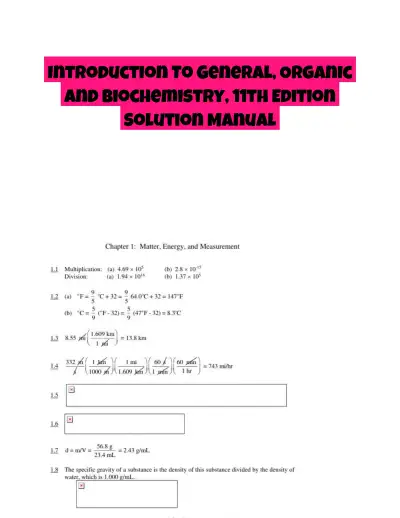 Textbook Guides
Introduction To General, Organic And Biochemistry, 11th Edition Solution Manual
Biochemistry
250 pagesMay 2025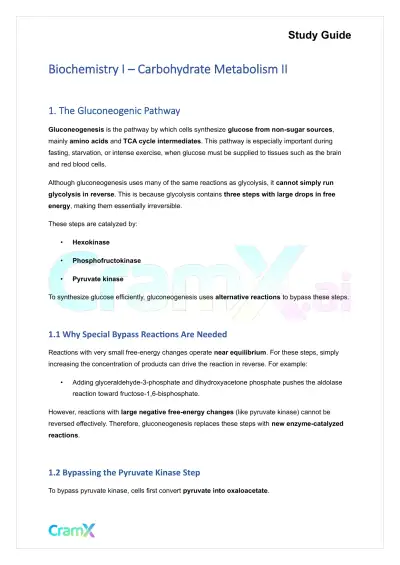 Quick Guides
Biochemistry I - Carbohydrate Metabolism II
Biochemistry
25 pagesMar 2026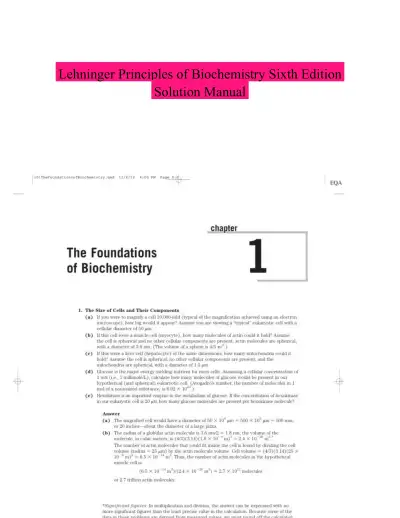 Textbook Guides
Lehninger Principles of Biochemistry Sixth Edition Solution Manual
Biochemistry
320 pagesMay 2025 Past Exams
BIOD171 Biochemistry Final Exam With Answers (29 Solved Questions)
Biochemistry
7 pagesMay 2025
Study this document with CramX
Once it is in your library, every tool can work from it.