

BIOL 101 Final exam
- Biology
- California State University
- 19 pages
- Shared May 2025
A final exam in Biology 101, covering fundamental biological concepts and processes.
Preview 6 of 19 pages
See the first 6 pages exactly as they appear in the document.
Page 1 Read page 1 as text
BIOL 101 Final exam FINAL EXAMINATION Please complete the final examination in this format (do not make any structural changes!) and submit it into your Assignment Folder as a Word attachment (.doc or .doxc only!): BIOL 101 Final exam . Do not forget to put your name on top of the exam! The deadline for submission is Sunday, March 10, 11:59 PM EST. I cannot accept any later submissions. YOUR NAME: ___________________________________________ Total possible points: 100 I. Multiple choice questions. Please boldface the correct answer; do NOT highlight your chosen answer!! (1 point each=50 points) 1. What is biology? A. The study of life B. The study of the environment C. The study of DNA D. the study of genetics E. The study of the earth Answer: A. The study of life 2. An integrated explanation of numerous hypotheses is known as a ________. A. fact B. law C. control D. theory E. guess Answer: D. theory
Page 2 Page 3 Read page 3 as text
3. In an experiment, what should be the relationship between the control group and the experimental group? A. they should be different in size B. they should resemble each other in at least two respects C. they should not be similar in any respects D. they should be similar in all respects but one Answer: D. they should be similar in all respects but one 4. Of the following, which is the first explanation of a problem? It is sometimes called an ‘educated guess’. A. principle B. theory C. fact D. hypothesis Answer: D. hypothesis 5. All living organisms A. reproduce B. evolve C. respond to environmental stimuli D. have all three characteristics. Answer: D. have all three characteristics 6. The smallest unit of life is A. atom B. cell
Page 4 Read page 4 as text
C. macromolecule D. organelle Answer: B. cell 7. Which of the following groups would contain the largest number of organisms? A. Class B. Order C. Species D. Kingdom E. Family Answer: D. Kingdom 8. You examine a cell under a microscope and see a nucleus and chloroplast. You conclude the cell is a ______________ cell. A. prokaryotic B. animal C. plant D. bacterial Answer: C. plant 9 . What do plants and animals have in common? A. they are both heterothrophic B. they are both autotrophic C. they are both prokaryotic D. they are both eukaryotic E. they are both hydrophobic
Page 5 Read page 5 as text
Answer: D. they are both eukaryotic 10. The positive particle of the nucleus of an atom is A. proton B. neutron C. electron D. hydrogen Answer: A. proton 11. All of the following are examples of elements except A. oxygen B. water C. hydrogen D. carbon Answer: B. water 12. Plants are classified as _______________________ A. consumers because they consume carbon dioxide from the environment B. decomposers because they break down the remains of dead organisms C. producers because they make their own food by photosynthesis D. consumers, because they use up water and minerals from the soil Answer: C. producers because they make their own food by photosynthesis 13. If an acid is added to water, the pH will A. decrease B. increase C. stay the same D. sometimes decrease and sometimes increase
Page 6 Read page 6 as text
E. become neutral Answer: A. decrease 14. The bond in which two atoms share one or more pairs of electrons is a_________ bond. A. polar B. hydrogen C. ionic D. covalent Answer: D. covalent 15. An ionic bond is caused by ___________________ A. differences in number of neutrons B. differences in number of carbohydrate molecules C. differences in number of shared electrons D. attraction of a positive charge to a negative charge E. formation of hydrogen Answer: D. attraction of a positive charge to a negative charge 16. The energy of the sun is converted into usable energy for the cell in the form of _________. A. ADP B. ATP C. CO2 D. glucose Answer: B. ATP 17. The starting materials of photosynthesis are _____________ A. carbon dioxide B. oxygen C. carbon dioxide and water D. oxygen and glucose Answer: C. carbon dioxide and water 18. The most important aspect of cellular respiration is that ___________________
13 more pages in the full document
Unlock it once and it stays in your library, ready to chat with or turn into flashcards.
Unlock the full documentMore Biology study materials
See all Solved Assignments
Biol 101 - DNA and Principles of Inheritance Quiz
Biology
6 pagesMay 2025 Solved Assignments
BIO/101 Exploring Scientific Principles and the Scientific Method in Everyday Life
Biology
9 pagesMay 2025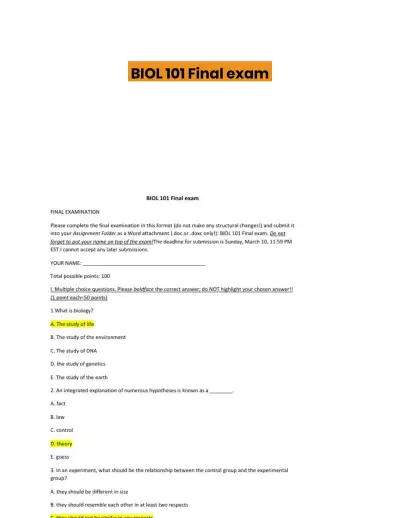 Solved Assignments
BIOL 101 Final exam
Biology
16 pagesMay 2025 Exam Guides
Test Bank for Genetics Essentials: Concepts and Connections, 3rd Edition
Biology
561 pages147downloadsFeb 2025 Past Exams
2024-2025 BIOL235 Nutrition Practice Exam with Answers (38 Solved Questions)
Biology
6 pages145downloadsFeb 2025 Exam Guides
Test Bank for Macroeconomics, 6th Edition
Biology
373 pages143downloadsFeb 2025 Exam Guides
Test Bank for Radiologic Science for Technologists: Physics, Biology, and Protection, 12th Edition (Chapters 1-40)
Biology
235 pages139downloadsFeb 2025 Past Exams
BIO1100 Anatomy and Physiology Openstax Test Bank with Answers (166 Solved Questions)
Biology
40 pages130downloadsFeb 2025
Study this document with CramX
Once it is in your library, every tool can work from it.