

Biology, Canadian Edition Test Bank
- Biology
- 1883 pages
- Shared May 2025
Biology, Canadian Edition Test Bank offers an effective way to prepare, including essential test questions and answers.
Preview 16 of 1883 pages
See the first 16 pages exactly as they appear in the document.
Page 1 Read page 1 as text
1 1. The simplest structure shared among all living organisms is the A. gut. B. cell. C. photosynthetic chloroplast. D. community. E. nucleus. 2. Which of the following is likely NOT a common principle shared among all living organisms? A. All living organisms use energy. B. All living organisms maintain organization. C. All living organisms have evolved over the course of many generations. D. All living organisms maintain some level of homeostasis. E. All living organisms are composed of similar structures. 3. All living organisms respond and adjust to their environments. A good example of this would be A. photosynthesis in plants. B. mammals developing a thicker coat in the winter. C. metabolism. D. growth and development of an animal. E. genomics. 4. Whether the external temperature is hot or cold, birds maintain an internal body temperature of approximately 40°C. This is an example of____. A. metabolism B. cellular respiration C. growth and development D. homeostasis E. functional proteomics and genomics
Page 2 Page 3 Read page 3 as text
5. Which is the best description of the main role of DNA in living organisms? A. DNA regulates metabolism. B. DNA provides the genetic blueprint for cellular function. C. DNA controls macromolecular synthesis. D. DNA contains many important genes. E. DNA is only important in reproduction and heredity. 6. We maintain a fairly constant body temperature despite exposure to different seasons or external temperatures. This is achieved through our capacity to A. adapt to changing environments. B. regulate body temperature. C. maintain homeostasis. D. All of these choices are correct. E. None of these choices are correct. 7. All of the chemical reactions used to break down nutrients and build up components within the body are collectively known as A. anabolism. B. catabolism. C. metabolism. D. proteolysis. E. hydrolysis. 8. Which level of organization includes all others? A. cell B. tissue C. organ D. organism E. population 9. Which level of organization is required for all others to form? A. cell B. tissue C. organ D. organism E. population
Page 4 Read page 4 as text
10. When cells associate with each other they form A. atoms. B. molecules. C. macromolecules. D. tissues. E. populations. 11. When communities of organisms interact with their physical environment they form a(n) A. population. B. organism. C. community. D. ecosystem. E. macromolecular community. 12. Which of the following is LEAST likely to be required for the digestion of a meal? A. molecules B. cells C. tissues D. organs E. populations 13. Which is the simplest of all levels of organization? A. atom B. cell C. organ D. organism E. population 14. Which level of organization reflects an individual composed of multiple organ systems? A. atom B. cell C. organ D. organism E. population
Page 5 Read page 5 as text
15. Which of the following are components of molecules? A. atoms B. cells C. organs D. organisms E. populations 16. Many people at a wedding ceremony represent which level of organization? A. cell B. organ C. organism D. population E. ecosystem 17. A flower on a plant represents which level of organization? A. atom B. cell C. organ D. organism E. population 18. The phenomenon through which populations of organisms change over several generations is termed A. homeostasis. B. growth and development. C. reproduction. D. biological evolution. E. organization. 19. Changes in ________ represent the predominant cause for biological evolution. A. homeostasis B. growth and development C. reproduction D. genetic makeup E. energy
Page 6 Read page 6 as text
20. A variety of finch species within the Hawaiian Islands have acquired different types of beaks needed for utilizing specific food resources. The process by which these different species of finches came about is likely to have involved A. natural selection. B. evolution. C. an accumulation of harmful genetic mutations. D. both natural selection and evolution. E. None of these choices are correct. 21. Which of the following is TRUE of a genetic mutation? A. It always produces harmful effects. B. It never affects protein structure or function. C. It is not a mechanism through which biological evolution occurs. D. It happens quite frequently in a population. E. It generally produces a change in the DNA sequence of a gene. 22. New species evolve from pre - existing species by the accumulation of A. metabolic events. B. genetic mutations. C. proteomes. D. reproductive events. E. developmental events. 23. Evolutionary change A. occurs through the modification of characteristics in a pre - existing population. B. may involve vertical descent with mutation. C. may involve horizontal gene transfer. D. All of these choices are correct. E. None of these choices are correct. 24. In the process of biological evolution, new species may evolve through exchange of genes from one species to another. This process is called A. proteome transfer. B. horizontal gene transfer. C. vertical evolution. D. vertical descent with mutation. E. genomic sciences.
Page 7 Read page 7 as text
25. The grouping or classification of species is termed A. eukaryotism. B. prokaryotism. C. genus. D. kingdom. E. taxonomy. 26. When grouping organisms, which classification is most general for a particular type of organism? A. Kingdom B. Phylum C. Order D. Family E. Species 27. When grouping organisms, which classification is most specific for a particular type of organism? A. Kingdom B. Phylum C. Order D. Family E. Species 28. Which Kingdom of organisms is most noted for its ability to carry out photosynthesis? A. Animilia B. Protista C. Fungi D. Plantae E. Bacteria 29. Biologists use nomenclature or the binomial to provide each species with a unique scientific name. Our species is called Homo sapiens . The first word refers to which taxonomical grouping? A. Kingdom B. Phylum C. Order D. Genus E. Species
Page 8 Read page 8 as text
30. When considering nomenclature for scientific names, what is the difference between the two primates, Homo sapiens and Homo erectus ? A. One is a primate but the other is not. B. They are animals of a different kingdom. C. They are animals of a different order. D. They are animals of a different species. E. They are animals of a different genus. 31. Which of the following is generally more complex than the others? A. Archaea B. Bacteria C. Prokarya D. Eukarya E. microorganisms 32. The complete genetic composition of an organism is called its A. proteome. B. genome. C. transcriptome. D. phenotype. E. None of these choices are correct. 33. Which is responsible for encoding the proteins found in a cell? A. genome B. proteome C. cytoskeleton D. evolution E. extracellular proteins 34. If a scientist were studying the interaction of different proteins in the regulation of insulin secretion from a pancreatic cell, he or she would be studying A. genomics. B. proteomics. C. cell biology. D. both genomics and proteomics. E. both proteomics and cell biology.
Page 9 Read page 9 as text
35. An explanation for a biological process that is substantiated by a large body of evidence is called (a) A. hypothesis. B. theory. C. systems biology. D. reductionism. E. prediction. 36. Collecting data without a specific hypothesis in mind is called A. reductionism. B. hypothesis testing. C. discovery - based science. D. theoretical. E. All of these choices are correct. 37. What is the appropriate order of the stages of investigating whether maple trees drop their leaves in the autumn because of colder days? (1) Maple trees are grown in 2 greenhouses where the only variable is temperature (15°C vs. 10°C). (2) The hypothesis is rejected. (3) There is no statistical difference in the number of leaves dropped at 10°C as compared to 15°C. (4) The observation is that maple trees drop their leaves in autumn. (5) The hypothesis is that maple trees drop their leaves because of colder temperatures. A. 1, 2, 3, 4, 5 B. 3, 4, 5, 1, 2 C. 1, 3, 4, 2, 5 D. 4, 5, 1, 3, 2 E. 3, 4, 2, 1, 5 38. The main difference between a hypothesis and a scientific theory would be that A. a hypothesis is a very short statement whereas a theory is usually quite long. B. a hypothesis can be disproven whereas a theory cannot be disproven. C. theories are constantly changing whereas hypotheses must remain unchanged. D. theories are broad explanations based on evidence whereas hypotheses are much more specific. E. hypothesis are proven explanations of observations whereas theories are theoretical explanations.
Page 10 Read page 10 as text
39. Imagine that two species of fish compete for resources in the Arctic Ocean. If water temperatures increase due to climate change, could natural selection affect the long - term survival of either or both species? A. No, because natural selection is not affected by man - made environmental changes. B. Yes, although both species would likely evolve to tolerate increased temperatures. C. No, because climate - change is very rapid and natural selection is very slow. D. Yes, if either species is better adapted to warmer conditions, it will have a selective advantage. E. No, because the survival of either species would be due to homeostasis, not natural selection. 40. Concept mapping would best be described as a learning strategy to A. memorize the details of scientific phenomena. B. rephrase passages from a text into one's own words. C. show how all biological processes are ultimately related. D. relate all biological concepts to physical and chemical laws. E. graphically organize and associate various concepts and processes. 41. A plant will begin flowering in response to changes in length of daylight, temperature, and light quality. This is an example of which unifying principle of life? A. Plants conduct photosynthesis. B. Living organisms maintain homeostasis. C. Living organisms interact with their environment. D. Living organisms grow and develop. E. Populations of organisms evolve from one generation to the next. 42. Boa constrictors on an island are an example of a(n) ____. A. cell B. organ C. organism D. population E. ecosystem
Page 11 Read page 11 as text
43. A wristwatch suddenly stops working. After replacing the battery, the watch starts working again. Which of the following statements correctly describes the situation from the perspective of the scientific method? A. This proves that a dead battery was the reason the wristwatch stopped working. B. This substantiates the theory that all wristwatches require functional batteries. C. This is consistent with the hypothesis that a dead battery caused the wristwatch to stop working. D. This leads to the prediction that a battery is required for wristwatch operation. E. This leads to the theory that batteries must have finite lifespans. 44. A researcher decides to test the scientific validity of the common phrase "An apple a day keeps the doctor away." What would be a valid hypothesis to investigate this specific question? A. Does one apple every day keep doctor visitation rates to a minimum? B. The daily consumption of a single apple does not change the number of visits to the doctor. C. Eating one apple every day is good for you. D. Apples are high in vitamin C. E. Those who consume apples are healthier than those who do not consume apples. 45. A researcher tests the hypothesis that large, daily doses of vitamin C help protect against catching the common cold. What would be the best experimental and control group to test this hypothesis? A. Experimental group: takes a large dose of vitamin C daily; Control group: takes nothing B. Experimental group: people with a cold are administered vitamin C daily; Control group: people without a cold are not administered vitamin C C. Experimental group: takes a large dose of vitamin C daily; Control group: takes a large weekly dose of vitamin C D. Experimental group: takes a large, daily dose of vitamin C; Control group: takes a daily dose of a sugar pill disguised as vitamin C E. Experimental group: takes a large, daily dose of vitamin C; Control group: takes a small dose of vitamin C daily
Page 12 Read page 12 as text
46. A researcher hypothesizes that crocodile gender is determined by the incubation temperature of the egg. The hypothesis states that an average nest temperature of 32 - 33 o C results in the birth of male crocodiles while cooler and higher incubation temperatures result in female crocodiles. What is a valid, testable prediction based on this hypothesis? A. Male crocodiles will prefer temperatures of 32 - 33 o C. B. Incubation of any crocodile egg at 32 o C will result in a male crocodile. C. Male eggs will hatch at 32 o C while female eggs will not hatch at 32 o C. D. Male eggs will be more fragile than female eggs. E. Crocodiles arrange the gender of offspring by manipulating incubation temperatures. 47. A scientist isolates a single celled organism from the bottom of a sulfur hot spring. When examined under the microscope, it is clear that the cell is very small and contains no nucleus. Based on this evidence alone, in what domain of life is this organism? A. Eukarya B. Bacteria C. Archaea D. Either bacteria or Archaea E. It is impossible to determine anything based on this evidence alone. 48. All tissues are composed of cells. True False 49. The capacity to maintain a fairly constant body temperature is a homeostatic process. True False 50. A community is composed of different populations of animals and plants. True False 51. A defining characteristic that distinguishes prokaryotic and eukaryotic organisms is the lack of cell structure in one versus the other. True False 52. The modification of a limb that was used for walking in a pre - existing ancestor to one that is used as a wing for a species today is called proteomics. True False
Page 13 Read page 13 as text
53. A bacterial infection such as pneumonia is most likely caused by organisms derived from the animal kingdom. True False 54. All genetic mutations are harmful to an organism. True False 55. Vertical evolution, whereby living organisms evolve from a common ancestor ("tree of life"), is the only mechanism of evolution on Earth. True False 56. The effects of a genetic mutation are always limited to simply a change in DNA sequence with little consequence to the proteins expressed. True False 57. The proteome, rather than genome, is most directly responsible for the structure, function, and appearance of organisms. True False 58. Little scientific evidence is necessary when formulating a theory. True False 59. The maintenance of cell structure requires energy. True False 60. Discovery - based science and hypothesis testing are the two major scientific approaches that help us understand biology. True False
Page 14 Read page 14 as text
1 Key 1. The simplest structure shared among all living organisms is the A. gut. B. cell. C. photosynthetic chloroplast. D. community. E. nucleus. Blooms: Remember Brooker - Chapter 01 #1 Difficulty: Easy Learning Objective: 01 - 01 - 01 Describe the principles of biology. Section: 1.1 Topic: The Principles of Life and Levels of Biological Organization 2. Which of the following is likely NOT a common principle shared among all living organisms? A. All living organisms use energy. B. All living organisms maintain organization. C. All living organisms have evolved over the course of many generations. D. All living organisms maintain some level of homeostasis. E. All living organisms are composed of similar structures. Blooms: Remember Brooker - Chapter 01 #2 Difficulty: Easy Learning Objective: 01 - 01 - 01 Describe the principles of biology. Section: 1.1 Topic: Principles of Life and Levels of Biological Organization 3. All living organisms respond and adjust to their environments. A good example of this would be A. photosynthesis in plants. B. mammals developing a thicker coat in the winter. C. metabolism. D. growth and development of an animal. E. genomics. Blooms: Remember Blooms: Understand Brooker - Chapter 01 #3 Difficulty: Easy Learning Objective: 01 - 01 - 01 Describe the principles of biology. Section: 1.1 Topic: Principles of Life and Levels of Biological Organization
Page 15 Read page 15 as text
4. Whether the external temperature is hot or cold, birds maintain an internal body temperature of approximately 40°C. This is an example of____. A. metabolism B. cellular respiration C. growth and development D. homeostasis E. functional proteomics and genomics Blooms: Apply Blooms: Remember Brooker - Chapter 01 #4 Difficulty: Easy Learning Objective: 01 - 01 - 01 Describe the principles of biology. Section: 1.1 Topic: Principles of Life and Levels of Biological Organization 5. Which is the best description of the main role of DNA in living organisms? A. DNA regulates metabolism. B. DNA provides the genetic blueprint for cellular function. C. DNA controls macromolecular synthesis. D. DNA contains many important genes. E. DNA is only important in reproduction and heredity. Blooms: Remember Brooker - Chapter 01 #5 Difficulty: Moderate Learning Objective: 01 - 01 - 01 Describe the principles of biology. Section: 1.1 Topic: Principles of Life and Levels of Biological Organization 6. We maintain a fairly constant body temperature despite exposure to different seasons or external temperatures. This is achieved through our capacity to A. adapt to changing environments. B. regulate body temperature. C. maintain homeostasis. D. All of these choices are correct. E. None of these choices are correct. Blooms: Understand Brooker - Chapter 01 #6 Difficulty: Moderate Learning Objective: 01 - 01 - 01 Describe the principles of biology. Section: 1.1 Topic: Principles of Life and Levels of Biological Organization
Page 16 Read page 16 as text
7. All of the chemical reactions used to break down nutrients and build up components within the body are collectively known as A. anabolism. B. catabolism. C. metabolism. D. proteolysis. E. hydrolysis. Blooms: Remember Brooker - Chapter 01 #7 Difficulty: Easy Learning Objective: 01 - 01 - 01 Describe the principles of biology. Section: 1.1 Topic: Principles of Life and Levels of Biological Organization 8. Which level of organization includes all others? A. cell B. tissue C. organ D. organism E. population Blooms: Remember Brooker - Chapter 01 #8 Difficulty: Easy Learning Objective: 01 - 01 - 02 Explain how life can be viewed at different levels of biological complexity. Section: 1.1 Topic: Principles of Life and Levels of Biological Organization 9. Which level of organization is required for all others to form? A. cell B. tissue C. organ D. organism E. population Blooms: Remember Brooker - Chapter 01 #9 Difficulty: Easy Learning Objective: 01 - 01 - 02 Explain how life can be viewed at different levels of biological complexity. Section: 1.1 Topic: Principles of Life and Levels of Biological Organization
1867 more pages in the full document
Unlock it once and it stays in your library, ready to chat with or turn into flashcards.
Unlock the full documentMore Biology study materials
See all Exam Guides
Test Bank For Biology, 3rd Edition
Biology
1637 pagesMay 2025 Exam Guides
Test Bank for Genetics Essentials: Concepts and Connections, 3rd Edition
Biology
561 pages147downloadsFeb 2025 Past Exams
2024-2025 BIOL235 Nutrition Practice Exam with Answers (38 Solved Questions)
Biology
6 pages145downloadsFeb 2025 Exam Guides
Test Bank for Macroeconomics, 6th Edition
Biology
373 pages143downloadsFeb 2025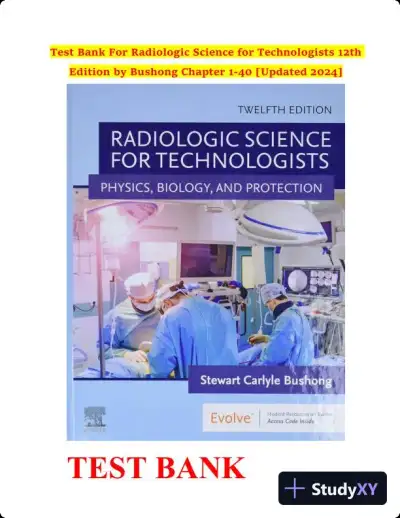 Exam Guides
Test Bank for Radiologic Science for Technologists: Physics, Biology, and Protection, 12th Edition (Chapters 1-40)
Biology
235 pages139downloadsFeb 2025 Past Exams
BIO1100 Anatomy and Physiology Openstax Test Bank with Answers (166 Solved Questions)
Biology
40 pages130downloadsFeb 2025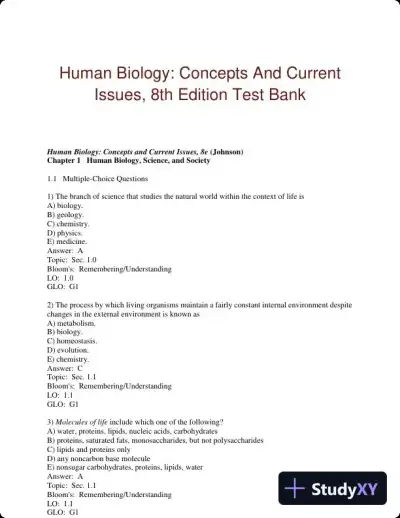 Exam Guides
Human Biology: Concepts And Current Issues, 8th Edition Test Bank
Biology
631 pages125downloadsFeb 2025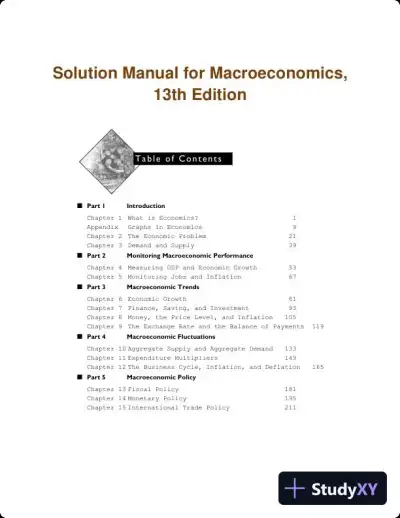 Textbook Guides
Solution Manual for Macroeconomics, 13th Edition
Biology
245 pages108downloadsFeb 2025
Study this document with CramX
Once it is in your library, every tool can work from it.