

Biology - Cellular Respiration
- Biology
- Texas A&M University
- 18 pages
- Shared March 2026
Preview 6 of 18 pages
See the first 6 pages exactly as they appear in the document.
Page 1 Read page 1 as text
Study Guide Biology – Cellular Respiration 1. Introduction to Cellular Respiration Living things need energy to grow, repair themselves, and carry out daily activities. Some organisms — especially plants — can capture energy directly from sunlight through photosynthesis . During this process, plants make glucose , a type of carbohydrate that stores energy in its chemical bonds. However, many organisms cannot perform photosynthesis. Animals, fungi, many protozoa, and most bacteria depend on plants (or on organisms that eat plants) for their energy. They obtain this energy by breaking down carbohydrates like glucose. 1.1 How Cells Get Energy from Food Cells release the energy stored in carbohydrates through a process called cellular respiration . During cellular respiration, glucose enters the cell’s cytoplasm and is gradually broken down through a series of chemical reactions. The energy released is not usually used right away. Instead, it is stored in a special molecule called adenosine triphosphate (ATP) . ATP is made by combining adenosine diphosphate (ADP) with a phosphate group. You can think of ATP like a rechargeable battery — it stores energy and releases it whenever the cell needs power for activities such as movement, growth, or making new molecules. 1.2 The Role of Oxygen and Carbon Dioxide Cellular respiration produces carbon dioxide (CO ₂ ) as a waste product. This carbon dioxide is released into the environment, where plants can reuse it during photosynthesis to make more glucose. Oxygen (O ₂ ) is also essential for cellular respiration. It acts as the final electron acceptor , allowing the process to continue efficiently. This oxygen is the same gas that plants release during photosynthesis. Because of this exchange, photosynthesis and cellular respiration are closely connected . Photosynthesis stores energy from sunlight in glucose, and cellular respiration releases that energy so cells can use it.
Page 2 Read page 2 as text
Study Guide 1.3 The Major Stages of Cellular Respiration Cellular respiration does not happen all at once. It occurs in four main stages , each with a specific role: 1. Glycolysis Glycolysis takes place in the cytoplasm . During this stage, one glucose molecule is broken down into two smaller molecules called pyruvic acid . 2. Krebs Cycle The pyruvic acid molecules enter the mitochondrion , where they are converted into acetyl CoA and then enter the Krebs cycle . In this stage, the molecules are broken down further, and energy is transferred to high - energy carriers such as NADH . 3. Electron Transport System The electrons carried by NADH move through a series of proteins called coenzymes and cytochromes . As electrons pass along this chain, they release energy. 4. Chemiosmosis The energy from the electrons is used to pump protons across a membrane. This creates a gradient that drives the production of large amounts of ATP . 1.4 The Overall Chemical Reaction The entire process of cellular respiration can be summarized by this chemical equation: C ₆ H ₁₂ O ₆ + 6 O ₂ → 6 H ₂ O + 6 CO ₂ + energy This equation shows that glucose reacts with oxygen to produce water, carbon dioxide, and usable energy in the form of ATP.
Page 3 Read page 3 as text
Study Guide 1.5 Where Cellular Respiration Happens • Glycolysis occurs in the cytoplasm . • Pyruvic acid conversion, the Krebs cycle, electron transport, and chemiosmosis all occur in the mitochondrion . Together, these steps allow cells to efficiently release and store energy so organisms can survive and function. 2. Glycolysis Glycolysis is the first major step of cellular respiration. In this process, one glucose molecule is broken down into two molecules of pyruvic acid (also called pyruvate ). This pathway happens in the cytoplasm of all types of cells, including animal cells, plant cells, and microorganisms . Glycolysis is not a single reaction. Instead, it is a multi - step metabolic pathway that uses at least six different enzymes to guide each step safely and efficiently. 2.1 Energy Investment: Starting the Process At the beginning of glycolysis, the cell must invest energy . In the first and third steps , ATP molecules provide energy to activate glucose and its intermediate compounds. • Two ATP molecules are used during these early steps. • This energy input helps prepare the glucose molecule for later breakdown. Think of this as “spending energy to make energy.”
Page 4 Read page 4 as text
Study Guide 2.2 Splitting the Glucose Molecule As glycolysis continues, the original six - carbon glucose molecule changes into several intermediate compounds. Eventually, it splits into two three - carbon molecules . These three - carbon molecules go through additional reactions, and by the end of glycolysis, each one becomes pyruvic acid . Since glucose splits into two parts, two pyruvic acid molecules are produced in total. 2.3 Energy Payoff: Making ATP During the later stages of glycolysis, energy is released from chemical reactions. This energy is used to make ATP . • Four ATP molecules are produced
Page 5 Read page 5 as text
Study Guide • Two ATP molecules were used earlier This results in a net gain of two ATP molecules for each glucose molecule broken down. 2.4 Formation of NADH Glycolysis also produces another important energy carrier. Some of the released energy is used to convert NAD into NADH (along with a hydrogen ion). • Two NADH molecules are formed during glycolysis • NADH stores energy that will be released later in the electron transport system 2.5 Glycolysis Does Not Need Oxygen One important feature of glycolysis is that it does not require oxygen . Because of this, glycolysis is described as an anaerobic process . For some organisms — such as certain bacteria and fermentation yeasts — glycolysis is the only way they can produce energy. 2.6 Efficiency of Glycolysis Glycolysis is considered somewhat inefficient . Although it produces ATP, most of the energy from glucose remains stored in the two pyruvic acid molecules . This remaining energy can be released later during the next stages of cellular respiration. Interestingly, glycolysis is somewhat similar to a reversal of photosynthesis , where energy - rich molecules are built rather than broken down. 3. Quiz Glycolysis 1. Question Fill in the blank: How many ATP molecules are produced through glycolysis?
Page 6 Read page 6 as text
Study Guide Answer Choices • Six molecules of ATP are created in the second half of glycolysis after two are required in the first half, for a net gain of four molecules of ATP. • Two ATP molecules are used in the initial steps and four are produced in the latter stages, for a net gain of two ATP molecules. • Two molecules of ATP are created in glycolysis, and none are used in the process. Correct Answer Two ATP molecules are used in the initial steps and four are produced in the latter stages, for a net gain of two ATP molecules. Why This Is Correct During glycolysis, the cell first invests 2 ATP molecules in the early reactions. Later, 4 ATP molecules are produced through substrate - level phosphorylation. Because 4 ATP are made and 2 ATP are used, the net gain is 2 ATP molecules per glucose molecule. 2. Question Fill in the blank: Which of the following statements about glycolysis is FALSE ? Answer Choices • It occurs in the cytoplasm. • It requires atmospheric oxygen. • It results in two molecules of pyruvic acid. Correct Answer It requires atmospheric oxygen.
12 more pages in the full document
Unlock it once and it stays in your library, ready to chat with or turn into flashcards.
Unlock the full documentMore Biology study materials
See all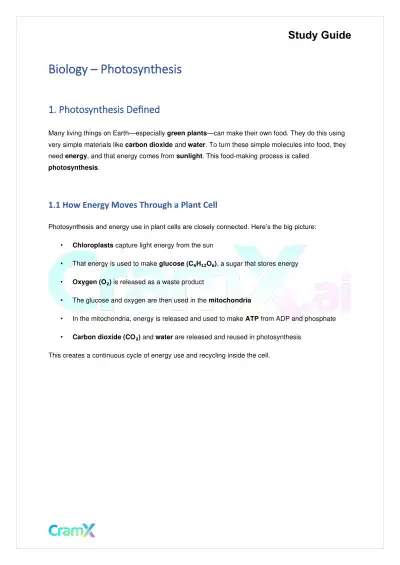 Quick Guides
Biology - Photosynthesis
Biology
15 pagesMar 2026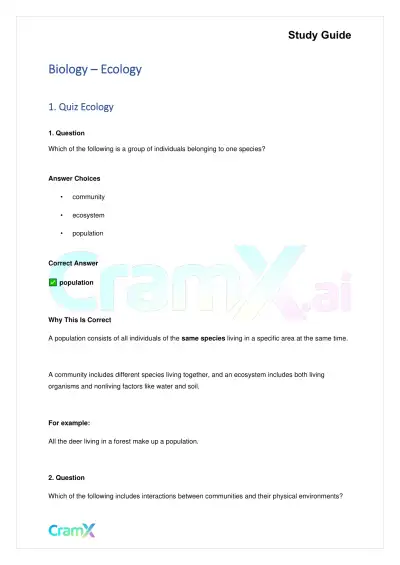 Quick Guides
Biology - Ecology
Biology
19 pagesMar 2026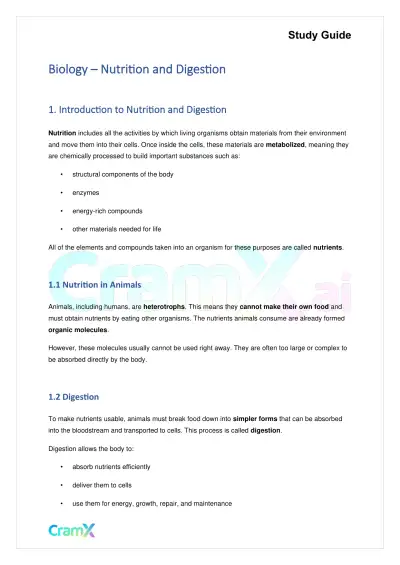 Quick Guides
Biology - Nutrition and Digestion
Biology
17 pagesMar 2026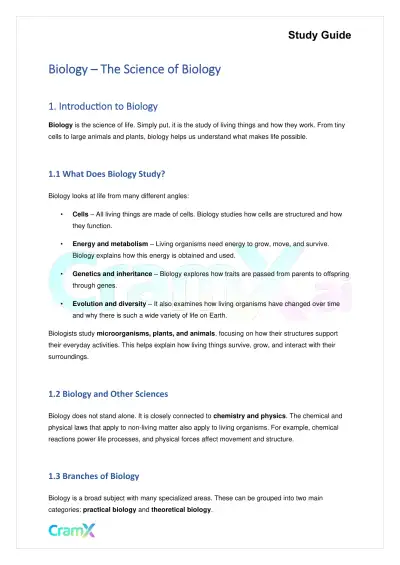 Quick Guides
Biology - The Science of Biology
Biology
13 pagesMar 2026 Quick Guides
Biology - Animals Vertebrates
Biology
21 pagesMar 2026 Quick Guides
Biology - Nervous Coordination
Biology
22 pagesMar 2026 Quick Guides
Biology - Classical (Mendelian) Genetics
Biology
14 pagesMar 2026 Quick Guides
Biology - Protista
Biology
28 pagesMar 2026
Study this document with CramX
Once it is in your library, every tool can work from it.