

Biology - Monera
- Biology
- Texas A&M University
- 24 pages
- Shared March 2026
Preview 8 of 24 pages
See the first 8 pages exactly as they appear in the document.
Page 1 Read page 1 as text
Study Guide Biology – Monera 1. Introduction to Prokaryotes and Viruses What Are Prokaryotes? Prokaryotes are microscopic organisms found in two major domains: Bacteria and Archaea . These cells are very simple in structure compared to plant or animal cells. • Prokaryotic cells do not have a nucleus . • They also lack membrane - bound organelles such as mitochondria or chloroplasts. • The only structures they have for making proteins are ribosomes . Instead of a nucleus, their genetic material is located in a region called the nucleoid . This DNA is: • A single loop • Double - stranded • Free within the cell (not enclosed by a membrane) 1. 1 How Prokaryotes Reproduce Prokaryotes reproduce through a simple, asexual process known as binary fission . Here’s what happens: 1. The DNA is copied. 2. The cell grows longer. 3. The cell splits into two identical cells. Unlike human cells, this process does not involve mitosis . Even without mitosis, binary fission is fast and very effective.
Page 2 Read page 2 as text
Study Guide 1. 2 Where Prokaryotes Live Prokaryotes are incredibly adaptable. You can find them almost everywhere on Earth , including: • Soil • Water • Air • On and inside living organisms They have been around for about 3.5 billion years , making them some of the oldest life forms on the planet. Over time, they have evolved to survive in nearly every environment — on the surface, underground, and even in extreme conditions. 1. 3 Shapes of Prokaryotic Cells Scientists often classify prokaryotes based on their shape , which helps with identification. • Cocci (singular: coccus ) are spherical • Bacilli (singular: bacillus ) are rod - shaped • Spiral - shaped bacteria come in two forms: ○ Spirochetes if they are rigid ○ Spirilla (singular: spirillum ) if they are flexible 1. 4 Prokaryotes and the Human Body Recent research has highlighted how important prokaryotes are to human health, especially through the microbiome . The microbiome refers to the many bacterial communities that live on and inside the human body . These microorganisms play key roles in digestion, immunity, and overall health. • Your intestines alone contain about 700 different species of prokaryotes. • Amazingly, prokaryotic cells in your body outnumber your own human cells by about ten to one .
Page 3 Read page 3 as text
Study Guide This means that prokaryotes are not just tiny organisms around us — they are essential partners in keeping us healthy. 1. 5 Why Prokaryotes Matter Although prokaryotes are small and simple, they are powerful, ancient, and essential to life on Earth. Understanding them helps us better understand biology, health, and the world around us. 2. Quiz Prokaryotes and Viruses 1. Question Which of the following does NOT describe prokaryotic cells? Answer Choices • Their hereditary material is a single loop of double - stranded DNA • They contain no organelles, only ribosomes • They divide by mitosis Correct Answer They divide by mitosis Why This Is Correct Prokaryotic cells do not divide by mitosis . Instead, they reproduce through a simpler process called binary fission , which does not involve the stages of mitosis seen in eukaryotic cells. The other statements correctly describe prokaryotic cells: • Their DNA exists as a single loop of double - stranded DNA in a region called the nucleoid. • They lack membrane - bound organelles and contain only ribosomes for protein synthesis. 2. Question How long have prokaryotes been on Earth?
Page 4 Read page 4 as text
Study Guide Answer Choices • 1.5 billion years • 2.5 billion years • 3.5 billion years Correct Answer 3.5 billion years Why This Is Correct Prokaryotes are the oldest known forms of life on Earth . Scientific evidence shows they have existed for about 3.5 billion years , surviving and evolving in nearly every environment on the planet. This long history explains their incredible diversity and ability to live in extreme conditions. 3. Question Which of the following descriptions is CORRECT ? Answer Choices • bacilli = spiral • cocci = spherical • spirochete = rod shaped Correct Answer cocci = spherical Why This Is Correct Bacteria are commonly classified by their shape : • Cocci are spherical (round) in shape. • Bacilli are rod - shaped , not spiral. • Spirochetes are spiral - shaped , not rods.
Page 5 Read page 5 as text
Study Guide Therefore, the only correct description is cocci = spherical . 4. Question What is the microbiome? Answer Choices • all the species of bacteria living in a community • all the species of bacteria living in an ecosystem • all the species of bacteria living in or on the human body Correct Answer all the species of bacteria living in or on the human body Why This Is Correct The microbiome refers to the collection of microorganisms — especially bacteria — that live in and on the human body , such as on the skin, in the mouth, and in the digestive tract. These microorganisms play important roles in digestion, immunity, and overall health. 5. Question Human intestines are home to how many species of prokaryotes? Answer Choices • 100 • 1,000 • 200 Correct Answer 1,000
Page 6 Read page 6 as text
Study Guide Why This Is Correct The human intestines contain a very diverse microbiome , with about 1,000 different species of prokaryotes . These microorganisms help with digestion, vitamin production, and protection against harmful pathogens. 3. Domain Bacteria What Is Domain Bacteria? Domain Bacteria includes the prokaryotic organisms that people come into contact with every day. These bacteria are found almost everywhere — on surfaces, in food, in soil, and even inside our bodies. Although they are tiny, they are incredibly diverse and play many import ant roles in nature and industry. 3. 1 Characteristics of Bacteria How Bacteria Get Their Food Most bacteria are heterotrophic , which means they cannot make their own food. Instead, they get energy from organic matter . • The largest group of bacteria are saprobic . These bacteria feed on dead or decaying plants and animals . • A smaller number of bacteria are parasitic . These bacteria live inside a host organism and can cause disease. Not all bacteria rely on other organisms for food. Some are autotrophic , meaning they make their own food . 3. 2 Autotrophic Bacteria Some autotrophic bacteria carry out photosynthesis , similar to plants.
Page 7 Read page 7 as text
Study Guide • They use pigments dissolved in their cytoplasm to capture energy from light. • Two major groups of photosynthetic bacteria are: ○ Green sulfur bacteria ○ Purple bacteria • The pigments in these bacteria are similar to plant pigments, even though they are not plants. Other autotrophic bacteria are chemosynthetic . • These bacteria use chemical reactions instead of sunlight as their energy source. • They use this energy to produce their own food. 3. 3 Where Bacteria Can Live Bacteria are extremely adaptable and can survive in many different environments. 3. 3 .1 Temperature Preferences • Psychrophilic bacteria live in very cold temperatures. • Mesophilic bacteria live at moderate temperatures , such as human body temperature. • Thermophilic bacteria thrive in very hot environments. 3. 3 .2 Oxygen Requirements • Aerobic bacteria require oxygen to survive. • Anaerobic bacteria live in environments without oxygen . • Facultative bacteria can survive with or without oxygen , depending on what is available. 3. 3 .3 pH Levels • Most bacteria prefer a neutral pH of about 7 . • Some bacteria live in acidic environments , such as yogurt or sour cream.
Page 8 Read page 8 as text
Study Guide • Others live in alkaline environments . • Certain bacteria can even survive at a pH of 2 , like that found in the human stomach. 3. 4 Activities of Bacteria Bacteria in the Environment Bacteria are essential to life on Earth. • Some bacteria live on the roots of legume plants (such as beans and peas). • These bacteria fix nitrogen from the air and convert it into forms plants can use. • Plants use nitrogen to make amino acids and proteins , which then pass to animals through food chains. Other bacteria act as decomposers . • They break down dead organisms and waste in landfills and natural environments. • This process recycles essential elements , returning them to the ecosystem. 3. 5 Bacteria in Industry and Medicine Bacteria are also extremely useful to humans. In the food industry , bacteria are used to make: • Cheese • Yogurt and other fermented dairy products • Sauerkraut • Pickles In industry and medicine , bacteria are used to produce: • Antibiotics • Chemicals and dyes • Vitamins and enzymes
16 more pages in the full document
Unlock it once and it stays in your library, ready to chat with or turn into flashcards.
Unlock the full documentMore Biology study materials
See all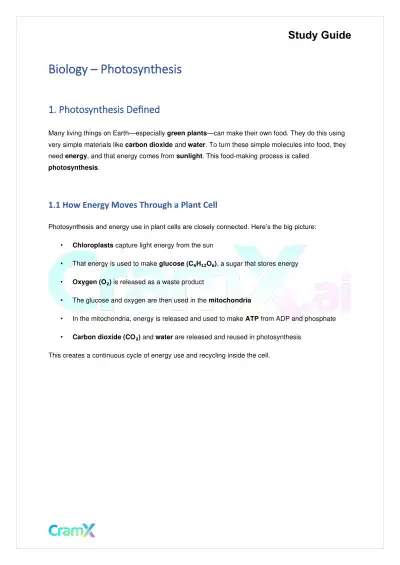 Quick Guides
Biology - Photosynthesis
Biology
15 pagesMar 2026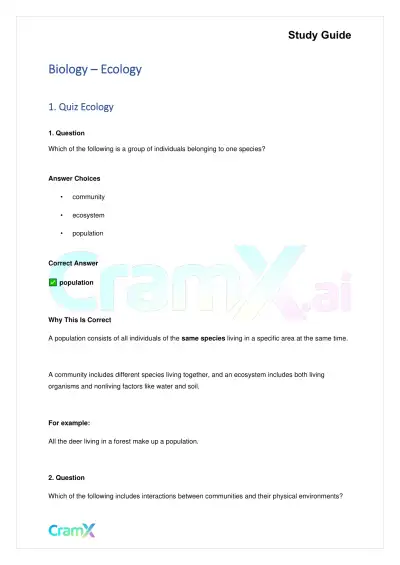 Quick Guides
Biology - Ecology
Biology
19 pagesMar 2026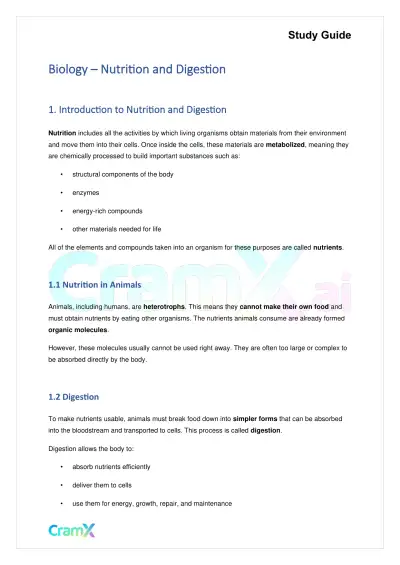 Quick Guides
Biology - Nutrition and Digestion
Biology
17 pagesMar 2026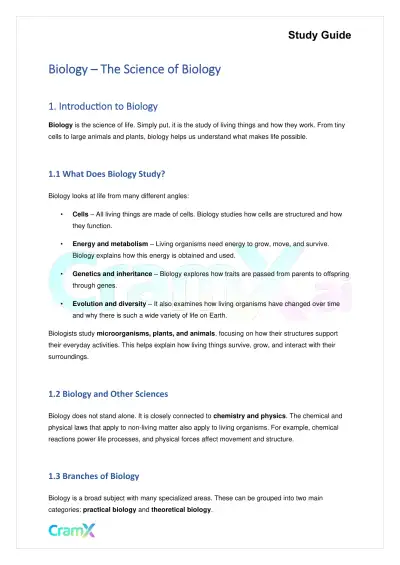 Quick Guides
Biology - The Science of Biology
Biology
13 pagesMar 2026 Quick Guides
Biology - Animals Vertebrates
Biology
21 pagesMar 2026 Quick Guides
Biology - Nervous Coordination
Biology
22 pagesMar 2026 Quick Guides
Biology - Classical (Mendelian) Genetics
Biology
14 pagesMar 2026 Quick Guides
Biology - Protista
Biology
28 pagesMar 2026
Study this document with CramX
Once it is in your library, every tool can work from it.