

Exploring Biological Energy Processes: Thermodynamics, Enzymes, Cellular Respiration, and Photosynthesis
- Biology
- 15 pages
- Shared May 2025
A review sheet on biological energy processes, including thermodynamics, enzymes, cellular respiration, and photosynthesis.
Preview 5 of 15 pages
See the first 5 pages exactly as they appear in the document.
Page 1 Read page 1 as text
Exploring Biological Energy Processes: Thermodynamics, Enzymes, Cellular Respiration, and Photosynthesis Chapter 8 T hermodynamics, enzymes, and ATP 1. Definitions of First and Second Laws of Thermodynamics: • First Law of Thermodynamics : Energy cannot be created or destroyed, only transformed from one form to another. Total energy in the universe remains constant. • Second Law of Thermodynamics : The entropy (disorder) of an isolated system tends to increase over time. In simpler terms, systems naturally progress toward disorder or randomness. 2. Why Cells and Organisms are Considered Open Systems: • Cells and organisms are open systems because they exchange energy and matter with their surroundings. They take in nutrients and expel waste, and require energy from the environment (like sunlight or food) to maintain their structure and function. 3. Definition of Energy and Its Units: • Energy : The capacity to do work or produce change. It exists in various forms such as chemical, kinetic, and potential energy. • Units of Energy : In biological systems, energy is often measured in kilocalories (kcal) or kilojoules (kJ) . The Joule (J) is the standard SI unit. 4. Definitions of Entropy (S), Free Energy (G), and Free Energy Change (ΔG): • Entropy (S) : A measure of disorder or randomness in a system. • Free Energy (G) : The energy available to do work in a system at constant temperature and pressure.
Page 2 Page 3 Read page 3 as text
• Free Energy Change (ΔG) : The change in free energy during a process. A negative ΔG indicates a spontaneous reaction, while a positive ΔG indicates a non - spontaneous reaction. 5. Relationships Between ΔH, ΔG, and ΔS: • ΔH (Change in Enthalpy) : The heat content or total energy of a system. • ΔG = ΔH - TΔS : This equation links the change in enthalpy, entropy, and temperature to determine the spontaneity of a reaction. o ΔG < 0 : Exergonic reaction (spontaneous). o ΔG > 0 : Endergonic reaction (non - spontaneous). 6. Endergonic vs. Exergonic Reactions and Spontaneous Reactions: • Endergonic Reactions : Reactions that require energy input (ΔG > 0), non - spontaneous. • Exergonic Reactions : Reactions that release energy (ΔG < 0), spontaneous. • Spontaneous Reactions : Reactions that occur naturally without external energy input, typically with a negative ΔG. 7. Equilibrium Constant (Keq) and Reaction at Equilibrium: • Keq : The ratio of the concentrations of products to reactants at equilibrium. • A reaction is at equilibrium when the rates of the forward and reverse reactions are equal, and the concentrations of reactants and products remain constant. 8. Equation Relating ΔG, Keq, and Substrate/Product Concentrations: • ΔG = ΔG° + RT ln([products]/[reactants])
Page 4 Read page 4 as text
o ΔG° is the standard free energy change, R is the gas constant, T is temperature, and the brackets represent concentrations of products and reactants. 9. Why ATP is Considered a Universal Energy Carrier: • ATP is considered a universal energy carrier because it stores energy in its phosphate bonds. When ATP is hydrolyzed to ADP and inorganic phosphate (Pi), energy is released, which can then be used to drive biochemical processes like muscle contraction, protein synthesis, and active transport. 10. Why Actual ΔG for ATP Hydrolysis is - 10 to - 12 kcal/mol (Not - 7.3 kcal/mol): • The actual ΔG for ATP hydrolysis is more negative than the standard value ( - 7.3 kcal/mol) due to the actual intracellular concentrations of ATP, ADP, and Pi, which makes the hydrolysis reaction more exergonic in living cells. 11. ATP Used to Drive Endergonic Reactions (Example): • Example: Protein Synthesis - The formation of peptide bonds during protein synthesis is an endergonic process (requires energy). ATP hydrolysis provides the necessary energy to drive this reaction, ensuring the synthesis of proteins. 12. Why Cells Maintain Product - to - Substrate Ratio Much Less Than Keq: • Cells maintain a product - to - substrate concentration ratio much lower than Keq to ensure that reactions proceed in the direction that supports cell functions (homeostasis). This helps cells to regulate metabolic pathways efficiently. 13. Energy of Activation, Active Center of an Enzyme:
Page 5 Read page 5 as text
• Energy of Activation : The energy required to start a reaction. Enzymes lower this energy barrier, making reactions occur faster. • Active Site : The part of an enzyme where the substrate binds. The specific amino acids in the active site participate in catalysis by stabilizing the transition state. 14. pH, Temperature Optima, Enzyme Specificity, and Induced Fit: • pH and Temperature Optima : Enzymes function best at specific pH and temperature conditions. • Enzyme Specificity : Enzymes are highly specific for their substrates. • Induced Fit : When an enzyme binds to its substrate, it undergoes a conformational change that helps catalyze the reaction. 15. Effect of Substrate on Enzyme Activity, Km, and Vmax: • Km : The substrate concentration at which the enzyme operates at half its maximum rate (Vmax). • Vmax : The maximum rate of an enzyme - catalyzed reaction when the enzyme is saturated with substrate. 16. Competitive and Noncompetitive Inhibition: • Competitive Inhibition : Inhibitor competes with the substrate for the active site. It increases Km but does not affect Vmax . • Noncompetitive Inhibition : Inhibitor binds to a different site (allosteric site), changing the enzyme's shape. It decreases Vmax but does not affect Km . 17. Feedback Inhibition and Allosteric Regulation:
10 more pages in the full document
Unlock it once and it stays in your library, ready to chat with or turn into flashcards.
Unlock the full documentMore Biology study materials
See all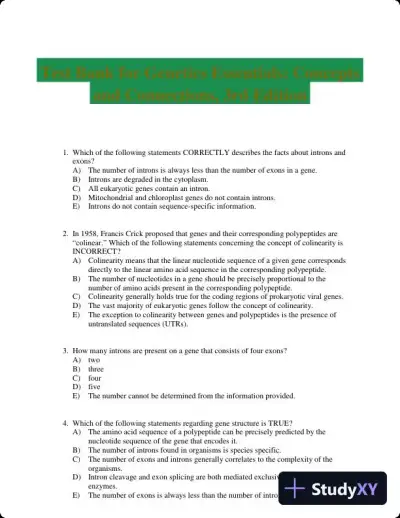 Exam Guides
Test Bank for Genetics Essentials: Concepts and Connections, 3rd Edition
Biology
561 pages147downloadsFeb 2025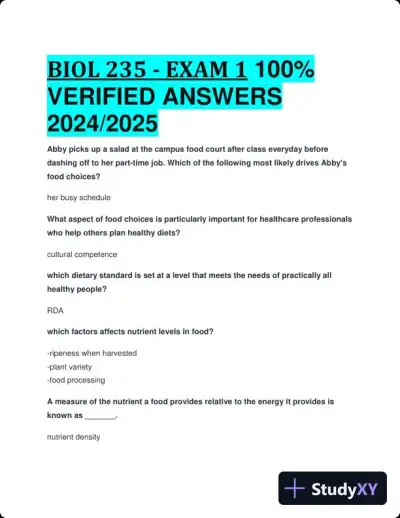 Past Exams
2024-2025 BIOL235 Nutrition Practice Exam with Answers (38 Solved Questions)
Biology
6 pages145downloadsFeb 2025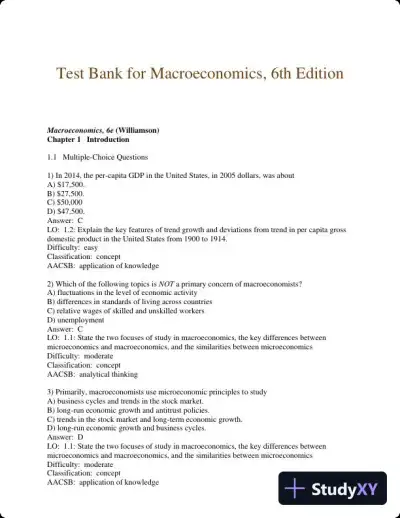 Exam Guides
Test Bank for Macroeconomics, 6th Edition
Biology
373 pages143downloadsFeb 2025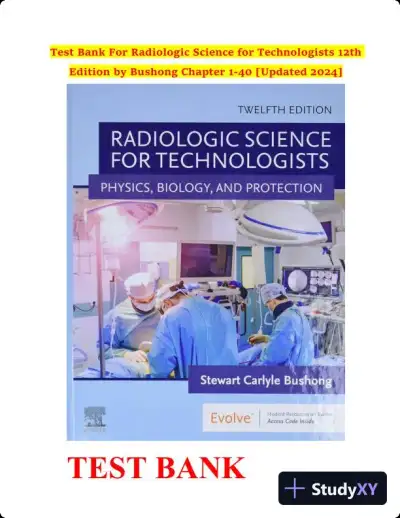 Exam Guides
Test Bank for Radiologic Science for Technologists: Physics, Biology, and Protection, 12th Edition (Chapters 1-40)
Biology
235 pages139downloadsFeb 2025 Past Exams
BIO1100 Anatomy and Physiology Openstax Test Bank with Answers (166 Solved Questions)
Biology
40 pages130downloadsFeb 2025 Exam Guides
Human Biology: Concepts And Current Issues, 8th Edition Test Bank
Biology
631 pages125downloadsFeb 2025 Textbook Guides
Solution Manual for Macroeconomics, 13th Edition
Biology
245 pages108downloadsFeb 2025 Textbook Guides
Solution Manual for Managerial Accounting, 6th Edition
Biology
929 pages100downloadsFeb 2025
Study this document with CramX
Once it is in your library, every tool can work from it.