

Plant Biology - The Shoot System Stems
- Biology
- Texas A&M University
- 12 pages
- Shared March 2026
Preview 4 of 12 pages
See the first 4 pages exactly as they appear in the document.
Page 1 Read page 1 as text
Study Guide Plant Biology – The Shoot System: Stems 1. Characteristics of Shoot Systems 1.1 What is the shoot system? The shoot system is the easily visible, above - ground part of a flowering plant. It includes the stem , leaves , flowers , and buds . Together, these parts help the plant grow upward, make food, and reproduce. 1.2 Structure of the stem Leaves are attached to the stem at specific points called nodes . The part of the stem between two nodes is known as an internode . The leaf axil is the upper angle formed between the leaf and the stem at a node. Inside each leaf axil, there is usually an axillary (lateral) bud . These buds can grow into: • Vegetative branches (leafy shoots), or • Flowers (reproductive structures). 1.3 Terminal bud and origin of the shoot At the tip of the main stem and its branches is the terminal bud . This bud contains apical meristem tissue , which is responsible for the increase in length of the shoot. The shoot begins to form during the embryonic stage of the plant. It develops at the end opposite the root . As it grows, the shoot forms a shoot apex , which is structurally different from the root apex.
Page 2 Read page 2 as text
Study Guide 1.4 Shoot apex and bud formation The apical meristem , which is the growing point of the shoot, is surrounded by young, developing leaves called leaf primordia . In the axils of these leaf primordia are bud primordia . There are two types of buds: • Vegetative buds – grow into leafy branches • Reproductive buds – contain early flower tissues and develop into flowers 1.5 Role of auxins and apical dominance Auxins are plant hormones produced mainly at the shoot tip. These hormones usually suppress the growth of lateral (axillary) buds , keeping them dormant for some time. • When apical dominance is strong , the terminal bud grows faster than lateral buds. The plant becomes cone - shaped , with one main stem and shorter side branches. • When apical dominance is weak , axillary buds grow soon after the main shoot elongates. This results in a bushy plant with many branches and no single dominant stem. Auxins produced in the leaf primordia also control the elongation and differentiation of primary meristems , helping the shoot grow in an organized manner.
Page 3 Read page 3 as text
Study Guide 2. Primary Growth of Stems 2. 1. How Stems Grow in Length
Page 4 Read page 4 as text
Study Guide Just like roots, stems grow longer from their tips . This growth happens because cells at the tip divide and then elongate . In stems (but not roots), the youngest cells at the tip are arranged into two zones : Tunica • The outer layer of the stem tip • Cells divide perpendicular to the stem axis • Forms several layers that cover the surface • Helps in forming the outer tissues Corpus • The inner region of the stem tip • Cells divide in all directions • Produces the bulk (inner mass) of the stem Together, the tunica and corpus make up the apical meristem , which is responsible for primary growth (increase in length) . 2 .2 Formation of Primary Meristems and Tissues Cells produced by the tunica and corpus continue dividing and become three primary (transitional) meristems : Primary Meristems → Primary Tissues
8 more pages in the full document
Unlock it once and it stays in your library, ready to chat with or turn into flashcards.
Unlock the full documentMore Biology study materials
See all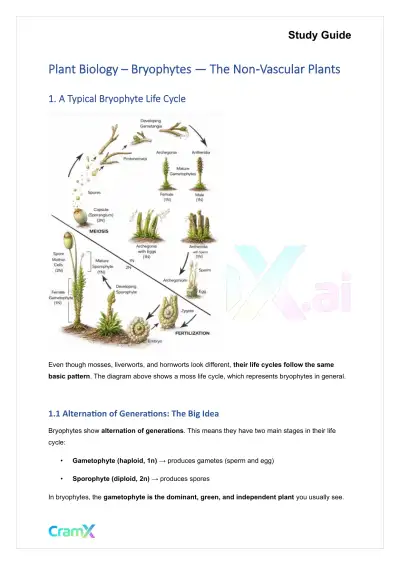 Quick Guides
Plant Biology - Bryophytes—The Non‐Vascular Plants
Biology
11 pagesMar 2026 Quick Guides
Plant Biology - Themes of Plant Biology
Biology
10 pagesMar 2026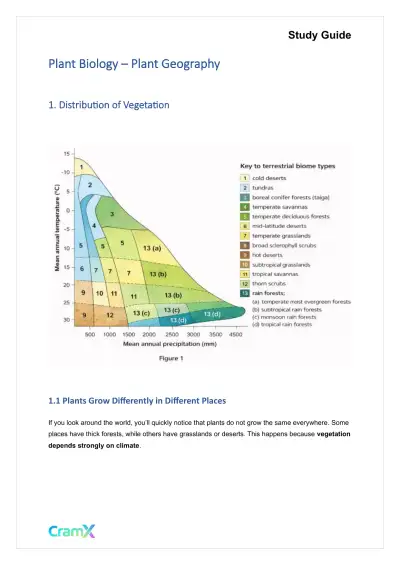 Quick Guides
Plant Biology - Plant Geography
Biology
8 pagesMar 2026 Quick Guides
Plant Biology - Tissues
Biology
10 pagesMar 2026 Quick Guides
Plant Biology - Roots
Biology
15 pagesMar 2026 Quick Guides
Plant Biology - Evolution
Biology
5 pagesMar 2026 Quick Guides
Plant Biology - Systematics
Biology
20 pagesMar 2026 Quick Guides
Plant Biology - A Synopsis of the Living World
Biology
11 pagesMar 2026
Study this document with CramX
Once it is in your library, every tool can work from it.