

Stern's Introductory Plant Biology 12th Edition Test Bank
- Biology
- 354 pages
- Shared May 2025
Need to sharpen your exam skills? Stern's Introductory Plant Biology 12th Edition Test Bank provides answers to tough questions, helping you excel.
Preview 16 of 354 pages
See the first 16 pages exactly as they appear in the document.
Page 1 Read page 1 as text
Chapter 01 - What Is Plant Biology? 1 - 1 Chapter 01 What Is Plant Biology? Multiple Choice Questions 1. The first microscopes were produced by ________________, who ground and fitted lenses in a small metal tube. A. Anton van Leeuwenhoek B. Dutch spectacle makers C. Linnaeus D. Carl Zeiss E. Otto Brunfels 2. The early scientist who first demonstrated experimentally that plants do not have the same modes of nutrition as animals was A. Nehemiah Grew. B. Carl Willdenow. C. Alexander von Humboldt. D. Sir J. D. Hooker. E. J. B. van Helmont. Stern - 001 Chapter... #3 3. Plant _______ study plant relationships, identify and classify plants into groups based on genetic similarity, and name plants according to these groups. A. taxonomists B. physiologists C. anatomists D. morphologists E. geographers Stern - 001 Chapter... #4
Page 2 Page 3 Read page 3 as text
Chapter 01 - What Is Plant Biology? 1 - 2 4. The science that deals with the form, structure, and embryology of plants is A. plant taxonomy. B. plant physiology. C. plant genetics. D. cytology. E. plant morphology. Stern - 001 Chapter... #5 5. The scientific method begins with A. reading scientific journals B. substantiated observations that aren’t explained by existing principles or theories C. a tentative, unproven explanation of an observation D. restating a general theory in understandable terms E. testing hypotheses generated to explain observations Stern - 001 Chapter... #6 6. The study of plants and their impact on humans is important because plants A. provide food, shelter, and clothing B. provide the ecological support system linking all living organisms in their environment C. contribute to the natural beauty of the world and play a role in many recreational pursuits D. influence world climate E. all of the choices are correct Stern - 001 Chapter... #7 7. Which sequence generally describes the steps of the scientific method? A. hypothesis, observation, testing, retesting B. testing, observation, hypothesis, retesting C. observation, hypothesis, testing, retesting D. observation, testing, hypothesis, retesting E. observation, writing, hypothesis, publishing Stern - 001 Chapter... #8
Page 4 Read page 4 as text
Chapter 01 - What Is Plant Biology? 1 - 3 8. The objective of scientific research is described as A. collecting data B. developing and testing hypotheses C. using human history to explain technological advances D. using scientific instrumentation such as microscopes E. applying results to improve human lives 9. Which of the following scientists would more likely be concerned with the rate of photosynthesis in leaves? A. plant anatomist B. plant physiologist C. forester D. plant geneticist E. plant geographer Stern - 001 Chapter... #9 10. The Swedish botanist who produced the elements of our present system of naming and classifying plants in the eighteenth century was A. Matt Johnson. B. Carolus Linnaeus. C. Gustav Bjorklund. D. J. B. van Helmont. E. Olaf Anderson. Stern - 001 Chapter... #10 11. A theory is A. an educated guess. B. an accumulation of data. C. a modified hypothesis. D. a repeatable observation. E. a group of generalizations or principles that help us understand events in the natural world Stern - 001 Chapter... #11
Page 5 Read page 5 as text
Chapter 01 - What Is Plant Biology? 1 - 4 12. An early English botanist who described the structure of wood more precisely than any of his predecessors was A. Nehemiah Grew. B. Sir Joseph D. Hooker. C. Charles Claude Smythe. D. James Worthington. E. Anton L. Bortenschlager. Stern - 001 Chapter... #12 13. Leeuwenhoek's microscopes could magnify objects up to A. 600 times. B. 500 times. C. 400 times. D. 300 times. E. 200 times. Stern - 001 Chapter... #13 14. According to the scientific method, an hypothesis is A. a well supported idea expanded from facts via reasoning but is not currently known to be entirely or universally true. B. an idea or explanation that is a basis for experimental investigation. C. information that is known and specific. D. the last step in the scientific method that deals with collection of data. E. an experimentally demonstrated fact. Stern - 001 Chapter... #14 15. People who study the interaction of people and plants in their environment are __________. A. ethnobotantists B. plant physiologists C. plant scientists D. plant taxonomists E. horticulturalists
Page 6 Read page 6 as text
Chapter 01 - What Is Plant Biology? 1 - 5 16. ______________ is the scientific investigation of the biology of plants, algae, and fungi. A. plant morphology B. ecology C. botany D. cytology E. ethnobotany 17. Environmental scientists are developing technologies to convert ___________ into __________ as a source of renewable, plant - based fuel. A. oil shale; diesel B. cellulose and starch; ethanol C. petroleum products; gasoline D. wind; electrical energy E. hydropower; electrical energy 18. When human populations increase, they increase their impact on plants and other living organisms by _______________________________________. A. using plants as fuel B. building homes C. harvesting plants for food for themselves and their animals D. replacing plant communities with agricultural crops E. all of the above 19. Plant ecologists and NASA scientists are working together to develop _________________ for space travel that use plants to recycle carbon dioxide and produce oxygen. A. chemical carbon dioxide scrubbers B. open pond systems C. methane generators D. closed systems E. water purification systems F.
Page 7 Read page 7 as text
Chapter 01 - What Is Plant Biology? 1 - 6 20. If a catastrophe destroyed all green plants and algae on land and in the water, animal life would be able to survive for approximately __________ before suffocating due to lack of oxygen. A. 6 months B. 1 year C. 6 years D. 11 years E. 100 years True / False Questions 21. Plants can live without humans but humans cannot live without plants. TRUE 22. Originally, the scientific method was considered to involve a routine series of steps. TRUE Stern - 001 Chapter... #15 23. The noted Swedish botanist Linnaeus published his book, Species Plantarum, in the early twentieth century. FALSE Stern - 001 Chapter... #16 24. Plant morphology is a discipline that deals with the naming and classification of plants. FALSE Stern - 001 Chapter... #17
Page 8 Read page 8 as text
Chapter 01 - What Is Plant Biology? 1 - 7 25. The microscope was invented during the eighteenth century. FALSE Stern - 001 Chapter... #18 26. Van Helmont concluded after his classical experiment with the willow tree that its increase in weight had been due to the water it had absorbed. TRUE Stern - 001 Chapter... #19 27. Science may be defined as “a search for knowledge of the natural world.” TRUE Stern - 001 Chapter... #20 28. The term microscope was first used during the fifteenth century. FALSE Stern - 001 Chapter... #21 29. Van Helmont's experiment with a willow branch demonstrated that the soil in which it grew gained weight over time. FALSE Stern - 001 Chapter... #22 30. Sections of plant stems can detect ‘up’ and ‘down’ directions when producing new roots and stems. TRUE
Page 9 Read page 9 as text
Chapter 02 - The Nature of Life 2 - 1 Chapter 02 The Nature of Life? Multiple Choice Questions 1. Which of the following is NOT a form of metabolism? A. respiration B. photosynthesis C. diffusion D. digestion E. assimilation 2. Which of the following metabolic activities of plants produces sugars? A. photosynthesis B. assimilation C. digestion D. respiration E. None of these answers are correct. 3. Determination of whether something is a living organism or a nonliving object is based on ___________. A. a single characteristic such as change in position B. presence of carbon and hydrogen atoms C. several characteristics such as DNA and other organic materials inside a cell D. movement E. presence of carbon and oxygen atoms 4. As living individuals grow and reproduce their response to environmental stimuli may include ___. A. movement B. increase in size C. change in position D. all of these E. none of these
Page 10 Read page 10 as text
Chapter 02 - The Nature of Life 2 - 2 5. Which of the following is NOT an attribute of all living organisms? A. response to stimuli B. metabolism C. nervous system D. reproduction E. growth 6. Which of the following is NOT an attribute of all living organisms? A. metabolism B. photosynthesis C. reproduction D. response to stimuli E. adaptation to the environment 7. Reproduction in living organisms results in __________________. A. new individuals of the same species B. new individuals that are always genetically identical to the parents C. new individuals that are never genetically identical to the parents D. overpopulation of the community by that species E. loss of genetic variability in the population 8. Response to a stimulus ___________________. A. requires movement B. may include a cell - level, or chemical change in the individual C. may occur without any chemical or physical change by the individual D. is not characteristic of rooted plants. E. always changes the genetic information 9. The basic ‘stuff of the universe’ or matter has which of the following characteristics? A. occupies space B. has mass C. is composed of atomic elements D. a and b only E. all of the above
Page 11 Read page 11 as text
Chapter 02 - The Nature of Life 2 - 3 10. At present the number of elements naturally occurring on earth is __________. A. less than 90 B. 93 C. 98 D. 104 E. more than 105 11. The number of protons and electrons in a neutral atom is A. quite variable. B. the same. C. unknown. D. always unequal. E. unrelated. Stern - 002 Chapter... #3 12. The atomic number of an element is based on A. the number of electrons associated with a single atom. B. the number of neutrons in the nucleus of an atom. C. the number of isotopes associated with it. D. the number of protons present in a single atom. E. its atomic mass. Stern - 002 Chapter... #15 13. The volume of space in which a given electron occurs 90% of the time is called A. an orbital. B. a nucleus. C. an atom. D. a molecule. E. a bond. Stern - 002 Chapter... #16
Page 12 Read page 12 as text
Chapter 02 - The Nature of Life 2 - 4 14. The element with the lowest atomic number and/or mass is A. oxygen. B. hydrogen. C. boron. D. nitrogen. E. carbon. Stern - 002 Chapter... #17 15. Electrons are essentially A. positive electric charges. B. negative electric charges. C. unstable isotopes. D. uncharged particles. E. atomic particles that are bonded together. Stern - 002 Chapter... #18 16. Which of the following carries a single positive charge? A. proton B. neutron C. lepton D. electron E. quark Stern - 002 Chapter... #27 17. The mass of the protons and neutrons added is the A. atomic sum. B. atomic number. C. atomic weight. D. atomic charge. E. atomic coefficient. Stern - 002 Chapter... #28
Page 13 Read page 13 as text
Chapter 02 - The Nature of Life 2 - 5 18. What is the maximum number of electrons that can occupy the innermost electron orbital? A. 2 B. 4 C. 6 D. 8 E. 10 Stern - 002 Chapter... #29 19. Unfilled positions within an electron orbital tend to make the atom A. unreactive. B. neutral. C. less reactive. D. more reactive. E. stable. Stern - 002 Chapter... #30 20. A substance consisting of two or more elements united in a definite ratio by chemical bonds is called a A. molecule. B. mixture. C. compound. D. base. E. valence. Stern - 002 Chapter... #4 21. The bonds that hold atoms together do so through the sharing or transfer of A. atomic nuclei. B. electrons. C. protons. D. neutrons. E. molecules. Stern - 002 Chapter... #10
Page 14 Read page 14 as text
Chapter 02 - The Nature of Life 2 - 6 22. Which type of chemical bond involves the transfer of electrons? A. ionic B. covalent C. hydrogen D. both [ionic and covalent] are correct E. both [ionic and hydrogen] are correct Stern - 002 Chapter... #31 23. Which element is capable of forming triple covalent bonds? A. carbon B. hydrogen C. oxygen D. nitrogen E. potassium Stern - 002 Chapter... #32 24. Carbon has an atomic number of 6. How many electrons does carbon have in its first and second electron orbitals, respectively? A. 2, 4 B. 4, 2 C. 1, 5 D. 3, 3 E. 0, 6 Stern - 002 Chapter... #33 25. If there is an asymmetric charge distribution on a molecule creating a positively charged sector and a negatively charged sector, the type of molecule resulting would be _____________. A. neutral. B. charged. C. polar. D. hydrophobic. E. radioactive.
Page 15 Read page 15 as text
Chapter 02 - The Nature of Life 2 - 7 26. A solution that is slightly alkaline would have a pH in the range of A. 8.5. B. 7.5. C. 7.0. D. 6.5. E. 2.0. Stern - 002 Chapter... #2 27. An acid is a compound that A. releases hydroxyl ions when dissolved in water. B. forms water when mixed with a salt. C. releases positively charged hydrogen ions when dissolved in water. D. converts starch to glucose. E. converts proteins to carbohydrates. Stern - 002 Chapter... #6 28. When an acid and a base are mixed together, which of the following is produced? A. a salt B. a mixture C. an isotope D. a lipid E. a carbohydrate 29. Which of the following pH value s is considered neutral (i.e., neither acidic nor basic)? A. 6.8 B. 7.3 C. 7.5 D. 8.0 E. none of the choices are correct
Page 16 Read page 16 as text
Chapter 02 - The Nature of Life 2 - 8 30. Laws pertaining to energy are called laws of ___________________. A. metabolism B. aerodynamics C. atomic fusion D. thermodynamics E. heredity 31. Covalent bonds between molecules inside living cells are often formed or broken through the addition or loss of ___________. A. carbon dioxide B. oxygen C. water D. chlorine and sodium E. neutrons 32. Classes of proteins called ___________________ function as organic catalysts for chemical reactions in cells. A. peptides B. enzymes C. thermal agents D. disaccharides E. hormones 33. ________________ polymers serve as the genetic memory in living cells. A. C arbohydrate B. N ucleic acids C. P roteins D. L ipids E. T wo or more of these
338 more pages in the full document
Unlock it once and it stays in your library, ready to chat with or turn into flashcards.
Unlock the full documentMore Biology study materials
See all Exam Guides
Test Bank for Genetics Essentials: Concepts and Connections, 3rd Edition
Biology
561 pages147downloadsFeb 2025 Past Exams
2024-2025 BIOL235 Nutrition Practice Exam with Answers (38 Solved Questions)
Biology
6 pages145downloadsFeb 2025 Exam Guides
Test Bank for Macroeconomics, 6th Edition
Biology
373 pages143downloadsFeb 2025 Exam Guides
Test Bank for Radiologic Science for Technologists: Physics, Biology, and Protection, 12th Edition (Chapters 1-40)
Biology
235 pages139downloadsFeb 2025 Past Exams
BIO1100 Anatomy and Physiology Openstax Test Bank with Answers (166 Solved Questions)
Biology
40 pages130downloadsFeb 2025 Exam Guides
Human Biology: Concepts And Current Issues, 8th Edition Test Bank
Biology
631 pages125downloadsFeb 2025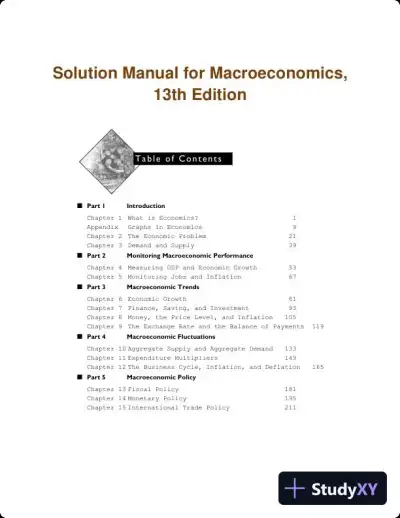 Textbook Guides
Solution Manual for Macroeconomics, 13th Edition
Biology
245 pages108downloadsFeb 2025 Textbook Guides
Solution Manual for Managerial Accounting, 6th Edition
Biology
929 pages100downloadsFeb 2025
Study this document with CramX
Once it is in your library, every tool can work from it.