

Test Bank For Becker's World of the Cell, 9th Edition
- Biology
- 573 pages
- Shared May 2025
Test Bank For Becker's World of the Cell, 9th Edition helps you grasp fundamental concepts quickly with well-organized study material and practice sets.
Preview 16 of 573 pages
See the first 16 pages exactly as they appear in the document.
Page 1 Read page 1 as text
1 Becker's The World of the Cell, 9e (Hardin/Bertoni/Kleinsmith) Chapter 1 A Preview of Cell Biology 1.1 Multiple-Choice Questions 1) Robert Hooke coined the term cell when studying thin slices of cork. These ________ were the first cells observed because ________. A) dead plant cells; the thick cells walls did not require high resolution or magnification to view B) dead animal cells; they were immobile and did not need to be fixed before viewing C) compartments; they were actually the result of multiple cells that had merged and died to form large compartments that were easy to view D) immune cells; they produce antibodies that embed in the cell membrane to make it visible E) "little rooms"; they were 100 nm in diameter, much larger than most plant cells Answer: A Chapter Section: 1.1 Bloom's Taxonomy: Comprehension Learning Outcome: 1.1 Global LO: G1 2) The Latin phrase omnis cellula e cellula refers to a cellular principle. Which of the following statements is the best interpretation of this phrase? A) Tissues are composed of similar cells. B) Cells generally are found in clusters. C) All cells arise only from preexisting cells. D) Organs are composed of tissues and cells. E) The cell is the basic unit of structure. Answer: C Chapter Section: 1.1 Bloom's Taxonomy: Comprehension Learning Outcome: 1.1 Global LO: G7 3) ________ improved the original light microscope in the late 1600s, allowing the visualization of ________. A) Theodor Schwann; the internal structures of cells, such as ribosomes, nuclei, and golgi bodies B) Robert Hooke; bacteria and viruses C) Antonie van Leeuwenhoek; sperm cells, bacteria, algae, and other protists D) Robert Brown; cell structures using fluorescent antibodies E) Rudolf Virchow; collagen and muscle cells Answer: C Chapter Section: 1.1 Bloom's Taxonomy: Knowledge Learning Outcome: 1.2 Global LO: G1
Page 2 Page 3 Read page 3 as text
2 4) Which organelle stores most of the DNA in plant and animal cells? A) Golgi complex B) mitochondrion C) chloroplast D) nucleus E) lysosome Answer: D Chapter Section: 1.2 Bloom's Taxonomy: Comprehension Learning Outcome: 1.2 Global LO: G1 5) Which of the following statements is false ? A) All organisms consist of one or more cells. B) All cells arise from preexisting cells. C) The cell is the basic unit of structure for all organisms. D) All cells have a membrane-bound nucleus. E) Cells come in a wide variety of sizes and shapes. Answer: D Chapter Section: 1.2 Bloom's Taxonomy: Analysis Learning Outcome: 1.1 Global LO: G7 6) Which of the following is true of a nanometer? A) A nanometer is about the size of a common bacterial cell. B) A nanometer is one millionth of a meter. C) A nanometer is equivalent to 10 Angstroms (Å). D) The nanometer is the most common measurement used in measuring whole cells. E) None of the above. Answer: C Chapter Section: 1.2 Bloom's Taxonomy: Comprehension Learning Outcome: 1.2 Global LO: G4 7) Which of the following is closest to a micrometer in size? A) the width of a strand of DNA B) the length of a plant cell C) the length of a chicken egg D) a typical prokaryotic cell E) the size of a ribosome Answer: D Chapter Section: 1.2 Bloom's Taxonomy: Application Learning Outcome: 1.2 Global LO: G4
Page 4 Read page 4 as text
3 8) Cell biology emerged from which of the following fields of biology? A) biochemistry B) cytology C) genetics D) biochemistry, cytology, and genetics E) cytology and biochemistry Answer: D Chapter Section: 1.2 Bloom's Taxonomy: Comprehension Learning Outcome: 1.1 Global LO: G1 9) Which of the following is smallest? A) ribosome B) virus C) protein D) mitochondrion E) prokaryote Answer: C Chapter Section: 1.2 Bloom's Taxonomy: Application Learning Outcome: 1.2 Global LO: G4 10) Early microscopes did not allow clear visualization of cells because they were limited by A) magnification. B) number of kernels. C) resolution. D) refraction. E) both magnification and resolution. Answer: E Chapter Section: 1.1 Bloom's Taxonomy: Comprehension Learning Outcome: 1.2 Global LO: G4
Page 5 Read page 5 as text
4 11) You are working on a project that involves the direct observation of DNA molecules. The microscope that would give you the best information at this time would be the A) light microscope. B) phase-contrast microscope. C) transmission electron microscope. D) digital video microscope. E) fluorescent microscope. Answer: C Chapter Section: 1.2 Bloom's Taxonomy: Analysis Learning Outcome: 1.2 Global LO: G4 12) The limit of resolution can best be defined as A) the distance that an object must be moved to be distinguished from its background. B) the inverse of the wavelength of light; it is greatest for black light. C) the distance that two objects must be apart to be distinguished as separate objects. D) the solvent that must be available to remix a solution. E) the magnification power of a microscope. Answer: C Chapter Section: 1.2 Bloom's Taxonomy: Knowledge Learning Outcome: 1.2 Global LO: G4 13) How does brightfield microscopy allow images to be visualized? A) Specimens are illuminated with white light. B) Electrons strike the specimen being examined. C) Specimens are fixed and have bright fluorescent molecules attached to them. D) Specimens are illuminated with blue light to visualize internal features of cells smaller than 100 nm. E) Specimens are viewed under phased light to improve magnification. Answer: A Chapter Section: 1.2 Bloom's Taxonomy: Knowledge Learning Outcome: 1.2 Global LO: G7
Page 6 Read page 6 as text
5 14) Which of the following is an application of immunofluorescence microscopy? A) Visualization of the natural fluorescence of a specimen under UV light. B) Identification of specific components of the immune system. C) Identifying which organelle or cellular compartment contains a particular protein. D) Visualization of the surface structures of a specimen. E) Construction of three-dimensional images of structures smaller than 10 nm. Answer: C Chapter Section: 1.2 Bloom's Taxonomy: Application Learning Outcome: 1.2 Global LO: G1 15) Which type of microscopy enhances and amplifies slight changes in the phase of transmitted light? A) differential interference contrast microscopy B) digital video microscopy C) fluorescence microscopy D) phase-contrast microscopy E) both differential interference contrast microscopy and phase-contrast microscopy Answer: E Chapter Section: 1.2 Bloom's Taxonomy: Knowledge Learning Outcome: 1.2 Global LO: G1 16) Which type of microscopy has the greatest resolving power? A) electron microscopy B) phase-contrast microscopy C) fluorescence microscopy D) digital video microscopy E) confocal scanning microscopy Answer: A Chapter Section: 1.2 Bloom's Taxonomy: Knowledge Learning Outcome: 1.2 Global LO: G4
Page 7 Read page 7 as text
6 17) Which of the following can only be viewed by electron microscopy? A) frog eggs B) DNA C) nuclei D) mitochondria E) prokaryotes Answer: B Chapter Section: 1.2 Bloom's Taxonomy: Knowledge Learning Outcome: 1.2 Global LO: G4 18) Which of the following types of light microscopy improves the resolution of thick specimens by illuminating one plane of the specimen at a time? A) fluorescence microscopy B) phase-contrast microscopy C) confocal microscopy D) differential interference contrast microscopy E) brightfield microscopy Answer: C Chapter Section: 1.2 Bloom's Taxonomy: Knowledge Learning Outcome: 1.2 Global LO: G4 19) A scientist is examining motile protist. He wishes to determine their direction of movement. Which of the following microscopic techniques is least likely to be used to view these cells? A) light microscopy B) electron microscopy C) differential interference contrast microscopy D) fluorescence microscopy E) phase-contrast microscopy Answer: B Chapter Section: 1.2 Bloom's Taxonomy: Application Learning Outcome: 1.2 Global LO: G2
Page 8 Read page 8 as text
7 20) Scanning electron microscopy (SEM) is especially suited to A) observing living specimens. B) examining internal cellular structure. C) creating a sense of depth. D) both observing living specimens and creating a sense of depth. E) simultaneously observing living specimens, examining internal cellular structure, and creating a sense of depth. Answer: C Chapter Section: 1.2 Bloom's Taxonomy: Application Learning Outcome: 1.2 Global LO: G2 21) Melvin Calvin and his colleagues used which of the following to deduce the steps in the Calvin cycle? A) negative staining B) Drosophila melanogaster C) electron microscopy D) ultracentrifugation E) radioisotopes Answer: E Chapter Section: 1.2 Bloom's Taxonomy: Knowledge Learning Outcome: 1.2 Global LO: G1 22) A microtome is used to A) view microscopic organisms. B) slice thin sections of specimens. C) focus short wavelengths of light. D) manipulate tiny objects. E) dissect cellular organelles. Answer: B Chapter Section: 1.2 Bloom's Taxonomy: Knowledge Learning Outcome: 1.2 Global LO: G4
Page 9 Read page 9 as text
8 23) The classic work of Friedrich Wöhler (1828) that united the fields of biology and chemistry was based on the A) discovery of yeast ferments. B) production of urea in the laboratory. C) discovery of ATP. D) identification of nucleotide bases. E) analysis of gene segregation. Answer: B Chapter Section: 1.2 Bloom's Taxonomy: Comprehension Learning Outcome: 1.2 Global LO: G1 24) You wish to obtain a purified sample of mitochondria from lysed cells. The best way to obtain this sample would be A) centrifugation. B) chromatography. C) polyacrylamide gel electrophoresis. D) agarose gel electrophoresis. E) both centrifugation and polyacrylamide gel electrophoresis. Answer: A Chapter Section: 1.2 Bloom's Taxonomy: Evaluation Learning Outcome: 1.2 Global LO: G2, G7 25) 1 mm = ________ nm A) 1,000,000 B) 1000 C) 10 D) 1/1000 E) 1/1,000,000 Answer: A Chapter Section: 1.2 Bloom's Taxonomy: Knowledge Learning Outcome: 1.2 Global LO: G4
Page 10 Read page 10 as text
9 26) The outcome of the joining of cytology and biochemistry yielded a better understanding of the cell by A) identification of cellular structures. B) identification of cellular biochemical pathways. C) creating bioinformatics. D) identification of cellular structures and biochemical pathways. E) identification of biochemical pathways and creating bioinformatics. Answer: D Chapter Section: 1.2 Bloom's Taxonomy: Synthesis Learning Outcome: 1.1 Global LO: G1 27) Wöhler revolutionized biology through his demonstration that biological molecules are governed by the ordinary laws of physics and chemistry. He demonstrated this principle by A) synthesizing urea in the laboratory from ammonium cyanate. B) developing techniques for isolating, purifying, and analyzing subcomponents of cells. C) defining the laws of heredity. D) discovering active agents in cell extracts that were specific biological catalysts that have since come to be called enzymes. E) inventing mass spectrometry which is commonly used to determine the size and composition of individual proteins. Answer: A Chapter Section: 1.2 Bloom's Taxonomy: Comprehension Learning Outcome: 1.1 Global LO: G1 28) Gregor Mendel was most influential in which field of biology? A) genetics B) chromatography C) biochemistry D) prokaryotic transformation E) cytology Answer: A Chapter Section: 1.2 Bloom's Taxonomy: Comprehension Learning Outcome: 1.1 Global LO: G1
Page 11 Read page 11 as text
10 29) The scientific work that established DNA, rather than protein, as the molecule of heredity was performed prior to A) Mendel's work on heredity. B) the elucidation of the double helix structure of DNA. C) Antonie van Leeuwenhoek's observation of internal cell structures. D) the description of the enzymatic steps of glycolysis. E) the formation of the chromosome theory of heredity. Answer: B Chapter Section: 1.2 Bloom's Taxonomy: Synthesis Learning Outcome: 1.1 Global LO: G1 30) Jacques Monod and François Jacob deduced the mechanism responsible for the regulation of prokaryotic gene expression. They are, therefore, responsible for launching the era of A) the scientific method. B) molecular genetics. C) biochemistry. D) light microscopy. E) radioisotopes. Answer: B Chapter Section: 1.2 Bloom's Taxonomy: Synthesis Learning Outcome: 1.1 Global LO: G1 31) Which of the following biochemical techniques uses an electrical field to separate macromolecules based on their mobility through a semisolid gel? A) light microscopy. B) ultracentrifugation. C) chromatography. D) electrophoresis. E) mass spectrometry. Answer: D Chapter Section: 1.2 Bloom's Taxonomy: Knowledge Learning Outcome: 1.2 Global LO: G1
Page 12 Read page 12 as text
11 32) To which of the following do Mendel's observations relate? A) thermodynamics B) gravity C) ideal gas laws D) heredity E) diffusion Answer: D Chapter Section: 1.2 Bloom's Taxonomy: Synthesis Learning Outcome: 1.1 Global LO: G1 33) The steps of the scientific method, in the correct order, are A) design experiments, draw conclusions, collect data, interpret results, make observations, and test the hypothesis. B) make observations, formulate the hypothesis, design experiments, collect data, interpret results, and draw conclusions. C) collect data, interpret results, test the hypothesis, design experiments, make observations, and draw conclusions. D) collect data, interpret results, test the hypothesis, make observations, and design experiments. E) none of the above. Answer: B Chapter Section: 1.3 Bloom's Taxonomy: Knowledge Learning Outcome: 1.3 Global LO: G1 34) Scientists use various terms to describe conclusions reached through the scientific method. Which of the following terms conveys the least degree of certainty? A) theory B) hypothesis C) law D) both hypothesis and theory E) both theory and law Answer: B Chapter Section: 1.3 Bloom's Taxonomy: Comprehension Learning Outcome: 1.3 Global LO: G1
Page 13 Read page 13 as text
12 35) Once a scientific theory becomes a law, it A) cannot be changed. B) cannot be challenged. C) becomes static. D) is subject to modification. E) is irrefutable. Answer: D Chapter Section: 1.3 Bloom's Taxonomy: Comprehension Learning Outcome: 1.3 Global LO: G1 36) You are studying the response of macrophages infected with the intracellular bacterium Brucella, specifically by examining which gene products are being expressed. You would be studying the macrophage ________ to obtain this information. A) proteome B) genome C) transciptome D) amplicon E) metabolome Answer: C Chapter Section: 1.2 Bloom's Taxonomy: Application Learning Outcome: 1.2 Global LO: G1 37) Which of the following is an important characteristic for a model organism? A) marginally characterized B) difficult to manipulate in the laboratory C) prone to random changes that alter primary characteristics D) widely studied E) all of the above Answer: D Chapter Section: 1.3 Bloom's Taxonomy: Comprehension Learning Outcome: 1.3 Global LO: G1
Page 14 Read page 14 as text
13 38) All of the following are model organisms, except A) Saccharomyces cerevisiae. B) Drosophila melanogaster. C) Caenorhabditis elegans. D) Arabidopsis thialana. E) Homo sapiens. Answer: E Chapter Section: 1.3 Bloom's Taxonomy: Knowledge Learning Outcome: 1.3 Global LO: G1 39) In studying osteoporosis in humans, you wish to test a newly designed treatment for efficacy. Your best choice for a model organism would be A) Escherichia coli. B) Mus musculus. C) Caenorhabditis elegans. D) Arabidopsis thaliana. E) Pisum sativum. Answer: B Chapter Section: 1.3 Bloom's Taxonomy: Application Learning Outcome: 1.3 Global LO: G1 40) Which of the following is mismatched? A) Escherichia coli - genetics B) Drosophila melanogaster - embryogenesis C) Mus musculus - immunology D) Caenorhabditis elegans - photosynthesis E) Arabidopsis thaliana - plant gene function Answer: D Chapter Section: 1.3 Bloom's Taxonomy: Analysis Learning Outcome: 1.3 Global LO: G1
Page 15 Read page 15 as text
14 1.2 Matching Questions Match each scientist or group of scientists on the left with the appropriate phrase to the right. A) fruit fly B) DNA double helix C) cell theory D) transfer RNA E) Calvin cycle F) "one gene—one enzyme" G) transformation H) translation I) chromosome theory of heredity J) embryonic bacteria K) "ferments" of yeast L) oral prokaryotes M) urea N) hereditary factors O) pollen grain P) dog saliva Q) transcription 1) Gregor Mendel Chapter Section: 1.2 Bloom's Taxonomy: Knowledge Learning Outcome: 1.1 Global LO: G1 2) Walter Sutton Chapter Section: 1.2 Bloom's Taxonomy: Knowledge Learning Outcome: 1.1 Global LO: G1 3) Matthias Schleiden Chapter Section: 1.2 Bloom's Taxonomy: Knowledge Learning Outcome: 1.1 Global LO: G1 4) Oswald Avery, Colin MacLeod, and Maclyn McCarty Chapter Section: 1.2 Bloom's Taxonomy: Knowledge Learning Outcome: 1.1 Global LO: G1
Page 16 Read page 16 as text
15 5) George Beadle and Edward Tatum Chapter Section: 1.2 Bloom's Taxonomy: Knowledge Learning Outcome: 1.1 Global LO: G1 6) James Watson and Francis Crick Chapter Section: 1.2 Bloom's Taxonomy: Knowledge Learning Outcome: 1.1 Global LO: G1 7) Thomas Hunt Morgan Chapter Section: 1.2 Bloom's Taxonomy: Knowledge Learning Outcome: 1.1 Global LO: G1 8) Friedrich Wöhler Chapter Section: 1.2 Bloom's Taxonomy: Knowledge Learning Outcome: 1.1 Global LO: G1 9) Louis Pasteur Chapter Section: 1.2 Bloom's Taxonomy: Knowledge Learning Outcome: 1.1 Global LO: G1 Answers: 1) N 2) I 3) C 4) G 5) F 6) B 7) A 8) M 9) K
557 more pages in the full document
Unlock it once and it stays in your library, ready to chat with or turn into flashcards.
Unlock the full documentMore Biology study materials
See all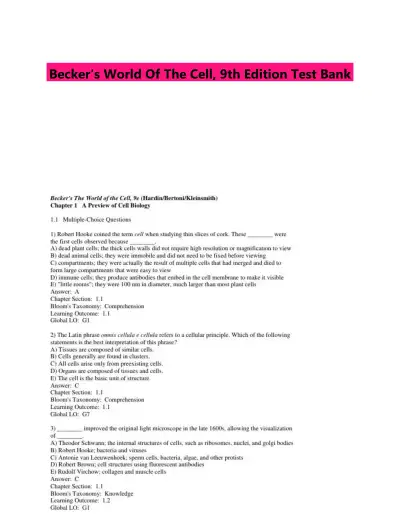 Exam Guides
Becker's World Of The Cell, 9th Edition Test Bank
Biology
573 pagesMay 2025 Exam Guides
Test Bank for Genetics Essentials: Concepts and Connections, 3rd Edition
Biology
561 pages147downloadsFeb 2025 Past Exams
2024-2025 BIOL235 Nutrition Practice Exam with Answers (38 Solved Questions)
Biology
6 pages145downloadsFeb 2025 Exam Guides
Test Bank for Macroeconomics, 6th Edition
Biology
373 pages143downloadsFeb 2025 Exam Guides
Test Bank for Radiologic Science for Technologists: Physics, Biology, and Protection, 12th Edition (Chapters 1-40)
Biology
235 pages139downloadsFeb 2025 Past Exams
BIO1100 Anatomy and Physiology Openstax Test Bank with Answers (166 Solved Questions)
Biology
40 pages130downloadsFeb 2025 Exam Guides
Human Biology: Concepts And Current Issues, 8th Edition Test Bank
Biology
631 pages125downloadsFeb 2025 Textbook Guides
Solution Manual for Macroeconomics, 13th Edition
Biology
245 pages108downloadsFeb 2025
Study this document with CramX
Once it is in your library, every tool can work from it.