

Test Bank For Essentials of Genetics, 10th Edition
- Biology
- 288 pages
- Shared May 2025
Test Bank For Essentials of Genetics, 10th Edition is an invaluable resource for exam day, offering practice MCQs to test your knowledge.
Preview 16 of 288 pages
See the first 16 pages exactly as they appear in the document.
Page 1 Read page 1 as text
1 Essentials of Genetics, 10e (Klug) Chapter 1 Introduction to Genetics 1) The CRISPR - Cas system potentially represents one of the most power techniques in genetics as a result of its role in ________ associated with specific human disorders. A) identifyi ng genes B) editing genes C) producing new genes D) regulating genes E) transmitting genes Answer: B Section: Introduction Bloom's Taxonomy: Remembering/Understanding 2) In the 1600s, William Harvey studied reproduction and development. What is the t erm given to his theory which states that an organism develops from the fertilized egg by a succession of developmental events that lead to an adult? A) preformation B) spontaneous generation C) cell theory D) transduction E) epigenesis Answer: E Section: 1.1 Bloom's Taxonomy: Remembering/Understanding 3) What is the term given to the th eory which states that the gamete contains a complete miniature adult? A) preformation B) transduction C) transformation D) conjugation E) cell theory Answer: A Section : 1.1 Bloom's Taxonomy: Remembering/Understanding 4) What is the term given to the theory which put forth the idea that living organisms could arise by incubating nonliving components? A) spontaneous generation B) natural selection C) evolution D) prefo rmation E) collective combination Answer: A Section: 1 .1 Bloom's Taxonomy: Remembering/Understanding
Page 2 Page 3 Read page 3 as text
2 5) Schleiden and Schwann proposed the cell theory which states that ________. A) cells contain genetic information in their nucleus B) cells move from the various parts of the body to the reproductive organs to produce offspring C) cells are derived from preexisting cells D) cells propagate via asexual reproduction E) cells represent the basic units of heredity Answer: C Section: 1.1 Bloom's Taxonomy: Remembering/Understanding 6) Who, along with Alfred Wa llace, formulated the theory of natural selection? A) Gregor Mendel B) William Harvey C) Louis Pasteur D) Charles Darwin E) James Watson Answer: D Section: 1.1 Bloom's Taxonomy: Remembering/Underst anding 7) Which of the following is an example of natural selection? A) a bird's beak is able to effectively crack the seeds it encounters B) dog breeding by humans C) depending on the food a turtle eats, its shell may grow faster or slower D) sometime du ring human' s life they break a bone E) bacteria can be effectively killed by treatment with bleach Answer: A Section: 1.1 Bloom's Taxonomy: Evaluating/Creating 8) Which of the following botanists was not involved with bringing Mendel's work to light in the 1900s? A) Carl Correns B) Carl Linnaeus C) Hugo de Vries D) Erich Tschermak Answer: A Section: 1.1 Bloom's Taxonomy: Remembering/Understanding
Page 4 Read page 4 as text
3 9) Who was the Augustinian monk that conducted a decade of experiments on the garden pea, eventually sh owing that t raits are passed from parents to offspring in predictable ways? A) Francis Crick B) Alfred Wallace C) Hippocrates D) Aristotle E) Gregor Mendel Answer: E Section: 1.2 Bloom's Taxonomy: Remembering/Understanding 10) In many species, there ar e two representatives of each chromosome. In such species, the characteristic number of chromosomes is called the ________ number. It is usually symbolized as ________. A) haploid; n B) haploid; 2n C) diploid; 2n D) diploid; n E) p olyploid; n Answer: C Se ction: 1.2 Bloom's Taxonomy: Remembering/Understanding 11) Genetics is defined as the branch of biology associated with ________. A) heredity and variation B) mutation and recession C) transcription and translation D) diploid an d haploid E) replication and recombination Answer: A Section: 1.2 Bloom's Taxonomy: Remembering/Understanding 12) Early in the twentieth century, Walter Sutton and Theodor Boveri noted that the behavior of chromosomes during meiosis is identical to the behavior of genes during gamete formation. They proposed that genes are carried on chromosomes, which led to the basis ________. A) of the germ - plasm theory B) of the chromosome theory of inheritance C) of the law of independent assortment D) for the determination of DNA as genet ic material E) of predicting patterns of inheritance Answer: B Section: 1.2 Bloom's Taxonomy: Remembering/Understanding
Page 5 Read page 5 as text
4 13) What is a simple definition of an allele? Answer: An allele is an alternative form of a ge ne. Section: 1.2 Bloom's Taxonomy: Remembering/Understanding 14) The observable feature of an organism is referred to as a ________. A) genotype B) phenotype C) prototype D) karyotype E) bryophyte Answer: B Section: 1.2 Bloom's Taxonomy: Remembering/ Understanding 15) Until the mid - 194 0s, many scientists considered proteins to be the likely candidates for the genetic material. Which of the following characteristics led scientists to believe DNA was NOT the genetic material? A) DNA is more stable than protein. B) DNA is less abundant tha n protein. C) DNA has less variation than protein. D) Protein can fold into may shapes. E) DNA is less abundant than protein and DNA has less variation than protein. Answer: E Section: 1.2 Bloom's Taxonomy: Applying/Analyzing 16) Which of the following is an example of heredity? A) A man has low blood pressure due to medications. B) Both moths and birds have wings and can fly. C) Dalmation dogs all have spots. D) Whales and fish both swim. E) Flies and molluscs both have eyes. Answer: C Section: 1.2 B loom's Taxonomy: Evaluating/Creating 17) Which is not a component of DNA? A) mRNA B) deoxyribose sugar C) nitrogenous base D) phosphate Answer: A Section: 1.3 Bloom's Taxonomy: Remember ing/Understanding
Page 6 Read page 6 as text
5 18) Distinguish the functions of DNA and RNA in a eukaryote. Answer: DNA is responsible for the storage and replication of genetic information; RNA is involved in the expression of stored genetic information. Section: 1.3 Bloom's Taxon omy: Applying/Analyzing 19) Genetic information contained in D NA that encodes for an amino acid is referred to as a(n) ________. A) allele B) trait C) nucleotide D) codon E) genotype Answer: D Section: 1.3 Bloom's Taxonomy: Remembering/Understanding 20) Which of the following processes describes the formation of a complementary RNA molecule? A) replication B) transcription C) translation D) mutation E) mosaicism Answer: B Section: 1.3 Bloom's Taxonomy: Remembering/Underst anding 21) Reference is often made to adapter molecules when describing protein synthesis in that they allow amino acids to associate with nucleic acids. To what class of molecules does this term refer? A) DNA B) protein C) mRNA D) amino acids E) tRNA Ans wer: E Section: 1.3 Bloom's Taxonomy: Remembering/Understanding
Page 7 Read page 7 as text
6 22) If a scientist cha nged a cell's ionic composition and complementarity between DNA strands could no longer occur, what would the scientist first detect? A) DNA becomes single stranded B) DNA strands become shorter C) RNA would start binding to DNA D) ribosomes would move int o the nucleus E) cell membranes would become less permeable Answer: A Section: 1.3 Bloom's Taxonomy: Evaluating/Creating 23) Sickle - cell anemia, which is associa ted with blockage of blood flow in capillaries and small blood vessels, causing severe pain and damage to the heart, brain, muscles, and kidneys is the result of ________. A) a large chromosome deletion B) a small chromosome deletion C) a change in a singl e nucleotide D) an environmental pathogen E) a hormonal variation Answer: C Section: 1.3 Bloom's Taxonomy: Remembering/Understanding 24) Which of the following contains all the others? A) double helix B) nucleotide C) hydrogen bond D) DNA strand E) sug ar Answer: A Section: 1.3 Bloom's Taxonomy: Applying/Analyzing 25) Once a protein is ma de, its biochemical or structural properties play a role in producing ________. A) genotype B) phenotype C) mutant D) chromosome E) DNA Answer: B Section: 1.3 Bloom's Taxonomy: Applying/Analyzing
Page 8 Read page 8 as text
7 26) A primary discovery to generate recombinant DNA mol ecules was the use of ________. A) spliceosomes B) restriction enzymes C) microscopes D) bioinformatics E) x - ray diffraction Answer: B Section: 1.4 Bloom's Taxo nomy: Remembering/Understanding 27) A ________ is an organism produced by biotechnology that involves the transfer of hereditary traits across species. A) transgenic organism B) mutant C) clone D) vector E) frankenfood Answer: A Section: 1.5 Bloom's Ta xonomy: Remembering/Understanding 28) The study of the structure, function, and evolution of genes and genomes is referred to as ________. A) genomics B) proteomics C) bioinformatics D) genetics E) cell theory Answer: A Section: 1.6 Bloom's Taxonomy: Remembering/Understanding 29) ________ is a discipline involved in the development of both ha rdware and software for processing, storing, and retrieving nucleotide and protein data. A) Bioinformatics B) Genomics C) Recombinant DNA techn ology D) Cloning E) Proteomics Answer: A Section: 1.6 Bloom's Taxonomy: Remembering/Understanding
Page 9 Read page 9 as text
8 30) There are various technologies to knock out genes in organisms, what is the primary rationale for performing these experiments? Answer: To determine the function of the gene based on changes in phenotype Section: 1.6 Bloom's Taxonomy: Applying/Analyzing 31) Organisms that are well understood from a scientific standpoint and are often used in basic biological research are often called ________. A) cl ones B) vectors C) recombinant DNA technology D) model organisms E) restriction enzymes Answer: D Section: 1.7 Bloom's Taxonomy: Remembering/Understanding 32) The most accurate depiction of the chronological order of genetic discoveries would be ________. A) chromosome theory of inheritance, Mendelian genetics, recombinant DNA technology, determination of DNA st ructure B) determination of DNA structure, chromoso me theory of inheritance, Mendelian genetics, recombinant DNA technology C) Mendelian genetics, chromosome theory of inheritance, determination of DNA structure, recombinant DNA technology D) Mendelian gen etics, determination of DNA structure, chromosome t heory of inheritance, recombinant DNA technology Answer: C Section: 1.8 Bloom's Taxonomy: Remembering/Understanding
Page 10 Read page 10 as text
1 Essentials of Genetics, 10e (Klug) Special Topics 1 Epigenetics 1) ________ is the study of phenomena and mechanisms that cause chromosome - associated heritable changes to gene expression that are not dependent on changes in DNA sequence. A) Population g enetics B) Transmission genetics C) Epigenetics D) Mutagenesis E) Preformation Answer: C Section: ST 1.1 Bloom's Taxonomy: Remembering/Unde rstanding 2) Which nitrogenous bases are most likely to be methylated? A) cytosines adjacent to guanines B) cytos ines adjacent to other cytosines C) guanines adjacent to cytosines D) guanines adjacent to other guanines E) cytosines base paired to guanines Answer: A Section: ST 1.1 Bloom's Taxonomy: Remembering/Understanding 3) In terms of epigenetics, which state ment best describes the promoter for a gene that is not expressed in lung tissue but is expressed in heart tissue? A) In lung cells, the guani nes in the promoter would be hypomethylated, but would be hypermethylated in heart cells. B) In lung cells, the gu anines in the promoter would be hypermethylated, and would be hypomethylated in heart cells. C) In lung cells, the cytosines of the promoter w ould be hypomethylated, and would be hypermethylated in heart cells. D) In lung cells, the cytosines of the promot er would be hypermethylated, and would be hypomethylated in heart cells. E) The promoters should appear the same in both types of cells, but t he mRNA produced would be hypermethylated more in lung cells compared to heart cells. Answer: D Section: ST 1.1 Bloom's Taxonomy: Applying/Analyzing
Page 11 Read page 11 as text
2 4) Which carbon atom is methylated on cytosine? A) 2' B) 4' C) 5' D) 6' Answer: C Section: ST 1.1 Bloom's Taxonomy: Remembering/Understanding 5) The sum of histone modifications and their interactions is called t he ________. A) genetic code B) histone code C) protein code D) expression code E) transcription code Answer: B Section: ST 1.1 Blo om's Taxonomy: Remembering/Understanding 6) Which of the following genes is known to cause instability in repetitive micr osatellite sequences when hypermethylated? A) BRCA1 B) CDKN2A C) MLH1 D) IGF2 E) H19 Answer: C Section: ST 1.3 Bloom's Taxonomy: Remembering/Understanding 7) Which statement about X inactivation is false ? A) X inactivation was the first example of epi genetic allele - specific regulation to be identified. B) All embryonic cells randomly inactivate paternal X chromos omes during early development. C) Xist is a sense lncRNA expressed on the inactivated X chromosome. D) Tsix is an antisense lncRNA expressed on the active X chromosome. E) Xist and Tsix are transcripts of the same gene that are transcribed in opposite dir ections. Answer: B Section: ST 1.2 Bloom's Taxonomy: Remembering/Understanding
Page 12 Read page 12 as text
3 8) A particular small noncoding RNA that is linked to sper matogenesis is most likely classified as what kind of noncoding RNA? A) microRNAs B) short interfering RNAs C) anti sense lncRNAs D) piwi - interacting RNAs E) bidirectional lncRNAs Answer: D Section: ST 1.1 Bloom's Taxonomy: Applying/Analyzing 9) Which o f the following mechanisms is an example of genomic imprinting in humans? A) The maternal and paternal alleles of a gene pair are both expressed. B) One of the two X chromosomes in females is randomly expressed and the other is repressed. C) A random patte rn of autosomal allele inactivation is observed. D) Human males have only one Y chromosome and one X chromosome. E) In some allele pairs, only the paternal allele is expressed, and in others, only the maternal allele is expressed. Answer: E Section: ST 1 .2 Bloom's Taxonomy: Remembering/Understanding 10) Which of the following genotypes would most likely lead to a low birth weight? A) Igf2 +/Igf2+ where neither maternal nor paternal allele is mutated. B) Igf2 +/Igf2 - where the mutated Igf2 - allele is mater nal. C) Igf2 +/Igf2 - where the mutated Igf2 - allele is paternal. D) Igf2 +/Igf2 - where the mutated Igf2 - allele is either maternal or paternal. E) Igf2 +/Igf2 - but only in female progeny as the Igf2 gene is on the X chromosome. Answer: C Section: ST 1.2 Bl oom's Taxonomy: Applying/Analyzing 11) What DNA regions regulate the expression of a cluster of genes through m ethylation? A) promoters B) insulators C) epimutations D) imprinting control regions E) enhancers Answer: D Section: ST 1.2 Bloom's Taxonomy: Remembering/Understanding
Page 13 Read page 13 as text
4 12) How would you interpret the histone code, H2K4me3? This code represents a ______ __. A) trimethylated lysine at position 2 from the N - terminus of histone H4 B) dimethylated lysine at position 4 from the N - terminus of histon e H3 C) trimethylated lysine at position 4 from the N - terminus of histone H2 D) dimethylated lysine at position 3 from the N - terminus of histone H3 E) trimethylated lysine at position 3 from the N - terminus of histone H4 Answer: C Section: ST 1.1 Bloom's Taxonomy: Applying/Analyzing 13) Which of the following statements best charac terizes mice pups that experienced low levels of maternal nurturing? A) As adults they have high levels of glucocorticoid receptor expression. B) As adults they have increased ability to adapt to stress. C) As adults they have increased promoter methylatio n. D) As adults they are more likely to nurture their offspring. E) As adults their brains are heavily mutated. Answer: C Section: ST 1.4 Bloom's Taxonomy: Remembering/Under standing 14) Consider the genes IGF2 and H19 and the imprinting control region (ICR) between them. If the paternal ICR region was mutated in such a way that it could not be methylated but the maternal ICR was not mutated, how would that effect growth? In your explanation describe the expression of IGF2 and H19 from both the maternal and paternal alleles. Answer: There would be reduced growth. The maternal copy of ICR is usually not methylated and so would remain unmethylated allowing for the expression of the maternal H19 . Expressed H19 produces a noncoding RNA that suppresses IGF2 . Typically, the paternal copy of ICR is hypermethylated so that H19 is not expressed and thus IGF2 can be expressed. In this mutant, the ICR is unable to be methylated and thus H19 will be expressed and then the resulting noncoding RNA will repress the IG F2 . This would result in the repression of both maternal and paternal copies of IGF2 and will result in slower growth. Section: ST 1.2 Bloom's Taxonomy: Applying/Analyzing 15) Explain the roles of Xist and Tsix during X inactivation in females. Answer: Both Xist and Tsix are long noncoding RNAs (lncRNA). Xist is expressed on the inactivated X - chromosomes. The Xist lncRNA will repress the genes on the inactivated X - chromosomes. Tsix is expressed on the active X chromosomes. When Tsix is expressed, its ln cRNA will repress Xist expression, thus preventing the active X chromosome from being silenced. Section: ST 1.2 Bloom's Taxonomy: Remembering/Understanding
Page 14 Read page 14 as text
5 16) Explain why ar tificial reproductive technologies (ART) such as in vitro fertilization are ass ociated with an increased risk of epimutations. Answer: There is an increase in imprinting errors, and maternal specific methylation is reduced when using ART. ART is conducted when epigenetic reprogramming is occurring and may interfere with that reprogr amming. Some examples are an increase in Beckwith – Wiedemann syndrome, Angelman syndrome, and Prader - Willi syndrome. Section: ST 1.2 Bloom's Taxonomy: Remembering/Understanding 17) Explai n why selected regions of the genome are hypermethylated in cancer cells even though genomes of cancer cells are typically characterized by global hypomethylation. Answer: Hypermethylation of promoters that regulate tumor - suppressor genes can lead to red uced expression of proteins involved in DNA repair. Loss of DNA repair mechanisms can lead to loss of cell cycle control and cancer. Hypermethylation of these genes is known to reduce their expression. Section: ST 1.3 Bloom's Taxonomy: Rememb ering/Unders tanding 18) Based on rat studies that show how maternal nurturing helps offspring respond better to stress, propose a model to help explain why human children who are abused have a higher suicide rate. Answer: From rat studies, it could be pr oposed that human children that are abused will have decreased histone acetylation and increased DNA methylation associated with the genes for glucocorticoid receptors. These receptors in the hypothalamic region of the brain are important in mediating stre ss. Section: ST 1.4 Bloom's Taxonomy: Evaluating/Creating 19) What are the two main goals of the NIH Roadmap Epigenomics Project? Answer: The goals are to (1) provide a set of at least 1000 reference epigenomes in a range of cell types from healthy and diseased in dividuals and (2) delineate the epigenetic differences in healthy and diseased states. Section: ST 1.5 Bloom's Taxonomy: Remembering/Understanding
Page 15 Read page 15 as text
1 Essentials of Genetics, 10e (Klug) Chapter 2 Mitosis and Meiosis 1) Living organisms are categorized into two major groups based on the presence or absence of a nucleus. What group is defined by the presence of a nucleus? A) eukaryotic organism B) virus C) eubacterium D) archaea E) bacteriophage Answer: A Section: 2.1 Bl oom's Taxonomy: Remembering/Understanding 2) What is the name of the membranous structure that compartmentalizes the cytoplasm of eukaryotic organisms? A) ribosome B) mitochondria C) cytosol D) endoplasmic reticulum E) nucleoid Answer: D Section: 2.1 B loom's Taxonomy: Remembering/Understanding 3) Organized by the centrioles, what structures are important in the movement of chromosomes during cell division? A) mitochondria B) chloro plasts C) cell walls D) spindle fibers E) centromeres Answer: D Section: 2.1 Bloom's Taxonomy: Remembering/Understanding 4) Which of the following is not a true statement about mitochondria? A) the mitochondrial genome is contained in the nucleus B) th e mitochondria duplicate themselves C) the mitochondria transcrib e and translate their own genetic information D) mitochondria are found in plants and animals E) mitochondria are sites for cellular respiration Answer: A Section: 2.1 Bloom's Taxonomy: Ap plying/Analyzing
Page 16 Read page 16 as text
2 5) The nucleolus organizer region (NOR) is resp onsible for production of what type of cell structure? A) nucleolus B) ribosome C) chromatids D) mitochondria E) endoplasmic reticulum Answer: B Section: 2.1 Bloom's Taxonomy: Remembering /Understanding 6) Which of the following terms defines a chromoso me in which the centromere is near one end, but not at the end of a chromosome? A) acentric B) submetacentric C) metacentric D) acrocentric E) telocentric Answer: D Section: 2.2 Bloom's Ta xonomy: Remembering/Understanding 7) The diploid chromosome number of an organism is usually represented as 2 n . Humans have a diploid chromosome number of 46. What would be the expected haploid chromosome number in a human? A) 92 B) 16 C) 12 D) 24 E) 23 Answer: E Section: 2.2 Bloom's Taxono my: Applying/Analyzing 8) Which of the following is incorrect? A) a locus is a gene site on a chromosome B) an allele is an alternate form of the same gene C) sex chromosomes are not strictly homologous D) homologou s chromosomes contain identical genetic information E) a karyotype is generated from a metaphase spread Answer: D Section: 2.2 Bloom's Taxonomy: Remembering/Understanding
272 more pages in the full document
Unlock it once and it stays in your library, ready to chat with or turn into flashcards.
Unlock the full documentMore Biology study materials
See all Exam Guides
Test Bank for Genetics Essentials: Concepts and Connections, 3rd Edition
Biology
561 pages147downloadsFeb 2025 Past Exams
2024-2025 BIOL235 Nutrition Practice Exam with Answers (38 Solved Questions)
Biology
6 pages145downloadsFeb 2025 Exam Guides
Test Bank for Macroeconomics, 6th Edition
Biology
373 pages143downloadsFeb 2025 Exam Guides
Test Bank for Radiologic Science for Technologists: Physics, Biology, and Protection, 12th Edition (Chapters 1-40)
Biology
235 pages139downloadsFeb 2025 Past Exams
BIO1100 Anatomy and Physiology Openstax Test Bank with Answers (166 Solved Questions)
Biology
40 pages130downloadsFeb 2025 Exam Guides
Human Biology: Concepts And Current Issues, 8th Edition Test Bank
Biology
631 pages125downloadsFeb 2025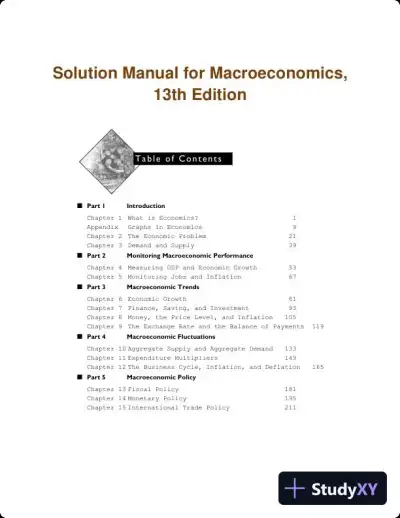 Textbook Guides
Solution Manual for Macroeconomics, 13th Edition
Biology
245 pages108downloadsFeb 2025 Textbook Guides
Solution Manual for Managerial Accounting, 6th Edition
Biology
929 pages100downloadsFeb 2025
Study this document with CramX
Once it is in your library, every tool can work from it.