

Test Bank For Ethics And The Conduct Of Business 8th Edition Test Bank
- Business Law
- 80 pages
- Shared February 2025
- 53 downloads
Test Bank For Ethics And The Conduct Of Business 8th Edition Test Bank offers detailed practice questions to sharpen your exam readiness. Download now!
Preview 25 of 80 pages
See the first 25 pages exactly as they appear in the document.
Page 1 Read page 1 as text
Instructor’s Manual and Test Bank for Boatright Ethics and the Conduct of Business Eighth Edition
Page 2 Page 3 Read page 3 as text
iii CONTENTS 1. Chapter One Ethics in the World of Business........................................................................................1 2. Chapter Two Ethical Decision Making...................................................................................................7 3. Chapter Three Ethical Theories...............................................................................................................13 4. Chapter Four Whistle-Blowing..............................................................................................................18 5. Chapter Five Trade Secrets and Conflict of Interest..............................................................................24 6. Chapter Six Privacy.............................................................................................................................30 7. Chapter Seven Discrimination and Affirmative Action...........................................................................35 8. Chapter Eight Employment Rights.........................................................................................................41 9. Chapter Nine Occupational Health and Safety.....................................................................................47 10. Chapter Ten Marketing, Advertising, and Product Safety..................................................................53 11. Chapter Eleven Ethics in Finance............................................................................................................58 12. Chapter Twelve Corporate Social Responsibility.....................................................................................63 13. Chapter Thirteen Corporate Governance and Accountability....................................................................68 14. Chapter Fourteen International Business Ethics…….................................................................................74
Page 4 Read page 4 as text
1 Chapter 1 Ethics in the World of Business Chapter Summary Business ethics is concerned with identifying and understanding the ethical issues that arise in business, along with the development of knowledge and skills needed by a practicing manager to address these issues and to make sound business decisions. Ethical issues are an inevitable element of business decision making, and they are deeply intertwined with managerial practice and economic activity in general. The success of individual managers, business organizations, and the whole economic system depend upon sound ethical decision making. Although economics and law are important guides for business decision making, they are not entirely sufficient. Organizational research conducted by psychologists and sociologists further show that the treatment of business ethics from a purely philosophical perspective is likewise an insufficient approach. Organizational misconduct is often the result of flaws in individual and organizational decision making that can be corrected only by changing the overall decision making process. Practicing managers can promote an ethical organizational culture by actively discouraging misconduct and rewarding ethical decision making and conduct. CHAPTER OBJECTIVES 1.1: Identify ethical issues created by diverse business situations and relationships and the level of decision making required to address them 1.2: Recognize the role of ethics in the conduct of business, with respect to economic principles and the law 1.3: Distinguish between ethical management and the management of ethics, and each of the three main roles of a manager 1.4: Analyze how ethical business conduct is challenged by decision making on individual and organizational levels SUGGESTED DISCUSSION PROMPTS 1. What types of ethical concerns do decision-makers at the management level need to take into account? 2. What types of ethical concerns do decision-makers at lower organizational levels need to take into account? 3. How would you respond to someone who says that a business should always do whatever is in its economic interests? 4. What is wrong with the thought that abiding by the law is all the ethics that a businessperson needs to worry about? 5. How does specialized knowledge come into play in the management of ethics?
Page 5 Read page 5 as text
2 ASSESSMENT FOR IN-CLASS USE Multiple Choice Questions Choose the BEST possible answer for each of the following. 1. In many cases, rules of business ethics can be determined by _________ . A. applicable laws B. company guidelines C. economic requirements D. rules of conduct that apply in everyday life Correct Answer: D 1.1: Identify ethical issues created by diverse business situations and relationships and the level of decision making required to address them Topic/Concept: Business Decision Making Difficulty Level: Easy Skill Level: Understanding 2. The economic character of business can be seen in its _________ . A. trading characteristics B. ethical dimensions C. personal aspects D. legal guidelines Correct Answer: A 1.1: Identify ethical issues created by diverse business situations and relationships and the level of decision making required to address them Topic/Concept: Business Decision Making Difficulty Level: Easy Skill Level: Understanding 3. Organization in business is characterized mainly by its ________ . A. rules B. hierarchy C. profits D. products Correct Answer: B 1.1: Identify ethical issues created by diverse business situations and relationships and the level of decision making required to address them Topic/Concept: Business Decision Making
Page 6 Read page 6 as text
3 Difficulty Level: Easy Skill Level: Understanding 4. Decision making in business occurs at various distinctive ________ . A. places B. levels C. objectives D. profits Correct Answer: B 1.1: Identify ethical issues created by diverse business situations and relationships and the level of decision making required to address them Topic/Concept: Business Decision Making Difficulty Level: Easy Skill Level: Understanding 5. If a business manager decides to proceed with a course of action although the manager has information that suggests the need to rethink the decision, the manager is being influenced by A. anchor heuristic B. confirmation bias C. sunk cost bias D. adjustment heuristic Correct Answer: C 1.4: Analyze how ethical business conduct is challenged by decision making on individual and organizational levels Topic/Concept: Ethics in Organizations Difficulty Level: Moderate Skill Level: Application 6. Economic reasoning describes how we _________. A. ought to reason B. prioritize our desires C. reason when pursuing our goals D. would reason if we could have whatever we wanted Correct Answer: C 1.2: Recognize the role of ethics in the conduct of business, with respect to economic principles and the law Topic/Concept: Ethics, Economics, and Law Difficulty Level: Easy Skill Level: Understanding
Page 7 Read page 7 as text
4 7. Adam Smith's economic theory is based on which of the following assumptions? A. People want to promote each others' interests. B. Morality is not relevant to economic concerns. C. Free markets will fix their own ethical problems. D. People will behave rationally as they pursue their interests. Correct Answer: D 1.2: Recognize the role of ethics in the conduct of business, with respect to economic principles and the law Topic/Concept: Ethics, Economics, and Law Difficulty Level: Moderate Skill Level: Analysis 8. What fact does the "ultimatum bargaining game" demonstrate? A. It is often rational to price products below their market value. B. Free markets will usually self-regulate. C. Many people do not understand economics. D. Many people would rather not trade than be treated unfairly. Correct Answer: D 1.2: Recognize the role of ethics in the conduct of business, with respect to economic principles and the law Topic/Concept: Ethics, Economics, and Law Difficulty Level: Moderate Skill Level: Analysis 9. The school of thought that says that law and ethics govern two different realms is wrong because ____________ A. ethics applies to every field of life B. anything that is legal is also ethical C. anything that is illegal is also unethical D. the law governs every aspect of life Correct Answer: A 1.2: Recognize the role of ethics in the conduct of business, with respect to economic principles and the law Topic/Concept: Ethics, Economics, and Law Difficulty Level: Easy Skill Level: Understanding 10. It is not ethically sufficient to obey the law because ___________ A. the law does not apply to business in general B. ethical constraints sometimes require that the law be ignored C. ethics goes beyond what can be legally codified
Page 8 Read page 8 as text
5 D. the law itself is stricter than ethics Correct Answer: C 1.2: Recognize the role of ethics in the conduct of business, with respect to economic principles and the law Topic/Concept: Ethics, Economics, and Law Difficulty Level: Moderate Skill Level: Application Essay Questions 1. Identify two dangers of rationalization which can lead an individual to make unethical decisions. 1.4: Analyze how ethical business conduct is challenged by decision making on individual and organizational levels Topic/Concept: Ethics in Organizations Difficulty Level: Moderate Skill Level: Analysis 2. Describe and explain an example of a business decision that would be unethical even though it is legal. 1.2: Recognize the role of ethics in the conduct of business, with respect to economic principles and the law Topic/Concept: Ethics, Economics, and Law Difficulty Level: Moderate Skill Level: Analysis 3. Examine one way in which a manager's role (job obligations) may conflict with his or her moral obligations. 1.3: Distinguish between ethical management and the management of ethics, and each of the three main roles of a manager Topic/Concept: Ethics and Management Difficulty Level: Moderate Skill Level: Analysis 4. What is wrong with the thought that abiding by the law is all the ethics that a businessperson needs to worry about? 1.2: Recognize the role of ethics in the conduct of business, with respect to economic principles and the law Topic/Concept: Ethics, Economics, and Law
Page 9 Read page 9 as text
6 Difficulty Level: Moderate Skill Level: Evaluation 5. How does specialized knowledge come into play in the management of ethics? 1.3: Distinguish between ethical management and the management of ethics, and each of the three main roles of a manager Topic/Concept: Ethics and Management Difficulty Level: Moderate Skill Level: Analysis
Page 10 Read page 10 as text
7 Chapter 2 Ethical Decision Making CHAPTER SUMMARY Ethical decision making in business is often difficult and complex. Some situations are easily handled because what one ought to do or what is right and wrong are evident. Those situations that give us pause or produce moral anguish require careful thought and ultimately an ability to engage in ethical reasoning. This chapter contributes to an understanding of ethical decision making by offering a division of business ethics into two parts: an ethics of the market and an ethics of roles and relationships, including firms. In business, we deal with some parties purely as market actors who are on the other side of a market transaction or exchange. For such market activity, certain moral rules or standards apply. These relationships are governed by professional ethics, a prime example being the legal profession. In addition to the law, an attorney must follow professional codes of ethics established by the state bar and/or professional association he or she belongs to. These codes can impose a greater obligation to act in the best interests of the client. For example, the attorney- client relationship imposes on the attorney a duty to avoid conflicts of interests, to protect client property, and to closely guard confidential information. Other professional relationships involving business dealings can also take the form of an agency. These relationships are built on trust and confidence so the principal’s interests must be protected. The agent owes the principal a duty of loyalty to act in the principal’s best interest in all business dealings involving the agency. When we attempt to think through the ethical issues that arise in business, we are engaging in ethical reasoning, which may be conducted on different levels. Ethical theories, which are presented in the next chapter, can guide ethical reasoning on the highest level by providing the most comprehensive and fundamental grounds for our moral beliefs and judgments. Fortunately, substantial moral arguments that do not require an understanding of these theories can be constructed. Most of our everyday ethical reasoning employs familiar ethical concepts and principles that can be readily understood and applied. Accordingly, this chapter provides a framework of seven basic ethical principles that are sufficient for most business decision making. For those who seek more, though, the next chapter provides a survey of the main philosophical theories of ethics. CHAPTER OBJECTIVES 2.1: Recognize the features of the market system, the ethics of market transactions, and the problems created by imperfect market conditions 2.2: Identify the duties and obligations associated with fundamental business roles and relationships in markets and firms 2.3: Describe the philosophical and psychological approaches to ethical reasoning and the principles that constitute a moral framework for business conduct
Page 11 Read page 11 as text
8 SUGGESTED DISCUSSION PROMPTS 1. What is ethically required of participants in a market economic system? 2. In what ways do participants in a market system have to depend upon each other? 3. In what ways do ethical considerations work against perfect operation of a market economy? 4. How does the prisoner’s dilemma reflect the limitations of a free market system? 5. What capacities are required of an agent to engage in ethical reasoning? ASSESSMENT FOR IN-CLASS USE Multiple Choice Questions Choose the BEST possible answer for each of the following. 1. A market economy is based fundamentally on ____. A. ethical motivations B. the profit motive C. human welfare D. manufacturing Correct Answer: B 2.1: Recognize the features of the market system, the ethics of market transactions, and the problems created by imperfect market conditions Topic/Concept: Market Ethics Difficulty Level: Easy Skill Level: Understanding 2. A market with perfect competition would require . A. agents to not be rational B. that there be no contracts C. that ethics not be necessary D. ethical guidelines to be legally codified Correct Answer: C 2.1: Recognize the features of the market system, the ethics of market transactions, and the problems created by imperfect market conditions Topic/Concept: Market Ethics Difficulty Level: Easy Skill Level: Understanding 3. Fraud is unethical because ______. A. all parties must have access to pertinent information B. no one may be permitted to profit too much C. market economies require freedom of action
Page 12 Read page 12 as text
9 D. the market requires everyone to further their own interests Correct Answer: A 2.1: Recognize the features of the market system, the ethics of market transactions, and the problems created by imperfect market conditions Topic/Concept: Market Ethics Difficulty Level: Easy Skill Level: Understanding 4. The difference between Homo economicus and actual people is that . A. Homo economicus is capable of making any decision B. Homo economicus pursues many different interests C. actual people pursue their own self-interest D. actual people are less than perfectly rational Correct Answer: D 2.1: Recognize the features of the market system, the ethics of market transactions, and the problems created by imperfect market conditions Topic/Concept: Market Ethics Difficulty Level: Moderate Skill Level: Analysis 5. A market economy alone cannot sustain public goods because . A. no one would want to take advantage of public goods B. people would be free riders if they could be C. people would try to sell each other public goods D. participants in a market economy are imperfectly rational Correct Answer: B 2.1: Recognize the features of the market system, the ethics of market transactions, and the problems created by imperfect market conditions Topic/Concept: Market Ethics Difficulty Level: Moderate Skill Level: Application 6. Market outcomes lead to unequal outcomes mainly because ______. A. it involves random processes B. participants have differing levels of skill C. free markets are inherently unjust D. there is government interference Correct Answer: B 2.1: Recognize the features of the market system, the ethics of market transactions, and the problems created by imperfect market conditions
Page 13 Read page 13 as text
10 Topic/Concept: Market Ethics Difficulty Level: Moderate Skill Level: Analysis 7. A fiduciary has the special responsibility to _________. A. care for another’s financial interests B. sell goods as efficiently as possible C. provide as much information as possible D. take a professional interest in another’s success Correct Answer: A 2.2: Identify the duties and obligations associated with fundamental business roles and relationships in markets and firms Topic/Concept: Roles, Relationships, and Firms Difficulty Level: Easy Skill Level: Understanding 8. Professions have a contract with society whereby they _____ in exchange for sharing the many benefits of their specialized knowledge. A. submit to total government regulation B. relinquish control over their work C. forgo licensing requirements D. are granted self-regulation Correct Answer: D 2.2: Identify the duties and obligations associated with fundamental business roles and relationships in markets and firms Topic/Concept: Roles, Relationships, and Firms Difficulty Level: Easy Skill Level: Understanding 9. From a traditional economic point of view, a firm was viewed as _____ which sought to maximize its profits. A. a combination of markets and relationships B. a series of relationships, roles, and markets C. a moral actor D. a market actor Correct Answer: D 2.2: Identify the duties and obligations associated with fundamental business roles and relationships in markets and firms Topic/Concept: Roles, Relationships, and Firms Difficulty Level: Easy Skill Level: Understanding
Page 14 Read page 14 as text
11 10. The ethical concept of dignity most centrally involves . A. treating all persons equally B. disclosing all information that is needed by others C. recognizing the intrinsic value of persons or other entities D. behaving with high standards of virtue Correct Answer: C 2.3: Describe the philosophical and psychological approaches to ethical reasoning and the principles that constitute a moral framework for business conduct Topic/Concept: Ethical Reasoning Difficulty Level: Easy Skill Level: Understanding Essay Questions 1. What are the basic components of a market system, and what assumptions are made about human behavior? 2.1: Recognize the features of the market system, the ethics of market transactions, and the problems created by imperfect market conditions Topic/Concept: Market Ethics Difficulty Level: Moderate Skill Level: Application 2. What is the difference between a fiduciary and an agent? What special obligations are characteristic of a fiduciary that is not an agent? 2.2: Identify the duties and obligations associated with fundamental business roles and relationships in markets and firms Topic/Concept: Roles, Relationships, and Firms Difficulty Level: Moderate Skill Level: Analysis 3. What are the required components of the moral point of view, and how are they exercised in a business setting? 2.3: Describe the philosophical and psychological approaches to ethical reasoning and the principles that constitute a moral framework for business conduct Topic/Concept: Ethical Reasoning Difficulty Level: Moderate Skill Level: Analysis 4. What are some basic questions that should be asked when making a decision that poses an ethical dilemma?
Page 15 Read page 15 as text
12 2.3: Describe the philosophical and psychological approaches to ethical reasoning and the principles that constitute a moral framework for business conduct Topic/Concept: Ethical Reasoning Difficulty Level: Moderate Skill Level: Application 5. Describe "context" and how it affects ethics and the decision-making process. 2.3: Describe the philosophical and psychological approaches to ethical reasoning and the principles that constitute a moral framework for business conduct Topic/Concept: Ethical Reasoning Difficulty Level: Easy Skill Level: Understanding
Page 16 Read page 16 as text
13 Chapter 3 Ethical Theories CHAPTER SUMMARY This chapter presents the main concepts and theories of ethics developed over centuries by major moral philosophers. The value of any theory for business ethics is its usefulness in evaluating business practices, institutional arrangements, and economic systems. Teleological theory examines the outcome stemming from a decision or behavior. Deontological theory is more concerned with the actual decision or behavior but not with the consequence stemming from the decision or behavior. In general, all of these theories justify most prevailing business practices, the institution of the modern corporation, and capitalism or the market system, but they also provide the basis for some criticism and improvement. In the subsequent chapters, this theoretical foundation is used to explore a wide range of practical business ethics topics. CHAPTER OBJECTIVES 3.1: Describe the four theses of classical utilitarianism, the utilitarian approach to decision making, and the main criticisms of the cost-benefit analysis method 3.2: Summarize the two intuitive principles of Kantian ethics and their implications for moral reasoning 3.3: Define virtue and explain how virtues and principles of virtue ethics are relevant to business 3.4: Identify the meaning and importance of rights and the types of rights that apply in different situations 3.5: Explain the role of justice in business ethics, the three kinds of justice outlined by Aristotle, and the contemporary principles of justice offered by Rawls and Nozick SUGGESTED DISCUSSION PROMPTS 1. What would an act utilitarian and a rule utilitarian say differently when evaluating the same case? 2. What specific problem is posed to utilitarianism by its economic application? 3. What is the major contrast between utilitarianism and Kantian ethics? 4. What are the attractive features of virtue theory? What are its limitations in application to business? 5. In what ways is the rights and justice perspective a fitting ethical theory for business ethics?
Page 17 Read page 17 as text
14 ASSESSMENT FOR IN-CLASS USE Multiple Choice Questions Choose the BEST possible answer for each of the following. 1. What does the P&G case show about the applicability of ethics to business? A. When a company makes unethical decisions, it is usually breaking the law. B. Ethics in business applies differently from how it does in the rest of the world. C. A company’s behavior many be unethical even if no harm is done. D. A company’s ethical decisions should always affect its bottom line. Correct Answer: C 3.1: Describe the four theses of classical utilitarianism, the utilitarian approach to decision making, and the main criticisms of the cost-benefit analysis method Topic/Concept: Utilitarianism Difficulty Level: Easy Skill Level: Understanding 2. Teleological theories of ethics locate goodness in _____. A. the outcome of actions B. the intentions of the agent C. the obligations of people to each other D. the maximization of economic opportunity Correct Answer: A 3.1: Describe the four theses of classical utilitarianism, the utilitarian approach to decision making, and the main criticisms of the cost-benefit analysis method Topic/Concept: Utilitarianism Difficulty Level: Easy Skill Level: Understanding 3. Rule utilitarianism favors rules that _____. A. always benefit the most people B. everyone agrees with C. utilitarians think are good rules D. would maximize goodness if everyone followed them Correct Answer: D 3.1: Describe the four theses of classical utilitarianism, the utilitarian approach to decision making, and the main criticisms of the cost-benefit analysis method. Topic/Concept: Utilitarianism Difficulty Level: Easy Skill Level: Understanding
Page 18 Read page 18 as text
15 4. What is the most fundamental drawback of having cost-benefit analyses serve as the basis for ethical decisions in business? A. Some things do not really have value. B. A determinate value must be placed on things that have incalculable value. C. Cost-benefit analyses are time-consuming and require specialized skill. D. Cost-benefit analyses require a commitment to consequentialism. Correct Answer: B 3.1: Describe the four theses of classical utilitarianism, the utilitarian approach to decision making, and the main criticisms of the cost-benefit analysis method Topic/Concept: Utilitarianism Difficulty Level: Easy Skill Level: Understanding 5. A “maxim,” according to Kant’s terminology, is ____. A. the outcome of an action B. the reason that one undertakes an action C. the moral principle that one has in mind D. that which would make an action moral Correct Answer: B 3.2: Summarize the two intuitive principles of Kantian ethics and their implications for moral reasoning Topic/Concept: Kantian Ethics Difficulty Level: Easy Skill Level: Understanding 6. Kant’s rule requiring respect for persons asks that we ________. A. not use people as means to an end B. view each person as a moral agent C. view each person as an end unto himself D. only use another person if we have sufficient reason for doing so Correct Answer: C 3.2: Summarize the two intuitive principles of Kantian ethics and their implications for moral reasoning Topic/Concept: Kantian Ethics Difficulty Level: Easy Skill Level: Understanding 7. Virtue ethics defines a moral action as that which ______. A. a wise person would do B. leads to the most virtue overall C. is done with the most virtuous intentions
Page 19 Read page 19 as text
16 D. is done according to the proper rules Correct Answer: A 3.3: Define virtue and explain how virtues and principles of virtue ethics are relevant to business Topic/Concept: Virtue Ethics Difficulty Level: Easy Skill Level: Understanding 8. A drawback to theorizing about business ethics in terms of rights is that __. A. not everyone has rights B. people’s rights may conflict C. it is hard to draw the line between different types of rights D. conceptions of rights differ between cultures Correct Answer: B 3.4: Identify the meaning and importance of rights and the types of rights that apply in different situations Topic/Concept: Rights Difficulty Level: Easy Skill Level: Understanding 9. The notion of justice is most basically concerned with __________. A. fairness B. equality C. rights D. economics Correct Answer: A 3.5: Explain the role of justice in business ethics, the three kinds of justice outlined by Aristotle, and the contemporary principles of justice offered by Rawls and Nozick Topic/Concept: Justice Difficulty Level: Easy Skill Level: Understanding Essay Questions 1. In what ways is the need to calculate utility a problem for utilitarianism? 3.1: Describe the four theses of classical utilitarianism, the utilitarian approach to decision making, and the main criticisms of the cost-benefit analysis method Topic/Concept: Utilitarianism Difficulty Level: Moderate Skill Level: Analysis
Page 20 Read page 20 as text
17 2. What is Kant’s categorical imperative? Explain its two formulations. 3.2: Summarize the two intuitive principles of Kantian ethics and their implications for moral reasoning Topic/Concept: Kantian Ethics Difficulty Level: Easy Skill Level: Understanding 3. Describe how rights and justice can be explained in terms of one another. 3.4: Identify the meaning and importance of rights and the types of rights that apply in different situations Topic/Concept: Rights Difficulty Level: Moderate Skill Level: Analysis 4. What is virtue? Explain how principles of virtue ethics are relevant to business. 3.3: Define virtue and explain how virtues and principles of virtue ethics are relevant to business Topic/Concept: Virtue Ethics Difficulty Level: Easy Skill Level: Understanding 5. Explain the contemporary justice principles according to Rawls and Nozick. 3.5: Explain the role of justice in business ethics, the three kinds of justice outlined by Aristotle, and the contemporary principles of justice offered by Rawls and Nozick Topic/Concept: Justice Difficulty Level: Easy Skill Level: Understanding
Page 21 Read page 21 as text
18 Chapter 4 Whistle-Blowing CHAPTER SUMMARY Whether or not to blow the whistle on misconduct in an organization is one of the most difficult decisions that some people will ever have to make. The decision is wrenching personally because the stakes are so high. Yet many whistle-blowers say that they could not have lived with themselves if they had stayed silent. The decision is also difficult ethically, because whistle-blowing involves a conflict between two competing duties: to protect the public and to be loyal to an organization. Although loyalty is not always overriding, as the loyal agent argument holds, neither is it inconsequential. Deciding between these duties often requires that an employee exercise very careful judgment. The one certain conclusion of this chapter is that whistle-blowing is ethically permissible under certain carefully specified conditions. (Whether it can ever be ethically required is a different question that seldom arises. Everyone has an obligation not to be a part of illegal and immoral activity, but exposing it at great risk to oneself is usually regarded as beyond what duty requires.) Blowing the whistle is only one response that an employee can make to report misconduct; however, the act of whistle-blowing itself can take on many different forms. So in addition to deciding whether to become a whistle-blower, employees are faced with the further question of how to blow the whistle in a justified manner. Finally, it is evident that employees who are justified in blowing the whistle ought not to suffer retaliation. What ought to be done to protect whistle-blowers from this fate is less clear. A plausible case can be made for legislation in this area, but the difficulty is drafting laws that achieve the desired result without interfering unduly in the legitimate conduct of business. CHAPTER OBJECTIVES 4.1: Define the significance of whistle-blowing and the act itself according to seven criteria 4.2: Assess situations where whistle-blowing may or may not be justified, given the duties and obligations of all parties and the potential consequences of the act 4.3: Describe the characteristics and importance of laws designed to protect whistle- blowers and key points in the debate over the moral justification of these laws 4.4: Identify the importance of developing an effective whistle-blowing policy for an organization and the key components of such a policy SUGGESTED DISCUSSION PROMPTS 1. Why do employees want to blow the whistle? 2. Do employers have valid reasons to frown on whistle-blowing? 3. What must employees do to ensure that they blow the whistle properly? 4. What are the objectives of legal protection for whistle-blowers? 5. Why would a company develop a whistle-blowing policy?
Page 22 Read page 22 as text
19 ASSESSMENT FOR IN-CLASS USE Multiple Choice Questions Choose the BEST possible answer for each of the following. 1. A whistle-blower is primarily motivated by _. A. retaliation B. ethical concern C. personal gain D. fear of retribution Correct Answer: B 4.1: Define the significance of whistle-blowing and the act itself according to seven criteria Topic/Concept: What Is Whistle-Blowing? Difficulty Level: Easy Skill Level: Understanding 2. Which of the following is necessary for whistle-blowing to occur? A. information B. legal protection C. a nondisclosure agreement D. managing authority Correct Answer: A 4.1: Define the significance of whistle-blowing and the act itself according to seven criteria Topic/Concept: What Is Whistle-Blowing? Difficulty Level: Easy Skill Level: Understanding 3. Some corporations have an ombudsman, whose role is to . A. blow the whistle B. release information to the public C. report on employees D. hear complaints Correct Answer: D 4.1: Define the significance of whistle-blowing and the act itself according to seven criteria Topic/Concept: What Is Whistle-Blowing? Difficulty Level: Easy Skill Level: Understanding
Page 23 Read page 23 as text
20 4. Why is the loyal agent argument supported by the law? A. The argument is supported because of the agent dictates the principal's job duties. B. The argument is supported because the agent is morally but not contractually obligated to follow the principal's directions. C. The argument is supported because the agent is not an employee of the principal. D. The argument is supported because the agent is contractually obligated to perform his or her duty. Correct Answer: D 4.2: Assess situations where whistle-blowing may or may not be justified, given the duties and obligations of all parties and the potential consequences of the act Topic/Concept: Justification of Whistle-Blowing Difficulty Level: Easy Skill Level: Understanding 5. The two Challenger spacecraft engineers who were concerned about possible O- ring failure were unsuccessful at whistleblowing because they ________. A. tried to resolve the matter internally at Morton Thiokol B. refused to use Morton Thiokol internal channels to address the matter C. did not document problems with the O-ring D. opted to contact the press before speaking with their superiors about potential problems with the O-ring Correct Answer: A 4.2: Assess situations where whistle-blowing may or may not be justified, given the duties and obligations of all parties and the potential consequences of the act Topic/Concept: Justification of Whistle-Blowing Difficulty Level: Easy Skill Level: Understanding 6. Loyalty to a corporation can sometimes lead to whistleblowing if _____. A. the corporation is a large one B. the whistleblower enjoys legal protection C. the whistleblower wants to see change in the corporation D. the government is paying the employee for the information Correct Answer: C 4.2: Assess situations where whistle-blowing may or may not be justified, given the duties and obligations of all parties and the potential consequences of the act Topic/Concept: Justification of Whistle-Blowing Difficulty Level: Easy Skill Level: Understanding
Page 24 Read page 24 as text
21 7. Employees who are most upset with a company will most often _____. A. write to the CEO B. simply leave the company C. go public with their complaints D. hope the company will reform from within Correct Answer: B 4.2: Assess situations where whistle-blowing may or may not be justified, given the duties and obligations of all parties and the potential consequences of the act Topic/Concept: Justification of Whistle-Blowing Difficulty Level: Easy Skill Level: Understanding 8. The main motivation for there to be whistleblower-protection laws is that whistleblowers _______ . A. represent a minority B. are likely to be oppressed C. benefit society D. should enjoy freedom of speech Correct Answer: C 4.3: Describe the characteristics and importance of laws designed to protect whistle- blowers and key points in the debate over the moral justification of these laws Topic/Concept: Right to Blow the Whistle Difficulty Level: Easy Skill Level: Understanding 9. The main reason that companies should have a whistle-blowing policy is that . A. it avoids tension and strife B. whistle-blowing helps business C. it enhances employee satisfaction D. wrongdoing harms them Correct Answer: D 4.4: Identify the importance of developing an effective whistle-blowing policy for an organization and the key components of such a policy Topic/Concept: Developing a Policy Difficulty Level: Easy Skill Level: Understanding 10. All whistle-blowing policies should include _____. A. a guarantee against retaliation B. a guarantee of continued employment C. a way for employees to go public
Page 25 Read page 25 as text
22 D. specific monetary awards Correct Answer: A 4.4: Identify the importance of developing an effective whistle-blowing policy for an organization and the key components of such a policy Topic/Concept: Developing a Policy Difficulty Level: Easy Skill Level: Understanding Essay Questions 1. Describe ways in which employers can deal with potential cases of whistle- blowing. How do they further their interests in this regard? 4.2: Assess situations where whistle-blowing may or may not be justified, given the duties and obligations of all parties and the potential consequences of the act Topic/Concept: Justification of Whistle-Blowing Difficulty Level: Moderate Skill Level: Evaluation 2. Explain the ironic dimension of whistle-blowing with respect to employee loyalty. 4.2: Assess situations where whistle-blowing may or may not be justified, given the duties and obligations of all parties and the potential consequences of the act Topic/Concept: Justification of Whistle-Blowing Difficulty Level: Easy Skill Level: Understanding 3. Describe the pros and cons of legal protection for whistle-blowing. 4.3: Describe the characteristics and importance of laws designed to protect whistle- blowers and key points in the debate over the moral justification of these laws Topic/Concept: Right to Blow the Whistle Difficulty Level: Moderate Skill Level: Analysis 4. Describe the criteria for whistle-blowing. 4.1: Define the significance of whistle-blowing and the act itself according to seven criteria Topic/Concept: 4.1: What Is Whistle-Blowing? Difficulty Level: Easy Skill Level: Understanding
55 more pages in the full document
Unlock it once and it stays in your library, ready to chat with or turn into flashcards.
Unlock the full documentMore Business Law study materials
See all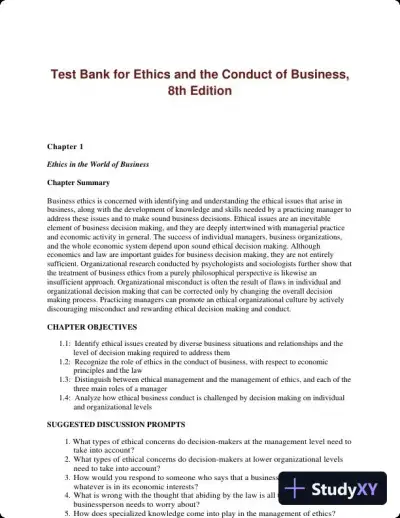 Exam Guides
Test Bank for Ethics and the Conduct of Business, 8th Edition
Business Law
81 pages119downloadsFeb 2025 Textbook Guides
Quantitative Methods For Business, 12th Edition Solution Manual
Business Law
469 pages51downloadsFeb 2025 Exam Guides
Ethics And The Conduct Of Business, 7th Edition Test Bank
Business Law
49 pagesMay 2025 Exam Guides
Employment And Labor Law, 9th Edition Test Bank
Business Law
349 pages146downloadsFeb 2025 Textbook Guides
Solution Manual for Smith and Roberson's Business Law, 18th Edition
Business Law
572 pages136downloadsFeb 2025 Exam Guides
Test Bank for Contract Law for Paralegals: Traditional and e-Contracts, 3rd Edition
Business Law
458 pages65downloadsFeb 2025 Exam Guides
Real Estate Principles: A Value Approach (The Mcgraw-hill/Irwin Series in Finance, Insurance, and Real Estate) 3rd Edition Test Bank
Business Law
209 pages37downloadsFeb 2025- Solved AssignmentsSolved Assignments
Commercial Law Assignment 1-1
Business Law
8 pagesJun 2025
Study this document with CramX
Once it is in your library, every tool can work from it.