

Class Notes for Strategic Management and Competitive Advantage: Concepts and Cases, 6th Edition
- Business Management
- 261 pages
- Shared February 2025
- 107 downloads
Class Notes for Strategic Management and Competitive Advantage: Concepts and Cases, 6th Edition helps you review course material quickly and effectively.
Preview 31 of 261 pages
See the first 31 pages exactly as they appear in the document.
Page 1 Read page 1 as text
Strategic Management and Competitive Advantage: Concepts and Cases Sixth Edition Jay B. Barney William S. Hesterly Instructor’s Resource Manual for Strategic Management and Competitive Advantage By: Ram Subramanian
Page 2 Page 3 Read page 3 as text
1 What Is Strategy and the Strategic Management Process? GETTING TO KNOW YOUR STUDENTS Chapter 1 and the accompanying class session will set the tone for the course. As such, this class session should be viewed as a bit of a sales job. Students that have spent time in the functional disciplines (finance, accounting, marketing, operations, etc.) sometimes view strategy as a fuzzy or touchy-feely class that is somehow less important than their functional discipline classes. Students also tend to view strategy as something that will matter 20 years down the road, but not in the immediate future. This is your opportunity to disabuse them of these ideas. This session can change minds and develop an enthusiasm among students that will lead to an enjoyable, informative semester for everyone involved. We have found that a brief discussion aimed at establishing shared expectations and a convincing story will usually win over any skeptics in the class. More than once we have had students approach us after the first day and say, “Wow! This class is going to be so different and so much better than we expected.” The Teaching Points section below and the example that follows offer some helpful suggestions. Teaching Points • Ask students what they have heard about your strategy class. • Ask students what they expect to learn about in your class. • Students will often connect strategy with sports, war, and/or chess. • Explain that strategy in the game of chess is all about positioning your own pieces to gain advantage. The most advantageous positioning depends on the current positioning of your own pieces, the current positioning of your opponent’s pieces, the expected future positioning of your opponent’s pieces, and the desired future positioning of your own pieces. Therefore, one needs to understand the implications of current positioning and have an idea of what positioning the opponent is likely to adopt in the future. • Explain to students that managing a firm is somewhat like playing chess. The resources of the firm are like the pieces of a chess set. Explain that this class will be about positioning the resources of the firm with a view toward
Page 4 Read page 4 as text
Chapter 1: What is Strategy and the Strategic Management Process? 2 gaining competitive advantage and earning superior economic returns. Explain that you will take them through several models of analysis that will look at the positioning of competitors, suppliers, customers, etc. Positioning of the focal firm’s own resources will be a central theme throughout the several models presented during the semester. INTRODUCTION TO THE STRATEGY COURSE We suggest beginning the class with an example of how a change in strategy can bring about tremendous change in the economic performance of companies. ► Example: How Eisner Reinvented the Disney Empire In 1984, Disney’s stock price had been flat for a decade. Earnings per share were only $0.06. Disney had profits that year of $242 million. By this point in time Disney had become primarily a theme park company. Seventy seven percent of its profits came from theme park operations that year. Twenty two percent of profits came from consumer products (licensing Mickey Mouse, Donald Duck, etc.). Only one percent of profits came from filmed entertainment in 1984. Indeed, Disney had become a different company from what Walt Disney and his brother Roy O. Disney left behind. In 1971 when Roy O. Disney died (he became CEO when Walt died in 1966), 50% of the company’s profits came from filmed entertainment. T he Disney board was dissatisfied with the firm’s direction and its financial performance. Michael Eisner was hired as the CEO of Disney in 1984. He had extensive experience in the entertainment industry including a stint as the president of Paramount Pictures. Eisner recognized the value of both the filmed entertainment legacy of the firm and the theme park operations that had been developed by that time. Eisner soon focused on the animation and movie studios. He also opened the Disney vault to explo it the relatively untapped value of Disney’s animated classics. Profits from filmed entertainment went from about $2.4 million in 1984 to $845 million in 1994. Eisner spent considerable time during the early days of his tenure touring the theme parks to see what the company really had. He decided to upgrade the theme parks and increase admission prices. Profits from the theme parks went from $186 million in 1984 to $688 million in 1994. Consumer products went from profits of $53 million in 1984 to $433 million in 1994, a natural result of the success of the company’s filmed entertainment and theme park operations. The impressive part of these changes and results is that Eisner, to quite an extent, used resources that Disney already possessed such as animation and live studios. Animators were challenged to create new and exciting content — something that had not happened in a long time. Some of the Disney classics pulled from the vault were converted to the VHS format and distributed to the home market. It’s true that the timing of the advent of the VHS format and the proliferation of home video was fortunate for Disney. But, it’s also true that Eisner deployed the resources of Disney in a
Page 5 Read page 5 as text
Chapter 1: What is Strategy and the Strategic Management Process? 3 different way from how they had been used in the years leading up to 1984. Disney ’s animators created The Little Mermaid in 1989 that had box office receipts of $83.5 million. It won an Oscar. Beauty and the Beast was released in 1991, setting new box office records for an animated film ($145.8 million). The Lion King came out in 1994 and has had box office sales of over $328.5 million and has sold over 30 million copies in the home video market. All three of these animated films did extremely well at the box office, the video store, and the toy store. In time, Eis ner also diversified the firm’s portfolio extensively. Disney bought ABC television, which included ESPN, hotels, professional sports teams (Anaheim Angels and the Mighty Ducks), a cruise ship, and developed a chain of retail stores. Licensing of Disney characters, old and new, was aggressively expanded. In the early 1990s, Disney characters were a common and highly prized toy included in kids’ meals at fast food restaurants and as prizes in breakfast cereal boxes. From 1984 to 1994, Disney’s market cap italization increased from $2 billion to $28 billion. Now that’s strategy! The Disney story is not so stellar during the second half of Eisner’s 20-year reign at Disney. Eisner battled with disenchanted board members and executives, most notably, Roy Disney who coincidentally was instrumental in hiring Eisner in 1984. Earnings per share peaked in 1997 at $0.95 and dipped to $-0.02 in 2001. Critics contended that the reason for the decline in performance was that Eisner had pushed out executives and board members that provided checks and balances to his power. Disney’s failed relationship with Pixar is often cited as a contributing factor to Disney’s woes. Other reasons for the decline were clearly outside Eisner’s control. The terrorist attacks of Sept. 11, 2001, kept people away from theme parks, especially foreign visitors. After Eisner’s departure in late 2005, Bob Iger took over. Under Iger, Disney’s revenues and net income have risen steadily over the years and were $55.6 billion and $9.4 billion, respectively, in fiscal year 2016. (Huey & McGowan, Fortune 4/17/1995, 131(7): 44-55; Wessel, Orlando Sentinel, March 15, 2004; Yahoo Finance accessed on August 22, 2017). Slide 1-2 Use this slide to explain to students that the Walt Disney Company had been implementing a strategy for several years that was very different from the company we know today. The company’s strategy through the late seventies and early eighties was also different from what Walt Disney himself left behind. The board knew the company needed a strategic change. Slide 1-3 Tell students that Eisner joined the company and began to make changes. Point out that the changes he made in theme parks and filmed entertainment were changes in the use of existing company assets. Mos t of what he did was a matter of using firm resources in new and different ways. Highlight the financial results of changes made in theme parks and
Page 6 Read page 6 as text
Chapter 1: What is Strategy and the Strategic Management Process? 4 filmed entertainment. The diversification efforts described in point 3 involved acquiring new resources fo r the firm. Taken together, these strategic changes led to phenomenal growth in the market capitalization of Walt Disney. I like to finish this slide by pointing to the screen with these actions and results and saying, “Now That’s Strategy!” DEFINING STRATEGY Define Strategy and Describe the Strategic Management Process Strategy is a firm’s theory about how to gain competitive advantage. While many other definitions of strategy refer to a plan or a set of coordinated actions, we take the definition back to the theoretical level that would influence the creation of any such plan or set of actions. You will see as the course unfolds that such a definition is very helpful in getting students to think about why a particular strategy would make sense for a particular firm in a particular set of circumstances. Slide 1-4 Use this slide to talk about the definition of strategy. Pose the questions suggested below in the teaching points section and then offer the final text block about what Eisner’s ‘theory ’ may have been. Teaching Points • Ask students what they think Michael Eisner’s theory about how to gain competitive advantage may have been. • Eisner’s theory seems to have been that people would be willing to pay a premium price for extraordinary entertainment. He recognized that Disney had the necessary resources to create extraordinary entertainment. • Herb Kelleher, a founder and CEO of Southwest Airlines, seems to have had a different theory about how to gain competitive advantage. His theory was that people would be willing to fly instead of driving, taking a bus, or taking a train if the price could be made affordable. He also theorized that a certain part of the market would prefer to pay a lower price and fly without some of the usual perks of air travel, like meals and reserved seats. • Both of these theories, and many others, can lead to competitive advantage depending on circumstances, strategic insight, and strategic implementation. Slide 1-5 Use this slide to take students through the teaching p oints below. THE STRATEGIC MANAGEMENT PROCESS Important Point: Students must understand that strategic management is a process. Learning Objective 1 .1
Page 7 Read page 7 as text
Chapter 1: What is Strategy and the Strategic Management Process? 5 Teaching Points • Explain to students that the course is designed to teach them a process. This will help manage expectations about the course. • Explain that each element of the framework is linked to every other element of the process framework. • Explain that students should take the long view — at the end of the semester each element of the model will make more sense than it does on the day they see it for the first time. • Show the slide of the whole model and explain that you will be taking them through each element of the model. • Refer back to the Disney example and explain that Eisner went through a process — it may not have been exactly this process. The point is that Eisner did not instantly decide to upgrade the theme parks. He went through a process of analysis before he came to the conclusion that updating the theme parks and increasing the admission price would likely lead to higher profits. Slide 1-6 Explain to students that the mission of the firm should inform all other parts of the strategic management process. Objectives should flow from the mission. External and internal analysis should be do ne with an appreciation for the firm’s mission. Strategic choices should reflect the mission. Strategic implementation should be done with the mission of the firm in mind. Finally, the competitive advantage a firm possesses should be a reflection of the firm’s mission. Mission. The text covers mission statements extensively; therefore, we suggest using class time to reinforce the following: • A firm’s ultimate ability to achieve competitive advantage is inextricably tied to its mission. • A firm’s mission is its raison d’etre (reason for existence). • The mission should inform every other segment of analysis throughout the process. Example: After short, but very successful careers in investment banking, two sisters started a shoe company. One of the sisters had worked on a merger between two shoe manufacturers. Their father had been a steel worker whose feet were badly injured in an industrial accident. These sisters were anxious to start a firm that had significant meaning to them. The mission of their new firm was “to provide the safest, highest quality shoes to the steel construction industry.” As you might imagine, they were passionate about the mission of their new firm: Steelcon Shoes. Discussion & Activity This discussion will help stu dents see how important the mission of an organization is. Ask students to identify the mission of a firm they recognize.
Page 8 Read page 8 as text
Chapter 1: What is Strategy and the Strategic Management Process? 6 Call on several students and list the companies they have identified along with a descriptive word or two about the mission of the f irm. Then ask students how the missions of the firms they have mentioned would influence the strategy of those firms. Try to draw out of the students some positive influences and some negative influences. Ask students if they think these firms could eas ily change what they do and how they do it given their respective missions. Slide 1-7 Use this slide to show how objectives should flow from the mission of the firm and influence the other elements of the strategic management process. Refer to the St eelcon example. Steelcon’s mission is ‘to provide the safest, highest quality shoes to the steel construction industry,’ but one of the firm’s objectives is to ‘establish relationships with the locals of the United Metal Workers Union in major U.S. cities. ’ Objectives. Objectives naturally flow from the miss ion or raison d’etre of firms. Objectives are specific, measurable targets that a firm needs to reach in order to carry out its mission. Emphasize that: • the mission and objectives of a firm should serve as the basis or background for the strategic management process. • a firm’s mission and objectives should inform the analysis done in every other segment of the model. • students should include a discussion of a firm’s mission and objectives in case analyses and in their written work to help ensure that they do not arrive at suggestions that are in conflict with the firm’s mission and objectives . External and Internal Analysis. The next steps in the strategic management process are external and internal analysis. At this point, it is best to: • offer a brief description of these two types of analyses • external analysis – a systematic examination of the environment in which the firm operates (phenomena external to the firm) • internal analysis – a systematic examination of a firm’s resources and capabilities (phenomena occurring within the firm) • emphasize that external and internal analysis enable a firm to make appropriate strategic choices. External and internal analysis are intended to enable managers to recognize sources of possible competitive advantage by identifying unmet needs, broadly defined, in the external environment and the firm’s abilities to meet those needs (internal analysis). Example: Steelcon Shoes goes through an analysis of the external environment and its internal environment (resources) whenever it considers introducing a new line of shoes. This analysis helps them identify opportunities and threats in the external environment to which they should pay attention. It also helps them to recognize what strengths and weaknesses they have as a firm.
Page 9 Read page 9 as text
Chapter 1: What is Strategy and the Strategic Management Process? 7 Slide 1-8 Explain that external and internal analys i s are critical steps in helping a firm determine what its theory will be regarding how to achieve competitive advantag e. External analysis helps the firm see threats and opportunities in the business environment. Internal analysis helps the firm see the strengths and weaknesses of the firm. Short lists of the types of things managers look for in each type of analysis a re offered. Strategic Choice. Strategic choice is the point in the process where managers choose how to organize and position the resources of the firm. Emphasize the following points: • meaningful strategic choices can be made only when managers understand the external and internal environments they face • strategic choices are made at two levels: the business level and the corporate level • business level strategic choices deal with the positioning of a given business • a business may be positioned at the top of the market — high quality, high price; it may be positioned at the lower end of the market — low quality, low price; or it may be positioned somewhere in between these extremes • corporate level strategic choices determine in which businesses a firm will operate The following example will help illustrate these points. ► Example: Stanley Black & Decker’s Strategic Choices Stanley Black & Decker makes small kitchen appliances and power tools for the home and industrial markets. Stanley Black & Decker must decide how each of these businesses will be positioned within their respective industries. These are business level strategic choices. There are different circumstances and conditions in each of these businesses. Conditions in the external environment may affect each of these businesses in a different way. Internal analysis may reveal that Stanley Black & Decker’s resources suggest positioning the small kitchen appliances business one way and positioning the home power tools business another way. Corporate level strategic choices are made as managers decide which businesses should form the corporate whole. Stanley Black & Decker must decide which businesses to buy or develop. Thus, Stanley Black & Decker would be making a corporate level strategic decision if they were to decide to enter the luggage business. They would be making a business level strategic decision if they were to decide to position their luggage at the very high end of the market and charge a premium price. Teaching Points • Explain that many firms operate in more than one business. • Explain that firms may choose to manage each business differently.
Page 10 Read page 10 as text
Chapter 1: What is Strategy and the Strategic Management Process? 8 • Explain that a firm is making a corporate level strategic choice any time it considers expanding into a new business or exiting a business. Thus, even small firms make corporate level strategic choices as they decide which business they will enter and which they will not. Slide 1-9 Explain that strategic choices can meaningfully be made only after e xternal and internal analysis. Discuss business level choices and corporate level choices. Use the Stanley Black & Decker example above to demonstrate how firms face both types of strategic choices. Strategy Implementation. The implementation element of the strategic management process is, just as the name implies, concerned with how managers carry out the strategic choices they make. Emphasize that: • organizational structure and control are the broad categories of implementation issues that are typically considered in the strategic management process. • hiring, promotion, compensation, and disciplinary policies are all issues that would need to be addressed as a firm engages in the strategic management process. • different strategic choices call for different implementation approaches. Inform students that implementation issues are addressed in each chapter as appropriate. Slide 1-10 Use this slide to emphasize that implementation issues are concerned with deciding exactly who will do what to actually carry out strategic choices. Describe formal and informal relationships that exist in organizations. It would be good to mention that implementation issues affect how ‘happy’ people are working for a company. If your strategy is to offer people an extraordinary entertainment or shopping experience, unhappy employees can be a serious liabi lity. Important Point: Stress that the best strategy in the world is only as good as its implementation. Several famous battles from history were determined by the relative quality of implementation as opposed to the quality of the strategy itself. The following story has proven quite effective in helping students appreciate the importance of implementation. ► Example: The Confederate Army: Good Strategy, Bad Implementation The Confederate Army at the Battle of Gettysburg arguably had the better strategy. However, they did not have the ability to successfully carry out that strategy because their supply train was still several days behind them. The soldiers were able to move more quickly than the supply train. The Confederate Army had moved into a superior position (that virtually guaranteed success) before the Union Army could amass a sufficient number of troops.
Page 11 Read page 11 as text
Chapter 1: What is Strategy and the Strategic Management Process? 9 However, the Confederate generals knew that with the Union Army moving towards Gettysburg, the Confederates would have a difficult time winning the battle in time. They knew that if the battle was not decided very quickly, the Confederates would run short on supplies and likely lose the battle. At this point, General Robert E. Lee understood that if he waited for the supply train, the advantage of his timing and positioning would be lost. He also understood that if he turned and ran, his soldiers would be so demoralized that they would have effectively lost the war at that point. He decided to attack. The results were disastrous for both sides. The battle lasted several days. Tens of thousands of soldiers lost their lives. The Confederate Army was defeated even though it had had the superior strategy. A similar story can be told of other famous battles such as the Battle of the Bulge in World War II wherein the Germans ran short of fuel when Allied forces captured German fuel supplies. Important Point: The main idea you want to drive home with students is that implementation issues are just as important as the strategic choices themselves. Teaching Points • Encourage students to address implementation issues throughout the course in their casework and projects. For example, if a student suggests that a firm should expand its product line, the student should be able to discuss implementation issues such as the possible need to hire more people. Slide 1-11 Explain that every strategic choice has implicit implementation issues associated with it. Different strategic choices may call for different implementation respons es. The ma i n point here is that implementation issues are just as important as formulation issues. One without the other won’t lead to competitive advantage. The Gettysburg example is a nice break at this point and it really helps drive home the point. Note: depending on where your students were born and raised they may take exception to this particular view of history. The account I read was written by a Union officer, Lawrence Chamberlain. Competitive Advantage. Competitive advantage is the desired end state of the strategic management process. Each of the other segments of the strategic management process is undertaken with the aim of achieving competitive advantage. Example: Any competitive advantage that Steelcon may enjoy will come from having analyzed the external environment and the internal environment to inform strategic choices, which will need to be implemented appropriately. If all this is done in a way that is consistent with the mission of Steelcon, it can reasonably expect to achieve competitive advantage.
Page 12 Read page 12 as text
Chapter 1: What is Strategy and the Strategic Management Process? 10 Slide 1-12 The purpose of this slide is to offer a brief definition of competitive advantage and then to explain that all the preceding elements of the strategic management process are aimed at achieving strategic advantage. Important Point: The concept of competitive advantage is foundational in the text and the course. Therefore, students must understand this concept well so that the remainder of the course makes sense. The following teaching points provide a transition into a detailed discussion of competitive advantage. Teaching Points • Remind students that the text provides an extensive discussion of competitive advantage and the measurement of competitive advantage. • Ask students why they chose to attend your university. Ask them why they didn’t choose other universities. Use their answers to explain that your university had some desirable characteristic(s) that made them prefer it over other universities. Those characteristics may be viewed as a competitive advantage. COMPETITIVE ADVANTAGE Define Competitive Advantage and Explain Its Relationship to Economic Value Creation Once we have taken students through a brief overview of the strategic management process, we move on to an in-depth discussion of competitive advantage and its measurement. Important Point: Remember that students need to understand the concept of competitive advantage extremely well if the course is to make sense to them. Defining Competitive Advantage Start by discussing the definition of competitive advantage: the ability to create more economic value than competitors. Explain and elaborate on the following: • competitive advantage means that there is something about a firm’s offering to the market that allows the firm to realize greater economic value than competitors (Harley-Davidson Motorcycles) • that difference in economic value could come about in several different ways • it could be that the product offered or the way it is offered causes people to prefer it to the point that they are willing to pay a higher price for the product (Nordstrom) • it could be that the firm has figured out a way to produce and distribute the product at a lower cost than competitors (Wal-Mart) • a firm’s strategic choices and its implementation o f those choices determine whether or not these differences will exist (K- Mart’s apparently failed attempts to move upscale) Learning Objective 1.2
Page 13 Read page 13 as text
Chapter 1: What is Strategy and the Strategic Management Process? 11 • thus, competitive advantage stems from preferences and/or cost advantages Slide 1-13 Point out that competitive advantage come s about as the result of differences. Emphasize that if many firms are doing the same thing in the same way, no firm will have an advantage over any other firm. The third bullet point is an important one. Make sure students understand that competitive a dvantage can come from doing something different from other firms, and from doing something similar, but doing it much better than competitors. Slide 1-14 Use this slide to make the point that difference that may lead to competitive advantage can be pu t into two broad categories: preferences and cost advantages. A subtle point with which many students will identify is that the competitive advantages of some firms in today’s world stem from differences in the people the firms are able to attract and hi re. Some firms are better than others at attracting the kind of human resources that will help lead to preferences for the firm’s output and/or cost advantages for the firm. Competitive Advantage and the Strategic Management Process Revisited This is a good place to refer back to the elements of the strategic management process and explain that the purpose of going through the analysis of each of these elements is to enable managers to make choices that will lead to: 1) preferences for the firm’s output, and/or 2) cost advantages for the firm’s output Emphasize that: • these differences in preference or cost are the bedrocks of competitive advantage. • there has to be something different about what a firm does in order for a competitive advantage to exist. • each element of the strategic management process framework should be viewed as having the potential to help a firm create this difference. Example: Consider Apple’s iPod. Apple’s mission statement reads in part, “ Apple is also spearheading the digital music revolution with its iPod portable music players and iTunes online music store.” A reasonable objective for Apple as it embarked upon this part of its mission would have been, “develop a stylish, highly functional digital music device.” Apple’s external analysis would have shown that there were competing technologies developing. An important part of their external analysis must have revealed that if a firm wanted to succeed with a hardware offering, it also needed a reliable content provid er. Apple’s internal analysis would have revealed that the firm definitely had the R&D and design capabilities. Apple’s marketing capabilities, in conjunction with its advertising agencies, were obviously capable, as evidenced by their history with other products. Strategic choices were made about developing the iPod and bringing it to market along with the iTunes service. Implementation issues surrounding the
Page 14 Read page 14 as text
Chapter 1: What is Strategy and the Strategic Management Process? 12 development and launch have been handled well. The ease of use of the iTunes service is indicative of attention to implementation issues. Apple appears to be achieving competitive advantage with its iPod product. Apple’s earnings increased from $1.989 billion in 2006, to $3.496 billion in 2007, to $4.834 billion in 2008. In 2009, Apple announced that with 4 billion iTunes downloads, it was the second largest music retailer after Wal-Mart. Apple appears to have applied the principles of the strategic management process to the development and introduction of the iPod. It later used basically the same process to successfully introduce the iPad tablet in 2010 to become the leader in that segment. Both the iPod and the iPad contributed the bulk of Apple’s 2016 revenues. Slide 1-15 Use this slide to reinforce the concept that the strategic management process is intended to help managers identify and exploit potential sources of difference that may lead to preferences and/or cost advantages, and ultimately to competitive advantage. Using a Graph to Explain Competitive Advantage Another way to explain competitive advantage is to compare a graph of a perfectly competitive market and a graph of a monopolistic market. Slide 1-16 shows these two graphs. These graphs feature the demand and cost curves facing individual firms within the respective markets. In the perfectly competitive market graph: • the assumption is that every firm is the same • any above normal profits have been bid away and every firm has the same cost curves • average total cost equals price, meaning there are no above normal profits • all firms in the market are assumed to be earning normal economic returns — just enough to keep capital invested in the activities of the firm • the demand curve facing any given firm in the market is flat, indicating that consumers have no preference for the product of one firm over the products of any other firms. (Note: The aggregate demand curve for the industry is downward sloping, but the demand curve facing any one firm is flat. This is because price is set where aggregate demand and aggregate supply intersect. Any firm that sets price any higher than this price would be unable to sell anything.) • thus, firms in this market are price takers, they cannot influence price In the monopolistic market graph: • the firm faces a downward sloping demand curve • the downward sloping demand curve indicates that the firm could raise price and some consumers would still buy their product • the cost curves are drawn such that there is the possibility of above normal returns indicated by the hash-marked area (Note: In models of long run monopolistic competition, economists assume that all firms have the same cost curves and that above normal profits have been bid away. We do not make that assumption.)
Page 15 Read page 15 as text
Chapter 1: What is Strategy and the Strategic Management Process? 13 Important Point: As you explain these graphs, make the point that it is conceivable that a firm in a competitive market could have a cost structure that allowed for an above average return. Thus, an above average return is possible due to favorable costs in either market type. However, the main point of the graphs is that the downward sloping demand curve suggests that buyers have a preference for the products of the focal firm. That preference could lead to a competitive advantage. Slide 1-16 Use this slide as suggested in this section. Point ou t that the cross - hatched area represents the increased economic performance (profits) available to firms in such a market — evidence of a competitive advantage. Explain that firms want to face a downward sloping demand curve. A firm’s demand curve would be downward sloping anytime customers had a preference for that firm’s product over the products of other firms. The preference could come from product features, level of service, convenience, etc. The point is that there is something different about the firm’s offering that customers prefer. Temporary and Sustainable Competitive Advantage One of the fundamentals of economics, and human behavior for that matter, is that if something proves to be profitable (or otherwise desirable) others will attempt to imitate or acquire it. Thus, if a firm develops a competitive advantage, other firms will attempt to imitate whatever it is that gives that firm an advantage. This means that most advantages will be relatively short-lived because of imitation. Example: Cellular telephone service providers quickly match the offerings of competitors — free nights and weekends, multiple phone family plans, nationwide long distance, variable usage plans, etc. Any one of these plan features would likely be a source of competitive advantage if a single firm could offer it without being quickly imitated. When these features were first offered, consumers had preferences for one company over another. After the major competitors all offered these features, there was no advantage to offering the features. You can go back to the demand curves to illustrate that if many firms offer essentially the same thing, the demand curve for any one firm is flat (there is no preference for one over another). If a firm faces a downward sloping demand curve because it has a rare offering, the efforts at imitation by other firms will tend to flatten that demand curve. Therefore, most competitive advantage will be temporary. Slide 1-17 Emphasize that competitors will be attracted to the hig h profits of firms that enjoy a competitive advantage. Once imitation efforts are successful, the competitive advantage will evaporate. When we say that a firm has a temporary competitive advantage , we mean that the specific imitation is foreseeable. Fo r example, we may know that a competitor is only 18 months away from introducing a very similar product.
Page 16 Read page 16 as text
Chapter 1: What is Strategy and the Strategic Management Process? 14 A competitive advantage may be sustainable if other firms are unable to imitate the source of competitive advantage. The research box in Chapter 1 explains that some competitive advantages do, in fact, last while others do not. The logic as to why and how competitive advantage can be sustainable will be covered in more detail later in the book. At this point in the course it is sufficient to state that competitive advantages will persist until another firm can either: • duplicate the source of competitive advantage, or • offer a substitute that is valued as highly as the original source of competitive advantage. Important Point: Perhaps the most important thing for students to understand at the beginning of the course is that when we talk about a sustainable competitive advantage, we do not mean that the advantage will last indefinitely, no matter what competitors do. As indicated in the research box, most firms that seem to have a sustainable competitive advantage are able to innovate repeatedly, such as by introducing new products, over time. Thus, the advantage seems to be the ability to innovate and stay ahead of competitors rather than a single product or service. Slide 1-18 Use this slide to explain that a sustainable competitive advantage means that others cannot imitate the advantage and that there is no better product in the foreseeable future. Explain that a sustainable competi tive advantage does not imply that the advantage will last forever. Rather, it means that right now , no one can imitate the advantage or offer a better product, etc. It could happen, it probably will happen, but we can’t foresee it happening. A firm’s competitive advantage is also dependent on what consumers want at any given point in time. U.S. automakers (GM, Ford, Chrysler) experienced several years of phenomenal sales of sport utility vehicles (SUVs). However, consumers appear to be losing their taste for these larger vehicles. Concerns about highway safety and gas consumption seem to be cooling the market for SUVs. If this trend continues, design ability and production capacity for SUVs could turn from a source of competitive advantage to a source of competitive disadvantage. Thus, a competitive advantage can fade away due to changes in consumer preferences even if competitors do not compete away the advantage. Competitive Parity Competitive parity means that a firm and/or its output are viewed as being about the same as other firms, or in other words, about average in the marketplace. Example: Many people view store brand denim jeans as being about the same. Shopko, Sears K-Mart, Costco, Wal-Mart, and Target all offer denim jeans. These jeans are basic and simple clothing. Consumers apparently do not see important differences among these offerings. As a result, these retailers do not enjoy any competitive advantage stemming from their store brand jeans. You can refer back to the flat demand curve to make the point that firms facing a flat demand curve are at competitive parity. They are not viewed as being any better or
Page 17 Read page 17 as text
Chapter 1: What is Strategy and the Strategic Management Process? 15 worse than the average firm. Customers have no preference or aversion to the market offering of the firm. Slide 1-19 Explain to students that most firms experience competitive parity in most aspects of their business. They are about average. As long as firms are hovering around averages, they will not enjoy competitive advantage. Preferences and/or cost advantages are negligible at best. Point out that competitive parity on some dimensions is critical to success . Competitive Disadvantage A competitive disadvantage can occur for many reasons: • potential customers may have an aversion (preference not to buy) to a firm’s market offering Example: Some consumers refuse to shop at Wal- Mart because of the company’s policies on various issues. Labor interests argue that Wal-Mart stifles attempts to organize labor and that it favors offshore labor by purchasing from foreign producers. Others oppose Wal- Mart’s expansion policies because they fear that Wal-Mart drives out smaller competitors and thereby destroys downtown areas of smaller towns and cities. Wal-Mart does not appear to suffer significant sales losses as a result of these aversions. However, among likeminded consumers, Wal-Mart is at a competitive disadvantage because of these policies. • an unfavorable cost structure due to outdated and inefficient equipment and/or technology • a bad reputation If the firm or the firm’s output is viewed as being inferior to most other firms, almost anything could potentially become a source of competitive disadvantage. Slide 1-20 Point out that firms may have disadvantages as well as advantages. Use the Wal - Mart ex ample above to illustrate that even though Wal - Mart appears to have so many advantages, it does have its disadvantages too. Competitive Advantage Summary Important Points : • most firms, by definition, experience competitive parity. • this strategy course is all about helping firms realize competitive advantage. In other words, the aim of the textbook and the course is to help firms avoid competitive disadvantage and competitive parity. • students should be informed that the remainder of the course will teach them how to help firms discover and exploit sources of competitive advantage.
Page 18 Read page 18 as text
Chapter 1: What is Strategy and the Strategic Management Process? 16 As you make the transition from competitive advantage as a concept to measuring it, it makes sense to take a detour to talk about a company’s business model. Recent work by Osterwalder and Pigneur on the “business model canvas” would be interesting to students because it helps managers see the entire landscape of their business as a single snapshot. Once the individual elements of the business model canvas are laid out, it would make sense to use the example of (say) Pandora Media to illustrate what the elements are and to see the fit (or lack of fit) among the elements. Measuring Competitive Advantage Describe Two Different Approaches to Measuring Competitive Advantage The basic logic of measuring competitive advantage is that if a firm has one or more competitive advantages, we should find evidence of that advantage in the performance of the firm. Important Point: Students must understand that it is sometimes difficult to directly link the performance of a firm to the firm’s competitive advantage. It is often easy to see that a firm is achieving superior performance, but it may be difficult to trace that superior performance to a specific competitive advantage. Even if we can trace superior performance to a specific competitive advantage it remains nearly impossible to measure and quantify the competitive advantage itself. Rather, we are left to use the firm’s performance as a proxy measure of the firm’ s competitive advantage. If there are several potential sources of competitive advantage within a firm, then the measurement issue becomes even more inexact. The following example will help illustrate this point. Example: For more than three decades, Southwest Airlines has consistently achieved economic performance superior to the rest of the airline industry. An analysis of Southwest reveals three potential sources of competitive advantage: • a set of human resource practices that has resulted in a workforce that is different from other airlines. The workforce is highly cross functional — to the point of pilots sometimes handling baggage. Employees are willing to do whatever is necessary to turn planes around at gates in about half the time it takes other airlines. On average, the workforce is paid less than other airlines pay and yet, Southwest’s employee turnover is extremely low. • a fleet of aircraft consisting of a single model – the Boeing 737. This policy creates efficiency in maintaining the aircraft and ensuring that every flight crew can handle every aircraft in the company. • a network of short non-hub-to-hub routes. These routes allow Southwest to use airports that have lower gate fees and less congestion than the larger metropolitan airports used by other major airlines. It’s easy to see that these differences from other airlines may be sources of competitive advantage for Southwest. Thus, we can see that Southwest has superior economic performance and we can see that there are several plausible sources of competitive advantage. However, we cannot measure the competitive Learning Objective 1.3
Page 19 Read page 19 as text
Chapter 1: What is Strategy and the Strategic Management Process? 17 advantage directly. Rather, we rely on economic performance as an indicator of sources of competitive advantage possessed by Southwest. Slide 1-21 Explain that m easuring competitive advantage directly is virtually impossible. We can look to economic performance for an indicator of competitive advantage. Accounting and Economic Measures of Competitive Advantage The text offers a detailed description of accounting and economic measures of competitive advantage. Students who have had an accounting and a finance class will easily recognize the measures of performance listed in the book. Enough detail is offered in the text that students who have not had these classes will still gain a basic understanding of the concepts. In our experience, students are more familiar with accounting ratios than the economic terms used to measure competitive advantage. Accounting ratios of the focal firm are simply compared to industry averages of those ratios to determine if the focal firm is achieving better than average performance. Therefore, we suggest that you focus more discussion on the economic measures of competitive advantage. Competitive advantage is often measured in accounting terms and economic terms. A firm is said to have a competitive advantage if one or more of its accounting measures exceed(s) the industry average for that particular measure. For example, if a firm’s return on sales is 23 percent and the industry average is 15 percent, we would take that as an indication that the firm had a competitive advantage. On the other hand, economic measures of performance are compared to a firm’s own cost of capital to determine if that firm has a competitive advantage. If a firm earns a 20 percent return on equity and the firm calculates that its cost of capital is only 12 percent, then we would conclude that the firm has a competitive advantage. Both of these methods of assessing the competitive advantage of a firm point back to our definition of a competitive advantage: the ability to create more economic value than competitors. Slide 1-22 Remind students that accounting returns compared to industry averages offer an indication of advantage, parity, or disadv antage. Economic measures are a matter of comparing a firm’s returns to its cost of capital. Explain that a firm’s cost of capital reflect s the markets’ expectations about the firm and other similar firms. If a firm earns in excess of that cost of capit al, the firm has bested the markets ’ expectations — indicating that the firm has an advantage over other firms. Important Points: • the logic behind the conclusion that a firm earning a return greater than its cost of capital as a competitive advantage typically requires more in-depth explanation than the logic behind accounting return measures of competitive advantage. • the language used to describe economic measures of competitive advantage will prove very useful throughout the course in talking about the effectiveness of a firm’s strategic management efforts . • a shared understanding of these terms is critical to the success of the course.
Page 20 Read page 20 as text
Chapter 1: What is Strategy and the Strategic Management Process? 18 Normal Economic Return When a firm just earns its cost of capital it is said to be earning a normal economic return. Such a firm is meeting the expectations of the market with regard to the level of risk an investment in such firm entails. Another way of looking at this idea is that if a firm is earning a normal return, investors are just barely willing to keep investing in the firm. If the firm were to earn any less, investors would pull their capital out of the firm. Above Normal Economic Return Specifically, a firm is said to be earning an above normal economic return if the firm is earning more than its cost of capital. An above normal economic return is indicative of a competitive advantage. By definition, such a firm is said to be exceeding the expectations of the market. This is another important indicator of competitive advantage. The firm is doing better than the market expects a firm to do in its particular industry. Such a firm will likely attract new capital as investors will be eager to get in on the higher returns of this firm. Below Normal Return Of course, a firm earning less than its cost of capital is said to be earning a below normal economic return. Firms cannot survive long if they are earning below normal economic returns. Investors will take their capital elsewhere. Important Point: The relationships between types of competitive advantage, accounting performance, and economic performance are fairly straightforward. A competitive advantage is said to lead to above average accounting performance and above normal economic performance. Competitive parity leads to average accounting performance and normal economic performance. Of course, competitive disadvantage is said to lead to below average accounting performance and below normal economic performance. Slide 1-23 Use this slide to illustrate that competitive advantage, pari ty, and disadvantage are viewed as having a predictable impact on economic performance. Refer to the explanations above to explain normal, above normal, and below normal economic performance. Remind students that our interest lies in helping firms achiev e above normal economic performance. Discussion & Activity Have the students break into their groups. Ask each group to identify a firm that they think has a competitive advantage. Ask them to identify the sources of competitive advantages in the firm th ey choose. Then ask the students if the firm’s performance would indicate a competitive advantage. Have the students reunite as a class. Have one or two of the groups share their groups’ findings with the class. Some of the firms mentioned may not ha ve well known above average accounting performance and students usually will not know a firm’s cost of capital. This provides a good opportunity to ask the students why they think a firm has a competitive advantage if they don’t or can’t see the performan ce indicators of competitive advantage. As
Page 21 Read page 21 as text
Chapter 1: What is Strategy and the Strategic Management Process? 19 the discussion continues , students should begin to see that there are other indicators of the differences among firms that lead to competitive advantage besides accounting returns and economic returns. EMERGENT VERSUS INTENDED STRATEGIES Explain the Difference Between Emergent and Intended Strategies Important Points : Emphasize that strategies often change. Students should understand that: • even if firms go through a rigorous strategic planning process at some point in time, they often change strategies in response to changes that occur in the firm and/or in the marketplace. • firms need to remain flexible in the strategic management process. As managers begin to implement a strategy, they often discover new information that was not available when they began the strategic management process. • effective managers will quickly integrate this new information into the strategic management process. A good example of this is Honda Motors’ entry into the U.S . market. Slide 1-24 Explain that managers must remain flexible throughout the strategic management process, even if an intended strategy has already been formulated, perhaps even implemented. If managers see that an intended strategy is not likely to lead to competitive advantage and above normal returns, they should adapt. Use the Honda example below to illustrate the importance of changing strategy when new information comes to light. ► Example: Honda: Smaller Bikes, Bigger Wins Honda’s intended strategy was to enter the U.S. market with motorbikes similar to the bikes that British manufacturers like Norton and Triumph were exporting to the U.S. in the late 1950s. Norton and Triumph had a tradition of making large, powerful road bikes that spanned several decades. Honda had no such tradition in mass-producing these larger bikes. Honda had gained experience on the race circuit, which had built its confidence that it could compete wi th British manufacturers. Honda’s experience in motorcycle production was centered around smaller bikes in the 50cc range that were used as delivery vehicles in Japan. The 50cc Supercub had been a very successful model for Honda in Japan. Honda’s first large bikes (250cc and 305cc, which would be small by today’s standards) in the U.S. were plagued with quality problems. They simply weren’t built to stand up to the rigors of U.S. highways. Many of the bikes had to be sent back to Japan because of quality problems. For a time, it looked as if Honda’s attempt to enter the U.S. market was doomed to Learning Objective 1.4
Page 22 Read page 22 as text
Chapter 1: What is Strategy and the Strategic Management Process? 20 failure. Honda had planned to introduce a mix of large and small bikes in the U.S., but their focus was to be on the larger bikes. During the early months of Honda’s entry into the U.S., company executives were riding some of the smaller bikes around Los Angeles as they were setting up operations. A buyer from Sears saw the small bikes, asked the men where they got them from, ordered some from Honda, and sales of the bikes were brisk. Honda soon learned that the smaller bikes were to be the source of early success in the U.S. Of course, Honda expanded into the larger bikes as brand recognition grew. After a few short years, Honda introduced its first automobile in the U.S. market in 1963. The company has since become one of the top motor companies in the world. (Pascale, 1989, Honda A & B Cases, HBS Publishing). Honda’s experience suggests the importance of planning and then remaining flexible as the plan is carried out. Important Points: • even though Honda did not carry out its original plan, the planning process had put them in a position to adopt an emerging strategy that turned out to be quite successful. • students should understand that there is a trade off between strict adherence to a strategy and responding to threats and opportunities that may present themselves along the way. • managers should remain flexible and be willing to apply strategic logic to new situations as they arise. SUMMARY As you summarize, remember that this class session has a sales component. Remind students of the vital role that the strategic management process can play in an organization. The Disney and the Gettysburg stories illustrate the important nature of strategic thinking in organizations. Emphasize the importance of implementation issues. Remind them that the effectiveness of any strategy is limited to the effectiveness of its implementation. Remind them of the Confederate Army’s failure at Gettysburg because of faulty implementation of a superior strategy. We suggest concluding the class session with a reminder of the importance of competitive advantage. • restate the definition: the ability to create more economic value than competitors. • remind students that the ability to create more economic value than competitors depends on differences . Firms have to offer something different in order to generate a competitive advantage. Important Point: The whole point of the strategic management process is to help firms recognize where sources of difference might be and how they might best be exploited. Referring back to a downward sloping demand curve seems to be a helpful way to get students to think about the importance of differences.
Page 23 Read page 23 as text
Chapter 1: What is Strategy and the Strategic Management Process? 21 Slide 1-25 Explain that firms could set out to merely survive. To do so, they would still need to adapt over time as competitors improved and new offerings were introduced. But who wants to merely survive? Quickly move to the next slide. Slide 1-26 Use this slide to drive home the point with enthusiasm that this course is about helping firms achieve competitive advantage. Emphasize that the strategic management process is intended to help managers find and exploit differences that will hopefully lead to comp etitive advantage. Quickly move to the next slide. Slide 1-27 Refer to this slide to show students that a perfectly competitive market is something firms would want to avoid. A perfectly competitive market is the survival story. The imperfectly compe titive market model on the left is the thriving story. Tell students that this class is about helping them help firms to enjoy the benefits of a downward sloping demand curve — meaning that people have a preference for the offering of the firm and they’re w illing to pay for it. WHY YOU NEED TO KNOW ABOUT STRATEGY Discuss Why it is Important for You to Study Strategy and the Strategic Management Process Point out to students that an understanding of strategy may have rather immediate benefits for them: • some major employers (Ford Motor Company, McKinsey & Co., KPMG, etc.) are now using case analyses as part of the recruiting process. Students who have a good foundation in strategy tend to have an advantage over students who have not had a strategic management course. • students will soon find themselves fulfilling roles in organizations where the ability to think strategically about issues will make them much more valuable to employers. A fund manager once commented in a recruiting meeting that he could hire any number of graduates who knew how to plug the numbers into formulas to project revenue growth, returns, etc. However, who he really wanted to hire were graduates who could come up with those numbers to plug into the formulas based on strategic thinking about what the firms had announced they were going to do. • even if students are not asked to set the grand strategy of an organization in their first job, they will almost surely be called upon to fulfill a role in which knowledge of the strategic management process will help them to do a better job. Learning Objective 1.5
Page 24 Read page 24 as text
Chapter 1: What is Strategy and the Strategic Management Process? 22 Slide 1-28 Help students realize that the concepts they will be learning in this course have application in their own lives. Students can apply the concepts to make better decisions about w hich firms to work for and which specialties to develop and exploit. Making Strategy Relevant: Career Path The authors know people who have used strategic logic to assess the actions of their employers to determine whether they want to remain with that firm or leave for another firm with a more promising future. Thus, students should understand that their personal career decisions can be better informed by the strategic management process. Remind students of the strategic management process. Explain that the balance of the course consists of studying each element of the process. Reassure them that by the end of the course, they will have a framework for thinking about issues they will surely face in their professional lives. Final Comments Your final comments to the class might be something to the effect that this is a class about competitive advantage. Students will learn the strategic management process with the goal of being able to help firms realize competitive advantage. Understanding the strategic management process will also help students manage their personal careers. Remind students that the difference between success and failure is often a matter of strategic management. Perhaps even more importantly, the difference between above normal performance and average performance (or mere survival) is often a matter of strategic management. Slide 1-29 Emphasize that strategy is a way of thinking about challenges we face in the workplace and in our personal lives. In a sense, disciplined stra tegic thinking forces us to anticipate the likely outcomes of our intended actions and efforts before we act. This process increases the probability that our actions will lead to success. Thus, thinking strategically can make a substantial difference in the outcomes of our actions and efforts. CHALLENGE QUESTIONS 1-1. Some firms publicize their corporate mission statements by including them in annual reports, on company letterheads, and in corporate advertising. What, if anything, does this practice say about the ability of these mission statements to be sources of sustained competitive advantage for a firm? The act of publicizing a mission statement indicates that the managers of a firm want the mission statement to be a source of sustained competitive advantage. However, simply publicizing the mission statement does not guarantee that it will lead to sustained competitive advantage. The real test of whether a mission statement is a source of competitive advantage is the ability of the mission statement to motivate and unite people in outperforming the competition.
Page 25 Read page 25 as text
Chapter 1: What is Strategy and the Strategic Management Process? 23 1-2 . Why would including a corporate mission statement on company letterhead or in corporate advertising be seen as a source of sustained competitive advantage? As indicated above, the real test of whether a mission statement is a source of competitive advantage is the ability of the mission statement to motivate and unite people in outperforming the competition. When a company includes its mission statement on its corporate stationery, it is sending the message that its mission is not only important but that everyone should work consistently toward it. 1-3. Little empirical evidence indicates that having a formal, written mission statement improves a firm’s performance. Yet many firm s spend a great deal of time and money developing mission statements. Why? Firms invest in developing mission statements in the hope that the mission statement will serve to motivate and unite people around a common goal. Ideally, the mission statement serves to inform people within the organization about what they can and should do to further the interests of the organization. The mission statement also communicates a message to people outside the organization. Firms rationally invest in efforts to develop mission statements because of the potential benefits of this favorable communication. 1-4. Explain if it is possible to distinguish between an emergent strategy and an ad hoc realization of a firm’s past decisions? Yes, if you know something about the extent to which the firm engaged in the strategic management process. If there is a clear history of the firm adjusting strategy in response to new information, while sticking to its mission and objectives, then the firm has engaged in an emergent strategy. If there appears to be no logical pattern to a firm’s past decisions, then it is unlikely that the firm really has a strategy. 1-5. Both external and internal analyses are important in the strategic management process. Is the order in which these analyses are done important? Although these two types of analysis are often done simultaneously, the order matters because internal analysis looks at how the focal firm’s resources compare to a competitor’s resources. In contrast, external analysis looks at factors outside the firm. The order is important because each affects the other and, in turn, both affect the company’s strategy. 1-6. If the order of analyses is important, which should come first: external analysis or internal analysis?
Page 26 Read page 26 as text
Chapter 1: What is Strategy and the Strategic Management Process? 24 An external analysis identifies opportunities and threats while an internal analysis indicates the company’s strengths and weaknesses . One could argue that a company’s strategy should attempt to exploit the opportunities. By this argument, an external analysis should come first. 1-7. Concerning external analysis and internal analysis, if the order of importance is not important, why not? Performing an external analysis first suggests that a company’s strategy should match a firm’s strengths with opportunities . One could argue that if an internal analysis is performed first, then its strengths could be used to develop opportunities. In short, this argument would say that the order does not matter because the end result is the same. 1-8. Will a firm that has a sustained competitive disadvantage necessarily go out of business? No, a firm could have a sustained competitive disadvantage and remain in business. Remember that a sustained competitive disadvantage simply means the firm is generating less value than competitors. Many firms continue to operate even though they do so at a competitive disadvantage in some areas because they usually have some advantage in another area. 1-9. Will a firm with below average accounting performance over a long period of time necessarily go out of business? No, a firm could have below average accounting performance and remain in business. As long as the returns to the owners of the firms are satisfactory, the firm will remain in business, even if those returns are less than the industry average. 1-10. Will a firm with below normal economic performance over a long period of time necessarily go out of business? Yes, a firm that earns a below average economic return over a long period of time will eventually go out of business. The reason for this is that the firm is earning less than its cost of capital. In time, the firm would be unable to attract capital and would be forced to go out of business. 1-11. Can more than one firm have a competitive advantage in an industry at the same time? Yes, more than one firm can have a competitive advantage in an industry at the same time. Two or more firms could have advantages in different areas and thereby appeal to different customers — each firm having an advantage over other firms with respect to different customers.
Page 27 Read page 27 as text
Chapter 1: What is Strategy and the Strategic Management Process? 25 1-12. Is it possible for a firm to simultaneously have a competitive advantage and a competitive disadvantage? Yes, a firm can simultaneously have a competitive advantage and a competitive disadvantage. Wal-Mart is a good example. Wal-Mart has a competitive advantage in distribution logistics and information technology. It also has a disadvantage in reputation among some customers because of its labor and location policies. On balance, it would appear that the advantages Wal-Mart enjoys vastly outweigh its disadvantages. Problem Set Answers 1-13. Write objectives for each of the following mission statements. a. We will be a leader in pharmaceutical innovation. b. Customer satisfaction is our primary goal. c. We promise on time delivery. d. Product quality is our first priority. Answers a. At least 25% of our sales in the next five years will be generated from new products. b. Ensure that customer complaints are less than 1% of all units sold. c. At least 98% of all deliveries each quarter will be consistent with the terms negotiated with our customers. d. Ensure that Six Sigma is implemented across all manufacturing lines within two years. 1-14. Rewrite each of the following objectives to make them more helpful in guiding a firm’s stra tegic management process. a. We will introduce five new drugs. b. We will understand our customer’s needs. c. Almost all of our products will be delivered on time. d. The number of defects in our products will fall. Answers a. For the next five years, one new drug will be successfully brought to market each year. b. Customer profiles will be developed for each of our customers through point of sale surveys leading to at least 98% accuracy in our customer database within two years. c. Less than 1% of our deliveries each quarter will fail to meet our specified delivery times. d. Defects will not exceed 1 defect per 10,000 units produced per quarter.
Page 28 Read page 28 as text
Chapter 1: What is Strategy and the Strategic Management Process? 26 1-15. Do firms with the following financial results have below normal, normal, or above normal economic performance? a. ROA = 14.3%, WACC = 12.8% b. ROA = 4.3%, WACC = 6.7% c. ROA = 6.5%, WACC = 9.2% d. ROA = 8.3%, WACC = 8.3% Answers a. Above normal economic performance b. Below normal economic performance c. Below normal economic performance d. Normal economic performance 1-16. Do these same firms have below average, average, or above average accounting performance? a. ROA = 14.3%, Industry Avg. ROA = 15.2% b. ROA = 4.3%, Industry Avg. ROA = 4.1% c. ROA = 6.5%, Industry Avg. ROA = 6.1% d. ROA = 8.3%, Industry Avg. ROA = 9.4% Answers a. Below average accounting performance b. Average (slightly above) accounting performance c. Above (average) average accounting performance d. Below average accounting performance 1-17. Is it possible for a firm to simultaneously earn above normal economic returns and below average accounting returns? How about below normal economic returns and above average accounting returns? Why or why not? If this can occur, which measure of performance is more reliable: economic performance or accounting performance? Why? Answer Generally, there is a correlation between economic and accounting measures of competitive advantage. It is possible for a firm to earn above average accounting performance and simultaneously below normal economic performance. The same is true for below average accounting performance and simultaneously above average economic performance. In the former, the firm is not earning its cost of capital but is earning above industry average accounting performance. In the latter, the firm has a very low cost of capital and is earning at a rate in excess of this cost, but still below the industry average.
Page 29 Read page 29 as text
Chapter 1: What is Strategy and the Strategic Management Process? 27 1-18. Examine the following corporate websites and determine if the strategies pursued by these firms were emergent, deliberate, or both emergent and deliberate. Justify your answers with facts from the websites. (a) www.walmart.com (b) www.homedepot.com (c) www.cardinal.com Answers a. While student answers will vary on how far back they look at Wal-Ma rt’s strategy, it would be clear that the company’s international strategy is a combination of emergent and deliberate. The company’s failure in certain foreign markets, such as Germany, for example, is a situation where their deliberate strategy failed, while their expansion into Mexico was carefully thought out and so was deliberate. a. Similar to Wal- Mart, Home Depot’s strategy early in its life was largely deliberate. Changes in the economy and emergence of competitors have changed this to a combination of deliberate and emergent. a. Cardinal Health manufactures and sells medical products to hospitals and hospital chains. Given the significant changes to the regulations in health care, Cardinal’s strategy is a mix of deliberate and emergent. For example, providing end-to-end inventory management to customers could be seen as largely emerging from hospitals’ need to manage costs better given the increase power of health insurance companies. 1-19. Using the information provided , calculate this firm’s ROA, ROE, Gross Profit Margin, and Quick Ratio. If this firm’s WACC is 6.6% and the average firm in its industry has an ROA of 8%, is this firm earning above or below normal economic performance and above or below average accounting performance? Net Sales 6,134 Cost of Goods Sold (4438) Selling, General Admin. Expense (996) Other Expenses (341) Interest Income 72 Interest Expense (47) Provision for Taxes (75) Other Income 245 Net Income 554 Operating Cash 3,226 Accounts Receivable 681 Inventories 20 Other Current Assets 0 Total Cur rent Assets 3,927 Gross Prop., Plant, Equip. 729 Accumulated Depreciation (411)
Page 30 Read page 30 as text
Chapter 1: What is Strategy and the Strategic Management Process? 28 Book Value of Fixed Assets 318 Goodwill 0 Net Other Operating Assets 916 Total Assets 5,161 Net Current Liabilities 1,549 Long Term Debt 300 Deferred Income Taxes 208 Preferred Stock 0 Retained Earnings 0 Common Stock 3,104 Other Liabilities 0 Total Liabilities and Equity 5,161 Answers a. ROA = 1.19 b. ROE = 17.8% c. Gross Profit Margin = 27.6% d. Quick Ratio = 2.52 It is apparent that this firm is earning below average accounting performance.
Page 31 Read page 31 as text
2 E valuating a Firm’s External Environment WHY EXTERNAL ANALYSIS? Students need to come away from this class session with a sound understanding of 1) why external analysis is a critical element of the strategic management process, 2) how to do an effective external analysis, and 3) what to do in response to external analysis. External analysis, as presented in the text, is intended to help firms understand the threats and opportunities that exist in the competitive environment in which a firm operates. A good grasp of these threats and opportunities tell a firm what it should do given what the firm faces. As such, external analysis is a necessary precursor to strategic choices. It wouldn’t make much sense for a firm to begin making strategic choices without knowing what it faced in the external environment. Firms that fail to do appropriate external analysis face the risk of encountering threats that were not anticipated in the strategic management process. Likewise, such firms may also miss out on opportunities. Of course, external analysis cannot identify every possible threat and opportunity, but it can greatly increase the probability that a firm’s strategy will be able to neutralize threats and exploit opportunities. Firms that take a disciplined approach to external analysis will likely have an advantage over those firms that embark upon strategies without taking the time to understand the external environment. A good analysis of the external environment may allow a firm to face threats and opportunities at a point in time when the firm does not have resources committed to a particular strategy. For example, a firm contemplating entry into a new business may discover a significant threat through its external analysis before actually entering the new business. Such a discovery would allow the firm to either abandon the idea or adopt a strategy that would neutralize that particular threat. The following teaching points suggest an engaging way to begin this session and get students to recognize the importance of external analysis. Teaching Points • Tell the students to assume they have just been informed that they have won an all expenses- paid extreme adventure vacation to one of the world’s most challenging destinations in a distant country.
230 more pages in the full document
Unlock it once and it stays in your library, ready to chat with or turn into flashcards.
Unlock the full documentMore Business Management study materials
See all Exam Guides
Test Bank for Strategic Management and Competitive Advantage: Concepts and Cases, 6th Edition
Business Management
349 pagesMay 2025 Textbook Guides
Solution Manual For Quality Technician's Handbook, The, 6th Edition
Business Management
22 pages173downloadsFeb 2025 Textbook Guides
Solution Manual for Business Essentials, 12th Edition
Business Management
421 pages147downloadsFeb 2025 Exam Guides
Solution Manual for Practice of Public Relations, The, 13th Edition
Business Management
310 pages146downloadsFeb 2025 Exam Guides
Test Bank for ISE International Business: Competing in the Global Marketplace, 14th Edition (Chapters 1-10)
Business Management
299 pages146downloadsFeb 2025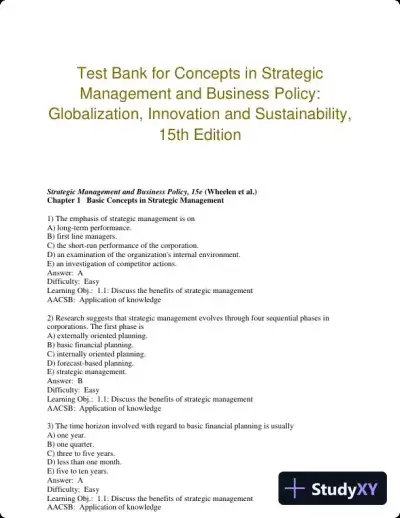 Exam Guides
Test Bank for Concepts in Strategic Management and Business Policy: Globalization, Innovation and Sustainability, 15th Edition
Business Management
374 pages138downloadsFeb 2025 Exam Guides
Test Bank for Interpersonal Communication, 7th New International Edition
Business Management
380 pages137downloadsFeb 2025 Textbook Guides
Concepts in Strategic Management and Business Policy: Globalization, Innovation and Sustainability, 15th Edition Solution Manual
Business Management
92 pages137downloadsFeb 2025
Study this document with CramX
Once it is in your library, every tool can work from it.