

Solution Manual for Crafting and Executing Strategy: Concepts , 22nd Edition
- Business Management
- 1764 pages
- Shared May 2025
Solution Manual for Crafting and Executing Strategy: Concepts, 22nd Edition is your textbook problem-solver, offering clear and concise solutions to difficult questions.
Preview 16 of 1764 pages
See the first 16 pages exactly as they appear in the document.
Page 1 Read page 1 as text
The Que st for Compe titive Adva ntage STRATEGY Crafting & Executing Concepts and Cases 22e Arthur A. Thompson, Jr. The University of Alabama Margaret A. Peteraf Dartmouth College John E. Gamble Texas A&M University – Corpus Christi A. J. Strickland III The University of Alabama Solution Guid e
Page 2 Page 3 Read page 3 as text
Section 1 Resources, Chapter Features, and Case Overview 1 Section 2 Using a Strategy Simulation in Your Course: The Compelling Benefits, What’s Involved, and How to Proceed 13 Section 3 Organizing Your Course, Deciding What the Workload Should Be, and Settling on Specific Assignments 43 Section 4 Sample Syllabi and Daily Course Schedules 76 Section 5 Lecture Notes for Chapters 1-12 105 Chapter 1 What is Strategy and Why is it Important? 106 Chapter 2 Charting a Company’s Direction: Vision and Mission, Objectives, and Strategy 114 Chapter 3 Evaluating a Company’s External Environment 127 Chapter 4 Evaluating a Company’s Resources, Capabilities, and Competitiveness 141 Chapter 5 The Five Generic Competitive Strategies – Which One to Employ? 156 Chapter 6 Strengthening a Company’s Competitive Position 169 Chapter 7 Strategies for Competing in International Markets 185 Chapter 8 Corporate Strategy: Diversification and The Multibusiness Company 200 Chapter 9 Ethics, Corporate Social Responsibility, Environmental Sustainability and Strategy 220 Chapter 10 Building an Organization Capable of Good Strategy Execution 233 Chapter 11 Managing Internal Operations: Actions that Promote Good Strategy Execution 247 Chapter 12 Corporate Culture and Leadership: Keys to Good Strategy Execution 258 Section 6 Teaching Notes 270 Case 1 Mystic Monk Coffee 271 Case 2 Airbnb in 2018 279 Case 3 Wil’s Grill 287 Case 4 Costco Wholesale Corp in 2018: Mission, Business Model, and Strategy 298 Case 5 Competition in the Craft Beer Industry in 2018 323 Case 6 Fixer Upper: Expanding the Magnolia Brand 331 Case 7 Under Armour’s Turnaround Strategy in 2018: Efforts to Revive North American Sales and Profitability 338 Case 8 MoviePass—Are Subscribers Loving It to Death? 362 Case 9 TOMS Shoes: Expanding Its Successful One For One Business Model 377 Case 10 Lola’s Market: Capturing a New Generation 384 Case 11 iRobot in 2018: Can the Company Keep the Magic? 395 Case 12 Chipotle Mexican Grill’s Strategy in 2018: Will the New CEO Be Able to Rebuild Customer Trust and Revive Sales Growth? 408 TABLE OF CONTENTS
Page 4 Read page 4 as text
’s Manual for Crafting and Executing Strategy, 20th Edition iii Case 13 Twitter, Inc in 2018: Too Little Too Late? 427 Case 14 Netflix’s Strategy in 2018: Does the Company Have Sufficient Competitive Strength to Fight Off Aggressive Rivals? 439 Case 15 Walmart’s Expansion into Specialty Online Retailing 463 Case 16 Amazon com, Inc : Driving Disruptive Change in the U S Grocery Market 472 Case 17 Aliexpress: Can It Mount a Global Challenge to Amazon? 487 Case 18 Tesla in 2018: Will the New Model 3 Save the Company? 499 Case 19 Mattel Incorporated in 2017: Can Ynon Kriez Save the Toys? 520 Case 20 Shearwater Adventures Ltd 535 Case 21 TJX Companies: Its Strategy in Off-Price Home Accessories and Apparel 546 Case 22 IKEA’s International Marketing Strategy in China 557 Case 23 Pepsico’s Diversification Strategy in 2018: Will the Company’s New Acquisitions Restore Its Growth 570 Case 24 The Walt Disney Company: Its Diversification Strategy in 2018 582 Case 25 Robin Hood 592 Case 26 Dilemma at Devil’s Den 601 Case 27 Nucor Corporation in 2018: Contending with the Challenges of Low-Cost Foreign Imports and Launching Initiatives to Grow Sales and Market Share 607 Case 28 Vail Resorts, Inc 628 Case 29 Starbucks in 2018: Striving for Operational Excellence and Innovation Agility 638 Case 30 Concussions in Collegiate and Professional Football: Who Has Responsibility to Protect Players? 655 Case 31 Chaos at Uber: The New CEO’s Challenge 668 Case 32 Profiting from Pain: Business and the U S Opioid Epidemic 677
Page 5 Read page 5 as text
case 1 • Case Assignment Questions Mystic Monk Coffee Assignment Questions 1. Has Father Daniel Mary established a future direction for the Carmelite Monks of Wyoming? What is his vision for the monastery? What is his vision for Mystic Monk Coffee? What is the mission of the Carmelite Monks of Wyoming? 2. Does it appear that Father Daniel Mary has set definite objectives and performance targets for achieving his vision? 3. What is Father Prior’s strategy for achieving his vision? What competitive advantage might Mystic Monk Coffee’s strategy produce? 4. Is Mystic Monk Coffee’s strategy a money-maker? What is MMC’s business model? What is your assessment of Mystic Monk Coffee’s customer value proposition? its profit formula? its resources that enable it to create and deliver value to customers? 5. Does the strategy qualify as a winning strategy? Why or why not? 6. What recommendations would you make to Father Daniel Mary in terms of crafting and executing strategy for the monastery’s coffee operations? Are changed needed in its long-term direction? its objectives? its strategy? its approach to strategy execution? Explain.
Page 6 Read page 6 as text
case 2 • Case Assignment Questions Airbnb in 2018 Assignment Questions 1. How would you illustrate and compare the business models for Airbnb, large hotel chains such as Marriott and Hilton, and bed & breakfast operators? Use the example chart in the textbook for business models as a guide (Concepts & Connections 1.1) 2. What are the general strengths and weaknesses of a) large, hotel chains such as Marriott and Hilton, b) bed & breakfasts, and c) Airbnb? Explain how you would compare and contrast those businesses. 3. In what ways has the lodging consumer changed, and how does Airbnb’s customer value-proposition meet this change? 4. What key factors may determine the success or failure of Airbnb? 5. What recommendations would you make to Airbnb to improve its competitiveness in the accommodation market while mitigating any current and future risks?
Page 7 Read page 7 as text
case 3 • Case Assignment Questions Wil’s Grill Assignment Questions 1. What are the resources, capabilities and core competencies required to compete in the street food market segment? How well do Wil’s Grill’s resources, capabilities, and core competencies stack up? 2. What does a VRIN analysis for Wil’s Grill reveal about its current resource strengths and capabilities, as well as competitive liabilities? Use the methodology in Table 4.3 to support your answer. 3. What does a SWOT analysis for Wil’s Grill reveal about its current position? Use the methodology in Table 4.2 to support your answer. Based on the SWOT, does Wil’s Grill have what it would take to compete in the catering industry? 4. Does it make good strategic sense for Wil’s Grill to be a competitor in both the street food and catering segments? Which one of these product lines — street food and catering segments — do you think is most important to Wil’s Grill’s future growth and profitability? Why? 5. What is your assessment of Wil’s Grill’s financial performance over the 2014 – 2016 period? (Use the financial ratios in Table 4.1 of the text as a guide in doing your financial analysis.) 6. Assess Wil’s Grill’s projections for 2017 – 2019. Are these realistic? How do you know? 7. What recommendations would you make to Wil’s Grill to address the strategic issues confronting it in 2016 in order to sustain its impressive growth in street food sales and sustain its newly-achieved profitability? Should John Christ expand in its current street food market segment, add a new market segment, catering, or do something else?
Page 8 Read page 8 as text
case 4 • Case Assignment Questions Costco Wholesale Corp. in 2018: Mission, Business Model, and Strategy Assignment Questions 1. What is Costco’s business model? Is the company’s business model appealing? Why or why not? 2. What are the chief elements of Costco’s strategy? How good is the strategy? 3. Do you think Jim Sinegal was an effective CEO? What grade would you give him in leading the process of crafting and executing Costco’s strategy? How well is Craig Jelinek performing as Sinegal’s successor; what grade would you give him so far in leading the process of crafting and executing strategy? What support can you offer for these grades? Refer to Figure 2.1 in Chapter 2 in developing your answers. 4. What core values or business principles did Jim Sinegal stress at Costco? 5. (In the event you have covered Chapter 3) What is competition like in the North American wholesale club industry? Which of the five competitive forces is strongest and why? Use the information in Figures 3.4, 3.5, 3.6, 3.7, and 3.8 (and the related discussions) in Chapter 3 to do a complete five-forces analysis of competition in the North American wholesale club industry. 6. How well is Costco performing from a financial perspective? Do some number-crunching using the data in case Exhibit 1 to support your answer. Use the financial ratios presented in Table 4.1 of Chapter 4 (pages 85-87) to help you diagnose Costco’s financial performance. 7. Based on the data in case Exhibits 1 and 4, is Costco’s financial performance superior to that at Sam’s Club and BJ’s Wholesale? 8. Does the data in case Exhibit 2 indicate that Costco’s expansion outside the U.S. is financially successful? Why or why not? 9. How well is Costco performing from a strategic perspective? Does Costco enjoy a competitive advantage over Sam’s Club? Over BJ’s Wholesale? If so, what is the nature of its competitive advantage? Does Costco have a winning strategy? Why or why not? 10. Are Costco’s prices too low? Why or why not? 11. What do you think of Costco’s compensation practices? Does it surprise you that Costco employees apparently are rather well-compensated? 12. What recommendations would you make to Costco top management regarding how best to sustain the company’s growth and improve its financial performance?
Page 9 Read page 9 as text
case 5 • Case Assignment Questions Competition in the Craft Beer Industry in 2018 Assignment Questions 1. What are the strategically relevant components of the U.S. and global craft beer industry macro-environment? 2. What is competition like in the craft beer industry? Which of the five competitive forces is strongest? Which is weakest? What competitive forces seem to have the greatest effect on industry attractiveness and the potential profitability of new entrants? 3. What does your strategic group map of the craft beer industry look like? Which strategic groups do you think are in the best positions? The worst positions? 4. What key factors may determine the success of a start-up or smaller, craft brewery? 5. What recommendations would you make to a smaller, craft brewery to improve its competitiveness in the market while mitigating any current and future risks? 6. Identify the strategic issues facing craft brewers in 2018. What effects may these issues have on the industry?
Page 10 Read page 10 as text
case 6 • Case Assignment Questions Fixer Upper: Expanding the Magnolia Brand Assignment Questions 1. What are the major elements of Magnolia Inc.’s competitive strategy? How well do the pieces fit together? Is the strategy evolving? 2. Explain the pressures facing Magnolia Inc. in its internal and external environments. How would you priori - tize those pressures? 3. What strategic issues confront Magnolia Inc. in 2018? What market or internal circumstances should most concern owners Chip and Joanna Gaines and the company’s senior management team? 4. What recommendations would you make to Magnolia Inc. to address the strategic issues confronting it in 2016 in order to sustain its impressive growth in revenues and achieve profitability?
Page 11 Read page 11 as text
case 7 • Case Assignment Questions Under Armour’s Turnaround Strategy in 2018 Assignment Questions 1. What is your assessment of the Under Armour’s performance downturn in North America that first appeared in the fourth quarter of 2016? Causes? Reasons? 2. What financial performance issues do you see at Under Armour based on the data in case Exhibits 1, 2, and 3? 3. What is your assessment of the strength of the competitive rivalry among the leading participants in the North American market for performance sports apparel headed into 2018? 4. How strong are the other four competitive forces confronting Under Armour, Nike, and The adidas Group as of 2018? Do a five-forces analysis to support your answer. 5. Does Under Armour have any core competencies and, if so, what are they? 6. Does Under Armour have any resource strengths or competitive capabilities that qualify as a distinctive competence? 7. What does a SWOT analysis reveal about the overall attractiveness of Under Armour’s situation headed into 2018? 8. What are the key elements of Under Armour’s strategy? 9. Which one of the five generic competitive strategies discussed in Chapter 5 most closely approximates the competitive approach that Under Armour is employing? 10. As of 2018, how does Under Armour’s competitive strength in the global market for sports apparel and athletic footwear compare against that of Nike and The adidas Group? Do a weighted competitive strength assessment using the methodology presented in Table 4.4 in Chapter 4 to support your answer. Based on your assessment and calculations, does Under Armour have a net competitive advantage or disadvantage in competing globally against Nike and The adidas Group? 11. What financial performance issues do you see at Under Armour based on the data in case Exhibits 1, 2, and 3? 12. What are the key issues confronting Under Armour’s top management team as of mid- 2018? 13. What recommendations and suggestions for improvement would you make to Kevin Plank regarding the turnaround strategy put in place at Under Armour?
Page 12 Read page 12 as text
case 8 • Case Assignment Questions MoviePass—Are Subscribers Loving It to Death? Assignment Questions 1. Describe the Movie Pass business model. From the data in the case, does it appear to be a sound corporate strategy? Support your answer. 2. What are the key elements of MoviePass’ strategy going into 2018? 3. Identify the threats that Movie Pass may face in its competitive environment. Prepare a SWOT analysis of the company. From this information, how do you evaluate the company’s overall situation and future prospects? 4. Assess the financial condition of Helios & Matheson. What is your assessment of the company’s liquidity and profitability? 5. Does the financial condition of Movie Pass support your SWOT assessment? 6. Consider the financial trends, the SWOT analysis and other information from the MoviePass case: does the collective information indicate survival for MoviePass? Support your conclusion. 7. From the data in the case, would you expect MoviePass to be able to achieve profitability before the cash runs out? 8. What advice would you give to the MoviePass Board of Directors?
Page 13 Read page 13 as text
case 9 • Case Assignment Questions TOMS Shoes: Expanding Its Successful One For One Business Model Assignment Questions 1. What are the key elements of TOMS shoes’ competitive strategy? Is the strategy best described as low cost, differentiation, or best cost? Has the company focused on a niche or chosen to pursue the broader footwear market? Explain. 2. In what ways does TOMS exercise its commitment to corporate social responsibility? 3. How does TOMS’ dedication to corporate social responsibility contribute to its competitive advantage? 4. What is TOMS Shoes situation like? What are its internal strengths and weaknesses? Its external opportunities and threats? 5. What evidence suggests whether TOMS shoes strategy is working? Does it have a competitive advantage? Is its financial performance improving or declining? 6. What strategic issues should TOMS shoes management and investors be most concerned with? Are there possible improvements to its competitive strategy? Are there internal weaknesses or external threats to its well-being that must be addressed?
Page 14 Read page 14 as text
case 10 • Case Assignment Questions Lola’s Market: Capturing a New Generation Assignment Questions 1. What are the strategically relevant components of the U.S. supermarket industry macro-environment? 2. What is competition like in the supermarket industry? Which of the five competitive forces is strongest? Which is or are weakest? What competitive forces seem to have the greatest effect on industry attractiveness and the potential profitability of new entrants? 3. What does your strategic group map of the supermarket industry look like? Is Lola’s Market well positioned? Why or why or why not? 4. What do you see as the key drivers of change in the U.S. supermarket industry? 5. What key factors may determine the success of Lola’s Markets? 6. What recommendations would you make to David Ortega to improve Lola’s Market’s competitiveness in the market while mitigating any current and future risks?
Page 15 Read page 15 as text
case 11 • Case Assignment Questions iRobot in 2018: Can the Company Keep the Magic? Assignment Questions 1. Identify the driving forces in the robotic vacuum industry. Which of these forces appears to be the strongest? Where does the industry appear to be headed as a result of these forces? 2. What are iRobot’s competitive and resource strengths, and what opportunities do you identify? What notable weaknesses and threats are facing the company? Assess the combined impact of these forces on iRobot’s future profitability. 3. Describe iRobot’s business strategy. Does it appear well-suited for the company in 2018? 4. iRobot has the largest market share in a growing market, but does the company have a competitive advantage? A sustainable advantage? What additional strategies could the company adopt to secure or sustain competitive advantage? 5. Which of iRobot’s competitors presents that greatest competitive threat? Why? Support your answer. 6. From the provided financial data, what is iRobot’s financial condition? What do the financial statements suggest about the company’s future? If present trends continue, where do you see iRobot in the next few years? 7. What advice would you offer to CEO Angle to improve iRobot’s market position and profitability. Support your decision.
Page 16 Read page 16 as text
case 12 • Case Assignment Questions Chipotle Mexican Grill’s Strategy in 2018 Assignment Questions 1. What is your assessment of the ways in which Chipotle responded to the food poisoning incidents in some of its restaurants? 2. Do you agree with Steve Ells’s decision to relinquish his position as CEO? Do you approve of the choice of Brian Nicol to become Chipotle’s new CEO? Are you surprised by the choice of Brian Nicol? 3. Does Chipotle Mexican Grill have any core competencies and, if so, what are they? 4. What does a SWOT analysis reveal about the attractiveness of Chipotle Mexican Grill’s situation and future prospects, as of mid-2018? 5. What are the primary and secondary components of Chipotle’s value chain? 6. What were the chief components of Chipotle’s strategy prior to the food poisoning episodes? What further strategy adjustments are needed now that Chipotle has (seemingly) gotten through the worst of the fallout of the food poisoning incidents? 7. Which one of the five generic competitive strategies discussed in Chapter 5 most closely approximates the competitive approach that Chipotle Mexican Grill is employing? 8. What chief difference(s) do you see between Chipotle’s strategy and the strategy being employed at Moe’s Southwest Grill? 9. What does an analysis of the data in case Exhibit 1 reveal about Chipotle Mexican Grill’s financial and operating performance? Use the financial ratios in Table 4.1 of Chapter 4 as a guide in doing the calculations needed to arrive at an analysis-based answer to your assessment of Chipotle’s financial performance. In addition to the ratios in Table 4.1, there are occasions when you will also need to calculate compound average growth rates (CAGR) for certain financial measures. The formula for calculating CAGR (in percentage terms) is as follows: CAGR % = [ending value ÷ beginning value] 1/n – 1 x 100 (where n = the number of year-to-year or period-to-period changes) 10. How does Chipotle Mexican Grill’s competitive strength compare against that of Taco Bell, Qdoba Mexican Eats, and Moe’s Southwest Grill as of mid-2018? Do a weighted competitive strength assessment using the methodology presented in Table 4.4 in Chapter 4 to support your answer. Based on your assessment and calculations, does Chipotle have a net competitive advantage over some or all of these rivals? Which rival— Chipotle Mexican Grill or Moe’s Southwest Grill or Qdoba Mexican Eats—seems to have the strongest set of resource strengths and competitive capabilities and is most likely to achieve the best financial performance? Does Chipotle have a good enough strategy and adequate resource strengths and competitive capabilities to compete effectively against Taco Bell? Your assessment should most definitely take into account the extent to which Chipotle’s food poisoning problems have cut into its competitive capabilities and performance prospects. 11. What action recommendations would you make to CMG’s new CEO, Brian Nicol, to help rejuvenate the company’s growth and profitability in the remainder of 2018 and on into 2019?
1748 more pages in the full document
Unlock it once and it stays in your library, ready to chat with or turn into flashcards.
Unlock the full documentMore Business Management study materials
See all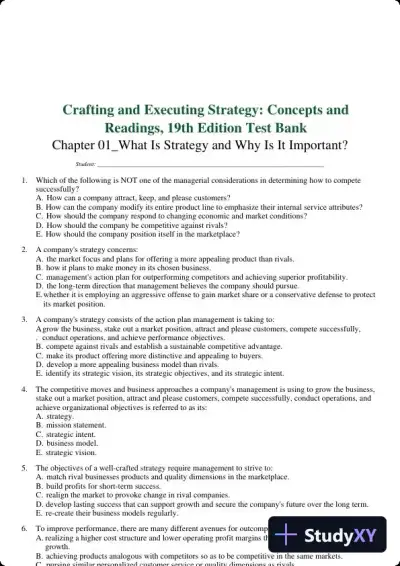 Exam Guides
Crafting and Executing Strategy: Concepts and Readings, 19th Edition Test Bank
Business Management
618 pages66downloadsFeb 2025 Textbook Guides
Solution Manual For Quality Technician's Handbook, The, 6th Edition
Business Management
22 pages173downloadsFeb 2025 Textbook Guides
Solution Manual for Business Essentials, 12th Edition
Business Management
421 pages147downloadsFeb 2025 Exam Guides
Solution Manual for Practice of Public Relations, The, 13th Edition
Business Management
310 pages146downloadsFeb 2025 Exam Guides
Test Bank for ISE International Business: Competing in the Global Marketplace, 14th Edition (Chapters 1-10)
Business Management
299 pages146downloadsFeb 2025 Exam Guides
Test Bank for Concepts in Strategic Management and Business Policy: Globalization, Innovation and Sustainability, 15th Edition
Business Management
374 pages138downloadsFeb 2025 Exam Guides
Test Bank for Interpersonal Communication, 7th New International Edition
Business Management
380 pages137downloadsFeb 2025 Textbook Guides
Concepts in Strategic Management and Business Policy: Globalization, Innovation and Sustainability, 15th Edition Solution Manual
Business Management
92 pages137downloadsFeb 2025
Study this document with CramX
Once it is in your library, every tool can work from it.