

Solution Manual for The Practice of Public Relations, 14th Edition
- Business Management
- 131 pages
- Shared May 2025
Solution Manual for The Practice of Public Relations, 14th Edition is the best resource for textbook solutions, helping you tackle even the hardest problems.
Preview 16 of 131 pages
See the first 16 pages exactly as they appear in the document.
Page 1 Read page 1 as text
The Practice of Public Relations Fourteenth Edition Fraser P. Seitel Solution Manual James A. Lingwall
Page 2 Page 3 Read page 3 as text
1-1 Part I: Evolution Chapter 1: Defining Public Relations Teaching Perspective—Chapter Overview Chapter 1 explains and clarifies the function of public relations. It demonstrates that there is no one generally accepted definition, but rather many approaches to defining public relations. It explains that because of this fractured identity, the practice of public relations is often misunderstood. At the same time, in the first two decades of the 21 st century, the power and value of public relations have never been greater. Indeed, it is clearly a growth industry. But—and here is the key but— the chapter makes it clear that the essence of public relations lies in the ethical underpinnings of the field. Public relations, stated simply, comes down to doing the right thing . And the chapter tries to reinforce to students, the importance of this thesis; that it is telling the truth that lies at the essence of public relations counsel. Spin , as the chapter suggests, is antithetical to that thesis. Spin, in other words, is the enemy of professional public relations professionals. Instructors should work hard to hammer home this concept. That’s why Chapter 1 and every other chapter in the text features ethical cases. Chapter 1 also stresses the importance of public relations as a planned process to influence public opinion —one that answers to top management and deals directly with the critical publics on whom an organization depends. The epic fall of movie mogul Harvey Weinstein and the rise of the #MeToo movement are chronicled in the case study at the end of Chapter 1. The subject of the From the Top interview at the chapter end is Harold Burson, arguably the most revered public relations practitioner in the world today. Among topics discussed in Chapter 1 are: Prominence of public relations What is public relations? Influencing public opinion Management interpreter Public interpreter Public relations publics Public relations functions The sin of “spin” What manner of man or woman?
Page 4 Read page 4 as text
1-2 A Question of Ethics: Harvard Disinvites a Leaker Consider the events at Harvard, one of the world’s most prestigious universities, during the fall of 2017. Among those honored as part of the class of 2017 Visiting Fellows was Chelsea Manning, a former U.S. Army intelligence analyst. Manning had become a household name four years earlier after being court-martialed and sentenced to 35 years in prison for violating the Espionage Act and other offenses, after leaking thousands of classified, confidential, and sensitive military documents to WikiLeaks. Manning’s invitation drew immediate, widespread criticism, placing Harvard squarely in the middle of a public relations crisis. Within days, Harvard got the message. Harvard Kennedy School Dean Douglas Elmendorf announced that the university was rescinding the invitation to Manning, taking blame for what he called a “mistake.” As this case illustrates, no matter where you work—company, government body, trade association, sports team, or academic institution—the practice of public relations looms large. Possible Answers 1. Some students may argue that the university had every right to exercise their academic freedom in inviting Manning as a Visiting Fellow. Others may counter that inviting a convicted felon and a leaker of classified information sent entirely the wrong message to key stakeholders. Some students may even contend that the university’s invitation was downright unpatriotic. Students should be asked to justify their thinking. 2. Some students may argue that Harvard had no other choice than to disinvite Manning, given the immediate, widespread criticism. After all, the public relations damage was just too extensive. Other students may contend that the university should have maintained a spirit of academic openness and honored the Manning invitation despite public pressure. Again, students should be asked to justify their thinking. 3. As Harvard’s public relations director, one could have advised the Kennedy School in advance to reconsider inviting Manning in order to avoid the controversy and negative optics. Once the invitation was made, the public relations director could encourage Harvard to embrace the controversy, promoting the Visiting Fellows program as an ultimate search for truth, despite its difficulties. Such a discussion demonstrates the importance of open, spirited discussion in our democracy.
Page 5 Read page 5 as text
1-3 Discussion Starters 1.1. Public relations has never been more prominent. In a world linked by satellites, social media, the Internet, and cellular technology, how one communicates becomes increasingly more critical. 1.2. According to PRSA’s 2012 definition, “Public relations is a strategic communication process that builds mutually beneficial relationships between organizations and their publics.” Public relations can also be defined as a planned process to influence public opinion, through sound character and proper performance, based on mutually satisfactory two-way communication. 1.3. Public relations means different things to different people. It is a confusing term to most, who are unfamiliar with its functions. Many public misperceptions arise from media stereotypes of the profession as spin-oriented and concerned with appearance over substance. The presidency of Donald Trump has only served to further confuse the public as Trump behaves unethically, spins extensively, and invents endless publicity stunts to show voters what he wants them to see. This all occurs regardless of Trumps actual performance - breaking another key tenet of public relations. 1.4. Planning is an essential factor in effective public relations. The success of a public relations program depends on knowing the goals for which communications are intended. 1.5. Action, or performance, is the most critical component. You cannot create effective communications without proper performance. 1.6. Advertising and marketing promote products and services. Public relations promotes an entire institution. 1.7. Among the United Way’s most important publics are its donors, its employees, and the recipients of its charity. 1.8. The seven functions of public relations practice are: 1) writing, 2) planning, 3) researching, 4) publicity, 5) media relations, 6) consumer relations, and 7) government relations. 1.9. Professional, effective public relations is about truth, honesty, and integrity. “Spin” is the enemy, and is to be avoided at all costs. 1.10. Technically, public relations professionals must have knowledge of a) the public relations field, b) communications, c) technology, d) current events, e) business and f) management. Attitudinally, public relations professionals must a) be pro- communications, b) be advocates for their organizations, c) be oriented toward counseling, d) be ethical, e) be willing to take risks, and f) be positive.
Page 6 Read page 6 as text
1-4 Case Study: Publicity Punctures a Powerful Pariah For decades, the worst-kept secret in Hollywood was that Harvey Weinstein, motion picture mogul, confidante of Presidents and politicians, and creator of instant stardom for obscure actors and actresses, was a serial sexual harasser. His inexcusable behavior may well have continued to be covered up by confidential legal settlements had it not been for the power of publicity. The wall came crumbling down for Harvey Weinstein in October 2017 with a front-page headline in The New York Times , “Harvey Weinstein Paid Off Sexual Harassment Accusers for Decades.” His career and personal life were ruined, alongside those of many around him. The one positive development coming out of the Harvey Weinstein saga was the immediate impact it had on women—and men—coming forward publicly to expose other sexual abusers. Actress Alyssa Milano started a “#MeToo” hashtag to denounce sexual abuse and harassment, and the crusade spread around the world. Within months, famous broadcasters, like Today Show host Matt Lauer and PBS interviewer Charley Rose; politicians, like Minnesota Senator Al Franken and Michigan Congressman John Conyers; and artists, like painter Chuck Close and opera conductor James Levine, and more than 100 other famous people were publicly accused as being sexual harassers. After decades of silence, millions of people were now speaking out against sexual abuse in the workplace and elsewhere. Milano told a TV interviewer, “We are going to be vocal until this stops. Not one more. It stops here.” Thanks to the megaphone of publicity and public opinion, an international crusade was born. Answers 1.11. As public relations director of The Weinstein Company, the only ethical course of action would be to advise Weinstein to face his accusers honestly in the media, tell the truth, and if necessary, resign his post. If he would not heed public relations counsel, the only ethical course of action would be to resign one’s position. This course of action is consistent with all definitions of public relations listed in Chapter 1 and throughout this book. 1.12. As poet William Shakespeare famously wrote, “The truth will out.” As public relations director for NBC, one should have advised executives to carefully investigate the story and then air it promptly before competing media organizations did the same. 1.13. Lisa Bloom and David Boies: As everyone is entitled to legal counsel, one might advise Bloom and Boies that of course, it is permissible to continue representing Weinstein as attorneys. However, their client, and what they did for him, are certainly not good for career longevity.
Page 7 Read page 7 as text
1-5 Sitrick & Company: As with the Weinstein Company, the only ethical course of action for Sitrick would be to advise Weinstein to face his accusers honestly in the media, tell the truth, and if necessary, resign his post. As Seitel notes, you can’t put lipstick on a pig. If Weinstein would not heed public relations counsel, the only ethical course of action would be to resign one’s position and leave the client to fend for himself. 1.14. As illustrated throughout this chapter, the practice of public relations is built upon establishing and maintaining mutually beneficial relationships with key publics. One could advise the #MeToo movement that they have a prime opportunity to launch a worthy social campaign that would certainly have “legs” across many settings and platforms. I would also advise them to first conduct public relations research on previous similar campaigns and to empower victims as key influencers in the campaign. Chapter 1 Review Quiz (* Indicates Correct Answer) 1. Public relations can be defined as: A. Marketing a firm’s products. B. Management of communications between a firm and its publics. * C. Publicizing the products of a firm. D. Advertising to sell products. 2. A valid definition of public relations is the following: A. An organization’s efforts to win the cooperation of groups of people. B. Persuasive communications designed to influence specific publics. C. The art of analyzing trends, predicting their outcomes, counseling organizational leaders, and implementing planned programs to serve both the organization’s and the public’s interest. D. All of the above. * 3. The job of a public relations professional is very much that of a/an: A. Interpreter. * B. Mouthpiece. C. Shill. D. Advertising agent.
Page 8 Read page 8 as text
1-6 4. The “essence” of the practice of public relations is: A. Promotion. B. Marketing. C. Truth. * D. Publicity. 5. Social media has made a _______________ impact on public relations. A. Minimal B. Some C. Negligible D. Significant * 6. Often in a political campaign, the vote of the _______________ is critical. A. Traditional B. Marginal C. Uncommitted * D. Active 7. Effective public relations means practicing _______________. A. Proper product packaging. B. Obfuscation and subterfuge. C. Aggressively posturing a difficult point of view. D. Ethics, truth, and credibility. * 8. The key element of the R-A-C-E process of public relations is _____________. A. Action. * B. Audience. C. Analysis. D. Attention. 9. Winning goodwill for an organization can be done relatively quickly. A. True. B. False. * 10. The key to public relations success today is simple: product publicity, impressive tours, and a smile at the teller’s counter. A. True. B. False. *
Page 9 Read page 9 as text
1-7 11. Two leading public relations organizations are the Public Relations Society of America and the International Association of Business Communicators. A. True. * B. False. 12. Public relations is effective as a temporary, defensive measure to compensate for management misjudgment. A. True. B. False. * 13. Supervisors, clerks, managers, stockholders, and the board of directors are examples of “external” publics. A. True. B. False. * 14. In the early 21 st century, public relations has been used for both good and evil, as we have seen in the activities of the “Islamic State” or ISIS. Describe some of these public relations activities. ISIS used an aggressive social media campaign to release statements of its conquests and major battles. It staged elaborate events, particularly parades, to showcase the weapons it captured. ISIS posted chilling high-quality videos of torture and beheadings of prisoners, including American journalists, to underscore its brutality. As ISIS used its public relations power in seizing parts of Iraq and Syria, it replaced the equally demonic Al Qaeda as terrorist enemy number one. 15. If you were the head of the Democratic/Republican Party and learned that a lobbyist had subsidized a congressman’s trips and lifestyle, in violation of congressional ethics rules, what would you recommend? Take immediate action and announce it to the American public. The key to proper public relations is full disclosure of all facts. Integrity and credibility, particularly of the people’s chosen representatives, cannot be compromised. Chapter 1: Essay Examinations 1. Describe the practice of public relations. Public relations is a process that “harmonizes” long-term relationships among individuals and institutions. There is no one definition. But the proper practice of
Page 10 Read page 10 as text
1-8 public relations involves: 1) researching the attitudes of the public about an organization, idea, product, or individual, 2) identifying action within the organization that answers the public need, 3) communicating to the public about that action, and 4) evaluating the results of that communications program. 2. Discuss the concept of “spin.” “Spin” means defending your client or employer—right or wrong, truthful or untruthful, honest or dishonest. It also means covering up their unethical performance by “spinning” a story or the facts behind an issue. Spin is anathema to the proper practice of public relations, and should be dismissed and disdained by any practitioner. True public relations professionals don’t spin. Instead, they communicate truth.
Page 11 Read page 11 as text
2-1 Chapter 2: The History and Growth of Public Relations Teaching Perspective Chapter 2 summarizes the history of public relations – from the Sophists in Greece to the early American experience to modern-day leaders. The study of public relations history is important in explaining to students how and why this relatively new field came into being. In addition, the chapter discusses the pioneers in the field and what they contributed. It’s important to indicate to students that while public relations antecedents stretch back over time – as long as individuals tried to persuade others to adopt their cause – the practice itself is very much a recent phenomenon. Ivy Lee assisting John D. Rockefeller, Jr. at the turn of the last century arguably “founded” the modern practice of public relations. The first public relations course was taught at New York University in 1923. The point is that modern public relations practice is not yet even 100 years old. Its history is still being written. Its leaders, therefore, are those teaching – and learning – in the practice as we speak. So the responsibility to help build this field lies with each of its practitioners and students. The Case Study at the end of Chapter 2 chronicles the dubious presidential election of Donald Trump. The subject of the From the Top interview is Edward Bernays, a 20 th -century public relations luminary who pioneered the application of the social sciences to public relations. Among topics discussed in Chapter 2 are: Ancient beginnings Early American experience Later American experience Ivy Lee: The real father of modern public relations The growth of modern public relations Public relations comes of age Public relations education A Question of Ethics: Burson Fumbles Facebook Flap In this mini-case, the venerable Burson-Marsteller was caught trying to make Google, their client’s competitor, look bad by approaching media members and bloggers with a “whisper” campaign about one of its products. In failing to reveal that they were representing Facebook, the two Burson employees committed a cardinal public relations sin, according to the PRSA Code of Professional Ethics.
Page 12 Read page 12 as text
2-2 One blogger was so enraged with the staffer’s actions that he posted Burson’s entire pitch online. The story took off and grabbed media headlines across the world. Given the nature of media and the fact that it is uncontrolled information, Burson should have seen this coming a mile away. Burson’s clumsy attempt to disparage a competitor led to considerable embarrassment at both Google and Facebook. To put it mildly, Burson-Marsteller was chastened. PRSA was quick to denounce the “fake news” efforts: “This reflects poorly upon the global public relations profession. Burson took the road of misleading and not disclosing who they were representing.” Possible Answers 1. The Burson team would have been wise to consult Chapter 1 of this text, which advises us that true public relations is based on sound character and proper performance. Spin is the enemy and must always be avoided. Instead, the employees should have built a straightforward campaign based on Facebook’s positive attributes. 2. Ideally, yes. Although some cynics claim that “the best public relations is invisible,” leading practitioners (including the historical luminaries discussed in this chapter) have always held that honest and openness is the only credible approach. Discussion Starters 2.1. The factors influencing the spread of public relations in society were: 1) the growth of big institutions, 2) increasing incidence of change, conflict, and confrontation in society, 3) heightened awareness of communications, and 4) increased importance of public opinion. 2.2. P.T. Barnum was a shameless self-promoter who deceived as much as he informed. 2.3. Samuel Adams organized Committees of Correspondence as a kind of revolutionary Associated Press. 2.4. Muckrakers reported the abuses of robber barons, thus leading to the creation of public relations professionals to explain the other side. 2.5. Both Lee and Bernays were among the first to realize that everyone deserved his or her day in the court of public opinion.
Page 13 Read page 13 as text
2-3 2.6. Both were effective forces in mobilizing public opinion in support of the United States and its objectives. They set the foundations for today’s United States Information Agency. 2.7. Arthur Page was a pacesetter as one of the first corporate public relations professionals, whose aim was to promote AT&T as an ethical and credible company. 2.8. Today, most public relations education programs are situated within colleges, schools, and departments of journalism and/or communication. However, given the growing influence of public relations within all organizations and across society, public relations education should also be incorporated into business programs at colleges and universities. 2.9. The importance of communications in every sector of society has propelled public relations practice to center stage. The field’s major associations boast growing membership. Together, the agencies that dominate the public relations practice earn revenues in the billions of dollars. And public relations professionals are important figures in every sector of society. 2.10. The encroachment of the field by practitioners of other disciplines is a concern. So is the small number of minority practitioners and the number of women in management positions. The Internet, social media, and how these should best be “harnessed” are other issues of importance. Issues related to respect continue to dog public relations professionals, who must constantly strive to convince their employers of the merit and importance of what they do. Case Study: The Election that Shook the World….and Tested Public Relations Donald Trump’s dark-horse presidential victory was a dubious triumph for the practice of public relations. For decades, Trump had meticulously constructed a public persona built primarily on public relations publicity, special events, media appearances, and round-the- clock image maximization. On the other hand, Trump’s climb to power ran afoul of many principles in the effective and ethical use of public relations. While effective public relations begins with real achievement, truthfully communicated, Donald Trump’s publicity quest has never been particularly concerned with either “achievement” or “truth.” Telling the truth, of course, is essential to the proper practice of public relations. So the criticism that Trump frequently lies was bothersome to many public relations professionals. Public relations counselors also preach the importance of “doing your homework.” Trump has rarely given the impression that he cares much about preparation. While the other candidates showed up prepared for set stump speeches and meetings with constituents, Trump rallies were more free-wheeling affairs. But in his unorthodoxy, Trump has still embraced one important public relations principle: Keep your primary message clear.
Page 14 Read page 14 as text
2-4 From one dizzying day to the next—both positively and negatively—President Donald Trump continued to stretch the bounds of traditional public relations strategies and tactics and confound the world. Possible Answers: 2.11. As an ethical public relations advisor to candidate Trump, one might advise him to follow the time-tested principles of ethical conduct, positive performance, relationship building, and then communicating the substance of that performance to key publics. But of course, that advice would run counter to Trump’s persona and underlying motivations. Providing public relations counsel to such a person would probably prove to be a futile task. 2.12. As an ethical public relations advisor to candidate Trump in competing with Hillary Clinton, one should advise him to take the high road in debates and on key issues, to back off on the personal insults, and to do his homework before speaking engagements. However, we are living in strange political times. This public relations counsel might well have caused Trump to lose support among his base and lose the presidential campaign. 2.13. As we will learn in the Government Relations chapter of this text, the presidential press secretary is charged with serving in a boundary role between the president and the American people. It is a high public trust. Therefore, as Sean Spicer, it would be highly unethical to knowingly inflate the size of the Inauguration Day crowd. One should explain this to the president, and if he could not understand this reality, resign the position. 2.14. This is a difficult question to answer, because Donald Trump has alienated such a large segment of American society through his words and actions. Indeed, his daily existence in the Oval Office seems to be antithetical to the ethical practice of public relations. Good advice would be to start telling the truth and to act in accord with the public interest. Also, plan out public relations initiatives in advance instead of resorting to the improvised chaos for which he is so well known. Chapter 2 Review Quiz (* Indicates Correct Answer) 1. Among the fundamental trends related to the evolution of public relations is the following: A. The growth of “big institutions.” * B. The increasing incidence of agreement in society. C. An increasing naiveté of people about what is going on around them. D. All of the above.
Page 15 Read page 15 as text
2-5 2. The precursor of today’s lobbyists were the: A. Romans. B. Committees of Correspondence. C. Sophists. * D. British loyalists. 3. The first Presidential press secretary was: A. Sam Adams. B. Edward Bernays. C. Ivy Lee. D. Amos Kendall. * 4. The reputed originator of the line, “The public be damned!” was: A. J.P. Morgan. B. Henry Clay Frick. C. William Vanderbilt. * D. John D. Rockefeller. 5. The “muckrakers” were: A. Reporters and editors. * B. Robber barons. C. Early public relations practitioners. D. None of the above. 6. Public relations pioneer Ivy Lee was criticized for his involvement with: A. The Creel Committee. B. The German Dye Trust. * C. Seton Filmways. D. The American Tobacco Company. 7. In the 21 st century, manipulation of the world’s ____ has become a disturbing objective of terrorists. A. Trains B. Ships C. Media * D. Political system
Page 16 Read page 16 as text
2-6 8. P.T. Barnum is beloved by public relations professionals. A. True. B. False. * 9. The Great Depression gave no impetus to the development of corporate public relations. A. True. B. False. * 10. The basic principle of successful corporate public relations is to make sure management thoughtfully analyzes its overall relation to its publics. A. True. * B. False. 11. McClure’s magazine had an anti-industry bias. A. True. * B. False. 12. To advocate ratification of the Constitution, political leaders like Alexander Hamilton and James Madison banded together, under the pseudonym Scandalous. A. True. B. False. * 13. What were the four fundamental trends that helped shape public relations? The growth of “big institutions.” The increasing incidence of conflict and confrontation in society. The heightened awareness of people everywhere because of more sophisticated communications technology. The outbreak of democracy in the world. 14. Why is public relations more important for organizations today? The credibility of organizations today is challenged constantly, and their role in society changes instantly. Expectations of an organization’s responsibilities have increased today. Emerging technologies of the computer age put added pressure on an organization to adapt continually to the standards of society. For all these reasons, good public relations is no longer an option, but a necessity.
115 more pages in the full document
Unlock it once and it stays in your library, ready to chat with or turn into flashcards.
Unlock the full documentMore Business Management study materials
See all Textbook Guides
Solution Manual For Quality Technician's Handbook, The, 6th Edition
Business Management
22 pages173downloadsFeb 2025 Textbook Guides
Solution Manual for Business Essentials, 12th Edition
Business Management
421 pages147downloadsFeb 2025 Exam Guides
Solution Manual for Practice of Public Relations, The, 13th Edition
Business Management
310 pages146downloadsFeb 2025 Exam Guides
Test Bank for ISE International Business: Competing in the Global Marketplace, 14th Edition (Chapters 1-10)
Business Management
299 pages146downloadsFeb 2025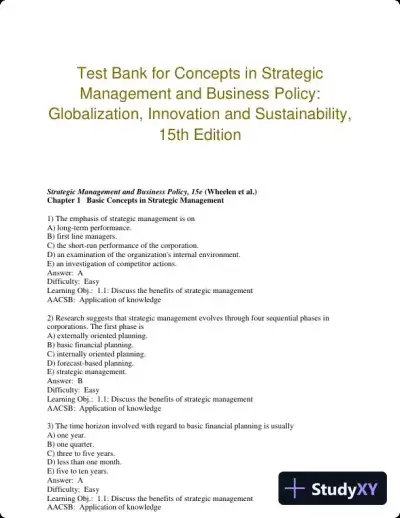 Exam Guides
Test Bank for Concepts in Strategic Management and Business Policy: Globalization, Innovation and Sustainability, 15th Edition
Business Management
374 pages138downloadsFeb 2025 Exam Guides
Test Bank for Interpersonal Communication, 7th New International Edition
Business Management
380 pages137downloadsFeb 2025 Textbook Guides
Concepts in Strategic Management and Business Policy: Globalization, Innovation and Sustainability, 15th Edition Solution Manual
Business Management
92 pages137downloadsFeb 2025 Textbook Guides
An Introduction To Management Science: Quantitative Approaches To Decision Making, Revised, 13th Edition Solution Manual
Business Management
512 pages135downloadsFeb 2025
Study this document with CramX
Once it is in your library, every tool can work from it.