
CramX Logo
WHAT IS THE FUTURE OF AOL & DIAL-UP NETWORKING? - Document preview page 1

WHAT IS THE FUTURE OF AOL & DIAL-UP NETWORKING? - Page 1

Document preview content for WHAT IS THE FUTURE OF AOL & DIAL-UP NETWORKING?

WHAT IS THE FUTURE OF AOL & DIAL-UP NETWORKING?

A case study exploring the future of AOL and dial-up networking in the digital age.

Emma Thompson
Contributor
4.9
0
12 months ago
Preview (3 of 8 Pages)
100%
Log in to unlock
Page 1 of 3
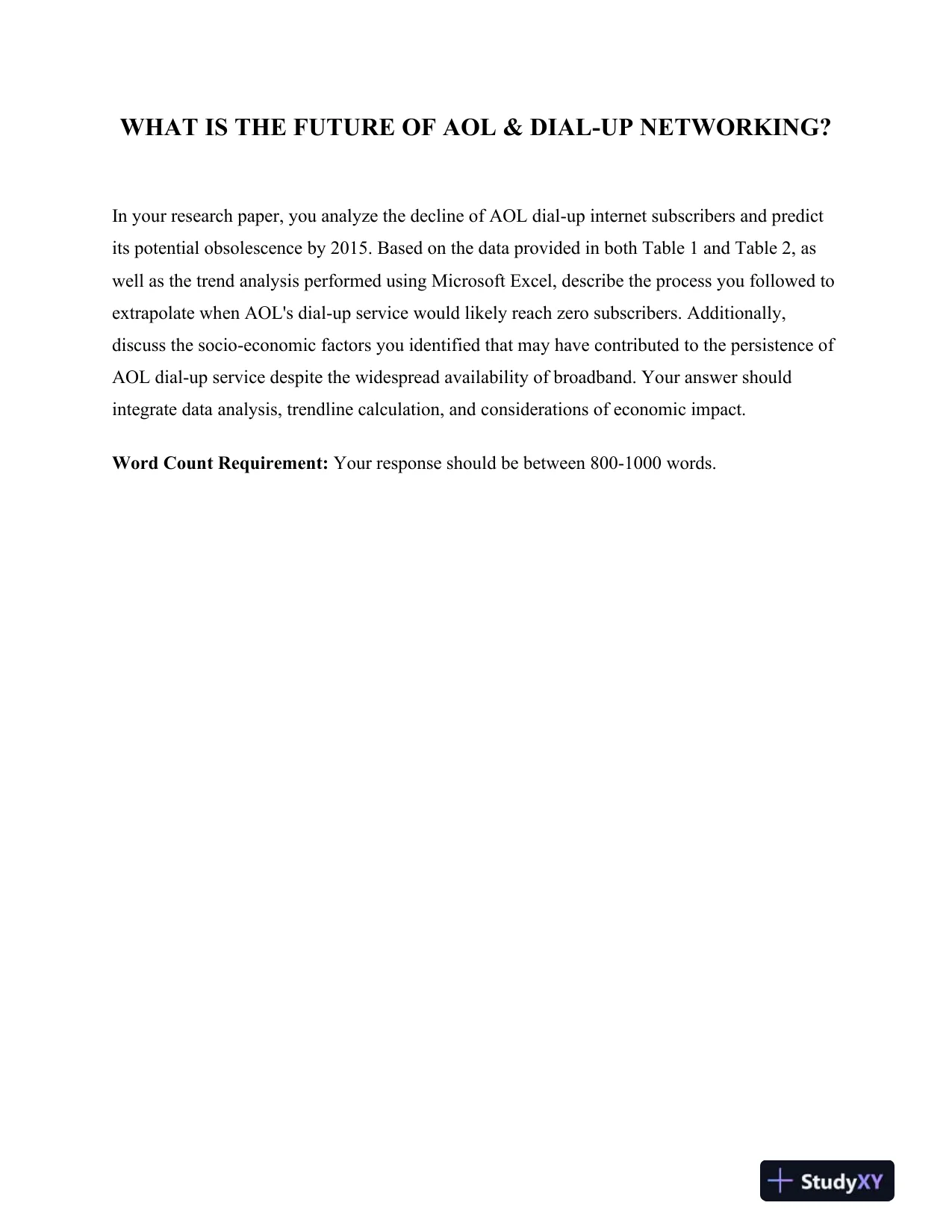
WHAT IS THE FUTURE OF AOL & DIAL-UP NETWORKING? - Page 1 preview imageWHAT IS THE FUTURE OFAOL &DIAL-UP NETWORKING?In your research paper, you analyze the decline of AOL dial-up internet subscribers and predictits potential obsolescence by 2015. Based on the data provided in both Table 1 and Table 2, aswell as the trend analysis performed using Microsoft Excel, describe the process you followed toextrapolate when AOL's dial-up service would likely reach zero subscribers. Additionally,discuss the socio-economic factors you identified that may have contributed to the persistence ofAOL dial-up service despite the widespread availability of broadband. Your answer shouldintegrate data analysis, trendline calculation, and considerations of economic impact.Word Count Requirement:Your response should be between 800-1000 words.
Page 2 of 3
WHAT IS THE FUTURE OF AOL & DIAL-UP NETWORKING? - Page 2 preview image
Page 3 of 3
WHAT IS THE FUTURE OF AOL & DIAL-UP NETWORKING? - Page 3 preview imageIn the latter half of 2012, a number of articles were published with what many found to be an astonishingfact;despite the wide reaching availability of broadband access in the United States, AOLthe avatar ofdial-up internet access since its explosion in the 1990’sstill had over 3.5 million subscribers.How could this be true? Could there still be Americans who didn’t have access tomuch faster DSL andcable internet services? Were there those who didn’t feel they needed bit rates more than 56 kilobits persecond? Had 3.5 million people just been putting off canceling their AOL accounts for the past 10 years?While it may be astonishing to imagine people still preferring dial-up to broadband in this decade, evenmore surprising was the fact that AOL had managed to add 200,000 new subscribers in the last quarter of2011. So what gives?Many articles deduced that this “resurgence” in the popularity of AOL was purely economical. As theUnited States dealt with its financial issues, some internet users decided that trading broadband, whichaverages around $37 a month, for dial-up, which averages around $22 a month.While the financial factor could have led to a small percentage of internet users jumping ship (and200,000 people represents only 0.135% of the total number of broadband users in the US in 2011,assuming that all 200,000 of the new AOL users at the end of 2011 left broadband to go there), the truth isthat the number of dial-up users has been decreasing steadily ever since broadband started to reach a largepercentage of the population in 2003.In fact, despite the 200,000 new users in 2011, total AOL subscriptions were down by over 500,000from2010 to 2011. And while broadband use was down for that same time period (from 66% of all adultAmericans to 62%), overall dial-up usage was down as wellfrom 5% in 2010 to 3% in 2011. If therewas an economical impact from that time period, it would appear to be that overall, less people werepaying to access the internet altogether.While the decrease in broadband usage was the first such instance since its infancy in 2000, dial-up usagehas dropped 38%-from 41% of American adults to 3%-since 2001. Clearly this technology is on itsway to obsolescence. The purpose of this research paper is to utilize data regarding the number of dial-up
Preview Mode

This document has 8 pages. Sign in to access the full document!