

Official ISC2 Guide to the CISSP CBK (2019)
- Certified Information Systems Security Professional
- 928 pages
- Shared February 2025
- 40 downloads
Official ISC2 Guide to the CISSP CBK (2019) provides detailed explanations to help you understand key concepts.
Preview 31 of 928 pages
See the first 31 pages exactly as they appear in the document.
Page 1 Read page 1 as text
CISSP The Official (ISC) 2 ® CISSP® CBK® Reference Fifth Edition
Page 2 Page 3 Page 4 Read page 4 as text
CISSP: Certified Information Systems Security Professional The Official (ISC) 2 ® CISSP® CBK® Reference Fifth Edition J O hn Wa RSI n KS e W IT h: Ma RK G R aff, Kev I n h en R y, Ch RISTOP he R hOO ve R , Ben Mal ISOW , Sean Mu RP hy, C. Paul Oa K e S , Ge ORG e Pa J a RI , Jeff T. Pa RK e R , Dav ID Se ID l, M IK e v a S quez
Page 5 Read page 5 as text
Development Editor: Kelly Talbot Senior Production Editor: Christine O’Connor Copy Editor: Kim Wimpsett Editorial Manager: Pete Gaughan Production Manager: Kathleen Wisor Associate Publisher: Jim Minatel Proofreader: Louise Watson, Word One New York Indexer: Johnna VanHoose Dinse Project Coordinator, Cover: Brent Savage Cover Designer: Wiley Copyright © 2019 by (ISC) 2 Published simultaneously in Canada ISBN: 978-1-119-42334-8 ISBN: 978-1-119-42332-4 (ebk.) ISBN: 978-1-119-42331-7 (ebk.) Manufactured in the United States of America No part of this publication may be reproduced, stored in a retrieval system or transmitted in any form or by any means, electronic, mechanical, photocopying, recording, scanning or otherwise, except as permitted under Sections 107 or 108 of the 1976 United States Copyright Act, without either the prior written permission of the Publisher, or authorization through payment of the appropriate per-copy fee to the Copyright Clearance Center, 222 Rosewood Drive, Danvers, MA 01923, (978) 750-8400, fax (978) 646-8600. Requests to the Publisher for permission should be addressed to the Permissions Department, John Wiley & Sons, Inc., 111 River Street, Hoboken, NJ 07030, (201) 748-6011, fax (201) 748-6008, or online at http://www.wiley.com/go/permissions . Limit of Liability/Disclaimer of Warranty: The publisher and the author make no representations or warranties with respect to the accuracy or completeness of the contents of this work and specifically disclaim all warranties, including without limitation warranties of fitness for a particular purpose. No warranty may be created or extended by sales or promotional materials. The advice and strategies contained herein may not be suitable for every situation. This work is sold with the understanding that the publisher is not engaged in rendering legal, accounting, or other professional services. If professional assistance is required, the services of a competent professional person should be sought. Neither the publisher nor the author shall be liable for damages arising herefrom. The fact that an organization or Web site is referred to in this work as a citation and/or a potential source of further information does not mean that the author or the publisher endorses the information the organization or Web site may provide or recommendations it may make. Further, readers should be aware that Internet Web sites listed in this work may have changed or disappeared between when this work was written and when it is read. For general information on our other products and services or to obtain technical support, please contact our Customer Care Department within the U.S. at (877) 762-2974, outside the U.S. at (317) 572-3993 or fax (317) 572-4002. Wiley publishes in a variety of print and electronic formats and by print-on-demand. Some material included with standard print versions of this book may not be included in e-books or in print-on-demand. If this book refers to media such as a CD or DVD that is not included in the version you purchased, you may download this material at http://booksupport.wiley.com . For more information about Wiley products, visit www.wiley.com . Library of Congress Control Number: 2019936840 TRADEMARKS: Wiley, the Wiley logo, and the Sybex logo are trademarks or registered trademarks of John Wiley & Sons, Inc. and/or its affiliates, in the United States and other countries, and may not be used without written permis- sion. (ISC) 2 , CISSP, and CBK are registered trademarks of (ISC) 2 , Inc. All other trademarks are the property of their respective owners. John Wiley & Sons, Inc. is not associated with any product or vendor mentioned in this book. 10 9 8 7 6 5 4 3 2 1
Page 6 Read page 6 as text
l ead a uthor and l ead Technical Reviewer Over the course of his 30-plus years as an information technology professional, John Warsinske has been exposed to a breadth of technologies and governance structures. He has been, at various times, a network analyst, IT manager, project manager, security analyst, and chief information officer. He has worked in local, state, and federal government; has worked in public, private, and nonprofit organizations; and has been variously a contractor, direct employee, and volunteer. He has served in the U.S. military in assignments at the tactical, operational, and strategic levels across the entire spectrum from peace to war. In these diverse environments, he has experienced both the uniqueness and the similarities in the activities necessary to secure their respective information assets. Mr. Warsinske has been an instructor for (ISC) 2 for more than five years; prior to that, he was an adjunct faculty instructor at the College of Southern Maryland. His (ISC) 2 certifications include the Certified Information Systems Security Professional (CISSP), Certified Cloud- Security Professional (CCSP), and HealthCare Information Security and Privacy Practitioner (HCISPP). He maintains several other industry credentials as well. When he is not traveling, Mr. Warsinske currently resides in Ormond Beach, Florida, with his wife and two extremely spoiled Carolina dogs. v
Page 7 Page 8 Read page 8 as text
Contributing a uthors Mark Graff (CISSP) , former chief information security officer for both NASDAQ and Law- rence Livermore National Laboratory, is a seasoned cybersecurity practitioner and thought leader. He has lectured on risk analysis, cybersecurity, and privacy issues before the American Academy for the Advancement of Science, the Federal Communications Commission, the Pentagon, the National Nuclear Security Administration, and other U.S. national security facilities. Graff has twice testified before Congress on cybersecurity, and in 2018–2019 served as an expert witness on software security to the Federal Trade Commission. His books—notably Secure Coding: Principles and Practices —have been used at dozens of universities worldwide in teaching how to design and build secure software-based systems. Today, as head of the consult- ing firm Tellagraff LLC ( www.markgraff.com ), Graff provides strategic advice to large compa- nies, small businesses, and government agencies. Recent work has included assisting multiple state governments in the area of election security. Kevin Henry (CAP, CCSP, CISSP, CISSP-ISSAP, CISSP-ISSEP, CISSP-ISSMP, CSSLP, and SSCP) is a passionate and effective educator and consultant in information security. Kevin has taught CISSP classes around the world and has contributed to the development of (ISC) 2 materials for nearly 20 years. He is a frequent speaker at security conferences and the author of several books on security management. Kevin’s years of work in telecommunications, government, and private industry have led to his strength in being able to combine real-world experience with the concepts and application of information security topics in an understand- able and effective manner. Chris Hoover, CISSP, CISA, is a cybersecurity and risk management professional with 20 years in the field. He spent most of his career protecting the U.S. government’s most sensitive data in the Pentagon, the Baghdad Embassy, NGA Headquarters, Los Alamos Labs, and many other locations. Mr. Hoover also developed security products for RSA that are deployed across the U.S. federal government, many state governments, and internationally. He is currently consulting for the DoD and runs a risk management start-up called Riskuary. He has a master’s degree in information assurance. Ben Malisow , CISSP, CISM, CCSP, Security+, SSCP, has been involved in INFOSEC and education for more than 20 years. At Carnegie Mellon University, he crafted and delivered the CISSP prep course for CMU’s CERT/SEU. Malisow was the ISSM for the FBI’s most highly classified counterterror intelligence-sharing network, served as an Air Force officer, and taught vii
Page 9 Read page 9 as text
viii Contributing Authors grades 6–12 at a reform school in the Las Vegas public school district (probably his most dangerous employment to date). His latest work has included CCSP Practice Tests and CCSP (ISC) 2 Certified Cloud Security Professional Official Study Guide , also from Sybex/ Wiley, and How to Pass Your INFOSEC Certification Test: A Guide to Passing the CISSP, CISA, CISM, Network+, Security+, and CCSP , available from Amazon Direct. In addi- tion to other consulting and teaching, Ben is a certified instructor for (ISC) 2 , delivering CISSP, CCSP, and SSCP courses. You can reach him at www.benmalisow.com or his INFOSEC blog, securityzed.com . Ben would also like to extend his personal gratitude to Todd R. Slack, MS, JD, CIPP/US, CIPP/E, CIPM, FIP, CISSP, for his invaluable con- tributions to this book. Sean Murphy, CISSP, HCISSP, is the vice president and chief information security officer for Premera Blue Cross (Seattle). He is responsible for providing and optimizing an enterprise-wide security program and architecture that minimizes risk, enables busi- ness imperatives, and further strengthens the health plan company’s security posture. He’s a healthcare information security expert with more than 20 years of experience in highly regulated, security-focused organizations. Sean retired from the U.S. Air Force (Medical Service Corps) after achieving the rank of lieutenant colonel. He has served as CIO and CISO in the military service and private sector at all levels of healthcare organizations. Sean has a master’s degree in business administration (advanced IT concentration) from the University of South Florida, a master’s degree in health services administration from Central Michigan University, and a bachelor’s degree in human resource management from the University of Maryland. He is a board chair of the Association for Executives in Healthcare Information Security (AEHIS). Sean is a past chairman of the HIMSS Privacy and Security Committee. He served on the (ISC) 2 committee to develop the HCISPP credential. He is also a noted speaker at the national level and the author of numerous industry whitepapers, articles, and educational materials, including his book Healthcare Information Security and Privacy . C. Paul Oakes , CISSP, CISSP-ISSAP, CCSP, CCSK, CSM, and CSPO, is an author, speaker, educator, technologist, and thought leader in cybersecurity, software devel- opment, and process improvement. Paul has worn many hats over his 20-plus years of experience. In his career he has been a security architect, consultant, software engineer, mentor, educator, and executive. Paul has worked with companies in various industries such as the financial industry, banking, publishing, utilities, government, e-commerce, education, training, research, and technology start-ups. His work has advanced the cause of software and information security on many fronts, ranging from writing security policy to implementing secure code and showing others how to do the same. Paul’s passion is to help people develop the skills they need to most effectively defend the line in cyberspace
Page 10 Read page 10 as text
ix Contributing Authors and advance the standard of cybersecurity practice. To this end, Paul continuously col- laborates with experts across many disciplines, ranging from cybersecurity to accelerated learning to mind-body medicine, to create and share the most effective strategies to rapidly learn cybersecurity and information technology subject matter. Most of all, Paul enjoys his life with his wife and young son, both of whom are the inspirations for his passion. George E. Pajari, CISSP-ISSAP, CISM, CIPP/E, is a fractional CISO, providing cybersecurity leadership on a consulting basis to a number of cloud service providers. Previously he was the chief information security officer (CISO) at Hootsuite, the most widely used social media management platform, trusted by more than 16 million people and employees at 80 percent of the Fortune 1000. He has presented at conferences including CanSecWest, ISACA CACS, and BSides Vancouver. As a volunteer, he helps with the running of BSides Vancouver, the (ISC)² Vancouver chapter, and the University of British Columbia’s Cybersecurity Summit. He is a recipient of the ISACA CISM Worldwide Excellence Award. Jeff Parker, CISSP, CySA+, CASP, is a certified technical trainer and security consultant specializing in governance, risk management, and compliance (GRC). Jeff began his information security career as a software engineer with an HP consulting group out of Boston. Enterprise clients for which Jeff has consulted on site include hospitals, universities, the U.S. Senate, and a half-dozen UN agencies. Jeff assessed these clients’ security posture and provided gap analysis and remediation. In 2006 Jeff relocated to Prague, Czech Republic, for a few years, where he designed a new risk management strategy for a multinational logistics firm. Presently, Jeff resides in Halifax, Canada, while consulting primarily for a GRC firm in Virginia. David Seidl , CISSP, GPEN, GCIH, CySA+, Pentest+, is the vice president for infor- mation technology and CIO at Miami University of Ohio. During his IT career, he has served in a variety of technical and information security roles, including serving as the senior director for Campus Technology Services at the University of Notre Dame and leading Notre Dame’s information security team as director of information security. David has taught college courses on information security and writes books on information security and cyberwarfare, including CompTIA CySA+ Study Guide: Exam CS0-001 , CompTIA PenTest+ Study Guide: Exam PT0-001 , CISSP Official (ISC) 2 Practice Tests , and CompTIA CySA+ Practice Tests: Exam CS0-001 , all from Wiley, and Cyberwar- fare: Information Operations in a Connected World from Jones and Bartlett. David holds a bachelor’s degree in communication technology and a master’s degree in information security from Eastern Michigan University.
Page 11 Read page 11 as text
x Michael Neal Vasquez has more than 25 years of IT experience and has held several industry certifications, including CISSP, MCSE: Security, MCSE+I, MCDBA, and CCNA. Mike is a senior security engineer on the red team for a Fortune 500 financial services firm, where he spends his days (and nights) looking for security holes. After obtaining his BA from Princeton University, he forged a security-focused IT career, both working in the trenches and training other IT professionals. Mike is a highly sought-after instructor because his classes blend real-world experience and practical knowledge with the technical information necessary to comprehend difficult material, and his students praise his ability to make any course material entertaining and informative. Mike has taught CISSP, security, and Microsoft to thousands of students across the globe through local colleges and online live classes. He has performed penetration testing engagements for healthcare, financial services, retail, utilities, and government entities. He also runs his own consulting and training company and can be reached on LinkedIn at https://www.linkedin.com/in/mnvasquez . Contributing Authors
Page 12 Read page 12 as text
Technical Reviewers Bill Burke, CISSP, CCSP, CRISC, CISM, CEH, is a security professional with more than 35 years serving the information technology and services community. He specializes in security architecture, governance, and compliance, primarily in the cloud space. He previously served on the board of directors of the Silicon Valley (ISC) 2 chapter, in addition to the board of directors of the Cloud Services Alliance – Silicon Valley. Bill can be reached via email at billburke@cloudcybersec.com . Charles Gaughf, CISSP, SSCP, CCSP, is both a member and an employee of (ISC)², the global nonprofit leader in educating and certifying information security professionals. For more than 15 years, he has worked in IT and security in different capacities for nonprofit, higher edu- cation, and telecommunications organizations to develop security education for the industry at large. In leading the security team for the last five years as the senior manager of security at (ISC)², he was responsible for the global security operations, security posture, and overall secu- rity health of (ISC)². Most recently he transitioned to the (ISC)² education team to develop immersive and enriching CPE opportunities and security training and education for the industry at large. He holds degrees in management of information systems and communications. Dr. Meng-Chow Kang, CISSP, is a practicing information security professional with more than 30 years of field experience in various technical information security and risk manage- ment roles for organizations that include the Singapore government, major global financial institutions, and security and technology providers. His research and part of his experience in the field have been published in his book Responsive Security: Be Ready to Be Secure from CRC Press. Meng-Chow has been a CISSP since 1998 and was a member of the (ISC) 2 board of directors from 2015 through 2017. He is also a recipient of the (ISC) 2 James Wade Service Award. Aaron Kraus, CISSP, CCSP, Security+, began his career as a security auditor for U.S. federal government clients working with the NIST RMF and Cybersecurity Framework, and then moved to the healthcare industry as an auditor working with the HIPAA and HITRUST frame- works. Next, he entered the financial services industry, where he designed a control and audit program for vendor risk management, incorporating financial compliance requirements and industry-standard frameworks including COBIT and ISO 27002. Since 2016 Aaron has been xi
Page 13 Read page 13 as text
xii Technical Reviewers working with startups based in San Francisco, first on a GRC SaaS platform and more recently in cyber-risk insurance, where he focuses on assisting small- to medium-sized businesses to identify their risks, mitigate them appropriately, and transfer risk via insur- ance. In addition to his technical certifications, he is a Learning Tree certified instructor who teaches cybersecurity exam prep and risk management. Professor Jill Slay, CISSP, CCFP, is the optus chair of cybersecurity at La Trobe Uni- versity, leads the Optus La Trobe Cyber Security Research Hub, and is the director of cyber-resilience initiatives for the Australian Computer Society. Jill is a director of the Victorian Oceania Research Centre and previously served two terms as a director of the International Information Systems Security Certification Consortium. She has estab- lished an international research reputation in cybersecurity (particularly digital forensics) and has worked in collaboration with many industry partners. She was made a member of the Order of Australia (AM) for service to the information technology industry through contributions in the areas of forensic computer science, security, protection of infrastruc- ture, and cyberterrorism. She is a fellow of the Australian Computer Society and a fellow of the International Information Systems Security Certification Consortium, both for her service to the information security industry. She also is a MACS CP.
Page 14 Read page 14 as text
Contents at a Glance Foreword xxv Introduction xxvii Domain 1: S E curity an D r i S k m anag E m E nt 1 Domain 2: aSSE t S E curity 131 Domain 3: S E curity a rchit E ctur E an D Engin EE ring 213 Domain 4: c ommunication an D nE twork S E curity 363 Domain 5: iDE ntity an D a cc ESS m anag E m E nt 483 Domain 6: S E curity aSSESS m E nt an D tES ting 539 Domain 7: S E curity o p E ration S 597 Domain 8: So F twar E D E v E lopm E nt S E curity 695 Index 875 xiii
Page 15 Page 16 Read page 16 as text
Contents Foreword xxv Introduction xxvii Domain 1: Security an D r i S k m anagement 1 Understand and Apply Concepts of Confidentiality, Integrity, and Availability 2 Information Security 3 Evaluate and Apply Security Governance Principles 6 Alignment of Security Functions to Business Strategy, Goals, Mission, and Objectives 6 Vision, Mission, and Strategy 6 Governance 7 Due Care 10 Determine Compliance Requirements 11 Legal Compliance 12 Jurisdiction 12 Legal Tradition 12 Legal Compliance Expectations 13 Understand Legal and Regulatory Issues That Pertain to Information Security in a Global Context 13 Cyber Crimes and Data Breaches 14 Privacy 36 Understand, Adhere to, and Promote Professional Ethics 49 Ethical Decision-Making 49 Established Standards of Ethical Conduct 51 (ISC)² Ethical Practices 56 Develop, Document, and Implement Security Policy, Standards, Procedures, and Guidelines 57 Organizational Documents 58 Policy Development 61 Policy Review Process 61 xv
Page 17 Read page 17 as text
Contents xvi Identify, Analyze, and Prioritize Business Continuity Requirements 62 Develop and Document Scope and Plan 62 Risk Assessment 70 Business Impact Analysis 71 Develop the Business Continuity Plan 73 Contribute to and Enforce Personnel Security Policies and Procedures 80 Key Control Principles 80 Candidate Screening and Hiring 82 Onboarding and Termination Processes 91 Vendor, Consultant, and Contractor Agreements and Controls 96 Privacy in the Workplace 97 Understand and Apply Risk Management Concepts 99 Risk 99 Risk Management Frameworks 99 Risk Assessment Methodologies 108 Understand and Apply Threat Modeling Concepts and Methodologies 111 Threat Modeling Concepts 111 Threat Modeling Methodologies 112 Apply Risk-Based Management Concepts to the Supply Chain 116 Supply Chain Risks 116 Supply Chain Risk Management 119 Establish and Maintain a Security Awareness, Education, and Training Program 121 Security Awareness Overview 122 Developing an Awareness Program 123 Training 127 Summary 128 Domain 2: aSS et Security 131 Asset Security Concepts 131 Data Policy 132 Data Governance 132 Data Quality 133 Data Documentation 134 Data Organization 136 Identify and Classify Information and Assets 139 Asset Classification 141 Determine and Maintain Information and Asset Ownership 145 Asset Management Lifecycle 146 Software Asset Management 148
Page 18 Read page 18 as text
Contents xvii Protect Privacy 152 Cross-Border Privacy and Data Flow Protection 153 Data Owners 161 Data Controllers 162 Data Processors 163 Data Stewards 164 Data Custodians 164 Data Remanence 164 Data Sovereignty 168 Data Localization or Residency 169 Government and Law Enforcement Access to Data 171 Collection Limitation 172 Understanding Data States 173 Data Issues with Emerging Technologies 173 Ensure Appropriate Asset Retention 175 Retention of Records 178 Determining Appropriate Records Retention 178 Retention of Records in Data Lifecycle 179 Records Retention Best Practices 180 Determine Data Security Controls 181 Technical, Administrative, and Physical Controls 183 Establishing the Baseline Security 185 Scoping and Tailoring 186 Standards Selection 189 Data Protection Methods 198 Establish Information and Asset Handling Requirements 208 Marking and Labeling 208 Handling 209 Declassifying Data 210 Storage 211 Summary 212 Domain 3: Security a rchitecture an D e ngineering 213 Implement and Manage Engineering Processes Using Secure Design Principles 215 Saltzer and Schroeder’s Principles 216 ISO/IEC 19249 221 Defense in Depth 229 Using Security Principles 230
Page 19 Read page 19 as text
Contents xviii Understand the Fundamental Concepts of Security Models 230 Bell-LaPadula Model 232 The Biba Integrity Model 234 The Clark-Wilson Model 235 The Brewer-Nash Model 235 Select Controls Based upon Systems Security Requirements 237 Understand Security Capabilities of Information Systems 241 Memory Protection 241 Virtualization 244 Secure Cryptoprocessor 247 Assess and Mitigate the Vulnerabilities of Security Architectures, Designs, and Solution Elements 253 Client-Based Systems 254 Server-Based Systems 255 Database Systems 257 Cryptographic Systems 260 Industrial Control Systems 267 Cloud-Based Systems 271 Distributed Systems 274 Internet of Things 275 Assess and Mitigate Vulnerabilities in Web-Based Systems 278 Injection Vulnerabilities 279 Broken Authentication 280 Sensitive Data Exposure 283 XML External Entities 284 Broken Access Control 284 Security Misconfiguration 285 Cross-Site Scripting 285 Using Components with Known Vulnerabilities 286 Insufficient Logging and Monitoring 286 Cross-Site Request Forgery 287 Assess and Mitigate Vulnerabilities in Mobile Systems 287 Passwords 288 Multifactor Authentication 288 Session Lifetime 289 Wireless Vulnerabilities 290 Mobile Malware 290 Unpatched Operating System or Browser 290
Page 20 Read page 20 as text
Contents xix Insecure Devices 291 Mobile Device Management 291 Assess and Mitigate Vulnerabilities in Embedded Devices 292 Apply Cryptography 295 Cryptographic Lifecycle 295 Cryptographic Methods 298 Public Key Infrastructure 311 Key Management Practices 315 Digital Signatures 318 Non-Repudiation 320 Integrity 321 Understand Methods of Cryptanalytic Attacks 325 Digital Rights Management 339 Apply Security Principles to Site and Facility Design 342 Implement Site and Facility Security Controls 343 Physical Access Controls 343 Wiring Closets/Intermediate Distribution Facilities 345 Server Rooms/Data Centers 346 Media Storage Facilities 348 Evidence Storage 349 Restricted and Work Area Security 349 Utilities and Heating, Ventilation, and Air Conditioning 351 Environmental Issues 355 Fire Prevention, Detection, and Suppression 358 Summary 362 Domain 4: c ommunication an D n etwork Security 363 Implement Secure Design Principles in Network Architectures 364 Open Systems Interconnection and Transmission Control Protocol/Internet Protocol Models 365 Internet Protocol Networking 382 Implications of Multilayer Protocols 392 Converged Protocols 394 Software-Defined Networks 395 Wireless Networks 396 Internet, Intranets, and Extranets 409 Demilitarized Zones 410 Virtual LANs 410
Page 21 Read page 21 as text
Contents xx Secure Network Components 411 Firewalls 412 Network Address Translation 418 Intrusion Detection System 421 Security Information and Event Management 422 Network Security from Hardware Devices 423 Transmission Media 429 Endpoint Security 442 Implementing Defense in Depth 447 Content Distribution Networks 448 Implement Secure Communication Channels According to Design 449 Secure Voice Communications 449 Multimedia Collaboration 452 Remote Access 458 Data Communications 466 Virtualized Networks 470 Summary 481 Domain 5: iD entity an D a cce SS m anagement 483 Control Physical and Logical Access to Assets 484 Information 485 Systems 486 Devices 487 Facilities 488 Manage Identification and Authentication of People, Devices, and Services 492 Identity Management Implementation 494 Single Factor/Multifactor Authentication 496 Accountability 511 Session Management 511 Registration and Proofing of Identity 513 Federated Identity Management 520 Credential Management Systems 524 Integrate Identity as a Third-Party Service 525 On-Premise 526 Cloud 527 Federated 527 Implement and Manage Authorization Mechanisms 528 Role-Based Access Control 528 Rule-Based Access Control 529
Page 22 Read page 22 as text
Contents xxi Mandatory Access Control 530 Discretionary Access Control 531 Attribute-Based Access Control 531 Manage the Identity and Access Provisioning Lifecycle 533 User Access Review 534 System Account Access Review 535 Provisioning and Deprovisioning 535 Auditing and Enforcement 536 Summary 537 Domain 6: Security aSS e SS ment an D t e S ting 539 Design and Validate Assessment, Test, and Audit Strategies 540 Assessment Standards 543 Conduct Security Control Testing 545 Vulnerability Assessment 546 Penetration Testing 554 Log Reviews 564 Synthetic Transactions 565 Code Review and Testing 567 Misuse Case Testing 571 Test Coverage Analysis 573 Interface Testing 574 Collect Security Process Data 575 Account Management 577 Management Review and Approval 579 Key Performance and Risk Indicators 580 Backup Verification Data 583 Training and Awareness 584 Disaster Recovery and Business Continuity 585 Analyze Test Output and Generate Report 587 Conduct or Facilitate Security Audits 590 Internal Audits 591 External Audits 591 Third-Party Audits 592 Integrating Internal and External Audits 593 Auditing Principles 593 Audit Programs 594 Summary 596
Page 23 Read page 23 as text
Contents xxii Domain 7: Security o peration S 597 Understand and Support Investigations 598 Evidence Collection and Handling 599 Reporting and Documentation 601 Investigative Techniques 602 Digital Forensics Tools, Techniques, and Procedures 604 Understand Requirements for Investigation Types 610 Administrative 611 Criminal 613 Civil 614 Regulatory 616 Industry Standards 616 Conduct Logging and Monitoring Activities 617 Define Auditable Events 618 Time 619 Protect Logs 620 Intrusion Detection and Prevention 621 Security Information and Event Management 623 Continuous Monitoring 625 Ingress Monitoring 629 Egress Monitoring 631 Securely Provision Resources 632 Asset Inventory 632 Asset Management 634 Configuration Management 635 Understand and Apply Foundational Security Operations Concepts 637 Need to Know/Least Privilege 637 Separation of Duties and Responsibilities 638 Privileged Account Management 640 Job Rotation 642 Information Lifecycle 643 Service Level Agreements 644 Apply Resource Protection Techniques to Media 647 Marking 647 Protecting 647 Transport 648 Sanitization and Disposal 649
Page 24 Read page 24 as text
Contents xxiii Conduct Incident Management 650 An Incident Management Program 651 Detection 653 Response 656 Mitigation 657 Reporting 658 Recovery 661 Remediation 661 Lessons Learned 661 Third-Party Considerations 662 Operate and Maintain Detective and Preventative Measures 663 White-listing/Black-listing 665 Third-Party Security Services 665 Honeypots/Honeynets 667 Anti-Malware 667 Implement and Support Patch and Vulnerability Management 670 Understand and Participate in Change Management Processes 672 Implement Recovery Strategies 673 Backup Storage Strategies 673 Recovery Site Strategies 676 Multiple Processing Sites 678 System Resilience, High Availability, Quality of Service, and Fault Tolerance 679 Implement Disaster Recovery Processes 679 Response 680 Personnel 680 Communications 682 Assessment 682 Restoration 683 Training and Awareness 684 Test Disaster Recovery Plans 685 Read-Through/Tabletop 686 Walk-Through 687 Simulation 687 Parallel 687 Full Interruption 688 Participate in Business Continuity Planning and Exercises 688 Implement and Manage Physical Security 689 Physical Access Control 689 The Data Center 692
Page 25 Read page 25 as text
Contents xxiv Address Personnel Safety and Security Concerns 693 Travel 693 Duress 693 Summary 694 Domain 8: Software Development Security 695 Understand and Integrate Security in the Software Development Lifecycle 696 Development Methodologies 696 Maturity Models 753 Operations and Maintenance 768 Change Management 770 Integrated Product Team 773 Identify and Apply Security Controls in Development Environments 776 Security of the Software Environment 777 Configuration Management as an Aspect of Secure Coding 796 Security of Code Repositories 798 Assess the Effectiveness of Software Security 802 Logging and Auditing of Changes 802 Risk Analysis and Mitigation 817 Assess the Security Impact of Acquired Software 835 Acquired Software Types 835 Software Acquisition Process 842 Relevant Standards 845 Software Assurance 848 Certification and Accreditation 852 Define and Apply Secure Coding Standards and Guidelines 853 Security Weaknesses and Vulnerabilities at the Source-Code Level 854 Security of Application Programming Interfaces 859 Secure Coding Practices 868 Summary 874 Index 875
Page 26 Read page 26 as text
Foreword Being recognized as a ciss P is an important step in investing in your information security career. Whether you are picking up this book to supplement your preparation to sit for the exam or you are an existing ciss P using this as a desk reference, you’ve acknowledged that this certifi- cation makes you recognized as one of the most respected and sought-after cybersecurity leaders in the world. a fter all, that’s what the ciss P sym- bolizes. You and your peers are among the ranks of the most knowledge- able practitioners in our community. The designation of ciss P instantly communicates to everyone within our industry that you are intellectually curious and traveling along a path of lifelong learning and improvement. i mportantly, as a member of ( isc )² you have officially committed to ethical conduct commensurate to your position of trust as a cyber- security professional. The recognized leader in the field of information security education and certification, ( isc ) 2 promotes the development of information security professionals throughout the world. a s a ciss P with all the benefits of ( isc ) 2 membership, you are part of a global network of more than 140,000 certified professionals who are working to inspire a safe and secure cyber world. Being a ciss P, though, is more than a credential; it is what you demonstrate daily in your information security role. The value of your knowledge is the proven ability to effectively design, implement, and manage a best-in-class cybersecurity program within your organization. To that end, it is my great pleasure to present the Official (ISC) 2 Guide to the CISSP (Certified Information Systems Security Professional) CBK . d rawing from a comprehensive, up-to-date global body of knowledge, the CISSP CBK provides you with valuable insights on how to implement every aspect of cybersecurity in your organization. i f you are an experienced ciss P, you will find this edition of the CISSP CBK to be a timely book to frequently reference for reminders on best practices. i f you are still gaining the experience and knowledge you need to join the ranks of ciss Ps, the CISSP CBK is a deep dive that can be used to supplement your studies. a s the largest nonprofit membership body of certified information security professionals worldwide, ( isc )² recognizes the need to identify and validate not only information security xxv
Page 27 Read page 27 as text
Foreword xxvi competency but also the ability to connect knowledge of several domains when building high-functioning cybersecurity teams that demonstrate cyber resiliency. The ciss P cre- dential represents advanced knowledge and competency in security design, implementa- tion, architecture, operations, controls, and more. i f you are leading or ready to lead your security team, reviewing the Official (ISC) 2 Guide to the CISSP CBK will be a great way to refresh your knowledge of the many fac- tors that go into securely implementing and managing cybersecurity systems that match your organization’s i T strategy and governance requirements. The goal for ciss P cre- dential holders is to achieve the highest standard for cybersecurity expertise—managing multiplatform i T infrastructures while keeping sensitive data secure. This becomes espe- cially crucial in the era of digital transformation, where cybersecurity permeates virtually every value stream imaginable. o rganizations that can demonstrate world-class cyberse- curity capabilities and trusted transaction methods can enable customer loyalty and fuel success. The opportunity has never been greater for dedicated men and women to carve out a meaningful career and make a difference in their organizations. The CISSP CBK will be your constant companion in protecting and securing the critical data assets of your orga- nization that will serve you for years to come. r egards, d avid P. s hearer, ciss P ceo , ( isc ) 2
Page 28 Read page 28 as text
Introduction The c er T ified i nfor M a T ion sY s T e M s s ecurity Professional ( ciss P) sig- nifies that an individual has a cross-disciplinary expertise across the broad spectrum of information security and that he or she understands the context of it within a business environment. There are two main requirements that must be met in order to achieve the status of ciss P. o ne must take and pass the certification exam, while also proving a minimum of five years of direct full-time security work experience in two or more of the domains of the ( isc )² ciss P c BK. The field of information security is wide, and there are many potential paths along one’s journey through this constantly and rapidly chang- ing profession. a firm comprehension of the domains within the ciss P c BK and an understand- ing of how they connect back to the business and its people are important components in meeting the requirements of the ciss P credential. e very reader will connect these domains to their own background and perspective. These connections will vary based on industry, regulatory environment, geography, culture, and unique business operating environment. With that sentiment in mind, this book’s purpose is not to address all of these issues or prescribe a set path in these areas. i nstead, the aim is to provide an official guide to the ciss P c BK and allow you, as a security professional, to connect your own knowledge, experience, and understanding to the ciss P domains and translate the c BK into value for your organization and the users you protect. Secur I ty and rIS k Manage M ent The s ecurity and r isk Management domain entails many of the foundational security concepts and principles of information security. This domain covers a broad set of topics and demonstrates how to generally apply the concepts of confidentiality, integrity and availability across a security program. This domain also includes understanding compli- ance requirements, governance, building security policies and procedures, business con- tinuity planning, risk management, security education, and training and awareness, and xxvii
Page 29 Read page 29 as text
Introduction xxviii most importantly it lays out the ethnical canons and professional conduct to be demon- strated by ( isc ) 2 members. The information security professional will be involved in all facets of security and risk management as part of the functions they perform across the enterprise. These functions may include developing and enforcing policy, championing governance and risk man- agement, and ensuring the continuity of operations across an organization in the event of unforeseen circumstances. To that end, the information security professional must safe- guard the organization’s people and data. aSS et Secur I ty The a sset s ecurity domain covers the safeguarding of information and information assets across their lifecycle to include the proper collection, classification, handling, selection, and application of controls. i mportant concepts within this domain are data ownership, privacy, data security controls, and cryptography. a sset security is used to identify controls for information and the technology that supports the exchange of that information to include systems, media, transmission, and privilege. The information security professional is expected to have a solid understanding of what must be protected, what access should be restricted, the control mechanisms avail- able, how those mechanisms may be abused, and the appropriateness of those controls, and they should be able to apply the principles of confidentiality, integrity, availability, and privacy against those assets. Secur I ty a rch I tecture and e ng I neer I ng The s ecurity a rchitecture and e ngineering domain covers the process of designing and building secure and resilient information systems and associated architecture so that the information systems can perform their function while minimizing the threats that can be caused by malicious actors, human error, natural disasters, or system failures. s ecurity must be considered in the design, in the implementation, and during the continuous delivery of an information system through its lifecycle. i t is paramount to understand secure design principles and to be able to apply security models to a wide variety of dis- tributed and disparate systems and to protect the facilities that house these systems. a n information security professional is expected to develop designs that demonstrate how controls are positioned and how they function within a system. The security controls must tie back to the overall system architecture and demonstrate how, through security engineering, those systems maintain the attributes of confidentiality, integrity, and availability.
Page 30 Read page 30 as text
Introduction xxix c o MM un I cat I on and n etwork Secur I ty The c ommunication and n etwork s ecurity domain covers secure design principles as they relate to network architectures. The domain provides a thorough understanding of com- ponents of a secure network, secure design, and models for secure network operation. The domain covers aspects of a layered defense, secure network technologies, and management techniques to prevent threats across a number of network types and converged networks. i t is necessary for an information security professional to have a thorough understand- ing of networks and the way in which organizations communicate. The connected world in which security professionals operate requires that organizations be able to access infor- mation and execute transactions in real time with an assurance of security. i t is therefore important that an information security professional be able to identify threats and risks and then implement mitigation techniques and strategies to protect these communication channels. Ident I ty and a cce SS Manage M ent (I a M) The i dentity and a ccess Management ( ia M) domain covers the mechanisms by which an information system permits or revokes the right to access information or perform an action against an information system. ia M is the mechanism by which organizations manage digital identities. ia M also includes the organizational policies and processes for managing digital identities as well as the underlying technologies and protocols needed to support identity management. i nformation security professionals and users alike interact with components of ia M every day. This includes business services logon authentication, file and print systems, and nearly any information system that retrieves and manipulates data. This can mean users or a web service that exposes data for user consumption. ia M plays a critical and indispensable part in these transactions and in determining whether a user’s request is validated or disqualified from access. Secur I ty aSS e SSM ent and t e S t I ng The s ecurity a ssessment and Testing domain covers the tenets of how to perform and manage the activities involved in security assessment and testing, which includes provid- ing a check and balance to regularly verify that security controls are performing optimally and efficiently to protect information assets. The domain describes the array of tools and methodologies for performing various activities such as vulnerability assessments, pene- tration tests, and software tests.
Page 31 Read page 31 as text
Introduction xxx The information security professional plays a critical role in ensuring that security controls remain effective over time. c hanges to the business environment, technical environment, and new threats will alter the effectiveness of controls. i t is important that the security professional be able to adapt controls in order to protect the confidentiality, integrity, and availability of information assets. Secur I ty o perat I on S The s ecurity o perations domain includes a wide range of concepts, principles, best practices, and responsibilities that are core to effectively running security operations in any organization. This domain explains how to protect and control information pro- cessing assets in centralized and distributed environments and how to execute the daily tasks required to keep security services operating reliably and efficiently. These activities include performing and supporting investigations, monitoring security, performing inci- dent response, implementing disaster recovery strategies, and managing physical security and personnel safety. i n the day-to-day operations of the organization, sustaining expected levels of con- fidentiality, availability, and integrity of information and business services is where the information security professional affects operational resiliency. The day-to-day securing, responding, monitoring, and maintenance of resources demonstrates how the informa- tion security professional is able to protect information assets and provide value to the organization. So F tware d evelop M ent Secur I ty The s oftware d evelopment s ecurity domain refers to the controls around software, its development lifecycle, and the vulnerabilities inherent in systems and applications. a pplications and data are the foundation of an information system. a n understanding of this process is essential to the development and maintenance required to ensure depend- able and secure software. This domain also covers the development of secure coding guidelines and standards, as well as the impacts of acquired software. s oftware underpins of every system that the information security professional and users in every business interact with on a daily basis. Being able to provide leadership and direction to the development process, audit mechanisms, database controls, and web application threats are all elements that the information security professional will put in place as part of the s oftware d evelopment s ecurity domain.
897 more pages in the full document
Unlock it once and it stays in your library, ready to chat with or turn into flashcards.
Unlock the full documentMore Certified Information Systems Security Professional study materials
See all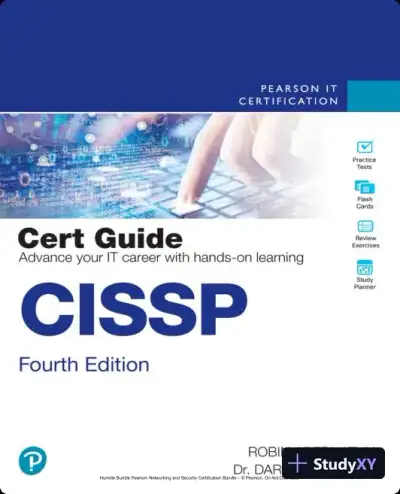 Certification Guides
CISSP Cert Guide (2022)
Certified Information Systems Security Professional
1033 pages148downloadsFeb 2025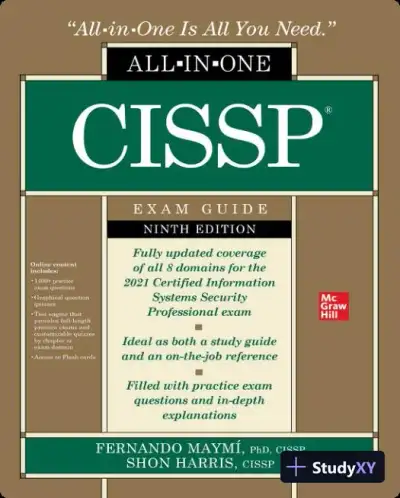 Certification Guides
CISSP All-in-One Exam Guide (2021)
Certified Information Systems Security Professional
1361 pages145downloadsFeb 2025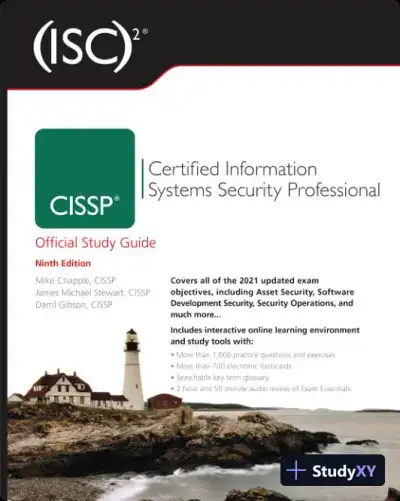 Certification Guides
CISSP Official Study Guide (2021)
Certified Information Systems Security Professional
1250 pages143downloadsFeb 2025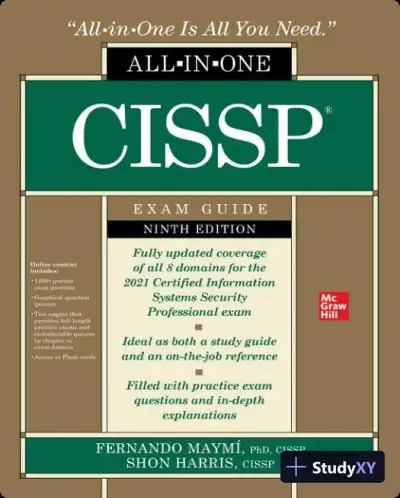 Certification Guides
All in One CISSP Exam Guide (2022)
Certified Information Systems Security Professional
1361 pages143downloadsFeb 2025 Certification Guides
ISC2 Cissp Certified Information Systems Security Professional Official Practice Tests (2021)
Certified Information Systems Security Professional
744 pages109downloadsFeb 2025 Certification Guides
CISSP Official Practice Tests (2021)
Certified Information Systems Security Professional
499 pages109downloadsFeb 2025 Certification Guides
CISSP® Study Guide (2023)
Certified Information Systems Security Professional
642 pages56downloadsFeb 2025 Certification Guides
The Official ISC2 CISSP CBK Reference (2021)
Certified Information Systems Security Professional
674 pages53downloadsFeb 2025
Study this document with CramX
Once it is in your library, every tool can work from it.