

CCNP Enterprise Wireless Design ENWLSD 300-425 and Implementation ENWLSI 300-430 Official Cert Guide (2024)
- Cisco Certified Network Professional
- 970 pages
- Shared February 2025
- 106 downloads
CCNP Enterprise Wireless Design ENWLSD 300-425 and Implementation ENWLSI 300-430 Official Cert Guide (2024) is your shortcut to certification success—start preparing today!
Preview 31 of 970 pages
See the first 31 pages exactly as they appear in the document.
Page 1 Read page 1 as text
T= StudyX
Page 2 Read page 2 as text
Downloaded from StudyXY.com = — ® + StudyXY Sd Ye. o> \ | iF ’ pr E \ 3 S Stu dy Anything This ContentHas been Posted On StudyXY.com as supplementary learning material. StudyXY does not endrose any university, college or publisher. Allmaterials posted are under the liability of the contributors. wv 8) www.studyxy.com
Page 3 Read page 3 as text
T= StudyX
Page 4 Read page 4 as text
About This eBook ePUB is an open, industry-standard format for eBooks. However, support of ePUB and its many features varies across reading devices and applications. Use your device or app settings to customize the presentation to your liking. Settings that you can customize often include font, font size, single or double column, landscape or portrait mode, and figures that you can click or tap to enlarge. For additional information about the settings and features on your reading device or app, visit the device manufacturer’s Web site. Many titles include programming code or configuration examples. To optimize the presentation of these elements, view the eBook in single- column, landscape mode and adjust the font size to the smallest setting. In addition to presenting code and configurations in the reflowable text format, we have included images of the code that mimic the presentation found in the print book; therefore, where the reflowable format may compromise the presentation of the code listing, you will see a “Click here to view code image” link. Click the link to view the print-fidelity code image. To return to the previous page viewed, click the Back button on your device or app.
Page 5 Read page 5 as text
CCNP Enterprise Wireless Design ENWLSD 300-425 and Implementation ENWLSI 300-430 Official Cert Guide 2nd Edition
Page 6 Read page 6 as text
Companion Website and Pearson Test Prep Access Code Access interactive study tools on this book’s companion website, including practice test software, review exercises, Key Term flash card application, a study planner, and more! To access the companion website, simply follow these steps: 1. Go to www.ciscopress.com/register. 2. Enter the print book ISBN: 9780138249892. 3. Answer the security question to validate your purchase. 4. Go to your account page. 5. Click on the Registered Products tab. 6. Under the book listing, click on the Access Bonus Content link. When you register your book, your Pearson Test Prep practice test access code will automatically be populated with the book listing under the Registered Products tab. You will need this code to access the practice test that comes with this book. You can redeem the code at PearsonTestPrep.com. Simply choose Pearson IT Certification as your product group and log into the site with the same credentials you used to register your book. Click the Activate New Product button and enter the access code. More detailed instructions on how to redeem your access code for both the online and desktop versions can be found on the companion website. If you have any issues accessing the companion website or obtaining your Pearson Test Prep practice test access code, you can contact our support team by going to pearsonitp.echelp.org.
Page 7 Read page 7 as text
CCNP Enterprise Wireless Design ENWLSD 300-425 and Implementation ENWLSI 300-430 Official Cert Guide 2nd Edition Jerome Henry, CCIE® No. 24750 David Hucaby, cCIE® No. 4594, CWNE No. 292 Cisco Press
Page 8 Read page 8 as text
CCNP Enterprise Wireless Design ENWLSD 300- 425 and Implementation ENWLSI 300-430 Official Cert Guide 2nd Edition Jerome Henry David Hucaby Copyright© 2024 Cisco Systems, Inc. Published by: Cisco Press $PrintCode Library of Congress Control Number: 2023920459 ISBN-13: 978-0-13-824989-2 ISBN-10: 0-13-824989-X Warning and Disclaimer This book is designed to provide information about the CCNP Enterprise Wireless Design ENWLSD 300-425 and Enterprise Wireless Implementation ENWLSI 300-430 exams. Every effort has been made to make this book as complete and as accurate as possible, but no warranty or fitness is implied. The information is provided on an “as is” basis. The authors, Cisco Press, and Cisco Systems, Inc. shall have neither liability nor responsibility to any person or entity with respect to any loss or damages arising from the information contained in this book or from the use of the discs or programs that may accompany it. The opinions expressed in this book belong to the authors and are not necessarily those of Cisco Systems, Inc.
Page 9 Read page 9 as text
Trademark Acknowledgments All terms mentioned in this book that are known to be trademarks or service marks have been appropriately capitalized. Cisco Press or Cisco Systems, Inc., cannot attest to the accuracy of this information. Use of a term in this book should not be regarded as affecting the validity of any trademark or service mark. Microsoft and/or its respective suppliers make no representations about the suitability of the information contained in the documents and related graphics published as part of the services for any purpose all such documents and related graphics are provided “as is” without warranty of any kind. Microsoft and/or its respective suppliers hereby disclaim all warranties and conditions with regard to this information, including all warranties and conditions of merchantability, whether express, implied or statutory, fitness for a particular purpose, title and non-infringement. In no event shall Microsoft and/or its respective suppliers be liable for any special, indirect or consequential damages or any damages whatsoever resulting from loss of use, data or profits, whether in an action of contract, negligence or other tortious action, arising out of or in connection with the use or performance of information available from the services. The documents and related graphics contained herein could include technical inaccuracies or typographical errors. Changes are periodically added to the information herein. Microsoft and/or its respective suppliers may make improvements and/or changes in the product(s) and/or the program(s) described herein at any time. Partial screen shots may be viewed in full within the software version specified. Microsoft® Windows®, and Microsoft Office® are registered trademarks of the Microsoft Corporation in the U.S.A. and other countries. This book is not sponsored or endorsed by or affiliated with the Microsoft Corporation. Special Sales For information about buying this title in bulk quantities, or for special sales opportunities (which may include electronic versions; custom cover designs; and content particular to your business, training goals, marketing focus, or
Page 10 Read page 10 as text
branding interests), please contact our corporate sales department at corpsales@pearsoned.com or (800) 382-3419. For government sales inquiries, please contact governmentsales@pearsoned.com. For questions about sales outside the U.S., please contact intlcs@pearson.com. Feedback Information At Cisco Press, our goal is to create in-depth technical books of the highest quality and value. Each book is crafted with care and precision, undergoing rigorous development that involves the unique expertise of members from the professional technical community. Readers’ feedback is a natural continuation of this process. If you have any comments regarding how we could improve the quality of this book, or otherwise alter it to better suit your needs, you can contact us through email at feedback@ciscopress.com. Please make sure to include the book title and ISBN in your message. We greatly appreciate your assistance. Vice President, IT Professional: Mark Taub Alliance Manager: Caroline Antonio Director, ITP Product Management: Brett Bartow Executive Editor: Nancy Davis Managing Editor: Sandra Schroeder Development Editor: Ellie Bru Senior Project Editor: Mandie Frank Copy Editor: Kitty Wilson Technical Editor: Samuel Clements
Page 11 Read page 11 as text
Editorial Assistant: Cindy Teeters Designer: Chuti Prasertsith Composition: codeMantra Indexer: Erika Millen Proofreader: Donna E. Mulder Americas Headquarters Cisco Systems, Inc. San Jose, CA Asia Pacific Headquarters Cisco Systems (USA) Pte. Ltd. Singapore Europe Headquarters Cisco Systems International BV Amsterdam, The Netherlands Cisco has more than 200 offices worldwide. Addresses, phone numbers, and fax numbers are listed on the Cisco Website at www.cisco.com/go/offices. CODE, CCENT. Cisco Eos, Cisco Health Presence, the Cisco logo, Cisco Lumin, Cisco Nexus, Cisco Stadium Vision, Cisco Telepresence, Cisco WebEx, DCE, and Welcome to the Human Network are trademarks; Changing the Way We Work, Live, Play, and Learn and Cisco Store are service marks; and Access Registrar, Airanet, AsyncOS, Bringing the Meeting To You, Catalyst, CCDA, CCDR CCIE, CCIR CCNA, CCNR CCSR CCVR Cisco, the Cisco Certified Internetwork Expert logo, Cisco 10S, Cisco Press, Cisco Systems, Cisco Systems Capital, the Cisco Systems
Page 12 Read page 12 as text
logo, Cisco Unity, Collaboration Without Limitation, EtherFast, EtherSwitch, Event Center, Fast Step Follow Me Browsing, FormShare, GigaDrlve, Home Link, Internet Quotient, IOS, i Phone, [Quick Study, IronPort, the Iran Port logo, LightStream, Linksys, MedlaTone, MeetingPlace, MeetingPlace Chime Sound, MGX, Networkers, Networking Academy, Network Registrar low, PIX, PowerPanels, ProConnect, ScriptShare, SenderBase, SMARTnet, Spectrum Expert, StackWise. The Fastest Way to Increase Your Internet Quotient TransPath, WebEx, and the WebEx logo are registered trademarks of Cisco Systems, Inc. and/or its affiliates In the United States and certain other countries. All other trademarks mentioned In this document or website are the property of their respective owners. The use of the word partner does not Imply a partnership relationship between Cisco and any other company. (0812R)
Page 13 Read page 13 as text
) . . . Pearson’s Commitment to Diversity, Equity, and Inclusion Pearson is dedicated to creating bias-free content that reflects the diversity of all learners. We embrace the many dimensions of diversity, including but not limited to race, ethnicity, gender, socioeconomic status, ability, age, sexual orientation, and religious or political beliefs. Education is a powerful force for equity and change in our world. It has the potential to deliver opportunities that improve lives and enable economic mobility. As we work with authors to create content for every product and service, we acknowledge our responsibility to demonstrate inclusivity and incorporate diverse scholarship so that everyone can achieve their potential through learning. As the world’s leading learning company, we have a duty to help drive change and live up to our purpose to help more people create a better life for themselves and to create a better world. Our ambition is to purposefully contribute to a world where: = Everyone has an equitable and lifelong opportunity to succeed through learning. = Our educational products and services are inclusive and represent the rich diversity of learners. = Our educational content accurately reflects the histories and experiences of the learners we serve. = Our educational content prompts deeper discussions with learners and motivates them to expand their own learning (and worldview). While we work hard to present unbiased content, we want to hear from you about any concerns or needs with this Pearson product so that we can investigate and address them. = Please contact us with concerns about any potential bias at https://www.pearson.com/report-bias.html.
Page 14 Read page 14 as text
About the Authors Jerome Henry, CCIE No. 24750, is a Distinguished Engineer in the Office of the Wireless CTO at Cisco Systems. Jerome has more than 20 years’ experience teaching technical Cisco courses, in more than 15 countries and four languages, to audiences ranging from bachelor’s degree students to networking professionals and Cisco internal system engineers. Focusing on his wireless and networking experience, Jerome joined Cisco in 2012. Before that time, he was consulting and teaching about heterogeneous networks and wireless integration with the European Airespace team, which was later acquired by Cisco to become its main wireless solution. He then spent several years with a Cisco Learning Partner, developing networking courses and working on training materials for emerging technologies. Jerome is a certified wireless networking expert (CWNE No. 45), has developed multiple Cisco courses, and has authored several books and video courses on wireless technology. Jerome holds more than 500 patents, is a member of the IEEE, where he was elevated to Senior Member in 2013, and also represents Cisco in multiple Wi-Fi Alliance working groups. With more than 10,000 hours in the classroom, Jerome was awarded the IT Training Award Best Instructor silver medal. He is based in Research Triangle Park, North Carolina. David Hucaby, CCIE No. 4594, CWNE No. 292, is a technical education content engineer for Cisco Meraki. Previously, he worked as a wireless escalation engineer in a large healthcare environment for over 20 years. David holds bachelor’s and master’s degrees in electrical engineering. He has been authoring Cisco Press titles for 25 years. David lives in Kentucky.
Page 15 Read page 15 as text
About the Technical Reviewer Samuel Clements, CCIE Wireless No. 40629, is a Mobility Technical Solutions Architect for World Wide Technology (wwt.com), a Global VAR. He is CWNE No. 101 and is active in all things Wi-Fi. You can find him blogging at http://www .sc-wifi.com/ and on X (formerly Twitter) at @samuel_clements. When he’s not doing Wi-Fi things, he’s spending time in Tennessee with his wife of 15 years, Sara, and his two children, Tristan and Ginny.
Page 16 Read page 16 as text
Dedications In many ways, this century (and probably the previous ones) resembles Wi- Fi. Every few years, new developments fundamentally change the way we work and communicate. Each time we look back a few years, we realize that today we have more information to absorb and more new technologies to understand. What was concluded as impossible is now experimented with or achieved sooner and faster than we thought. As you open this book, dear reader, to prepare for the CCNP exam, this step may look steep today, but it will soon be just a memory of a time you knew less and could do less. Your will to excel and deepen your knowledge is what you, dear reader, give to us, the authors, as a reason to continue sharpening our expertise and sharing what we have learned on the way. So this book is for you, dear reader, and your aspiration to excellence. As my family blazon says, sic itur ad astro: “this is how you reach for the stars.” —Jerome Henry As always, my work is dedicated to my wife, my daughters, and my twin grandsons, for their love and support, and to God, who has blessed me with opportunities to learn, write, and work with so many friends—abundant life indeed! —David Hucaby
Page 17 Read page 17 as text
Acknowledgments My dear wife, Corinne, often says that she knows “that look,” she knows “that pace,” when I walk back and forth in the corridor of our home leading to my office. She knows when I am not satisfied with a sentence, critical of an explanation that I do not find clear enough, or unhappy with an example or an analogy that does not quite work like it should. Each time, she patiently throws me a question to help me verbalize the problem and, in the end, puts her finger on what was missing. This book would not have been possible without her patience. “Patience made human” is also how I see Brett Bartow and Nancy Davis, who helped us navigate the complexity of changing exam scopes, and Ellie Bru, who week after week herded us, her authors, corrected our mistakes, and patted our backs to help us stay at the level of quality she expected. If this book is not a collection of disorganized notes on pieces of napkins, it is thanks to them. And, of course, flying with multiple pilots only works if each of them mixes excellence in their domain, acceptance that another one may be covering the left or the right field, and a permanent re- assessment of who is where, who has covered what, and who has left what gap or ground to complete. I could not dream of a better co-pilot than Dave, who was kind enough to accept me and enjoy this flight together. —Jerome Henry It’s again a great pleasure to have worked on a project with Jerome Henry, whom I have long admired for his Wi-Fi knowledge and experience. He’s not only that—he’s been a superb co-author and a kind and gracious friend. Ellie Bru has been an awesome development editor and has kept us motivated all along the way with encouragement and funny GIFs. I'm grateful to Brett Bartow and Nancy Davis for giving me another opportunity to write. Many thanks to Samuel Clements for his fine technical editing, expertise, and review. I have graduated from reading his blog to reading his comments and suggestions. —David Hucaby
Page 18 Read page 18 as text
Contents at a Glance Introduction Part I Wireless Design (ENWLSD) Chapter 1 Wireless Design Requirements Chapter 2 Conducting an Offsite Site Survey Chapter 3 Conducting an Onsite Site Survey Chapter 4 Physical and Logical Infrastructure Requirements Chapter 5 Applying Wireless Design Requirements Chapter 6 Designing Radio Management Chapter 7 Designing Wireless Mesh Networks Chapter 8 Designing for Client Mobility Chapter 9 Designing High Availability Part IT Wireless Implementation (ENWLSI) Chapter 10 Implementing FlexConnect Chapter 11 Implementing Quality of Service on a Wireless Network Chapter 12 Implementing Multicast Chapter 13 Location Services Deployment Chapter 14 Advanced Location Services Implementation Chapter 15 Security for Wireless Client Connectivity
Page 19 Read page 19 as text
Chapter 16 Monitoring and Troubleshooting WLAN Components Chapter 17 Device Hardening Chapter 18 Final Preparation Chapter 19 ENWLSD 300-425 and ENWLSI 300-430 Exam Updates Appendix A Wi-Fi 6 (802.11ax) Appendix B Software-Defined Access with Wireless Appendix C RRM TPC Algorithm Example Appendix D Answers to the “Do I Know This Already?” Quizzes and Review Questions Glossary Index Online Element Appendix E Study Planner
Page 20 Read page 20 as text
Reader Services Register your copy at www.ciscopress.com/title/9780138249892 for convenient access to downloads, updates, and corrections as they become available. To start the registration process, go to www.ciscopress.com/register and log in or create an account.* Enter the product ISBN 9780138249892 and click Submit. When the process is complete, you will find any available bonus content under Registered Products. *Be sure to check the box indicating that you would like to hear from us to receive exclusive discounts on future editions of this product.
Page 21 Read page 21 as text
Contents Introduction Part I Wireless Design (ENWLSD) Chapter 1 Wireless Design Requirements “Do I Know This Already?” Quiz Foundation Topics Following a Design Process Evaluating Customer Requirements Evaluating Client Requirements Examining Client 802.11 Capabilities Examining Client RF Capabilities Examining Client Security Capabilities Examining Client Density Choosing AP Types Evaluating Security Requirements AP Deployment Models Data Deployment Model Voice/Video Deployment Model Location Deployment Model AP Deployment Model Summary Summary Exam Preparation Tasks Review All Key Topics Define Key Terms
Page 22 Read page 22 as text
Chapter 2 Conducting an Offsite Site Survey “Do I Know This Already?” Quiz Foundation Topics The Effect of Material Attenuation on Wireless Design Common Deployment Models for Different Industries Enterprise Office Small or Home Offices Healthcare Hospitality and Hotels Hotspots Education Retail Warehousing Manufacturing Designing with Regulations in Mind Choosing the Right Survey Type A Survey of Wireless Planning Tools Conducting a Predictive Site Survey Summary References Exam Preparation Tasks Review All Key Topics Define Key Terms Chapter 3 Conducting an Onsite Site Survey “Do I Know This Already?” Quiz Foundation Topics Performing a Walkthrough Survey
Page 23 Read page 23 as text
Performing a Layer 1 Survey L1 Sweep Tool Essentials Interferer Types and Effects Surveying for Interferers Performing a Layer 2 Survey The Site Survey Process Data Versus Voice Versus Location Deployments Performing a Post-Deployment Onsite Survey Summary References Exam Preparation Tasks Review All Key Topics Define Key Term Chapter 4 Physical and Logical Infrastructure Requirements “Do I Know This Already?” Quiz Foundation Topics Physical Infrastructure Requirements PoE and PoE+ UPOE and UPOE+ Power Injectors MultiGigabit Mounting Access Points Ceiling and Wall Mounting Access Points Mounting Access Points Below a Suspended Ceiling Mounting Access Points Above the Ceiling Tiles Grounding and Securing Access Points Logical Infrastructure Requirements
Page 24 Read page 24 as text
CAPWAP Flow AAA and DHCP Services Logical Path Licensing Overview Right to Use Licensing Smart Licensing Summary References Exam Preparation Tasks Review All Key Topics Define Key Terms Chapter 5 Applying Wireless Design Requirements “Do I Know This Already?” Quiz Foundation Topics Defining AP Coverage Considering Receive Sensitivity Considering the Signal-to-Noise Ratio Further AP Cell Considerations Expanding Coverage with Additional APs Designing a Wireless Network for Data Designing a Wireless Network for High Density Limiting the Transmit Power Level Leveraging APs and Antennas Designing a Wireless Network for Voice and Video Designing a Wireless Network for Location Summary Exam Preparation Tasks Review All Key Topics
Page 25 Read page 25 as text
Define Key Terms Chapter 6 Designing Radio Management “Do I Know This Already?” Quiz Foundation Topics Understanding RRM Discovering the RF Neighborhood with NDP RF Groups Transmit Power Control (TPC) Dynamic Channel Assignment (DCA) Coverage Hole Detection Flexible Radio Assignment (FRA) Localizing RRM with RF Profiles Optimizing AP Cell Sensitivity with RxSOP Summary Exam Preparation Tasks Review All Key Topics Define Key Terms Chapter 7 Designing Wireless Mesh Networks “Do I Know This Already?” Quiz Foundation Topics Mesh Network Architecture and Components Mesh Access Points Access Point Roles in a Mesh Network Mesh Network Architecture Overview Site Preparation and Planning Supported Frequency Bands Dynamic Frequency Selection
Page 26 Read page 26 as text
Antenna and Mounting Considerations for Outdoor Mesh Mesh Convergence and Traffic Flows Adaptive Wireless Path Protocol Traffic Flow Through the Mesh Ethernet Bridging Cisco Wi-Fi Mesh Configuration Daisy-Chaining Wireless Mesh Links Workgroup Bridges Workgroup Bridging Overview Configuring Workgroup Bridges Summary References Exam Preparation Tasks Review All Key Topics Define Key Terms Chapter 8 Designing for Client Mobility “Do I Know This Already?” Quiz Foundation Topics Roaming Review Autonomous APs Intra-Controller (Layer 2) Roam Inter-Controller (Layer 2) Roam Inter-Controller (Layer 3) Roam Organizing Roaming Behavior with Mobility Groups Defining the Mobility Hierarchy Exploring Mobility Operations Validating the Mobility Hierarchy and Tunneling
Page 27 Read page 27 as text
Optimizing AP Selection for Client Roaming Optimizing the AP Scanning Process Optimizing with CCX Assistance Optimizing with 802.11k Assistance Optimizing with 802.11v Assistance Optimizing Security Processes for Roaming RSN in a Nutshell PMKID Caching or SKC Caching Opportunistic Key Caching (OKC) Preauthentication CCKM 802.11r: Fast BSS Transition (FT) Fast Secure Roaming Review Summary Exam Preparation Tasks Review All Key Topics Define Key Terms Chapter 9 Designing High Availability “Do I Know This Already?” Quiz Foundation Topics Making Controller Connectivity More Resilient Designing High Availability for APs AP Prioritization Detecting a Controller Failure AP Fallback Designing High Availability for Controllers N+1 Redundancy
Page 28 Read page 28 as text
N+N Redundancy N+N+1 Redundancy SSO Redundancy Summary Exam Preparation Tasks Review All Key Topics Define Key Terms Part IT Wireless Implementation (ENWLSI) Chapter 10 Implementing FlexConnect “Do I Know This Already?” Quiz Foundation Topics Remote Office Wireless Deployment Modes FlexConnect Overview and Requirements Modes of Operation WAN Requirements for FlexConnect Implementing FlexConnect with AireOS Converting the AP to FlexConnect Mode Configuring the Locally Switched WLANs Configuring the Native VLAN and WLAN-to- VLAN Mapping Implementing FlexConnect Groups FlexConnect High Availability and Resiliency FlexConnect Resiliency Scenarios AAA Survivability Configuring AAA Survivability CAPWAP Message Aggregation FlexConnect ACLs
Page 29 Read page 29 as text
VLAN ACLs FlexConnect Split Tunneling (Using the Split ACL Mapping Feature) FlexConnect Smart AP Image Upgrades Implementing FlexConnect with IOS XE Controllers A Summary of FlexConnect Best Practice Recommendations Office Extend ME and EWC Summary References Exam Preparation Tasks Review All Key Topics Define Key Terms Chapter 11 Implementing Quality of Service on a Wireless Network “Do I Know This Already?” Quiz Foundation Topics An Overview of Wireless QoS Principles The Distributed Coordination Function Retrofitting DCF: Enhanced Distributed Channel Access (EDCA) Access Categories Arbitration Interframe Space Number (AIFSN) Contention Window Enhancements Transmission Opportunity (TXOP) 802.11 Traffic Specification (TSpec) Implementing QoS Policies on Wireless Controllers
Page 30 Read page 30 as text
QoS Mapping and Marking Schemes Between the Client and Controller Handling QoS Ceilings for the WLAN Implementing QoS on an IOS XE Controller Implementing QoS on an AireOS Controller Implementing QoS for Wireless Clients Implementing Client QoS Marking Schemes Implementing Application Visibility and Control Implementing AVC on a Cisco Wireless Controller Summary References Exam Preparation Tasks Review All Key Topics Define Key Terms Chapter 12 Implementing Multicast “Do I Know This Already?” Quiz Foundation Topics Multicast Overview Multicast Delivery in a Wireless Network IGMP Snooping Implementing Wireless Multicast Implementing mDNS Implementing Multicast Direct Summary References Exam Preparation Tasks Review All Key Topics
Page 31 Read page 31 as text
Define Key Terms Chapter 13 Location Services Deployment “Do I Know This Already?” Quiz Foundation Topics Indoor Location Indoor Location Protocols Infrastructure and 802.11-Based Location Cell of Origin Techniques RSSI Trilateration Techniques Angle of Arrival (AoA) Techniques 802.11 Frames Used for Location Precision Versus Accuracy Deploying Location Services Location Engines and Services Configuring APs and WLCs for Location Support Deploying Cisco Spaces and CMX Initial Installation CMX Deployment Configuration Cisco Spaces Deployment Configuration Tracking Clients, RFID Tags, Rogues, and Interferers Tracking Mobile Devices with CMX Tracking Mobile Devices with Cisco Spaces Customizing Location Services Customizing CMX Location Services Customizing Cisco Spaces Location Services Summary References
939 more pages in the full document
Unlock it once and it stays in your library, ready to chat with or turn into flashcards.
Unlock the full documentMore Cisco Certified Network Professional study materials
See all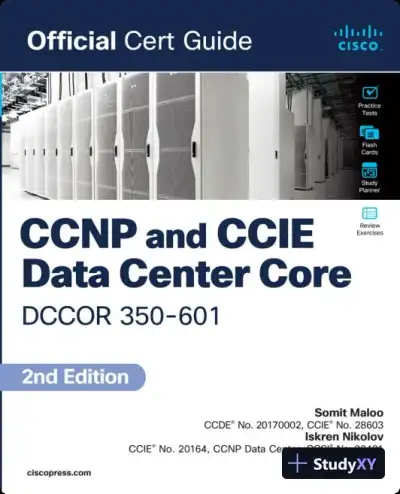 Certification Guides
CCNP and CCIE Data Center Core DCCOR 350-601 Official Cert Guide (2023)
Cisco Certified Network Professional
1111 pages161downloadsFeb 2025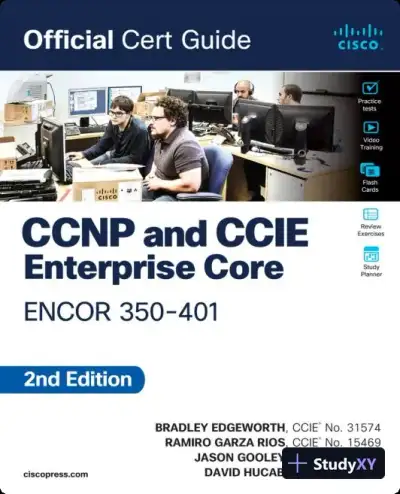 Certification Guides
CCNP and CCIE Enterprise Core ENCOR 350-401 Official Cert Guide (2023)
Cisco Certified Network Professional
1149 pages151downloadsFeb 2025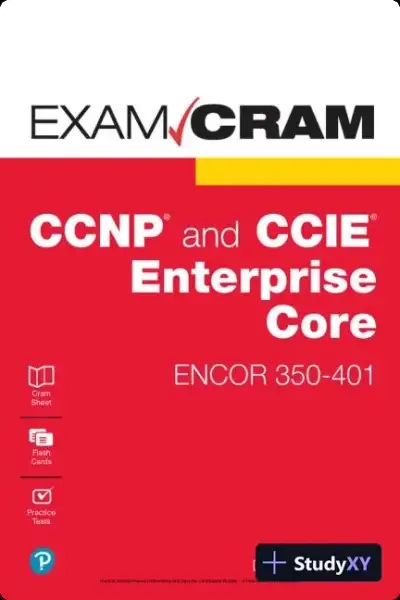 Certification Guides
CCNP and CCIE Enterprise Core ENCOR 350-401 Exam Cram (2022)
Cisco Certified Network Professional
798 pages130downloadsFeb 2025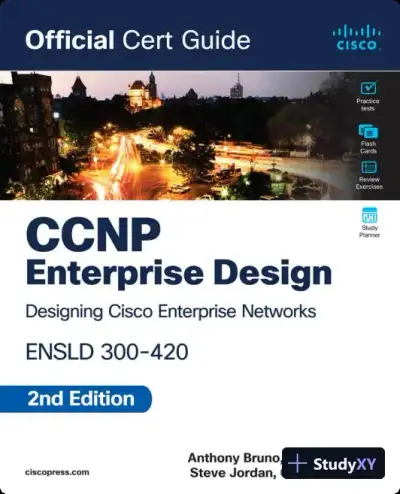 Certification Guides
CCNP Enterprise Design ENSLD 300-420 Official Cert Guide (2024)
Cisco Certified Network Professional
601 pages124downloadsFeb 2025 Certification Guides
CCNP and CCIE Enterprise Core ENCOR 350-401 Exam Cram (2022)
Cisco Certified Network Professional
827 pages110downloadsFeb 2025 Certification Guides
CCNP Enterprise Certification Study Guide (2020)
Cisco Certified Network Professional
679 pages108downloadsFeb 2025 Certification Guides
CCNP and CCIE Data Center Core DCCOR 350-601 Official Cert Guide (2020)
Cisco Certified Network Professional
1260 pages102downloadsFeb 2025 Certification Guides
CCNP and CCIE Enterprise Core and CCNP Advanced Routing Portable Command Guide: All ENCOR (350-401) and ENARSI (300-410) (2020)
Cisco Certified Network Professional
1146 pages92downloadsFeb 2025
Study this document with CramX
Once it is in your library, every tool can work from it.