

Criminal Justice - The Criminal Justice System
- Criminal Justice
- Texas A&M University
- 12 pages
- Shared March 2026
Preview 4 of 12 pages
See the first 4 pages exactly as they appear in the document.
Page 1 Read page 1 as text
Study Guide Criminal Jus Ɵ ce – The Criminal Jus Ɵ ce System 1. The Process of Criminal Jus Ɵ ce 1.1 Rules in Criminal Jus Ɵ ce The criminal justice system follows rules that come from many sources: • The U.S. Constitution and the Bill of Rights • State constitutions • Federal and state laws (codes) • Court decisions • Federal and state rules of criminal procedure • Rules from government agencies and departments For example, the Federal Rules of Criminal Procedure tell courts across the U.S. how criminal cases should be handled. 1.2 Discre Ɵ on: Decisions Beyond the Rules While rules are important, criminal justice also involves discretion . Discretion means making a decision based on personal judgment , not just following rules. Discretion happens all the time in criminal justice: • Police decide whether to investigate, search, arrest, or use force. • Prosecutors decide whether to file charges or offer plea deals. • Judges set bail, accept or reject plea bargains, and decide sentences.
Page 2 Read page 2 as text
Study Guide • Parole boards decide when inmates can be released. Basically, discretion lets criminal justice professionals weigh options and make the best choice in each situation. 1.3 Steps in the Criminal Jus Ɵ ce Process The criminal justice process has many steps. Here’s a clear guide: 1. Inves Ɵ ga Ɵ on Police investigate crimes to collect evidence , identify suspects, and prepare for arrests. Investigations can include searches , which require probable cause — facts that show evidence of a crime is likely in a specific place. 2. Arrest An arrest happens when the police take someone into custody . Like searches, arrests also require probable cause — a reasonable link between a person and a crime. 3. Prosecu Ɵ on The district attorney (DA) decides whether to charge a suspect with a crime . They consider the seriousness of the offense and the strength of the evidence. 4. Charging: Indictment or Informa Ɵ on • For serious crimes, a grand jury may issue an indictment , deciding in a closed hearing whether charges should move forward. • In other cases, prosecutors can file an information , followed by a preliminary hearing to see if there’s enough evidence for trial. • Probable cause is the standard here, too. 5. Arraignment
Page 3 Read page 3 as text
Study Guide The defendant goes to court to enter a plea — usually “guilty” or “not guilty.” 6. Pretrial Deten Ɵ on or Bail • Detention is temporary custody before trial. • Bail is money paid to ensure the defendant will return for trial. 7. Plea Bargaining Sometimes, the defense and prosecutor negotiate a deal. The defendant may plead guilty in exchange for a reduced charge or lighter sentence . 8. Trial If the case goes to trial, a judge or jury decides guilt. • The standard is beyond a reasonable doubt — not 100% certain, but high enough that there’s no reasonable question. 9. Sentencing If found guilty, the judge decides the punishment , which can include: • Fines • Probation • Jail or prison time • A combination of supervision and incarceration 10. Appeals The defendant can challenge a conviction in appellate court . • If the appellate court reverses the case, it may go back to trial. • The prosecutor may refile or drop charges, but the case can still be prosecuted later if the statute of limitations hasn’t expired.
Page 4 Read page 4 as text
Study Guide 11. Punishment and Rehabilita Ɵ on Most inmates don’t serve their full sentence. They may be released early through: • Parole • Pardon • Or by serving the full sentence 1.4 The “Funnel” of Criminal Jus Ɵ ce Think of the criminal justice process like a funnel : • Wide at the top: Many cases start with investigations and arrests. • Narrow at the bottom: Fewer cases reach trial and incarceration. Some cases are dismissed or sent for treatment or counseling instead of going further. The law requires that the government prove its case with facts whenever it takes away someone’s rights or freedom. The more serious the action , the more evidence is needed : • A street stop requires fewer facts than an arrest. • An arrest requires fewer facts than an indictment. • An indictment requires fewer facts than a conviction. 2. The Poli Ɵ cs of Criminal Jus Ɵ ce Politics plays a big role in criminal justice. At its core, politics is about deciding who gets what, when, and how . This process affects how laws are made, how decisions are enforced, and how resources are distributed. While politics is necessary, it can sometimes create challenges for the justice system. Let’s explore how.
8 more pages in the full document
Unlock it once and it stays in your library, ready to chat with or turn into flashcards.
Unlock the full documentMore Criminal Justice study materials
See all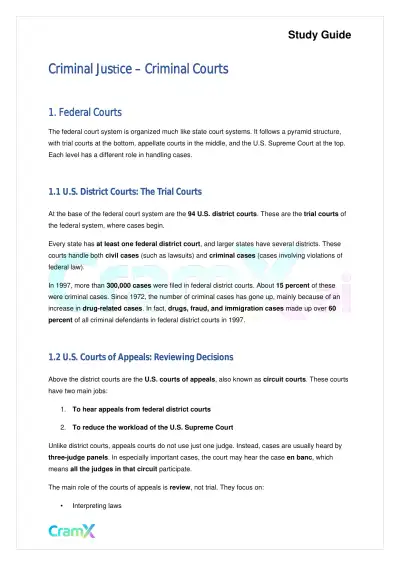 Quick Guides
Criminal Justice - Criminal Courts
Criminal Justice
19 pagesMar 2026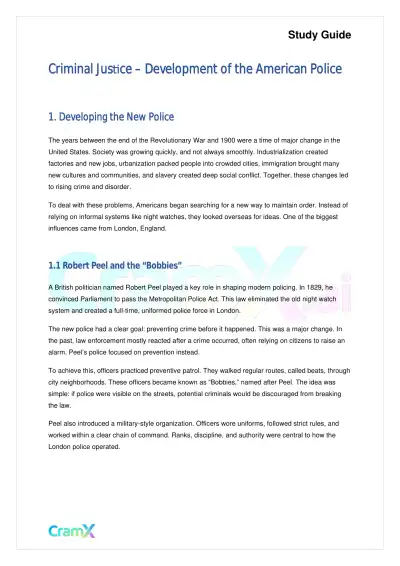 Quick Guides
Criminal Justice - Development of the American Pol
Criminal Justice
22 pagesMar 2026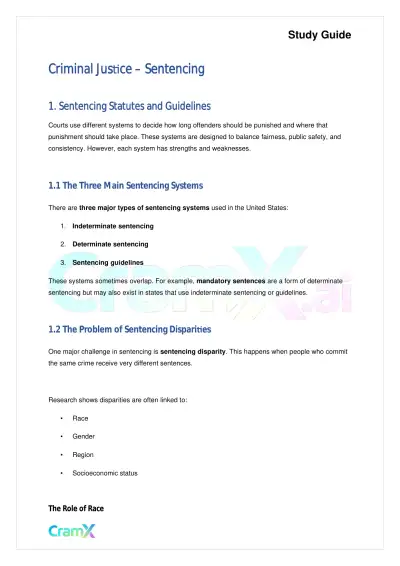 Quick Guides
Criminal Justice - Sentencing
Criminal Justice
18 pagesMar 2026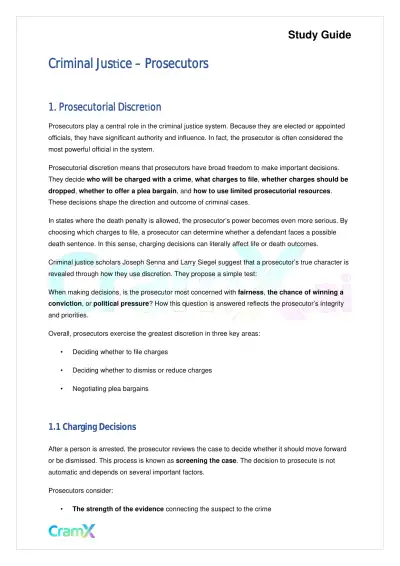 Quick Guides
Criminal Justice - Prosecutors
Criminal Justice
14 pagesMar 2026 Quick Guides
Criminal Justice - Police Powers and Citizens' Rig
Criminal Justice
20 pagesMar 2026 Quick Guides
Criminal Justice - Prisons and Prisoners' Rights
Criminal Justice
13 pagesMar 2026 Quick Guides
Criminal Justice - Defendants' Rights
Criminal Justice
15 pagesMar 2026 Quick Guides
Criminal Justice - Police Function
Criminal Justice
22 pagesMar 2026
Study this document with CramX
Once it is in your library, every tool can work from it.