

College Reading : The Science And Strategies Of Expert Readers, 1st Edition Solution Manual
- Education
- 101 pages
- Shared May 2025
College Reading : The Science And Strategies Of Expert Readers, 1st Edition Solution Manual is your shortcut to understanding difficult textbook chapters.
Preview 16 of 101 pages
See the first 16 pages exactly as they appear in the document.
Page 1 Read page 1 as text
College Reading: The Science and Strategies of Expert Readers 1 TABLE OF CONTENTS T HE N EW S CIENCE OF T EACHING AND L EARNING Background...................................................................................................................................... 4 Introduction ..................................................................................................................................... 4 Benefits of Brain-Compatible Teaching........................................................................................... 4 Make Your Classroom More Brain Compatible .............................................................................. 5 Why Teach Reading? ....................................................................................................................... 7 Why Teach Students about the Brain? ............................................................................................. 7 H OW TO T EACH WITH THE F EATURES IN S CIENCE AND S TRATEGIES Student to Student ............................................................................................................................ 8 Making Connections ........................................................................................................................ 9 Brain Connections: Self-Assessment................................................................................................ 9 Comprehension Checks.................................................................................................................. 10 Tip from the Brain Doctor ............................................................................................................. 10 Practice with a Reading Passage .................................................................................................. 11 Chapter Summary .......................................................................................................................... 11 Post Test......................................................................................................................................... 11 Brain Strengths Options................................................................................................................. 12 C OURSE T EACHING T IPS The First Day of Class: Icebreakers .............................................................................................. 13 Teaching Tips to Engage Students................................................................................................. 15 Mind Mapping in Science and Strategies ....................................................................................... 17 Creating and Facilitating Effective Groups................................................................................... 19 Using Journals with Science and Strategies .................................................................................. 30 Sample Syllabi................................................................................................................................ 31 F EATURES , T EACHING T IPS , AND T ESTS C HAPTER 1: M AKING B RAIN C ONNECTIONS TO B ECOME AN E XPERT R EADER Author Spotlight................................................................................................................ 46 Activities............................................................................................................................ 48 C HAPTER 2: R EMEMBERING W HAT Y OU R EAD Author Spotlight................................................................................................................ 52 Activities............................................................................................................................ 52 C HAPTER 3: D EVELOPING Y OUR C OLLEGE V OCABULARY Author Spotlight................................................................................................................ 57 Activities............................................................................................................................ 58 C HAPTER 4: L OCATING S TATED M AIN I DEAS Author Spotlight................................................................................................................ 60 Activities............................................................................................................................ 61 C HAPTER 5: F INDING S UPPORTING D ETAILS Author Spotlight................................................................................................................ 65 Activities............................................................................................................................ 65 C HAPTER 6: U SING I NFERENCE TO I DENTIFY I MPLIED M AIN I DEAS Author Spotlight................................................................................................................ 67 Activities............................................................................................................................ 68 © C L A N w w
Page 2 Page 3 Read page 3 as text
College Reading: The Science and Strategies of Expert Readers 2 C HAPTER 7: R ECOGNIZING P ATTERNS OF O RGANIZATION Author Spotlight................................................................................................................ 72 Activities............................................................................................................................ 72 C HAPTER 8: U SING P REVIEW , S TUDY -R EAD , AND R EVIEW (PSR) Author Spotlight................................................................................................................ 77 Activities............................................................................................................................ 79 C HAPTER 9: T AKING C ONTROL OF Y OUR T EXTBOOK : M ARKING AND N OTE T AKING Author Spotlight................................................................................................................ 82 Activities............................................................................................................................ 82 C HAPTER 10: U SING V ISUALS TO I NCREASE Y OUR U NDERSTANDING OF T EXTBOOKS Author Spotlight................................................................................................................ 86 Activities............................................................................................................................ 87 C HAPTER 11: U NDERSTANDING AND C REATING A RGUMENTS Author Spotlight................................................................................................................ 90 Activities............................................................................................................................ 91 C HAPTER 12: R EADING A RGUMENTS C RITICALLY Author Spotlight................................................................................................................ 95 Activities............................................................................................................................ 95 C HAPTER 13: R EADING B EYOND THE W ORDS Author Spotlight................................................................................................................ 97 Activities............................................................................................................................ 98 Test Bank questions and answers can be found on the instructor companion website for this title. Go to www.cengagebrain.com to locate the specific book site.
Page 4 Read page 4 as text
College Reading: The Science and Strategies of Expert Readers 4 THE NEW SCIENCE OF TEACHING AND LEARNING Background In the last few years, research on teaching and learning has exploded, including research coming from the fields of neuroscience, medicine, and psychology. In fact, a new specialty has arisen—Educational Neuroscience. In the past, teachers used the term brain-based to speak about these new insights from brain research into the teaching and learning process. As this field has progressed, we have moved to new terminology and new insights, and we can talk about how science, particularly neuroscience, has informed our practice in the classroom. Historically, some untenable leaps were made, but now, as more and more scientists are working with educators and building this bridge between science and education, we have learned more about underlying processes, environmental factors, and student differences that affect learning. Some of this research has implications for actual classroom teaching strategies and student study strategies. While brain research still does not prove anything about what we do in the classroom, it certainly is providing a new window into the learning process and giving us insights that we can translate into practice. This textbook is designed to work with new information coming from all of the cognitive and medical sciences that are illuminating the field of education. Education is at the edge of an exciting new frontier in which new technologies in brain imaging are leading to new insights which lead to new scientific studies involving students leading to new implications for our classrooms. Many steps are required from the brain imaging to the classroom implications, but this new bridge is being crossed and this book is designed with this new information in mind. Introduction College Reading: The Science and Strategies of Expert Readers was written in part by a cognitive neuroscientist who specializes in Educational Neuroscience. Throughout the chapters, you will find tips, information, and strategies coming from this field. Underlying the pedagogy is an understanding of what we currently know about how the brain learns best. Implications from brain research underlie much of what is in the book, in some cases explicitly and in other cases implicitly. Throughout this book you will see lessons and activities that are designed in a way that support the learning process as we are coming to understand it. Traditional lessons and activities are still included for those who prefer to teach and test in traditional style, but at the same time additional options are provided that approach the lessons differently. This combination may be the best of both worlds. Teachers can do what they have seen works best with their students, while having an opportunity to explore non-traditional approaches, activities, and assessments if they so desire. This textbook makes it easy for a teacher to create a more brain-compatible classroom by simply taking advantage of many of the features in this book. Benefits of Brain-Compatible Teaching The benefits of teaching with an awareness of brain research are many. When you as a teacher understand the biological nature of learning (discussed explicitly in Chapter 1 and in segments throughout the book), you can design your lessons accordingly. This explanation of the learning process is presented to students in this textbook because research shows that when students learn that their brain is malleable—that it changes as a result of learning—their achievement rises. This book is designed to increase student achievement by providing them with this important information immediately. We also know that when students understand why something should be done, they are more willing to do it. Therefore, students learn about their brain and the why behind the activities and strategies. This transparency of the learning process is a unique feature of this book. Teachers and students acquire these new insights into learning together.
Page 5 Read page 5 as text
College Reading: The Science and Strategies of Expert Readers 5 Additional benefits to this new approach to teaching and learning accrue throughout the book. The design of the activities, the sometimes unusual process by which a student is taken through a lesson, the order of activities, and the additional options are based on an understanding of the importance of several key aspects of teaching based on neuroscience insights. Making Your Classroom More Brain Compatible There are many ways to create a more brain-compatible classroom that are implicitly and explicitly presented throughout the textbook. Teacher Tips , Tips from the Brain Doctor for the student, and textual information provide you with this information as you go. However, some of the key strategies and insights underlying this textbook are: • Learning involves making connections . The chapters start with a section called Making Connections. This section enables you to guide the student through connecting some of the concepts that will be learned to an existing neural network—what the student is already familiar with. It can be used in multiple ways: class discussion, journal activity, group discussion, or individual reflection. • It isn't enough to fire it , the student must wire it . This means repetition, but not necessarily “drill and kill.” Neuroscience has made clear the importance of repetition and also the sequencing of it, so this underlies the instructions and activities in the book. The repetition or practice occurs in a recursive and spiral fashion and is often achieved by activating more than one pathway or process. • Metacognition is a key factor in learning . Therefore, students are asked to draw their dendrites as a metaphorical metacognitive activity to get them to stop and assess what they know with the Brain Connections: Self-Assessment feature. It also is a factor in reminding them that they have the power to change their brain and to control their learning. A sense of progress is rewarding to the brain and this feature provides them with that sense of progress by asking them to complete the self-assessment early and again later in the learning process. • Students learn better when they figure things out for themselves . This principle from brain research relates to several learning pathways. When students figure things out for themselves, it is rewarding to the brain in the form of chemicals that make them feel good. Many of the activities in the book are designed in such a way as to create this reward. In addition, when students figure things out, they own it, rather than when they memorize it. This process is also motivating and engaging. Rigor is rewarding to the brain, so lessons get more challenging as they go along. This stimulates students who may learn quickly or easily at first and provides a sense of progress, another sense leading to rewarding chemicals in the brain. • Relationships are key to learning. Therefore, most of the activities are designed in such a way that you can put students into groups to do part or all of the activity. In addition, Brain Strengths Options at the end of each chapter provide opportunities for collaborative learning. • We are probably all wired differently . Teachers want to address learning differences in the classroom but find this a challenge. The Brain Strengths Options is a feature designed to work with learning differences. The variety of options allows for students to self-select an activity that uses their strengths. It is critical that students be allowed to select the activity rather than it being assigned. We want to tap into strengths (which they will naturally select) rather than increase stress by giving an assignment that taps into a weakness, such as asking them to show the class a drawing or to sing for the class. It is encouraged that a project be part of every chapter, but you may find that class time does not allow for this. This feature can be used in other ways. Students may select one of these as an alternative to traditional testing if you wish to make that option available. Alternatively, you may allow a student to do a project to make up for missed work. © C L A N w w
Page 6 Read page 6 as text
College Reading: The Science and Strategies of Expert Readers 6 • Learning is more effective when it is meaningful and relates to real life. The readings, activities, and examples were selected with this brain-research principle in mind. The Student to Student feature capitalizes on this. And, Brain Strengths Options is an attempt to create more meaningful activities than that of answering objective questions. As you work with the book, you will gather ideas that you can use to design your own brain- compatible activities. In addition to textbook material, the classroom environment is also important to an effective learning environment based on what we know about brain research and engagement, motivation, relationship to physiology, and emotion. The most important aspect of the classroom environment is safety—emotional safety. Sarcasm, anger, or demeaning comments, of course are not appropriate, as teachers know. However, this goes beyond that. Freedom to fail and try again gives a feeling of safety. Having choice is key to the kind of emotion that is effective for learning. Not only do the Brain Strengths Options provide choices, you can find other ways to give students choice wherever possible as appropriate. Allowing students to work with their strengths when possible through use of Brain Strengths Options gives them a feeling that they will be able to do some of the work and builds success. Starting with something likely to be achievable on the first attempt is another concept coming from brain research. The lessons start simple and build to more challenging tasks. Use the Brain Connections: Self-Assessment feature as a way to remind students of the progress that they are making. Address testing anxiety with some of the suggestions provided in the appendix of the textbook. This is an important issue because anxiety can make it more difficult for students to perform well on tests, thus creating a misleading impression of their true ability. Some simple steps will help you make your overall course more brain compatible: Addressing classroom behavior is an important first step. It is not compatible with what we know about emotion and learning to scare students the first day or to start off hard and get easier, as previous maxims indicate. Negative emotion and fear is not conducive to learning. However, starting out firm yet positive is important. By providing students with a clear, written list of procedures (rules) and consequences you are creating a safe yet effective classroom. Be sure to include that bullying or mocking another student will not be tolerated and state the consequence (sent to dean, referred to counselor, etc.) Another important step is to form relationships . Learn students’ names and have them learn each other’s names. One exciting way to do this is to tell them you are stepping out of the classroom for ten minutes and when you return everyone must know everyone else’s name. That is appropriate for a class of 30 or less and it is exciting and attainable. In addition, you want to address them by name. Not only does that improve attention, but also it creates positive emotion that enhances learning. Take stiff paper and fold it in half lengthwise. Write their name on one side in big letters and have them bring it to class and stand it up on their desk until all names are learned. If they forget it, have them make one and keep some tape handy so they can tape it to the front of their desk. Tell them you are doing this because their name is important to you, but you have 100+ (or whatever the case may be) names to learn. Make sure you use their names. A third important step is to provide a clear, simple syllabus . Design it with the student in mind. Include deadlines. Create a calendar for every month with holidays, test days, and deadlines. Just as with your handout on procedures and consequences, having a sense of what to expect is important to the proper learning environment. Provide assignments in written fashion whenever possible. Keep in mind that students ages 18-25 are still developing their frontal lobes and may not exercise the executive brain as well as older students would. They may struggle with using good judgment, meeting deadlines, planning early for tests, and budgeting their time. Consider giving one free “pass” for a deadline not met. However, keep in mind also that a teacher’s job is to help students grow their frontal lobes well by
Page 7 Read page 7 as text
College Reading: The Science and Strategies of Expert Readers 7 providing them with and expecting them to meet deadlines and schedules. Our job is not to make school easy but to make it engaging! Set a challenge and expect them to rise to it, but keep some scaffolding handy. There are example syllabi on page 31 of this that you can refer to as well. Finally, since research shows that when students understand how much control they have over their learning they rise in achievement, be sure to insist they read the part of the text that instructs them in the learning process . This is the best thing you can do for your students. You will convince them by your leadership that learning about their brain and learning about learning is important with an emphasis on this important aspect of the textbook. Perhaps you may feel that learning study skills is a topic best taught elsewhere or something that can be omitted when time is short, but this textbook goes beyond study skills—it is how to be a better learner , which translates into being a better reader when working through Science and Strategies . Yes, working through this textbook is important and will make them a better reader, but teaching them about their brain, how to use it, and how much control they have over the process will enhance their learning in all classes and throughout life. Why Teach Reading? Reading is not a normal activity. Yes, you read that correctly. There is no single part of the brain devoted to reading as there is for vision or hearing. Instead, there are multiple parts of the brain working together to do a task for which the brain was not originally designed. Reading uses parts of the brain designed for other tasks and recruits them in this task that is relatively new in human history. Therefore, learning to read requires wiring a pathway that is effective and efficient for reading. Neuroimaging shows us that while most good readers use a similar pathway in the brain that is efficient and effective, those with dyslexia sometimes use an alternative pathway. This pathway is not as efficient or effective. In fact, often those with dyslexia must use a compensatory pathway or compensatory strategies to accomplish this quite intricate skill of reading. Science and Strategies was written with this understanding in mind. Topics are selected to help the reader consciously learn the skills and strategies of expert readers. Some will struggle with this more than others depending upon their prior reading experience and their “wiring” for reading. Therefore, opportunities for compensation are included. Suggestions for leading with strengths are provided. Brain Strength Options also reminds students that while reading may be a weakness, they have other strengths that can be used in life to compensate and to support achievement. Why Teach Students about the Brain? Recent neuroscience research studies indicate that when students learn that the brain is malleable and that it changes as a result of experience, their achievement rises. Therefore, Science and Strategies provides explicit information throughout the book about how the activities change the way they have been using their brain or help them create more effective brain “wiring.” A unique feature of Science and Strategies is the chapter on the memory process. It takes the student beyond “I am not good at memorizing” to an understanding of how the brain creates a memory, and the steps that a student can take to consciously create stronger memories. A difficulty that may be invisible to teachers but can underlie reading comprehension problems is working memory. Teachers think that a student can’t comprehend even though he or she seems to be a good reader, but this may actually be a deficit in working memory capacity. The student cannot hold the entire sentence or paragraph in working memory long enough to process the information and make sense of it. To our knowledge, this is the first and only textbook on the market that addresses this underlying issue of working memory. The textbook shows students how to deal with this issue and break down material into © C L A N w w
Page 8 Read page 8 as text
College Reading: The Science and Strategies of Expert Readers 8 units that they can process. It is very empowering to students to understand that it is not that they can’t comprehend, but that they may be “biting off more than they can chew” for their working memory and how to compensate for this. Vocabulary instruction is included throughout the textbook because learning means making connections in the brain, but if students have no understanding of the concept, they cannot make a connection. If they can’t “fire it” then they certainly can’t “wire it.” Again, the importance of this is made explicit to the student. Oftentimes students have trouble reading because they do not understand what is important and what to focus on when reading. Explicit strategies throughout the book help students learn this skill of evaluating what they read and making sense of it. HOW TO TEACH WITH THE FEATURES IN SCIENCE AND STRATEGIES Science and Strategies includes specific features, which were designed with both the instructor and student in mind. The features are designed to provide relevancy, motivation, formative and summative assessments, collaborative experiences, as well as independent learning. It’s not easy motivating students who initially don’t want to be in a developmental reading class. By teaching students that academic success isn’t about intelligence you will open doors; our students are far more capable than they may at first imagine. Success is all about knowing what skills and strategies to use, when to use them, and how to use them. By teaching students how to optimize their ability to learn, instructors can make an immediate connection with students, keep them on track, and provide them with successful and authentic learning experiences. The following features demonstrate to students that successful learning can be fun, engaging, and is a choice. Each feature and strategy provides a goal, as well as the intended benefit to students and instructors. Along with the various features included in the book, the authors wanted to give instructors more information on their favorite parts of Science and Strategies . Throughout the you will find Author Spotlight features and activities for classroom use. The Author Spotlights give you information on why the authors included these items in the book and how to use them in your own classroom. Student to Student Goal : The goal of this feature is to make the instruction relevant. Introducing students to another student who has experienced what they are experiencing also provides students with hope. Relevancy and hope help create a positive foundation for instruction. Overview : Students were interviewed from around the country and invited to discuss their concerns, frustrations, and strengths regarding specific topics. They were also encouraged to share strategies that worked. Benefit to Students : When the chapters are introduced, students who have gone before current students share their story regarding specific strategies and skills. This makes what instructors teach relevant. These introductions are a way to legitimize what students are being asked to learn.
Page 9 Read page 9 as text
College Reading: The Science and Strategies of Expert Readers 9 Benefit to Instructors : In order to get students to buy-in to what you are teaching, it has to be relevant; students need to be able to connect with it. These introductions make that needed connection. They give their viewpoints and provide students with hope. Making Connections Goal: The goal of this feature is to activate students’ existing network of knowledge in order to help them make connections to the new material introduced in that chapter. Overview: The feature consists of a list of five to eight questions. There are no specific instructions for this feature other than a very general guideline. It is to be used as the instructor prefers. Students may think about it, write about it, or talk about it. It is the process , not the modality that is the important part of this feature. Benefit to Students : In order to learn, students must make connections from existing knowledge to the new material. These questions help them activate what they already know and use that prior knowledge to process the information in the chapter. It is a sort of scaffolding for students in that it helps them apply existing concepts and experiences to the new material. It also builds confidence as they start out with a no-fail activity. Benefit to Instructors : Activating prior knowledge is a step that is easily overlooked by instructors as they are pressed for time to get into the chapter. This provides a quick and easy way to incorporate that important first step of ascertaining what they already know. It is designed to be quite flexible for the instructor who can just have them think about it while taking roll, use it for a learning journal, or use it for class discussion to start off a chapter so that students can begin with no wrong answers and build confidence going into the chapter. A teacher may want to select only one question or use them all. It is a very flexible, efficient, and effective way to start the conversation about the concepts in the chapter. Brain Connections: Self-Assessment Goal: This feature is the key to student confidence, engagement, and motivation. Students gain the metacognitive knowledge that when they are practicing, processing, thinking, trying to understand, and working at learning something, their brain actually grows dendrites, which underlie their learning, understanding, and skill. When students make this real connection, they know they can and will learn if they work at it. They know it is a physical fact that by their practicing, processing, thinking, trying to understand, and working at learning, the result will be natural physical changes in their brain that will be their new learning. This metacognitive knowledge empowers students because it provides them with knowledge and confidence about how and why they can and will learn. Thus, by having students self-assess how much they know by imagining and representing how many new dendrites they might have grown, it is no longer a mystery how and why learning occurs; they see that it is in their own hands: If they do it, they grow it; if they grow it, they know it. Share this statement with your students, as and after they learn about the brain in Chapter 1. Also let them know, and remind them each time they do a self-assessment by drawing the amount of dendrites (knowledge, understanding, skill) they imagine that they have, that this metacognitive activity will show them that they can be successful learners if and when they do the work and practice needed to grow their dendrites. Students are always happy to hear this. There are two goals of this feature. One goal is to give students the opportunity to assess the knowledge they already have for the material in the new chapter before they begin reading the chapter. The second goal is to give students the opportunity periodically to focus on and assess their level of understanding as they progress through the chapter. That is, this feature gives students a specific, clear, focused way to assess what they already know about the topic of a chapter and also to keep track of how and what they are learning as they proceed through a chapter. © C L A N w w
Page 10 Read page 10 as text
College Reading: The Science and Strategies of Expert Readers 10 Format: The format for this feature is a box at the beginning of each chapter. The box contains an illustration of a brain cell upon which students are to draw the amount of dendrites they imagine that they already have—the knowledge they already have—for this chapter. There is also a box containing a brain cell at the end of the chapter upon which students draw the amount of dendrites they imagine that they have so far grown, representing the amount of knowledge and skill they have so far learned in the chapter. Benefit to Students: When students understand that learning actually means their brain is growing dendrites, they are able to visualize their learning, which in turn demystifies learning. This metacognitive knowledge is empowering. It makes it possible for students to say, “If I do this work that the teacher and book give me to do, my brain will grow new dendrites—I will learn. Let me draw the dendrites I think that I have now which is what I know now.” As they progress through a chapter, they draw more dendrites on their brain cell, which they know means they have learned more. Because of this empowering knowledge, their confidence, self-efficacy, and engagement increase. Benefit to Instructors: Demystifying learning makes an instructor’s work easier and less stressful. Instructors who guide students to focus on growing their dendrites find that their students are motivated to do more work so they can grow more dendrites and know more. Thus, instructors no longer have the problem of how to motivate or engage their students because students are responsive to their instructor’s assignments when they know that if they do the work assigned by their instructor, they will grow their dendrites and learn more. Discussing with students the connection between drawing dendrites and what students have learned and are learning helps instructors ensure that their students are motivated and engaged. Comprehension Checks Goal: The Comprehension Check is a formative assessment technique—a type of classroom assessment technique (CAT). The goal is to let students and instructors know if students understand the information that has been presented in the chapter, up to the point of the Comprehension Check . Benefit to Students: The Comprehension Checks become a metacognitive tool for students. They begin to think about their thinking in every chapter by learning how to monitor their own thinking. They are guided to ask questions about what they understand. It serves as a checkpoint for students to know if they need to ask for assistance, or if they feel comfortable moving forward. The Comprehension Check is a strategy students should begin applying to all of their other coursework. Benefit to Instructors: The Comprehension Checks let instructors know if corrections need to be made to their lesson plans, or not. If students do not understand the new information presented in the chapter, it will be very obvious. Instructors don’t want to wait for the end-of-the-chapter assessments to learn that students didn’t understand the intent. If necessary, instructors can then use additional activities from the to reinforce concepts, or move on if all students understand the information. Tip from the Brain Doctor Goal: This feature gives students information about the brain from an outside source that they would find credible. Sometimes students don't want to hear study tips from their parents or their teacher, but might be more accepting if they knew the study skills came from someone else, such as a scientific researcher. The feature consists of a piece of research explained in layman terms followed by an explanation of what this might mean in terms of student learning and success, or a tip based on
Page 11 Read page 11 as text
College Reading: The Science and Strategies of Expert Readers 11 something presented in the text. It is written informally, as if the scientist were giving the students an insider tip. Benefit to Students : This feature puts information into a format that might not be overlooked or ignored. It is set apart, quickly read, and is clearly for the students’ benefit. It is more personal than the rest of the text so it benefits them by putting them at the center of the learning. Benefit to Instructors Much of this research may be unfamiliar to instructors as well, so they are actually gaining teaching tips. The feature contains research and practice in a visible, brief format so that it can be accessed and used. It is one of the pathways in the chapters used to reinforce material, but in this case, in a more personal format. Practice with a Reading Passage Goal : This feature is designed to provide guided reading practice with longer readings. Questions become incrementally more challenging so that students are scaffolded through application of the reading strategies taught. Format : This feature occurs at the end of each chapter and has pre- and post-reading questions. Pre- reading questions reinforce the idea of previewing readings. The post-reading questions synthesize the reading strategies from all previous chapters and the current chapter. Benefit to Students : Students can begin to synthesize reading strategies and gain practice in applying them. Benefit to Instructors : This feature sets up scaffolding in learning and allows instructors to address any weak areas before post testing students. Chapter Summary Goal : The summary provides the main point and important details of a chapter, thus providing another review of the material to strengthen the learning of the material. Benefit to Students: The summary is a previewing tool that students can use in order to get an overview of the chapter. It also helps students see the essential elements of a chapter after studying the chapter. Benefit to Instructors : A summary presents important points of a chapter so instructors can review chapters with students. A summary also serves as a previewing tool. Post Test Goal : The Post Test serves as a measurement of student learning, or student learning outcome. Format : A Post Test is presented at the end of the chapter as a cumulative test. Part 1 consists of multiple-choice, matching, true-and-false, and fill-in-the-blank question types. Part 1I provides students with a reading selection, and students will be expected to apply the reading strategies presented in the current chapter and preceding chapters. Questions, at varying levels of Bloom’s Taxonomy, will be asked to test their understanding of the reading selection. © C L A N w w
Page 12 Read page 12 as text
College Reading: The Science and Strategies of Expert Readers 12 Benefit to Students : Students will become aware of the gaps in their learning. They will know where they need to focus to remediate. It’s important for them to understand the strategies they still haven’t mastered or to celebrate those they have. Benefit to Instructors : It’s difficult for instructors to make adjustments in their teaching if they are not certain what students have learned or how well they have learned it. The Post Test provides an opportunity for instructors to remediate and opportunities to offer supplemental instructional materials, if necessary. Test Bank questions and answers can be found on the instructor companion website for this title. Go to www.cengagebrain.com to locate the specific book site. Brain Strengths Options Goal: Brain-compatible teaching and learning includes the understanding that we are probably all wired differently and that students have differing strengths and deficits. It is impossible to diagnose and remediate the wide variety of differences in underlying processes, such as memory and attention, subtypes of reading difficulty, biological and learning exceptionalities, impact of English as a second language, and experiential differences. Providing an opportunity for students to self-select learning strategies and/or assessments enables the instructor to address some of these differences. This feature provides options that tap into a variety of strengths that can be used to compensate for deficits. This feature also increases motivation and engagement as it provides students with an opportunity to show the instructor their strengths instead of a constant focus on their deficits. Format: This feature is designed for use in a variety of ways according to the preferences of the instructor. • Alternative assessment: Educators know that objective tests do not always measure the true level of understanding, especially in those with test anxiety, dyslexia, second-language issues, or other exceptionalities. Providing options for alternative assessment using strengths helps instructors address these challenges. We suggest allowing students to self-select the option so that they can lead with their strength rather than assigning items, as that potentially taps into another weakness, thus increasing stress and discouragement. • Brain-compatible learning: The Brain Strengths Options feature is designed to create a learning scenario that is more compatible with the way the brain learns best. These activities are designed to be more engaging, more like real life, more social, and to utilize a variety of skills to reach the goal. Therefore, instructors may wish to have students do a project per chapter as an alternative to some of the paper and pencil activities throughout the chapter. As-needed options: Sometimes students need to be allowed to complete make-up work due to illness or other legitimate absences. Having them complete activities later that they did not turn in earlier is not always an option when the rest of the class has completed the work and possibly even had their work graded and returned. These options are ideal for make-up work. The student would have to select ones that could be done individually. Sometimes instructors want to allow students to do make-up work if they have failed a test. These options are ideal for that as well. Benefit to Students: This feature is of great benefit to students because they would not be in this reading class if their skills were up to par. However, everything else in the book requires them to use their weak modality of reading to learn any of the concepts or information. This feature allows them to use their strength to unlock the material. If they speak well, they may choose an oral presentation. If they are artistic, they may choose to represent, for example, patterns of organization with
Page 13 Read page 13 as text
College Reading: The Science and Strategies of Expert Readers 13 illustrations or a poster. Some may choose to use their computer strengths to review and present the information. Benefit to Instructors: In our experience, teachers read the research and want to apply it, but few actually know what that looks like in the classroom. Also, how do you diversify your strategies with everything else you have to plan for and cover? This section provides them with strategies that have proven popular with instructors in our experience working with diverse and challenged learners. It makes it very easy for teachers to deal with learning differences. Teachers can allow students to select a project rather than a post test, which deals with memory—a problem for many students. They can be used for make-up work. However, these are options available to the instructor, not required . COURSE TEACHING TIPS One of the great features about Science and Strategies is that it intentionally provides many extra activities. At first glance, the size of the book may look overwhelming. However, we have provided additional information so that you can select some or all of the material to ensure that your students have learned the skills and strategies presented in each chapter. If students are having difficulty after the Comprehension Checks , all of the activities may be used. Or, individual students can be given extra work for extra credit. If, however, students seem to understand the concepts, you can choose to move forward. We acknowledge that you are a reading professional who is teaching the course using this textbook and honor your experience, background knowledge, and ability to teach. This book is a vehicle designed to help you facilitate your teaching and students’ learning. The First Day of Class: Icebreakers The first day of class is usually one of the most important days. You get to introduce yourself, your expectations, the syllabus, and your environment to your students. You set the stage for a great semester. From day one, you begin to build a sense of community. Share something about yourself. Begin to bridge the humanistic side of learning with the academic. Icebreakers help you to accomplish this. They are not “fluff” if done correctly. Critical thinking will not occur in a classroom where students feel uncomfortable sharing information. You want students to engage in learning, not sit through class in fear of appearing stupid to others. Students need to know that what they think is important to you, the instructor. Icebreakers are a great way to get to know students, and they allow students an opportunity to get to know each other. Icebreakers play a critical role in developing a safe environment in your class. If you expect students to develop authentic critical thinking skills, students need to know that they have the right to disagree and that they are not going to be punished for sharing their thoughts. Icebreakers bridge the academic with the humanistic. They make students feel comfortable, relaxed, and give students an opportunity to connect fun with learning. They give students a chance to learn about each other and make connections. The time you invest in your initial icebreaker will be well worth it. Provided are some favorite, tried-and-true icebreakers for you to consider: • M&Ms Give students small treat-size packet of M&Ms. Have each student dump his/her individual bag to determine which color of M&M occurs most. (Or give students a 3 x 5 card with a color on it as they enter the room. Not as much fun as the candy, but students still like it.) Have students © C L A N w w
Page 14 Read page 14 as text
College Reading: The Science and Strategies of Expert Readers 14 introduce themselves by their names, and then answer the question for the most color of M&M in their bags, or have each student respond to the color on the card he/she selected. If students have more of the following colors, they answer the question associated with it: Green: most exciting moment Blue: a funny thing that happened to me Yellow: favorite book Brown: best learning experience Red: most frightening moment • Beach Ball (Thumb-ball) In each slice of color on the beach ball, write a number using a permanent marker, 1–6. On the board or on a handout, list six questions of your choice, suggestions provided here: 1. My favorite novel/movie/cartoon character 2. Favorite time period 3. The most unusual thing about me 4. If money weren’t an option, I would 5. My favorite hero 6. Most exciting day of my life Throw the ball to anyone to get it started. Whichever number is touching the student’s left thumb, that’s the question he/she responds to. Then, that student throws the ball to another student until everyone responds and is introduced. • 3 x 3 Squares Create a sheet with six to nine squares (the number will depend on available time). In each square put a characteristic (i.e., someone who plays an instrument, someone who has an unusual collection, someone who is married, someone who is has been a Brownie or Girl Scout, someone who writes poetry, someone who is a parent, someone who is a musician, someone who is a serious athlete, etc.) Students need to move around the room and find someone who fits the square and can initial it. Then when class reconvenes, each student introduces one person from their square to the rest of the class. Variation: Six to nine other students need to fill in the squares by providing the answer and signing their names. Each student first fills in one of the squares. In the squares for students to fill in, questions may include: longest journey to school, weirdest thing I’ve ever eaten, unusual hobby, favorite author, favorite class, best day of my life, most frightening moment, etc. • Fact or Fiction Each person writes down three facts about themselves, one of which is a lie. Each person takes turns reading his/her list aloud and the rest of the class writes down the one they think is the lie with the person’s name. When everyone has finished going around, you can go through list and have students vote on the lie. Each person then identifies the lie. • Interview Students pair up and interview each other. Each pair introduces themselves to the class when class reconvenes, remembering key points without taking notes.
Page 15 Read page 15 as text
College Reading: The Science and Strategies of Expert Readers 15 • Desert Island To start this icebreaker, announce, “You've been exiled to a deserted island for up to two years. You are allowed to take a few clothes, enough food, soap, toothpaste, etc. You may take one piece of music, one book, and one luxury item you can carry with you. What would you take and why?” Allow a few minutes for students to write down their list of three items. Then, in a circle, have students introduce themselves and share their three items. You will want to share your three items with the class as well. You’ll need to be a timekeeper to keep everyone on track. There are many versions of this activity; however, this version works well as an icebreaker. Students get to pick their items. Teaching Tips to Engage Students • See If You Can Figure It Out Use this sentence to encourage students to cooperate with you and each other in a learning environment where students are given time and tools to figure out patterns and logical structures in what they are learning. This “figure it out” strategy creates a stronger memory in students’ brains, which helps learning. This strategy underscores most of the instruction in Science and Strategies . When students figure out a pattern or an idea with guidance, they have a more vivid and positive learning experience. Instructors should look for any opportunity to let students discover knowledge. Many of the Teaching Tips in the Annotated Instructor’s Edition of Science and Strategies give examples of “figure it out” teaching strategies. • Keep It Rewarding (share this information with students) Some people, such as the authors of Science and Strategies , are actually addicted to learning. This means that they choose to engage in this activity as often as possible because it makes them feel good. They take more courses and keep going to school. They love to read material that enables them to learn new information. They devour books. They have learned that learning is a very pleasurable activity. These are the lifelong learners. And since our world is changing so rapidly and we are in an information age, these are the people who can learn, change, adapt, and continue to have a great quality of life no matter what life throws at them. Sounds good, doesn’t it? How can students take advantage of this? First, in order to get that feel-good feeling, students have to actually learn , and that means they have to be emotionally engaged and involved with the material. So tell students to approach Science and Strategies with the attitude that they are actually going to learn , not just go through the motions. • 10-80-10 To optimize learning, it is recommended that you consider using the 10-80-10 plan. At the beginning of class, 10% of the class time is spent reviewing the last class—making connections. 80% of the class time is spent on a new topic, or new session. And, at the end of the class, 10% of the class time is spent reviewing the current day’s lesson. It’s an excellent way to ensure that your students understand and learn what was being taught. Both the preview and review can be classroom assessment techniques (CATs). This is a great way to engage students, keep them focused, and make everything you teach relevant. • Creating the Safe Environment Creating a safe environment cannot be over-stressed. If students are going to learn to think critically, they need to know that it’s ok to disagree. A safe environment produces good chemicals in the brain: serotonin and dopamine. These good chemicals optimize the brain’s ability to learn. If students feel safe, they are more likely to participate. If they know that it’s ok to not answer correctly, students will be motivated to participate. All ideas are good; however, not © C L A N w w
Page 16 Read page 16 as text
College Reading: The Science and Strategies of Expert Readers 16 all answers may be the right answers. All responses—seeing multiple viewpoints—make teachable moments! A great educator, Parker Palmer, has said that creating a safe environment is a way for instructors to bridge the academic with the humanistic. It’s a way to connect learning to fun and positive thinking—something many students have unfortunately not experienced during their years in education. • Emphasize the Need to Develop Vocabulary Encourage students to practice the methods that will help them to learn vocabulary. Regardless of all other reading strategies taught, students’ ability to read will be thwarted by a limited vocabulary. If they don’t understand the words and they don’t have a vocabulary system, their reading will not usually improve. Developing a strong vocabulary makes connections. Knowing the language used in textbooks and college-level words will help students make sense of what they are reading. Additionally, students will often be hired because of their ability to speak and read well. This book provides students with strategies to help them to define and learn new words and to process new words into their long-term memory. Students are taught how to identify context clues, word analysis, word mapping, and a card review system (CRS). • Group Work Almost all of the activities presented in the textbook can be done in groups. Group work is an excellent way to facilitate students’ learning. From our experience in the classroom, students benefit from working with each other. Weaker students have new skills reinforced when working with other students. They are able to expand their thinking about reading by making connections they may have missed without the benefit of a group. Very often, the instructor assumes students understand what’s being presented, but it’s the group work that often allows students to move beyond the frustration and instructional levels, and segue into the application level of learning. Students feel comfortable asking other students questions, and students enjoy demonstrating what they know. Moving around, talking and moving in groups oxygenates the brain, which in turn energizes the brain. This is an opportunity for optimal learning. All students benefit from the group success; it gives students confidence, and it connects into students’ competitiveness when you use games with the groups. Group work is explained in more detail on page 19 of this . • Mind Maps Mind maps are one of the most powerful learning/study tools we have used with students in the classroom. It forces them to look at the textbook information differently than they previously have been. It makes the concept of main idea and supporting details very concrete, and it makes students’ thinking very visible. Students learn to slow down and analyze what they are reading. Mind maps are more visual than outlines, even though outlines utilize the same concept. Because the information is presented non-linearly, the relationship between ideas is more visible and serves as a great study aid. To begin learning how to create mind maps, group work is recommended. More information regarding how to help students create mind maps is presented on the next two pages. • Classroom Assessment Techniques Classroom assessment techniques (CATs) are opportunities for instructors to know if their students learned what was intended or how much students already know about a concept or strategy. It allows students to know what they know and have not yet learned. CATs should be used to establish lesson plans for each class. They are usually presented during the first 10 minutes of class or the last 10 minutes to review. CATs also let instructors know how much of the book will be used/needed to teach each strategy.
85 more pages in the full document
Unlock it once and it stays in your library, ready to chat with or turn into flashcards.
Unlock the full documentMore Education study materials
See all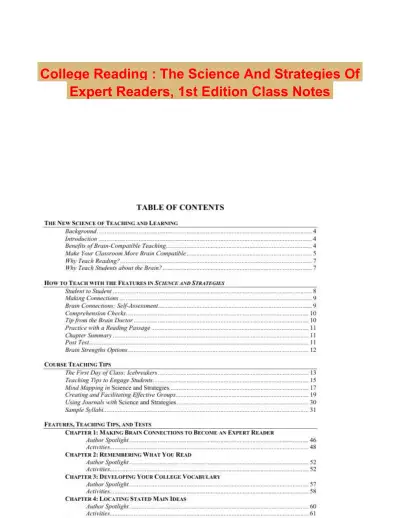 Class Notes
College Reading : The Science And Strategies Of Expert Readers, 1st Edition Class Notes
Education
102 pagesMay 2025 Exam Guides
Test Bank for Academic Vocabulary: Academic Words , 6th Edition
Education
94 pages157downloadsFeb 2025 Exam Guides
Test Bank For Learning Disabilities and Related Disabilities: Strategies for Success 13th Edition Test Bank
Education
260 pages146downloadsFeb 2025 Exam Guides
Human Exceptionality: School, Community, And Family, 12th Edition Test Bank
Education
354 pages130downloadsFeb 2025 Class Notes
Class Notes for Teaching Young Children: An Introduction, 6th Edition
Education
94 pages109downloadsFeb 2025 Textbook Guides
Solution Manual for Academic Vocabulary: Academic Words, 6th Edition
Education
25 pages73downloadsFeb 2025 Exam Guides
Building Classroom Management: Methods and Models, 12th Edition Test Bank
Education
118 pages70downloadsFeb 2025 Textbook Guides
Solution Manual for Direct Instruction Reading, 3rd Edition
Education
180 pages64downloadsFeb 2025
Study this document with CramX
Once it is in your library, every tool can work from it.