

GED Exam Flashcard Study System: GED Test Practice Questions and Review (2020)
- Education
- 862 pages
- Shared May 2025
Simplify your preparation with GED Exam Flashcard Study System: GED Test Practice Questions and Review (2020) , a complete study solution designed to improve retention and recall.
Preview 16 of 862 pages
See the first 16 pages exactly as they appear in the document.
Page 1 Page 2 Page 3 Read page 3 as text
Basic Math © Mometrix Media - flashcardsecrets.com/ged GED Explain fractions, numerators, and denominators.
Page 4 Read page 4 as text
Basic Math A fraction is a number that is expressed as one integer written above another integer, with a dividing line between them ( ). It represents the quotient of the two numbers “ x divided by y .” It can also be thought of as x out of y equal parts. The top number of a fraction is called the numerator , and it represents the number of parts under consideration. The 1 in means that 1 part out of the whole is being considered in the calculation. The bottom number of a fraction is called the denominator , and it represents the total number of equal parts. The 4 in means that the whole consists of 4 equal parts. A fraction cannot have a denominator of zero; this is referred to as “undefined.”
Page 5 Read page 5 as text
Basic Math © Mometrix Media - flashcardsecrets.com/ged GED Define the following common arithmetic terms specific to numbers: integers, prime, composite, even, and odd. Visit mometrix.com/academy for a related video. Enter video code: 461071
Page 6 Read page 6 as text
Basic Math Numbers are the basic building blocks of mathematics. Specific features of numbers are identified by the following terms: Integers – The set of positive and negative numbers, including zero. Integers do not include fractions ( ), decimals (0.56), or mixed numbers ( ). Prime number – A whole number greater than 1 that has only two factors, itself and 1; that is, a number that can be divided evenly only by 1 and itself. Composite number – A whole number greater than 1 that has more than two different factors; in other words, any whole number that is not a prime number. For example: The composite number 8 has the factors of 1, 2, 4, and 8. Even number – Any integer that can be divided by 2 without leaving a remainder. For example: 2, 4, 6, 8, and so on. Odd number – Any integer that cannot be divided evenly by 2. For example: 3, 5, 7, 9, and so on.
Page 7 Read page 7 as text
Basic Math © Mometrix Media - flashcardsecrets.com/ged GED Discuss improper fractions and mixed numbers.
Page 8 Read page 8 as text
Basic Math A fraction whose denominator is greater than its numerator is known as a proper fraction , while a fraction whose numerator is greater than its denominator is known as an improper fraction . Proper fractions have values less than one while improper fractions have values greater than one. A mixed number is a number that contains both an integer and a fraction. Any improper fraction can be rewritten as a mixed number. Example: . Similarly, any mixed number can be rewritten as an improper fraction. Example: .
Page 9 Read page 9 as text
Basic Math © Mometrix Media - flashcardsecrets.com/ged GED Explain the relationships between percentages, fractions, and decimals.
Page 10 Read page 10 as text
Basic Math Percentages can be thought of as fractions that are based on a whole of 100; that is, one whole is equal to 100%. The word percent means per hundred . Fractions can be expressed as percentages by finding equivalent fractions with a denomination of 100. Example: ; . To express a percentage as a fraction, divide the percentage number by 100 and reduce the fraction to its simplest possible terms. Example: ; . Converting decimals to percentages and percentages to decimals is as simple as moving the decimal point. To convert from a decimal to a percentage, move the decimal point two places to the right. To convert from a percentage to a decimal, move it two places to the left. Example: 0.23 = 23%; 5.34 = 534%; 0.007 = 0.7%; 700% = 7.00; 86% = 0.86; 0.15% = 0.0015. It may be helpful to remember that the percentage number will always be larger than the equivalent decimal number.
Page 11 Read page 11 as text
Basic Math © Mometrix Media - flashcardsecrets.com/ged GED Define greatest common factor (GCF) and least common multiple (LCM). Visit mometrix.com/academy for related videos. Enter video codes: 946579 and 838699
Page 12 Read page 12 as text
Basic Math The greatest common factor (GCF) is the largest number that is a factor of two or more numbers. For example, the factors of 15 are 1, 3, 5, and 15; the factors of 35 are 1, 5, 7, and 35. Therefore, the greatest common factor of 15 and 35 is 5. The least common multiple (LCM) is the smallest number that is a multiple of two or more numbers. For example, the multiples of 3 include 3, 6, 9, 12, 15, etc.; the multiples of 5 include 5, 10, 15, 20, etc. Therefore, the least common multiple of 3 and 5 is 15.
Page 13 Read page 13 as text
Basic Math © Mometrix Media - flashcardsecrets.com/ged GED Define the term factor, and explain common and prime factors with examples. Visit mometrix.com/academy for a related video. Enter video code: 920086
Page 14 Read page 14 as text
Basic Math Factors are numbers that are multiplied together to obtain a product . For example, in the equation 2 × 3 = 6, the numbers 2 and 3 are factors. A prime number has only two factors (1 and itself), but other numbers can have many factors. A common factor is a number that divides exactly into two or more other numbers. For example, the factors of 12 are 1, 2, 3, 4, 6, and 12, while the factors of 15 are 1, 3, 5, and 15. The common factors of 12 and 15 are 1 and 3. A prime factor is also a prime number. Therefore, the prime factors of 12 are 2 and 3. For 15, the prime factors are 3 and 5.
Page 15 Read page 15 as text
Basic Math © Mometrix Media - flashcardsecrets.com/ged GED Describe exponents and parentheses.
Page 16 Read page 16 as text
Basic Math An exponent is a superscript number placed next to another number at the top right. It indicates how many times the base number is to be multiplied by itself. Exponents provide a shorthand way to write what would be a longer mathematical expression. Example: a 2 = a × a; 2 4 = 2 × 2 × 2 × 2. A number with an exponent of 2 is said to be “squared,” while a number with an exponent of 3 is said to be “cubed.” The value of a number raised to an exponent is called its power . So, 8 4 is read as “8 to the 4th power,” or “8 raised to the power of 4.” A negative exponent is the same as the reciprocal of a positive exponent. Example: a -2 = 1/a 2 . Parentheses are used to designate which operations should be done first when there are multiple operations. Example: 4 – (2 + 1) = 1; the parentheses tell us that we must add 2 and 1, and then subtract the sum from 4, rather than subtracting 2 from 4 and then adding 1 (this would give us an answer of 3).
846 more pages in the full document
Unlock it once and it stays in your library, ready to chat with or turn into flashcards.
Unlock the full documentMore Education study materials
See all Exam Guides
Test Bank for Academic Vocabulary: Academic Words , 6th Edition
Education
94 pages157downloadsFeb 2025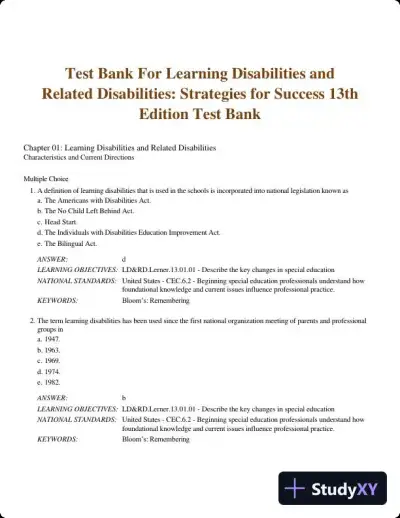 Exam Guides
Test Bank For Learning Disabilities and Related Disabilities: Strategies for Success 13th Edition Test Bank
Education
260 pages146downloadsFeb 2025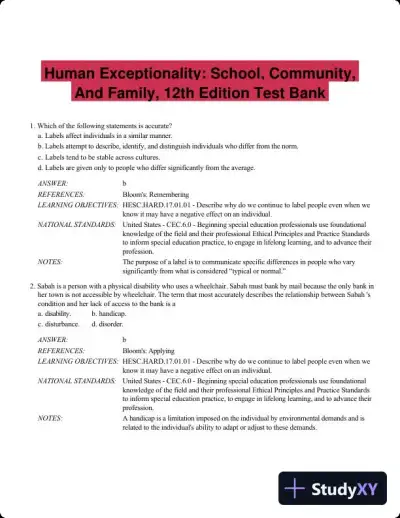 Exam Guides
Human Exceptionality: School, Community, And Family, 12th Edition Test Bank
Education
354 pages130downloadsFeb 2025 Class Notes
Class Notes for Teaching Young Children: An Introduction, 6th Edition
Education
94 pages109downloadsFeb 2025 Textbook Guides
Solution Manual for Academic Vocabulary: Academic Words, 6th Edition
Education
25 pages73downloadsFeb 2025 Exam Guides
Building Classroom Management: Methods and Models, 12th Edition Test Bank
Education
118 pages70downloadsFeb 2025 Textbook Guides
Solution Manual for Direct Instruction Reading, 3rd Edition
Education
180 pages64downloadsFeb 2025 Exam Guides
Test Bank for Creative Thinking and Arts-Based Learning: Preschool Through Fourth Grade, 7th Edition
Education
101 pages59downloadsFeb 2025
Study this document with CramX
Once it is in your library, every tool can work from it.