

Test Bank for College Reading and Study Skills, 14th Edition
- Education
- 119 pages
- Shared May 2025
Test Bank for College Reading and Study Skills, 14th Edition offers a selection of past exam questions and answers to give you an edge in your preparation.
Preview 16 of 119 pages
See the first 16 pages exactly as they appear in the document.
Page 1 Read page 1 as text
Test Bank For College Reading and Study Skills Fourteenth Edition Kathleen T. McWhorter Niagara County Community College
Page 2 Page 3 Read page 3 as text
v CONTENTS CHAPTER REVIEW QUIZZES –TEST BANK 1 Chapter 1 1 Chapter 2 3 Chapter 3 5 Chapter 4 7 Chapter 5 9 Chapter 6 11 Chapter 7 13 Chapter 8 15 Chapter 9 17 Chapter 10 19 Chapter 11 21 Chapter 12 23 Chapter 13 25 Chapter 14 27 Answer Key to Chapter Review Quizzes—Test Bank 1 29 CHAPTER REVIEW QUIZZES –TEST BANK 2 Chapter 1 33 Chapter 2 35 Chapter 3 37 Chapter 4 39 Chapter 5 41 Chapter 6 43 Chapter 7 45 Chapter 8 47 Chapter 9 49 Chapter 10 51
Page 4 Read page 4 as text
vi Chapter 11 53 Chapter 12 55 Chapter 13 57 Chapter 14 59 Answer Key to Chapter Review Quizzes—Test Bank 2 61 MASTERY TESTS Chapter 1 65 Chapter 2 71 Chapter 3 73 Chapter 4 75 Chapter 5 79 Chapter 6 81 Chapter 7 85 Chapter 8 88 Chapter 9 91 Chapter 10 95 Chapter 11 98 Chapter 12 101 Chapter 13 104 Chapter 14 107 Answer Key to Mastery Tests 110
Page 5 Read page 5 as text
vii IN T R O D U C T IO N This assessment package contains two types of assessment for each chapter in College Reading and Study Skills , fourteenth edition: chapter review quizzes and mastery tests. These alternative measurements provide the instructor with a variety of opportunities to assess students’ ability to learn and apply the techniques and strategies presented in the text. CHAPTER REVIEW QUIZZES The chapter review quizzes are primarily intended to provide an assessment of students’ knowledge and comprehension of chapter content. There are two sets of chapter review quizzes. Each set includes a ten-item multiple- choice quiz for each chapter. Although the concepts tested in each set are similar, the test questions are different. An answer key is provided for each chapter review quiz. Coverage It is the purpose of the chapter review quizzes to assess whether students have acquired foundational knowledge of each chapter’s content to enable them to apply the skill. Although the focus of each quiz is knowledge and comprehension of chapter content, quizzes do include application questions that provide hypothetical situations for evaluating students’ ability to apply the skill. Instructional Uses Although the quizzes are intended as assessment tools, they can be used instructionally in several different ways: 1. Treat the quiz as an open-book exam, allowing students to locate the answers in the text. This activity will provide students with the opportunity to review chapter content and realize what skills are emphasized. 2. Ask students to predict or write questions they think will be on the quiz and then compare their predictions with the actual quiz. This activity will help students to determine what is important in each chapter, as well as to develop an important test-taking strategy. 3. Treat each quiz as a collaborative learning activity. Students can discuss each item and identify sections in the chapter that establish their choices as correct. 4. Use the quiz as a chapter preview. Allow students to skim or read the quiz questions before reading the chapter. The questions will establish an intent to remember chapter content .
Page 6 Read page 6 as text
viii MASTERY TESTS The mastery tests are designed to measure students’ ability to apply the skills learned in each chapter. These objective tests are intended to be practical, realistic simulations of reading and study situations that college students face. For the instructor’s convenience, these tests were written to be self-scored, although instructors may elect to score these tests themselves. An answer key is provided for each mastery test. Coverage Not all skills covered in a given chapter have been tested on the mastery test. Instead, the tests focus on the essential skills taught in each chapter. It was not possible to include skills that are too complex or time-consuming to measure within a testing situation. Some mastery tests contain more than one part, each measuring a different skill. Each part can be administered separately or given as a separate mastery test. Instructional Uses Although the mastery tests are intended as assessment tools, they can be used as instructional tools as well: 1. Use the mastery tests as collaborative learning activities in which students work together to complete the task(s) in each mastery test. 2. Use the mastery tests as additional practice exercises. Some students may require additional guided practice in learning and applying particular skills taught. The tests are also appropriate for students who are not co-registered for other academic courses and, thus, are unable to complete the academic application exercises in the text.
Page 7 Read page 7 as text
ix PART ONE CHAPTER REVIEW QUIZZ ES TE ST BANK 1
Page 8 Read page 8 as text
1 NA M E: DA TE: SECTI O N: CHAPTER 1 FIRST STEPS TO ACADEMIC SUCCESS Directions: Write the letter of the choice that best completes each statement in the space provided. 1. If Paula takes 15 hours of classes next semester, she should expect to study each w ee k for about a. 7½ hours. b. 10 hours. c. 15 hours. d. 30 hours. 2. The online study tool that lets students practice what they are learning using flash cards, self-testing games, and interactive diagrams is called a. Quizlet. b. Evernote. c. Schooltraq. d. GoConqr. 3. A term plan lists all of your a. unchanging commitments. b. specific study times. c. homework assignments. d. leisure activities. 4. The first step in creating your weekly schedule should be to a. assess the upcoming week’s workload. b. block out time for having fun and relaxing. c. write in appointments and commitments. d. set aside time for breaks before studying new subjects. 5. The best time to study for a Thursday morning class is a. Tuesday morning. b. Wednesday evening. c. Friday evening. d. over the weekend.
Page 9 Read page 9 as text
2 6. The learning strategy that is appropriate for both visual and spatial learners is a. drawing diagrams and charts. b. recording lectures. c. writing summaries. d. talking aloud when studying. 7. The spatial/verbal section of the Learning Style Questionnaire reveals a. your ability to visualize how things work or how they are positioned in space. b. whether practical applications are necessary for your understanding of idea s. c. your preferred level of interaction with other people in the learning process. d. whether you prefer to learn by taking risks or following rules. 8. A n example of an active learning strategy is a. b. writing down everything the instructor says. rereading textbook assignments. c. considering the purpose behind assignments. d. doing only what is expected to get a good grade. 9. According to the progression of thinking skills first developed by Benjamin Bloom, the highest level of thinking is a. remembering. b. understanding. c. analyzing. d. creating. 10. An English instructor who wanted to give an assignment at the applying level of thinki ng might ask students to a. compare two poems by the same author. b. edit a poorly punctuated paragraph. c. evaluate the effectiveness of an essay about writing. d. define a list of grammatical terms.
Page 10 Read page 10 as text
3 NA M E: DA TE: SECTI O N: CHAPTER 2 TAKING NOTES IN CLASS Directions: Write the letter of the choice that best completes each statement in the space provided . 1. In each waking hour, the average adult is likely to spend the most time a. listening. b. w riti ng. c. reading. d. speaking. 2. One difference between listening and hearing is that hearing a. is an intellectual, purposeful activity. b. involves the processing and interpretation of incoming information. c. is a passive, biological process. d. is intentional and deliberate. 3. One way to improve your listening skills during a lecture is to a. focus on delivery rather than content. b. concentrate on remembering separate, unconnected facts. c. disregard the speaker’s opening comments. d. try to understand the speaker’s purpose. 4. Compared to the average rate of speech, the rate of thinking is about a. the same. b. half as fast. c. twice as fast. d. four times as fast. 5. A a. good set of lecture notes does not have to serve as a record of the lecture’s main points. b. include enough details so that the information can be recalled later . c. d. show the organization of the lecture. include everything the lecturer said.
Page 11 Read page 11 as text
4 6. Speakers typically do not indicate that information is important by a. speaking more loudly. b. speaking more quickly. c. listing or numbering points. d. using PowerPoint slides. 7. If you are using indentation to show a lecture’s organization, the item that should be indented the most is a. a major topic. b. a main idea. c. a detail. d. an example. 8. The most effective way to review your notes after a lecture is to a. edit your notes as soon as possible. b. wait a few days and then reread your notes aloud. c. recopy your notes to make them more legible. d. transcribe your notes from an audio recording. 9. Julie is trying a new system to improve how she reviews and studies her lecture notes. After she has edited her notes, she fills in the left margin with words and phrases that summarize her notes and help trigger her memory. This information indicates that Julie is using a. enumeration. b. pragmatic editing. c. mnemonic devices. d. the recall clue system. 10. While editing his notes after a lecture, Lee asked himself how his notes fit in with other lectures and with the textbook assignment. Lee’s questions are at the level of thinking known as a. remembering. b. understanding. c. analyzing. d. creating.
Page 12 Read page 12 as text
5 NA M E: DA TE: SECTI O N: CHAPTER 3 COMMUNICATING IN THE CLASSROOM Directions: Write the letter of the choice that best completes each statement in the space provided . 1. Listening critically involves a. focusing on the speaker rather than the message. b. keeping an open mind toward a speaker or a topic. c. ignoring any ideas with which you disagree. d. forming an immediate reaction toward a speaker or topic. 2. An effective way to improve your questioning skills is to a. wait until another student asks the question you were thinking of. b. make excuses for asking a question. c. d. pose questions for the sake of asking a question. form questions as you read an assignment and bring them to class. 3. When you are asking a question in class, an example of a question at the creating level of thinking is: a. In what situations can this information be used? b. How do these ideas fit together? c. Of what value is this information? d. How can this idea be combined with related ideas in new ways? 4. A strategy that will not help you prepare for a class discussion is a. reading the assignment and any background material. b. marking and highlighting important information as you read. c. skimming the assignment for basic, factual information. d. asking critical thinking questions as you read. 5. The best tip for posting messages in an online discussion is to a. assume you are already familiar with the software. b. repeat comments that someone else has said . c. let people figure out the context of your comments. d. make your comments clear and easy to read.
Page 13 Read page 13 as text
6 6. To participate constructively in class discussions, you should avoid a. trying to say something early in the discussion. b. making your comments brief and to the point. c. getting involved in direct exchanges with other class members. d. giving others a chance to express their ideas. 7. The most appropriate strategy for overcoming a fear of public speaking is to a. design and use a variety of visual aids. b. plan on changing the tone of your voice as you speak. c. practice delivering your speech several times. d. write out your speech word-for-word so you can read it to your audience. 8. When you are working on collaborative activities, the best approach to helping the group function efficiently is to a. choose only the people you already know as group members. b. spend time joking with group members to keep it fun. c. always let someone else take a leadership role. d. consider individual strengths and weaknesses when assigning tasks. 9. The first step in making an effective oral presentation is to a. collect and organize information. b. understand the purpose of the assignment. c. prepare an outline. d. decide on possible visual aids. 10. When communicating with professors, it is best to use a. an informal level of communication. b. correct grammar, spelling, and punctuation. c. familiar language or slang. d. text messages.
Page 14 Read page 14 as text
7 NA M E: DA TE: SECTI O N: CHAPTER 4 IDENTIFY AND ORGANIZE WHAT TO LEARN Directions: Write the letter of the choice that best completes each statement in the space provided . 1. The primary purpose of paraphrasing is to a. restate the author’s meaning in your own words. b. express your opinion of the author’s ideas. c. choose one or two of the author’s statements as summaries. d. quote the author’s main points. 2. Paraphrasing is appropriate when a. the material is easy to understand. b. the author uses simple or familiar language. c. the material is not especially complex. d. detailed comprehension is required. 3. When you are highlighting a textbook, you should a. highlight supporting facts as well as main ideas. b. ignore any boldfaced headings. c. highlight complete sentences. d. highlight as quickly as you can. 4. As a general rule, you should highlight a. most of the sentences on a page. b. no more than one-third of each page. c. d. one key word from each sentence on a page. only the headings on a page. 5. An example of a marginal note at the evaluating level of thinking is a. jotting notes about how to use the information. b. drawing arrows to link related material. c. commenting on the value and relevance of ideas. d. condensing ideas into your own words.
Page 15 Read page 15 as text
8 6. Using standard outline format, the item placed closest to the left margin is a. a major topic. b. an important detail. c. a minor detail. d. an example. 7. Of the following situations, writing a summary would be least effective for a. preparing for an essay exam in history. b. recording the results of a chemistry experiment. c. learning the bones of the hand for an anatomy quiz. d. understanding the plot of a novel assigned in English class. 8. After you have defined your purpose for writing a summary, your next step is to a. determine the author’s attitude and approach toward the subject. b. locate and evaluate key supporting details. c. underline or highlight key terms and definitions. d. identify the author’s main idea and write a statement that expresses it. 9. Of the following topics in a political science course, a time line would be most effective for showing a. how a bill becomes a law. b. the chain of command in a police department. c. the sequence of events leading up to World War I. d. differences between the Democratic and Republican parties. 10. The only situation that is not an example of plagiarism is a. using information from the Internet without listing the source. b. paraphrasing an author’s words without giving the author credit. c. using commonly known facts without documentation. d. accidentally omitting quotation marks when quoting an author.
Page 16 Read page 16 as text
9 NA M E: DA TE: SECTI O N: CHAPTER 5 LEARNING AND MEMORY Directions: Write the letter of the choice that best completes each statement in the space provided. 1. One aspect of forgetting is that a. people tend to forget information that they use frequently. b. for most people, forgetting occurs very slowly. c. certain techniques can prevent or slow down forgetting. d. forgetting only occurs with information stored in long-term memory. 2. The process through which environmental stimuli enter the brain is known as a. encoding. b. sensory storage. c. retrieval. d. information transfer. 3. Information is retained in short-term memory for a. less than a minute. b. about an hour. c. 8-10 hours. d. 24 hours. 4. When your brain automatically sorts out important information from trivial signals, it is engaging in a. visualization. b. rote learning. c. interference. d. selective attention. 5. The function of sensory storage is to a. retain information until it is sent to short-term memory or discarded. b. rearrange information into groups or sets. c. allow you to practice information to learn it. d. store information permanently until you recall it.
103 more pages in the full document
Unlock it once and it stays in your library, ready to chat with or turn into flashcards.
Unlock the full documentMore Education study materials
See all Exam Guides
Test Bank for Academic Vocabulary: Academic Words , 6th Edition
Education
94 pages157downloadsFeb 2025 Exam Guides
Test Bank For Learning Disabilities and Related Disabilities: Strategies for Success 13th Edition Test Bank
Education
260 pages146downloadsFeb 2025 Exam Guides
Human Exceptionality: School, Community, And Family, 12th Edition Test Bank
Education
354 pages130downloadsFeb 2025 Class Notes
Class Notes for Teaching Young Children: An Introduction, 6th Edition
Education
94 pages109downloadsFeb 2025 Textbook Guides
Solution Manual for Academic Vocabulary: Academic Words, 6th Edition
Education
25 pages73downloadsFeb 2025 Exam Guides
Building Classroom Management: Methods and Models, 12th Edition Test Bank
Education
118 pages70downloadsFeb 2025 Textbook Guides
Solution Manual for Direct Instruction Reading, 3rd Edition
Education
180 pages64downloadsFeb 2025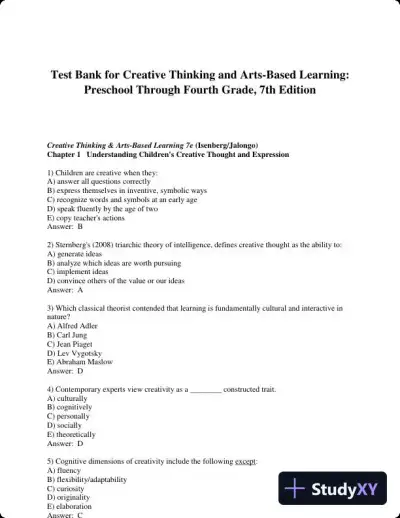 Exam Guides
Test Bank for Creative Thinking and Arts-Based Learning: Preschool Through Fourth Grade, 7th Edition
Education
101 pages59downloadsFeb 2025
Study this document with CramX
Once it is in your library, every tool can work from it.