

The Role Of Play In Child Development: Understanding The Connection Between Play And Learning
- Education
- 7 pages
- Shared May 2025
This Solved Assignment explores the significance of play in childhood development. Download now!
Preview 3 of 7 pages
See the first 3 pages exactly as they appear in the document.
Page 1 Read page 1 as text
Running head: WHY PLAY =LEARNING, CHILD DEVELOPMENT The Role of Play in Child Development: Understanding the Connection Between Play and Learning In the paper "Why Play = Learning," various forms of play are discussed in the context of child development and learning. Based on the research and examples presented, explain the significance of different types of play (object play, pretend play, physical play, and guided play) in promoting academic and social development in young children. How do these types of play contribute to cognitive skills, emotional regulation, and social competence? In your discussion, reference key studies mentioned in the paper and explain their findings on how play impacts child learning. (Word count: 400 - 500 words)
Page 2 Page 3 Read page 3 as text
Running head: WHY PLAY =LEARNING, CHILD DEVELOPMENT Why Play = Learning Child Development Child development Why Play = Learning Abstract In this paper I have mentioned various forms of play, used for the early development of children. These games help children to become morally excellent citizens. Introduction By the research it is now proved that play plays important part in learning children , exercise motor skills, allows children to copy adult behaviors, apply motor ability , process emotional events, and educate much concerning world. It is not serious conduct . According to Piaget , play is the exercise of childhood. Both free plays as well as guided play are needed for the growth of academic ability. ( Piaget , 1962) Subject Still sch olars find the term Play difficult to describe despite of plenty of writings. According to Researchers exist four types of play which are as follows: (a) Object play : In this type, chi ldren learn about their properties, and change them to new purposes. (b) Pretend play : It is played e ither alone or with other children , diversely denoted as socio - dramatic play , fantasy, symbolic play, or striking play, where children experim ent with different social roles.
4 more pages in the full document
Unlock it once and it stays in your library, ready to chat with or turn into flashcards.
Unlock the full documentMore Education study materials
See all Exam Guides
Test Bank for Academic Vocabulary: Academic Words , 6th Edition
Education
94 pages157downloadsFeb 2025 Exam Guides
Test Bank For Learning Disabilities and Related Disabilities: Strategies for Success 13th Edition Test Bank
Education
260 pages146downloadsFeb 2025 Exam Guides
Human Exceptionality: School, Community, And Family, 12th Edition Test Bank
Education
354 pages130downloadsFeb 2025 Class Notes
Class Notes for Teaching Young Children: An Introduction, 6th Edition
Education
94 pages109downloadsFeb 2025 Textbook Guides
Solution Manual for Academic Vocabulary: Academic Words, 6th Edition
Education
25 pages73downloadsFeb 2025 Exam Guides
Building Classroom Management: Methods and Models, 12th Edition Test Bank
Education
118 pages70downloadsFeb 2025 Textbook Guides
Solution Manual for Direct Instruction Reading, 3rd Edition
Education
180 pages64downloadsFeb 2025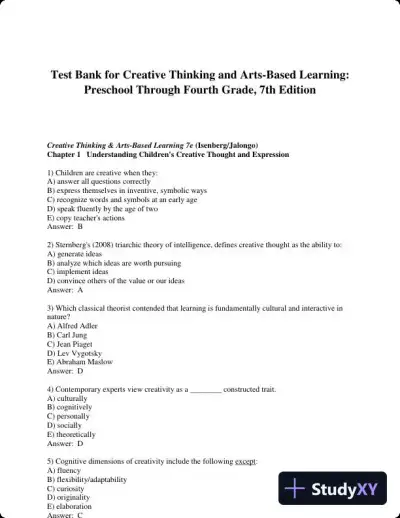 Exam Guides
Test Bank for Creative Thinking and Arts-Based Learning: Preschool Through Fourth Grade, 7th Edition
Education
101 pages59downloadsFeb 2025
Study this document with CramX
Once it is in your library, every tool can work from it.