
Class Notes
Class Notes for Corporate Finance, 2nd Edition
- Finance
- 200 pages
- Shared February 2025
- 86 downloads
Class Notes for Corporate Finance, 2nd Edition summarizes important topics for quick revision.
Preview · 31 of 200 pages
100%
Page 1
 Instructor’s Resource GuideforDr. Michael CaseyUniversity of Central Arkansas
Page 2

Page 3
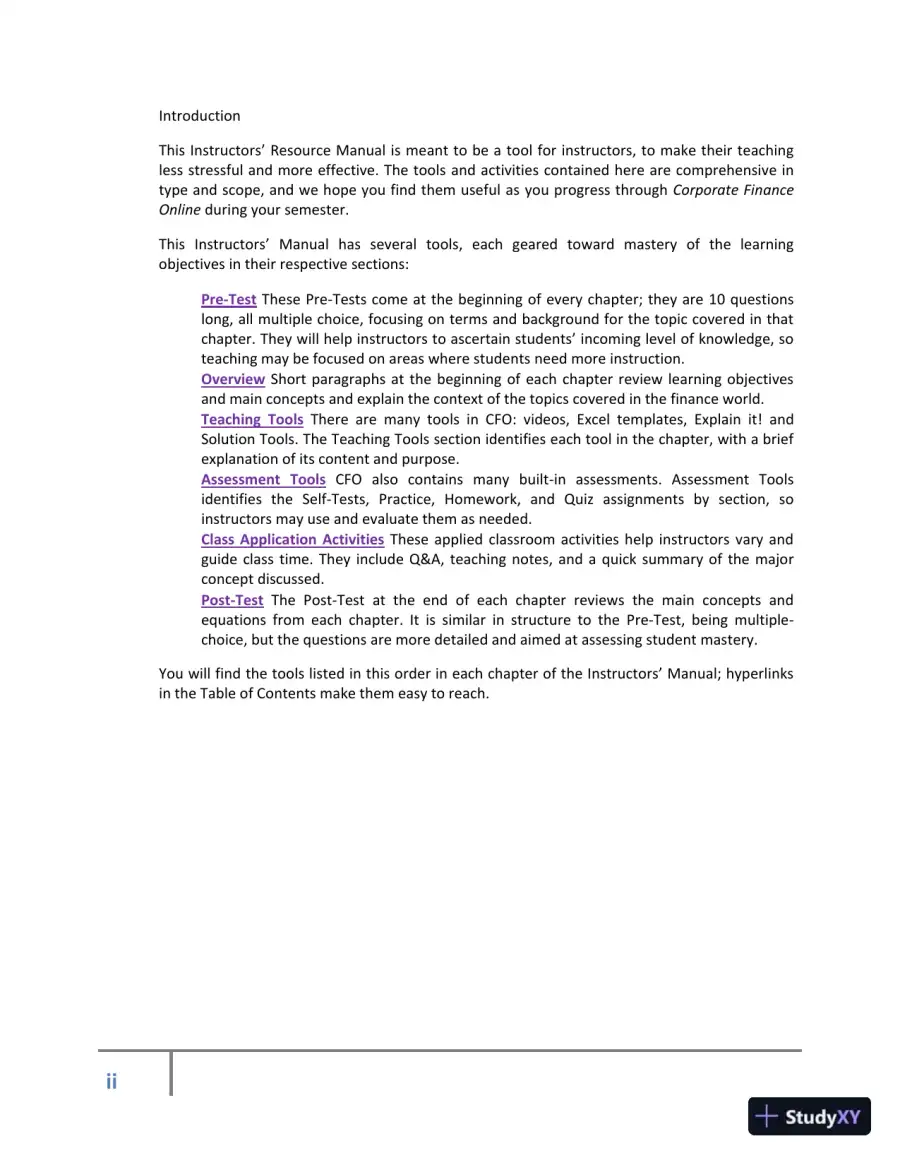 iiIntroductionThis Instructors’ Resource Manual is meant to be a tool for instructors, to make their teachingless stressful and more effective. The tools and activities contained here are comprehensive intype and scope, and we hope you find them useful as you progress throughCorporate FinanceOnlineduring your semester.This Instructors’ Manualhas several tools, each geared toward mastery of the learningobjectives in their respective sections:Pre-TestThese Pre-Tests come at the beginning of every chapter; they are 10 questionslong, all multiple choice, focusing on terms and background for the topic covered in thatchapter. They will help instructors to ascertain students’ incoming level of knowledge, soteaching may be focused on areas where students need more instruction.OverviewShort paragraphs at the beginning of each chapter review learning objectivesand main concepts and explain the context of the topics covered in the finance world.Teaching ToolsThere are many tools in CFO: videos, Excel templates, Explain it! andSolution Tools. The Teaching Tools section identifies each tool in the chapter, with a briefexplanation of its content and purpose.Assessment ToolsCFOalso contains many built-in assessments. Assessment Toolsidentifies the Self-Tests, Practice, Homework, and Quiz assignments by section, soinstructors may use and evaluate them as needed.Class Application ActivitiesThese applied classroom activities help instructors vary andguide class time. They include Q&A, teaching notes, and a quick summary of the majorconcept discussed.Post-TestThe Post-Test at the end of each chapter reviews the main concepts andequations from each chapter. It is similar in structure to the Pre-Test, being multiple-choice, but the questions are more detailed and aimed at assessing student mastery.You will find the tools listed in this order in each chapter of the Instructors’ Manual; hyperlinksin the Table of Contents make them easy to reach.
Page 4
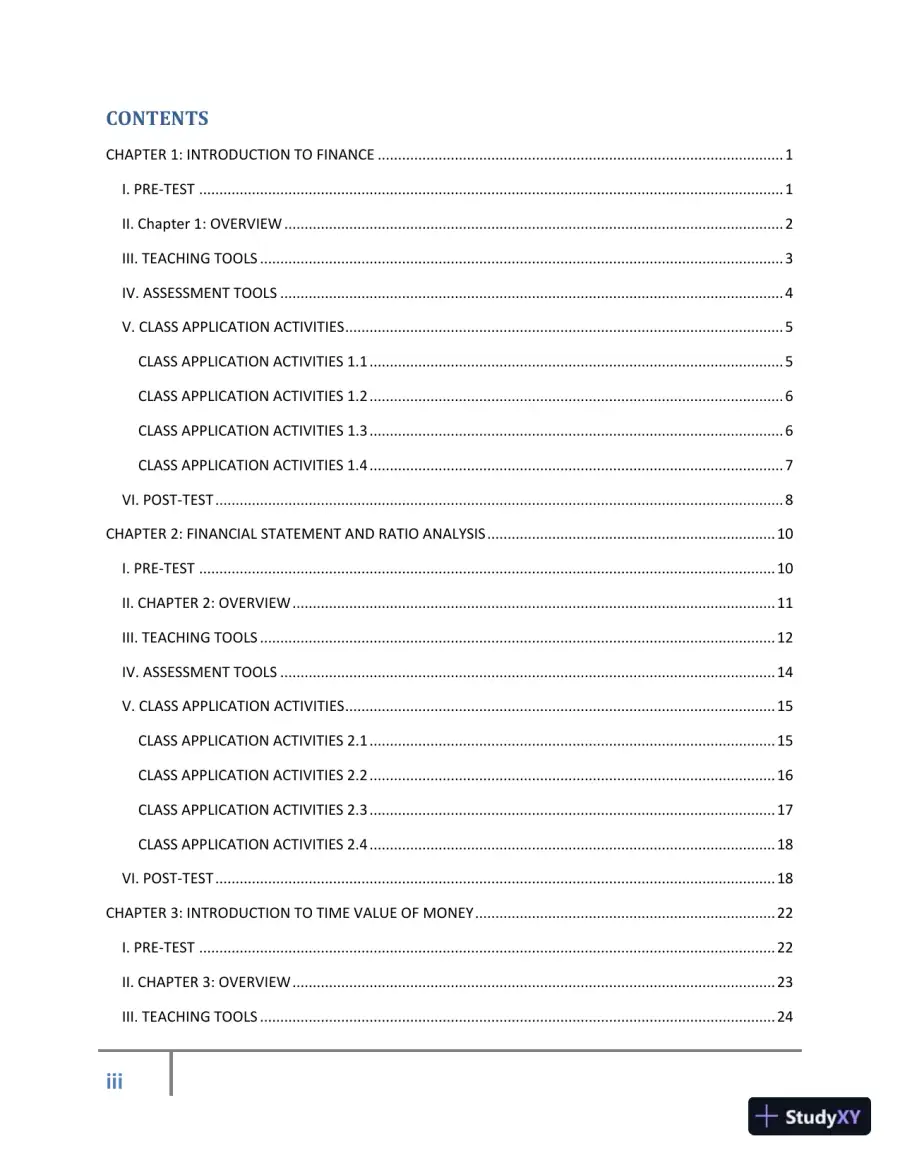 iiiCONTENTSCHAPTER 1: INTRODUCTION TO FINANCE .................................................................................................... 1I. PRE-TEST ................................................................................................................................................ 1II. Chapter 1: OVERVIEW ........................................................................................................................... 2III. TEACHING TOOLS ................................................................................................................................. 3IV. ASSESSMENT TOOLS ............................................................................................................................ 4V. CLASS APPLICATION ACTIVITIES............................................................................................................ 5CLASS APPLICATION ACTIVITIES 1.1 ...................................................................................................... 5CLASS APPLICATION ACTIVITIES 1.2 ...................................................................................................... 6CLASS APPLICATION ACTIVITIES 1.3...................................................................................................... 6CLASS APPLICATION ACTIVITIES 1.4 ...................................................................................................... 7VI. POST-TEST ............................................................................................................................................ 8CHAPTER 2: FINANCIAL STATEMENT AND RATIO ANALYSIS....................................................................... 10I. PRE-TEST .............................................................................................................................................. 10II. CHAPTER 2: OVERVIEW....................................................................................................................... 11III. TEACHING TOOLS ............................................................................................................................... 12IV. ASSESSMENT TOOLS .......................................................................................................................... 14V. CLASS APPLICATION ACTIVITIES.......................................................................................................... 15CLASS APPLICATION ACTIVITIES 2.1 .................................................................................................... 15CLASS APPLICATION ACTIVITIES 2.2 .................................................................................................... 16CLASS APPLICATION ACTIVITIES 2.3 .................................................................................................... 17CLASS APPLICATION ACTIVITIES 2.4 .................................................................................................... 18VI. POST-TEST .......................................................................................................................................... 18CHAPTER 3: INTRODUCTION TO TIME VALUE OF MONEY.......................................................................... 22I. PRE-TEST .............................................................................................................................................. 22II. CHAPTER 3: OVERVIEW....................................................................................................................... 23III. TEACHING TOOLS ............................................................................................................................... 24
Page 5
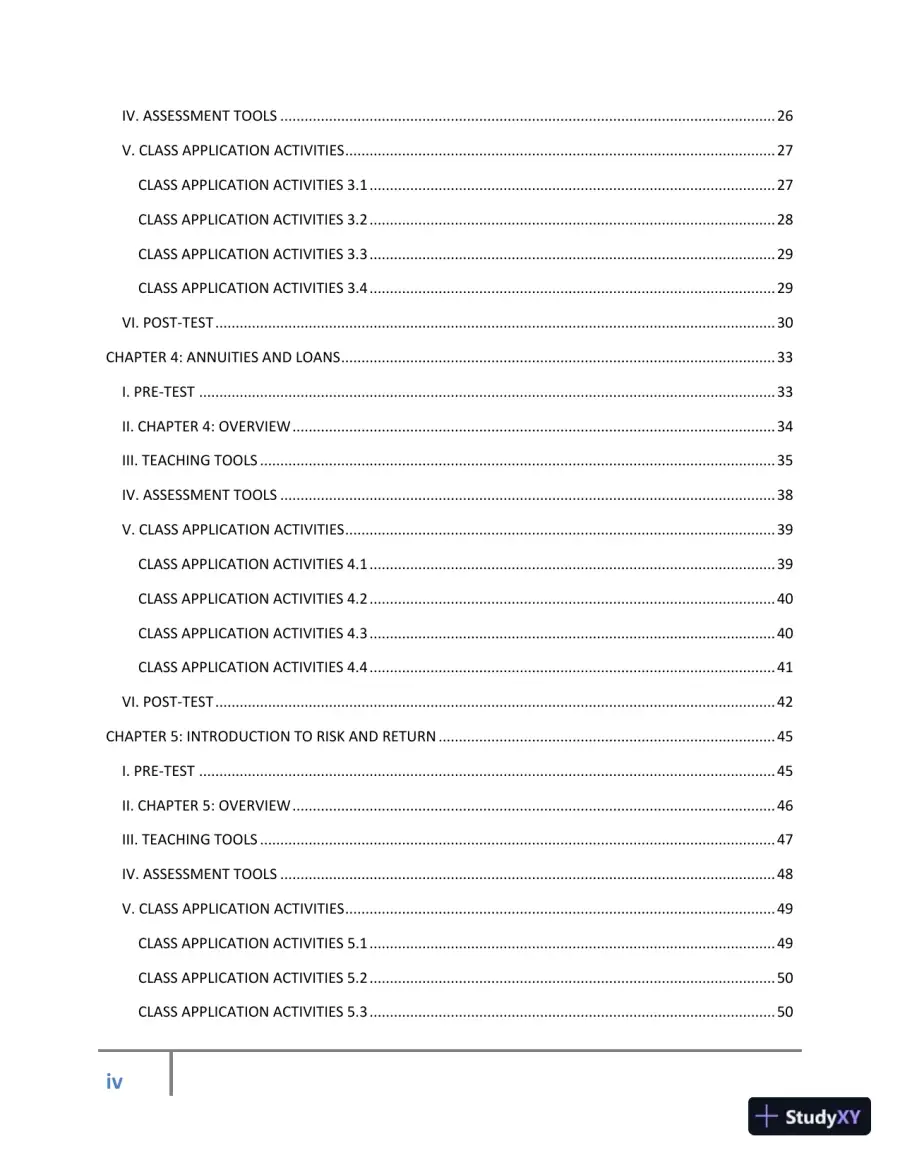 ivIV. ASSESSMENT TOOLS .......................................................................................................................... 26V. CLASS APPLICATION ACTIVITIES.......................................................................................................... 27CLASS APPLICATION ACTIVITIES 3.1 .................................................................................................... 27CLASS APPLICATION ACTIVITIES 3.2 .................................................................................................... 28CLASS APPLICATION ACTIVITIES 3.3 .................................................................................................... 29CLASS APPLICATION ACTIVITIES 3.4.................................................................................................... 29VI. POST-TEST .......................................................................................................................................... 30CHAPTER 4: ANNUITIES AND LOANS........................................................................................................... 33I. PRE-TEST .............................................................................................................................................. 33II. CHAPTER 4: OVERVIEW....................................................................................................................... 34III. TEACHING TOOLS ............................................................................................................................... 35IV. ASSESSMENT TOOLS .......................................................................................................................... 38V. CLASS APPLICATION ACTIVITIES.......................................................................................................... 39CLASS APPLICATION ACTIVITIES 4.1 .................................................................................................... 39CLASS APPLICATION ACTIVITIES 4.2 .................................................................................................... 40CLASS APPLICATION ACTIVITIES 4.3 .................................................................................................... 40CLASS APPLICATION ACTIVITIES 4.4 .................................................................................................... 41VI. POST-TEST .......................................................................................................................................... 42CHAPTER 5: INTRODUCTION TO RISK AND RETURN ................................................................................... 45I. PRE-TEST .............................................................................................................................................. 45II. CHAPTER 5: OVERVIEW....................................................................................................................... 46III. TEACHING TOOLS ............................................................................................................................... 47IV. ASSESSMENT TOOLS .......................................................................................................................... 48V. CLASS APPLICATION ACTIVITIES.......................................................................................................... 49CLASS APPLICATION ACTIVITIES 5.1.................................................................................................... 49CLASS APPLICATION ACTIVITIES 5.2 .................................................................................................... 50CLASS APPLICATION ACTIVITIES 5.3 .................................................................................................... 50
Page 6
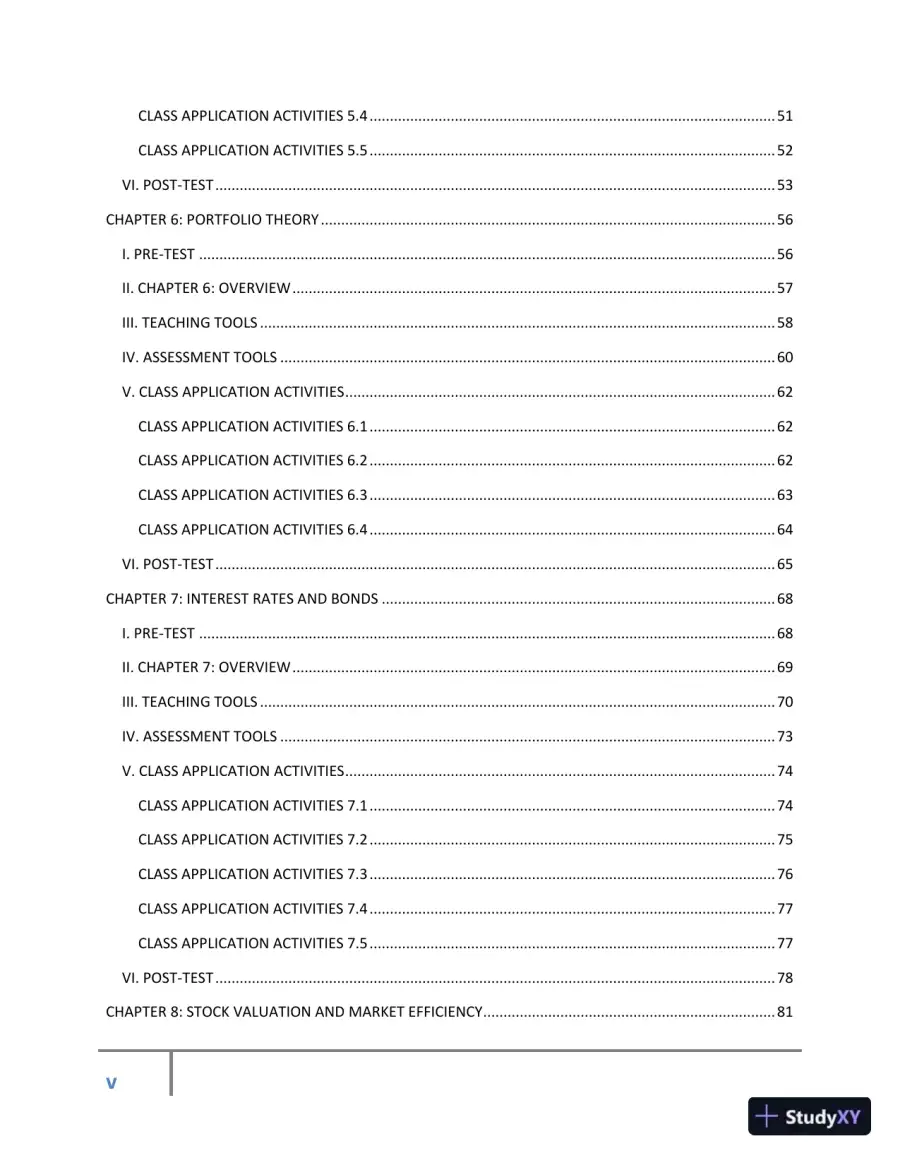 vCLASS APPLICATION ACTIVITIES 5.4 .................................................................................................... 51CLASS APPLICATION ACTIVITIES 5.5.................................................................................................... 52VI. POST-TEST .......................................................................................................................................... 53CHAPTER 6: PORTFOLIO THEORY ................................................................................................................ 56I. PRE-TEST .............................................................................................................................................. 56II. CHAPTER 6: OVERVIEW....................................................................................................................... 57III. TEACHING TOOLS ............................................................................................................................... 58IV. ASSESSMENT TOOLS .......................................................................................................................... 60V. CLASS APPLICATION ACTIVITIES.......................................................................................................... 62CLASS APPLICATION ACTIVITIES 6.1 .................................................................................................... 62CLASS APPLICATION ACTIVITIES 6.2 .................................................................................................... 62CLASS APPLICATION ACTIVITIES 6.3 .................................................................................................... 63CLASS APPLICATION ACTIVITIES 6.4 .................................................................................................... 64VI. POST-TEST .......................................................................................................................................... 65CHAPTER 7: INTEREST RATES AND BONDS ................................................................................................. 68I. PRE-TEST .............................................................................................................................................. 68II. CHAPTER 7: OVERVIEW....................................................................................................................... 69III. TEACHING TOOLS ............................................................................................................................... 70IV. ASSESSMENT TOOLS .......................................................................................................................... 73V. CLASS APPLICATION ACTIVITIES.......................................................................................................... 74CLASS APPLICATION ACTIVITIES 7.1.................................................................................................... 74CLASS APPLICATION ACTIVITIES 7.2 .................................................................................................... 75CLASS APPLICATION ACTIVITIES 7.3 .................................................................................................... 76CLASS APPLICATION ACTIVITIES 7.4 .................................................................................................... 77CLASS APPLICATION ACTIVITIES 7.5.................................................................................................... 77VI. POST-TEST .......................................................................................................................................... 78CHAPTER 8: STOCK VALUATION AND MARKET EFFICIENCY........................................................................ 81
Page 7
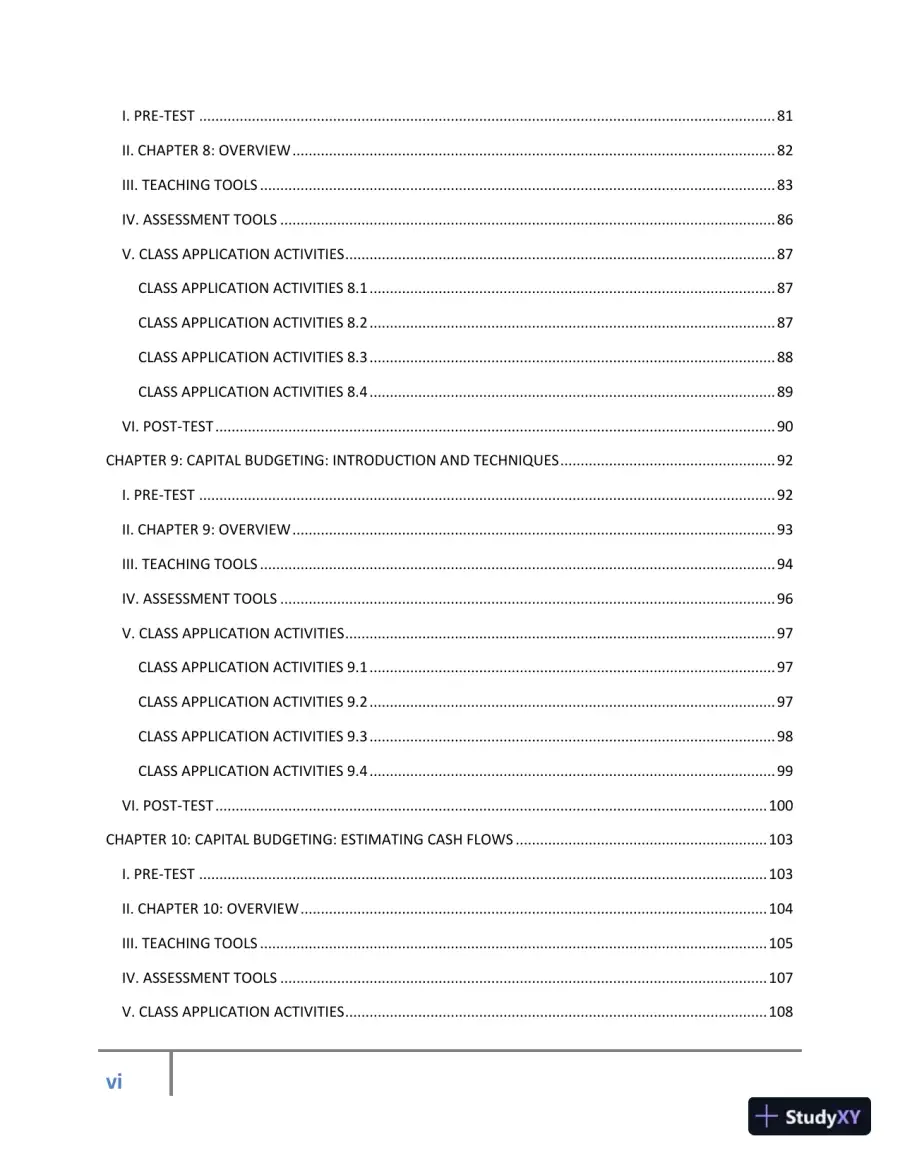 viI. PRE-TEST .............................................................................................................................................. 81II. CHAPTER 8: OVERVIEW....................................................................................................................... 82III. TEACHING TOOLS ............................................................................................................................... 83IV. ASSESSMENT TOOLS .......................................................................................................................... 86V. CLASS APPLICATION ACTIVITIES.......................................................................................................... 87CLASS APPLICATION ACTIVITIES 8.1 .................................................................................................... 87CLASS APPLICATION ACTIVITIES 8.2 .................................................................................................... 87CLASS APPLICATION ACTIVITIES 8.3 .................................................................................................... 88CLASS APPLICATION ACTIVITIES 8.4 .................................................................................................... 89VI. POST-TEST .......................................................................................................................................... 90CHAPTER 9: CAPITAL BUDGETING: INTRODUCTION AND TECHNIQUES..................................................... 92I. PRE-TEST .............................................................................................................................................. 92II. CHAPTER 9: OVERVIEW....................................................................................................................... 93III. TEACHING TOOLS ............................................................................................................................... 94IV. ASSESSMENT TOOLS .......................................................................................................................... 96V. CLASS APPLICATION ACTIVITIES.......................................................................................................... 97CLASS APPLICATION ACTIVITIES 9.1 .................................................................................................... 97CLASS APPLICATION ACTIVITIES 9.2 .................................................................................................... 97CLASS APPLICATION ACTIVITIES 9.3 .................................................................................................... 98CLASS APPLICATION ACTIVITIES 9.4 .................................................................................................... 99VI. POST-TEST ........................................................................................................................................ 100CHAPTER 10: CAPITAL BUDGETING: ESTIMATING CASH FLOWS .............................................................. 103I. PRE-TEST ............................................................................................................................................ 103II. CHAPTER 10: OVERVIEW................................................................................................................... 104III. TEACHING TOOLS ............................................................................................................................. 105IV. ASSESSMENT TOOLS ........................................................................................................................ 107V. CLASS APPLICATION ACTIVITIES........................................................................................................ 108
Page 8
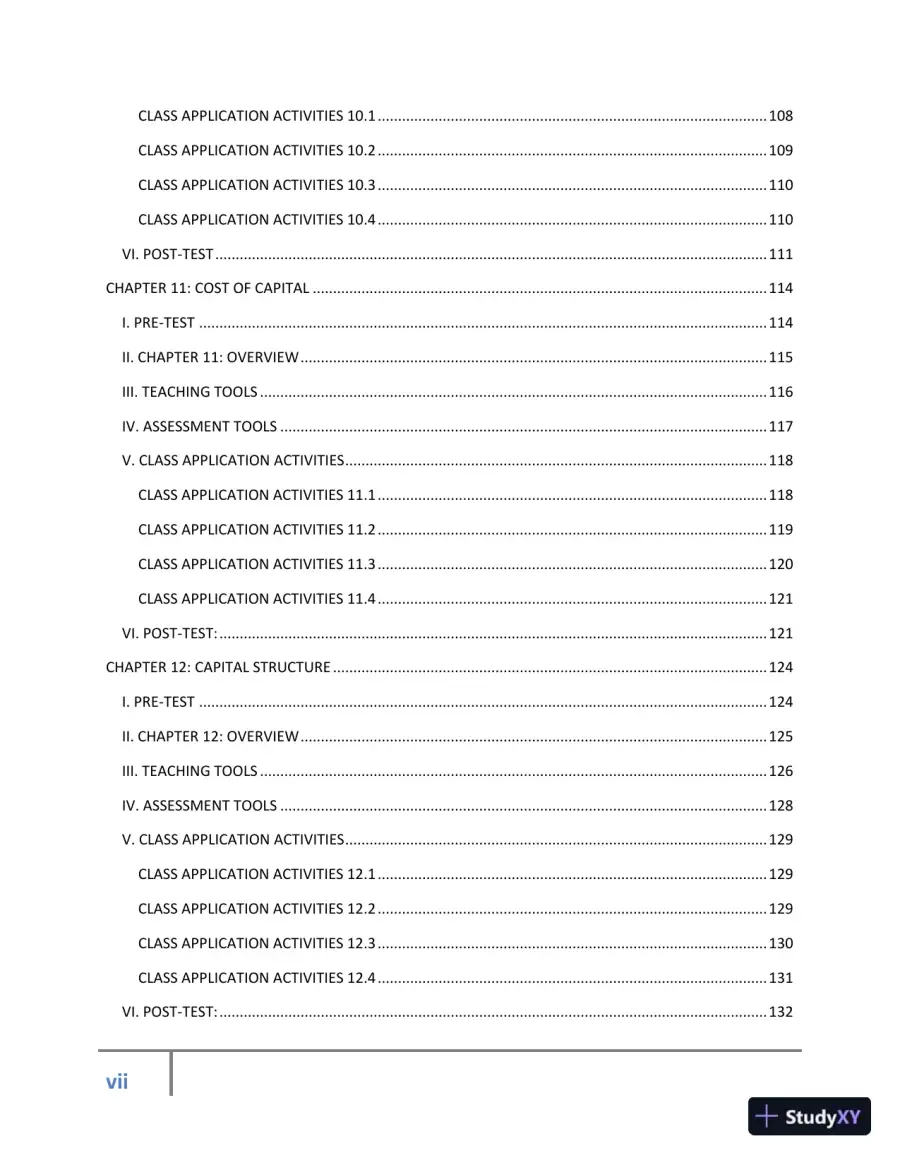 viiCLASS APPLICATION ACTIVITIES 10.1 ................................................................................................ 108CLASS APPLICATION ACTIVITIES 10.2 ................................................................................................ 109CLASS APPLICATION ACTIVITIES 10.3................................................................................................ 110CLASS APPLICATION ACTIVITIES 10.4 ................................................................................................ 110VI. POST-TEST ........................................................................................................................................ 111CHAPTER 11: COST OF CAPITAL ................................................................................................................ 114I. PRE-TEST ............................................................................................................................................ 114II. CHAPTER 11: OVERVIEW................................................................................................................... 115III. TEACHING TOOLS ............................................................................................................................. 116IV. ASSESSMENT TOOLS ........................................................................................................................ 117V. CLASS APPLICATION ACTIVITIES........................................................................................................ 118CLASS APPLICATION ACTIVITIES 11.1 ................................................................................................ 118CLASS APPLICATION ACTIVITIES 11.2................................................................................................ 119CLASS APPLICATION ACTIVITIES 11.3 ................................................................................................ 120CLASS APPLICATION ACTIVITIES 11.4 ................................................................................................ 121VI. POST-TEST:....................................................................................................................................... 121CHAPTER 12: CAPITAL STRUCTURE ........................................................................................................... 124I. PRE-TEST ............................................................................................................................................ 124II. CHAPTER 12: OVERVIEW................................................................................................................... 125III. TEACHING TOOLS ............................................................................................................................. 126IV. ASSESSMENT TOOLS ........................................................................................................................ 128V. CLASS APPLICATION ACTIVITIES........................................................................................................ 129CLASS APPLICATION ACTIVITIES 12.1 ................................................................................................ 129CLASS APPLICATION ACTIVITIES 12.2 ................................................................................................ 129CLASS APPLICATION ACTIVITIES 12.3 ................................................................................................ 130CLASS APPLICATION ACTIVITIES 12.4................................................................................................ 131VI. POST-TEST:....................................................................................................................................... 132
Page 9
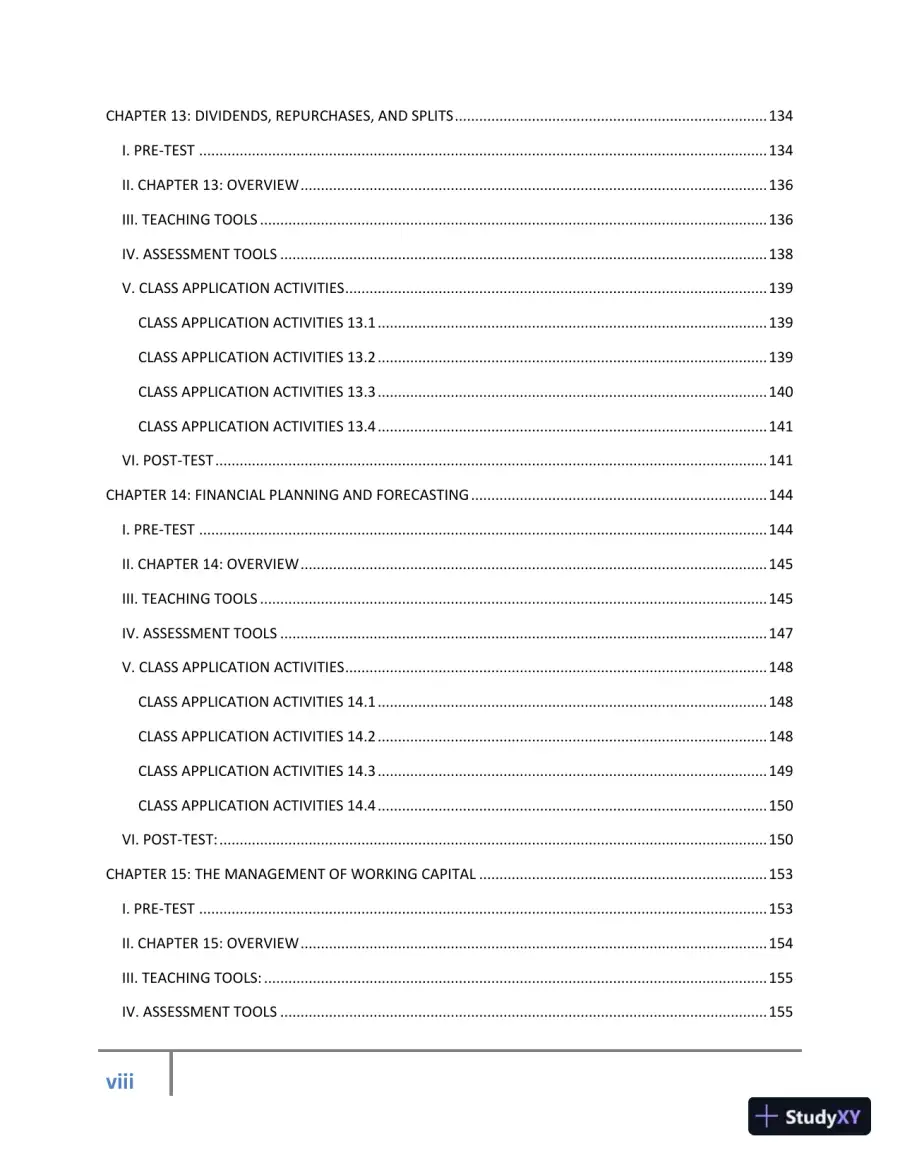 viiiCHAPTER 13: DIVIDENDS, REPURCHASES, AND SPLITS............................................................................. 134I. PRE-TEST ............................................................................................................................................ 134II. CHAPTER 13: OVERVIEW................................................................................................................... 136III. TEACHING TOOLS ............................................................................................................................. 136IV. ASSESSMENT TOOLS ........................................................................................................................ 138V. CLASS APPLICATION ACTIVITIES........................................................................................................ 139CLASS APPLICATION ACTIVITIES 13.1 ................................................................................................ 139CLASS APPLICATION ACTIVITIES 13.2 ................................................................................................ 139CLASS APPLICATION ACTIVITIES 13.3 ................................................................................................ 140CLASS APPLICATION ACTIVITIES 13.4................................................................................................ 141VI. POST-TEST ........................................................................................................................................ 141CHAPTER 14: FINANCIAL PLANNING AND FORECASTING ......................................................................... 144I. PRE-TEST ............................................................................................................................................ 144II. CHAPTER 14: OVERVIEW................................................................................................................... 145III. TEACHING TOOLS ............................................................................................................................. 145IV. ASSESSMENT TOOLS ........................................................................................................................ 147V. CLASS APPLICATION ACTIVITIES........................................................................................................ 148CLASS APPLICATION ACTIVITIES 14.1 ................................................................................................ 148CLASS APPLICATION ACTIVITIES 14.2 ................................................................................................ 148CLASS APPLICATION ACTIVITIES 14.3 ................................................................................................ 149CLASS APPLICATION ACTIVITIES 14.4 ................................................................................................ 150VI. POST-TEST:....................................................................................................................................... 150CHAPTER 15: THE MANAGEMENT OF WORKING CAPITAL ....................................................................... 153I. PRE-TEST ............................................................................................................................................ 153II. CHAPTER 15: OVERVIEW................................................................................................................... 154III. TEACHING TOOLS: ............................................................................................................................ 155IV. ASSESSMENT TOOLS ........................................................................................................................ 155
Page 10
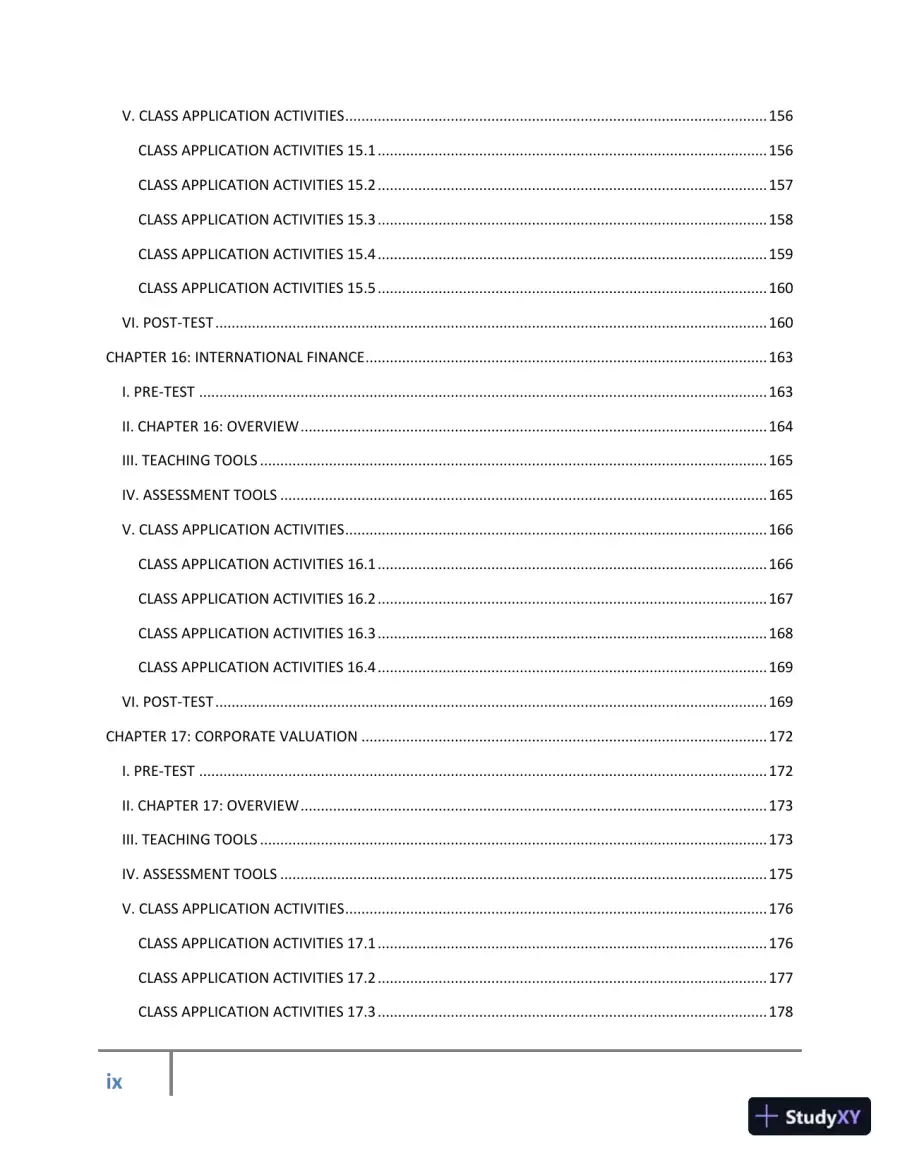 ixV. CLASS APPLICATION ACTIVITIES........................................................................................................ 156CLASS APPLICATION ACTIVITIES 15.1 ................................................................................................ 156CLASS APPLICATION ACTIVITIES 15.2 ................................................................................................ 157CLASS APPLICATION ACTIVITIES 15.3................................................................................................ 158CLASS APPLICATION ACTIVITIES 15.4 ................................................................................................ 159CLASS APPLICATION ACTIVITIES 15.5 ................................................................................................ 160VI. POST-TEST ........................................................................................................................................ 160CHAPTER 16: INTERNATIONAL FINANCE................................................................................................... 163I. PRE-TEST ............................................................................................................................................ 163II. CHAPTER 16: OVERVIEW................................................................................................................... 164III. TEACHING TOOLS ............................................................................................................................. 165IV. ASSESSMENT TOOLS ........................................................................................................................ 165V. CLASS APPLICATION ACTIVITIES........................................................................................................ 166CLASS APPLICATION ACTIVITIES 16.1................................................................................................ 166CLASS APPLICATION ACTIVITIES 16.2 ................................................................................................ 167CLASS APPLICATION ACTIVITIES 16.3 ................................................................................................ 168CLASS APPLICATION ACTIVITIES 16.4 ................................................................................................ 169VI. POST-TEST ........................................................................................................................................ 169CHAPTER 17: CORPORATE VALUATION .................................................................................................... 172I. PRE-TEST ............................................................................................................................................ 172II. CHAPTER 17: OVERVIEW................................................................................................................... 173III. TEACHING TOOLS ............................................................................................................................. 173IV. ASSESSMENT TOOLS ........................................................................................................................ 175V. CLASS APPLICATION ACTIVITIES........................................................................................................ 176CLASS APPLICATION ACTIVITIES 17.1 ................................................................................................ 176CLASS APPLICATION ACTIVITIES 17.2 ................................................................................................ 177CLASS APPLICATION ACTIVITIES 17.3................................................................................................ 178
Page 11
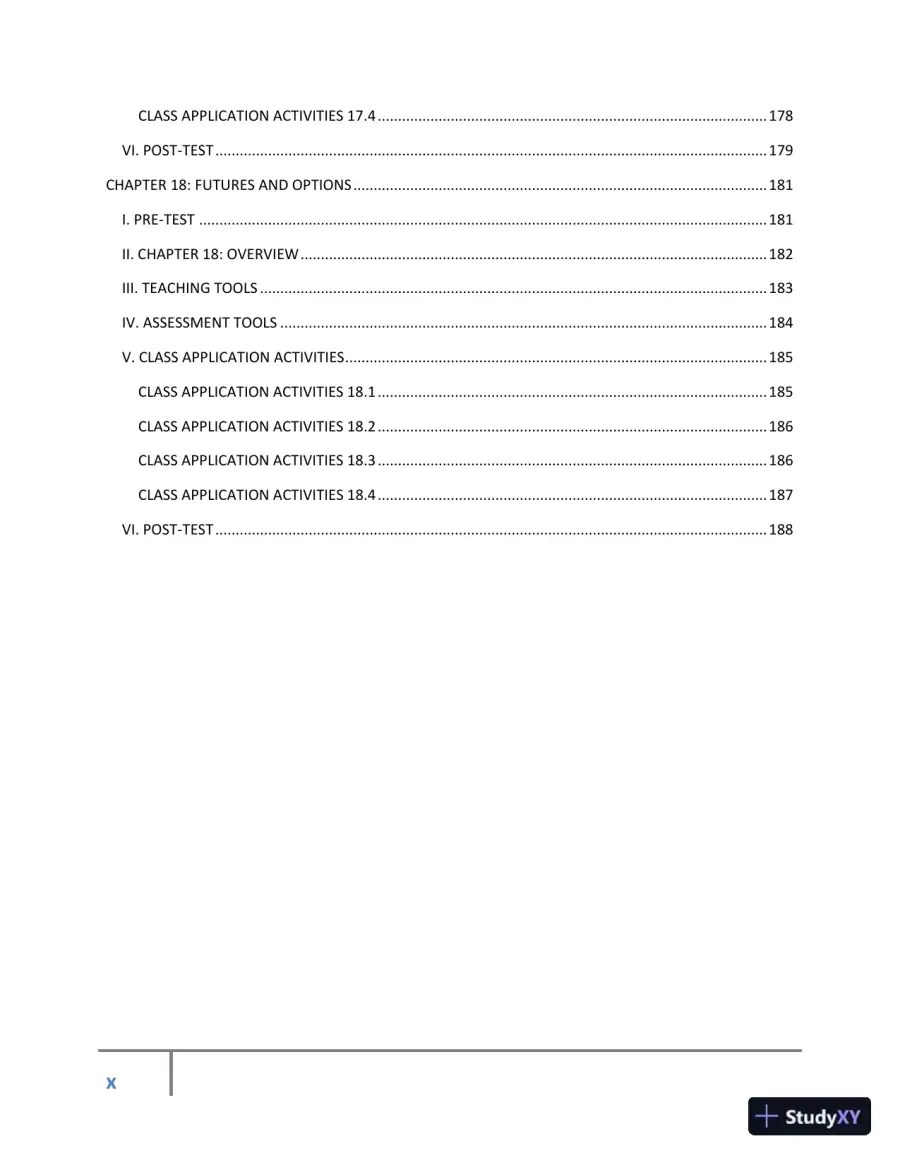 xCLASS APPLICATION ACTIVITIES 17.4 ................................................................................................ 178VI. POST-TEST ........................................................................................................................................ 179CHAPTER 18: FUTURES AND OPTIONS...................................................................................................... 181I. PRE-TEST ............................................................................................................................................ 181II. CHAPTER 18: OVERVIEW................................................................................................................... 182III. TEACHING TOOLS ............................................................................................................................. 183IV. ASSESSMENT TOOLS ........................................................................................................................ 184V. CLASS APPLICATION ACTIVITIES........................................................................................................ 185CLASS APPLICATION ACTIVITIES 18.1 ................................................................................................ 185CLASS APPLICATION ACTIVITIES 18.2 ................................................................................................ 186CLASS APPLICATION ACTIVITIES 18.3 ................................................................................................ 186CLASS APPLICATION ACTIVITIES 18.4................................................................................................ 187VI. POST-TEST ........................................................................................................................................ 188
Page 12
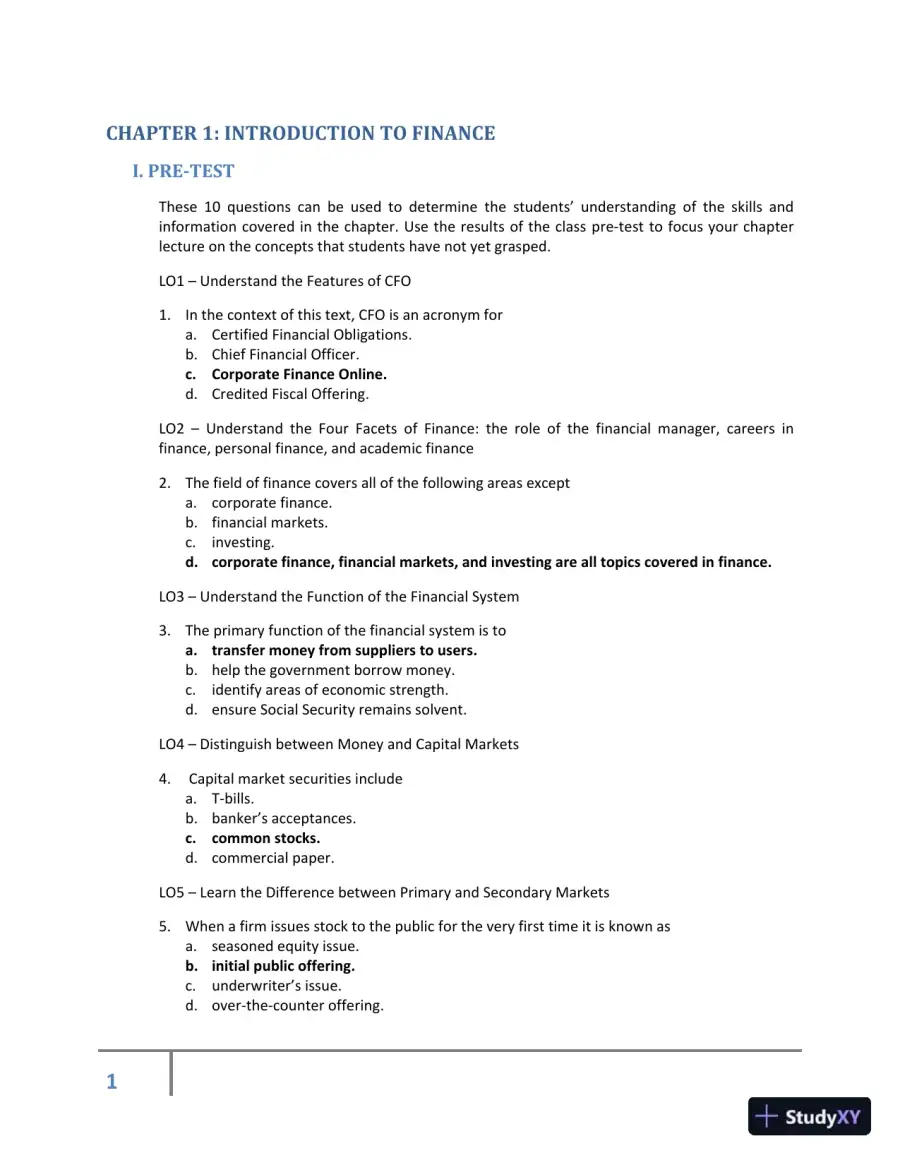 1CHAPTER 1: INTRODUCTION TO FINANCEI. PRE-TESTThese 10 questions can be used to determinethe students’ understanding of the skills andinformation covered in the chapter. Use the results of the class pre-test to focus your chapterlecture on the concepts that students have not yet grasped.LO1–Understand the Features of CFO1.In the context of this text, CFO is an acronym fora.Certified Financial Obligations.b.Chief Financial Officer.c.Corporate Finance Online.d.Credited Fiscal Offering.LO2–Understand the Four Facets of Finance: the role of the financial manager, careers infinance, personal finance, and academic finance2.The field of finance covers all of the following areas excepta.corporate finance.b.financial markets.c.investing.d.corporate finance, financial markets, and investing are all topics covered in finance.LO3–Understand the Function of the Financial System3.The primary function of the financial system is toa.transfer money from suppliers to users.b.help the government borrow money.c.identify areas of economic strength.d.ensure Social Security remains solvent.LO4–Distinguish between Money and Capital Markets4.Capital market securities includea.T-bills.b.banker’s acceptances.c.common stocks.d.commercial paper.LO5–Learn the Difference between Primary and Secondary Markets5.When a firm issues stock to the public for the very first time it is known asa.seasoned equity issue.b.initial public offering.c.underwriter’s issue.d.over-the-counter offering.
Page 13
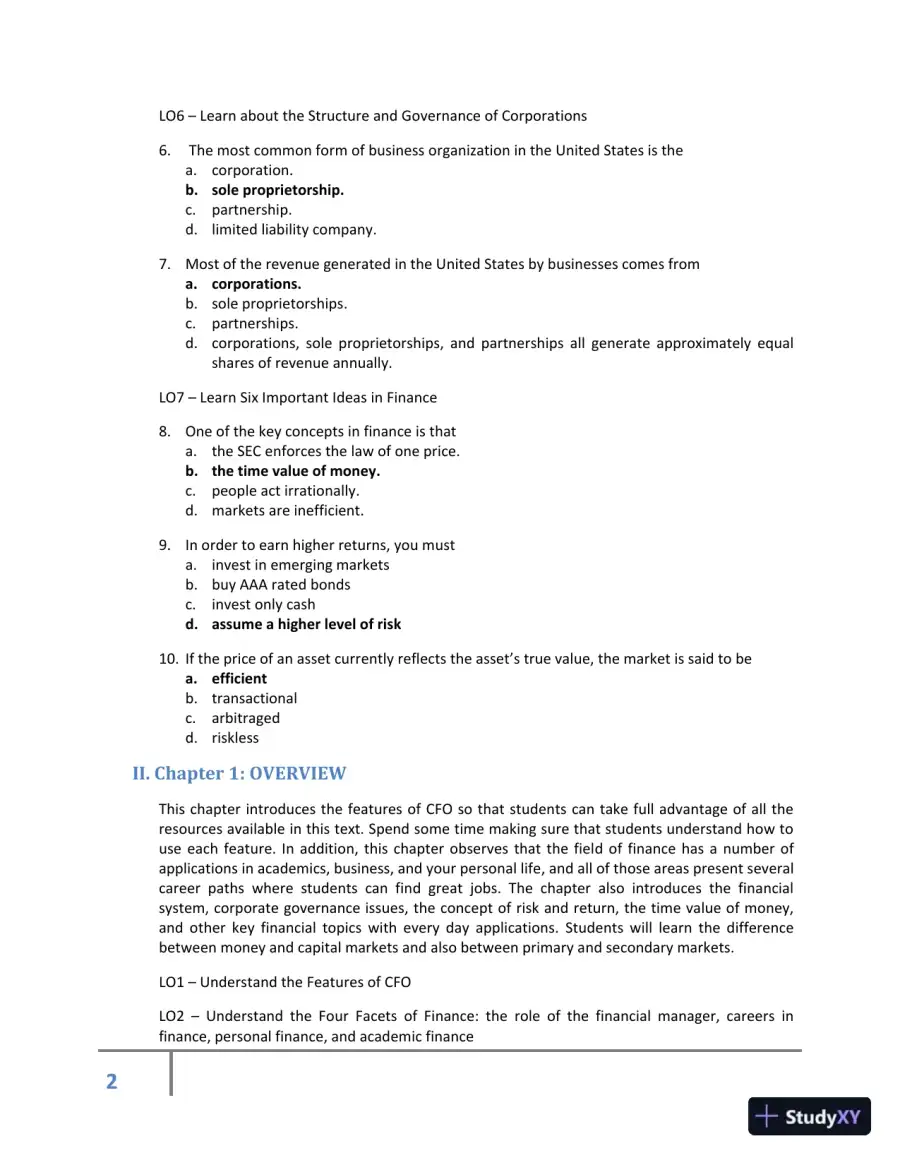 2LO6–Learn about the Structure and Governance of Corporations6.The most common form of business organization in the United States is thea.corporation.b.sole proprietorship.c.partnership.d.limited liability company.7.Most of the revenue generated in the United States by businesses comes froma.corporations.b.sole proprietorships.c.partnerships.d.corporations, sole proprietorships, and partnerships all generate approximately equalshares of revenue annually.LO7–Learn Six Important Ideas in Finance8.One of the key concepts in finance is thata.the SEC enforces the law of one price.b.the time value of money.c.people act irrationally.d.markets are inefficient.9.In order to earn higher returns, you musta.invest in emerging marketsb.buy AAA rated bondsc.invest only cashd.assume a higher level of risk10.If the price of an asset currently reflects the asset’s true value, the market is said to bea.efficientb.transactionalc.arbitragedd.risklessII. Chapter 1: OVERVIEWThis chapter introduces the features of CFO so that students can take full advantage of all theresources available in this text. Spend some time making sure that students understand how touse each feature. In addition, this chapter observes that the field of finance has a number ofapplications in academics, business, and your personal life, and all of those areas present severalcareer paths where students can find great jobs. The chapter also introduces the financialsystem, corporate governance issues, the concept of risk and return, the time value of money,and other key financial topics with every day applications. Students will learn the differencebetween money and capital markets and also between primary and secondary markets.LO1–Understand the Features of CFOLO2–Understand the Four Facets of Finance: the role of the financial manager, careers infinance, personal finance, and academic finance
Page 14
 3LO3–Understand the Function of the Financial SystemLO4–Distinguish between Money and Capital MarketsLO5–Learn the Difference between Primary and Secondary MarketsLO6–Learn about the Structure and Governance of CorporationsLO7–Learn Six Important Ideas in FinanceIII. TEACHING TOOLSThe following list summarizes the concepts covered in the chapter videos and solution tools.1.1.1 Explain It–Features of CFO - LO1:This video explains the features of CFO using Explain Itvideos, Interactive graphs, and Solution Tools that will be utilized throughout the text to providegreater detail on certain concepts and problems.1.2.1 Explain It–Four Facets of Finance - LO2:This video shows the student the four differentperspectives through which you can view the field of finance: academic finance, businessfinance, careers in finance, and personal finance.1.5.1 Explain It–Initial Public Offerings–LO5:This text file provides some specifics on a recentIPO and also some information on IPO investing.1.5.2 Explain it–Dealer Markets Part 1–LO5:This video shows how a dealer buys and sellsshares of stock and makes a profit on the spread (the difference in the bid and ask prices).1.5.2 Explain it–Dealer Markets Part 2–LO5:This video shows how buying and selling sharesof stock (demand and supply) impacts price determination in the market.1.6.2 Explain it–Management’s Fiduciary Duty –LO6:This text file provides two exampleswhere managers placed the interest of one stakeholder group over shareholders and the stockprices responded negatively.1.6.2 Explain it–Principal-Agent Problem: Contractual Remedies–LO6:This video illustratesthe classic principal agent problem using Tyco’s CEO Dennis Kozlowski’sexorbitant corporatespending practices.1.6.2 Explain it–Principal-Agent Problem: Government Regulation–LO6:This text box directsstudents to conduct an Internet search for information on Tyco, Enron, or WorldCom, since eachcase represents a clear example of an agency problem.1.7.2 Explain it–Bernie Madoff and the Risk/Return Tradeoff–LO7:This text box providessome historical information on Bernie Madoff and his Ponzi scheme and how it relates to riskand return.1.7.3 Explain it–Efficiency, Arbitrage, and Law of One Price–LO7:This video provides ahumorous introduction to the concept of market efficiency.
Page 15
 4IV. ASSESSMENT TOOLSHere is a listing (by page number) and description of all the assessments provided in thischapter.Page NumberDescription1.2.1Self-Test Question 11.2.1Self-Test Question 21.3.1Self-Test Question 31.3.1Self-Test Question 41.4.1Self-Test Question 51.4.1Self-Test Question 61.4.2Self-Test Question 71.5.1Self-Test Question 81.5.2Self-Test Question 91.5.2Self-Test Question 101.6.1Self-Test Question 111.6.2Self-Test Question 121.7.6Self-Test Question 131.7.6Self-Test Question 14Practice Section 1.2Practice Section 1.3Practice Section 1.4Practice Section 1.5Chapter1HomeworkChapter 1 Quiz
Page 16
 5V. CLASS APPLICATION ACTIVITIESThese activities, complete with solutions, provide opportunities to reinforce (either in class or insmall groups) students’ ability to apply chapter concepts in business contexts.CLASS APPLICATION ACTIVITIES 1.1Title: Occupational Outlook Handbook and Finance CareersLO2–Understand the Four Facets of Finance: the role of the financial manager, careers infinance, personal finance, and academic financeNumerous career options are available to finance graduates. Students can begin careers ingovernment,thenon-profitsector,corporatefinance,banking,investmentsandwealthmanagement, education and other fields. However, it is useful to know the expected salariesand the projected job demand for a particular skill set prior to spending years acquiring theexpertise to work in that field. One of the ways you can learn more about a particular career isto research that career in theOccupational Outlook Handbookpublished by the Bureau of LaborStatistics. Go to the following website:http://www.bls.gov/ooh/Now look under the heading “Occupation Groups” and click on the link “Business and Financial.”Scroll down through the list of job titles and select one that interests you and read all theinformation posted about that job.Questions to pose:1.What is the education required for an entry-level position? Does the job require anylicensure requirements?Answer: It varies according to the job selected.2.What is the expected starting salary for this position?Answer: It varies according to the job selected.3.What is the projected job growth in this field for the next several years?Answer: It varies according to the job selected.Time on task:This exercise can take between 15 and 30 minutes, depending on how long ittakes to find and summarize the findings.Teaching Notes:This activity pushes students to begin thinking in terms of the market demandfor a particular skill set. You can extend this activity by requiring groups to make presentationson two or three jobs or have individuals draft a one-page report about a specific job.
Page 17
 6CLASS APPLICATION ACTIVITIES 1.2Title: Nasdaq IPOsLO5–Learn the Difference between Primary and Secondary MarketsAn initial public offering (IPO) occurs when corporations sell equity capital to the public for thefirst time and become listed and publicly traded on an organized stock exchange. Sizes of theIPOs typically fall into the $50 million to $500 million range and are relatively unknowncompanies. Nasdaq tracks IPOs and maintains an extensive database on IPOs in the pipeline andrecent IPOs. Go to the following website and then answer a few questions.http://www.nasdaq.com/markets/ipos/Questions to pose:1.Look at the “Latest IPOs” and click on the link “View All Latest IPOs.”How many IPOs cameout during that period? What was the size (offer amount) of the largest IPO? What was thesize (offer amount) of the smallest? What was the smallest offer price? What was the largestoffer price?Answer: Varies.2.Scroll down the page to the “IPO Performance” graph that shows the best and worstperformers over the past six months. What company generated the best returns forinvestors?Whatcompanygeneratedtheworstreturnsforinvestor?Providesomebackground information on each firm and information on the returns generated.Answer: Varies.Time on task:This exercise can take between 15 and 30 minutes, depending on how long ittakes to find and summarize the findings.Teaching Notes:This activity allows students to learn about the IPO market at the time they aretaking the class. You can ask dozens of questions about the material on this site and IPOs ingeneral.Table of ContentsCLASS APPLICATION ACTIVITIES 1.3Title: Charles PonziLO6–Learn about the Structure and Governance of CorporationsWe’ve all heard of Ponzi schemes buthow much do you know about Charles Ponzi? A particulartype of financial fraud, Ponzi schemes were named after an Italian immigrant named CharlesPonzi who became famous for his fraudulent activities in the early 1900s. Go to your favoriteInternet searchengine and search for “Charles Ponzi” and then answer a few questions aboutPonzi schemes and Charles Ponzi.
Page 18
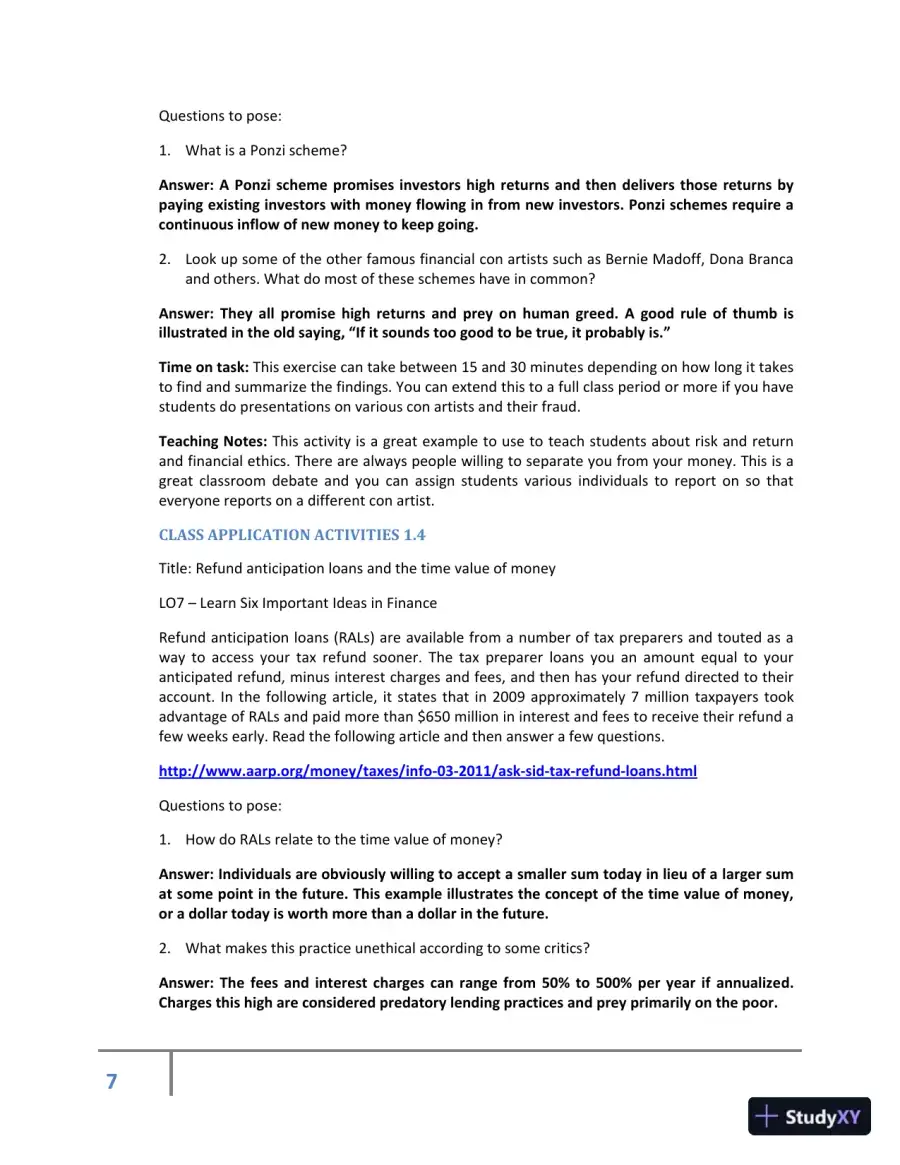 7Questions to pose:1.What is a Ponzi scheme?Answer: A Ponzi scheme promises investors high returns and then delivers those returns bypaying existing investors with money flowing in from new investors. Ponzi schemes require acontinuous inflow of new money to keep going.2.Look up some of the other famous financial con artists such as Bernie Madoff, Dona Brancaand others. What do most of these schemes have in common?Answer: They all promise high returns and prey on human greed. A good rule of thumb isillustrated in the old saying, “If it sounds too good to be true, it probably is.”Time on task:This exercise can take between 15 and 30 minutes depending on how long it takesto find and summarize the findings. You can extend this to a full class period or more if you havestudents do presentations on various con artists and their fraud.Teaching Notes:This activity is a great example to use to teach students about risk and returnand financial ethics. There are always people willing to separate you from your money. This is agreat classroom debate and you can assign students various individuals to report on so thateveryone reports on a different con artist.CLASS APPLICATION ACTIVITIES 1.4Title: Refund anticipation loans and the time value of moneyLO7–Learn Six Important Ideas in FinanceRefund anticipation loans (RALs) are available from a number of tax preparers and touted as away to access your tax refund sooner. The tax preparer loans you an amount equal to youranticipated refund, minus interest charges and fees, and then has your refund directed to theiraccount. In the following article, it states that in 2009 approximately 7 million taxpayers tookadvantage of RALs and paid more than $650 million in interest and fees to receive their refund afew weeks early. Read the following article and then answer a few questions.http://www.aarp.org/money/taxes/info-03-2011/ask-sid-tax-refund-loans.htmlQuestions to pose:1.How do RALs relate to the time value of money?Answer: Individuals are obviously willing to accept a smaller sum today in lieu of a larger sumat some point in the future. This example illustrates the concept of the time value of money,or a dollar today is worth more than a dollar in the future.2.What makes this practice unethical according to some critics?Answer: The fees and interest charges can range from 50% to 500% per year if annualized.Charges this high are considered predatory lending practices and prey primarily on the poor.
Page 19
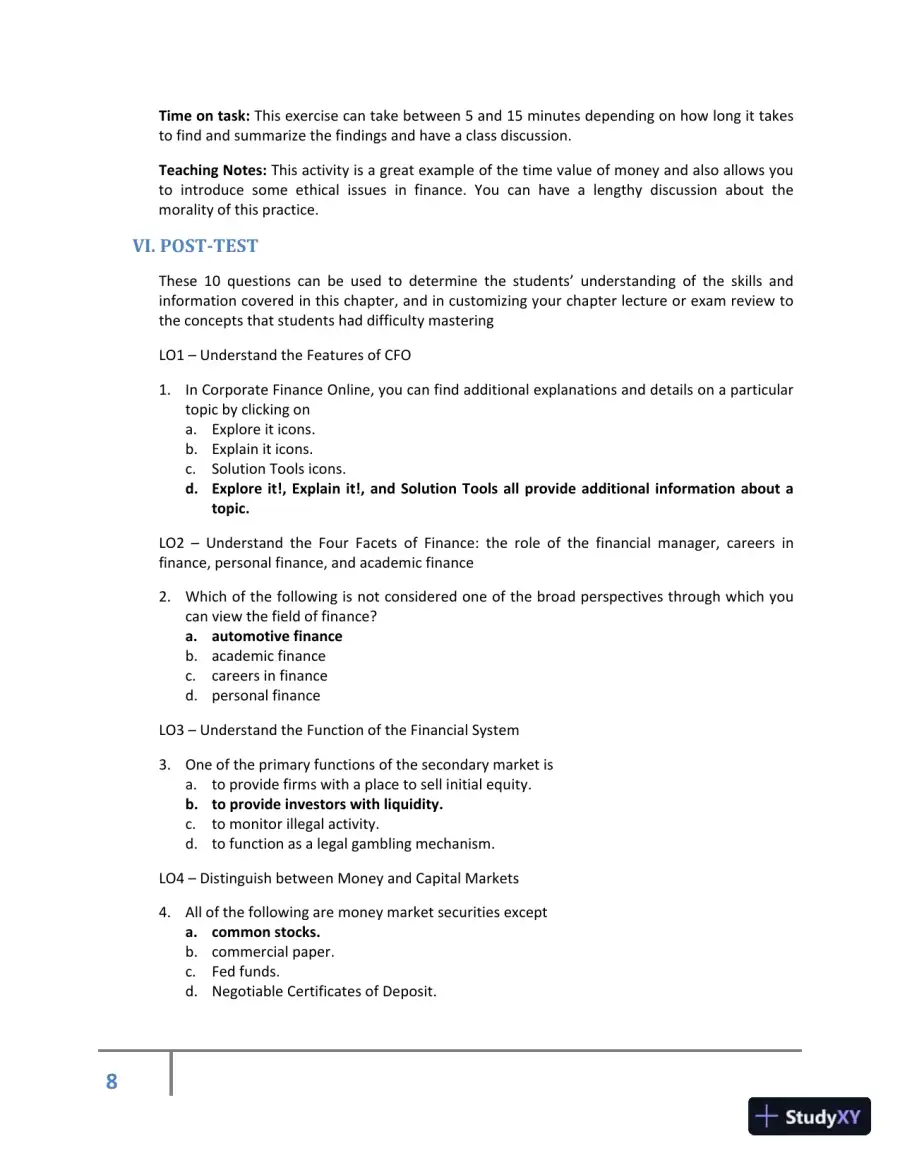 8Time on task:This exercise can take between 5 and 15 minutes depending on how long it takesto find and summarize the findings and have a class discussion.Teaching Notes:This activity is a great example of the time value of money and also allows youto introduce some ethical issues in finance. You can have a lengthy discussion about themorality of this practice.VI. POST-TESTThese 10 questions can be used to determine the students’ understanding of the skills andinformation covered in this chapter, and in customizing your chapter lecture or exam review tothe concepts that students had difficulty masteringLO1–Understand the Features of CFO1.In Corporate Finance Online, you can find additional explanations and details on a particulartopic by clicking ona.Explore it icons.b.Explain it icons.c.Solution Tools icons.d.Explore it!, Explain it!, and Solution Tools all provide additional information about atopic.LO2–Understand the Four Facets of Finance: the role of the financial manager, careers infinance, personal finance, and academic finance2.Which of the following is not considered one of the broad perspectives through which youcan view the field of finance?a.automotive financeb.academic financec.careers in financed.personal financeLO3–Understand the Function of the Financial System3.One of the primary functions of the secondary market isa.to provide firms with a place to sell initial equity.b.to provide investors with liquidity.c.to monitor illegal activity.d.to function as a legal gambling mechanism.LO4–Distinguish between Money and Capital Markets4.All of the following are money market securities excepta.common stocks.b.commercial paper.c.Fed funds.d.Negotiable Certificates of Deposit.
Page 20
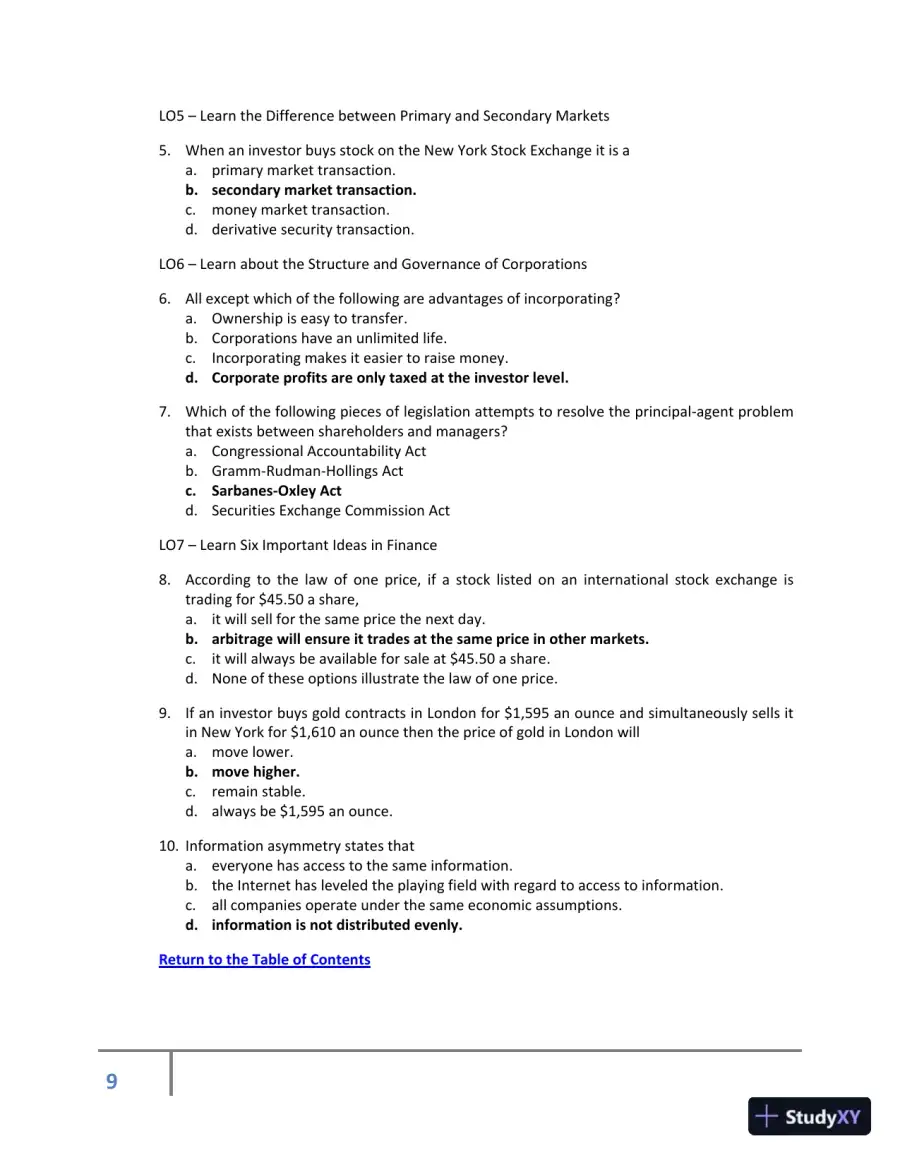 9LO5–Learn the Difference between Primary and Secondary Markets5.When an investor buys stock on the New York Stock Exchange it is aa.primary market transaction.b.secondary market transaction.c.money market transaction.d.derivative security transaction.LO6–Learn about the Structure and Governance of Corporations6.All except which of the following are advantages of incorporating?a.Ownership is easy to transfer.b.Corporations have an unlimited life.c.Incorporating makes it easier to raise money.d.Corporate profits are only taxed at the investor level.7.Which of the following pieces of legislation attempts to resolve the principal-agent problemthat exists between shareholders and managers?a.Congressional Accountability Actb.Gramm-Rudman-Hollings Actc.Sarbanes-Oxley Actd.Securities Exchange Commission ActLO7–Learn Six Important Ideas in Finance8.According to the law of one price, if a stock listed on an international stock exchange istrading for $45.50 a share,a.it will sell for the same price the next day.b.arbitrage will ensure it trades at the same price in other markets.c.it will always be available for sale at $45.50 a share.d.None of these options illustrate the law of one price.9.If an investor buys gold contracts in London for $1,595 an ounce and simultaneously sells itin New York for $1,610 an ounce then the price of gold in London willa.move lower.b.move higher.c.remain stable.d.always be $1,595 an ounce.10. Information asymmetry states thata.everyone has access to the same information.b.the Internet has leveled the playing field with regard to access to information.c.all companies operate under the same economic assumptions.d.information is not distributed evenly.Return to the Table of Contents
Page 21
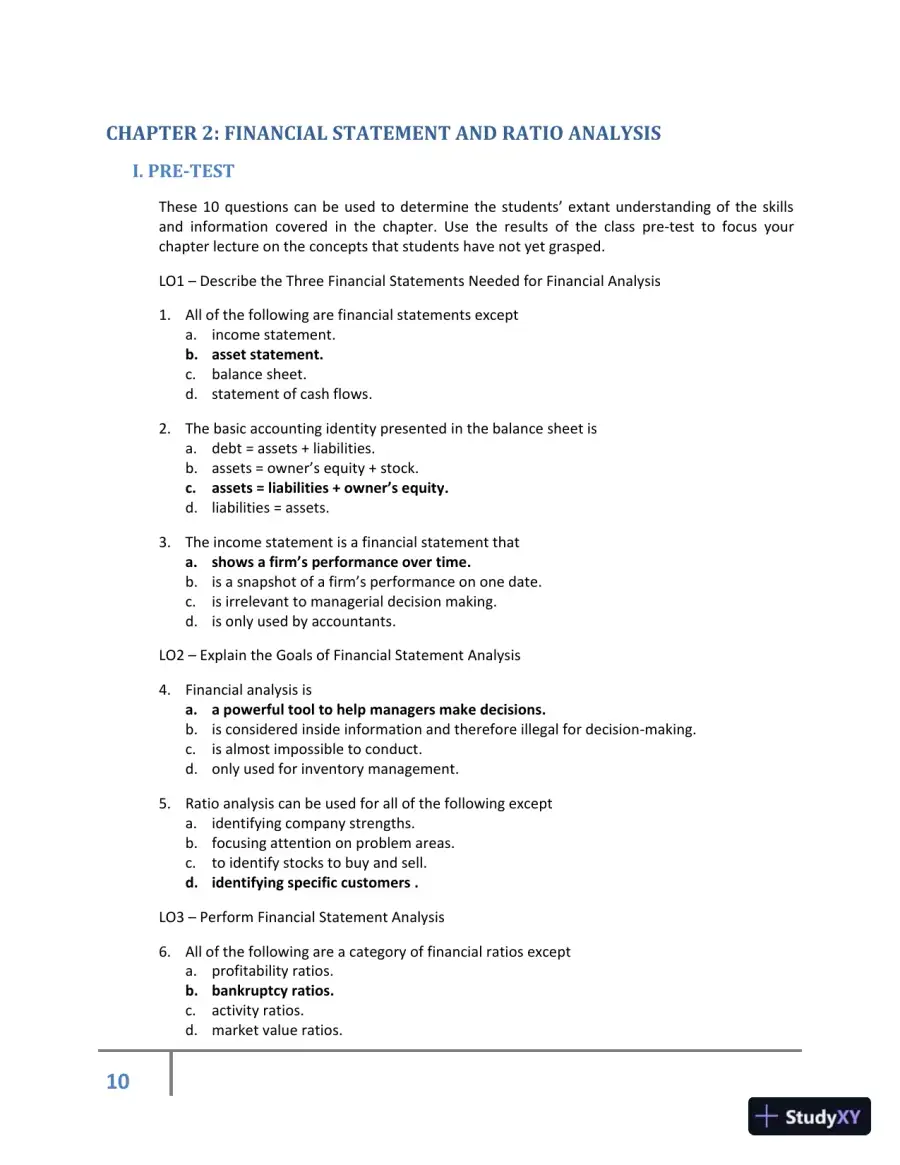 10CHAPTER 2: FINANCIAL STATEMENT AND RATIO ANALYSISI. PRE-TESTThese 10 questions can be used to determine the students’ extant understanding of the skillsand information covered in the chapter. Use the results of the class pre-test to focus yourchapter lecture on the concepts that students have not yet grasped.LO1–Describe the Three Financial Statements Needed for Financial Analysis1.All of the following are financial statements excepta.income statement.b.asset statement.c.balance sheet.d.statement of cash flows.2.The basic accounting identity presented in the balance sheet isa.debt = assets + liabilities.b.assets = owner’s equity + stock.c.assets = liabilities + owner’s equity.d.liabilities = assets.3.The income statement is a financial statement thata.shows a firm’s performance over time.b.isa snapshot of a firm’s performance on one date.c.is irrelevant to managerial decision making.d.is only used by accountants.LO2–Explain the Goals of Financial Statement Analysis4.Financial analysis isa.a powerful tool to help managers make decisions.b.is considered inside information and therefore illegal for decision-making.c.is almost impossible to conduct.d.only used for inventory management.5.Ratio analysis can be used for all of the following excepta.identifying company strengths.b.focusing attention on problem areas.c.to identify stocks to buy and sell.d.identifying specific customers .LO3–Perform Financial Statement Analysis6.All of the following are a category of financial ratios excepta.profitability ratios.b.bankruptcy ratios.c.activity ratios.d.market value ratios.
Page 22
 117.Liquidity ratios provide lenders with information abouta.a firm’s ability to meet its financial obligations.b.a firm’s ability to manage its assets.c.a firm’s overall profitability.d.a firm’s stock price.LO4–Prepare Common Sized Financial Statements8.To construct a common-sized balance sheet, you divide every balance sheet item by what sothat you can make comparisons with other firms?a.100b.total assetsc.salesd.72LO5–Evaluate Company Performance Using the DuPont Ratio9.The Du Pont ratio analysis was developed bya.consultants.b.the Du Pont Corporation.c.Henry Du Pont.d.none of these.LO6–Integrate Ratios Together to Perform Company Analysis10. Ratio interaction makes it useful for a financial analyst or manager to evaluate a firma.using only liquidity ratios.b.using several ratios at the same time.c.by pairing certain ratios that go together.d.None of these is correct.II. CHAPTER 2: OVERVIEWFinancial statements provide financial managers with the information they need to makedecisions that contribute to shareholder wealth maximization. This chapter provides the toolsnecessary to perform analysis using that information. Students will learn how to calculate andinterpret ratios that help us make decisions about asset utilization, efficiency, liquidity,financing, and market valuation. Students will also learn how to prepare common sized financialstatements and evaluate a firm using the DuPont ratio. By the end of this chapter, studentsshould:LO1–Describe the Three Financial Statements Needed for Financial AnalysisLO2–Explain the Goals of Financial Statement AnalysisLO3–Perform Financial Statement AnalysisLO4–Prepare Common Sized Financial StatementsLO5–Evaluate Company Performance Using the DuPont RatioLO6–Integrate Ratios Together to Perform Company Analysis
Page 23
 12III. TEACHING TOOLSThe following list summarizes the concepts covered in the chapter videos and solution tools.2.1.1 Explain it–The Balance Sheet- LO1–This video shows a sample balance sheet and thenprovides a concise explanation of the balance sheet; it also shows how a financial manager canglean a tremendous amount of useful information from the raw data.2.1.2 Explain it–The Income Statement - LO1–This video shows a sample income statementand provides an explanation of the various components, such as sales, profits, etc. The authoralso points out a primary difference between the income statement and the balance sheet. Theincome statement provides the financial manager with information about operations over oneoperating cycle, whereas the balance sheet is a snapshot of the firm’s assets and liabilities at apoint in time.2.1.3 Explain it–Statement of Cash Flows- LO1–This video provides a brief explanation of thethree components of the statement of cash flows. The first section shows whether the firm isgenerating cash from operations. The other two components of the statement of cash flowsshow cash flows from investing activities and cash flows from financing activities.2.3.1 Explain it–SIC Codes and Industry Classification–LO3–This text explains StandardIndustrial Classification (SIC) codes and how you can use that information to find peer data touse for comparison with your firm.TABLE 2.4–2.3.2 - Profitability Ratios2.3.2 Explain it–Return on Equity (ROE) (equation 2.1)–LO3–This video explains how tocalculate ROE, shows you where to find the ratio inputs, and then provides information on howto interpret this ratio.2.3.2 Explain it–Return on Assets (ROA) (equation 2.2)–LO3–This video explains how tocalculate the ROA, shows you where to find the ratio inputs, and then provides information onhow to interpret this ratio.2.3.2 Explain it–Gross Profit Margin (equation 2.3)–LO3–This video explains how tocalculate the Gross Profit Margin, shows you where to find the ratio inputs, and then providesinformation on how to interpret this ratio.2.3.2 Explain it–Operating Profit Margin (equation 2.4)–LO3–This video explains how tocalculate the Operating Profit Margin, shows you where to find the ratio inputs, and thenprovides information on how to interpret this ratio.2.3.2 Explain it–Net Profit Margin (equation 2.5)–LO3–This video explains how to calculatethe Net Profit Margin, shows you where to find the ratio inputs, and then provides informationon how to interpret this ratio.2.3.2 Explain it–Summary of Profitability Ratios–LO3:This video provides a detailedexplanation about how profitability ratios are used in practice. The video focuses on how eachdifferent profitability ratio gives us slightly different useful information that we can use toimprove operations, evaluate performance or both.
Page 24
 13TABLE 2.5–2.3.3 - Liquidity Ratios2.3.1 Explain it–Liquidity Ratios–LO3–This text explains how lenders use liquidity ratios toevaluate whether a firm has sufficient liquidity to warrant making a loan.2.3.1 Explain it–Current Ratio (equation 2.6)–LO3–This video explains how to calculate theCurrent Ratio, shows you where to find the ratio inputs, and also provides information on howto interpret this ratio.2.3.1 Explain it–Quick Ratio (equation 2.7)–LO3–This video explains how to calculate theQuick Ratio, shows you where to find the ratio inputs, and also provides information on how tointerpret this ratio.2.3.1 Explain it–Liquidity Summary–LO3–This video uses some sample liquidity ratios fromindustry and explains how these ratios can be interpreted in different ways.TABLE 2.6–2.3.4 - Activity Ratios2.3.4 Explain it–Inventory Turnover (equation 2.8)–LO3–This video explains how to calculatethe Inventory Turnover ratio, shows you where to find the ratio inputs, and also providesinformation on how to interpret this ratio.2.3.4 Explain it–Accounts Receivables Turnover (equation 2.9)–LO3–This video explains howto calculate the Accounts Receivables Turnover ratio, shows you where to find the ratio inputs,and also provides information on how to interpret this ratio.2.3.4 Explain it–Total Asset Turnover (equation 2.10)–LO3–This video explains how tocalculate the Total Asset Turnover ratio, shows you where to find the ratio inputs, and alsoprovides information on how to interpret this ratio.2.3.4 Explain it–Average Collection Period (equation 2.11)–LO3–This video explains how tocalculate the Average Collection Period, shows you where to find the ratio inputs, and alsoprovides information on how to interpret this ratio.TABLE 2.7–2.3.5–Financing Ratios2.3.5 Explain it–Debt Ratio (equation 2.12)–LO3–This video explains how to calculate theDebt Ratio, shows you where to find the ratio inputs, and also provides information on how tointerpret this ratio.2.3.5 Explain it–Debt Equity Ratio (equation 2.13)–LO3–This video explains how to calculatethe Debt to Equity Ratio, shows you where to find the ratio inputs, and also providesinformation on how to interpret this ratio.2.3.5 Explain it–Times Interest Earned Ratio (equation 2.14)–LO3–This video explains howto calculate the Times Interest Earned, shows you where to find the ratio inputs, and alsoprovides information on how to interpret this ratio.TABLE 2.8–2.3.6–Market Ratios
Page 25
 142.3.6 Explain it–Earnings Per Share (equation 2.15)–LO3–This video explains how tocalculate Earnings Per Share, shows you where to find the ratio inputs, and also providesinformation on how to interpret this ratio.2.3.6 Explain it–Price Earnings (PE) (equation 2.16)–LO3–This video explains how tocalculate the Price Earnings ratio, shows you where to find the ratio inputs, and also providesinformation on how to interpret this ratio.2.3.6 Explain it–Market to Book (equation 2.17)–LO3–This video explains how to calculatethe Market to Book ratio, shows you where to find the ratio inputs, and also providesinformation on how to interpret this ratio.2.4.1 Explain it–Common-Sized Financial Statements–LO4–This video explains how to createcommon-sized balance sheets using spreadsheet software and then how to use this informationfor trend analysis. The video then shows how to create common-sized income statements andhow to interpret the information contained in this statement.2.5.1 Explain it–DuPont Analysis–LO5–This video explains how to perform analysis using theDuPont analysis method.IV. ASSESSMENT TOOLSHere is a listing (by page number) and description of all the assessments provided in thischapter.Page Number(Chapter: Learning Objective: Page)Description2.1.3Self-Test Question 12.1.3Self-Test Question 22.1.3Self-Test Question 32.2.1Self-Test Question 42.3.1Self-Test Question 52.3.1Self-Test Question 62.3.2Self-TestQuestion 72.3.3Self-Test Question 82.3.3Self-Test Question 92.3.4Self-Test Question 102.3.5Self-Test Question 112.3.6Self-Test Question 122.4.1Self-Test Question 132.4.1Self-Test Question 142.5.1Self-Test Question 15
Page 26
 15Page Number(Chapter: Learning Objective: Page)Description2.5.1Self-Test Question 162.6.1Self-Test Question 172.6.1Self-Test Question 18Practice Section 2.1Practice Section 2.2Practice Section 2.3Practice Section 2.4Practice Section 2.5Practice Section 2.6Chapter 2 HomeworkChapter 2 QuizV. CLASS APPLICATION ACTIVITIESThese activities, complete with solutions, provide opportunities to reinforce (either in class or insmall groups) students’ ability to apply chapter concepts in business contexts.CLASS APPLICATION ACTIVITIES 2.1Wal-Mart’s Income StatementLO1–Describe the Three Financial Statements Needed for Financial AnalysisWal-Mart Stores Inc. (WMT) is one of the largest companies in the world and has more than twomillion employees. The company operates retail outlets in various formats in all 50 U.S. statesand 26 countries other than the United States. Wal-Mart also has online retail operations.Go to your favorite financial site and type in the ticker symbol for Wal-Mart Stores Inc. (WMT).Find a button labeled as “Financial Statements” or “Financials” and then navigate to the incomestatement and look at the last three years.Questions to pose:1.What was WMT’s revenue trend for the past three years?Answer: Varies depending on the period.2.Has WMT’s net income been increasing or decreasing?Answer: Varies depending on the period.3.Briefly summarize the information you can rapidly glean from WMT’s income statement.Does anything surprise you?
Page 27
 16Answer: Varies.Time on task:This exercise can take between 10 and 20 minutes depending on how long it takesto find and summarize the findings.Teaching Notes:This activity is a current example of the types of information you can gleanfrom an income statement. In addition, it provides an opportunity to discuss how some firmscontinue to perform well even during poor economic conditions.CLASS APPLICATION ACTIVITIES 2.2Benchmarking and Peer ComparisonLO2–Explain the Goals of Financial Statement AnalysisBenchmarking is the process of comparing some aspect of firm performance with industry peersthat are performing at a high level. A financial ratio may not provide much information inisolation but when compared with other firms in the same industry, it allows a financial managerto see whether they are performing at an average, below average, or above average level. Thiscomparison can then be used to focus attention only on areas in need of improvement. Sowhere do you find peer data? RMA’s annual statement studies are one sourceof peerinformation.Go to the following website:http://www.rmahq.org/tools-publications/publications/annual-statement-studies/annual-statement-studiesNow open the PDF file entitled “Sample Financial Ratio Benchmarks” and look over this sampledata.Next open the PDF file entitled “Financial Ratio Benchmarks: Definition of Ratios.” Use theinformation in these two files to answer the following questions.Questions to pose:1.Which liquidity ratios are available for comparison?Answer: Both the current ratio and the quick ratio are reported.2.Why does RMA report three different current ratios for each size firm?Answer: The top ratio is the cutoff for the upper quartile of firms where 25% of the firms haveratios higher than that reported number. The middle ratio is the median current ratio, whichmeans 50% of the firms have current ratios higher than this number and 50% have currentratios lower than this number. The bottom number is the cutoff for the lower quartile where25% of the firms have ratios lower than this reported number.Time on task:This exercise can take between 15 and 30 minutes depending on how long it takesto find and summarize the findings.Teaching Notes:This activity is a current example how ratios can be used for peer groupcomparison and benchmarking. You can spend more time on this exercise and look at more
Page 28
 17financial data and also have a discussion about the importance of selecting the appropriatepeers for your firm.CLASS APPLICATION ACTIVITIES 2.3Altman’s Z-ScoreLO3–Perform Financial Statement AnalysisEdward Altman published the following seminal paper in finance on predicting firm bankruptcy:"Financial Ratios, Discriminant Analysis, and the Prediction of Corporate Bankruptcy."Journal ofFinance: 189–209 (September 1968).In the paper, Altman used a statistical method known as discriminant analysis to calculate asingle score, known as a Z-score, that was useful in predicting whether a firm was in danger offiling bankruptcy. Altman used publicly available information and calculated several ratios fromthe financial data that were good predictors of bankruptcy. Spend some time looking upinformation on Altman’s paper, or find a copy of Altman’s paper, and then answer the followingquestions.Questions to pose:1.What specific ratios did Altman include in his bankruptcy prediction model? Why do youthink these ratios provide information about bankruptcy?Answer: Ratio 1 = Working Capital / Total Assets. This ratio is a good measure of liquidity,which tells us whether a firm has enough liquid assets to pay its debt.Ratio 2 = Retained Earnings / Total Assets. This ratio is a measure of profitability over timerelative to a firm’s size.Ratio 3 = Earnings Before Interest and Taxes / Total Assets. This ratio tells us whether the firm isgenerating profits from current operations.Ratio 4 = Market Value of Equity / Book Value of Total Liabilities. This ratio gives some indicationof investor awareness of high debt levels. Investors concerned that a firm’s debt is too high willsell shares and push the stock price down.Ratio 5 = Sales/ Total Assets. (Total asset turnover). This asset utilization ratio tells us how wellthe firm is doing generating sales with the current level of assets.These ratios all provide indications of profitability, cash flows, leverage, and a firm’s ability toservice debt. Because firms file bankruptcy when cash flows are not sufficient to meet currentobligations, these ratios are a good indicator of financial problems over time.Time on task:This exercise can take between 25 and 40 minutes depending on how long it takesto find and summarize the findings.Teaching Notes:This activity is a good example of how ratio analysis can provide external userswith important information about the overall health of a firm. Note that most of these ratios arenot the ones covered in the text. This illustrates how financial ratios can be created that focus
Page 29
 18on specific components of a firm where either an internal user or external user may beinterested in learning more information.CLASS APPLICATION ACTIVITIES 2.4Ratio Analysis in PracticeLO3–Perform Financial Statement AnalysisRatio analysis can provide both internal and external users with a tremendous amount ofinformation about firm performance. Select a publicly traded firm in the manufacturing sectorand have the students conduct a ratio analysis of this firm and report their findings.Questions to pose:1.Does the firm have any problem areas that you would investigate further if you were amanager?Answer: Varies depending on the firm selected.2.Are there any other specific pieces of information that you would request from yourmanagement team with regards to this firm? If so, why?Answer: Varies depending on the firm selected.3.Would you invest money in this firm based on your analysis?Answer: Varies depending on the firm selected.Time on task:This exercise can take between 45 and 60 minutes depending on how long it takesto find and summarize the findings. Often the interpretation can take more time.Teaching Notes:This activity gives the students the ability to practice ratio analysis. This activityis also a very good team project. Team members can split the analysis into ratio groups and eachmember do a ratio group (liquidity ratios, profitability ratios, etc.) and then have a discussion oftheir findings. Short group presentations can then be given that enable other students toprovide input on interpretation. This gives the instructor opportunity to show why a ratio canoften be interpreted as “good” or “bad” and often we need additional informationto make amore informed decision.VI. POST-TESTThese 10 questions can be used to determine the students’ understanding of the skills andinformation covered in this chapter, and in customizing your chapter lecture or exam review tothe concepts that students had difficulty mastering.LO1–Know the Three Financial Statements Needed for Financial Analysis1.Assets are used by the firm toa.generate income.Answer: Correct. A firm uses assets to generate income.b.provide financing.Answer: Incorrect. A firm uses assets to generate income.
Page 30
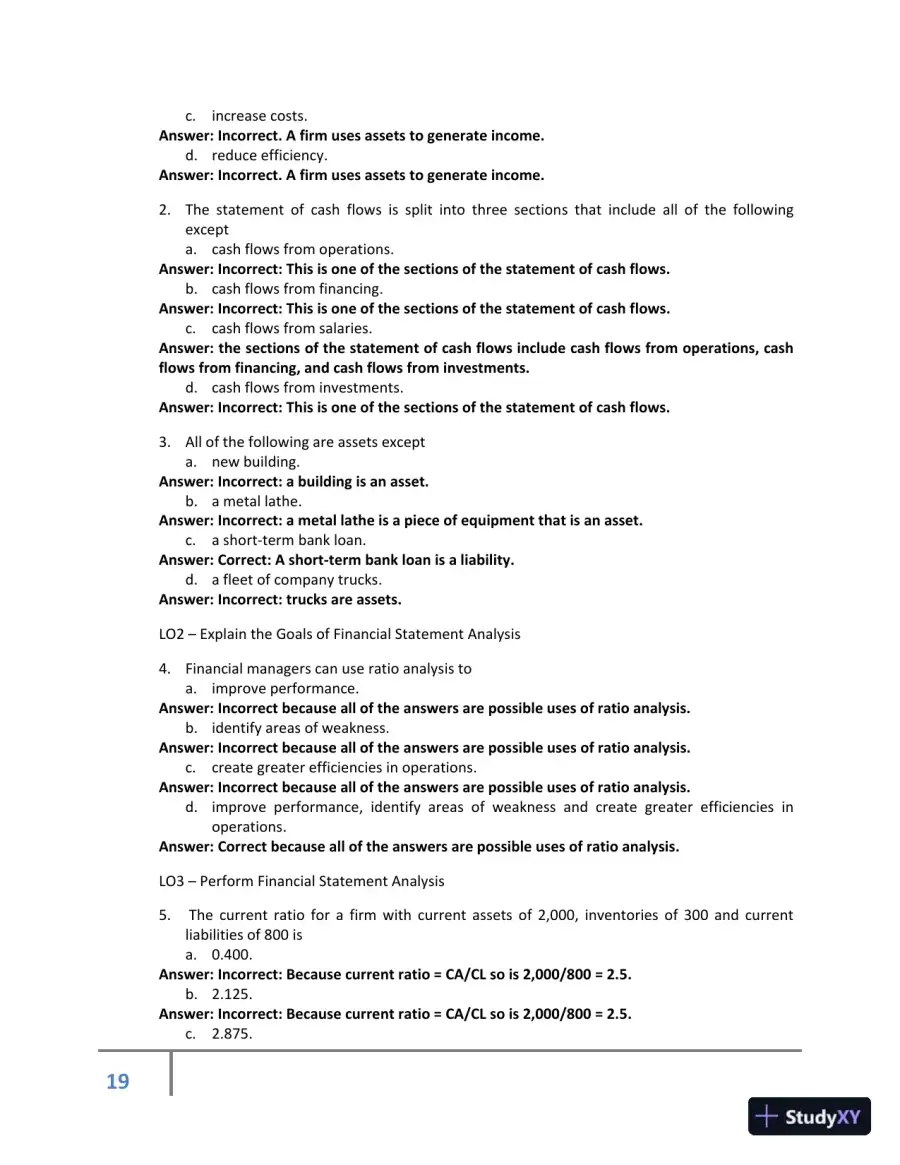 19c.increase costs.Answer: Incorrect. A firm uses assets to generate income.d.reduce efficiency.Answer: Incorrect. A firm uses assets to generate income.2.The statement of cash flows is split into three sections that include all of the followingexcepta.cash flows from operations.Answer: Incorrect: This is one of the sections of the statement of cash flows.b.cash flows from financing.Answer: Incorrect: This is one of the sections of the statement of cash flows.c.cash flows from salaries.Answer: the sections of the statement of cash flows include cash flows from operations, cashflows from financing, and cash flows from investments.d.cash flows from investments.Answer: Incorrect: This is one of the sections of the statement of cash flows.3.All of the following are assets excepta.new building.Answer: Incorrect: a building is an asset.b.a metal lathe.Answer: Incorrect: a metal lathe is a piece of equipment that is an asset.c.a short-term bank loan.Answer: Correct: A short-term bank loan is a liability.d.a fleet of company trucks.Answer: Incorrect: trucks are assets.LO2–Explain the Goals of Financial Statement Analysis4.Financial managers can use ratio analysis toa.improve performance.Answer: Incorrect because all of the answers are possible uses of ratio analysis.b.identify areas of weakness.Answer: Incorrect because all of the answers are possible uses of ratio analysis.c.create greater efficiencies in operations.Answer: Incorrect because all of the answers are possible uses of ratio analysis.d.improve performance, identify areas of weakness and create greater efficiencies inoperations.Answer: Correct because all of the answers are possible uses of ratio analysis.LO3–Perform Financial Statement Analysis5.The current ratio for a firm with current assets of 2,000, inventories of 300 and currentliabilities of 800 isa.0.400.Answer: Incorrect: Because current ratio = CA/CL so is 2,000/800 = 2.5.b.2.125.Answer: Incorrect: Because current ratio = CA/CL so is 2,000/800 = 2.5.c.2.875.
Page 31
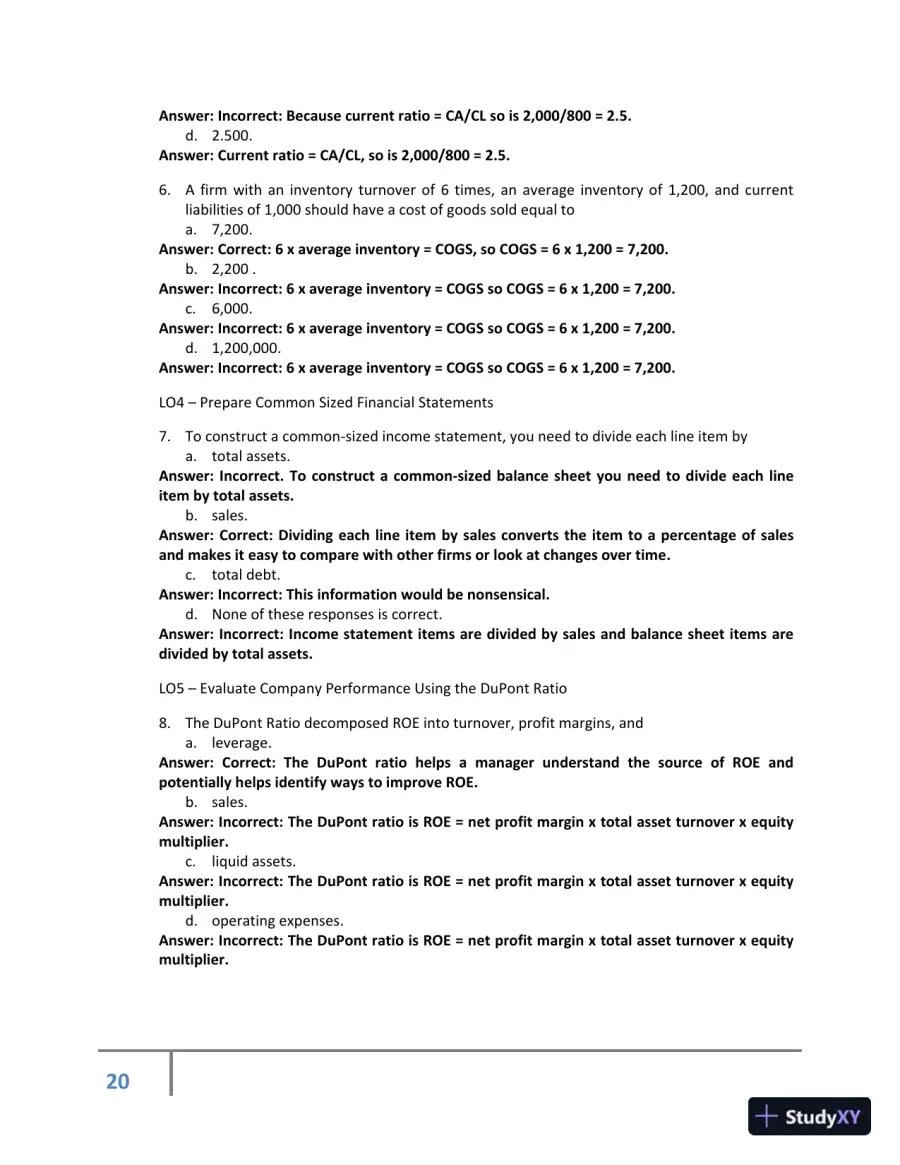 20Answer: Incorrect: Because current ratio = CA/CL so is 2,000/800 = 2.5.d.2.500.Answer: Current ratio = CA/CL, so is 2,000/800 = 2.5.6.A firm with an inventory turnover of 6 times, an average inventory of 1,200, and currentliabilities of 1,000 should have a cost of goods sold equal toa.7,200.Answer: Correct: 6 x average inventory = COGS, so COGS = 6 x 1,200 = 7,200.b.2,200 .Answer: Incorrect: 6 x average inventory = COGS so COGS = 6 x 1,200 = 7,200.c.6,000.Answer: Incorrect: 6 x average inventory = COGS so COGS = 6 x 1,200 = 7,200.d.1,200,000.Answer: Incorrect: 6 x average inventory = COGS so COGS = 6 x 1,200 = 7,200.LO4–Prepare Common Sized Financial Statements7.To construct a common-sized income statement, you need to divide each line item bya.total assets.Answer: Incorrect. To construct a common-sized balance sheet you need to divide each lineitem by total assets.b.sales.Answer: Correct: Dividing each line item by sales converts the item to a percentage of salesand makes it easy to compare with other firms or look at changes over time.c.total debt.Answer: Incorrect: This information would be nonsensical.d.None of these responses is correct.Answer: Incorrect: Income statement items are divided by sales and balance sheet items aredivided by total assets.LO5–Evaluate Company Performance Using the DuPont Ratio8.The DuPont Ratio decomposed ROE into turnover, profit margins, anda.leverage.Answer: Correct: The DuPont ratio helps a manager understand the source of ROE andpotentially helps identify ways to improve ROE.b.sales.Answer: Incorrect: The DuPont ratio is ROE = net profit margin x total asset turnover x equitymultiplier.c.liquid assets.Answer: Incorrect: The DuPont ratio is ROE = net profit margin x total asset turnover x equitymultiplier.d.operating expenses.Answer: Incorrect: The DuPont ratio is ROE = net profit margin x total asset turnover x equitymultiplier.
169 more pages in the full document
Unlock it once and it stays in your library, ready to chat with or turn into flashcards.
Unlock the full documentMore Finance study materials
See all Exam Guides
Test Bank for Corporate Finance Online, 2nd Edition
Finance
1142 pages51downloadsFeb 2025 Textbook Guides
Solution Manual For Investments, 12th Edition
Finance
314 pages161downloadsFeb 2025 Exam Guides
Test Bank for Principles of Managerial Finance, 8th Edition
Finance
851 pages158downloadsFeb 2025 Textbook Guides
Solution Manual for Financial Institutions Management: A Risk Management Approach, 8th Edition
Finance
486 pages154downloadsFeb 2025 Exam Guides
Test Bank for Principles of Managerial Finance, Arab World Edition
Finance
373 pages148downloadsFeb 2025 Textbook Guides
Multinational Financial Management, Study Guide, 6th Edition Solution Manual
Finance
278 pages146downloadsFeb 2025 Textbook Guides
Financial Markets and Institutions, 7th Edition Solution Manual
Finance
194 pages136downloadsFeb 2025 Certification Guides
Wiley Finra Series 3 Exam Review (2019)
Finance
253 pages131downloadsFeb 2025
Study this document with CramX
Once it is in your library, every tool can work from it.