
Exam Guides
Test Bank for Corporate Finance Online, 2nd Edition
- Finance
- 1142 pages
- Shared February 2025
- 51 downloads
Strengthen your understanding with Test Bank for Corporate Finance Online, 2nd Edition, packed with challenging questions and expert solutions.
Preview · 31 of 1142 pages
100%
Page 1
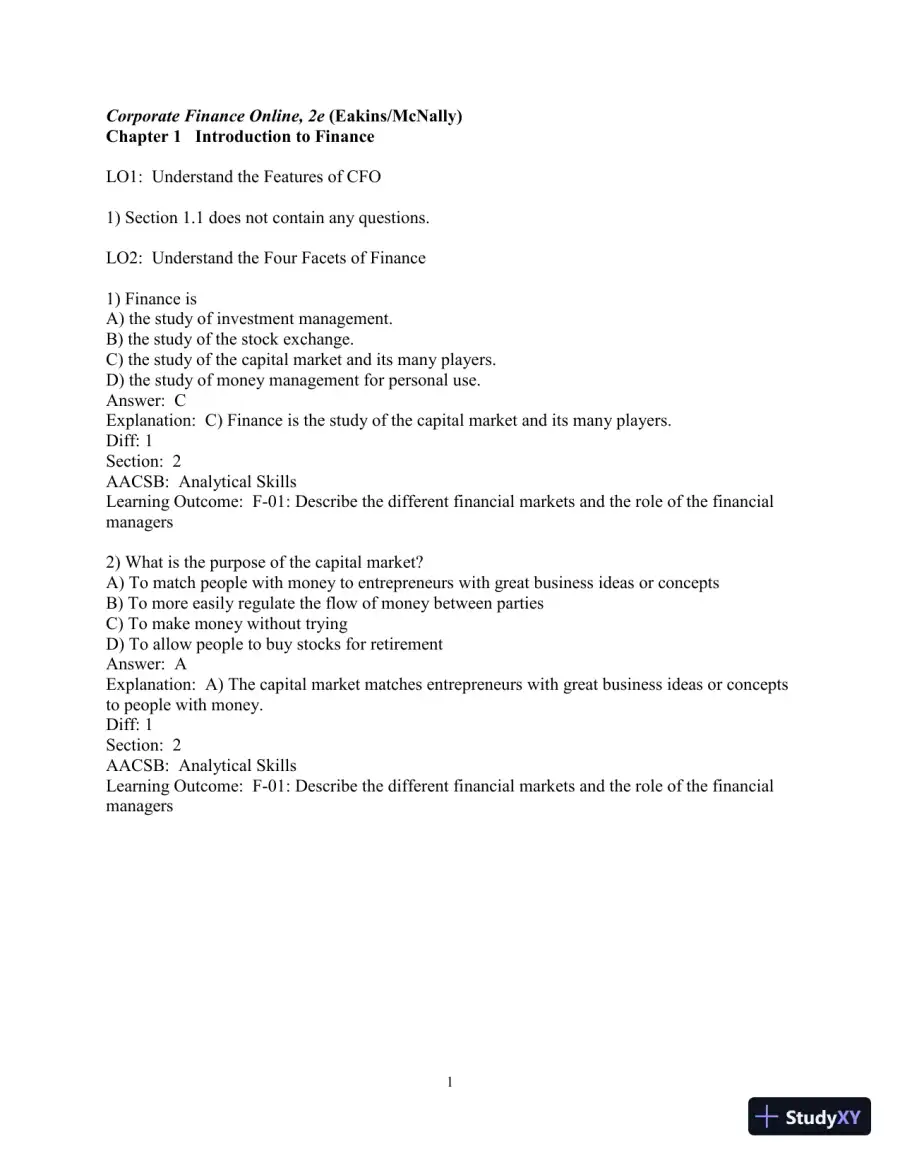 1Corporate Finance Online, 2e(Eakins/McNally)Chapter 1Introduction to FinanceLO1: Understand the Features of CFO1) Section 1.1 does not contain any questions.LO2: Understand the Four Facets of Finance1) Finance isA) the study of investment management.B) the study of the stock exchange.C) the study of the capital market and its many players.D) the study of money management for personal use.Answer: CExplanation: C) Finance is the study of the capital market and its many players.Diff: 1Section: 2AACSB: Analytical SkillsLearning Outcome: F-01: Describe the different financial markets and the role of the financialmanagers2) What is the purpose of the capital market?A) To match people with money to entrepreneurs with great business ideas or conceptsB) To more easily regulate the flow of money between partiesC) To make money without tryingD) To allow people to buy stocks for retirementAnswer: AExplanation: A) The capital market matches entrepreneurs with great business ideas or conceptsto people with money.Diff: 1Section: 2AACSB: Analytical SkillsLearning Outcome: F-01: Describe the different financial markets and the role of the financialmanagers
Page 2

Page 3
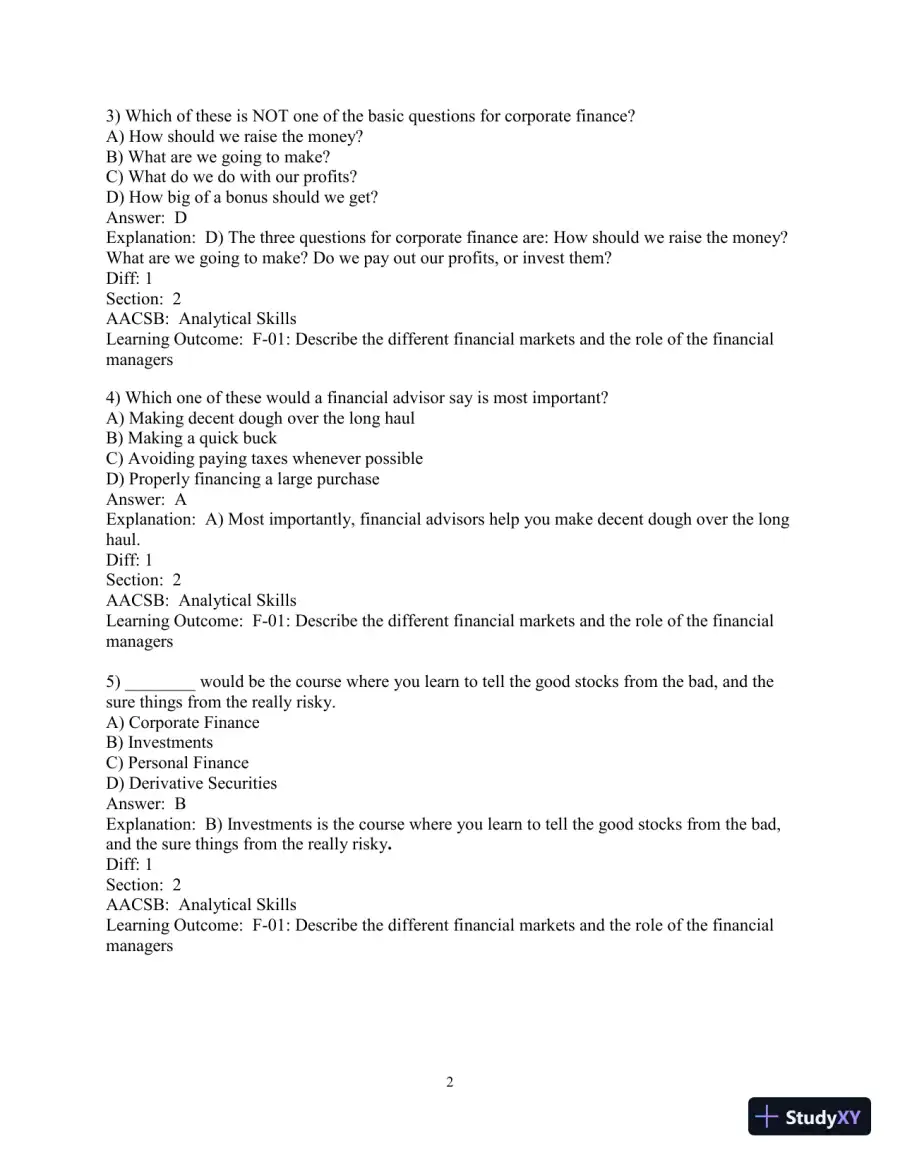 23) Which of these is NOT one of the basic questions for corporate finance?A) How should we raise the money?B) What are we going to make?C) What do we do with our profits?D) How big of a bonus should we get?Answer: DExplanation: D) The three questions for corporate finance are: How should we raise the money?What are we going to make? Do we pay out our profits, or invest them?Diff: 1Section: 2AACSB: Analytical SkillsLearning Outcome: F-01: Describe the different financial markets and the role of the financialmanagers4) Which one of these would a financial advisor say is most important?A) Making decent dough over the long haulB) Making a quick buckC) Avoiding paying taxes whenever possibleD) Properly financing a large purchaseAnswer: AExplanation: A) Most importantly, financial advisors help you make decent dough over the longhaul.Diff: 1Section: 2AACSB: Analytical SkillsLearning Outcome: F-01: Describe the different financial markets and the role of the financialmanagers5) ________ would be the course where you learn to tell the good stocks from the bad, and thesure things from the really risky.A) Corporate FinanceB) InvestmentsC) Personal FinanceD) Derivative SecuritiesAnswer: BExplanation: B) Investments is the course where you learn to tell the good stocks from the bad,and the sure things from the really risky.Diff: 1Section: 2AACSB: Analytical SkillsLearning Outcome: F-01: Describe the different financial markets and the role of the financialmanagers
Page 4
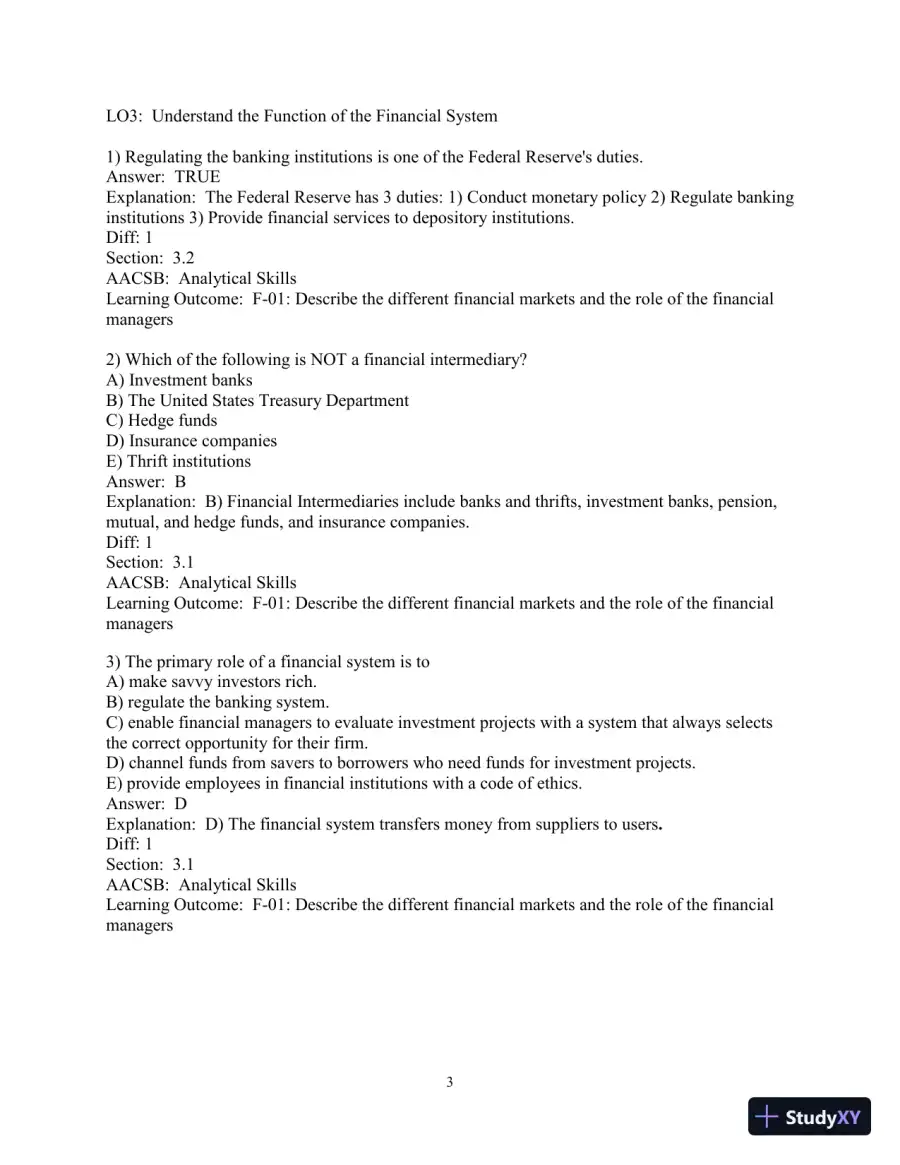 3LO3: Understand the Function of the Financial System1) Regulating the banking institutions is one of the Federal Reserve's duties.Answer: TRUEExplanation: The Federal Reserve has 3 duties: 1) Conduct monetary policy 2) Regulate bankinginstitutions 3) Provide financial services to depository institutions.Diff: 1Section: 3.2AACSB: Analytical SkillsLearning Outcome: F-01: Describe the different financial markets and the role of the financialmanagers2) Which of the following is NOT a financial intermediary?A) Investment banksB) The United States Treasury DepartmentC) Hedge fundsD) Insurance companiesE) Thrift institutionsAnswer: BExplanation: B) Financial Intermediaries include banks and thrifts, investment banks, pension,mutual, and hedge funds, and insurance companies.Diff: 1Section: 3.1AACSB: Analytical SkillsLearning Outcome: F-01: Describe the different financial markets and the role of the financialmanagers3) The primary role of a financial system is toA) make savvy investors rich.B) regulate the banking system.C) enable financial managers to evaluate investment projects with a system that always selectsthe correct opportunity for their firm.D) channel funds from savers to borrowers who need funds for investment projects.E) provide employees in financial institutions with a code of ethics.Answer: DExplanation: D) The financial system transfers money from suppliers to users.Diff: 1Section: 3.1AACSB: Analytical SkillsLearning Outcome: F-01: Describe the different financial markets and the role of the financialmanagers
Page 5
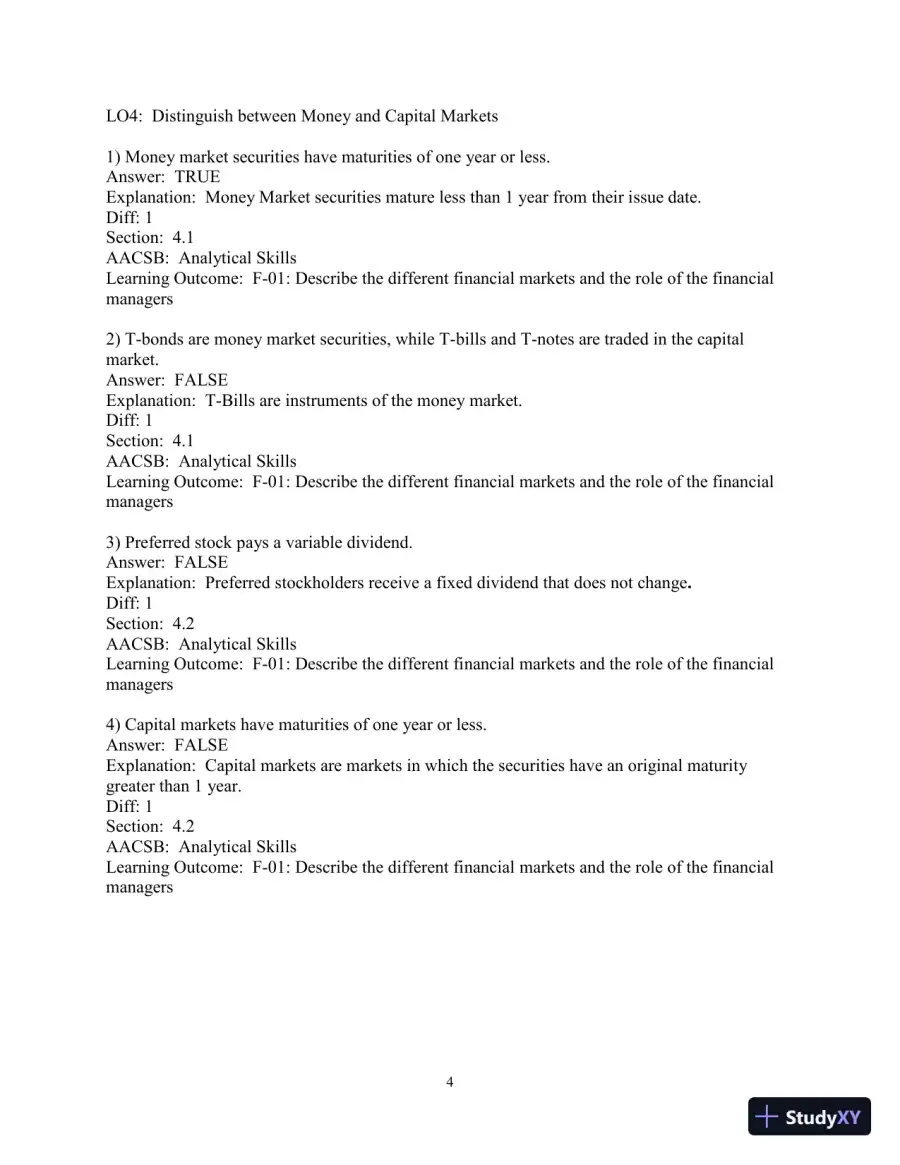 4LO4: Distinguish between Money and Capital Markets1) Money market securities have maturities of one year or less.Answer: TRUEExplanation: Money Market securities mature less than 1 year from their issue date.Diff: 1Section: 4.1AACSB: Analytical SkillsLearning Outcome: F-01: Describe the different financial markets and the role of the financialmanagers2) T-bonds are money market securities, while T-bills and T-notes are traded in the capitalmarket.Answer: FALSEExplanation: T-Bills are instruments of the money market.Diff: 1Section: 4.1AACSB: Analytical SkillsLearning Outcome: F-01: Describe the different financial markets and the role of the financialmanagers3) Preferred stock pays a variable dividend.Answer: FALSEExplanation: Preferred stockholders receive a fixed dividend that does not change.Diff: 1Section: 4.2AACSB: Analytical SkillsLearning Outcome: F-01: Describe the different financial markets and the role of the financialmanagers4) Capital markets have maturities of one year or less.Answer: FALSEExplanation: Capital markets are markets in which the securities have an original maturitygreater than 1 year.Diff: 1Section: 4.2AACSB: Analytical SkillsLearning Outcome: F-01: Describe the different financial markets and the role of the financialmanagers
Page 6
 55) According to your text, major players in the money market include all of the followingEXCEPTA) the U.S. Treasury.B) the Federal Reserve System.C) commercial banks.D) companies.E) the U.S. Commerce Department.Answer: EExplanation: E) The U.S. Commerce Department is not a major player in the money market.Diff: 1Section: 4.1AACSB: Analytical SkillsLearning Outcome: F-01: Describe the different financial markets and the role of the financialmanagers6) Which of the following is NOT considered a capital market security?A) Mortgage-backed securitiesB) Corporate bondsC) Common stockD) Foreign currenciesE) Municipal bondsAnswer: DExplanation: D) Foreign currencies are not capital market securitiesDiff: 1Section: 4.2AACSB: Analytical SkillsLearning Outcome: F-01: Describe the different financial markets and the role of the financialmanagers7) Money markets are markets forA) foreign currency exchange.B) corporate stocks.C) long-term bonds.D) short-term debt securities.E) preferred securities.Answer: DExplanation: D) In a money market, the securities are short term and highly liquid.Diff: 1Section: 4.1AACSB: Analytical SkillsLearning Outcome: F-01: Describe the different financial markets and the role of the financialmanagers
Page 7
 68) Which of the following statements is TRUE regarding common and preferred shares?A) Preferred shareholders have more voting power than common shareholders.B) Common shareholders are guaranteed a fixed dividend.C) Common shareholders have a more senior claim against assets than preferred shareholders.D) Preferred shareholders are entitled to their dividends before common shareholdersE) Common shareholders earn a better return than preferred shareholders.Answer: DExplanation: D) Preferred shareholders are entitled to their dividends before commonshareholders.Diff: 1Section: 4.2AACSB: Analytical SkillsLearning Outcome: F-01: Describe the different financial markets and the role of the financialmanagers9) Common stockholders expect to receive a return through capital gains andA) interest payments.B) dividends.C) fixed periodic dividends.D) coupon payments.E) receiving shares of preferred stock.Answer: BExplanation: B) Common shareholders receive a dividend at the discretion of the board.Diff: 1Section: 4.2AACSB: Analytical SkillsLearning Outcome: F-01: Describe the different financial markets and the role of the financialmanagers10) Which of the following is NOT a major participant in the money market?A) Money market mutual fundsB) Commercial banksC) Wall Street dealersD) Federal ReserveE) U.S. TreasuryAnswer: CExplanation: C) The players in the money market are the U.S. Treasury, Corporations, Banks,Funds, Federal Reserve, Insurance Cos, Pensions, and Banks.Diff: 1Section: 4.1AACSB: Analytical SkillsLearning Outcome: F-01: Describe the different financial markets and the role of the financialmanagers
Page 8
 711) Shares of ________ are units of ownership interest, or equity, in a corporation.A) debtB) common stockC) bank loansD) commercial paperE) debenturesAnswer: BExplanation: B) Shares of Common Stock represent ownership in a corporationDiff: 1Section: 4.2AACSB: Analytical SkillsLearning Outcome: F-01: Describe the different financial markets and the role of the financialmanagers12) ________ are long-term debt instruments business and government use to raise large sums ofmoney.A) T-billsB) BondsC) Common stocksD) Preferred stocksE) Commercial papersAnswer: BExplanation: B) Bonds are debt instruments issued by governments and corporations with amaturity of more than a year.Diff: 1Section: 4.2AACSB: Analytical SkillsLearning Outcome: F-01: Describe the different financial markets and the role of the financialmanagers13) Which of the following statements best describes mutual funds?A) They are illegal in the United States, but popular in Europe.B) They enable investors to buy many shares of stock in a single firm at a lower cost than using astockbroker.C) They provide good investment returns, but insufficient diversification.D) They enable many investors with limited funds to buy a diversified portfolio.E) They appeal only to wealthy investors.Answer: DExplanation: D) A mutual fund is a professionally managed pool of money which comes from adisparate group of investors who exchange their money for shares in the fund.Diff: 1Section: 4.2AACSB: Analytical SkillsLearning Outcome: F-01: Describe the different financial markets and the role of the financialmanagers
Page 9
 814) The ________ is a financial relationship created by a number of institutions witharrangements that allow the suppliers and demanders of long-term funds to make transactions.A) money marketB) eurobond marketC) bond marketD) capital marketE) futures marketAnswer: DExplanation: D) Capital markets are markets in which securities have an original maturitygreater than one year.Diff: 1Section: 4.2AACSB: Analytical SkillsLearning Outcome: F-01: Describe the different financial markets and the role of the financialmanagers15) Which of the following are rights of stockholders?A) To share in the firm's profits after all other creditors have been satisfiedB) To be guaranteed a dividendC) To decide whether or not to pay taxes on capital gainsD) To vote for directors, but never on specific issuesE) To avoid losses when the firm's prospects declineAnswer: AExplanation: A) Stockholders are residual claimants, meaning they share in the profits after allother creditors have been satisfied.Diff: 1Section: 4.2AACSB: Analytical SkillsLearning Outcome: F-01: Describe the different financial markets and the role of the financialmanagersLO5: Learn the Difference between Primary and Secondary Markets1) The ________ price is ________ the ________ price.A) bid; above; askB) bid; below; askC) ask; below; bidD) ask; above; bidE) Both B and D are correct.Answer: EExplanation: E) The ask price is the price the seller wants to receive and the bid price is theprice the buyer is willing to pay.Diff: 1Section: 5.2AACSB: Analytical SkillsLearning Outcome: F-01: Describe the different financial markets and the role of the financialmanagers
Page 10
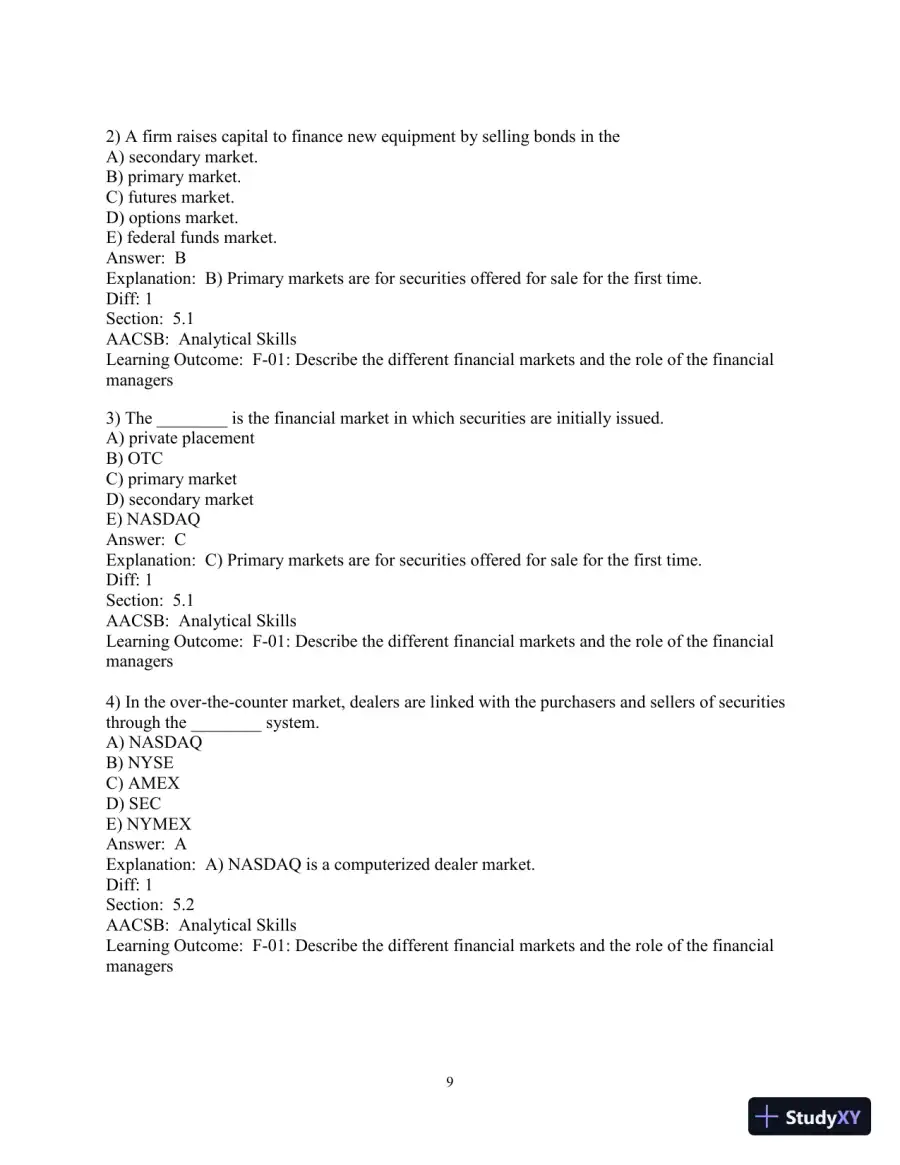 92) A firm raises capital to finance new equipment by selling bonds in theA) secondary market.B) primary market.C) futures market.D) options market.E) federal funds market.Answer: BExplanation: B) Primary markets are for securities offered for sale for the first time.Diff: 1Section: 5.1AACSB: Analytical SkillsLearning Outcome: F-01: Describe the different financial markets and the role of the financialmanagers3) The ________ is the financial market in which securities are initially issued.A) private placementB) OTCC) primary marketD) secondary marketE) NASDAQAnswer: CExplanation: C) Primary markets are for securities offered for sale for the first time.Diff: 1Section: 5.1AACSB: Analytical SkillsLearning Outcome: F-01: Describe the different financial markets and the role of the financialmanagers4) In the over-the-counter market, dealers are linked with the purchasers and sellers of securitiesthrough the ________ system.A) NASDAQB) NYSEC) AMEXD) SECE) NYMEXAnswer: AExplanation: A) NASDAQ is a computerized dealer market.Diff: 1Section: 5.2AACSB: Analytical SkillsLearning Outcome: F-01: Describe the different financial markets and the role of the financialmanagers
Page 11
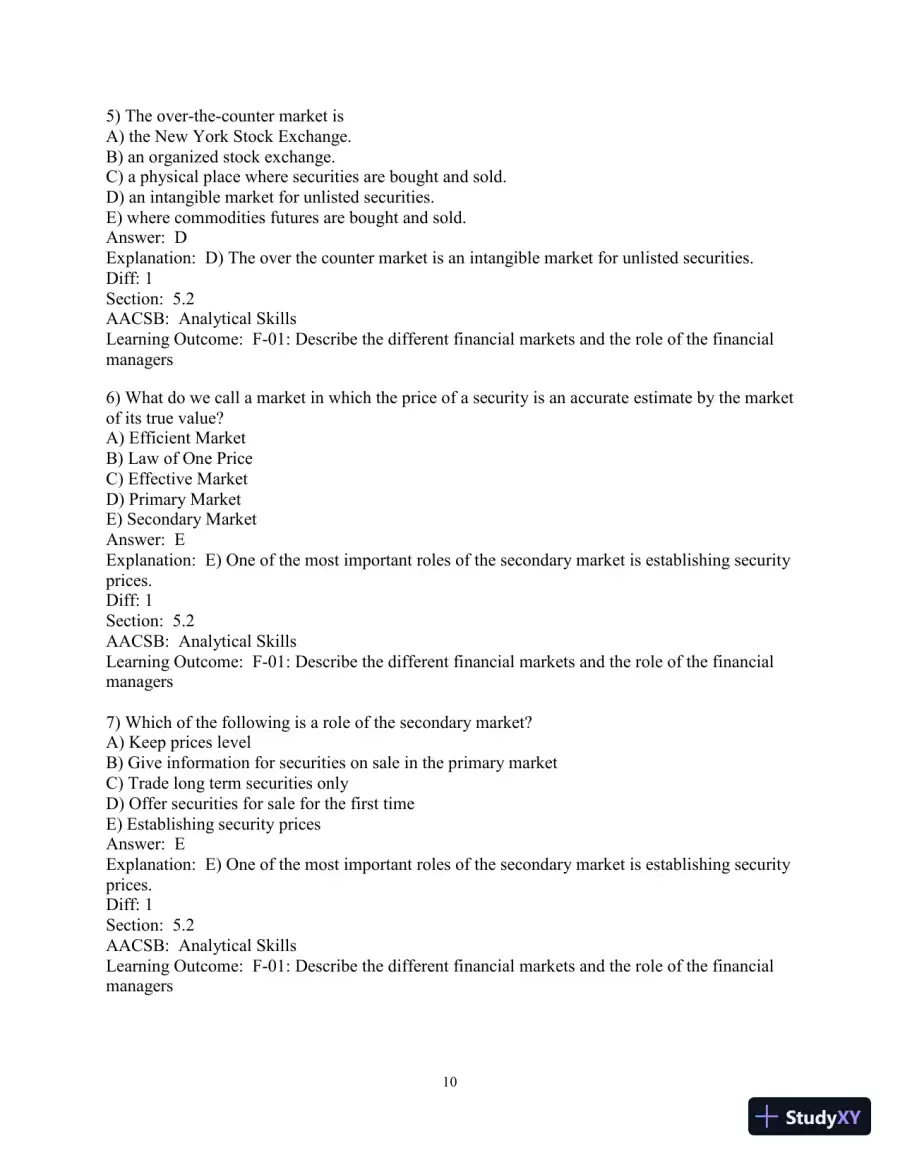 105) The over-the-counter market isA) the New York Stock Exchange.B) an organized stock exchange.C) a physical place where securities are bought and sold.D) an intangible market for unlisted securities.E) where commodities futures are bought and sold.Answer: DExplanation: D) The over the counter market is an intangible market for unlisted securities.Diff: 1Section: 5.2AACSB: Analytical SkillsLearning Outcome: F-01: Describe the different financial markets and the role of the financialmanagers6) What do we call a market in which the price of a security is an accurate estimate by the marketof its true value?A) Efficient MarketB) Law of One PriceC) Effective MarketD) Primary MarketE) Secondary MarketAnswer: EExplanation: E) One of the most important roles of the secondary market is establishing securityprices.Diff: 1Section: 5.2AACSB: Analytical SkillsLearning Outcome: F-01: Describe the different financial markets and the role of the financialmanagers7) Which of the following is a role of the secondary market?A) Keep prices levelB) Give information for securities on sale in the primary marketC) Trade long term securities onlyD) Offer securities for sale for the first timeE) Establishing security pricesAnswer: EExplanation: E) One of the most important roles of the secondary market is establishing securityprices.Diff: 1Section: 5.2AACSB: Analytical SkillsLearning Outcome: F-01: Describe the different financial markets and the role of the financialmanagers
Page 12
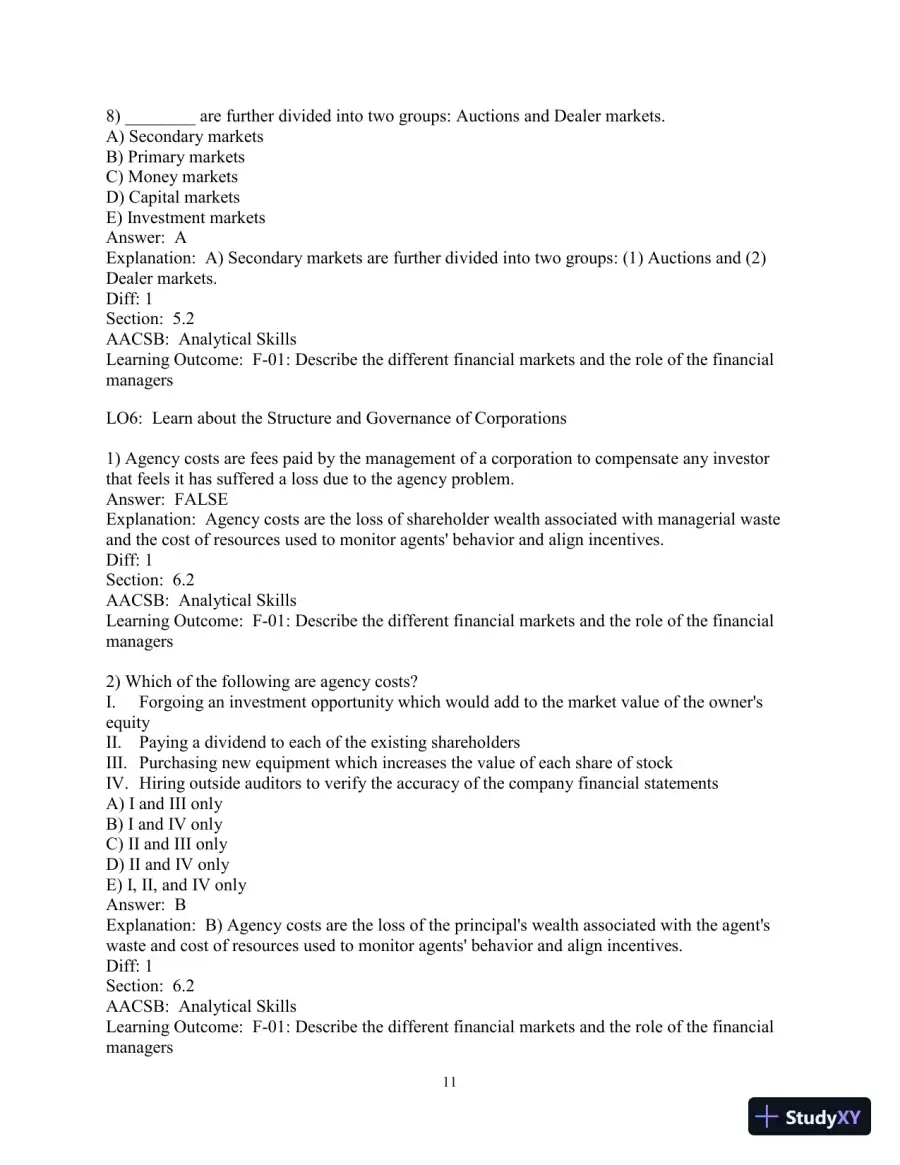 118) ________ are further divided into two groups: Auctions and Dealer markets.A) Secondary marketsB) Primary marketsC) Money marketsD) Capital marketsE) Investment marketsAnswer: AExplanation: A) Secondary markets are further divided into two groups: (1) Auctions and (2)Dealer markets.Diff: 1Section: 5.2AACSB: Analytical SkillsLearning Outcome: F-01: Describe the different financial markets and the role of the financialmanagersLO6: Learn about the Structure and Governance of Corporations1) Agency costs are fees paid by the management of a corporation to compensate any investorthat feels it has suffered a loss due to the agency problem.Answer: FALSEExplanation: Agency costs are the loss of shareholder wealth associated with managerial wasteand the cost of resources used to monitor agents' behavior and align incentives.Diff: 1Section: 6.2AACSB: Analytical SkillsLearning Outcome: F-01: Describe the different financial markets and the role of the financialmanagers2) Which of the following are agency costs?I.Forgoing an investment opportunity which would add to the market value of the owner'sequityII.Paying a dividend to each of the existing shareholdersIII.Purchasing new equipment which increases the value of each share of stockIV. Hiring outside auditors to verify the accuracy of the company financial statementsA) I and III onlyB) I and IV onlyC) II and III onlyD) II and IV onlyE) I, II, and IV onlyAnswer: BExplanation: B) Agency costs are the loss of the principal's wealth associated with the agent'swaste and cost of resources used to monitor agents' behavior and align incentives.Diff: 1Section: 6.2AACSB: Analytical SkillsLearning Outcome: F-01: Describe the different financial markets and the role of the financialmanagers
Page 13
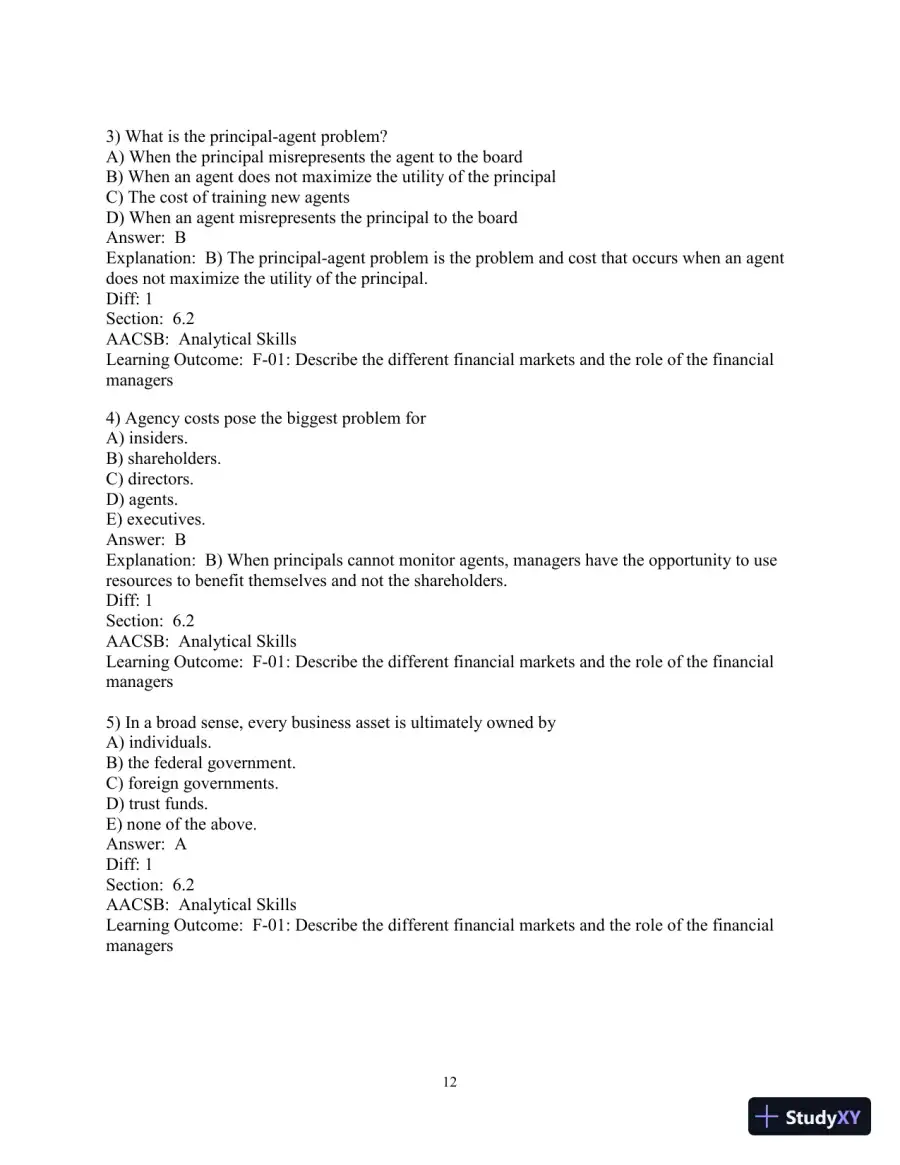 123) What is the principal-agent problem?A) When the principal misrepresents the agent to the boardB) When an agent does not maximize the utility of the principalC) The cost of training new agentsD) When an agent misrepresents the principal to the boardAnswer: BExplanation: B) The principal-agent problem is the problem and cost that occurs when an agentdoes not maximize the utility of the principal.Diff: 1Section: 6.2AACSB: Analytical SkillsLearning Outcome: F-01: Describe the different financial markets and the role of the financialmanagers4) Agency costs pose the biggest problem forA) insiders.B) shareholders.C) directors.D) agents.E) executives.Answer: BExplanation: B) When principals cannot monitor agents, managers have the opportunity to useresources to benefit themselves and not the shareholders.Diff: 1Section: 6.2AACSB: Analytical SkillsLearning Outcome: F-01: Describe the different financial markets and the role of the financialmanagers5) In a broad sense, every business asset is ultimately owned byA) individuals.B) the federal government.C) foreign governments.D) trust funds.E) none of the above.Answer: ADiff: 1Section: 6.2AACSB: Analytical SkillsLearning Outcome: F-01: Describe the different financial markets and the role of the financialmanagers
Page 14
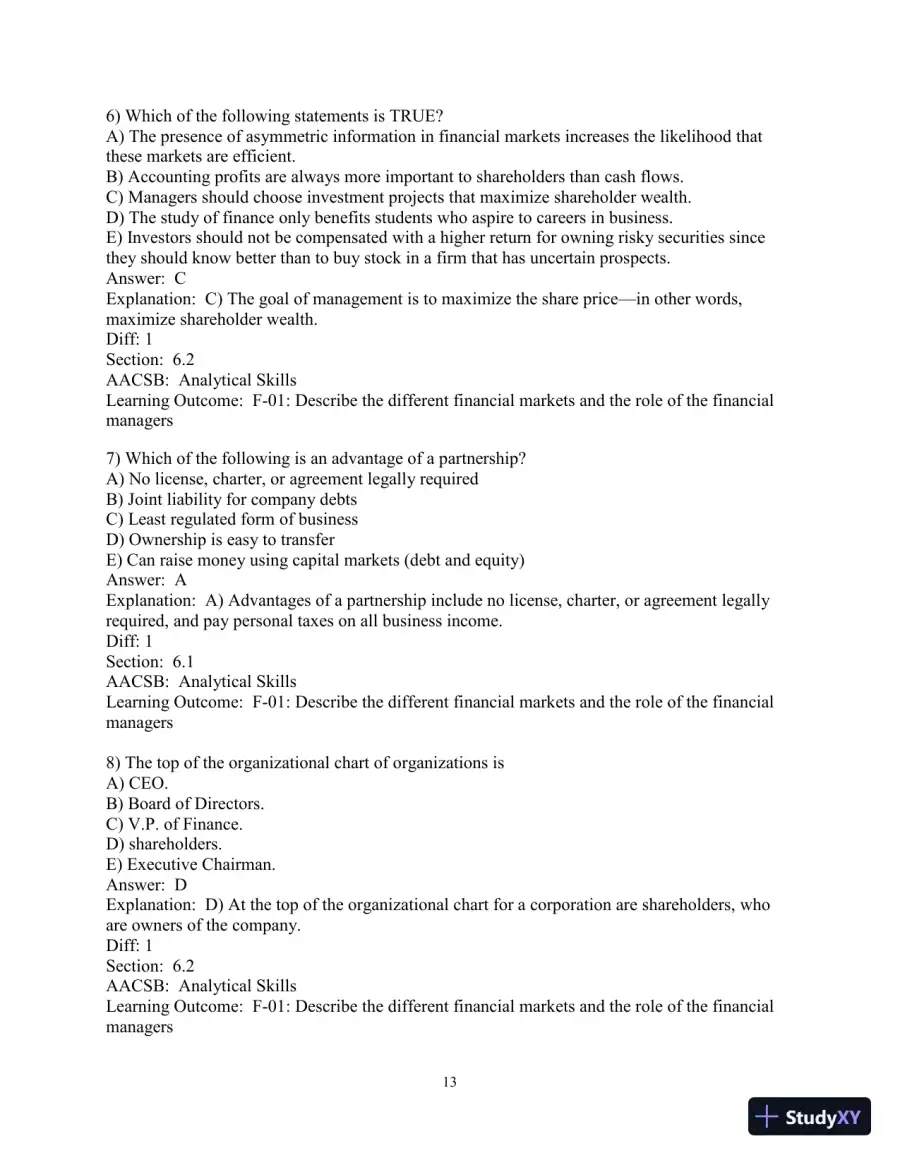 136) Which of the following statements is TRUE?A) The presence of asymmetric information in financial markets increases the likelihood thatthese markets are efficient.B) Accounting profits are always more important to shareholders than cash flows.C) Managers should choose investment projects that maximize shareholder wealth.D) The study of finance only benefits students who aspire to careers in business.E) Investors should not be compensated with a higher return for owning risky securities sincethey should know better than to buy stock in a firm that has uncertain prospects.Answer: CExplanation: C) The goal of management is to maximize the share price—in other words,maximize shareholder wealth.Diff: 1Section: 6.2AACSB: Analytical SkillsLearning Outcome: F-01: Describe the different financial markets and the role of the financialmanagers7) Which of the following is an advantage of a partnership?A) No license, charter, or agreement legally requiredB) Joint liability for company debtsC) Least regulated form of businessD) Ownership is easy to transferE) Can raise money using capital markets (debt and equity)Answer: AExplanation: A) Advantages of a partnership include no license, charter, or agreement legallyrequired, and pay personal taxes on all business income.Diff: 1Section: 6.1AACSB: Analytical SkillsLearning Outcome: F-01: Describe the different financial markets and the role of the financialmanagers8) The top of the organizational chart of organizations isA) CEO.B) Board of Directors.C) V.P. of Finance.D) shareholders.E) Executive Chairman.Answer: DExplanation: D) At the top of the organizational chart for a corporation are shareholders, whoare owners of the company.Diff: 1Section: 6.2AACSB: Analytical SkillsLearning Outcome: F-01: Describe the different financial markets and the role of the financialmanagers
Page 15
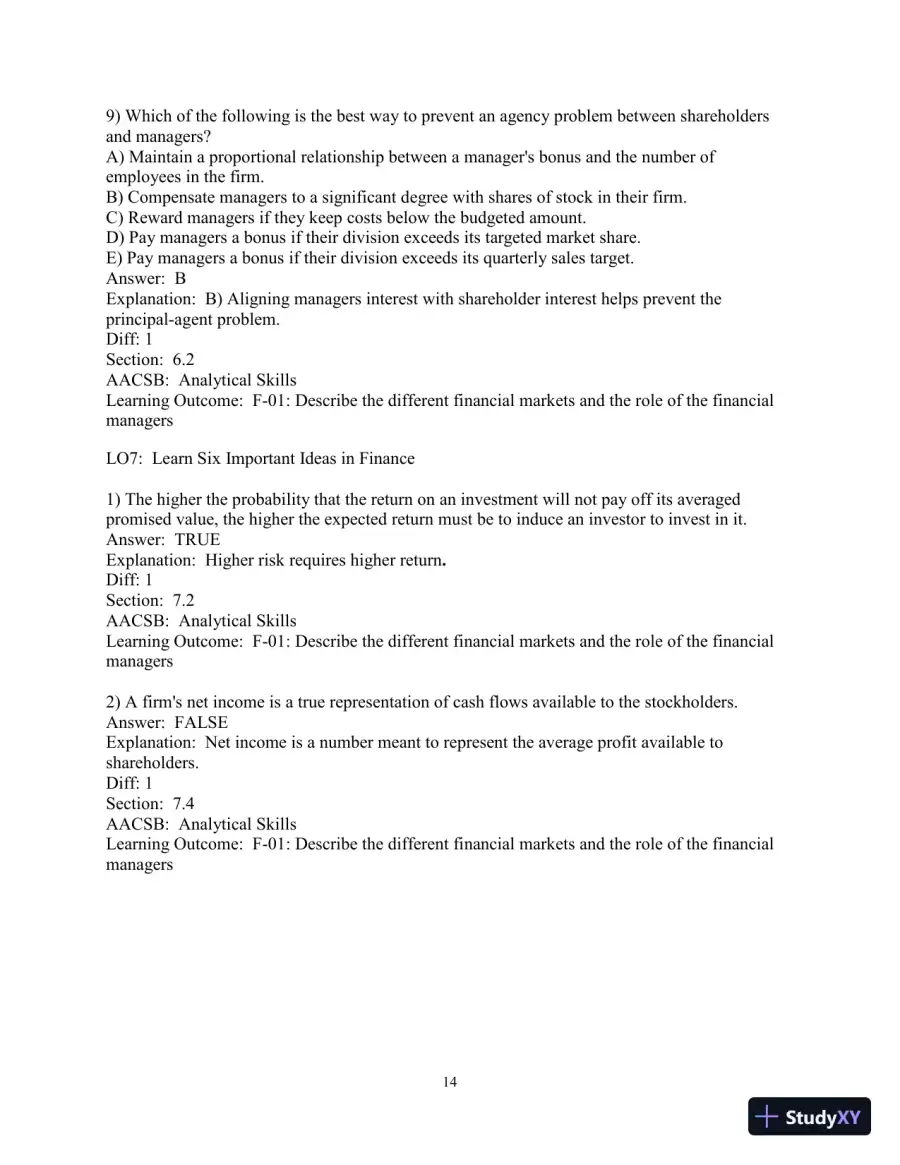 149) Which of the following is the best way to prevent an agency problem between shareholdersand managers?A) Maintain a proportional relationship between a manager's bonus and the number ofemployees in the firm.B) Compensate managers to a significant degree with shares of stock in their firm.C) Reward managers if they keep costs below the budgeted amount.D) Pay managers a bonus if their division exceeds its targeted market share.E) Pay managers a bonus if their division exceeds its quarterly sales target.Answer: BExplanation: B) Aligning managers interest with shareholder interest helps prevent theprincipal-agent problem.Diff: 1Section: 6.2AACSB: Analytical SkillsLearning Outcome: F-01: Describe the different financial markets and the role of the financialmanagersLO7: Learn Six Important Ideas in Finance1) The higher the probability that the return on an investment will not pay off its averagedpromised value, the higher the expected return must be to induce an investor to invest in it.Answer: TRUEExplanation: Higher risk requires higher return.Diff: 1Section: 7.2AACSB: Analytical SkillsLearning Outcome: F-01: Describe the different financial markets and the role of the financialmanagers2) A firm's net income is a true representation of cash flows available to the stockholders.Answer: FALSEExplanation: Net income is a number meant to represent the average profit available toshareholders.Diff: 1Section: 7.4AACSB: Analytical SkillsLearning Outcome: F-01: Describe the different financial markets and the role of the financialmanagers
Page 16
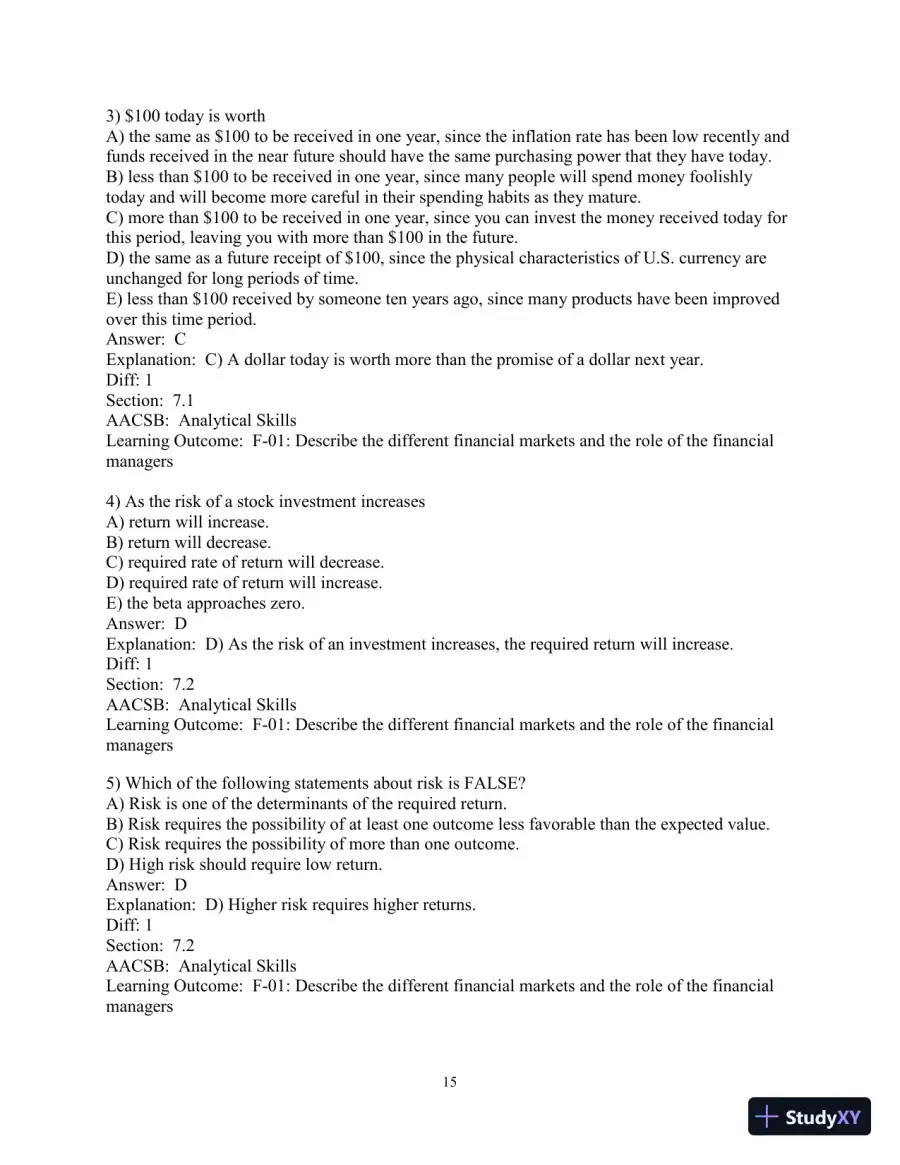 153) $100 today is worthA) the same as $100 to be received in one year, since the inflation rate has been low recently andfunds received in the near future should have the same purchasing power that they have today.B) less than $100 to be received in one year, since many people will spend money foolishlytoday and will become more careful in their spending habits as they mature.C) more than $100 to be received in one year, since you can invest the money received today forthis period, leaving you with more than $100 in the future.D) the same as a future receipt of $100, since the physical characteristics of U.S. currency areunchanged for long periods of time.E) less than $100 received by someone ten years ago, since many products have been improvedover this time period.Answer: CExplanation: C) A dollar today is worth more than the promise of a dollar next year.Diff: 1Section: 7.1AACSB: Analytical SkillsLearning Outcome: F-01: Describe the different financial markets and the role of the financialmanagers4) As the risk of a stock investment increasesA) return will increase.B) return will decrease.C) required rate of return will decrease.D) required rate of return will increase.E) the beta approaches zero.Answer: DExplanation: D) As the risk of an investment increases, the required return will increase.Diff: 1Section: 7.2AACSB: Analytical SkillsLearning Outcome: F-01: Describe the different financial markets and the role of the financialmanagers5) Which of the following statements about risk is FALSE?A) Risk is one of the determinants of the required return.B) Risk requires the possibility of at least one outcome less favorable than the expected value.C) Risk requires the possibility of more than one outcome.D) High risk should require low return.Answer: DExplanation: D) Higher risk requires higher returns.Diff: 1Section: 7.2AACSB: Analytical SkillsLearning Outcome: F-01: Describe the different financial markets and the role of the financialmanagers
Page 17
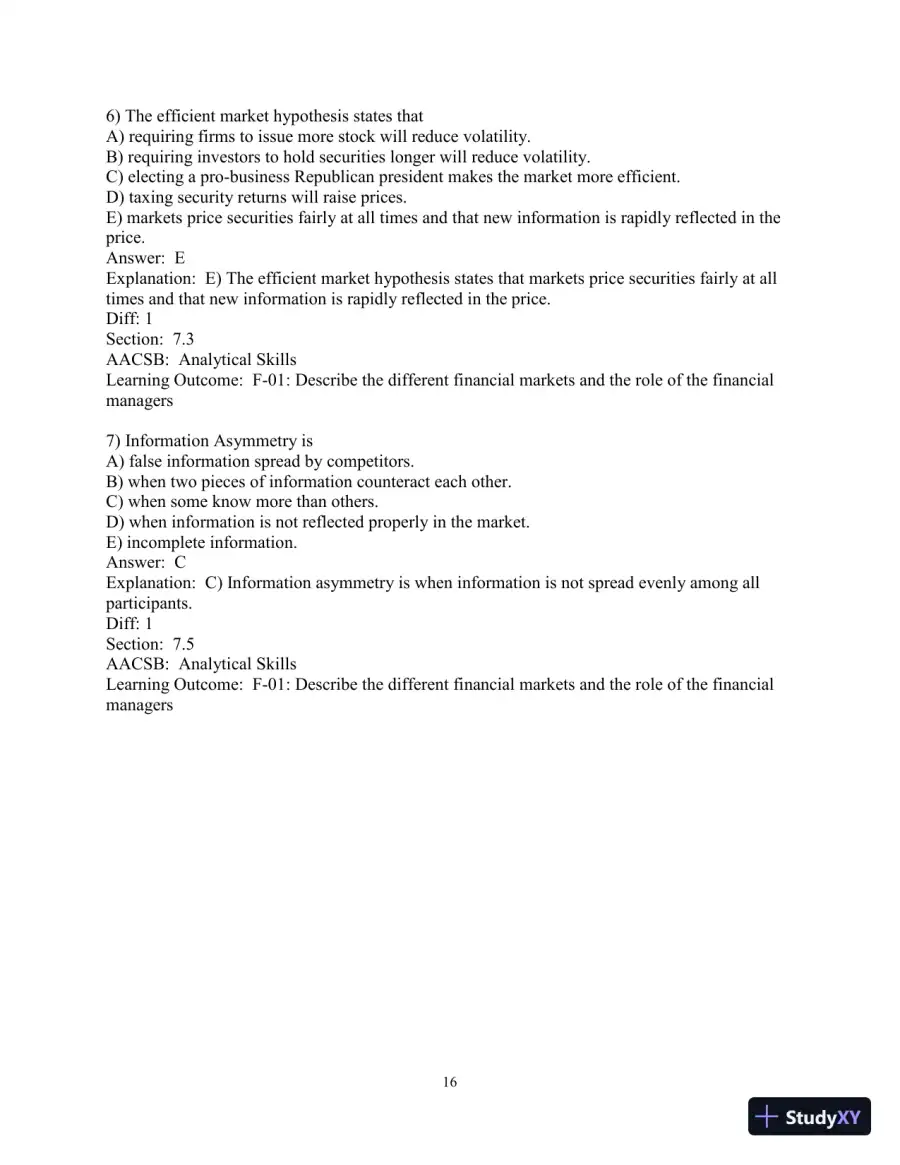 166) The efficient market hypothesis states thatA) requiring firms to issue more stock will reduce volatility.B) requiring investors to hold securities longer will reduce volatility.C) electing a pro-business Republican president makes the market more efficient.D) taxing security returns will raise prices.E) markets price securities fairly at all times and that new information is rapidly reflected in theprice.Answer: EExplanation: E) The efficient market hypothesis states that markets price securities fairly at alltimes and that new information is rapidly reflected in the price.Diff: 1Section: 7.3AACSB: Analytical SkillsLearning Outcome: F-01: Describe the different financial markets and the role of the financialmanagers7) Information Asymmetry isA) false information spread by competitors.B) when two pieces of information counteract each other.C) when some know more than others.D) when information is not reflected properly in the market.E) incomplete information.Answer: CExplanation: C) Information asymmetry is when information is not spread evenly among allparticipants.Diff: 1Section: 7.5AACSB: Analytical SkillsLearning Outcome: F-01: Describe the different financial markets and the role of the financialmanagers
Page 18
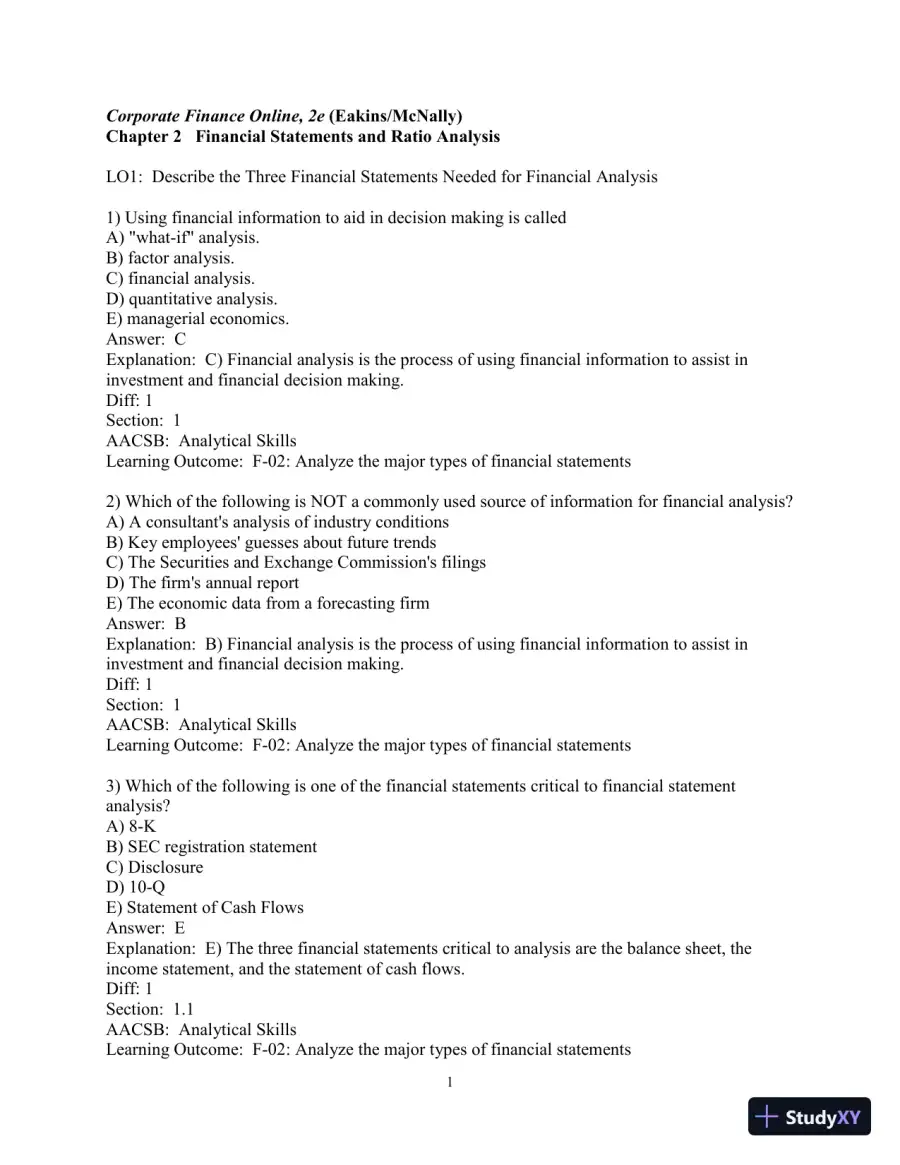 1Corporate Finance Online, 2e(Eakins/McNally)Chapter 2Financial Statements and Ratio AnalysisLO1: Describe the Three Financial Statements Needed for Financial Analysis1) Using financial information to aid in decision making is calledA) "what-if" analysis.B) factor analysis.C) financial analysis.D) quantitative analysis.E) managerial economics.Answer: CExplanation: C) Financial analysis is the process of using financial information to assist ininvestment and financial decision making.Diff: 1Section: 1AACSB: Analytical SkillsLearning Outcome: F-02: Analyze the major types of financial statements2) Which of the following is NOT a commonly used source of information for financial analysis?A) A consultant's analysis of industry conditionsB) Key employees' guesses about future trendsC) The Securities and Exchange Commission's filingsD) The firm's annual reportE) The economic data from a forecasting firmAnswer: BExplanation: B) Financial analysis is the process of using financial information to assist ininvestment and financial decision making.Diff: 1Section: 1AACSB: Analytical SkillsLearning Outcome: F-02: Analyze the major types of financial statements3) Which of the following is one of the financial statements critical to financial statementanalysis?A) 8-KB) SEC registration statementC) DisclosureD) 10-QE) Statement of Cash FlowsAnswer: EExplanation: E) The three financial statements critical to analysis are the balance sheet, theincome statement, and the statement of cash flows.Diff: 1Section: 1.1AACSB: Analytical SkillsLearning Outcome: F-02: Analyze the major types of financial statements
Page 19
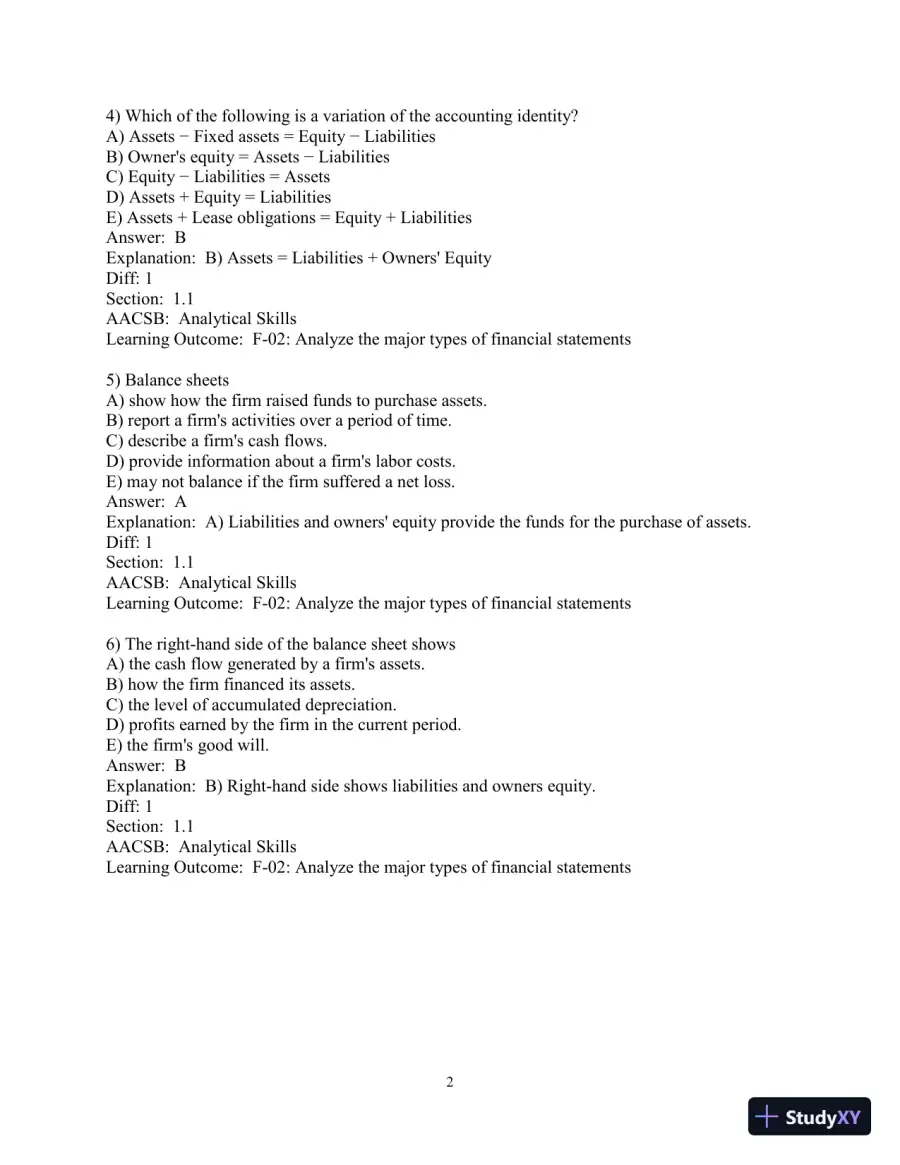 24) Which of the following is a variation of the accounting identity?A) Assets − Fixed assets = Equity − LiabilitiesB) Owner's equity = Assets − LiabilitiesC) Equity − Liabilities = AssetsD) Assets + Equity = LiabilitiesE) Assets + Lease obligations = Equity + LiabilitiesAnswer: BExplanation: B) Assets = Liabilities + Owners' EquityDiff: 1Section: 1.1AACSB: Analytical SkillsLearning Outcome: F-02: Analyze the major types of financial statements5) Balance sheetsA) show how the firm raised funds to purchase assets.B) report a firm's activities over a period of time.C) describe a firm's cash flows.D) provide information about a firm's labor costs.E) may not balance if the firm suffered a net loss.Answer: AExplanation: A) Liabilities and owners' equity provide the funds for the purchase of assets.Diff: 1Section: 1.1AACSB: Analytical SkillsLearning Outcome: F-02: Analyze the major types of financial statements6) The right-hand side of the balance sheet showsA) the cash flow generated by a firm's assets.B) how the firm financed its assets.C) the level of accumulated depreciation.D) profits earned by the firm in the current period.E) the firm's good will.Answer: BExplanation: B) Right-hand side shows liabilities and owners equity.Diff: 1Section: 1.1AACSB: Analytical SkillsLearning Outcome: F-02: Analyze the major types of financial statements
Page 20
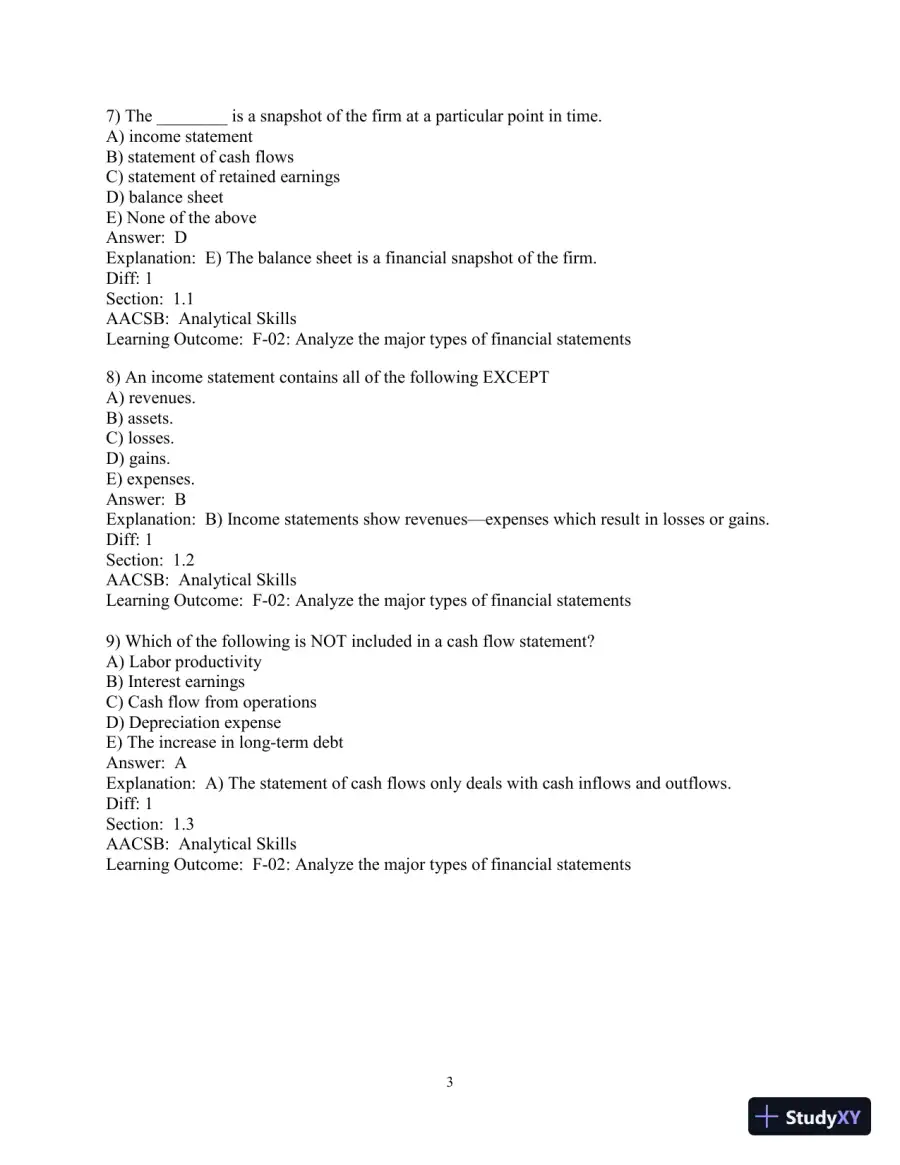 37) The ________ is a snapshot of the firm at a particular point in time.A) income statementB) statement of cash flowsC) statement of retained earningsD) balance sheetE) None of the aboveAnswer: DExplanation: E) The balance sheet is a financial snapshot of the firm.Diff: 1Section: 1.1AACSB: Analytical SkillsLearning Outcome: F-02: Analyze the major types of financial statements8) An income statement contains all of the following EXCEPTA) revenues.B) assets.C) losses.D) gains.E) expenses.Answer: BExplanation: B) Income statements show revenues—expenses which result in losses or gains.Diff: 1Section: 1.2AACSB: Analytical SkillsLearning Outcome: F-02: Analyze the major types of financial statements9) Which of the following is NOT included in a cash flow statement?A) Labor productivityB) Interest earningsC) Cash flow from operationsD) Depreciation expenseE) The increase in long-term debtAnswer: AExplanation: A) The statement of cash flows only deals with cash inflows and outflows.Diff: 1Section: 1.3AACSB: Analytical SkillsLearning Outcome: F-02: Analyze the major types of financial statements
Page 21
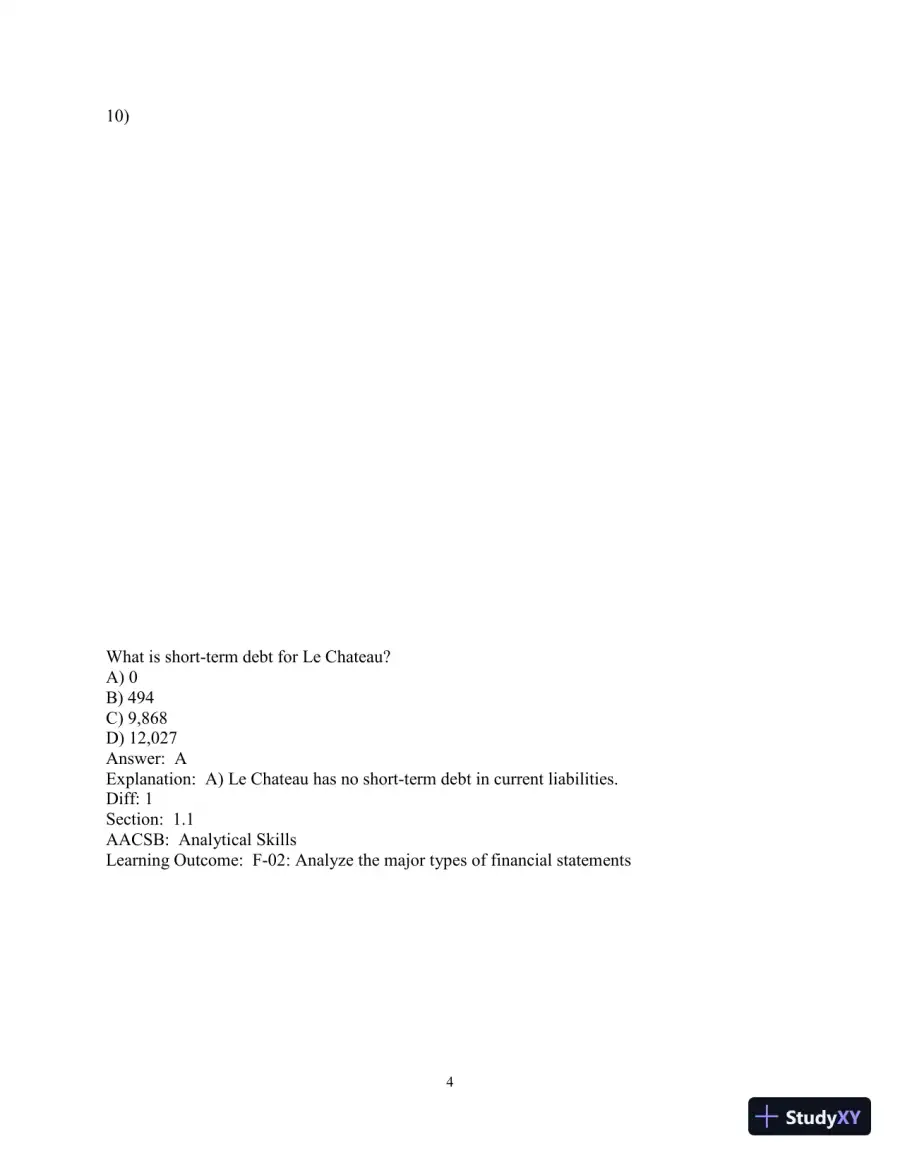 410)What is short-term debt for Le Chateau?A) 0B) 494C) 9,868D) 12,027Answer: AExplanation: A) Le Chateau has no short-term debt in current liabilities.Diff: 1Section: 1.1AACSB: Analytical SkillsLearning Outcome: F-02: Analyze the major types of financial statements
Page 22
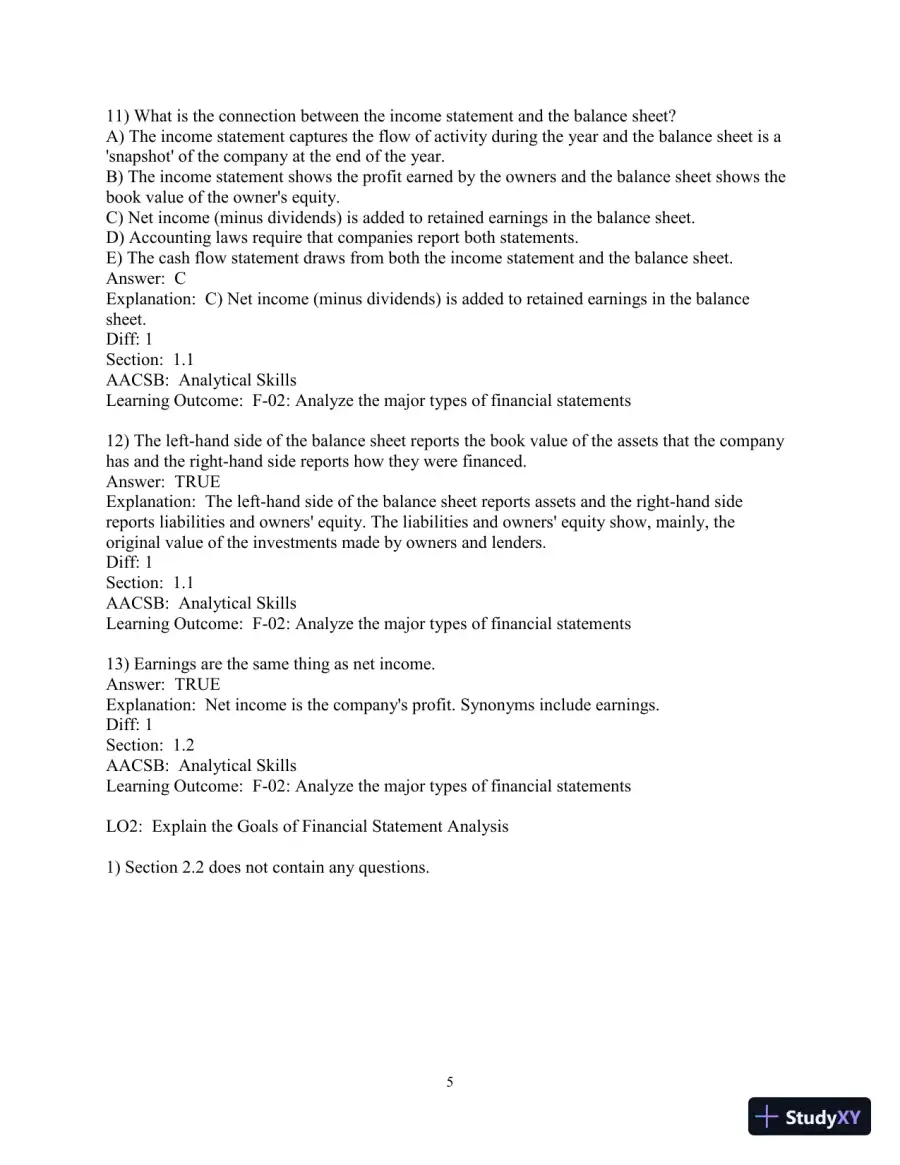 511) What is the connection between the income statement and the balance sheet?A) The income statement captures the flow of activity during the year and the balance sheet is a'snapshot' of the company at the end of the year.B) The income statement shows the profit earned by the owners and the balance sheet shows thebook value of the owner's equity.C) Net income (minus dividends) is added to retained earnings in the balance sheet.D) Accounting laws require that companies report both statements.E) The cash flow statement draws from both the income statement and the balance sheet.Answer: CExplanation: C) Net income (minus dividends) is added to retained earnings in the balancesheet.Diff: 1Section: 1.1AACSB: Analytical SkillsLearning Outcome: F-02: Analyze the major types of financial statements12) The left-hand side of the balance sheet reports the book value of the assets that the companyhas and the right-hand side reports how they were financed.Answer: TRUEExplanation: The left-hand side of the balance sheet reports assets and the right-hand sidereports liabilities and owners' equity. The liabilities and owners' equity show, mainly, theoriginal value of the investments made by owners and lenders.Diff: 1Section: 1.1AACSB: Analytical SkillsLearning Outcome: F-02: Analyze the major types of financial statements13) Earnings are the same thing as net income.Answer: TRUEExplanation: Net income is the company's profit. Synonyms include earnings.Diff: 1Section: 1.2AACSB: Analytical SkillsLearning Outcome: F-02: Analyze the major types of financial statementsLO2: Explain the Goals of Financial Statement Analysis1) Section 2.2 does not contain any questions.
Page 23
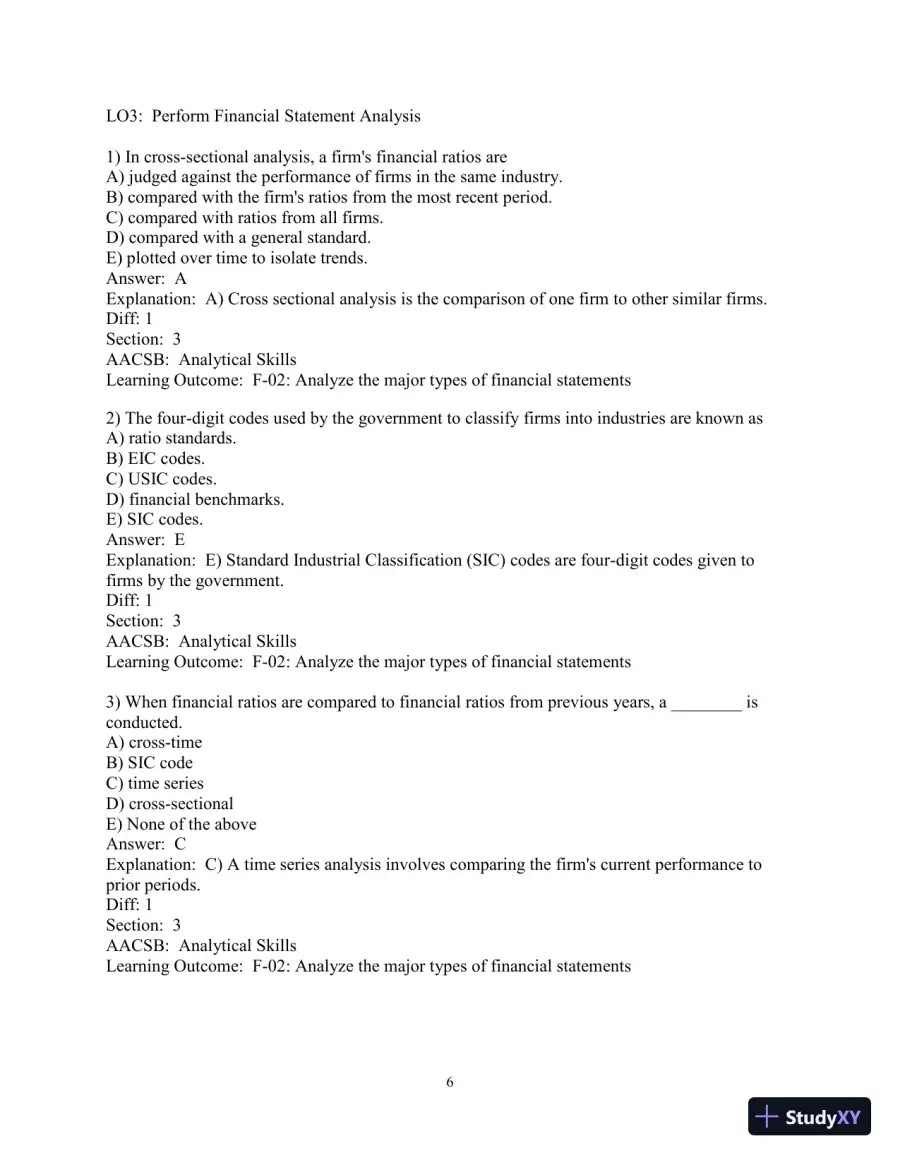 6LO3: Perform Financial Statement Analysis1) In cross-sectional analysis, a firm's financial ratios areA) judged against the performance of firms in the same industry.B) compared with the firm's ratios from the most recent period.C) compared with ratios from all firms.D) compared with a general standard.E) plotted over time to isolate trends.Answer: AExplanation: A) Cross sectional analysis is the comparison of one firm to other similar firms.Diff: 1Section: 3AACSB: Analytical SkillsLearning Outcome: F-02: Analyze the major types of financial statements2) The four-digit codes used by the government to classify firms into industries are known asA) ratio standards.B) EIC codes.C) USIC codes.D) financial benchmarks.E) SIC codes.Answer: EExplanation: E) Standard Industrial Classification (SIC) codes are four-digit codes given tofirms by the government.Diff: 1Section: 3AACSB: Analytical SkillsLearning Outcome: F-02: Analyze the major types of financial statements3) When financial ratios are compared to financial ratios from previous years, a ________ isconducted.A) cross-timeB) SIC codeC) time seriesD) cross-sectionalE) None of the aboveAnswer: CExplanation: C) A time series analysis involves comparing the firm's current performance toprior periods.Diff: 1Section: 3AACSB: Analytical SkillsLearning Outcome: F-02: Analyze the major types of financial statements
Page 24
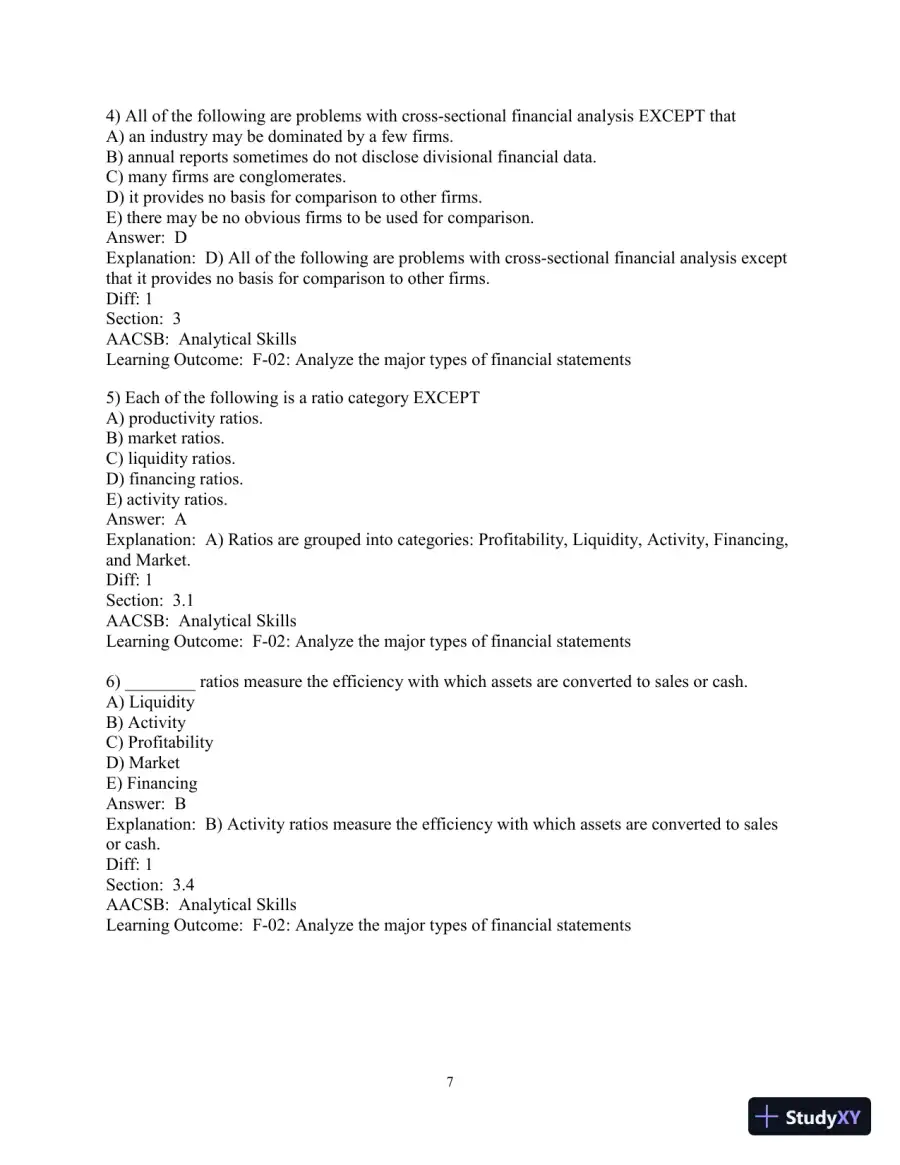 74) All of the following are problems with cross-sectional financial analysis EXCEPT thatA) an industry may be dominated by a few firms.B) annual reports sometimes do not disclose divisional financial data.C) many firms are conglomerates.D) it provides no basis for comparison to other firms.E) there may be no obvious firms to be used for comparison.Answer: DExplanation: D) All of the following are problems with cross-sectional financial analysis exceptthat it provides no basis for comparison to other firms.Diff: 1Section: 3AACSB: Analytical SkillsLearning Outcome: F-02: Analyze the major types of financial statements5) Each of the following is a ratio category EXCEPTA) productivity ratios.B) market ratios.C) liquidity ratios.D) financing ratios.E) activity ratios.Answer: AExplanation: A) Ratios are grouped into categories: Profitability, Liquidity, Activity, Financing,and Market.Diff: 1Section: 3.1AACSB: Analytical SkillsLearning Outcome: F-02: Analyze the major types of financial statements6) ________ ratios measure the efficiency with which assets are converted to sales or cash.A) LiquidityB) ActivityC) ProfitabilityD) MarketE) FinancingAnswer: BExplanation: B) Activity ratios measure the efficiency with which assets are converted to salesor cash.Diff: 1Section: 3.4AACSB: Analytical SkillsLearning Outcome: F-02: Analyze the major types of financial statements
Page 25
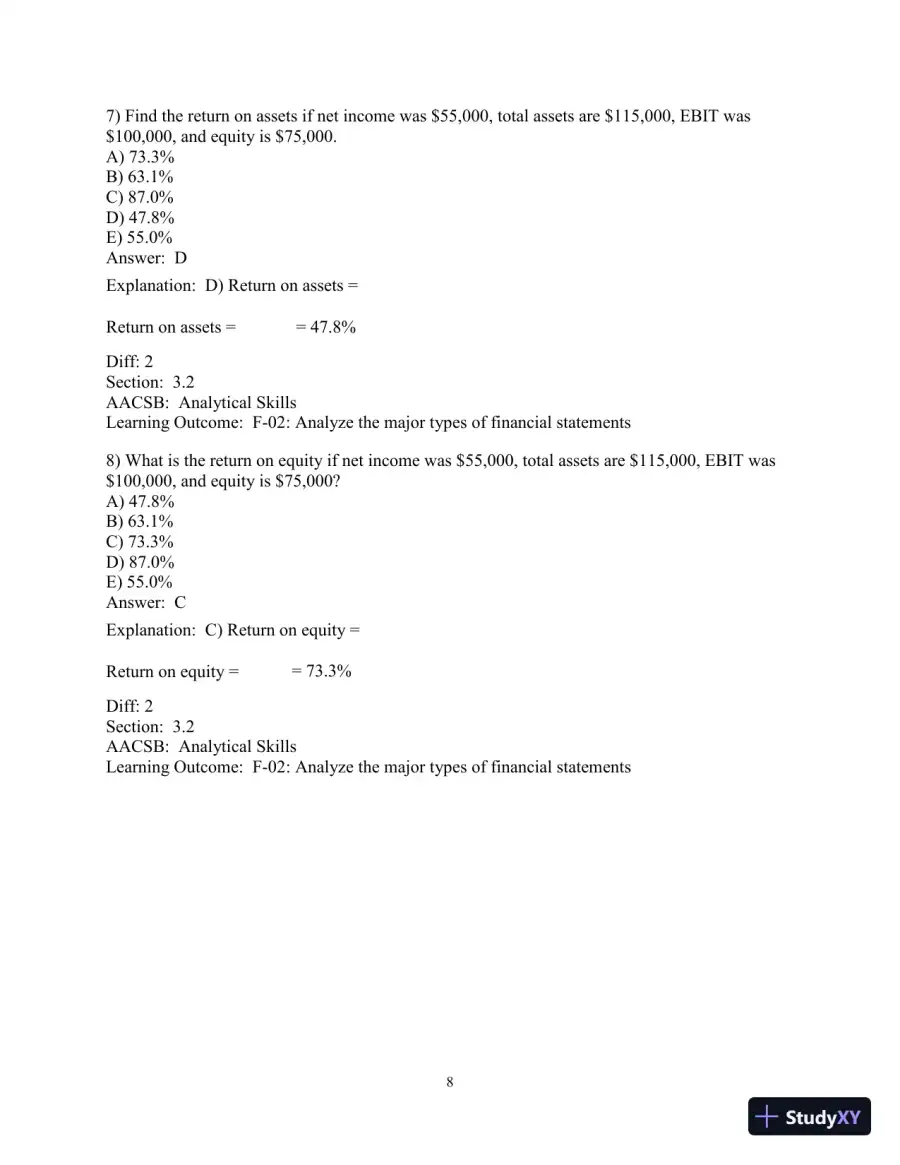 87) Find the return on assets if net income was $55,000, total assets are $115,000, EBIT was$100,000, and equity is $75,000.A) 73.3%B) 63.1%C) 87.0%D) 47.8%E) 55.0%Answer: DExplanation: D) Return on assets =Return on assets == 47.8%Diff: 2Section: 3.2AACSB: Analytical SkillsLearning Outcome: F-02: Analyze the major types of financial statements8) What is the return on equity if net income was $55,000, total assets are $115,000, EBIT was$100,000, and equity is $75,000?A) 47.8%B) 63.1%C) 73.3%D) 87.0%E) 55.0%Answer: CExplanation: C) Return on equity =Return on equity == 73.3%Diff: 2Section: 3.2AACSB: Analytical SkillsLearning Outcome: F-02: Analyze the major types of financial statements
Page 26
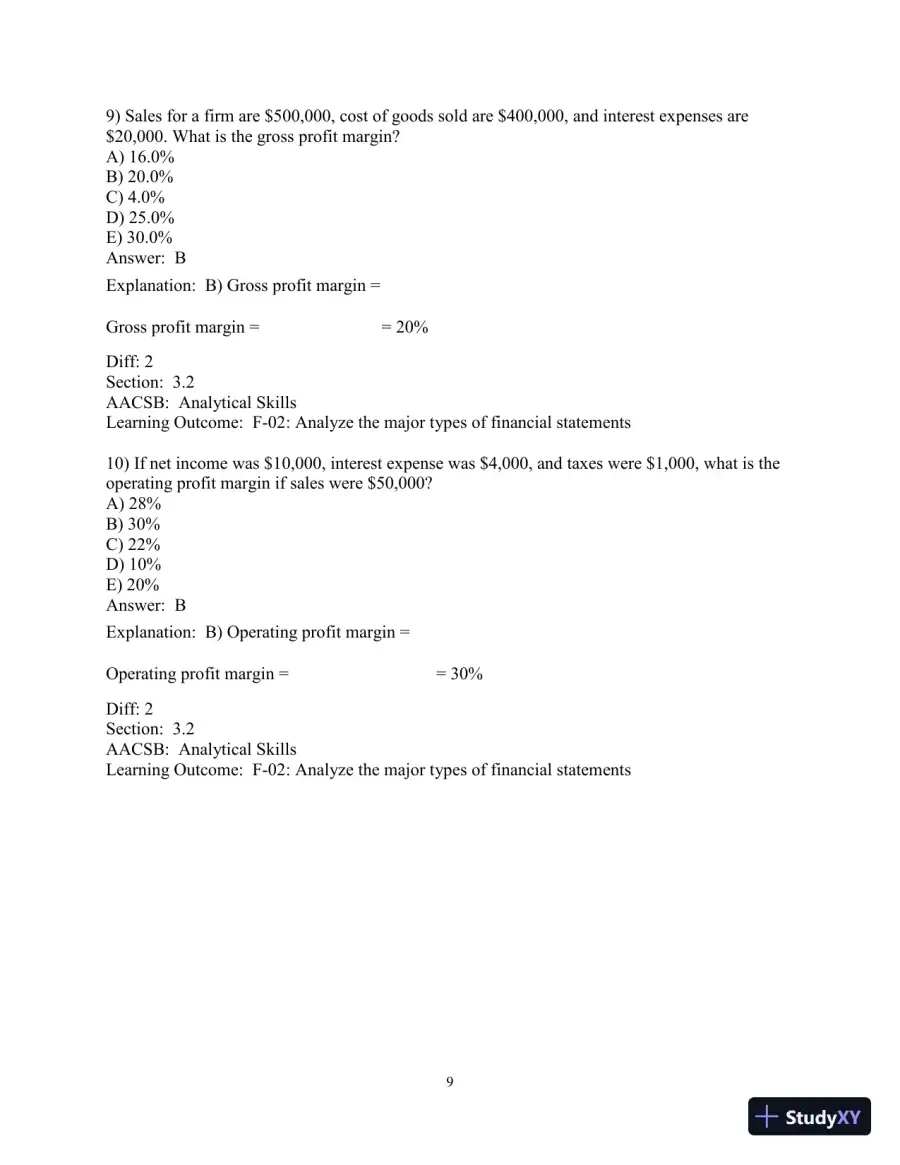 99) Sales for a firm are $500,000, cost of goods sold are $400,000, and interest expenses are$20,000. What is the gross profit margin?A) 16.0%B) 20.0%C) 4.0%D) 25.0%E) 30.0%Answer: BExplanation: B) Gross profit margin =Gross profit margin == 20%Diff: 2Section: 3.2AACSB: Analytical SkillsLearning Outcome: F-02: Analyze the major types of financial statements10) If net income was $10,000, interest expense was $4,000, and taxes were $1,000, what is theoperating profit margin if sales were $50,000?A) 28%B) 30%C) 22%D) 10%E) 20%Answer: BExplanation: B) Operating profit margin =Operating profit margin == 30%Diff: 2Section: 3.2AACSB: Analytical SkillsLearning Outcome: F-02: Analyze the major types of financial statements
Page 27
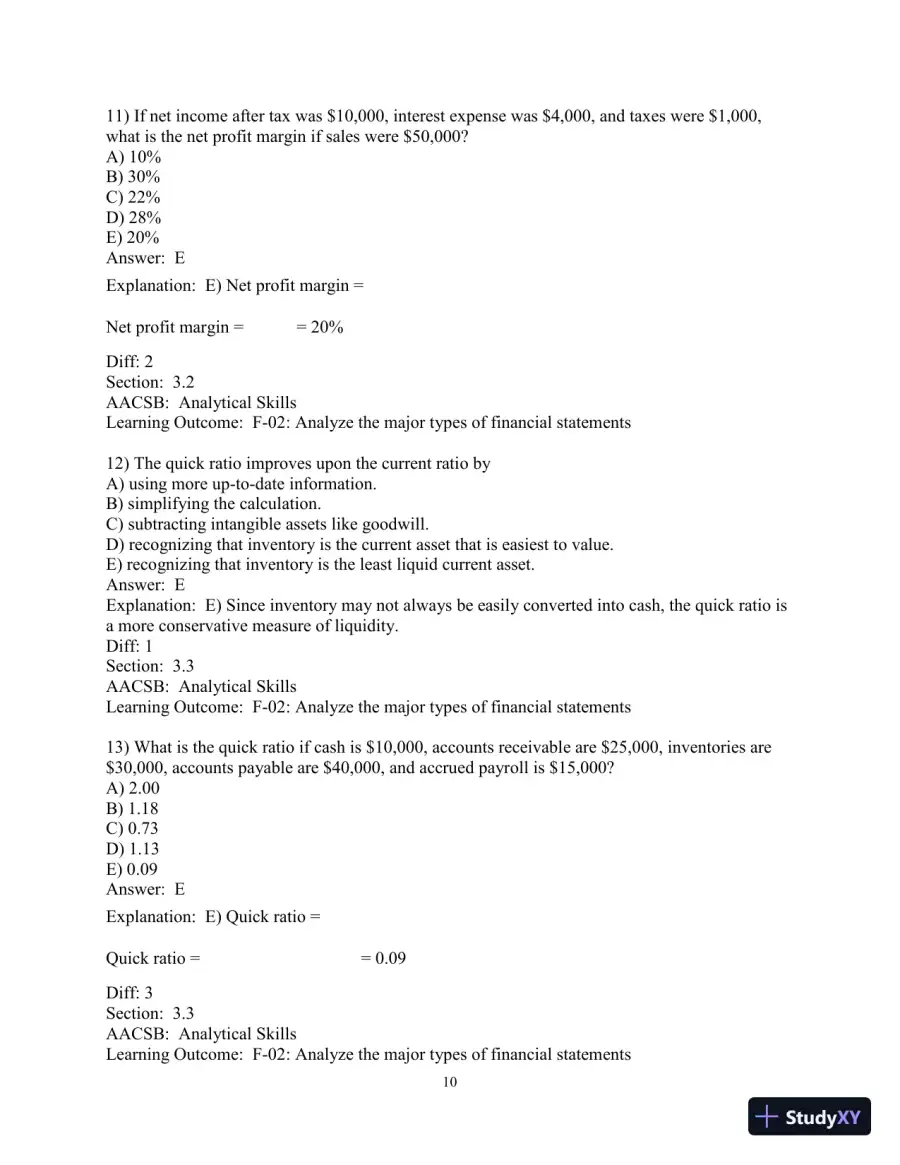 1011) If net income after tax was $10,000, interest expense was $4,000, and taxes were $1,000,what is the net profit margin if sales were $50,000?A) 10%B) 30%C) 22%D) 28%E) 20%Answer: EExplanation: E) Net profit margin =Net profit margin == 20%Diff: 2Section: 3.2AACSB: Analytical SkillsLearning Outcome: F-02: Analyze the major types of financial statements12) The quick ratio improves upon the current ratio byA) using more up-to-date information.B) simplifying the calculation.C) subtracting intangible assets like goodwill.D) recognizing that inventory is the current asset that is easiest to value.E) recognizing that inventory is the least liquid current asset.Answer: EExplanation: E) Since inventory may not always be easily converted into cash, the quick ratio isa more conservative measure of liquidity.Diff: 1Section: 3.3AACSB: Analytical SkillsLearning Outcome: F-02: Analyze the major types of financial statements13) What is the quick ratio if cash is $10,000, accounts receivable are $25,000, inventories are$30,000, accounts payable are $40,000, and accrued payroll is $15,000?A) 2.00B) 1.18C) 0.73D) 1.13E) 0.09Answer: EExplanation: E) Quick ratio =Quick ratio == 0.09Diff: 3Section: 3.3AACSB: Analytical SkillsLearning Outcome: F-02: Analyze the major types of financial statements
Page 28
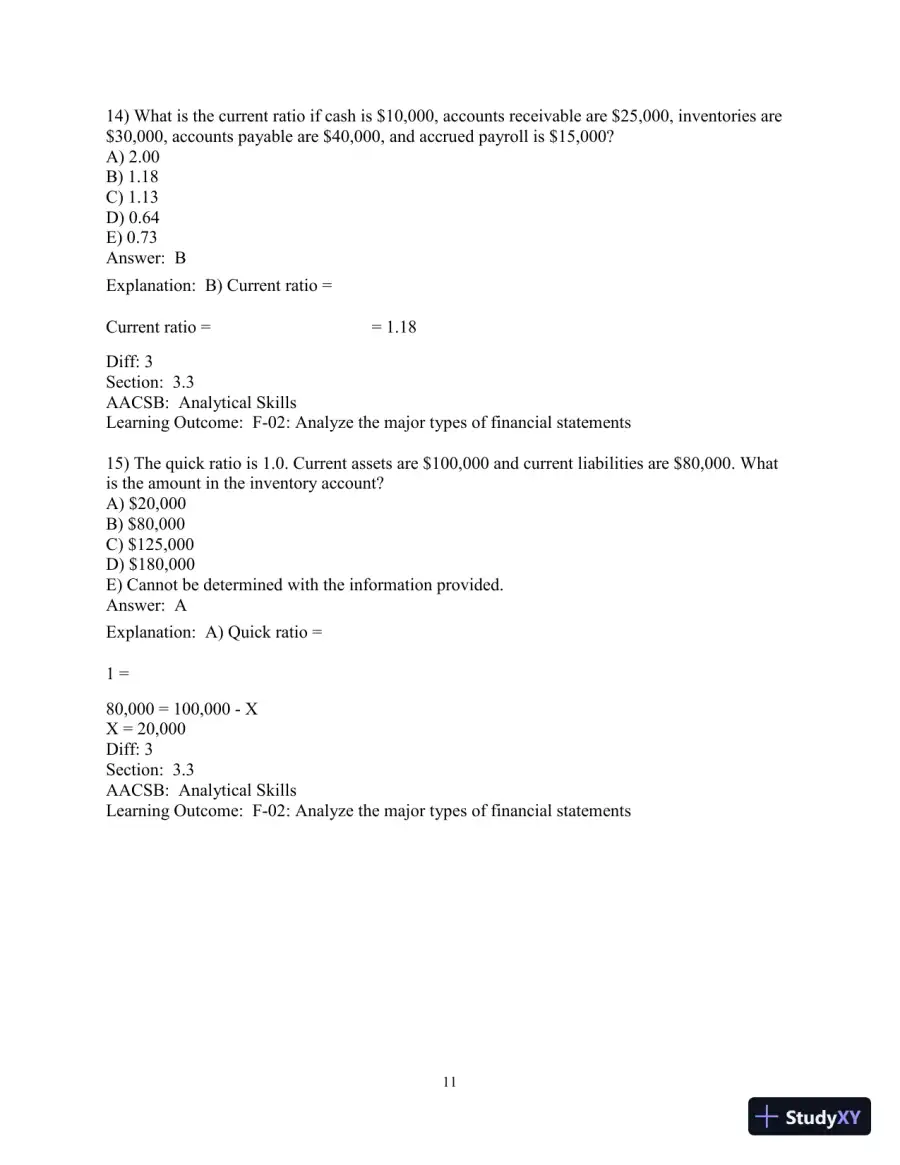 1114) What is the current ratio if cash is $10,000, accounts receivable are $25,000, inventories are$30,000, accounts payable are $40,000, and accrued payroll is $15,000?A) 2.00B) 1.18C) 1.13D) 0.64E) 0.73Answer: BExplanation: B) Current ratio =Current ratio == 1.18Diff: 3Section: 3.3AACSB: Analytical SkillsLearning Outcome: F-02: Analyze the major types of financial statements15) The quick ratio is 1.0. Current assets are $100,000 and current liabilities are $80,000. Whatis the amount in the inventory account?A) $20,000B) $80,000C) $125,000D) $180,000E) Cannot be determined with the information provided.Answer: AExplanation: A) Quick ratio =1 =80,000 = 100,000 - XX = 20,000Diff: 3Section: 3.3AACSB: Analytical SkillsLearning Outcome: F-02: Analyze the major types of financial statements
Page 29
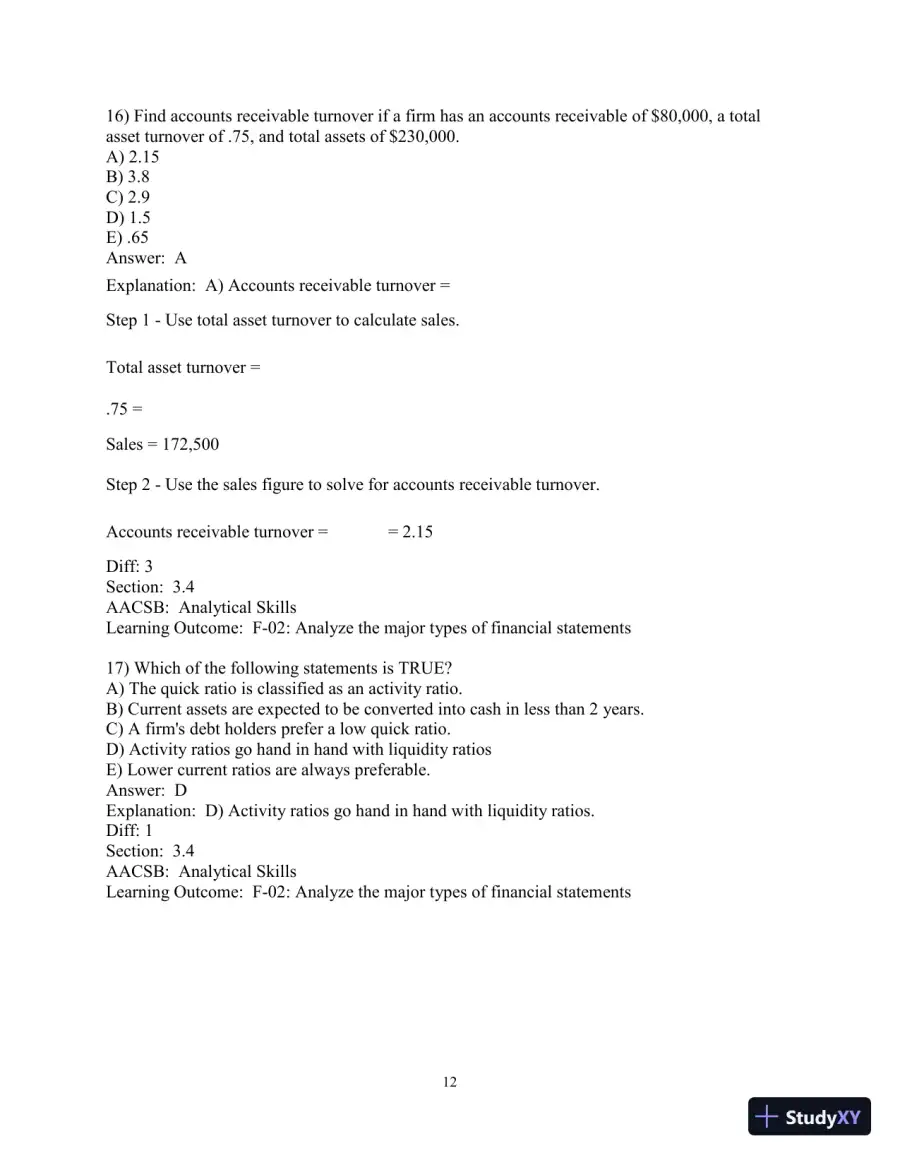 1216) Find accounts receivable turnover if a firm has an accounts receivable of $80,000, a totalasset turnover of .75, and total assets of $230,000.A) 2.15B) 3.8C) 2.9D) 1.5E) .65Answer: AExplanation: A) Accounts receivable turnover =Step 1 - Use total asset turnover to calculate sales.Total asset turnover =.75 =Sales = 172,500Step 2 - Use the sales figure to solve for accounts receivable turnover.Accounts receivable turnover == 2.15Diff: 3Section: 3.4AACSB: Analytical SkillsLearning Outcome: F-02: Analyze the major types of financial statements17) Which of the following statements is TRUE?A) The quick ratio is classified as an activity ratio.B) Current assets are expected to be converted into cash in less than 2 years.C) A firm's debt holders prefer a low quick ratio.D) Activity ratios go hand in hand with liquidity ratiosE) Lower current ratios are always preferable.Answer: DExplanation: D) Activity ratios go hand in hand with liquidity ratios.Diff: 1Section: 3.4AACSB: Analytical SkillsLearning Outcome: F-02: Analyze the major types of financial statements
Page 30
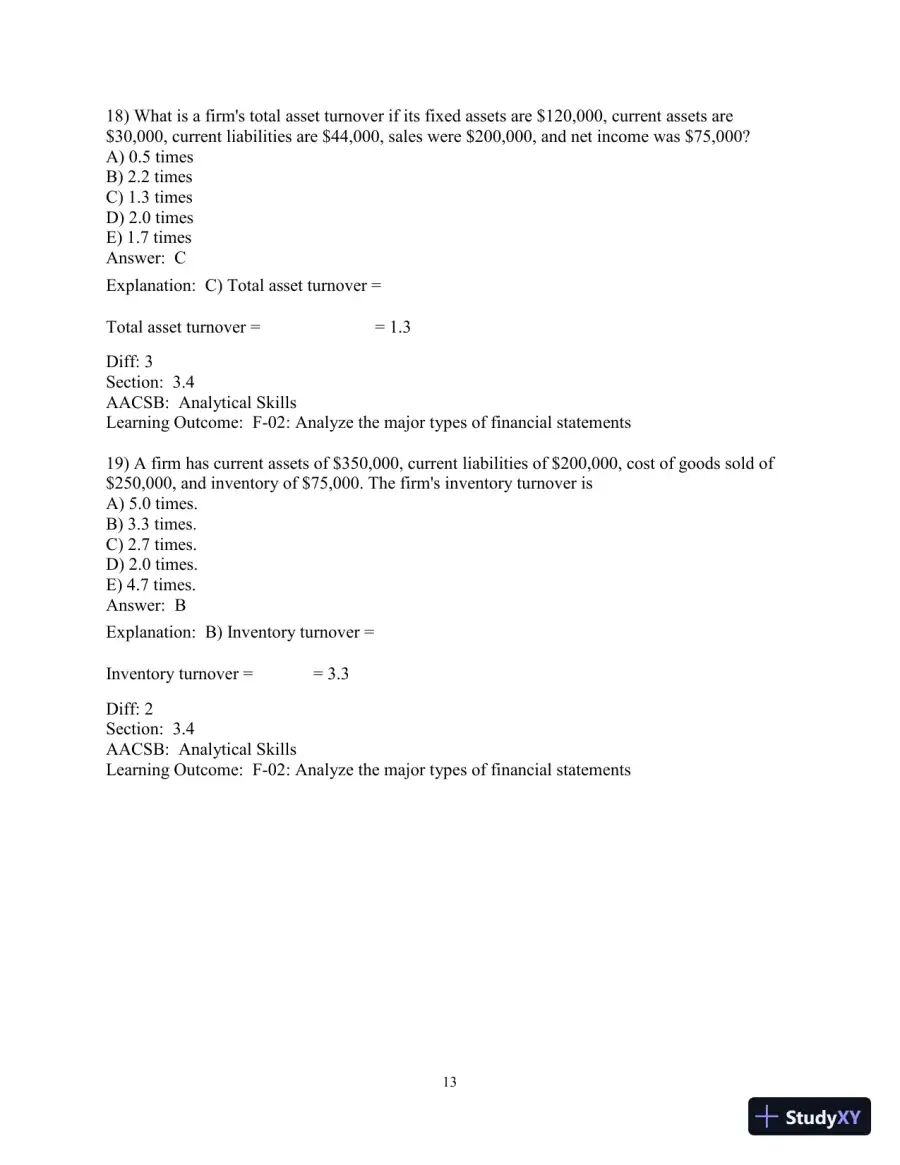 1318) What is a firm's total asset turnover if its fixed assets are $120,000, current assets are$30,000, current liabilities are $44,000, sales were $200,000, and net income was $75,000?A) 0.5 timesB) 2.2 timesC) 1.3 timesD) 2.0 timesE) 1.7 timesAnswer: CExplanation: C) Total asset turnover =Total asset turnover == 1.3Diff: 3Section: 3.4AACSB: Analytical SkillsLearning Outcome: F-02: Analyze the major types of financial statements19) A firm has current assets of $350,000, current liabilities of $200,000, cost of goods sold of$250,000, and inventory of $75,000. The firm's inventory turnover isA) 5.0 times.B) 3.3 times.C) 2.7 times.D) 2.0 times.E) 4.7 times.Answer: BExplanation: B) Inventory turnover =Inventory turnover == 3.3Diff: 2Section: 3.4AACSB: Analytical SkillsLearning Outcome: F-02: Analyze the major types of financial statements
Page 31
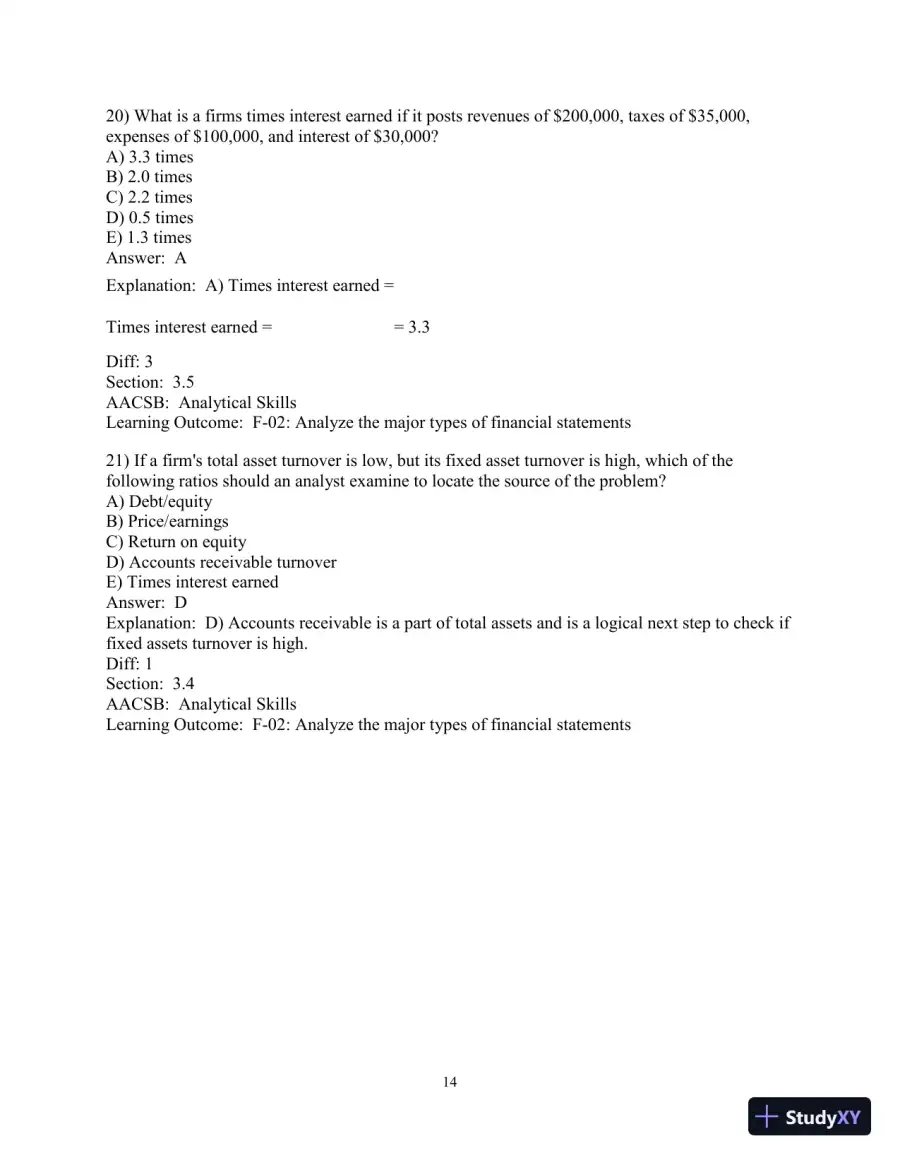 1420) What is a firms times interest earned if it posts revenues of $200,000, taxes of $35,000,expenses of $100,000, and interest of $30,000?A) 3.3 timesB) 2.0 timesC) 2.2 timesD) 0.5 timesE) 1.3 timesAnswer: AExplanation: A) Times interest earned =Times interest earned == 3.3Diff: 3Section: 3.5AACSB: Analytical SkillsLearning Outcome: F-02: Analyze the major types of financial statements21) If a firm's total asset turnover is low, but its fixed asset turnover is high, which of thefollowing ratios should an analyst examine to locate the source of the problem?A) Debt/equityB) Price/earningsC) Return on equityD) Accounts receivable turnoverE) Times interest earnedAnswer: DExplanation: D) Accounts receivable is a part of total assets and is a logical next step to check iffixed assets turnover is high.Diff: 1Section: 3.4AACSB: Analytical SkillsLearning Outcome: F-02: Analyze the major types of financial statements
1111 more pages in the full document
Unlock it once and it stays in your library, ready to chat with or turn into flashcards.
Unlock the full documentMore Finance study materials
See all Class Notes
Class Notes for Corporate Finance, 2nd Edition
Finance
200 pages86downloadsFeb 2025 Textbook Guides
Solution Manual For Investments, 12th Edition
Finance
314 pages161downloadsFeb 2025 Exam Guides
Test Bank for Principles of Managerial Finance, 8th Edition
Finance
851 pages158downloadsFeb 2025 Textbook Guides
Solution Manual for Financial Institutions Management: A Risk Management Approach, 8th Edition
Finance
486 pages154downloadsFeb 2025 Exam Guides
Test Bank for Principles of Managerial Finance, Arab World Edition
Finance
373 pages148downloadsFeb 2025 Textbook Guides
Multinational Financial Management, Study Guide, 6th Edition Solution Manual
Finance
278 pages146downloadsFeb 2025 Textbook Guides
Financial Markets and Institutions, 7th Edition Solution Manual
Finance
194 pages136downloadsFeb 2025 Certification Guides
Wiley Finra Series 3 Exam Review (2019)
Finance
253 pages131downloadsFeb 2025
Study this document with CramX
Once it is in your library, every tool can work from it.