

Financial Statement Analysis
- Finance
- 9 pages
- Shared May 2025
Detailed breakdown of financial statements and key performance indicators.
Preview 3 of 9 pages
See the first 3 pages exactly as they appear in the document.
Page 1 Read page 1 as text
Financial Statement Analysis Heading - Display All Questions True - False Questions [Q1] True False - 2 Points Net Operating Assets (NOA) is determined by subtracting non - operating assets from total assets. [Q2] True False - 2 Points Operating assets typically include cash, receivables, property, plant and equipment (PPE), and capitalized lease assets. [Q3] True False - 2 Points Tax expense on the income statement reflects both operating and non - operating revenue and expenses. [Q4] True False - 2 Points Operating assets exclude short - term and long - term investments in marketable securities. [Q5] True False - 2 Points All things equal, a higher NOAT is preferable than a lower one. [Q6] True False - 2 Points Net Operating Assets = Net Nonoperating Obligations + Stockholders' Equity [Q7] True False - 2 Points A limitation of Generally Accepted Accounting Principles (GAAP) is that financial statements reflect what can be reliably measured, therefore, excluding some assets that cannot be reliably measured. [Q8] True False - 2 Points The net assets of discontinued operations should be considered to be nonoperating, however, their after - tax profit (loss) should be treated as operating. [Q9] True False - 2 Points Vertical analysis facilitates comparisons within a set of financial statements and horizontal analysis provides comparisons across time periods. [Q10] True False - 2 Points Ratios provide one way to compare companies in the same industry, regardless of their size. [Q11] True False - 2 Points Highly leveraged firms have a higher RNOA than firms with lower leverage. [Q12] True False - 2 Points
Page 2 Page 3 Read page 3 as text
Repurchasing shares of common stock near year end will increase a firm's return on equity (ROE). [Q13] True False - 2 Points To determine tax on net operating profit, we begin with total tax expense and deduct taxes related to net nonoperating expenses. [Q14] True False - 2 Points NOPAT is equivalent to income before tax from operating activities. [Q15] True False - 2 Points NOPAT is equivalent to income after tax from operating activities. [Q16] True False - 2 Points Increasing a company's net operating asset turnover (NOAT) increases both RNOA and ROE. [Q17] True False - 2 Points If company A has a higher net operating profit margin (NOPM) than Company B, then Company A's RNOA will be higher. [Q18] True False - 2 Points Net operating asset turnover (NOAT) measures a company's profitabiltiy. [Q19] True False - 2 Points All else being equal, higher financial leverage will decrease a company's debt rating and increase the interest rate it must pay. [Q20] True False - 2 Points A current ratio greater than 1.0 is generally desirable for a company. [Q21] True False - 2 Points Solvency ratios measure a company's ability to meet its debt obligations. [Q22] True False - 2 Points The DuPont analysis disaggregates return on equity into profitability, efficiency and leverage components. Pg. 4 - 30 [Q23] True False - 2 Points The times Interest Earned (T.I.E.) ratio is a financial metric used to assess a company's solvency. [Q24] True False - 2 Points The quick ratio includes cash, accounts receivable and inventory assets in the numerator. One benefit of using ratio analysis
6 more pages in the full document
Unlock it once and it stays in your library, ready to chat with or turn into flashcards.
Unlock the full documentMore Finance study materials
See all Textbook Guides
Solution Manual For Investments, 12th Edition
Finance
314 pages161downloadsFeb 2025 Exam Guides
Test Bank for Principles of Managerial Finance, 8th Edition
Finance
851 pages158downloadsFeb 2025 Textbook Guides
Solution Manual for Financial Institutions Management: A Risk Management Approach, 8th Edition
Finance
486 pages154downloadsFeb 2025 Exam Guides
Test Bank for Principles of Managerial Finance, Arab World Edition
Finance
373 pages148downloadsFeb 2025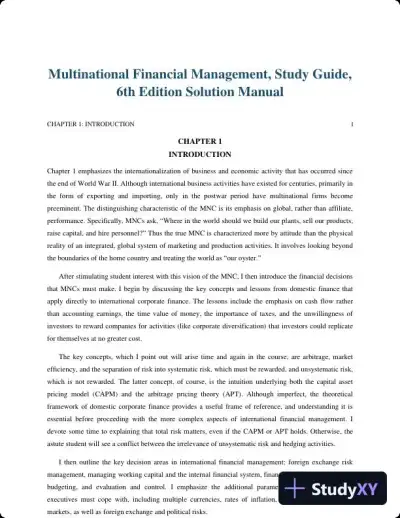 Textbook Guides
Multinational Financial Management, Study Guide, 6th Edition Solution Manual
Finance
278 pages146downloadsFeb 2025 Textbook Guides
Financial Markets and Institutions, 7th Edition Solution Manual
Finance
194 pages136downloadsFeb 2025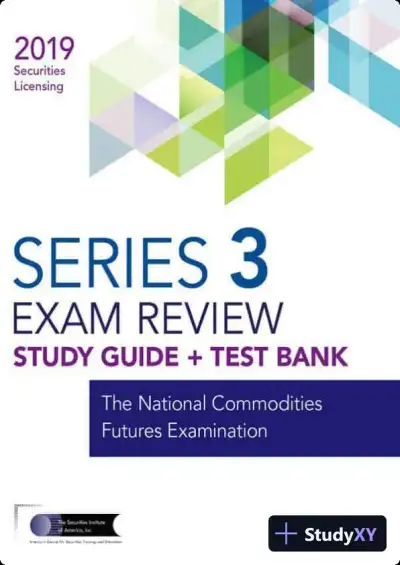 Certification Guides
Wiley Finra Series 3 Exam Review (2019)
Finance
253 pages131downloadsFeb 2025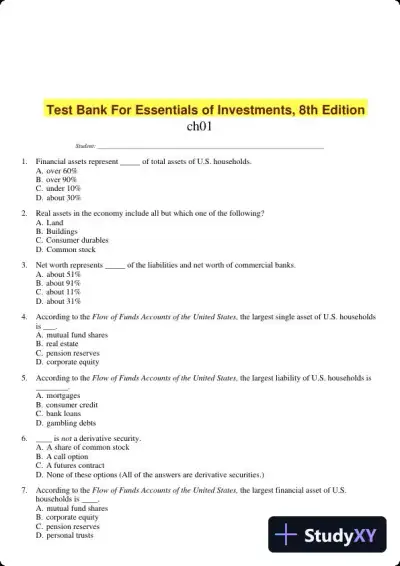 Exam Guides
Test Bank For Essentials of Investments, 8th Edition
Finance
368 pages130downloadsFeb 2025
Study this document with CramX
Once it is in your library, every tool can work from it.