

Teaching Net Present Value (NPV) And Future Value (FV) - BUS 401
- Finance
- Ashford University
- 16 pages
- Shared May 2025
Download this Project PPT to understand the concepts of Net Present Value (NPV) and Future Value (FV).
Preview 5 of 16 pages
See the first 5 pages exactly as they appear in the document.
Page 1 Read page 1 as text
1 Teaching Net Present Value (NPV) and Future Value (FV) BUS 401 Name Date Instructor
Page 2 Page 3 Read page 3 as text
Net Present Value (NPV) ➢ NPV is used to compare the value of money that is to be received in the future with the present value of the same amount of money (Hickman, K. and Byrd, J. 2013) ➢ The value of money changes with time. NPV is calculated while making investment decision in order to factor in changes in the value of money in the decision making process. ➢ A given amount of money will have less worth in the future than in the present in any situation. 2
Page 4 Read page 4 as text
Reasons for Time Value of Money ➢ A dollar will always have low value in the future than in the present because: 1. People would rather consume money in the present than in the future (Hickman, K. and Byrd,2013) 2. Monetary inflation means that the same amount of money would purchase few items in the future ( Fabozzi & Markowitz, 2002). 3. Uncertainty of future events exposes the investment to significant risks. 3
Page 5 Read page 5 as text
Calculating the NPV ➢ Obtain the cash outflows from the investments. ❑ Get the net cash flow for each period by subtracting the cash outflows from the cash inflows. ❑ Determine the discounting rate. The discounting rate represent the cost at which present benefits are traded for future benefits (Dayananda, 2002). ❑ The discounting also represent the opportunity cost as factors the gains that the investor would have made if he would have undertaken a different project (Chass, 2005). 4
11 more pages in the full document
Unlock it once and it stays in your library, ready to chat with or turn into flashcards.
Unlock the full documentMore Finance study materials
See all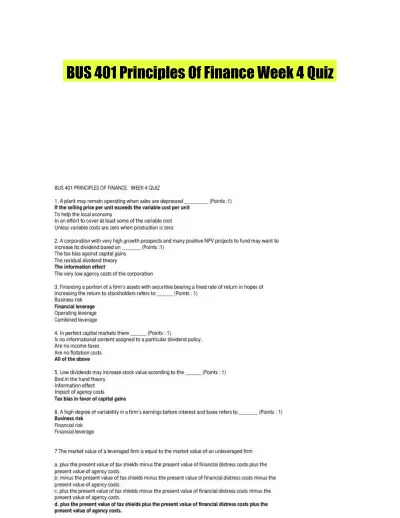 Solved Assignments
BUS 401 Principles Of Finance Week 4 Quiz
Finance
8 pagesMay 2025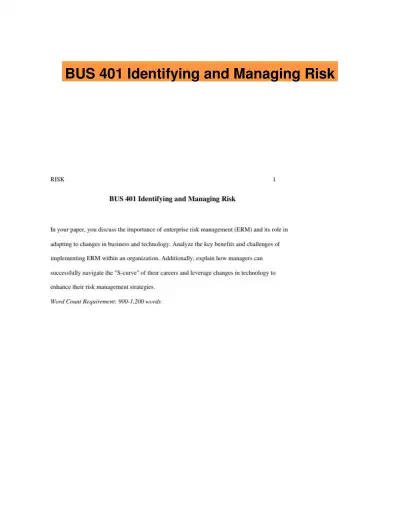 Solved Assignments
BUS 401 Identifying and Managing Risk
Business Management
5 pagesMay 2025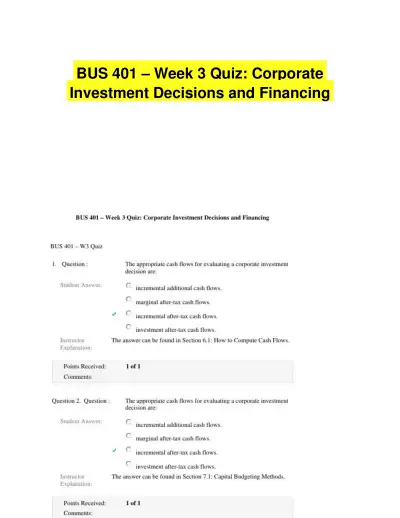 Solved Assignments
BUS 401 � Week 3 Quiz: Corporate Investment Decisions and Financing
Finance
5 pagesMay 2025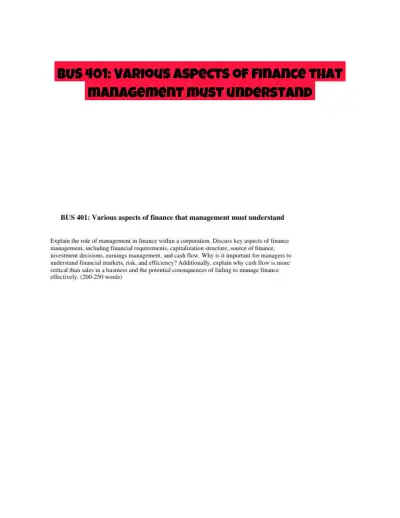 Solved Assignments
BUS 401: Various aspects of finance that management must understand
Finance
4 pagesMay 2025 Solved Assignments
BUS 401 Financial Analysis and Investment Potential of Wrigley Jr. Co
Business Management
10 pagesMay 2025 Textbook Guides
Solution Manual For Investments, 12th Edition
Finance
314 pages161downloadsFeb 2025 Exam Guides
Test Bank for Principles of Managerial Finance, 8th Edition
Finance
851 pages158downloadsFeb 2025 Textbook Guides
Solution Manual for Financial Institutions Management: A Risk Management Approach, 8th Edition
Finance
486 pages154downloadsFeb 2025
Study this document with CramX
Once it is in your library, every tool can work from it.