

Geology - Metamorphic Rock Types
- Geology
- Texas A&M University
- 16 pages
- Shared March 2026
Preview 5 of 16 pages
See the first 5 pages exactly as they appear in the document.
Page 1 Read page 1 as text
Study Guide Geology – Metamorphic Rock Types 1. Factors That Control Metamorphism Metamorphism happens when rocks are changed by heat, pressure, water, and stress deep inside the Earth. Even though these conditions can strongly affect a rock’s texture and minerals, one important thing usually stays the same: the overall chemical composition of the rock . 1.1 Rock Chemistry: The Star Ɵ ng Point Ma Ʃ ers In most cases, a metamorphic rock keeps a chemistry very similar to its original, or parent , rock. • A quartz sandstone , which is rich in silica, will turn into a metamorphic rock that is also rich in silica. • A limestone , which is rich in calcite (calcium carbonate), can only metamorphose into a calcium - rich metamorphic rock. Because of this, a quartz sandstone cannot change into a calcium - rich rock. Metamorphism rearranges minerals — it does not completely change the rock’s chemistry. 1.2 Temperature and Pressure: Driving Mineral Changes Temperature and pressure are two of the most important controls on metamorphism. • Different minerals form under different combinations of heat and pressure. • Each mineral is stable only within a certain range, called its stability field . • When temperature or pressure moves outside that range, the mineral breaks down and new, more stable minerals form. Higher temperatures also: • Cause minerals that are generally less dense to form • Speed up chemical reactions, making metamorphism happen more efficiently
Page 2 Read page 2 as text
Study Guide 1.3 Water: A Powerful Helper Water plays a major role in metamorphic reactions. • The amount of water available affects how quickly and how strongly metamorphism occurs. • Water helps minerals dissolve and recrystallize, making chemical reactions easier. Most metamorphic rocks form very slowly — often over 10 to 20 million years or more — so time is just as important as water. 1.4 Geosta Ɵ c (Con fi ning) Pressure: Pressure from Burial Geostatic pressure , also called confining pressure , comes from the weight of overlying rock. • It pushes equally from all directions on a deeply buried rock mass. • The deeper a rock is buried, the greater the geostatic pressure it experiences. This type of pressure changes mineral structures without causing rocks to stretch or flatten in one direction. 1.5 Di ff eren Ɵ al Stress: Unequal Forces Differential stress occurs when pressure is applied unevenly, usually because of tectonic forces. • The rock is pushed more from one direction than another. • This causes the rock mass to stretch and become elongated . • The stronger the differential stress, the more stretched the rock becomes. Rock components such as mineral crystals, fragments, or pillow structures can be stretched so much that they are hard to recognize.
Page 3 Read page 3 as text
Study Guide 1.6 Compressive Stress: Squeezing from Both Sides Compressive stress is a special type of stress applied from directly opposite directions . • Instead of stretching the rock, it compresses and flattens it. • This type of stress is common in mountain - building regions. 1.7 Shearing: Sliding Past Each Other Shearing happens when parts of a rock mass slide past each other. • It is closely related to differential stress. • Minerals tend to align or grow along flat surfaces called shear planes . These shear planes:
Page 4 Read page 4 as text
Study Guide • Become zones of weakness • Allow mineral grains to be crushed or recrystallized • Let water enter the rock, which speeds up metamorphic reactions 1.8 Folia Ɵ on: Layered Textures in Metamorphic Rocks When rocks experience long - lasting compressive stress, differential stress, or shearing, mineral grains can become aligned. This alignment forms parallel layers or bands called foliation . • New metamorphic minerals often grow along these foliation planes. • The direction of foliation depends on the direction of stress. • Foliation may cut across the original sedimentary layers, sometimes completely hiding them. 1.9 Types of Folia Ɵ on Textures Different conditions produce different foliated textures: • Slaty cleavage ○ Rock splits easily along closely spaced, parallel foliation planes ○ Common in low - grade metamorphic rocks like slate • Schistose foliation ○ More massive texture ○ Coarser mineral grains grow along foliation planes ○ Foliation planes are more widely spaced than in slate • Gneissic texture ○ Found in intensely metamorphosed rocks ○ Extremely high temperatures and pressures make the rock soft and plastic ○ Light - and dark - colored minerals separate into distinct bands
Page 5 Read page 5 as text
Study Guide 2. Types of Metamorphism Geologists group metamorphism into two main types based on where it happens and what causes it : regional metamorphism and contact metamorphism . 2.1 Regional Metamorphism: Changes Over Large Areas Regional metamorphism (also called dynamothermal metamorphism ) is the most common type of metamorphism. It happens when rocks are affected by: • Strong tectonic forces • High pressure • High temperature These conditions usually occur deep in the Earth during mountain - building events , where large sections of the crust are squeezed, buried, and heated. Key features of regional metamorphism: • Affects large regions , not just small areas • Rocks are often foliated (minerals line up in layers or bands) • Rocks are commonly deformed by pressure • Many of these rocks are thought to be remnants of ancient mountain ranges 2.2 Metamorphic Grades: How Intense Was the Change? During regional metamorphism, different minerals form depending on the pressure and temperature conditions. These mineral groups are called metamorphic facies (or grades). Each facies represents a specific range of pressure and temperature where certain minerals are stable. From low grade to high grade metamorphism: • Zeolite facies
11 more pages in the full document
Unlock it once and it stays in your library, ready to chat with or turn into flashcards.
Unlock the full documentMore Geology study materials
See all Quick Guides
Geology - Groundwater
Geology
16 pagesMar 2026 Quick Guides
Geology - Earth Resources We Depend On
Geology
16 pagesMar 2026 Quick Guides
Geology - Weathering and Erosion
Geology
11 pagesMar 2026 Quick Guides
Geology - Glaciers and Glaciation
Geology
21 pagesMar 2026 Quick Guides
Geology - Introduction to Physical Geology
Geology
10 pagesMar 2026 Quick Guides
Geology - Running Water
Geology
19 pagesMar 2026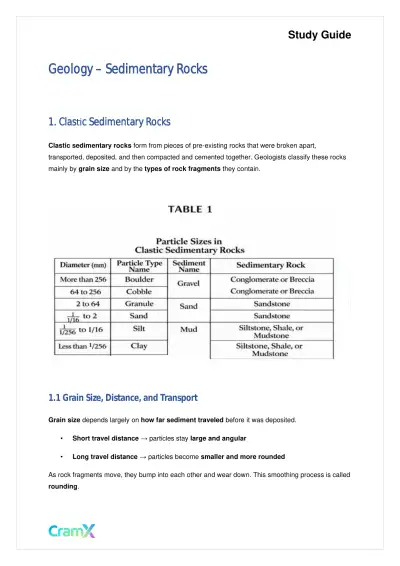 Quick Guides
Geology - Sedimentary Rocks
Geology
15 pagesMar 2026 Quick Guides
Geology - The Ocean Floor
Geology
21 pagesMar 2026
Study this document with CramX
Once it is in your library, every tool can work from it.