
Geology Notes, Questions, and Study Resources
academicGeology is the study of the Earth’s structure, materials, and the natural processes that shape the planet over time. It explores how rocks, minerals, fossils, and landforms form through processes such as plate tectonics, erosion, sedimentation, and volcanic activity. Understanding geology helps explain how landscapes evolve and how natural resources are formed.
On CramX, you can explore a wide range of geology resources designed to support coursework and exam preparation. This includes geology notes and study documents, step-by-step problem explanations, and flashcards for quick revision. These materials help students understand geological concepts and apply scientific reasoning to real-world problems.
Geology covers important areas such as mineralogy, petrology, stratigraphy, paleontology, and structural geology. These topics help students understand Earth’s history, rock formation processes, natural hazards, and environmental changes over geological time scales.
Students studying geology develop analytical and observational skills that are valuable for careers in environmental science, mining, petroleum exploration, engineering, and research. Geology also plays an important role in understanding earthquakes, landslides, groundwater systems, and climate change.
You may also find related learning materials in Earth Science, Environmental Science, Physics, and Chemistry, which support deeper understanding of geological processes.
Recent Geology Documents
Explore the latest Geology notes, study materials, and exam resources. These documents help you understand key concepts and prepare effectively for coursework and exams. These resources cover essential topics, key concepts, and commonly studied areas within Geology. Latest Geology documents include notes, assignments, and practice materials from various courses and universities.
Most Popular Geology Documents
Explore the most popular Geology notes, study materials, and solution manuals trusted by students. Ranked based on student ratings, downloads, and engagement.
Recent Geology Flashcards
Explore recently created Geology flashcard decks that simplify complex topics and support quick revision and active recall. Browse interactive flashcard decks created by students to help with Geology revision and exam preparation. Perfect for quick revision and spaced repetition learning.
Plate Tectonics and Geology Concepts
Land Navigation with MAPS
Igneous Rocks Flashcards
Recent Geology Questions & Answers
Explore recently answered Geology questions, including step-by-step solutions and explanations to support your learning and exam preparation. These questions cover important topics, concepts, and real-world problems commonly asked in Geology courses and exams. Perfect for homework help, quick problem-solving, and concept clarification. New questions and answers are added regularly to keep content fresh and relevant.
Which number is a composite number? 23, 31, 17, 19, 57, 53 | | None of these | | --- | --- | | | 31 | | | 53 | | | 23 | | | 57 |
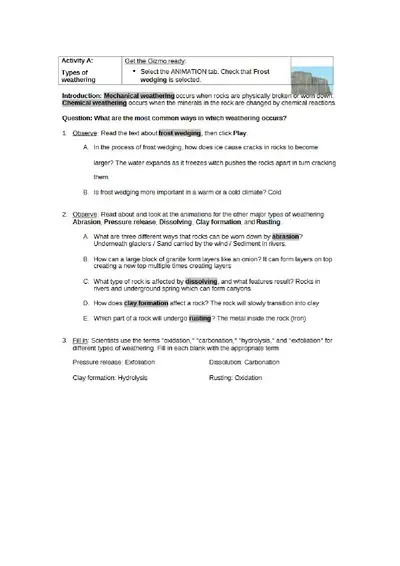
"Which of the following is an example of chemical weathering? A. The breaking of rocks into smaller pieces due to freeze-thaw cycles B. The cracking of rocks from plant root growth C. The hydrolysis of feldspar minerals to form clay minerals D. The abrasion of rocks by wind-blown sand"
What is catastrophism, who proposed it, and how did they propose this caused the layering of fossils in strata?
What is scoria, and how does it differ from pumice? A. Scoria is a vesicular ejecta that is produced from mafic magma. Although pumice is also vesicular, it differs from scoria in that pumice is felsic. B. A change in the composition of gases being released. C. Lava from shield volcanoes is mafic and has a low viscosity. D. A conduit is the circular path through which magma ascends to the vent, which is the surface opening of the conduit. A crater is a funnel-shaped depression around the vent.
What are the pros and cons of the Gall-Peters projection?
"Study the graph about seismic waves. Graph of P & S Wave Travel Times, showing travel time in minutes across distance in kilometers for P and S waves. The S wave starts at zero kilometers, zero minutes, and increases to 10,000 kilometers, 25 minutes. The P wave starts at zero kilometers, zero minutes, and increases to 10,000 kilometers, 13 minutes. What does the graph show? A. The S and P waves travel the same distance through Earth’s crust in the same amount of time. B. The P wave travels through Earth’s crust more quickly than the S wave travels. C. It takes the P wave 18 minutes to travel 6,000 km through Earth’s crust. D. It takes the S wave 11 minutes to travel 8,000 km through Earth’s crust."
What would happen if the Ring of Fire erupted all at once?
What is the difference between a convergent and divergent plate boundary?
Explore Related Subjects and Topics
Discover related subjects and academic topics connected to Geology. Explore study materials, notes, flashcards, and questions across multiple disciplines. These subjects share important concepts with Geology and can help you build a broader understanding. Browse study materials, documents, flashcards, and answers across these subjects.
Geology Study Materials from Top Universities
Explore Geology study materials, notes, and documents from top universities and institutions. Access resources created by students and educators from leading academic programs. These universities offer a wide range of Geology resources across different courses and levels of study. Trusted by students from universities worldwide. Browse documents, notes, and study materials from these universities.