

GMAT For Dummies 2020: Book + 7 Practice Tests (2020)
- Graduate Management Admission Test
- 714 pages
- Shared February 2025
- 131 downloads
GMAT For Dummies 2020: Book + 7 Practice Tests (2020) provides real-world examples to reinforce your learning.
Preview 31 of 714 pages
See the first 31 pages exactly as they appear in the document.
Page 1 Page 2 Read page 2 as text
Downloaded from StudyXY.com [= Ww + StudyXY oi as . Za \ Rr ' BE \ Stu dy Anything This ContentHas been Posted On StudyXY.com as supplementary learning material. StudyXY does not endrose any university, college or publisher. Allmaterials posted are under the liability of the contributors. | 8) www.studyxy.com
Page 3 Page 4 Page 5 Read page 5 as text
GMAT™ 2020 For Dummies® with Online Practice Published by: John Wiley & Sons, Inc., 111 River Street, Hoboken, NJ 07030-5774, www .wiley.com Copyright © 2020 by John Wiley & Sons, Inc., Hoboken, New Jersey Published simultaneously in Canada No part of this publication may be reproduced, stored in a retrieval system or transmitted in any form or by any means, electronic, mechanical, photocopying, recording, scanning or otherwise, except as permitted under Sections 107 or 108 of the 1976 United States Copyright Act, without the prior written permission of the Publisher. Requests to the Publisher for permission should be addressed to the Permissions Department, John Wiley & Sons, Inc., 111 River Street, Hoboken, NJ 07030, (201) 748- 6011, fax (201) 748-6008, or online at http://www.wiley.com/go/permissions. Trademarks: Wiley, For Dummies, the Dummies Man logo, Dummies.com, Making Everything Easier, and related trade dress are trademarks or registered trademarks of John Wiley & Sons, Inc., and may not be used without written permission. GMAT is a registered trademark of the Graduate Admission Management Council ™. The Graduate Admission Management Council™ does not endorse, and is not affiliated with the owner or content of GMAT For Dummies. All other trademarks are the property of their respective owners. John Wiley & Sons, Inc., is not associated with any product or vendor mentioned in this book. LIMIT OF LIABILITY/DISCLAIMER OF WARRANTY: WHILE THE PUBLISHER AND AUTHOR HAVE USED THEIR BEST EFFORTS IN PREPARING THIS BOOK, THEY MAKE NO REPRESENTATIONS OR WARRANTIES WITH RESPECT TO THE ACCURACY OR COMPLETENESS OF THE CONTENTS OF THIS BOOK AND SPECIFICALLY DISCLAIM ANY IMPLIED WARRANTIES OF MERCHANTABILITY OR FITNESS FOR A PARTICULAR PURPOSE. NO WARRANTY MAY BE CREATED OR EXTENDED BY SALES REPRESENTATIVES OR WRITTEN SALES MATERIALS. THE ADVISE AND STRATEGIES CONTAINED
Page 6 Read page 6 as text
HEREIN MAY NOT BE SUITABLE FOR YOUR SITUATION. YOU SHOULD CONSULT WITH A PROFESSIONAL WHERE APPROPRIATE. NEITHER THE PUBLISHER NOR THE AUTHOR SHALL BE LIABLE FOR DAMAGES ARISING HEREFROM. For general information on our other products and services, please contact our Customer Care Department within the U.S. at 877-762-2974, outside the U.S. at 317-572-3993, or fax 317-572-4002. For technical support, please visit https: //hub.wiley.com/community/support/dummies. Wiley publishes in a variety of print and electronic formats and by print- on-demand. Some material included with standard print versions of this book may not be included in e-books or in print-on-demand. If this book refers to media such as a CD or DVD that is not included in the version you purchased, you may download this material at http://booksupport.wiley.com. For more information about Wiley products, visit www.wiley.com. Library of Congress Control Number: 2019916791 ISBN 978-1-119-61794-5 (pbk); ISBN 978-1-119-61795-2 (ebk); ISBN 978-1-119-61797-6 (ebk)
Page 7 Read page 7 as text
GMAT™ 2020 For Dummies® To view this book's Cheat Sheet, simply go to www.dummies.com and search for “GMAT 2020 For Dummies Cheat Sheet” in the Search box. Table of Contents Cover Introduction About This Book Foolish Assumptions Icons Used in This Book Beyond the Book Where to Go from Here Part 1: Getting Started with the GMAT Chapter 1: The Lowdown on the GMAT Knowing Why the GMAT Is Important Timing It Perfectly: When to Take the GMAT (And What to Bring Forming First Impressions: The Format of the GMAT Knowing Where You Stand: Scoring Considerations Repeating the Process: Retaking the GMAT Chapter 2: Maximizing Your Score on the GMAT Discovering Strategies for Successful Guessing Winning the Race against the Clock Getting Rid of Wrong Answers Playing It Smart: A Few Things You Shouldn't Do When Taking the Test
Page 8 Read page 8 as text
Tackling a Case of Nerves with Relaxation Techniques Devising a Plan of Attack Chapter 3: Mastering Business School Admissions Choosing a Business School Lining Up Your Ducks — Applying to Business Schools Crafting Effective Business School Essays Part 2: Vanquishing the Verbal Section Chapter 4: Applying What You Learned (We Hope) in Grammar Class: Sentence Correction Building a Solid Foundation: Grammar Basics Pointing Out Mistakes: Common Sentence Correction Errors Implementing an Approach to Sentence Correction Questions Sentence Correction Practice Problems with Answer Explanations Chapter 5: Not as Enticing as a Bestseller: Reading Comprehension Judging by Appearances: What Reading Comprehension Questions Look Like Approaching Reading Passages Sticking to the Subject: Types of Passages Approaching Reading Comprehension Questions Reading Comprehension Practice Questions with Answer Explanations Chapter 6: Thinking This through Logically: Critical Reasoning Focusing on “Critical” Concepts: An Overview Making a Case: Essentials of Informal Logic Thinking Inside the Box: Question Types Stalking Your Prey: How to Approach Each Question Type Critical Reasoning Practice Questions and Answer Explanations Chapter 7: Bringing It Together: A Mini Practice Verbal Section Working Through Verbal Reasoning Practice Questions Understanding What's Right with Answer Explanations
Page 9 Read page 9 as text
Part 3: Acing the Analytical Writing Section Chapter 8: Analyze This: What to Expect from the Analytical Writing Assessment Fitting in the AWA with the Rest of the GMAT Calling 411: Your AWA Writing Tools Analyzing an Argument Racking Up the Points: How the GMAT Scores Your Essay Chapter 9: Present Perfect Paragraphs: How to Write a GMAT Essay Avoiding Grammar, Punctuation, and Mechanics Errors Building a Better Essay: Ten Steps to a Higher Score Chapter 10: Deconstructing Sample GMAT Essays Defining GMAT AWA Scores Taking a Look at Sample Essays Chapter 11: Sampling a Series of Writing Prompts Sample Prompt #1 Sample Prompt #2 Sample Prompt #3 Sample Prompt #4 Part 4: Conquering the Quantitative Section Chapter 12: Getting Back to Basics: Numbers and Operations Just Your Type: Kinds of Numbers It's Not Brain Surgery: Basic Operations Using Little Numbers for Big Values: Bases and Exponents Checking Out the Ancestry: Roots Order of Operations: Please Excuse My Dear Aunt Sally Splitting Up: Fractions, Decimals, and Percentages Making Comparisons: Ratios and Proportions Playing the Numbers: Scientific Notation Chapter 13: Considering All the Variables: Algebra
Page 10 Read page 10 as text
Defining the Elements: Algebraic Terms Maintaining an Orderly Fashion: Algebraic Operations Extracting Information: Factoring Polynomials Minding Your Ps and Qs: Functions Putting On Your Thinking Cap: Problem Solving Chapter 14: Getting the Angle on Geometry: Planes and Solids Fishing for the Answers: Lines and Angles Trusting Triangles Playing Four Square: Quadrilaterals Showing Their Good Sides: Other Polygons Eating Up Pieces of Pi: Circles Getting a Little Depth Perception: Three-Dimensional Geometry Chapter 15: Keeping in Step: Coordinate Geometry Taking Flight: The Coordinate Plane Slip-Sliding Away: Slope and Linear Equations Fully Functioning: Graphing Functions Chapter 16: Manipulating Numbers: Statistics and Sets Joining a Clique: Groups Setting Up Sets Making Arrangements: Permutations and Combinations Meeting in the Middle: Mean, Median, and Mode Straying from Home: Range and Standard Deviation Predicting the Future: Probability Chapter 17: It’s All in the Presentation: GMAT Quantitative Question Types Enough’s Enough: Data Sufficiency Questions Taking a Look at Data Sufficiency Practice Problems Houston, We Have a Problem: Problem Solving Questions Trying Out Some Problem Solving Practice Problems Chapter 18: All Together Now: A Mini Practice
Page 11 Read page 11 as text
Quantitative Section Tackling GMAT Math Practice Questions Checking Out the Answer Explanations Part 5: Excelling on the Integrated Reasoning Section Chapter 19: Best of Both Worlds: The Integrated Reasoning Section Understanding What the IR Section Is All About Figuring Out How the IR Section Is Scored Making the Most of Your Time Approaching Each Question Type Chapter 20: Deciphering Data in Charts and Graphs Approaching Integrated Reasoning Data in Five Easy Steps Translating Information in Tables Making Comparisons with Bar Graphs Evaluating Line Graphs Clarifying Circle Graphs (Also Known as Pie Charts) Extracting Data from Venn Diagrams Part 6: Practice Makes Perfect Chapter 21: GMAT Practice Test Answer Sheet Section 1: Analytical Writing Assessment Section 2: Integrated Reasoning Section 3: Quantitative Section 4: Verbal Chapter 22: Practice Test Answers and Explanations Section 1: Analytical Writing Assessment Section 2: Integrated Reasoning Section 3: Quantitative Reasoning Section 4: Verbal Answers at a Glance Part 7: The Part of Tens
Page 12 Read page 12 as text
Chapter 23: Ten Question Types You've Got a Good Shot At Main-Theme Reading Questions Specific Information Reading Questions Sentence Corrections Exception Questions for Reading Passages Strengthening or Weakening Critical Arguments Data Sufficiency Math Questions Math Problem Solving with Figures Math Problems Involving Basic Operations Substitution Math Problems Graph- and Table Analysis Questions Chapter 24: Ten Writing Errors to Avoid Composing Complicated Sentences Presenting Your Text in Passive Voice Wasting Time with Unfamiliar Words Using Unclear (Or Zero) Transitions Going Overboard with Generic Terms Writing in Informal English Giving a Laundry List of Examples Succumbing to Sentence Fragments Announcing a Position without Explanation Putting Aside Proofreading Chapter 25: Ten Ways to Increase Your Chances of Getting into Business School Accumulate a Little Work Experience Ace the Interview Apply Early Apply While You're Upwardly Mobile Capitalize on What Makes You Unique Demonstrate Interest Focus on Fit Get the Right Recommendations
Page 13 Read page 13 as text
Study for the GMAT Write a Memorable Admissions Essay Index About the Authors Advertisement Page Connect with Dummies End User License Agreement List of Tables Chapter 4 TABLE 4-1 Idiomatically Correct Constructions for the GMAT TABLE 4-2 Correlative Expressions Chapter 12 TABLE 12-1 Rules for Multiplying and Dividing with Exponents Chapter 13 TABLE 13-1 Defining Terms for Functions TABLE 13-2 Mathematical Symbols for Equality and Inequality TABLE 13-3 Common Words and Their Math Equivalents Chapter 14 TABLE 14-1 Rules for Lines and Angles Chapter 16 TABLE 16-1 The Weighted Mean of Grade Point Averages TABLE 16-2 Finding the Probability of the Occurrence of Multiple Events List of Illustrations Chapter 12 FIGURE 12-1: Fraction of a pie.
Page 14 Read page 14 as text
Chapter 14 FIGURE 14-1: Line, line segment, and ray. FIGURE 14-2: Acute angle. FIGURE 14-3: Right angle. FIGURE 14-4: Obtuse angle. FIGURE 14-5: Angles of a triangle are in proportion to their opposite sides. FIGURE 14-6: The base and height of a triangle. FIGURE 14-7: The 30:60:90-degree triangle. FIGURE 14-8: The 45:45:90-degree triangle. FIGURE 14-9: Similar triangles. FIGURE 14-10: A parallelogram. FIGURE 14-11: Finding the area of a parallelogram. FIGURE 14-12: The bases and height of a trapezoid. FIGURE 14-13: Radius and diameter of a circle. FIGURE 14-14: An arc and central angle. FIGURE 14-15: A chord. FIGURE 14-16: Inscribed and circumscribed figures. FIGURE 14-17: Tangent line. FIGURE 14-18: Volume of a rectangular solid. FIGURE 14-19: Surface area of a rectangular solid. FIGURE 14-20: A cube. FIGURE 14-21: A right circular cylinder. Chapter 15 FIGURE 15-1: Points on the coordinate plane. FIGURE 15-2: Finding slope. FIGURE 15-3: Types of slope. FIGURE 15-4: The graph of y = 4x + 1. FIGURE 15-5: Graphing lines and inequalities. FIGURE 15-6: Finding the distance between two points. FIGURE 15-7: A parabola with its vertex on the origin. FIGURE 15-8: Straight lines that pass the vertical line test. FIGURE 15-9: Graphs of curved lines (parabolas). FIGURE 15-10: Domain and range demonstrated by a parabola.
Page 15 Read page 15 as text
FIGURE 15-11: Domain and range demonstrated by a sloping straight line. FIGURE 15-12: Domain and range demonstrated by a horizontal line. Chapter 16 FIGURE 16-1: Venn diagrams showing the union and intersection of sets. FIGURE 16-2: Distribution of the standard deviation from the mean. Chapter 17 FIGURE 17-1: Data sufficiency answer elimination chart. Chapter 19 FIGURE 19-1: The GMAT calculator. FIGURE 19-2: Sample table analysis format. FIGURE 19-3: Sample multi-source reasoning format, background tab. FIGURE 19-4: Sample multi-source reasoning format, contract tab. FIGURE 19-5: Sample multi-source reasoning format, guest list tab. Chapter 20 FIGURE 20-1: You're likely to see a table like this one as part of a GMAT integ... FIGURE 20-2: Simple bar graph. FIGURE 20-3: Simple bar graph showing ranges of values. FIGURE 20-4: Bar graph with multiple categories. FIGURE 20-5: Segmented bar graph with subcategories. FIGURE 20-6: Line graph. FIGURE 20-7: Scatter plot or scatter graph. FIGURE 20-8: Scatter plot with trend line. FIGURE 20-9: Scatter plot with multiple variables. FIGURE 20-10: Circle graph or pie chart. FIGURE 20-11: Venn diagram of 100 cat and dog owners. FIGURE 20-12: Venn diagram of 100 pet owners.
Page 16 Read page 16 as text
Introduction You're merrily skimming through the admissions requirements for your favorite MBA programs when all of a sudden, you're dealt a shocking blow. Your absolute top choice program — you’ll die if you don’t get in — requires that you take the Graduate Management Admission Test (GMAT). And you thought your days of speed-reading passages and solving for x were over. Many MBA programs include the GMAT as an admissions requirement, so you’ll be in good company. But how do you prepare for such a comprehensive test? What are you going to do? Get out your spiral notebooks from undergraduate courses and sift through years’ worth of doodles? Many years may have gone by since you encountered a geometry problem, and we bet your grammar skills have gotten a little rusty since English 101. Clearly, you need a readable, concisely structured resource. Well, you’ve come to the right place. GMAT For Dummies 2020, with Online Practice, puts at your fingertips everything you need to know to conquer the GMAT. We give you complete math and grammar reviews and provide insights into how to avoid the pitfalls that the GMAT creators want you to fall into. We also try to make this book as enjoyable as a book that devotes itself to setting up equations and critiquing arguments can be. About This Book We suspect that you aren’t eagerly anticipating sitting through the GMAT, and you’re probably not looking forward to studying for it, either. Therefore, we’ve attempted to make the study process as painless as possible by giving you clearly written advice in a casual tone. We realize you have a bunch of things you’d rather be doing, so we’ve broken down the information into easily digested bites. If you have an extra hour before work or Pilates class, you can devour a chapter or even a particular section within a chapter. (If these eating metaphors are making you hungry, feel
Page 17 Read page 17 as text
free to take a snack break.) In this book, you can find Plenty of sample questions so you can see just how the GMAT tests a particular concept. Our sample questions read like the actual test questions, so you can get comfortable with the way the GMAT phrases questions and expresses answer choices. Detailed explanations of the strategies for mastering all four sections of the GMAT. Enjoy a grammar review for the verbal reasoning section, an extensive math lesson to help you with the quantitative reasoning section, a summary of good writing practices for the analytical writing assessment, and a how-to on reading all kinds of charts and graphs for the integrated reasoning section. Seven practice tests. One appears in this book in Chapter 21, and you’ll find that one, plus five others online. Ultimately, the best way to prepare for any standardized test is to practice on lots of test questions, and this book, along with the accompanying online test bank, has around 500 of them. Time-tested techniques for improving your score. We show you how to quickly eliminate incorrect answer choices and make educated guesses. Tips on how to manage your time wisely. Suggestions for creating a relaxation routine to employ if you start to panic during the test. We’ve included all kinds of information to help you do your best on the GMAT! You should find this book easily accessible, but a few things may require explanation. A few of the chapters may contain sidebars (a paragraph or two in a shaded box) with quirky bits of information that we think may interest you but aren’t essential to your performance on the GMAT. If you’re trying to save time, you can skip the sidebars. + Studyxy
Page 18 Read page 18 as text
Foolish Assumptions Although we guess it’s possible that you picked up this book just because you have an insatiable love for math, grammar, and argument analysis, we’re betting it’s more likely that you’re reading this book particularly because you’ve been told you need to take the GMAT. (We have been praised for our startling ability to recognize the obvious!) And because we’re pretty astute, we’ve figured that this means that you intend to apply to MBA programs and probably are considering working toward a Master of Business Administration. Generally, MBA programs are pretty selective, so we’re thinking that you’re pretty motivated to get into the program of your choice. Some of you are fresh out of college and may have more recent experience with math and grammar. Others of you probably haven’t stepped into a classroom in over a decade but possess work skills and life experience that will help you maximize your GMAT score despite the time that’s passed since college. If math and grammar are fresh in your mind and you just need to know what to expect when you arrive at the test site, this book has that information for you. If you’ve been out of school for a while, this book provides you with all the basics as well as advanced concepts to give you everything you need to know to excel on the GMAT. Icons Used in This Book One exciting feature of this book is the icons that highlight especially significant portions of the text. These little pictures in the margins alert you to areas where you should pay particularly close attention. This icon highlights really important information that you should remember even after you close the book.
Page 19 Read page 19 as text
Throughout the book, we give you insights into how you can enhance your performance on the GMAT. The tips give you juicy timesavers and point out especially relevant concepts to keep in mind for the test. Your world won’t fall apart if you ignore our warnings, but your score may suffer. Heed these cautionary pointers to avoid making careless mistakes that can cost you points. Whenever you see this icon in the text, you know you're going to get to practice the particular area of instruction covered in that section with a question like one you may see on the test. Our examples include detailed explanations of how to most efficiently answer GMAT questions and avoid common pitfalls. Beyond the Book Be sure to check out the free Cheat Sheet for a handy guide that covers tips and tricks for answering questions in each section of the GMAT. To get this Cheat Sheet, simply go to www. dummies. com and enter “GMAT For Dummies Cheat Sheet” in the Search box. You also get access to seven full-length online practice tests, as well as 100 flashcards (50 verbal and 50 quantitative). To gain access to the online practice, all you have to do is register. Just follow these simple steps: 1. Register your book or ebook at Dummies.com to get your PIN. Go to www. dummies .com/go/getaccess. StudyXY
Page 20 Read page 20 as text
2. Select your product from the drop-down list on that page. 3. Follow the prompts to validate your product, and then check your email for a confirmation message that includes your PIN and instructions for logging in. If you do not receive this email within two hours, please check your spam folder before contacting us through our Technical Support website at http://support.wiley.com or by phone at 877-762-2974. Now you're ready to go! You can come back to the practice material as often as you want — simply log on with the username and password you created during your initial login. No need to enter the access code a second time. Your registration is good for one year from the day you activate your PIN. Where to Go from Here We know that everyone who uses this book has different strengths and weaknesses, so this book is designed for you to read in the way that best suits you. If you're a math whiz and need to brush up only on your verbal skills, you can skim Part 4 and focus on Parts 1, 2, and 3. If you've been writing proposals every day for the last ten years, you can probably scan Part 3 and focus your attention on the math review in Part 4. Because the integrated reasoning section differs so significantly from other standardized test questions, you’ll benefit from reading Part 5 regardless of your math prowess or verbal genius. We suggest that you take a more thorough approach, however. Familiarize yourself with the general test-taking process in the first two chapters and then go through the complete GMAT review, starting with the verbal section and working your way through the analytical writing, math, and integrated reasoning sections. You can skim through information that you know more about by just reading the Tips and Warnings and working through the examples in those sections. Some of our students like to take a diagnostic test before they study. This
Page 21 Read page 21 as text
is a fancy way of saying that they take one of the full-length practice tests before they read the rest of the book. Taking a preview test shows you which questions you seem to cruise through and which areas need more work. After you’ve taken a practice exam, you can focus your study time on the question types that gave you the most trouble during the exam. Then, when you’ve finished reading through the rest of the book (Parts 1, 2, 3, 4, and 5), you can take another practice test and compare your score to the one you got on the first test. This way, you can see just how much you improve with practice. This book provides you with a bunch of practice tests, but you can never get enough practice. So, if after taking all the practice tests provided at dummies.com, you still crave more, visit the official GMAT website at www. mba. com and download the free GMATPrep software from there. This software mimics the computerized format of the test and gives you practice on the types of mouse-clicking and eye-straining skills you need to succeed on the exam. That way, you can experience using the same software you’ll see on the exam. We're confident that if you devote a few hours a week for at least six weeks to practicing the skills and tips we provide for you in this book, you’ll do the best you can when you sit in front of that computer on GMAT test day. We wish you our best for your ultimate GMAT score!
Page 22 Read page 22 as text
Part 1 Getting Started with the GMAT
Page 23 Read page 23 as text
IN THIS PART ... Familiarize yourself with the format of the test. Find out how to maximize your score by organizing your time and streamlining your approach. Discover what you can and should do to gain admission to the business school of your choice.
Page 24 Read page 24 as text
Chapter 1 The Lowdown on the GMAT IN THIS CHAPTER Finding out how MBA programs use your GMAT score Deciding when to take the GMAT and knowing what to bring Figuring out the format of the GMAT Understanding how the GMAT is scored Considering whether you should retake the GMAT Congratulations on deciding to take a significant step in your business career! More than 100 countries offer the Graduate Management Admission Test (GMAT), and according to the Graduate Management Admission Council, more than 7,000 programs at 2,300 universities and organizations in 110 countries use the GMAT to make admissions decisions. That said, you're probably not taking the GMAT because you want to. In fact, you may not be looking forward to the experience at all! But the GMAT need not be a daunting ordeal. A little knowledge can help calm your nerves, so this chapter shows you how admissions programs use your test score, and addresses the concerns you may have about the GMAT’s format and testing and scoring procedures. Knowing Why the GMAT Is Important If you're reading this book, you’re probably thinking about applying to an MBA program. And if you're applying to an MBA program, you probably need to take the GMAT. Many MBA programs require that you submit a GMAT score for the admissions process. (Some may require other tests or no test at all, so make sure you check each program’s admissions
Page 25 Read page 25 as text
checklist.) Your GMAT score gives the admissions committee another tool to use to assess your skills and compare you with other applicants. But if you're seeking a career in business, you’re probably resigned to being continually assessed and compared. The GMAT doesn’t attempt to evaluate any particular subject area that you may have studied, but instead it gives admissions officers a reliable idea of how you’ll likely perform in the classes that make up a graduate business curriculum. Although the GMAT doesn’t rate your experience or motivation, it does provide an estimate of your academic preparation for graduate business studies. Not every MBA applicant has the same undergraduate experience, but most applicants take a standardized test. Other admissions factors, like college grades, work experience, the admissions essay or essays, and a personal interview, are important, but the GMAT is a tool that admissions committees can use to directly compare you with other applicants. The most selective schools primarily admit candidates with solid GMAT scores, and good scores will certainly strengthen your application to any program, but you shouldn’t feel discouraged if your practice tests don’t put you in the 90th percentile. Very few students achieve anything near a perfect score on the GMAT. Even if you don’t score as high as you want to, you undoubtedly have other strengths in your admissions profile, such as work experience, leadership ability, good college grades, motivation, and people skills. You may want to contact the admissions offices of the schools you’re interested in to see how much they emphasize the GMAT. That said, the GMAT is a very important factor in admissions, and because you’re required to take the test anyway, you should do everything you can to perform your best! Timing It Perfectly: When to Take
Page 26 Read page 26 as text
the GMAT (And What to Bring) Which MBA programs to apply to isn’t the only decision you have to make. After you've figured out where you want to go, you have to make plans for the GMAT. You need to determine the best time to take the test and what to bring with you when you do. The following sections can help you out. When to register for and take the GMAT When is the best time to take the GMAT? With the computerized testing procedures, this question has become more interesting than it was in the days of paper-based tests. When the exam was a paper-and-pencil format with a test booklet and an answer sheet full of bubbles, you had a limited choice of possible test dates — about one every two months. Now you’ve got much more flexibility when choosing the date and time for taking the test. You can pick just about any time to sit down and click answer choices with your mouse. Registering when you’re ready The first step in the GMAT registration process is scheduling an appointment, but don’t put off making this appointment the way you’d put off calling the dentist (even though you’d probably like to avoid both!). Depending on the time of year, appointment times can go quickly. Usually, you have to wait at least a month for an open time. To determine what’s available, you can go to the official GMAT website at www. mba. com. From there, you can choose a testing location and find out what dates and times are available at that location. When you find a date and time you like, you can register online, over the phone, or by mail or fax. The best time to take the GMAT is after you’ve had about four to six weeks of quality study time and during a period when you don’t have a lot of other things going on to distract you. Of course, if your MBA program application is due in four weeks, put this book down and schedule an appointment right away! Be sure to come right back, though. You need to start studying — and now! If you have more flexibility, you should still
Page 27 Read page 27 as text
plan to take the GMAT as soon as you think you’ve studied sufficiently. All the following circumstances warrant taking the GMAT as soon as you can: You want to start your MBA program right away. If you're confident that you’d like to begin business school within the next few semesters, you should consider taking the GMAT in the near future. After you know your score, you’ll be better able to narrow down the business schools you want to apply to. Then you can focus on the other parts of your application, and you won’t have to worry about having an application due in four weeks and no GMAT score. You’re considering attending business school. Maybe you don’t know whether you want to pursue an MBA. Even so, now’s a good time to take the GMAT. Your GMAT score may help you decide that you have the skills to succeed academically in graduate business school. You may think that you don’t have what it takes, but your performance on the GMAT may surprise you! If you do decide to apply to an MBA program, you’ll already have one key component of the application under wraps. You’re about to earn (or have just earned) your bachelor’s degree. If you're nearing graduation or have just graduated from college and you think you may want to get an MBA, it’s better to take the GMAT now than wait until later. You're used to studying. You're used to tests. And math and grammar concepts are probably as fresh on your mind as they’ll ever be. You don’t have to start an MBA program right away. Your GMAT scores are generally valid for up to five years, so you can take the test now and take advantage of your current skills as a student to get you into a great graduate program later. Giving yourself about four to six weeks to study provides you with enough time to master the GMAT concepts but not so much time that you forget what you’ve studied by the time you sit for the
Page 28 Read page 28 as text
test. Scheduling for success Whenever you register, you want to consider your own schedule when picking a test date and time. Take advantage of the flexibility allowed by the computer format. The GMAT is no longer just an 8 a.m. Saturday morning option. You can take the test any day of the week except Sunday, and, depending on the test center, you may be able to start at a variety of times. Many centers offer 8 a.m. testing times, but some have other options, even 6:30 at night — great for those night owls who consider 8 a.m. a good bedtime rather than a good exam time. You have a little bit of control over making the test fit into your life instead of having to make your life fit the test! If you're not a morning person, don’t schedule an early test if you can help it. If you're better able to handle a nonstop, two-and-a-half-hour barrage of questions — not to mention the analytical essay — after the sun hits its highest point in the sky, schedule your test for the afternoon or evening. By choosing the time that works for you, you’ll be able to comfortably approach the test instead of worrying whether you set your alarm. We’re guessing that you have enough to worry about in life as it is without the added stress of an inconvenient test time. Check the GMAT website for the available testing times at the test centers near you. Then study for the test at the different available times of the day to see when you’re at your best. Schedule your test session for that time. Even if you have to take a few hours away from work or classes, being able to take the test at a time that’s best for you is worth it. And you may end up picking a test center based on its available times rather than its proximity to you. While you're thinking about the time that’s best for the test, you should think about days of the week, as well. For some people, Saturday may be a good day for a test. For others, the weekend is the wrong time for that type of concentrated academic activity. If you're used to taking the weekends
Page 29 Read page 29 as text
off, scheduling the test during the week may make more sense for you. Choosing the time and day to take the GMAT is primarily up to you. Be honest with yourself about your habits, preferences, and schedule, and pick a time and day when you’ll excel. Things to take to the GMAT (and things to leave at home) The most important thing you can bring to the GMAT is a positive attitude and a willingness to succeed. However, if you forget your admission voucher or your photo ID, you won’t get the chance to apply those qualities! In addition to the voucher and ID, you may bring a list of five schools where you’d like to have your scores sent. You can send your scores to up to five schools for free if you select those schools when entering your pretest information at the test site. (You can skip this step at the testing center if you provide your school information when you register online.) You can, of course, list fewer than five schools, but if you decide to send your scores to additional schools later, you’ll have to pay. If you can come up with five schools you’d like to apply to, you may as well send your scores for free. Because you can take two optional eight-minute breaks, we recommend you bring along a quick snack, like a granola bar, and perhaps a bottle of water. You can’t take food or drink with you to the testing area, but you're given a little locker that you can access during a break. That’s really all you need to bring. You can’t use a calculator, and the test center provides a booklet of five noteboards and a special black pen (but no eraser), which you’re required to use instead of pencil and paper. You can ask for another booklet if you fill yours up.
Page 30 Read page 30 as text
Forming First Impressions: The Format of the GMAT The GMAT is a standardized test, and by now in your academic career, you’re probably familiar with what that means: lots of questions to answer in a short period of time, now way to cram for them or memorize answers, and very little chance of scoring 100 percent. The skills tested on the GMAT are those that leading business schools have decided are important for MBA students: analytical writing, integrated reasoning, quantitative reasoning, and verbal reasoning. The GMAT allows you to choose the order in which you take the four sections: The original order of analytical writing assessment, integrated reasoning, quantitative, and verbal Quantitative, verbal, analytical writing assessment, and integrated reasoning Verbal, quantitative, analytical writing assessment, and integrated reasoning Pick the order that’s most comfortable for you. If you’re unsure, we suggest leaving the less important writing and integrated reasoning sections for the end when you’re more fatigued. Whether you take the quantitative or verbal first depends on which section is easier for you. You may want to lead with your strength or get the section you like least out of the way in the beginning. Getting familiar with what the GMAT tests Standardized tests are supposed to test your academic potential, not your knowledge of specific subjects. The GMAT focuses on the areas that admissions committees have found to be relevant to MBA programs. The sections that follow are an introduction to the four GMAT sections. We devote the majority of the rest of this book to telling you exactly how to
Page 31 Read page 31 as text
approach each one. Demonstrating your writing ability You type an original analytical writing sample during the GMAT. The test gives you 30 minutes to compose and type an essay that analyzes an argument. You’re expected to write this essay in standard written English. Although you won’t know exactly the nature of the argument you’ll get on test day, examining previous essay prompts gives you adequate preparation for the type of task you’re bound to see. The readers of your GMAT essay score your essay based on the overall quality of your ideas and your ability to organize, develop, express, and support those ideas. Integrating your reasoning skills The second GMAT section is a 30-minute integrated reasoning test that examines your ability to read and evaluate charts, graphs, and other forms of presented data. You’ll examine a variety of data representation and answer 12 questions based on the information. The GMAT categorizes the four basic question types in this section as graphics interpretation, two-part analysis, table analysis, and multi-source reasoning. Graphics interpretation and table analysis questions are self- explanatory: You interpret graphs and analyze tables — simple enough, right? The two-part analysis questions present a problem and related data, provided in two columns. You choose a piece of information from each column to solve the problem. Multi-source reasoning questions provide you with a bunch of information from which you have to decide what piece or pieces of data actually give you what you need to know to solve the problem. Quizzing your quantitative skills The quantitative section is pretty similar to most standardized math sections except that it presents you with a different question format and tests your knowledge of statistics and probability. In the 31-question
683 more pages in the full document
Unlock it once and it stays in your library, ready to chat with or turn into flashcards.
Unlock the full documentMore Graduate Management Admission Test study materials
See all Certification Guides
Princeton Review GMAT Premium Prep, 2021: 6 Computer-Adaptive Practice Tests + Review and Techniques (2020)
Graduate Management Admission Test
1089 pages110downloadsFeb 2025 Certification Guides
Princeton Review GMAT Focus Premium Prep : 3 Full-Length CAT Practice Exams + 2 Diagnostic Tests + Complete Content Review (2024)
Graduate Management Admission Test
926 pages108downloadsFeb 2025 Certification Guides
GMAT For Dummies 2021 (2021)
Graduate Management Admission Test
1089 pages102downloadsFeb 2025 Certification Guides
Princeton Review GMAT Premium Prep, 2024: 6 Computer-Adaptive Practice Tests + Online Question Bank (2023)
Graduate Management Admission Test
1185 pages100downloadsFeb 2025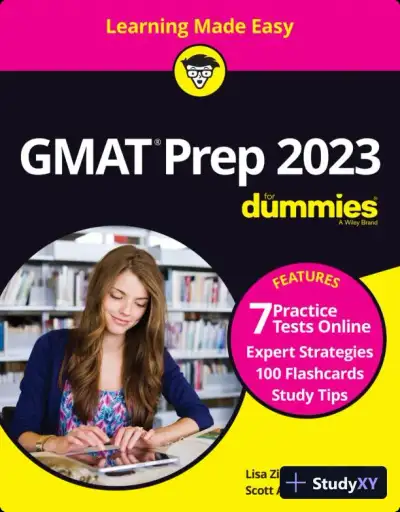 Certification Guides
GMAT Prep 2023 For Dummies With Online Practice (2022)
Graduate Management Admission Test
467 pages96downloadsFeb 2025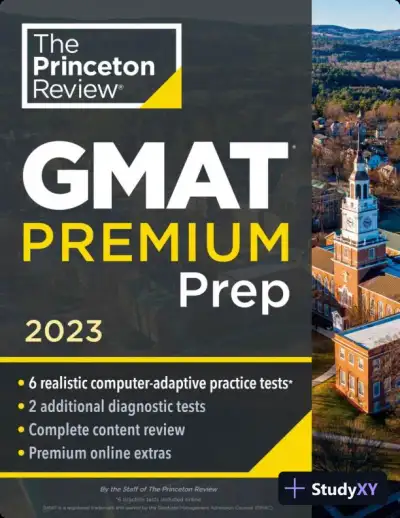 Certification Guides
Princeton Review GMAT Premium Prep, 2023: 6 Computer-Adaptive Practice Tests + Review and Techniques (2022)
Graduate Management Admission Test
1289 pages59downloadsFeb 2025 Certification Guides
All the GMAT, 7th Edition (2019)
Graduate Management Admission Test
791 pagesMay 2025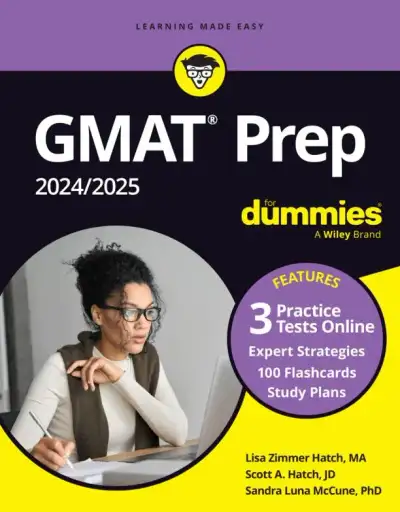 Certification Guides
GMAT Prep 2024/2025 For Dummies with Online Practice (2023)
Graduate Management Admission Test
355 pagesMay 2025
Study this document with CramX
Once it is in your library, every tool can work from it.