

Princeton Review GMAT Premium Prep, 2021: 6 Computer-Adaptive Practice Tests + Review and Techniques (2020)
- Graduate Management Admission Test
- 1089 pages
- Shared February 2025
- 110 downloads
Princeton Review GMAT Premium Prep, 2021: 6 Computer-Adaptive Practice Tests + Review and Techniques (2020) is your shortcut to certification success—start preparing today!
Preview 31 of 1089 pages
See the first 31 pages exactly as they appear in the document.
Page 1 Page 2 Read page 2 as text
Downloaded from StudyXY.com [= Ww + StudyXY oi as . Za \ Rr ' BE \ Stu dy Anything This ContentHas been Posted On StudyXY.com as supplementary learning material. StudyXY does not endrose any university, college or publisher. Allmaterials posted are under the liability of the contributors. | 8) www.studyxy.com
Page 3 Page 4 Read page 4 as text
Editorial Rob Franek, Editor-in-Chief David Soto, Director of Content Development Stephen Koch, Student Survey Manager Deborah Weber, Director of Production Gabriel Berlin, Production Design Manager Selena Coppock, Managing Editor Aaron Riccio, Senior Editor Meave Shelton, Senior Editor Chris Chimera, Editor Eleanor Green, Editor Orion McBean, Editor Brian Saladino, Editor Patricia Murphy, Editorial Assistant Penguin Random House Publishing Team Tom Russell, VP, Publisher Alison Stoltzfus, Publishing Director Amanda Yee, Associate Managing Editor Ellen Reed, Production Manager Suzanne Lee, Designer The Princeton Review 110 East 42nd Street, 7th Floor New York, NY 10017 Email: editorialsupport@review.com Copyright © 2020 by TPR Education IP Holdings, LLC. All rights reserved. Published in the United States by Penguin Random House LLC, New York, and in Canada by Random House of Canada, a division of Penguin Random House Ltd., Toronto. Terms of Service: The Princeton Review Online Companion Tools (“Student Tools”) for retail books are available for only the two most recent editions of that book. Student Tools may be activated only once per eligible book purchased for a total of 24 months of access. Activation of Student Tools more than once per book is in direct violation of these Terms of Service and may result in discontinuation of access to Student Tools Services.
Page 5 Read page 5 as text
ISBN 9780525569367 Ebook ISBN 9780525569756 GMAT is a registered trademark and owned by the Graduate Management Admission Council (GMAC). The material in this book is up-to-date at the time of publication. However, changes may have been instituted by the testing body in the test after this book was published. If there are any important late-breaking developments, changes, or corrections to the materials in this book, we will post that information online in the Student Tools. Register your book and check your Student Tools to see if there are any updates posted there. The Princeton Review is not affiliated with Princeton University. Editor: Eleanor Green Production Artist: Jason Ullmeyer Production Editors: Kathy Carter and Sarah Litt Cover art by brt PHOTO / Alamy Stock Photo Cover design by Suzanne Lee a_prh_5.5.0_c0_r0 + Studyxy
Page 6 Read page 6 as text
Acknowledgments Our GMAT course is much more than clever techniques and powerful computer score reports; the reason our results are great is that our teachers care so much about their students. Thanks to all the teachers who have made the GMAT course so successful, but in particular the core group of teachers and development people who helped get it off the ground: Alicia Ernst, Tom Meltzer, Paul Foglino, John Sheehan, Mark Sawula, Nell Goddin, Teresa Connelly, Phillip Yee, Kimberly Beth Hollingsworth, Bobby Hood, Chris Chimera, Chris Hinkle, Peter Hanink, Cathy Evins, and Doug Scripture. Special thanks to John Fulmer and Kyle Fox for their valuable contributions to the 2021 edition of this book. Special thanks to Adam Robinson, who conceived of and perfected the Joe Bloggs approach to standardized tests and many of the other successful techniques used by The Princeton Review. We are also, as always, very appreciative of the time and attention given to each page by Jason Ulimeyer, Kathy Carter, and Sarah Litt.
Page 7 Read page 7 as text
Contents Cover Title Page Copyright Acknowledgments Get More (Free) Content Part I: Orientation 1 Introduction 2 How to Think About the GMAT 3 Cracking the Adaptive Sections: Basic Principles 4 Cracking the Adaptive Sections: Intermediate Principles 5 Cracking the Adaptive Sections: Advanced Principles 6 Taking the GMAT Part II: How to Crack the Quantitative GMAT 7 GMAT Math: Basic Principles 8 POE and GMAT Math 9 Data Sufficiency: Basic Principles 10 Arithmetic 11 Algebra 12 Plugging in 13 Applied Arithmetic 14 Geometry 15 Number Theory 16 Advanced Data Sufficiency 17 Hard math
Page 8 Read page 8 as text
Part lll: How to Crack the Verbal GMAT 18 Grammar Review 19 Sentence Correction 20 Reading Comprehension 21 Critical Reasoning Part IV: How to Crack the Integrated Reasoning GMAT 22 Integrated Reasoning: Basics 23 Integrated Reasoning: Strategies 24 Integrated Reasoning: Drills Part V: How to Crack the Analytical Writing Assessment 25 Analytical Writing Assessment Part VI: Answer Key to Drills Part VII: The Princeton Review GMAT Math and Verbal Warm-Up Test and Explanations 26 GMAT Math and Verbal Warm-Up Test 27 GMAT Math and Verbal Warm-Up Test: Answers and Explanations Part VIII: The Princeton Review GMAT Math and Verbal Practice Bins and Explanations 28 GMAT Math and Verbal Practice Bins 29 GMAT Math and Verbal Practice Bins: Answers and Explanations
Page 9 Read page 9 as text
1 Go to PrincetonReview.com/prep and enter the following ISBN for your book: 9780525569756 2 Answer a few simple questions to set up an exclusive Princeton Review account. (If you already have one, you can just log in.)
Page 10 Read page 10 as text
3 Enjoy access to your FREE content! Need to report a potential content issue? Contact EditorialSupport@review.com and include: o full title of the book
Page 11 Read page 11 as text
* ISBN * page number Need to report a technical issue? Contact TPRStudentTech@review.com and provide: o your full name + email address used to register the book o full book title and ISBN e Operating system (Mac/PC) and browser (Firefox, Safari, etc.) Once you've registered, you can... * Take 6 full-length practice GMAT exams * Download additional practice material excerpted from 3 other Princeton Review GMAT titles * Plan your review sessions with study guides based on your schedule—4 weeks, 8 weeks, 12 weeks * Watch short video tutorials in which top-notch Princeton Review teachers discuss GMAT question types and strategies, working through problems step by step * Research admissions rates and average test scores for dozens of popular business schools * Access the Business School Insider, our guide to financial aid, admissions, writing winning application essays, MBA job prospects, and more
Page 12 Read page 12 as text
« Check to see if there have been any corrections or updates to this edition * Get our take on any recent or pending updates to the GMAT Book PREMIUM PORTAL ONLINE VIDEO TUTORIALS ONLINE ARTICLES ONLINE PRACTICE DRILLS ONLINE PRACTICE TESTS PROVEN TECHNIQUES APPLIED STRATEGIES TIME-SAVING TIP
Page 13 Read page 13 as text
OTHER REFERENCES WATCH OUT
Page 14 Read page 14 as text
Part Orientation 1 Introduction 2 How to Think About the GMAT 3 Cracking the Adaptive Sections: Basic Principles 4 Cracking the Adaptive Sections: Intermediate Principles 5 Cracking the Adaptive Sections: Advanced Principles 6 Taking the GMAT
Page 15 Read page 15 as text
Chapter 1 Introduction Congratulations on your decision to attend business school, and welcome to GMAT Premium Prep, 2021 Edition! Preparing for the GMAT is an important part of the process, so let’s get started. This chapter will provide you with a strategic plan for acing the GMAT, as well as an overview of the test itself, including question formats and information on how the test is scored.
Page 16 Read page 16 as text
HOW TO USE THIS BOOK: A STRATEGIC PLAN FOR ACING THE GMAT 1. Learn the Famed Princeton Review Test-Taking Strategies In the next few chapters, you'll find the strategies that have given our GMAT students the edge for the past 20 years. Go to your Student Tools to download our study plans—tailored for 4, 8, and 12 weeks of available prep time! See this page for instructions. 2. Learn the Specific Math and Verbal Skills You’ll Need Our courses include an extremely thorough review of the math and verbal skills our students need to ace the GMAT, and this book will give you that same review. 3. Practice Each Type of Question—at the Difficulty Level You Need to Master Two of the GMAT’s sections, the Quantitative and Verbal sections, are computer adaptive. These sections quickly hone in on your ability level and then mostly give you questions at or just above that level. It makes sense for you to practice on the level of problem you will actually see during the test. GMAT Premium Prep is the only book out there with practice questions grouped by difficulty. Page after page of practice questions are arranged at the back of this book in difficulty “bins”— just like the questions on the real GMAT—so that you can concentrate on the question level you will have to answer on the actual test in order
Page 17 Read page 17 as text
to get the score you need. The Integrated Reasoning section of the GMAT is not computer adaptive. We've provided two complete Integrated Reasoning sections at the back of this book to help you prepare for this section of the test. To register for the GMAT: 800-717-GMAT To reach GMAC Customer Service: 866-505-6559 or 703-668-9605 4. Periodically Take Simulated GMATSs to Measure Your Progress As you work through the book, you'll want to take our online practice tests to see how you're doing. These tests closely mimic the GMAT so you can become familiar with the test’s content and structure. Our tests include adaptive sections for the Quantitative and Verbal sections and a non-adaptive section for the Integrated Reasoning section. Our practice tests can be found at PrincetonReview.com. In addition, we actively encourage students to use The Official Guide for GMAT Review, which is published by the Graduate Management Admission Council (GMAC). It contains actual test questions from previous administrations of the GMAT. You should also take at least one of the real practice tests available through the GMAT website, www.mba.com. your tests. Please refer to the “Get More (Free) Content” on this page to learn how to do just that.
Page 18 Read page 18 as text
5. Hone Your Skills Using the detailed score reports from your practice exams, you'll be able to zero in on problem areas and quickly achieve mastery through additional practice. And as your score rises on the adaptive sections, this book is ready with more difficult question bins to keep you on track for the score you need. You can use the two practice Integrated Reasoning sections in this book to help you prepare for your practice tests and your real GMAT. 6. Keep Track of the Application Process Throughout the book, you will find informative sidebars explaining how and when to register for the test, how and when to apply to business school, the advantages and disadvantages of applying early, and much more. Plus, at PrincetonReview.com, you'll be able to take advantage of our powerful web-based tools to match yourself with schools that meet your needs and preferences. To register for the GMAT: www.mba.com WHAT IS THE GRADUATE MANAGEMENT ADMISSION TEST? The Graduate Management Admission Test (GMAT) is a standardized test used by business schools as a tool to decide whom they are going to let into their MBA programs. Where Does the GMAT Come From? The GMAT is published and administered by the Graduate Management Admission Council (GMAC). GMAC is a private company. We'll tell you more about them later on in this book.
Page 19 Read page 19 as text
Check out our survey-driven guide, The Best 294 Business Schools, for profiles of the nation’s top b- schools. What Does the Test Look Like? The GMAT is offered only on computer. The 3.5-hour test is administered at a secure computer terminal at an approved testing center. You enter your multiple-choice answers on the screen with a mouse; you must compose your essay for the Writing Assessment section on the computer as well. 1. One 30-minute essay to be written on the computer with a generic word-processing program 2. One 30-minute, 12-question, multiple-choice Integrated Reasoning section. Some Integrated Reasoning questions can have multiple parts. (optional break) 3. A 62-minute, 31-question multiple-choice Quantitative section (optional break) 4. A 65-minute, 36-question multiple-choice Verbal section On average, this would give you two minutes for each quantitative question and a little less than two minutes for each verbal question—
Page 20 Read page 20 as text
but you will find that our Princeton Review strategies will slightly revise these times. You must answer a question in order to get to the next question—which means that you can’t skip a question and come back to it. And while you are not required to finish any of the sections, your score will be adjusted downward to reflect questions you did not complete. On each of the Quantitative and Verbal sections, approximately one- quarter of the questions you encounter will be experimental and will not count toward your score. These questions, which will be mixed in among the regular questions, are there so the test company can try out new questions for future tests. We'll have much more to say about the experimental questions later. But Wait, There’s More One of the first options you'll encounter when taking the GMAT is the option to choose from one of three possible orders for the exam sections. You pick your preferred section order on the day of the test. Here are the possible section orders: How Do You Know What Order to Pick? The answer to that depends on your goals for the test and your level of comfort with the different sections. Are you looking to get a high Quantitative score, but you don’t care so much about the Verbal? Has your school told you they never consider the essay and Integrated
Page 21 Read page 21 as text
Reasoning section? Are you good at Verbal but not so good at Quantitative? The answer to these questions and other questions like them help to inform your section order choice. How Does This Impact Your Studying? We recommend that you take your first two tests using the classic order. A major goal of your first practice test is to simply get acquainted with the sections, question types, content, and timing of the GMAT. A major goal of your second practice test is to start putting into use some of the basic approaches for important question types. Taking your first two tests using the classic section order provides a baseline score. Having established a baseline score, you can then try out different section orders for the remaining tests. Compare the results of the tests with different section orders to the results of the tests with the classic section order and see if there are any improvements. In addition to looking for score improvements, you should also pay attention to a handful of other factors about your preferences in test taking. For instance, do you like to ease into a test or hit the ground running? If you like to ease into a test, you may want to stick with the classic section order. While all parts of your GMAT score are important, most schools do attach less importance to your AWA (Analytical Writing Assessment) and Integrated Reasoning scores than your Quantitative and Verbal scores. Remember, as well, that only the Quantitative and Verbal scores are used in calculating the overall score. So, if you like to ease into a test, the AWA and Integrated Reasoning can provide that way to ease in. Do you like to do the section you're most worried about first? Some test-takers like to get the section that they are most worried about out of the way. If that’s you, you'll probably want to pick either the Verbal
Page 22 Read page 22 as text
First or Quantitative First orders, depending on which section you are most worried about! Are you worried about fatigue? Most test-takers find the GMAT both fast-paced and tiring. Fatigue can be a very real issue. If you are worried about fatigue, you probably want to do either the Verbal First or Quantitative First orders as they place the two least consequential sections at the end of the test. What Information Is Tested on the GMAT? You will find several different types of multiple-choice questions on the GMAT. Quantitative (31 questions total) ¢ Problem Solving—approximately 16 questions » Data Sufficiency (a strange type of problem that exists on no other test in the world)—approximately 15 questions Verbal (36 questions total) » Reading Comprehension (tests your ability to answer questions about a passage)—approximately 12 questions » Sentence Correction (a grammar-related question type)—approximately 14 questions « Critical Reasoning (a logic-based question type recycled from the LSAT)—approximately 10 questions Integrated Reasoning (12 questions total) » Table Analysis—data is presented in a sortable table (like an Excel spreadsheet); each question usually
Page 23 Read page 23 as text
has three parts. o Graphics Interpretation—a chart or graph is used to display data; each question usually has two parts; answers are selected from drop-down boxes. o Multi-Source Reasoning—information (a combination of charts, text, and tables) is presented on two or three tabs; each set of tabbed information is usually accompanied by three questions. o Two-Part Analysis—each question usually has five or six options of which you need to pick two. How Is the GMAT Scored? As soon as you've finished taking the GMAT, your computer will calculate and display your unofficial results, not including your Writing Assessment score. You can print a copy of your unofficial results to take with you. Within 20 days, you will receive your score report online; a written report will be available only by request. Most people think of the GMAT score as a single number, but in fact there are five separate numbers: 1. Quantitative score (reported on a scale that runs from 6 to 51 in one-point increments) 2. Verbal score (reported on a scale that runs from 6 to 51 in one- point increments) 3. Total score (reported on a scale that runs from 200 to 800 and based only on the results of Quantitative and Verbal sections) 4. Analytic Writing Assessment score (reported on a scale of 0 to 6, in half-point increments; 6 is the highest score) 5. Integrated Reasoning score (reported on a scale from 1 to 8 in one- point increments)
Page 24 Read page 24 as text
The report will look something like this: Scores in the Quantitative and Verbal sections of the test are based on three factors: the number of questions you answer, whether you answered the question correctly, and the parameters of the question (such as difficulty). Your score improves if you answer more questions, answer them correctly, and answer them at a higher level of difficulty. Scores below 6 or above 51 are exceedingly rare. Get The Princeton Review's definitive list of admissions rates and average test scores for dozens of top business schools. Visit your Student Tools for more info. Many business schools tend to focus on the total score, which means that you may make up for weakness in one area by being strong in another. For example, if your quantitative skills are better than your verbal skills, they'll help pull up your total score—although some of the more selective schools say they prefer to see math and verbal sub- scores that are balanced. According to GMAC, two-thirds of test-takers receive a total score between 400 and 600. Total scores go up or down in ten-point increments. In other words, you might receive 490 or 500 on the GMAT, but never 494 or 495. The Integrated Reasoning section is scored from 1 to 8 in one-point increments. Questions have multiple parts, and you must answer each part correctly to get credit for the question. The Integrated Reasoning
Page 25 Read page 25 as text
score is not included in the Overall score. The score on the Analytical Writing Assessment section is based on the submission of one Analysis of an Argument essay. The essay is scored independently twice, and the average of the scores is taken. One of the scorers for the essay may be an automated essay-scoring engine. You will also see a percentile ranking next to each score. For example, if you see a percentile of 72 next to your Verbal score, it means that 72 percent of the people who took this test scored lower than you did on the Verbal section. WHAT IS THE PRINCETON REVIEW? The Princeton Review is a test-preparation company founded in New York City. It has branches in more than 50 cities across the country, as well as abroad. The Princeton Review’s techniques are unique and powerful, and they were developed after a study of thousands of real GMAT questions. They work because they are based on the same principles that are used in writing the actual test. The Princeton Review's techniques for beating the GMAT will help you improve your scores by teaching you to: o think like the test-writers eo take full advantage of the computer-adaptive algorithms upon which the GMAT is based » find the answers to questions you don’t understand by using Process of Elimination o avoid the traps that test-writers have set for you (and use those traps to your advantage) A Warning Many of our techniques for beating the GMAT may be very different from the way that you would naturally approach problems. Some methods may even seem counterintuitive. Rest assured, however, that
Page 26 Read page 26 as text
many test-takers have used our methods to get great GMAT scores. To get the full benefit of our techniques, you must trust them. The only way to develop this trust is to practice the techniques and persuade yourself that they work. Practice with Real Questions One reason coaching books do not use real GMAT questions is that GMAC won't let them. So far, the council has refused to let anyone (including us) license actual questions from old tests. As we mentioned above, the council has its own review book, The Official Guide for GMAT Review, which we heartily recommend that you purchase. GMAC also puts out preparation software called GMATPrep, which can be downloaded for free from www.mba.com. This software includes two computer-adaptive tests plus additional practice sets, all of which feature real GMAT questions. By practicing our techniques on real GMAT items, you will be able to prove to yourself that the techniques work and increase your confidence when you actually take the test. And, remember, by using The Princeton Review’s practice questions grouped by level of difficulty at the back of this book, you'll be able to concentrate on types of questions you are actually likely to see. Additional Resources In addition to the material in this book, we offer a number of other resources to aid you during your GMAT preparation. Register your book at PrincetonReview.com to gain access to your Student Tools, the companion website to this book. There you will find 6 full-length GMAT exams, assorted videos that demonstrate step-by- step approaches to GMAT question types and strategy, extra drills and practice, and tons of useful articles, essays, and information.
Page 27 Read page 27 as text
Premium Student Tools To gain access, follow the instructions on this page. + StudyXY
Page 28 Read page 28 as text
Summary o By using a combination of The Princeton Review's Integrated Reasoning introduction, math and verbal reviews, the practice questions contained in this book, and periodic simulated tests, you will be able to improve your score on the GMAT. o The test itself is taken on computer. It consists of the following:
Page 29 Page 30 Read page 30 as text
Chapter 2 How to Think About the GMAT If you think the GMAT tests your business knowledge or shows how smart you are, you're in for a surprise. This chapter will give you a new way to look at the GMAT to guide your studies in the right direction.
Page 31 Read page 31 as text
How Do You Think About Standardized Tests? If you're like most people, you think standardized tests measure how smart you are. If you score 800 on the GMAT, you may think of yourself as a genius (and the future manager of a corporate empire). If you score 200, you may think of yourself as an idiot (and the future manager of...well...nothing). You may think that the GMAT measures your verbal and math abilities. At the very least, you probably believe the GMAT is an accurate predictor of how you'll do in business school. What Does the GMAT Measure? The GMAT is not a test of how smart you are. Nor is it a test of your business acumen or even a predictor of your grades in business school. It’s simply a test of how good you are at taking the GMAT. In fact, you will learn that by studying the very specific knowledge outlined in this book, you can substantially improve your score. The GMAT as a Job Interview The first axiom of any how-to book on job interviewing is that you must always tell your interviewer what he or she wants to hear. No matter whether this is good job-hunting advice, it happens to be a very useful strategy on the GMAT. The test-writers think in predictable ways. You can improve your score by learning to think the way they do and anticipating the kinds of answers that they think are correct. How Closely Does The Princeton Review Monitor the GMAT? Very closely. Each year, we publish a new edition of this book to reflect the subtle shifts that happen over time, or, in the case of the introduction of the Integrated Reasoning section, the major changes to the GMAT. For the latest information on the GMAT, please visit our website PrincetonReview.com, Is This Book Just Like The Princeton Review Course? No. You won't have the benefit of taking 10 computer-adaptive GMATSs
1058 more pages in the full document
Unlock it once and it stays in your library, ready to chat with or turn into flashcards.
Unlock the full documentMore Graduate Management Admission Test study materials
See all Certification Guides
GMAT For Dummies 2020: Book + 7 Practice Tests (2020)
Graduate Management Admission Test
714 pages131downloadsFeb 2025 Certification Guides
Princeton Review GMAT Focus Premium Prep : 3 Full-Length CAT Practice Exams + 2 Diagnostic Tests + Complete Content Review (2024)
Graduate Management Admission Test
926 pages108downloadsFeb 2025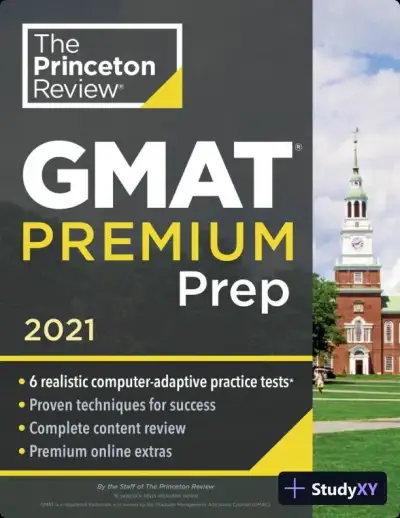 Certification Guides
GMAT For Dummies 2021 (2021)
Graduate Management Admission Test
1089 pages102downloadsFeb 2025 Certification Guides
Princeton Review GMAT Premium Prep, 2024: 6 Computer-Adaptive Practice Tests + Online Question Bank (2023)
Graduate Management Admission Test
1185 pages100downloadsFeb 2025 Certification Guides
GMAT Prep 2023 For Dummies With Online Practice (2022)
Graduate Management Admission Test
467 pages96downloadsFeb 2025 Certification Guides
Princeton Review GMAT Premium Prep, 2023: 6 Computer-Adaptive Practice Tests + Review and Techniques (2022)
Graduate Management Admission Test
1289 pages59downloadsFeb 2025 Certification Guides
All the GMAT, 7th Edition (2019)
Graduate Management Admission Test
791 pagesMay 2025 Certification Guides
GMAT Prep 2024/2025 For Dummies with Online Practice (2023)
Graduate Management Admission Test
355 pagesMay 2025
Study this document with CramX
Once it is in your library, every tool can work from it.