

Revision Notes for Intermediate Algebra, 13th Edition
- Mathematics
- 90 pages
- Shared May 2025
Revision Notes for Intermediate Algebra, 13th Edition simplifies your revision process with clear and concise notes designed to highlight key concepts.
Preview 16 of 90 pages
See the first 16 pages exactly as they appear in the document.
Page 1 Read page 1 as text
I NSTRUCTOR ’ S R ESOURCE M ANUAL D AVID A TWOOD Rochester Community and Technical College I NTERMEDIATE A LGEBRA T HIRTEENTH E DITION Margaret L. Lial American River College John Hornsby University of New Orleans Terry McGinnis LECTURE NOTES
Page 2 Page 3 Read page 3 as text
Contents____________________________ iii __________________________________ Mini-Lectures by Section ………………………………………………….......................3 Mini-Lecture Graph Answers …………………………………………..………77
Page 4 Page 5 Read page 5 as text
M INI -L ECTURES
Page 6 Page 7 Read page 7 as text
Mini-Lecture R.1 3 INTERMEDIATE ALGEBRA Fractions, Decimals, and Percents Learning Objectives: 1. Write fractions in lowest terms. 2. Convert between improper fractions and mixed numbers. 3. Perform operations with fractions. 4. Write decimals as fractions. 5. Perform operations with decimals. 6. Write fractions as decimals. 7. Write percents as decimals and decimals as percents. 8. Writer percents as fractions and fractions as percents. Examples: 2. Simplify each fraction. a) 5 10 b) 16 64 c) 42 77 d) 88 90 3. Change each improper fraction to a mixed number or a whole number, or change each mixed number to an improper fraction. a) 8 5 b) 34 4 c) 3 2 4 d) 2 6 9 4. Find each product and write in lowest terms. a) 5 3 9 15 b) 5 9 6 2 c) 4 18 9 d) 1 1 3 1 2 4 5. Find each quotient and write in lowest terms. a) 5 3 9 15 b) 5 9 6 2 c) 5 36 24 24 d) 5 3 8 3 4 6. Find each sum or difference and write in lowest terms. a) 3 4 14 14 b) 2 1 3 3 c) 2 1 4 8 d) 5 7 6 8 e) 7 9 12 30 f) 2 2 1 3 24 6 g) 3 1 8 1 10 10 h) 3 1 12 10 8 4 7. Write the following decimal numbers as fractions. Do not write in lowest terms. a) 0.42 b) 1.285 c) 0.9375 8. Add or subtract as indicated.. a) 5 0.586 b) 45.3 33.306 c) 4.1 1.03 2.12 9. Multiply or divide as indicated. a) 5.864 3.2 b) 1687.14 23.4 c) 7.86375 2.25 d) 57.4 1000 10. Write each fraction as a decimal. a) 24 5 b) 7 9 c) 3 8
Page 8 Read page 8 as text
INTERMEDIATE ALGEBRA 4 Mini-Lecture R.1 11. Write each percent as a decimal. a) 53% b) 255% c) 3 4 % 4 12. Write each decimal as a percent. a) 0.428 b) 3.21 c) 0.305 13. Write each percent as a fraction. Give answers in lowest terms. a) 7% b) 185% c) 12.4% 14. Write each fraction as a percent. a) 3 5 b) 1 3 c) 9 2 Teaching Notes: Encourage students to simplify fractions by dividing numerator and denominator by the same number and by factoring into primes and dividing out common factors. Some students try to multiply/divide whole number parts together, and then multiply/divide fractional parts together when working with mixed numbers. Some students add/subtract the denominators when adding/subtracting fractions. Many students are confused by percents that are less than 1%. It may be helpful to have the students distinguish between 0.2 and 0.2%. Many students are confused by percents that are greater than 100%. It may be helpful to show that 100% =1 Mention to students that another way to convert a fraction to a percent is to first convert the fraction to a decimal and then convert the decimal to a percent. Answers: 1a) prime, b) composite, 5 13 , c) prime, d) composite, 2 2 2 3 3 3 ; 2a) 1 2 , b) 1 4 , c) 6 11 , d) 44 45 ; 3a) 3 5 1 , b) 1 2 8 , c) 11 4 , d) 56 9 ; 4a) 1 9 , b) 15 4 or 3 4 3 , c) 8, d) 35 8 or 3 8 4 ; 5a) 25 9 or 7 9 2 , b) 5 27 , c) 5 36 , d) 4 21 ; 6a) 1 2 , b) 1 3 , c) 5 8 , d) 41 24 or 17 24 1 , e) 53 60 , f) 11 12 , g) 2 5 9 , h) 1 8 2 ;7a) 42 100 , b) 1285 1000 , c) 9375 10, 000 ; 8a) 4.414, b) 11.994, c) 5.19, 9a) 1.8325, b) 72.1, c)3.495, d) 0.0574; 10a) 4.8, b) 0.7 , c) 0.375; 11a) 0.53, b) 2.55, c) 0.475; 12a) 42.8%, b) 321%, c) 30.5%; 13a) 7 100 , b) 17 1 20 , c) 31 250 , 14a) 60%, b) 33.3% , c) 450%
Page 9 Read page 9 as text
Mini-Lecture R.2 5 INTERMEDIATE ALGEBRA Basic Concepts from Algebra Learning Objectives: 1. Write sets using set notation. 2. Use number lines. 3. Classify numbers 4. Find additive inverses. 5. Use absolute value. 6. Use inequality symbols. Examples: 1. List all numbers from the set 3 10, 5, 2 , 0, 5, 10 4 that are: a) natural numbers b) whole numbers c) integers d) rational numbers e) irrational numbers f) real numbers 2. Graph each of the numbers on a number line: 1 1 5, 5, 4 , 1 , 3 2 . 3. Select the lesser number in each pair. a) –3, 8 b) 4 1 , 5 3 c) 10, –12 4. For each number, find the additive inverse. a) 6 b) –5 c) 2.7 5. Simplify. a) 3 b) 6 c) 13 16 6. Decide whether the statement is true or false. a) 5 11 b) 3 5 c) 7 1 7. Write the following in interval notation and graph the interval. a) | 5 x x b) | 8 x x c) | 1 3 x x Teaching Notes: Many students need to be reminded of set notation. Remind students that integers are rational numbers; any integer can be written as the ratio of itself and 1. Decimal numbers that terminate or repeat in a fixed block are examples of rational numbers; ask students to give examples of both. The decimal form of an irrational number neither terminates nor repeats. The number line is a good way to illustrate opposite numbers/additive inverses Answers: 1a) 10, b) 0, 10, c) –10, –5, 0, 10, d) –10, –5, 3 2 4 , 0, 10, e) 5 , f) –10, –5, 3 2 4 , 0, 5 , 10; 2) ; 3a) –3, b) 4 5 , c) –12; 4a) –6, b) 5, c) –2.7; 5a) 3, b) –6, c) 3; 6a) true, b) true, c) false; 7a) ,5 b) 8, c) 1,3
Page 10 Read page 10 as text
INTERMEDIATE ALGEBRA 6 Mini-Lecture R.3 Operations on Real Numbers Learning Objectives: 1. Add real numbers. 2. Subtract real numbers. 3. Find the distance between two points on a number line. 4. Multiply real numbers. 5. Find reciprocals and divide real numbers. Examples: 1. Perform the operations indicated. a) –5 + (–3) b) 5 + 3 c) 5 + (–3) d) –5 + 3 e) 3 – 5 f) 3 – (–5) g) –3 – 5 h) –3 – (–5) i) (3)(5) j) (–3)(–5) k) (–3)(5) l) (3)(–5) 2. Find the distance between each pair of points. a) 7 and 6 b) 3 and 9 3. Give the reciprocal of each number. a) 12 b) 5 6 c) 1 2 d) 0 4. Find each quotient. a) 8 4 b) –8 –4 c) –8 4 d) 8 –4 5. Perform each of the following operations, if possible. a) |–2.1 + (–7.3)| b) 3 15 5 20 c) – 2 12 + 3 24 d) |5.4 – 9.2| e) 0 –4 f) 3.2 0 g) 1 1 2 2 h) 4.2 4.2 8.4 i) 13.32 + 9.75 – 5.21 j) 3 8 4 - Teaching Notes: Refer students to the charts for Adding , Subtracting , Multiplying , and Dividing Real Numbers . Many students find working with fractions difficult. It may be useful to review finding the least common denominator. Remind students that only nonzero numbers have inverses. The fraction is undefined when zero is “underneath”. Answers: 1a) –8, b) 8, c) 2, d) –2, e) –2, f) 8, g) –8, h) 2, i) 15, j) 15, k) –15, l) –15; 2a) 13 , b) 6; 3a) 1/12, b) 6/5, c) –2, d) zero does not have a reciprocal, or multiplicative inverse; 4a) 2, b) 2, c) –2, d) –2; 5a) 9.4, b) –4/5, c) –1/24, d) 3.8, e) 0, f) undefined, g) 0, h) 1, i) 17.86, j) –3/32
Page 11 Read page 11 as text
Mini–Lecture R.4 7 INTERMEDIATE ALGEBRA Exponents, Roots, and Order of Operations Learning Objectives: 1. Use exponents. 2. Find square roots. 3. Use the order of operations. 4. Evaluate algebraic expressions for given values of variables. Examples: 1. Write in exponential form. a) (4)(4)(4)(4)(4) b) (–2)(–2)(–2)(–2) c) x x x y y 2. Evaluate. a) 2 5 b) 3 2 c) 4 3 d) (–5) 2 e) –5 2 f) (–2) 3 g) –2 3 h) (–3) 4 i) 2 1 2 j) (–1.2) 3 3. Find each square root, if it exists. a) 4 b) 4 c) 4 d) 25 e) 0.25 f) 49 36 g) 30 6 h) 1 3 16 16 4. Simplify using the order of operations. a) 5(2 4) 6 b) 2 7 3(2 4) c) 3 (9 6 1) 4 9 d) ( 9)( 36) ( 2)( 9) e) 2 3 ( 5) 8 3 4(6 5) f) 2 2 6 9 3 6 5. Evaluate each expression for the values given. a) 2 5 ; 3 x x x b) 2 4 2 ; 2, 4 y x x y Teaching Notes: In 1b) some students answer –2 4 instead of (–2) 4 . Many students think these are equal. Many students do not understand that the square root symbol indicates a principal square root, which is never negative. Order of Operations – introduce PEMDAS or Please Excuse My Dear Aunt Sally. Answers: 1a) 4 5 , b) (–2) 4 , c) x 3 y 2 ; 2a) 25, b) 8, c) 81, d) 25, e) –25, f) –8, g) –8, h) 81, i) ¼, j) –1.728; 3a) 2, b) –2, c) DNE, d) DNE, e) 0.5, f) –7/6, g) 6, h) –1/2; 4a) –4, b) –43, c) –7, d) –72, e) 13, f) –1/3; 5a) –6, b) 0
Page 12 Read page 12 as text
INTERMEDIATE ALGEBRA 8 Mini-Lecture R.5 Properties of Real Numbers Learning Objectives: 1. Use the distributive property. 2. Use the identity properties. 3. Use the inverse properties. 4. Use the commutative and associative properties. Examples: 1. Name the property that justifies each statement. a) (–5) + 3 = 3 + (–5) b) (5 + 2) + 4 = 5 + (2 + 4) c) 1 3 1 3 d) 7 + (–7) = 0 e) 4(5 + 2) = 4 5 + 4 2 f) 3 3 1 5 5 g) 6.3 + 0 = 6.3 h) 5 (4 2) ( 5 4) 2 i) 4 3 = 3 4 2. Simplify. a) 4 5 x x b) 1 12 y y c) 3 9 12 x x d) 2.5 8.6 3.4 12.3 y y e) 3 6 9 y f) 2 5 4 k k g) 7.3 8.1 2 3.2 0.4 b b h) 1 1 12 4 30 2 6 x x y i) 9 3 6 t t Teaching Notes: Remind students that the commutative property deals with the order of the operands, while, the associative property deals with the grouping of the operands. Discuss difference between the identity properties and the inverse properties. Remind students that when we use the identity property the result is identical to the quantity we begin with. Remind students that parentheses do not always imply that the distributive property is to be used (e.g., 3 5 6 90 a b ab , not 3 5 3 6 a a b ). Answers: 1a) commutative property of addition, b) associative property of addition, c) inverse property of multiplication, d) inverse property of addition, e) distributive property of multiplication with respect to addition, f) identity property of multiplication, g) identity property of addition, h) associative property of multiplication, i) commutative property of multiplication; 2a) 9x , b) 1 11y , c) 9x 9 , d) . . 5 9 y 20 9 , e) 18 y 27 , f) 3k 4 , g) . . 0 9b 8 9 , h) 1 x y 2 6 , i) 4t 15
Page 13 Read page 13 as text
Mini-Lecture 1.1 9 INTERMEDIATE ALGEBRA Linear Equations in One Variable Learning Objectives : 1. Distinguish between expressions and equations. 2. Identify linear equations. 3. Solve linear equations using the addition and multiplication properties of equality. 4. Solve linear equations using the distributive property. 5. Solve linear equations with fractions or decimals. 6. Identify conditional equations, contradictions, and identities. Examples : 1. Decide whether each of the following is an expression or an equation. a) 4 1 x b) 4 1 0 x c) 2 3 4 2 5 x x d) 2 3 4 2 5 x x 2. Determine whether the given value is a solution to the equation. a) Is x = 3 a solution to 4 2 18 x ? Why or why not? b) Is x = 12 a solution to 5 10 6 x ? Why or why not? 3. Solve. Check your solutions. a) 12 2 x b) 13 35 x c) 5 45 x d) 5 70 x e) 10 5 17 x f) 6 3 2 9 x x g) 14 10 8 5 x x h) 6 2 5 4 12 x x x i) 5 8 2( 1) x x 4. Solve. Check your solutions. a) 1 8 2 x b) 5 10 6 x c) 3 5 3 5 x d) 4 5 3 5 2 x x e) 2 3 ( 2) 1 3 x f) 0.1 0.5 0.4 0.9 x x g) 0.5 0.2 0.3 0.8 x x h) 0.4(3 1) 1 x i) 0.4( 3) 2 0.4 x x 5. Classify each of the following equations as a conditional equation , a contradiction , or an identity . a) 3 2 5 6 2 x x x b) 2 3 7 x c) 5 7 3 9 4 x x x Teaching Notes: Encourage students to check their solutions. Encourage students to simplify each side of the equation as a first step. Some students prefer to always end with the variable on the left, while others prefer to arrive at a positive coefficient of the variable. Some students try to subtract the coefficient from the variable instead of eliminating it by dividing. Answers: 1a) expression, b) equation, c) equation, d) expression; 2a) no because 4 3+2 18, b) yes because (5/6) 12=10; 3a) {10}, b) {–48},c) {9}, d) {–14}, e) {6/5}, f) {–3}, g) {–2}, h) {2}, i) {5}; 4a) {16}, b) {–12}, c){– 66/5}, d) {25/22}, e) {1}, f) { . 4 6 }, g) {5}, h) {0.5}, i) ; 5a) identity, b) conditional equation, c) contradiction
Page 14 Read page 14 as text
INTERMEDIATE ALGEBRA 10 Mini-Lecture 1.2 Formulas and Percent Learning Objectives: 1. Solve a formula for a specified variable. 2. Solve applied problems using formulas. 3. Solve percent problems. 4. Solve problems involving percent increase or decrease. 5. Solve problems from the health care industry. Examples: 1. Solve each formula for the specified variable. a) 6 3 5 x y ; for y b) 2 3 3 y x ; for x c) V lwh ; for h d) ( ) 2 h A B b ; for b e) 2 A rh ; for r f) 3(4 ) 3 ax y ax y ; for x 2. Solve as indicated. a) Solve 9 32 5 F C for C ; then evaluate for F = 25 . Round to the nearest tenth b) Solve 2 1 3 V r h for h ; then evaluate for V = 5.35, r = 2, 3.14 . Round to the nearest hundredth 3. Application problems. a) 15 is what percent of 90? a) Suppose economists use 0.644 5.822 C D as a model of the country’s economy, where C and D are in billions of dollars. Solve the equation for D , and use this result to determine the disposable income D if the consumption C is $9.44 billion. Round your answer to the nearest tenth of a billion b) Some doctors use the formula ND = 1.1 T to relate N (the number of appointments scheduled in one day), D (the duration of each appointment), and T (the total number of minutes the doctor can use to see patients in one day). Solve the formula for D , and use this result to find the duration of each appointment if the doctor has 6 hours available for appointments and must see 25 patients per day. c) A car salesman earned $6750 in commission on sales of automobiles amounting to $45,000. What is his rate of commission? d) In July, there were 14,150 visitors to the Dunes State Park . In August, there were 9644 visitors. What was the percent increase/decrease in visitors from July to August? Teaching Notes: For questions like number 1, encourage students to underline or circle the specified variable. When calculating a percent increase or decrease, be sure to use the original number as the denominator. Answers: 1a) y=–2x+(5/3), b) x=(–3/2)y+(9/2), c) V h lw , d) 2 A b B h , e) A r 2 h , f) 4 y x 9a ; 2a) C=(5/9)(F–32), C –3.9 , b) 3V h 2 r , h 1.28; 3a) 16.7%, b) . . C 5 822 D 0 644 , D $5.6 billion, c) D=1.1T/N, D=15.84 min, d) 15%, e) 31.8% decrease
Page 15 Read page 15 as text
Mini-Lecture 1.3 11 INTERMEDIATE ALGEBRA Applications of Linear Equations Learning Objectives : 1. Translate from words to mathematical expressions. 2. Write equations from given information. 3. Distinguish between simplifying expressions and solving equations. 4. Use the six steps in solving an applied problem. 5. Solve percent problems. 6. Solve investment problems. 7. Solve mixture problems. Examples: 1. Translate into a mathematical expression, then simplify. a) The sum of three consecutive integers if the first integer is x b) The perimeter of a rectangle with length x and width x – 7 c) The total amount of money (in cents) in x quarters, 5 x dimes, and (3 x – 1) nickels 2. Use the six-step approach to solving applied problems to solve each of the following. a) Geometry The length of a rectangular room is 6 feet longer than twice the width. If the room’s perimeter is 168 feet, what are the room’s dimensions? b) Rental It costs $40 plus $0.25 per mile to rent a truck from U-Rent. How many miles were traveled if the final bill was $48.25? c) Revenue The revenue of Company X quadrupled. Then it increased by $1.6 million. The present revenue is $24.4 million. What was the original revenue? d) Satellite Phone Shaun’s satellite phone provider charges its customers $15 per month plus 30 cents per minute of on-line usage. Shaun received a bill from the provider covering a month period and was charged a total of $52.50. How many minutes did he spend using this phone service that period, to the nearest whole minute? e) Balloon Altitude A hot air balloon spent several minutes ascending. It then stayed at a level altitude for three times as long as it had ascended. It took 5 minutes less to descend than it had to ascend. The entire trip took one hour and 30 minutes. For how long was the balloon at a level altitude? f) Investment Joe invested $12,000 in certificates of deposit paying 4%. How much additional money should he invest in certificates paying 6% so that his total return for the investments will be $792? g) Mixture How much water must be added to 10 quarts of an 8% concentrated detergent to reduce the concentration to 5%? Teaching Notes: Have students create a list of key terms and associated mathematical operations. Some students need to see many of the number problems in order to understand how an English sentence can be represented as an algebraic equation. Encourage students to draw and label diagrams when appropriate. Refer students to the Solving an Applied Problem and the Translating from Words to Mathematical Expressions charts in the textbook. Answers: 1a) , x x 1 x 2 3x 3 , b) 2x 2 x 7 , 4x 14 c) ( ) 25x 10 5x 5 3x 1 , 90x 5 ; 2a) l=58 ft, w=26 ft, b) 33 miles, c) $5.7 million, d) 125 minutes, e) 57 minutes, f) $5200, g) 6 quarts
Page 16 Read page 16 as text
INTERMEDIATE ALGEBRA 12 Mini-Lecture 1.4 Further Applications of Linear Equations Learning Objectives: 1. Solve problems about different denominations of money. 2. Solve problems about uniform motion. 3. Solve problems about angles. 4. Solve problems about consecutive integers. Examples: 1. Mary has a bank in which she has saved only dimes and quarters. She has 17 coins in the bank worth $2.45. How many coins of each type does she have? 2. Angela has 37 coins, consisting of only dimes and quarters, worth $7.45. How many coins of each type does she have? 3. A collection of 70 coins consisting of dimes, quarters, and half-dollars has a value of $17.75. There are three times as many quarters as dimes. Find the number of each kind of coin. 4. Two cars are traveling on opposite directions on a highway. One car is driving 4 miles per hour faster than the other car. After 3 hours the cars are 414 miles apart. Find the speed of both cars. 5. Lori starts jogging at 5 miles per hour. One half hour later, Debbie starts jogging on the same route at 7 miles per hour. How long will it take Debbie to catch Lori? 6. One angle of a triangle measures 4 more degrees than three times the measure of the second angle. The third angle measures 40 . What are the measures of the two unknown angles of the triangle? 7. Two angles are complementary if the sum of their measures is 90º. If the measure of the first angle is x º, and the measure of the second angle is (3 x – 2)º, find the measure of each angle. 8. The sum of three consecutive positive integers is 135. Find the three integers. 9. The sum of three consecutive odd integers is 69. Find the three integers. Teaching Notes: Encourage students to draw and label diagrams when appropriate. Some students need to see several examples of each type of word problem. Refer students to the Solving an Applied Problem chart in the previous section of the text.. Answers: 1) 12 dimes and 5 quarters; 2) 12 dimes and 25 quarters; 3) 15 dimes, 45 quarters, and 10 half-dollars; 4) 67 mph, 71 mph; 5) 1 hour 15 minutes; 6) 34º and 106º; 7) 23º and 67º, 8) 44, 45, 46 , 9) 21, 23, 25
74 more pages in the full document
Unlock it once and it stays in your library, ready to chat with or turn into flashcards.
Unlock the full documentMore Mathematics study materials
See all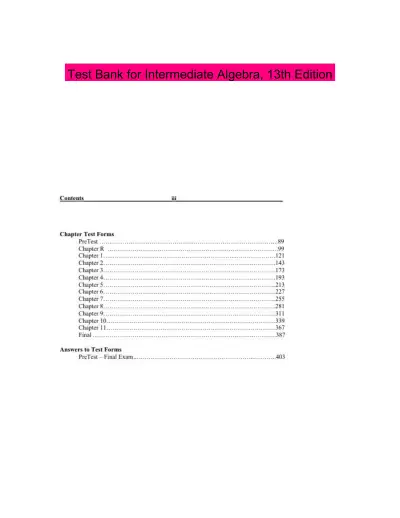 Exam Guides
Test Bank for Intermediate Algebra, 13th Edition
Mathematics
380 pagesMay 2025 Exam Guides
Test Bank for Precalculus, 6th Edition
Mathematics
1051 pages175downloadsFeb 2025 Textbook Guides
Solution Manual For Introduction To Management Science, 11th Edition
Mathematics
437 pages167downloadsFeb 2025 Textbook Guides
Solution Manual For Derivatives Markets, 3rd Edition
Mathematics
358 pages143downloadsFeb 2025 Textbook Guides
Solution Manual for Geometry, 1st Edition
Mathematics
446 pages141downloadsFeb 2025 Textbook Guides
Solution Manual for Beginning Algebra, 7th Edition
Mathematics
479 pages139downloadsFeb 2025 Textbook Guides
Solution Manual for Developmental Mathematics, 1st Edition
Mathematics
1623 pages137downloadsFeb 2025 Textbook Guides
Solution Manual for Elementary and Intermediate Algebra: Graphs and Models, 5th Edition
Mathematics
1278 pages126downloadsFeb 2025
Study this document with CramX
Once it is in your library, every tool can work from it.