

Solution Manual for First Course in Abstract Algebra, A, 8th Edition
- Mathematics
- 221 pages
- Shared May 2025
Solve textbook problems with ease using Solution Manual for First Course in Abstract Algebra, A, 8th Edition, featuring detailed solutions and step-by-step guides.
Preview 16 of 221 pages
See the first 16 pages exactly as they appear in the document.
Page 1 Read page 1 as text
’ S S OLUTIONS M ANUAL J OHN B. F RALEIGH AND N EAL B RAND A F IRST C OURSE IN A BSTRACT A LGEBRA E IGHTH E DITION John B. Fraleigh University of Rhode Island Neal Brand University of North Texas
Page 2 Page 3 Read page 3 as text
CONTENTS 0. Sets and Relations 01 I. Groups and Subgroups 1. Binary Operations 05 2. Groups 08 3. Abelian Examples 14 4. Nonabelian Examples 19 5. Subgroups 22 6. Cyclic Groups 27 7. Generators and Cayley Digraphs 32 II. Structure of Groups 8. Groups of Permutations 34 9. Finitely Generated Abelian Groups 40 10. Cosets and the Theorem of Lagrange 45 11. Plane Isometries 50 III. Homomorphisms and Factor Groups 12. Factor Groups 53 13. Factor Group Computations and Simple Groups 58 14. Group Action on a Set 65 15. Applications of G-Sets to Counting 70 VI. Advanced Group Theory 16. Isomorphism Theorems 73 17. Sylow Theorems 75 18. Series of Groups 80 19. Free Abelian Groups 85 20. Free Groups 88 21. Group Presentations 91
Page 4 Read page 4 as text
V. Rings and Fields 22. Rings and Fields 95 23. Integral Domains 102 24. Fermat’s and Euler’s Theorems 106 25. RSA Encryption 109 VI. Constructing Rings and Fields 26. The Field of Quotients of an Integral Domain 110 27. Rings of Polynomials 112 28. Factorization of Polynomials over a Field 116 29. Algebraic Coding Theory 123 30. Homomorphisms and Factor Rings 125 31. Prime and Maximal Ideals 131 32. Noncommutative Examples 137 VII. Commutative Algebra 33. Vector Spaces 140 34. Unique Factorization Domains 145 35. Euclidean Domains 149 36. Number Theory 154 37. Algebraic Geometry 160 38. Gröbner Bases for Ideals 163 VIII. Extension Fields 39. Introduction to Extension Fields 168 40. Algebraic Extensions 174 41. Geometric Constructions 179 42. Finite Fields 182 IX. Galois Theory 43. Automorphisms of Fields 185 44. Splitting Fields 191 45. Separable Extensions 195 46. Galois Theory 199
Page 5 Read page 5 as text
47. Illustrations of Galois Theory 203 48. Cyclotomic Extensions 211 49. Insolvability of the Quintic 214 APPENDIX: Matrix Algebra 216
Page 6 Page 7 Read page 7 as text
0. Sets and Relations 1 0. Sets and Relations 1. { 3, 3} − 2. {2, –3}. 3. {1, −1, 2, −2, 3, −3, 4, −4, 5, −5, 6, −6, 10, −10, 12, −12, 15, −15, 20, −20, 30, −30, 60, −60} 4. {2, 3, 4, 5, 6, 7, 8} 5. It is not a well-defined set. (Some may argue that no element of + is large, because every element exceeds only a finite number of other elements but is exceeded by an infinite number of other elements. Such people might claim the answer should be ∅ .) 6. ∅ 7. The set is ∅ because 3 3 = 27 and 4 3 = 64. 8. { 2 n a r r ∈ = for some a a + ∈ and some integer n ≥ 0}. 9. It is not a well-defined set. 10. The set containing all numbers that are (positive, negative, or zero) integer multiples of 1, 1/2, or 1/3. 11. {( a , 1), ( a , 2), ( a , c ), ( b , 1), ( b , 2), ( b , c ), ( c , 1), ( c , 2), ( c , c )} 12. a. This is a function which is both one-to-one and onto B. b. This not a subset of A × B , and therefore not a function. c. It is not a function because there are two pairs with first member 1. d. This is a function which is neither one-to-one (6 appears twice in the second coordinate) nor onto B ( 4 is not in the second coordinate). e. It is a function. It is not one-to-one because there are two pairs with second member 6. It is not onto B because there is no pair with second member 2. f. This is not a function mapping A into B since 3 is not in the first coordinate of any ordered pair. 13. Draw the line through P and x , and let y be its point of intersection with the line segment CD . 14. a. [ ] [ ] ( ) : 0,1 0, 2 where 2 x x φ φ → = b. [ ] [ ] ( ) : 1, 3 5, 25 wher 2 3 e x x φ φ = + → c. [ ] [ ] ( ) ( ) : , , where d c a b c d x c x a b a φ φ − → = + − − 15. Let ( ) 1 2 : be defined by tan( ( )). S x x φ φ π → = − 16. a. ; cardinality 1 ∅ b. , ; cardinali { } ty 2 a ∅ c. { } { } { } , , , , ; cardinality 4 a b a b ∅ d. { } { } { } { } { } , , , , , , , , , , , , ; cardinalit { } y { } 8 a b c a b a c b c a b c ∅
Page 8 Read page 8 as text
2 0. Sets and Relations 17. Conjecture: ( ) | | . | 2 | 2 s A P A = = Proof The number of subsets of a set A depends only on the cardinality of A , not on what the elements of A actually are. Suppose B = {1 , 2 , 3 , · · · , s − 1} and A = {1 , 2 , 3 , · · · , s }. Then A has all the elements of B plus the one additional element s . All subsets of B are also subsets of A ; these are precisely the subsets of A that do not contain s , so the number of subsets of A not containing s is |P ( B ) | . Any other subset of A must contain s , and removal of the s would produce a subset of B . Thus the number of subsets of A containing s is also |P ( B ) | . Because every subset of A either contains s or does not contain s (but not both), we see that the number of subsets of A is 2 |P ( B ) | . We have shown that if A has one more element that B , then |P ( A ) | = 2 |P ( B ) |. Now |P ( ∅ ) | = 1, so if |A| = s , then |P ( A ) | = 2 s . 18. We define a one-to-one map φ of B A onto P ( A ). Let f ∈ B A , and let ( ) ( ) { | 1 . } f x A f x φ = ∈ = Suppose φ ( f ) = φ ( g ). Then f ( x ) = 1 if and only if g ( x ) = 1. Because the only possible values for f ( x ) and g ( x ) are 0 and 1, we see that f ( x ) = 0 if and only if g ( x ) = 0. Consequently f ( x ) = g ( x ) for all x ∈ A so f = g and φ is one to one. To show that φ is onto P ( A ), let S ⊆ A , and let h : A → {0 , 1} be defined by h ( x ) = 1 if x ∈ S and h ( x ) = 0 otherwise. Clearly φ ( h ) = S , showing that φ is indeed onto P ( A ). 19. Picking up from the hint, let ( ) { | }. Z x A x x φ = ∈ ∈ We claim that for any ( ) , . a A a Z φ ∈ = Either ( ) , a a φ ∈ in which case ( ) , or , a Z a a φ ∈ ∈ in which case . a Z ∈ Thus Z and φ ( a ) are certainly different subsets of A ; one of them contains a and the other one does not. Based on what we just showed, we feel that the power set of A has cardinality greater than |A| . Proceeding naively, we can start with the infinite set , form its power set, then form the power set of that, and continue this process indefinitely. If there were only a finite number of infinite cardinal numbers, this process would have to terminate after a fixed finite number of steps. Since it doesn’t, it appears that there must be an infinite number of different infinite cardinal numbers. The set of everything is not logically acceptable, because the set of all subsets of the set of everything would be larger than the set of everything, which is a fallacy. 20. a. The set containing precisely the two elements of A and the three (different) elements of B is C = {1 , 2 , 3 , 4 , 5} which has 5 elements. i) Let A = { − 2 , − 1 , 0} and B = {1 , 2 , 3 , · · · } = . + Then |A| = 3 and |B| = ℵ 0 , and A and B have no elements in common. The set C containing all elements in either A or B is C = { − 2 , − 1 , 0 , 1 , 2 , 3 , · · · }. The map φ : C → B defined by φ ( x ) = x + 3 is one to one and onto B , so |C| = |B| = ℵ 0 . Thus we consider 3 + ℵ 0 = ℵ 0 . ii) Let A = {1 , 2 , 3 , · · · } and B = {1 / 2 , 3 / 2 , 5 / 2 , · · · }. Then |A| = |B| = ℵ 0 and A and B have no elements in common. The set C containing all elements in either A of B is C = {1 / 2 , 1 , 3 / 2 , 2 , 5 / 2 , 3 , · · · }. The map φ : C → A defined by φ ( x ) = 2 x is one to one and onto A , so |C| = |A| = ℵ 0 . Thus we consider ℵ 0 + ℵ 0 = ℵ 0 b. We leave the plotting of the points in A × B to you. Figure 0.15 in the text, where there are ℵ 0 rows each having ℵ 0 entries, illustrates that we would consider that ℵ 0 · ℵ 0 = ℵ 0 .
Page 9 Read page 9 as text
0. Sets and Relations 3 21. There are 10 2 = 100 numbers (.00 through .99) of the form .##, and 10 5 = 100, 000 numbers (.00000 through .99999) of the form .#####. Thus for .##### · · · , we expect 10 0 ℵ sequences representing all numbers x ∈ such that 0 ≤ x ≤ 1, but a sequence trailing off in 0’s may represent the same x ∈ as a sequence trailing of in 9’s. At any rate, we should have 10 0 ℵ ≥ |[0, 1]| = ; see Exercise 15. On the other hand, we can represent numbers in using any integer base n > 1, and these same 10 0 ℵ sequences using digits from 0 to 9 in base n = 12 would not represent all x ∈ [0 , 1], so we have 10 . 0 ℵ ≤ Thus we consider the value of 10 0 ℵ to be . We could make the same argument using any other integer base n > 1, and thus consider n 0 ℵ = for n ∈ , + n > 1. In particular, 12 12 . 0 0 ℵ ℵ = = 22. ( 2 ) | | 2 ) (2 ) 0 ( , , 2 , 2 | 2 | , ℵ 23. 1. There is only one partition {{ a }} of a one-element set { a }. 24. There are two partitions of { a , b }, namely {{ a , b }} and {{ a }, { b }}. 25. There are five partitions of { a , b , c }, namely {{ a , b , c }}, {{ a }, { b , c }}, {{ b }, { a , c }}, {{ c }, { a , b }}, and {{ a }, { b }, { c }}. 26. 15. The set { a, b, c, d } has 1 partition into one cell, 7 partitions into two cells (four with a 1,3 split and three with a 2,2 split), 6 partitions into three cells, and 1 partition into four cells for a total of 15 partitions. 27. 52. The set { a, b, c, d, e } has 1 partition into one cell, 15 into two cells, 25 into three cells, 10 into four cells, and 1 into five cells for a total of 52. (Do a combinatorics count for each possible case, such as a 1,2,2 split where there are 15 possible partitions.) 28. Reflexive: In order for x R x to be true, x must be in the same cell of the partition as the cell that contains x . This is certainly true. Transitive: Suppose that x R y and y R z . Then x is in the same cell as y so , x y = and y is in the same cell as z so that . y z = By the transitivity of the set equality relation on the collection of cells in the partition, we see that x z = so that x is in the same cell as z . Consequently, x R z . 29. Not an equivalence relation; 0 is not related to 0, so it is not reflexive. 30. Not an equivalence relation; 3 ≥ 2 but 2 3, ≥ so it is not symmetric. 31. Not an equivalence relation since transitivity fails: 3 R 15 and 15 R 5, but 3 R 5. Also not reflexive: 1 R 1. 32. 0 (0, 0) = and ( ) , x y is the circle centered at the origin with radius 2 2 . x y + 33. (See the answer in the text.) 34. It is an equivalence relation; 1 1, 11, 21, 31,· · · , 2 2, 12, 22, 32, { } { } { · · · , · · ·, 10 10, 20, 30, 40,· ·} · . = = = 35. a. { . . . , –3, 0, 3, . . . }, { . . . , –2, 1, 4, . . .}, { . . . , –1, 2, 5, . . .} b. { . . . , –4, 0, 4, . . . }, { . . . , –3, 1, 4, . . .}, { . . . , –6, –2, 2, . . .}, { . . . , –5, –1, 3, . . .} c. { . . . , –5, 0, 5, . . . }, {. . . , –4, 1, 6, . . . }, { . . . , –3, 2, 7, . . .}, { . . . , –2, 3, 8, . . . }. { . . . , –1, 4, 9, . . . }
Page 10 Read page 10 as text
4 0. Sets and Relations 36. a. { } 0, 1, 2 b. { } 0, 1, 2, 3 c. { } 0, 1, 2, 3, 4 37. { } 1 = ha remainder s 1 x x n ∈ ÷ depends on the value of n . 38. a. Let h, k, and m be positive integers. We check the three criteria. Reflexive: h – h = n 0 so h ∼ h. Symmetric: If h ∼ k so that h – k = ns for some s ∈ , then k – h = n (– s ) so k ∼ h . Transitive: If h ∼ k and k ∼ m , then for some s, t ∈ , we have h – k = ns and k – m = nt . Then h – m = ( h − k ) + ( k – m ) = ns + nt = n ( s + t ), so h ∼ m . b. Let h, k ∈ . In the sense of this exercise, h ∼ k if and only if h – k = nq for some q ∈ . In the sense of Example 0.19, h ≡ k (mod n ) if and only if h and k have the same remainder when divided by n . Write h = nq 1 + r 1 and k = nq 2 + r 2 where 0 ≤ r 1 < n and 0 ≤ r 2 < n . Then h – k = n ( q 1 – q 2 ) + ( r 1 – r 2 ) and we see that h – k is a multiple of n if and only if r 1 = r 2 . Thus the conditions are the same. 39. ( ) ( ) ( ) ( ) 1 1 2 2 1 2 1 2 a b a b a a b b + − + = − + − which is the sum of two multiples of n. Since the sum of two multiples of n is also a multiple of n, ( ) ( ) 1 1 2 2 . a b a b + + 40. ( ) ( ) ( ) ( ) ( ) ( ) ( ) ( ) 1 1 2 2 1 1 1 2 1 2 2 2 1 1 2 1 2 2 a b a b a b a b a b a b a b b a a b − = − + − = − + − which is the sum of two multiples of n. Since the sum of two multiples of n is also a multiple of n , ( ) ( ) 1 1 2 2 . a b a b 41. The name two-to-two function suggests that such a function f should carry every pair of distinct points into two distinct points. Such a function is one-to-one in the conventional sense. (If the domain has only one element, the function cannot fail to be two-to-two, because the only way it can fail to be two-to-two is to carry two points into one point, and the set does not have two points.) Conversely, every function that is one-to-one in the conventional sense carries each pair of distinct points into two distinct points. Thus the functions conventionally called one-to-one are precisely those that carry two points into two points, which is a much more intuitive unidirectional way of regarding them. Also, the standard way of trying to show that a function is one-to-one is precisely to show that it does not fail to be two-to-two. That is, proving that a function is one-to-one becomes more natural in the two-to-two terminology.
Page 11 Read page 11 as text
1. Binary Operations 5 1. Binary Operations 1. b ∗ d = e, c ∗ c = b, [( a ∗ c ) ∗ e ] ∗ a = [ c ∗ e ] ∗ a = a ∗ a = a 2. ( a ∗ b ) ∗ c = b ∗ c = a and a ∗ ( b ∗ c ) = a ∗ a = a , so the operation might be associative, but we can’t tell without checking all other triple products. 3. ( b ∗ d ) ∗ c = e ∗ c = a and b ∗ ( d ∗ c ) = b ∗ b = c , so the operation is not associative. 4. It is not commutative because b ∗ e = c but e ∗ b = b . 5. Now d ∗ a = d so fill in d for a ∗ d . Also, c ∗ b = a so fill in a for b ∗ c . Now b ∗ d = c so fill in c for d ∗ b . Finally, c ∗ d = b so fill in b for d ∗ c . 6. d ∗ a = ( c ∗ b ) ∗ a = c ∗ ( b ∗ a ) = c ∗ b = d . In a similar fashion, substituting c ∗ b for d and using the associative property, we find that d ∗ b = c, d ∗ c = c, and d ∗ d = d. a is an identity . 7. It is not commutative because 1 – 2 ≠ 2 – 1. It is not associative because 2 = 1 – (2 – 3) ≠ (1 – 2) – 3 = –4. No identity. 8. Commutative since 2 ab + 3 = 2 ba + 3. Not associative since (1 ∗ 2) ∗ 3 = 45 and 1 ∗ (2 ∗ 3) = 33. No identity since 0 ∗ e = 3 ≠ 0. 9. Commutative since a ∗ b = ab + a + b = b ∗ a . Associative since a ∗ b = ( a + 1) ( b + 1) – 1 making it easy to see that ( a * b ) ∗ c = ( a + 1) ( b + 1) ( c + 1) – 1 = a ∗ ( b ∗ c ). The identity is 0. 10. It is commutative because 2 ab = 2 ba for all , . a b + ∈ It is not associative because (2 ) 2 2 ( ) ab ab c a b c c ∗ ∗ = ∗ = , but ( ) 2 2 2 ( ) bc bc a b a c a = ∗ ∗ = ∗ . No identity. 11. It is not commutative because 2 ∗ 3 = 2 3 = 8 ≠ 9 = 3 2 = 3 ∗ 2. It is not associative because a ∗ ( b ∗ c ) = a ∗ b c = ( ) , c b a but ( a ∗ b ) ∗ c = a b ∗ c = ( a b ) c = a bc , and bc ≠ b c for some , . b c + ∈ No identity. 12. If S has just one element, there is only one possible binary operation on S ; the table must be filled in with that single element. If S has two elements, there are 16 possible operations, for there are four places to fill in a table, and each may be filled in two ways, and 2 ⋅ 2 ⋅ 2 ⋅ 2 = 16. There are 19,683 operations on a set S with three elements, for there are nine places to fill in a table, and 3 9 = 19 , 683. With n elements, there are n 2 places to fill in a table, each of which can be done in n ways, so there are ( ) 2 n n possible tables. 13. A commutative binary operation on a set with n elements is completely determined by the elements on or above the main diagonal in its table, which runs from the upper left corner to the lower right corner. The number of such places to fill in is 2 2 . 2 2 n n n n n − + + = Thus there are ( ) 2 /2 n n n + possible commutative binary operations on an n -element set. For n = 2, we obtain 2 3 = 8, and for n = 3 we obtain 3 6 = 729. 14. n n ( n – 1)) since there are n 2 – n = n ( n – 1) spots to be filled once the diagonal is filled.
Page 12 Read page 12 as text
6 1. Binary Operations 15. 2 – (( ) 1) n n since after the first row and column are determined there are ( n – 1) 2 spots to be filled. 16. It is incorrect. Mention should be made of the underlying set for ∗ and the universal quantifier, for all , should appear. A binary operation ∗ on a set S is commutative if and only if a ∗ b = b ∗ a for all , . a b S ∈ 17. The definition is correct. 18. It is incorrect. Replace the final S by H . 19. An identity in the set S with operation ∗ is element e S ∈ such that for all , a S ∈ a ∗ e = e ∗ a = a . 20. No, because e 1 ∗ e 2 = e 1 and e 1 ∗ e 2 = e 2 . 21. This is an operation. 22. No. Condition 2 is violated. 1 ∗ 2 should be 0, but 0 . + ∉ 23. No. Condition 2 is violated. 2 ∗ 1 should be 0, but 0 . + ∉ 24. No. Condition 1 is violated since the value of 1 ∗ 2 is not well defined as it could either be 1 or –1. Also, Condition 2 is violated since –1 ∗ 2 is undefined. 25. It is not a binary operation. Condition 1 is violated, for 2 ∗ 3 might be any integer greater than 9. 26. It is not a binary operation. Condition 2 is violated, for 1 ∗ 1 = 0 and 0 . + ∉ 27. a. Yes. ( ) . a b c d a c b d b a d c b d a c − − + − + + = + + b. Yes. ( ) . a b c d ac bd ad bc b a d c ad bc ac bd − − − − + = + − 28. F T F F F T T T T F F F T F 29. (See the answer in the text.) 30. We have ( a ∗ b ) ∗ ( c ∗ d ) = ( c ∗ d ) ∗ ( a ∗ b ) = ( d ∗ c ) ∗ ( a ∗ b ) = [( d ∗ c ) ∗ a ] ∗ b , where we used commutativity for the first two steps and associativity for the last. 31. The statement is true. Commutativity and associativity assert the equality of certain computations. For a binary operation on a set with just one element, that element is the result of every computation involving the operation, so the operation must be commutative and associative. ∗ a b 32. a b a The statement is false. Consider the operation on { a , b } defined by b a a the table. Then ( a ∗ a ) ∗ b = b ∗ b = a but a ∗ ( a ∗ b ) = a ∗ a = b . 33. It is associative. Proof: [( f + g ) + h ]( x ) = ( f + g )( x ) + h ( x ) = [ f ( x ) + g ( x )] + h ( x ) = f ( x ) + [ g ( x ) + h ( x )] = f ( x ) + [( g + h )( x )] = [ f + ( g + h )]( x ) because addition in is associative.
Page 13 Read page 13 as text
1. Binary Operations 7 34. It is not commutative. Let f ( x ) = 2 x and g ( x ) = 5 x . Then ( f – g )( x ) = f ( x ) – g ( x ) = 2 x – 5 x = –3 x while ( g – f )( x ) = g ( x ) – f ( x ) = 5 x – 2 x = 3 x . 35. It is not associative. Let f ( x ) = 2 x , g ( x ) = 5 x , and h ( x ) = 8 x . Then [ f – ( g – h )]( x ) = f ( x ) – ( g – h )( x ) = f ( x ) – [ g ( x ) – h ( x )] = f ( x ) – g ( x ) + h ( x ) = 2 x – 5 x + 8 x = 5 x , but [( f – g ) – h ]( x ) = ( f – g )( x ) – h ( x ) = f ( x ) – g ( x ) – h ( x ) = 2 x – 5 x – 8 x = –11 x . 36. No identity. 37. The constant function f ( x ) = 1 is an identity element in F. 38. It is commutative. Proof: ( f ⋅ g )( x ) = f ( x ) ⋅ g ( x ) = g ( x ) ⋅ f ( x ) = ( g ⋅ f )( x ) because multiplication in is commutative. 39. It is associative. Proof: [( f ⋅ g ) ⋅ h ]( x ) = ( f ⋅ g )( x ) ⋅ h ( x ) = [ f ( x ) ⋅ g ( x )] ⋅ h ( x ) = f ( x ) ⋅ [ g ( x ) ⋅ h ( x )] = [ f ⋅ ( g ⋅ h )]( x ) because multiplication in is associative. 40. It is not commutative. Let f ( x ) = x 2 and g ( x ) = x + 1. Then ( f o g )(3) = f ( g (3)) = f (4) = 16 but ( g o f )(3) = g ( f (3)) = g (9) = 10. 41. It is not true. Let ∗ be + and let ∗ ′ be ⋅ and let S = . Then 2 + (3 ⋅ 5) = 17 but (2 + 3) ⋅ (2 + 5) = 35. 42. Let , . a b H ∈ By definition of H , we have a ∗ x = x ∗ a and b ∗ x = x ∗ b for all . x S ∈ Using the fact that ∗ is associative, we then obtain, for all , x S ∈ ( ) ( ) ( ) ( ) ( ) ( . ) a b x a b x a x b a x b x a b x a b ∗ ∗ = ∗ ∗ = ∗ ∗ = ∗ ∗ = ∗ ∗ = ∗ ∗ This shows that a ∗ b satisfies the defining criterion for an element of H , so ( ) . a b H ∗ ∈ 43. Let , . a b H ∈ By definition of H , we have a ∗ a = a and b ∗ b = b . Using, one step at a time, the fact that ∗ is associative and commutative, we obtain ( ) ( ) [( ) ] [ ( )] [ ( )] [( ) ] ( ) ( ) . a b a b a b a b a b a b a a b b a a b b a b b a b b a b ∗ ∗ ∗ = ∗ ∗ ∗ = ∗ ∗ ∗ = ∗ ∗ ∗ = ∗ ∗ ∗ = ∗ ∗ = ∗ ∗ = ∗ This show that a ∗ b satisfies the defining criterion for an element of H , so ( ) a b H ∗ ∈ . 44. For any , , x y S ∈ x ∗ y = ( x ∗ y ) ∗ ( x ∗ y ) = (( x ∗ y ) ∗ x ) ∗ y = (( y ∗ x ) ∗ x ) ∗ y = (( x ∗ x ) ∗ y ) ∗ y = ( x ∗ y ) ∗ y = ( y ∗ y ) ∗ x = y ∗ x . So ∗ is commutative. Since ∗ is commutative, ( x ∗ y ) ∗ z = ( y ∗ z ) ∗ x = x ∗ ( y ∗ z ) for and , . x y S ∈ So ∗ is associative.
Page 14 Read page 14 as text
8 2. Groups 2. Groups 1. No. G 3 fails. 2. Yes 3. No. G 1 fails. 4. No. G 3 fails. 5. No. G 1 fails. 6. No. G 2 fails. 7. No. G 3 fails. 8. No. G 2 fails. 9. No. G 1 fails: ( ) ( ) a b b a b b ∗ ∗ = ∗ ∗ / 10. a. Closure: Let nr and ns be two elements of n . Now ( ) nr ns n r s n + = + ∈ so n is closed under addition. Associative: We know that addition of integers is associative. Identity: 0 0 , n n = ∈ and 0 is the additive identity element. Inverses: For each nm n ∈ , we also have ( ) n m n − ∈ and ( ) ( ) 0 0 nm n m n m m n + − = − = = . b. Let : n → f be defined by ( ) = m nm f for m ∈ . Clearly f is one to one and maps onto n . For r , s ∈ , we have ( ) ( ) ( ) ( ) r s n r s nr ns r s + = + = + = + f f f . Thus f is an isomorphism of , + with , . n + 11. Yes, it is a group. Addition of diagonal matrices amounts to adding in entries in corresponding positions on the diagonals, and that addition is associative. The matrix with all entries 0 is the additive identity, and changing the sign of the entries in a matrix yields the additive inverse of the matrix. 12. No, it is not a group. Multiplication of diagonal matrices amounts to multiplying in entries in corresponding positions on the diagonals. The matrix with 1 at all places on the diagonal is the identity element, but a matrix having a diagonal entry 0 has no inverse. 13. Yes, it is a group. See the answer to Exercise 12. 14. Yes, it is a group. See the answer to Exercise 12. 15. No. The matrix with all entries 0 is upper triangular, but has no inverse. 16. Yes, it is a group. The sum of upper-triangular matrices is again upper triangular, and addition amounts to just adding entries in in corresponding positions. 17. Yes, it is a group. Closure: Let A and B be upper triangular with determinant 1. Then entry c ij in row i and column j in C = AB is 0 if i > j , because for each product a ik b kj where i > j appearing in the computation of c ij , either k < i so that a ik = 0 or k ≥ i > j so that b kj = 0. Thus the product of two upper-triangular matrices is again upper triangular. The equation det( AB ) = det( A ) · det( B ), shows that the product of two matrices of determinant 1 again has determinant 1. Associative: We know that matrix multiplication is associative. Identity: The n × n identity matrix n I has determinant 1 and is upper triangular. Inverse: The product property 1 1 ( ) ( 1 det det det ) det ) ( ( ) n I A A A A − − = = = ⋅ shows that if det( A ) = 1, then det( A − 1 ) = 1 also.
Page 15 Read page 15 as text
2. Groups 9 18. Matrix multiplication is associative, so it remains to show that G is closed under matrix multiplication, G has an identity and each element of G has an inverse. The ∗ e a b table for G is e e a b from which all of these properties are easily spotted. a a b e b b e a 19. a. We must show that S is closed under ∗ , that is, that 1 a b ab + + = − / for a , . b S ∈ Now a + b + ab = − 1 if and only if ( 0 1 1)( ). 1 ab a b a b = + + + = + + This is the case if and only if either a = − 1 or b = − 1, which is not the case for a , . b S ∈ b. Associative: We have ( ) ( ) ( ) ( ) a b c a b c bc a b c bc a b c bc a b c ab ac bc abc ∗ ∗ = ∗ + + = + + + + + + = + + + + + + and ( ) ( ) ( ) ( ) . a b c a b ab c a b ab c a b ab c a b c ab ac bc abc ∗ ∗ = + + ∗ = + + + + + + = + + + + + + Identity: 0 acts as identity element for ∗ , for 0 0 . a a a ∗ = ∗ = Inverses: 1 a a − + acts as inverse of a , for 2 ( 1) 0 0. 1 1 1 1 1 a a a a a a a a a a a a a a a − − − + − − ∗ = + + = = = + + + + + c. Because the operation is commutative, 2 3 2 3 11 . x x x ∗ ∗ = ∗ ∗ = ∗ Now the inverse of 11 is –11/12 by Part( b ). From 11 ∗ x = 7, we obtain 11 11 11 11 84 77 4 1 7 7 7 . 12 12 12 12 12 3 x − − − − + − − = ∗ = + + = = = − 20. e a b c e a b c e a b c e e a b c e e a b c e e a b c a a e c b a a e c b a a b c e b b c e a b b c a e b b c e a c c b a e c c b e a c c e a b Table I Table II Table III Table I is structurally different from the others because every element is its own inverse. Table II can be made to look just like Table III by interchanging the names a and b everywhere to obtain.
Page 16 Read page 16 as text
10 2. Groups e b a c e e b a c b b e c a a a c b c c c a e b and rewriting this table in the order e , a , b , c . a. The symmetry of each table in its main diagonal shows that all groups of order 4 are commutative. b. Relabel 1 0 0 1 as e , 0 1 1 0 − as a , 1 0 0 1 − − as b , 0 1 1 0 − as c to obtain Table III. c. Take n = 2. There are four 2 × 2 diagonal matrices with entries ±1, namely 1 0 1 0 1 0 1 0 , , , and . 0 1 0 1 0 1 0 1 E A B C − − = = = = − − If we write the table for this group using the letters E , A , B , C in that order, we obtain Table I with the letters capitalized. 21. A binary operation on a set { x , y } of two elements that produces a group is completely determined by the choice of x or y to serve as identity element, so just 2 of the 16 possible tables give groups. For a set { x , y , z } of three elements, a group binary operation is again determined by the choice x , y , or z to serve as identity element, so there are just 3 of the 19,683 binary operations that give groups. (Recall that there is only one way to fill out a group table for { e , a } and for { e , a , b } if you require e to be the identity element.) 22. The orders G 1 G 3 G 2 , G 3 G 1 G 2 , and G 3 G 2 G 1 are not acceptable. The identity element e occurs in the statement of G 3 , which must not come before e is defined in G 2 . 23. Ignoring spelling, punctuation and grammar, here are some of the mathematical errors. a. The statement “ x = identity” is wrong. b. The identity element should be e , not ( e ). It would also be nice to give the properties satisfied by the identity element and by inverse elements. c. Associativity is missing. Logically, the identity element should be mentioned before inverses. The statement “an inverse exists” is not quantified correctly: for each element of the set, an inverse exists. Again, it would be nice to give the properties satisfied by the identity element and by inverse elements. d. Replace “such that for all a , b G ∈ ” by “if for all a G ∈ ”. Delete “under addition” in line 2. The element should be e , not { e }. Replace “= e ” by “= a ” in line 3.
205 more pages in the full document
Unlock it once and it stays in your library, ready to chat with or turn into flashcards.
Unlock the full documentMore Mathematics study materials
See all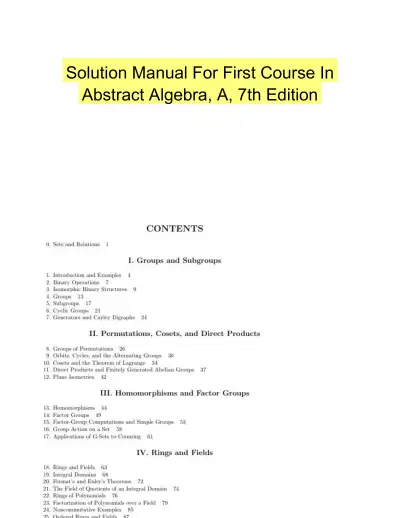 Textbook Guides
Solution Manual For First Course In Abstract Algebra, A, 7th Edition
Mathematics
189 pagesMay 2025 Exam Guides
Test Bank for Precalculus, 6th Edition
Mathematics
1051 pages175downloadsFeb 2025 Textbook Guides
Solution Manual For Introduction To Management Science, 11th Edition
Mathematics
437 pages167downloadsFeb 2025 Textbook Guides
Solution Manual For Derivatives Markets, 3rd Edition
Mathematics
358 pages143downloadsFeb 2025 Textbook Guides
Solution Manual for Geometry, 1st Edition
Mathematics
446 pages141downloadsFeb 2025 Textbook Guides
Solution Manual for Beginning Algebra, 7th Edition
Mathematics
479 pages139downloadsFeb 2025 Textbook Guides
Solution Manual for Developmental Mathematics, 1st Edition
Mathematics
1623 pages137downloadsFeb 2025 Textbook Guides
Solution Manual for Elementary and Intermediate Algebra: Graphs and Models, 5th Edition
Mathematics
1278 pages126downloadsFeb 2025
Study this document with CramX
Once it is in your library, every tool can work from it.