

PDW Test Practice Exam with Answers (95 Solved Questions)
- Medicine
- 19 pages
- Shared February 2025
- 136 downloads
PDW Test Practice Exam with Answers helps you build confidence by practicing with past papers.
Preview 6 of 19 pages
See the first 6 pages exactly as they appear in the document.
Page 1 Read page 1 as text
PDW Test 1. During the inspection process, restorers shall make a reasonable effort to (A) remove the excess water (B) check for moisture in walls (C) identify and address potential safety hazards (D) eliminate possible furniture staining and damage (C) identify and address potential safety hazards 2. A significant amount of water absorption and evap- oration load where wet porous materials represent ~5% to ~40% of combined ceiling, walls, and flooring surface areas and where low evaporation materials and assemblies are minimally wet is (A) class 1 (B) class 2 (C) class 3 (D) class 4 (B) class 2 3. Multiple extractions of salvageable materials, espe- cially porous material (carpet, cushion), often are re- quired to (A) eliminate potential microbial growth (B) decrease drying time (C) eliminate the need for antimicrobial (biocide) ap- plication (D) increase the need for additional dehumidification 4. To enhance drying, restorers should manage both ambient temperature and. (A) surface temperatures of affected materials (B)outside temperatures of building envelopes (C) dehumidifier process output temperatures (D) output temperatures of the airmovers (A) surface tem- perature of affect- ed materials 5. Water damage restoration services should not begin until after the (A) damage survey has been submitted (B) restorer has entered into an adequately written contract (B) restorer has entered into an adequately written contract 1 / 19
Page 2 Page 3 Read page 3 as text
PDW Test (C) insurance adjuster authorizes the work (D) insurance policy has been reviewed and explained 6. Two tools that should be used properly disengage most stretched-in carpet are (A) pliers and staple remover (B) power stretcher and knee kicker (C) knee kicker and carpet awl. (D) base molding lifter and carpet awl (C) knee kicker and carpet awl 7. When inspecting a water-damaged structure, restor- ers should inspect (A) with thermal imaging camera to show definite ar- eas of water (B) only where water is visible (C) only rooms that customer or adjuster says were affected (D) all potentially affected areas (D) all potentially affected areas 8. Buckled or damaged particle board should (A) be dried to a pre-loss condition using desiccant dehumidifiers (B) be removed and replaced with new material (C) be dried from underneath the subfloor (D) return to its original size after it dries to pre-loss moisture content (B) be removed and replaced with new material 9. Upon entering a building, professional moisture de- tection equipment should be used to evaluate and document (A) inside psychometric readings only (B) manometer readings for the purpose of drying (C) thermographic readings and picture from a ther- mal imaging camera (D) applicable psychrometric conditions and moisture content or level readings (D) applicable psy- chrometric condi- tions and mois- ture content or lev- el readings 10. When wet, a structural material that loses most of its structural integrity, but regains its strength when dry is (A) concrete 2 / 19
Page 4 Read page 4 as text
PDW Test (A) concrete (B) gypsum board (drywall) (C) plywood (D) oak or maple flooring 11. Initially, a method to search for abnormal moisture behind ceramic tile or resilient flooring can be accom- plished by (A) using a non-penetrating (non-invasive) moisture meter (B) drilling small holes in the grout (C) using a penetrating (invasive) moisture meter (D) removing one section of tile (A) using a non-penetrat- ing (non-invasive) moisture meter 12. To minimize damage and reduce drying time, restor- ers should (A) begin mitigation as soon as safely possible (B) apply an antimicrobial (biocide) to control odor development (C) disengage carpet at a corner to inspect for stand- ing water (D) contact and insurance adjuster (A) begin mitiga- tion as soon as safely possible 13. The moisture content of structural materials should be measured with a (A) moisture meter (B) moisture sensor (C) digital hygrometer (D) thermal imaging camera (A) moisture meter 14. When accessible from below, to dry wet wood sub- flooring under stone or tile flooring, restorers can use low-humidity air and (A) air filtration (B) thermal energy (C) time for set up (D) a vapor barrier (D) vapor barrier 15. Biocides designed to destroy or eliminate all forms of microbial life and their spores are (C) fungicides 3 / 19
Page 5 Read page 5 as text
PDW Test (A) disinfectants (B) sanitizers (C) fungicides (D) sterilizers 16. When carpet is wet it can be delaminated by (A) properly cleaning with temperatures over 120F (49C) (B) excessive tuft bind and shrinkage while drying (C) anionic compounds (D) improper handling and disengaging (D) improper han- dling and disen- gaging 17. To minimize or control aerosolized soils or contami- nants during restoration, restorers can (A) install low-grain refrigerant dehumidifiers (LGRs) (B) install one or more air filtration devices (AFDs) (C) install additional laminar style airmovers (D) use the HVAC system for increased air circulation (B) install one or more air filtration devices (AFDs) 18. When pre-existing damage is discovered, restorer should (A) bring it to the attention of the adjuster only (B) increase pricing to cover the ore-existing damage (C) ignore pre-existing damage and treat only wet areas (D) document and bring it to the attention of materially interested parties (D) document and bring it to the at- tention of materi- ally interested par- ties 19. Rapid drying of structural materials is achieved by (A) promoting evaporation and dehumidification or ventilation (B) increasing humidity ratio and dew point tempera- ture (C) decreasing wet material's surface temperature (D) decreasing temperature without increasing me- chanical airflow (A) promot- ing evaporation and dehumidifica- tion or ventilation 20. When carpet and cushion (pas, underlay) are saturat- ed with Category 3 water (A) both should be dried as quickly as possible (B) Both should be removed for prop- er disposal 4 / 19
Page 6 Read page 6 as text
PDW Test (B) Both should be removed for proper disposal (C) cushion should be removed and disposed; carpet cleaned and sanitized (D) they should be restored according to adjuster in- structions 21. To minimize safety concerns and to speed structural drying, gypsum board (drywall) ceilings that are satu- rated and sagging should be (A) drained, removed quickly, and properly disposed (B) dried from below and above (C) perforated to increase airflow while drying (d) supported to prevent collapse while drying (A) drained, re- moved quickly, and properly dis- posed 22. The force entered by late molecules in the air on sur- rounding surfaces is (A) relative humidity (B) vapor pressure (C) dew point (D) humidity ratio (B) vapor pressure 23. Generally, fastest rate of evaporation from wet mate- rials with a 70F (21C) surface temperature [0.67 VP] would be an environment with (A) 60F (4C) and 80% RH (B) 70F (21C) and 25% RH (C) 70F (21C) and 100% RH (D) 75F (24C) and 40% RH 24. Two hazardous materials more likely found in older building that require compliance with laws and regu- lations when handled are (A) vinyl composition tile and vinyl asbestos tile (B) PCBs and biological contaminants (C) lead-based paint and asbestos (D) Masonite and medium density fiberboard C) lead-based paint and as- bestos 25. As humidity ratio increases (or decreases) another psychrometric chart property that also increases (or decreases) is (C) vapor pressure 5 / 19
13 more pages in the full document
Unlock it once and it stays in your library, ready to chat with or turn into flashcards.
Unlock the full documentMore Medicine study materials
See all Exam Guides
Test Bank for The Human Body in Health and Illness, 7th Edition (Chapters 1-27)
Medicine
370 pages162downloadsFeb 2025 Textbook Guides
Solution Manual for Pearson's Comprehensive Medical Coding, 2nd Edition
Medicine
462 pages153downloadsFeb 2025 Certification Guides
Mosbys Exam Review for Computed Tomography 3rd Edition (2019)
Medicine
624 pages150downloadsFeb 2025 Exam Guides
Test Bank for CURRENT Medical Diagnosis and Treatment 2020, 59th Edition
Medicine
461 pages149downloadsFeb 2025 Exam Guides
Test Bank for Henke's Med-Math: Dosage Calculation, Preparation, and Administration, 9th Edition (Chapters 1-10)
Medicine
58 pages139downloadsFeb 2025 Exam Guides
Pathophysiology of Disease: An Introduction to Clinical Medicine 8th Edition Test Bank
Medicine
284 pages138downloadsFeb 2025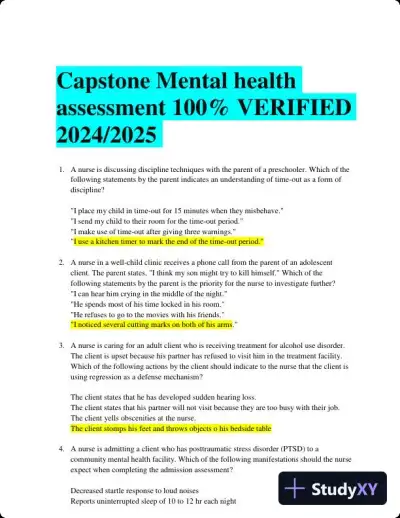 Past Exams
2024-2025 Capstone Mental Health Assessment with Answers (50 Solved Questions)
Medicine
12 pages135downloadsFeb 2025 Exam Guides
Test Bank For Pathophysiology of Disease: An Introduction to Clinical Medicine, 8th Edition
Medicine
284 pages135downloadsFeb 2025
Study this document with CramX
Once it is in your library, every tool can work from it.