

2023 NCLEX RN Physiology Comprehensive Exit Exam With NGN With Answers (30 Solved Questions)
- National Council Licensure Examination
- 20 pages
- Shared May 2025
Get the most out of your revision with 2023 NCLEX RN Physiology Comprehensive Exit Exam With NGN With Answers, featuring past test questions.
Preview 7 of 20 pages
See the first 7 pages exactly as they appear in the document.
Page 1 Read page 1 as text
NCLEX RN COMPREHENSIVE EXIT EXAMS WITH NGN, 2023 VERSION (REAL EXAM) 1. Ques ( on Category: Physiological Adaptation The nurse is aware that the following terms used to describe reduced cardiac output and perfusion impairment due to ineffective pumping of the heart is: A. Anaphylactic shock B. Cardiogenic shock C. Distributive shock D. Myocardial infarction (MI) Correct Answer: B. Cardiogenic shock Cardiogenic shock is shock related to ineffective pumping of the heart. 2. Ques ( on Category: Physiological Adaptation A client with hypertension asks the nurse which factors can cause blood pressure to drop to normal levels? A. Kidneys’ excretion to sodium only. B. Kidneys’ retention of sodium and water. C. Kidneys’ excretion of sodium and water. D. Kidneys’ retention of sodium and excretion of water. Correct Answer: C. Kidneys’ excretion of sodium and water. The kidneys respond to rise in blood pressure by excreting sodium and excess water. This response ultimately affects systolic blood pressure by regulating blood volume. 3. Ques ( on Category: Pharmacological and Parenteral Therapies
Page 2 Page 3 Read page 3 as text
Nurse Rose is aware that the statement that best explains why furosemide (Lasix) is administered to treat hypertension is: A. It dilates peripheral blood vessels. B. It decreases sympathetic cardio acceleration. C. It inhibits the angiotensin-converting enzymes. D. It inhibits the reabsorption of sodium and water in the loop of Henle. Correct Correct Answer: D. It inhibits the reabsorption of sodium and water in the loop of Henle. Furosemide is a loop diuretic that inhibits sodium and water reabsorption in the loop Henle, thereby causing a decrease in blood pressure. Option A: Vasodilators cause dilation of peripheral blood vessels, directly relaxing vascular smooth muscle and decreasing blood pressure. Option B: Adrenergic blockers decrease sympathetic cardio acceleration and decrease blood pressure. Option C: Angiotensin-converting enzyme inhibitors decrease blood pressure due to their action on angiotensin. 4. Ques ( on Category: Reduction of Risk Potential Nurse Nikki knows that laboratory results supports the diagnosis of systemic lupus erythematosus (SLE) is: A. Elevated serum complement level B. Thrombocytosis, elevated sedimentation rate C. Pancytopenia, elevated antinuclear antibody (ANA) titer D. Leukocytosis, elevated blood urea nitrogen (BUN) and creatinine levels Correct Answer: C. Pancytopenia, elevated antinuclear antibody (ANA) titer Laboratory findings for clients with SLE usually show pancytopenia, elevated ANA titer, and decreased serum complement levels.
Page 4 Read page 4 as text
Option A: Decreased levels of serum complement is usually associated with SLE. The cause of complement activation in SLE is the formation of immune complexes, which in turn activate complement, predominantly by means of the classical pathway. Option B: Thrombocytopenia is one of the components of pancytopenia. It is a condition in which the platelet count is decreased. Option D: Clients may have elevated BUN and creatinine levels from nephritis, but the increase does not indicate SLE. The part of the kidney most frequently troubled by SLE is part of the nephron called the glomerulus, a tuft of capillaries that functions to filter substances from the blood. For this reason, the type of kidney inflammation most commonly experienced in lupus is glomerulonephritis. 5. Ques ( on Category: Health Promotion and Maintenance Arnold, a 19-year-old client with a mild concussion is discharged from the emergency department. Before discharge, he complains of a headache. When offered acetaminophen, his mother tells the nurse the headache is severe and she would like her son to have something stronger. Which of the following responses by the nurse is appropriate? A. “Your son had a mild concussion, acetaminophen is strong enough.” B. “Aspirin is avoided because of the danger of Reye’s syndrome in children or young adults.” C. “Narcotics are avoided after a head injury because they may hide a worsening condition.” D. Stronger medications may lead to vomiting, which increases the intracranial pressure (ICP).” Correct Correct Answer: C. Narcotics are avoided after a head injury because they may hide a worsening condition. Narcotics may mask changes in the level of consciousness that indicate increased ICP. Option A: Acetaminophen is strong enough ignores the mother’s question and therefore isn’t appropriate. Option B: Aspirin is contraindicated in conditions that may have bleeding, such as trauma, and for children or young adults with viral illnesses due to the danger of Reye’s syndrome. Option D: Stronger medications may not necessarily lead to vomiting but will sedate the client, thereby masking changes in his level of consciousness. 6. Ques ( on
Page 5 Read page 5 as text
Category: Reduction of Risk Potential When evaluating an arterial blood gas from a male client with a subdural hematoma, the nurse notes the Paco2 is 30 mm Hg. Which of the following responses best describes the result? A. Appropriate; lowering carbon dioxide (CO2) reduces intracranial pressure (ICP). B. Emergent; the client is poorly oxygenated. C. Normal. D. Significant; the client has alveolar hypoventilation. Correct Answer: A. Appropriate; lowering carbon dioxide (CO2) reduces intracranial pressure (ICP) A normal Paco2 value is 35 to 45 mm Hg CO2 has vasodilating properties; therefore, lowering Paco2 through hyperventilation will lower ICP caused by dilated cerebral vessels. Option B: Oxygenation is evaluated through Pao2 and oxygen saturation. Option C: The normal PaCO2 level is between 35 to 45 mmHg. PaCO2 or the partial pressure of carbon dioxide is the measure of carbon dioxide within arterial or venous blood. Option D: Alveolar hypoventilation would be reflected in an increased Paco2. Alveolar hypoventilation is defined as insufficient ventilation leading to hypercapnia, which is an increase in the partial pressure of carbon dioxide as measured by arterial blood gas analysis. 7. Ques ( on Category: Management of Care When prioritizing care, which of the following clients should the nurse Olivia assess first? A. A 17-year-old client 24-hours post appendectomy. B. A 33-year-old client with a recent diagnosis of Guillain-Barre syndrome. C. A 50-year-old client 3 days post myocardial infarction. D. A 50-year-old client with diverticulitis. Correct Answer: B. A 33-year-old client with a recent diagnosis of Guillain-Barre syndrome
Page 6 Read page 6 as text
Guillain-Barre syndrome is characterized by ascending paralysis and potential respiratory failure. The order of client assessment should follow client priorities, with disorder of airways, breathing, and then circulation. Option A: The client who is post appendectomy has no signs of hemorrhage or unstable vital signs. Possible complications of appendectomy are bleeding, wound infection, peritonitis, blocked bowels, and injury to nearby organs. Option C: There’s no information to suggest the postmyocardial infarction client has an arrhythmia or other complication. About 90% of patients who have an acute MI develop some form of cardiac arrhythmia during or immediately after the event. Option D: There’s no evidence to suggest perforation for the client with diverticulitis as a priority of care. Diverticula are small, bulging pouches that can form in the lining of the digestive system.when one or more of the pouches become inflamed, and in some cases infected, that condition is known as diverticulitis. 8. Ques ( on Category: Physiological Adaptation JP has been diagnosed with gout and wants to know why colchicine is used in the treatment of gout. Which of the following actions of colchicines explains why it’s effective for gout? A. Replaces estrogen. B. Decreases infection. C. Decreases inflammation. D. Decreases bone demineralization. Correct Answer: C. Decreases inflammation. The action of colchicines is to decrease inflammation by reducing the migration of leukocytes to synovial fluid. Option A: Colchicine does not replace estrogen. Colchicine works by reducing the inflammation caused by crystals of uric acid in the joints. Option B: Decreasing infection is not a mechanism of action of colchicine. The primary mechanism of action of colchicine is tubulin disruption. This leads to subsequent downregulation of multiple inflammatory pathways and modulation of innate immunity.
Page 7 Read page 7 as text
Option D: Colchicine doesn’t decrease bone demineralization. The toxic effects of colchicine are related to this anti-mitotic activity within proliferating tissue such as skin, hair, and bone marrow. 9. Ques ( on Category: Physiological Adaptation Norma asks for information about osteoarthritis. Which of the following statements about osteoarthritis is correct? A. Osteoarthritis is rarely debilitating. B. Osteoarthritis is a rare form of arthritis. C. Osteoarthritis is the most common form of arthritis. D. Osteoarthritis affects people over 60. Correct Answer: C. Osteoarthritis is the most common form of arthritis Osteoarthritis is the most common form of arthritis and can be extremely debilitating. It can afflict people of any age, although most are elderly. 10. Ques ( on Category: Pharmacological and Parenteral Therapies Ruby is receiving thyroid replacement therapy, develops the flu, and forgets to take her thyroid replacement medicine. The nurse understands that skipping this medication will put the client at risk for developing which of the following life-threatening complications? A. Exophthalmos B. Thyroid storm C. Myxedema coma D. Tibial myxedema Correct Answer: C. Myxedema coma Myxedema coma, severe hypothyroidism, is a life-threatening condition that may develop if thyroid replacement medication isn’t taken.
13 more pages in the full document
Unlock it once and it stays in your library, ready to chat with or turn into flashcards.
Unlock the full documentMore National Council Licensure Examination study materials
See all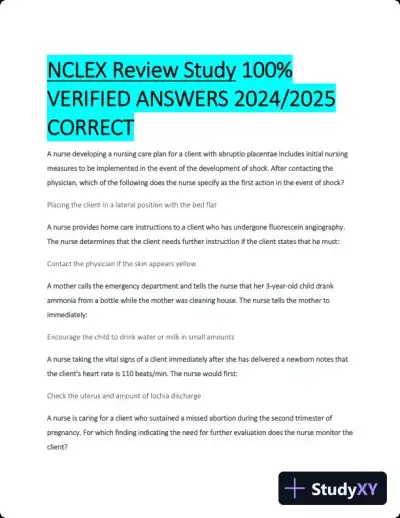 Past Exams
2024-2025 NCLEX Review Study Guide with Answers (50 Solved Questions)
National Council Licensure Examination
9 pages169downloadsFeb 2025 Certification Guides
Developing Clinical Judgment for Professional Nursing and the Next-Generation NCLEX-RN® Examination (2020)
National Council Licensure Examination
713 pages162downloadsFeb 2025 Certification Guides
NCLEX-RN Notes: Core Review and Exam Prep (2007)
National Council Licensure Examination
281 pages156downloadsFeb 2025 Certification Guides
HESI Comprehensive Review for the NCLEX-RN Examination 6th Edition (2019)
National Council Licensure Examination
842 pages150downloadsFeb 2025 Certification Guides
2020 NCLEX-PN Test Prep. Questions and Answers with Explanations (2020)
National Council Licensure Examination
943 pages147downloadsFeb 2025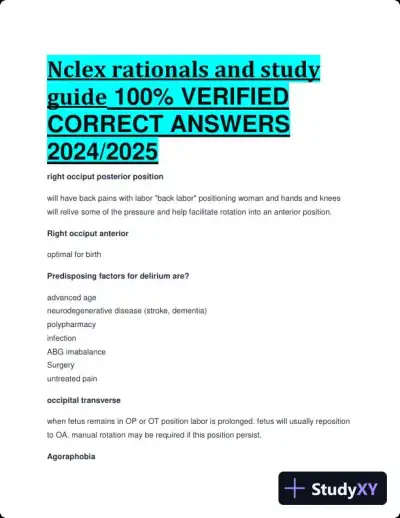 Past Exams
2024-2025 NCLEX Rationals and Study Guide with Answers (168 Solved Questions)
National Council Licensure Examination
41 pages130downloadsFeb 2025 Certification Guides
CliffsTestPrep NCLEX-RN (2011)
National Council Licensure Examination
510 pages130downloadsFeb 2025 Certification Guides
NCLEX-RN For Dummies with Online Practice Tests (2020)
National Council Licensure Examination
485 pages125downloadsFeb 2025
Study this document with CramX
Once it is in your library, every tool can work from it.