

Lippincott Style NCLEX Practice Questions
- National Council Licensure Examination
- 17 pages
- Shared June 2025
Lippincott-style NCLEX practice Q&A: Covers heart failure, furosemide, hypokalemia, warfarin safety, and critical nursing assessments. Perfect for clinical judgment and exam prep.
Preview 6 of 17 pages
See the first 6 pages exactly as they appear in the document.
Page 1 Read page 1 as text
Lippincott-Style NCLEX Practice Questions Question 1: A nurse is caring for a client with heart failure who is receiving furosemide. Which assessment finding requires immediate action? (Variation 12) (Select all that apply) A Potassium level of 3.0 mEq/L B. Blood pressure of 110/70 mmHg C. Heart rate of 80 bpm □ . Reports of nausea Question 2: A nurse is educating a client on warfarin therapy. Which statement indicates a need for further teaching? (Variation 8) A 'I will avoid green leafy vegetables.' B. 'I will use an electric razor to shave.' C. 'I will take ibuprofen for headaches.' D. 'I will have regular blood tests to monitor my INR.' Question 3: A nurse is caring for a client with heart failure who is receiving furosemide. Which assessment finding requires immediate action? (Variation 18) A Potassium level of 3.0 mEq/L B. Blood pressure of 110/70 mmHg C. Heart rate of 80 bpm D. Reports of nausea Question 4: A client with diabetes mellitus reports shakiness and confusion. The nurse should first: (Variation 1) (Select all that apply) A Check the client's blood glucose B. Administer insulin C. Give a high-protein snack D. Encourage fluids Question 5: A nurse is assessing a client with chronic obstructive pulmonary disease (COPD). Which finding is most concerning? (Variation 5) A Barrel-shaped chest B. Clubbing of fingers C. Oxygen saturation of 88% D. Respiratory rate of 22 breaths/min Question 6: A nurse is caring for a client with pneumonia. Which nursing intervention is the priority? (Variation 9) (Which intervention is the priority?) A Encourage oral fluids
Page 2 Read page 2 as text
B. Obtain a sputum culture C. Administer oxygen therapy D. Monitor temperature Question 7: A nurse is assessing a client with chronic obstructive pulmonary disease (COPD). Which finding is most concerning? (Variation 8) (Select ail that apply) A. Barrel-shaped chest B. Clubbing of fingers C. Oxygen saturation of 88% D. Respiratory rate of 22 breath s/min Question 8: A nurse is educating a client on warfarin therapy. Which statement indicates a need for further teaching? (Variation 6) (Which task should the nurse delegate?) A 'I will avoid green leafy vegetables.' B. ’I will use an electric razor to shave/ C. 1 will take ibuprofen for headaches.’ D. 1 will have regular blood tests to monitor my INR.' Question 8: A nurse is assessing a client with chronic obstructive pulmonary disease (COPD). Which finding is most concerning? (Variation 19) A. Barrel-shaped chest B. Clubbing of fingers C. Oxygen saturation of 88% D. Respiratory rate of 22 breaths/min Question 10: A nurse is educating a client on warfarin therapy. Which statement indicates a need for further teaching? (Variation 12} (Select all that apply) A 'I will avoid green leafy vegetables.' B. 'I will use an electric razor to shave.' C. 1 will take ibuprofen for headaches.’ D. ’I will have regular blood tests to monitor my INR.' Question 11: A client with diabetes mellitus reports shakiness and confusion. The nurse should first: (Variation 6) (Which intervention is the priority?) A Check the client's blood glucose B. Administer insulin C. Give a high-protein snack D. Encourage fluids Question 12: A nurse is caring for a client with heart failure who is receiving furosemide. Which assessment finding requires immediate action? (Variation 14) A Potassium level of 3.0 mEq/L
Page 3 Read page 3 as text
B. Blood pressure of 110/70 mmHg C. Heart rate of 80 bpm D. Reports of nausea Question 13: A client with diabetes mellitus reports shakiness and confusion. The nurse should first: (Variation 15) (Select all that apply) A Check the client's blood glucose B. Administer insulin C. Give a high-protein snack □ . Encourage fluids Question 14: A nurse is educating a client on warfarin therapy. Which statement indicates a need for further teaching? (Variation 13) A 'I will avoid green leafy vegetables.' B ’I will use an electric razor to shave/ C. 'I will take ibuprofen for headaches/ □ . 'I will have regular blood tests to monitor my INR. 1 Question 15: A client with diabetes mellitus reports shakiness and confusion. The nurse should first: (Variation 20) (Which task should the nurse delegate?) A Check the client's blood glucose B. Administer insulin C. Give a high-protein snack D. Encourage fluids Question 16: A nurse is caring for a client with heart failure who is receiving furosemide. Which assessment finding requires immediate action? (Variation 4) (Select all that apply) A Potassium level of 3.0 mEq/L B. Blood pressure of 110/70 mmHg C. Heart rate of 80 bpm □ . Reports of nausea Question 17: A nurse is caring for a client with heart failure who is receiving furosemide. Which assessment finding requires immediate action? (Variation 6) A Potassium level of 3 0 mEq/L B. Blood pressure of 110/70 mmHg C. Heart rate of 80 bpm D. Reports of nausea Question 18: A nurse is educating a client on warfarin therapy. Which statement indicates a need for further teaching? (Variation 2) A 'I will avoid green leafy vegetables.'
Page 4 Read page 4 as text
B. 'I will use an electric razor to shave.' C. 'I will take ibuprofen for headaches.' □ . ’I will have regular blood tests to monitor my INR.' Question 19: A nurse is educating a client on warfarin therapy. Which statement indicates a need for further teaching? (Variation 20) (Select all that apply) A 'I will avoid green leafy vegetables.' B. 'I will use an electric razor to shave/ C. 1 will take ibuprofen for headaches/ D. 1 will have regular blood tests to monitor my INR.' Question 20: A nurse is educating a client on warfarin therapy. Which statement indicates a need for further teaching? (Variation 17) A 'I will avoid green leafy vegetables.' B. 'I will use an electric razor to shave/ C. 'I will take ibuprofen for headaches/ D. 'I will have regular blood tests to monitor my INR/ Question 21: A nurse is caring for a client with pneumonia. Which nursing intervention is the priority? (Variation 2) (Which intervention is the priority?) A Encourage oral fluids B. Obtain a sputum culture C. Administer oxygen therapy □ . Monitor temperature Question 22: A nurse is caring for a client with heart failure who is receiving furosemide. Which assessment finding requires immediate action? (Variation 16) (Select all that apply) A Potassium level of 3.0 mEq/L B. Blood pressure of 110/70 mmHg C. Heart rate of 80 bpm D. Reports of nausea Question 23: A nurse is caring for a client with heart failure who is receiving furosemide. Which assessment finding requires immediate action? (Variation 5) A Potassium level of 3.0 mEq/L B. Blood pressure of 110/70 mmHg C. Heart rate of 80 bpm D. Reports of nausea Question 24: A nurse is assessing a client with chronic obstructive pulmonary disease (COPD). Which finding is most concerning? (Variation 3) A Barrel-shaped chest
Page 5 Read page 5 as text
B. Clubbing of fingers C. Oxygen saturation of 88% □ . Respiratory rate of 22 breath s/min Question 25: A nurse is assessing a client with chronic obstructive pulmonary disease (COPD). Which finding is most concerning? (Variation 13) (Select all that apply) A Barrel-shaped chest B. Clubbing of fingers C. Oxygen saturation of 88% D. Respiratory rate of 22 breaths/min Question 26: A nurse is educating a client on warfarin therapy. Which statement indicates a need for further teaching? (Variation 9) (Which intervention is the priority?) A 'I will avoid green leafy vegetables.’ B. 'I will use an electric razor to shave.’ C. 'I will take ibuprofen for headaches/ D. 'I will have regular blood tests to monitor my INR.’ Question 27: A client with diabetes mellitus reports shakiness and confusion. The nurse should first: (Variation 9) A Check the client's blood glucose B. Administer insulin C. Give a high-protein snack D. Encourage fluids Question 28: A nurse is assessing a client with chronic obstructive pulmonary disease (COPD). Which finding is most concerning? (Variation 11) (Select all that apply) A Barrel-shaped chest B. Clubbing of fingers C. Oxygen saturation of 88% D. Respiratory rate of 22 breaths/min Question 29: A nurse is caring for a client with pneumonia. Which nursing intervention is the priority? (Variation 11) (Which task should the nurse delegate?) A Encourage oral fluids B. Obtain a sputum culture C. Administer oxygen therapy D. Monitor temperature Question 30: A nurse is assessing a client with chronic obstructive pulmonary disease (COPD). Which finding is most concerning? (Variation 15) A Barrel-shaped chest
Page 6 Read page 6 as text
B. Clubbing of fingers C. Oxygen saturation of 88% D. Respiratory rate of 22 breaths/min Question 31: A nurse is assessing a client with chronic obstructive pulmonary disease (COPD). Which finding is most concerning? (Variation 17) (Select all that apply) A. Barrel-shaped chest B. Clubbing of fingers C. Oxygen saturation of 88% D. Respiratory rate of 22 breaths/min Question 32: A nurse is assessing a client with chronic obstructive pulmonary disease (COPD). Which finding is most concerning? (Variation 6) A Barrel-shaped chest B. Clubbing of fingers C. Oxygen saturation of 88% D. Respiratory rate of 22 breaths/min Question 33: A nurse is caring for a client with pneumonia. Which nursing intervention is the priority? (Variation 1) A Encourage oral fluids B. Obtain a sputum culture C. Administer oxygen therapy D. Monitor temperature Question 34: A nurse is educating a client on warfarin therapy. Which statement indicates a need for further teaching? (Variation 15) (Select all that apply) A 'I will avoid green leafy vegetables. 1 B. ’I will use an electric razor to shave. 1 C. 'I will take ibuprofen for headaches/ D. 'I will have regular blood tests to monitor my INR. 1 Question 35: A nurse is caring for a client with heart failure who is receiving furosemide. Which assessment finding requires immediate action? (Variation 19) A Potassium level of 3.0 mEq/L B. Blood pressure of 110/70 mmHg C. Heart rate of 80 bpm D. Reports of nausea Question 36: A nurse is caring for a client with pneumonia. Which nursing intervention is the priority? (Variation 18) (Which intervention is the priority?) A Encourage oral fluids
11 more pages in the full document
Unlock it once and it stays in your library, ready to chat with or turn into flashcards.
Unlock the full documentMore National Council Licensure Examination study materials
See all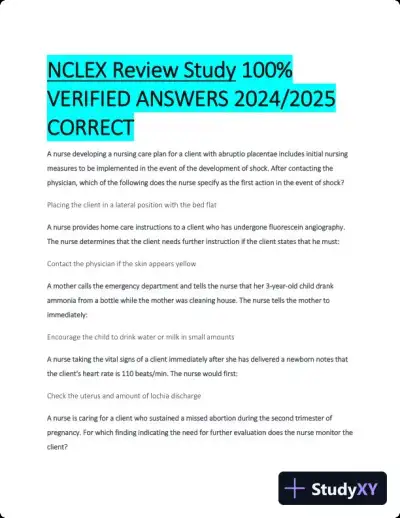 Past Exams
2024-2025 NCLEX Review Study Guide with Answers (50 Solved Questions)
National Council Licensure Examination
9 pages169downloadsFeb 2025 Certification Guides
Developing Clinical Judgment for Professional Nursing and the Next-Generation NCLEX-RN® Examination (2020)
National Council Licensure Examination
713 pages162downloadsFeb 2025 Certification Guides
NCLEX-RN Notes: Core Review and Exam Prep (2007)
National Council Licensure Examination
281 pages156downloadsFeb 2025 Certification Guides
HESI Comprehensive Review for the NCLEX-RN Examination 6th Edition (2019)
National Council Licensure Examination
842 pages150downloadsFeb 2025 Certification Guides
2020 NCLEX-PN Test Prep. Questions and Answers with Explanations (2020)
National Council Licensure Examination
943 pages147downloadsFeb 2025 Certification Guides
CliffsTestPrep NCLEX-RN (2011)
National Council Licensure Examination
510 pages130downloadsFeb 2025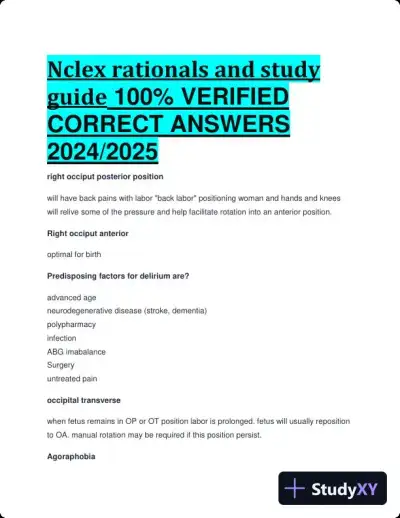 Past Exams
2024-2025 NCLEX Rationals and Study Guide with Answers (168 Solved Questions)
National Council Licensure Examination
41 pages130downloadsFeb 2025 Certification Guides
NCLEX-RN For Dummies with Online Practice Tests (2020)
National Council Licensure Examination
485 pages125downloadsFeb 2025
Study this document with CramX
Once it is in your library, every tool can work from it.