

Master the NCLEX-RN Exam (2022)
- National Council Licensure Examination
- 334 pages
- Shared February 2025
- 41 downloads
Get certified faster with Master the NCLEX-RN Exam (2022), a top-rated exam prep guide.
Preview 31 of 334 pages
See the first 31 pages exactly as they appear in the document.
Page 1 Page 2 Read page 2 as text
Downloaded from StudyXY.com ® + StudyXY Sd Ye. o> \ | iF ’ pr E \ 3 S Stu dy Anything This ContentHas been Posted On StudyXY.com as supplementary learning material. StudyXY does not endrose any university, college or publisher. Allmaterials posted are under the liability of the contributors. wv 8) www.studyxy.com
Page 3 Page 4 Read page 4 as text
MASTER THE™ NCLEX-RN® 1ST EDITION
Page 5 Read page 5 as text
About Peterson’s” Peterson's has been your trusted educational publisher for over 50 years. It's a milestone we're quite proud of, as we continue to offer the most accurate, dependable, high-quality educational content in the field, providing you with everything you need to succeed. No matter where you are on your academic or professional path, you can rely on Peterson's for its books, online information, expert test-prep tools, the most up-to-date education exploration data, and the highest quality career success resources—everything you need to achieve your education goals. For our complete line of products, visit www.petersons.com. For more information, contact Peterson's, 8740 Lucent Blvd., Suite 400, Highlands Ranch, CO 80129, or find us online at www.petersons.com. NCLEX", NCLEX-RN*, and NCSBN" are registered trademarks of the National Council of State Boards of Nursing, Inc. (NCSBN), which did not collaborate in the development of, and does not endorse, this product. ©2019 Peterson’s” ALL RIGHTS RESERVED. No part of this work covered by the copyright herein may be reproduced or used in any form or by any means— graphic, electronic, or mechanical, including photocopying, recording, taping, Web distribution, or information storage and retrieval systems—without the prior written permission of the publisher. For permission to use material from this text or product, complete the Permission Request Form at www.petersonspublishing.com/spa/permissions.aspx. ISBN: 978-0-7689-4366-5 Printed in the United States of America 1098765432 212019 First Edition Study!
Page 6 Read page 6 as text
Peterson’s Updates Check out our website at www.petersonspublishing.com/publishingupdates to see if there is any new information regarding the test and any revisions or corrections to the content of this book. We've made sure the information in this book is accurate and up to date; however, the test format or content may have changed since the time of publication. Study!
Page 7 Read page 7 as text
Contents Before You Begin Who Should Use This Book? How This Book Is Organized How to Use This Book Special Study Features Proven Strategies to Raise Your Score Give Us Your Feedback You're Well on Your Way to Success! PART I: THE REGISTERED NURSING PROFESSION AND THE NCLEX-RN® 1 About the RN Profession and the NCLEX-RN® Overview Registered Nurses and Their Career Outlook Nursing Education Licensure NCLEX-RN® Exam Basics Proven Test-Taking Strategies and Study Techniques NCLEX-RN® Test Plan Top 10 Strategies for Choosing the Correct Answer Summing It Up PART II: DIAGNOSING STRENGTHS AND WEAKNESSES 2 Practice Test 1: Diagnostic Test Answer Sheet Answer Key and Explanations Diagnostic Test Assessment Grid PART III: NCLEX-RN® REVIEW 3 Safe and Effective Care Environment Overview Client Needs for Management of Care Case Management Client Rights Concepts of Management Information Security and Confidentiality Legal Rights and Responsibilities Client Needs for Safety and Infection Control Handling Hazardous and Infectious Materials Reporting of Incident/Event/Irregular Occurrence/Variance Safe Use of Equipment Home Safety Summing It Up Practice Questions: Safe and Effective Care Environment Answer Key and Explanations 4 Health Promotion and Maintenance Overview The Aging Process Ante/Intra/Postpartum and Newborn Care Developmental Stages and Transitions Health Promotion/Disease Prevention Health Screening High-Risk Behaviors Lifestyle Choices Self-Care Study!
Page 8 Read page 8 as text
Techniques of Physical Assessment Summing It Up Practice Questions: Health Promotion and Maintenance Answer Key and Explanations 5 Psychosocial Integrity Overview Abuse and Neglect Behavioral Interventions Coping Mechanisms Crisis Intervention Cultural Awareness/Cultural Influences on Health End-of-Life Care Family Dynamics Grief and Loss Mental Health Concepts Religious and Spiritual Influences on Health Sensory/Perceptual Alterations Stress Management Substance Use and Other Disorders and Dependencies Support Systems Therapeutic Communication Therapeutic Environment Summing It Up Practice Questions: Psychosocial Integrity Answer Key and Explanations 6 Physiological Integrity Overview Client Needs for Basic Care and Comfort Assistive Devices Elimination Mobility/Immobility Nonpharmacological Comfort Interventions Nutrition and Oral Hydration Personal Hygiene, Rest, and Sleep Client Needs for Pharmacological and Parenteral Therapies Contraindications, Interactions, Side Effects, and Adverse Effects Dosage Calculation Medication Administration Total Parenteral Nutrition (TPN) Pharmacological Pain Management Client Needs for Reduction of Risk Potential Monitoring Changes in Client Condition Diagnostic Tests and Laboratory Values Potential for Alterations in Body Systems Potential Complications from Diagnostic Tests, Treatments, and Procedures Potential Complications from Surgical Procedures and Health Alterations System-Specific Assessments and Therapeutic Procedures Client Needs for Physiological Adaptation Alterations in Body Systems Fluid and Electrolyte Imbalances Hemodynamics Iliness Management Pathophysiology and Medical Emergencies Summing It Up Practice Questions: Physiological Integrity Answer Key and Explanations PART IV: PRACTICE TESTS Practice Test 2 Answer Sheet Answer Key and Explanations Practice Test 3 Answer Sheet Answer Key and Explanations Study!
Page 9 Read page 9 as text
PART V: APPENDICES A State Boards of Nursing B Nursing Organizations C Websites of Interest T StudyX
Page 10 Read page 10 as text
. Before You Begin Peterson’s Master the™ NCLEX-RN™ is written for candidates hoping to pass the NCLEX-RN examination, given by National Council of State Boards of Nursing, Inc. (NCSBN®). This book gives you the most thorough review and test-like practice available, covering all the categories and subcategories tested on the exam. WHO SHOULD USE THIS BOOK? Peterson’s Master the™ NCLEX-RN" is perfect for nurses who have six months or less of nursing experience and are interested in preparing to become a registered nurse. Use this book if you can answer “yes” to the following statements: * You want to prepare on your own time and at your own pace, but you don’t have time for a preparation program that takes weeks to complete. * You want a guide that covers all the key points you need to know but doesn’t waste time on topics you don’t absolutely have to know for the exam. * You want to avoid taking risks with this all-important exam by relying on “beat the system” guides that are long on promises but short on substance. * You want a collection of practice NCLEX-RN exams that look like the tests you will actually take to pass the exam. Study!
Page 11 Read page 11 as text
HOW THIS BOOK IS ORGANIZED Peterson’s Master the™ NCLEX-RN® is divided into four parts to help you understand the role of the registered nurse, the structure of the NCLEX-RN, and what you need to know to pass the NCLEX-RN examination and obtain licensure. Full-length practice tests are included to help test your knowledge and provide a basis for creating a study plan. Part I (Chapter 1) gives you a quick overview of the important facts you need to know about the registered nurse profession, the current NCLEX-RN Test Plan, and the computer-adaptive testing environment. Part II (Chapter 2) provides the first full-length practice test, a diagnostic test designed to help you identify those areas where you need to spend more time in your review sessions. Part ITI (Chapters 3-6) reviews the following Client Needs categories and subcategories found on the current NCLEX-RN Test Plan: 1. Safe and Effective Care Environment Management of Care Safety and Infection Control 2. Health Promotion and Maintenance 3. Psychosocial Integrity 4. Physiological Integrity Basic Care and Comfort Pharmacological and Parenteral Therapies Reduction of Risk Potential Physiological Adaptation Part IV (Practice Tests 2 and 3) includes two full-length practice tests that simulate the actual exam, so you're fully prepared for test day. Part V (Appendix A—-C) provides supplemental information on state boards of nursing and professional organizations, as well as websites you can check for health, education, and job information. Study!
Page 12 Read page 12 as text
HOW TO USE THIS BOOK Review Part I to familiarize yourself with the registered nurse profession, the array of career opportunities, and the career outlook. Part I will also provide you with the opportunity to review the NCLEX-RN Test Plan. Proven test-taking strategies and study techniques are provided along with our top 10 strategies for choosing the correct answer. Take the Diagnostic Test in Part IL. This full-length test is designed to replicate the types of questions you will find on the actual NCLEX-RN. We've provided detailed answer explanations for all answer choices so that you can review why an answer was correct or not correct. Utilize the Diagnostic Test Assessment Grid at the end of the chapter to help pinpoint what you know— and what you don’t know. Your results provide you with a starting point to tailor your study plan. Review the chapters in Part III. Each review chapter covers one of the client needs categories and its sub-categories in depth, reviewing all the major concepts you will need to know to pass the NCLEX-RN. Before you dive into a chapter, skim the bulleted overview, which lists the topics covered in the chapter. The overview will allow you to quickly target the areas in which you are most interested. At the end of every review chapter, you will find 10 practice questions along with detailed answer explanations. Use these questions to test your understanding and further assess where you will need to focus your study plan. Take the practice tests in Part IV under test-like conditions. As you finish each practice test, check your answers against the answer keys and read the explanation for each question you missed. If you have the time, read all the answer explanations—they re great for more in-depth NCLEX-RN review. You can use your results from these practice tests to identify your strengths and weaknesses, and then spend the rest of your time leading up to your exam reviewing the areas where you need the most improvement. Reference the supplemental material in Part V as needed for more information on professional organizations and helpful websites to enhance your learning experience and expand your knowledge base. Print or Online? You Decide! In addition to the two online tests that are included with the purchase of this book, Peterson’s now gives you the option to take the diagnostic and practice tests in Peterson's Master the™ NCLEX-RN"® either on paper or online. Choose how you want to take them: on paper for a more traditional study approach, or online to simulate the actual NCLEX-RN test-taking experience, with automated timing, instant feedback, and scoring results. Take all the tests on paper, all online, or in a combination of the two. The choice is yours. To access your free online tests, visit the following URL: www.petersons.com/testprep/nclex/ Add the NCLEX-RN Online Companion to your cart and enter the coupon code NCLEX1 at checkout. Study.
Page 13 Read page 13 as text
SPECIAL STUDY FEATURES Master the™ NCLEX-RN® is designed to be as user-friendly as it is complete. To this end, it includes several features to make your preparation more efficient. Overview Each chapter begins with a bulleted overview listing the topics that are covered in the chapter. This will allow you to quickly target the areas in which you are most interested. Summing It Up Each review chapter ends with a point-by-point summary that captures the most important information in the chapter. The summaries are a convenient way to review the main points one last time before the exam. Notes and Tips As you make your way through this guide, be on the lookout for the NOTE and TIP boxes. This bonus information is designed to draw your attention to valuable concepts and test-taking advice, as well as to highlight vital details about the NCLEX-RN exam format. PROVEN STRATEGIES TO RAISE YOUR SCORE In taking the NCLEX-RN exam, some strategies are more useful than others. The following tips will help you pass the exam. 1. Create a study plan and stick to it. The right study plan will help you get the most out of this book in the time that you have. 2. Review key test elements daily for several weeks before the exam. Reread the Test Plan to be sure that you understand the categories and subcategories, and reread the information about alternate test formats. 3. Complete all the exercises in this book. Doing so will help you recognize your areas of strength and discover which areas need improvement. 4. If possible, visit the test center before the day of the exam. This will help you become familiar with the location and how long it takes to travel there. On the day of the exam, leave plenty of time to get to the test center in case the buses/subways/trains are running late, the weather is bad, or parking your car is a problem. 5. Avoid cramming the night before the exam. This will only make you feel more nervous. It is not likely to help you learn enough to make a difference on your test score. 6. Relax the night before the test. Try to take your mind off the exam for a while. Go to a movie or hang out with a friend—but not with someone who will be taking the test with you. 7. Be sure to bring one acceptable form of identification to the test center. You will not be able to take the exam without the proper form of identification, and you will have to reregister and pay another examination fee. 8. Listen to what the test administrator tells you and pay attention to the tutorial. Don’t worry, though, because you don’t need to be a computer whiz to take the test. 9. Read every word of every question on the exam. Pay attention to details. They provide clues and help prevent you from selecting the wrong answer choice. 10. Don’t spend too much time on any one question. You have up to six hours to complete your exam—but you still can’t afford to spend too much time on any one question. Try to maintain a steady pace. Due to the computer-adaptive nature of the exam, it is more important to get the questions right so the exam is accurately assessing your abilities. Study!
Page 14 Read page 14 as text
GIVE US YOUR FEEDBACK Peterson’s publishes a full line of books—test prep, education exploration, financial aid, and career preparation. Peterson’s publications can be found at high school guidance offices, college libraries and career centers, and your local bookstore and library. In addition, you can find Peterson’s products online at www.petersons.com. We welcome any comments or suggestions you may have about this publication. Please call our customer service department at 800-338-3282 Ext. 54229 or send an email message to custsve@petersons.com. Your feedback will help us make educational dreams possible for you —and others like you. YOU'RE WELL ON YOUR WAY TO SUCCESS! Remember that knowledge is power. Using Peterson’s Master the™ NCLEX-RN® will help you become familiar with the kind of content that appears in the actual NCLEX-RN exam. We look forward to helping you obtain your RN license. Good luck! Study!
Page 15 Read page 15 as text
PART 1 THE REGISTERED NURSING PROFESSION AND THE NCLEX-RN®
Page 16 Read page 16 as text
. About the RN Profession and the NCLEX-RN® OVERVIEW + Registered Nurses and Their Career Outlook + Nursing Education «+ Licensure + NCLEX-RN® Exam Basics + Proven Test-Taking Strategies and Study Techniques + NCLEX-RN® Test Plan + Top 10 Strategies for Choosing the Correct Answer + Summing It Up Congratulations on your journey to becoming a registered nurse! By picking up this book, you're making a commitment to prep hard, pass your NCLEX-RN exam, and start along the path toward the exciting, challenging, and vital career of nursing. This chapter will lay out the profession as a whole and will explain all you need to know about the NCLEX-RN exam. REGISTERED NURSES AND THEIR CAREER OUTLOOK According to the National Council of State Boards of Nursing (NCSBN), there are currently more than 4.8 million active registered nurses in the United States. Although the number of employed registered nurses per population in each state varies widely, professional nurses are the largest health care profession in the United States. According to the American Nurses Association (ANA), there will be more registered nurse jobs available through 2022 than for any other profession. The U.S. Bureau of Labor Statistics (2018) projects that 1.1 million new RNs will be needed to avoid a further shortage. The projected need for additional nurses is due to the increased emphasis on preventative care, increasing chronic conditions, and the overall demand for health care services from the aging population that is living longer and engaging in more active lives. According to the U.S. Bureau of Labor Statistics, between May 2016 and May 2017, the majority of nurses earned an income ranging from $48,690 to $104,100 annually, with a median salary of $70,000 per year. This figure represents a 3.7% increase compared to the previous year. Factors that influence nursing salaries include specified areas of practice, employment environment, length of practice, and educational level. Nursing salaries also vary from state to state. Study!
Page 17 Read page 17 as text
NURSING EDUCATION Professional nursing education did not begin until 1860 in England, where nursing education was founded on the principles established by Florence Nightingale. In 1873, the first school of nursing established in the United States was based on those same principles. In the 1890s, nurses began organizing significant professional associations, including the organizations now known as the National League for Nursing and the American Nurses Association. During that period, state nursing associations were beginning to form and were instrumental in establishing and passing state registration acts. These acts intended to establish the legal title of the professional registered nurse (RN) and to provide a licensing system for the practice of nursing. Currently, prelicensure education includes accredited nursing programs that offer an associate degree, bachelor’s degree, or master’s degree. Admission requirements to a nursing program vary based on the academic institutional requirements. LICENSURE The requirements for eligibility to take the NCLEX-RN examination are determined by the state board of nursing for the state in which the candidate intends to practice. The examination the candidate will take to obtain licensure is developed by the NCSBN. The NCLEX-RN is a national examination that does not contain state-specific information. A licensed RN can only practice in the state for which licensure has been obtained. For an RN to obtain licensure in another state, he or she must apply for endorsement by the desired state board of nursing. It is not necessary to retake the NCLEX-RN examination; however, requirements for licensure vary from state to state, so it is important to check with the specific state board of nursing. A compact license (or multistate license) is terminology that refers to the Nurse Licensure Compact (NLC). The nurse included in an NLC has a primary license plus the ability to practice in all NLC states. To be eligible for the NLC, the nurse must declare a compact state as his or her legal residence. Nurses who reside in noncompact states may apply for licensure by endorsement, which limits practice to a single-state license. There is no limit to how many single-state licenses a nurse may hold. An enhanced Nurse Licensure Compact (eNLC) was implemented on January 19, 2018, with 31 member states as of July 2019. The intent of the eNLC is to align licensing standards across participating states, allowing nurses to have one multistate license with the ability to practice in person or via telehealth in his or her home state as well as other eNLC states. See Appendix A for contact information for the boards of nursing for each state belonging to the eNLC. It is important to note that the board of nursing for each state has rules and regulations that define the scope of practice within that state. Study!
Page 18 Read page 18 as text
NCLEX-RN® EXAM BASICS The NCLEX-RN examination was developed to ensure the minimum knowledge, skills, and abilities necessary to deliver safe, effective nursing care were present at an entry level. Entry level is defined as six months or less of nursing experience. The examination is based on a test plan that serves as a blueprint outlining the content on which the candidate will be tested. The basic test plan for the NCLEX-RN is updated every three years to ensure the competencies that are measured are current. After reviewing the requirements and eligibility to take the NCLEX-RN examination as determined by the board of nursing for the state in which the candidate intends to practice, all candidates should access the NCSBN’s website (www.ncsbn.org) for the most up-to-date information regarding the NCLEX-RN exam. The NCSBN website includes instructions for the application and registration process, designated testing locations, and the current NCLEX-RN Test Plan. The site will also tell you what to do to prepare before the exam, what to do the day of the exam, and what occurs after the exam. Computer Adaptive Testing An interactive system called computer adaptive testing (CAT) is used to administer the NCLEX-RN examination. CAT uses computer technology and measurement theory to provide a valid and reliable measurement of nursing competence. Each NCLEX-RN examination is unique because the technology can interactively select questions that match the candidates ability based on the previous questions that have been answered. The chosen questions are classified by test plan category and level of difficulty. This testing process continues until the candidate’s knowledge and skills meet the NCLEX-RN test plan requirements and until a pass or fail decision is made. The NCLEX-RN test questions can range from 75 to 265 items. This number includes 15 items classified as pretest items, which are not scored. There is a maximum time limit of 6 hours for the examination; there is no minimum time limit. The allotted maximum time includes time allocated for the tutorial and sample items, as well as all optional breaks during the exam. Test questions are presented one at a time on the computer screen. The item shown must be answered in order to proceed to the next. Once an answer is submitted, you will no longer have the ability to return to the previous item. The overall duration for the NCLEX-RN examination is determined by the amount of correct and incorrect responses to the items. The computer-adaptive nature of the examination selects items based on your responses. Each item requires a varied amount of time to complete. A good rule of thumb is to spend 1-2 minutes on each test item to maintain an adequate pace throughout the exam. The length of your examination is not an indication of a pass or fail result, as it is possible to fail regardless of the length of the examination. The decision for passing or failing the NCLEX-RN examination is governed in the following three ways: 1. The examination ends when it can be determined with 95% confidence that your performance is either above or below the passing standard, regardless of the number of items answered or the amount of testing time that has elapsed. 2. If your ability levels are very close to the passing standard, the computer will continue to administer items until the maximum number is reached. At this point, the 95% confidence rule is disregarded, and the final ability is estimated. If the final ability is above the passing standard, then you will pass, and if it is below, you will fail the exam. 3. If you run out of time and the computer has not determined with 95% certainty whether you have passed or failed, alternative criteria are used. If at least the minimum number of required items were answered, the computer looks at the last 60 ability estimates. This does not mean that you had to answer the last 60 questions correctly. Each ability estimate is based on all previous answers. If the last 60 ability estimates were consistently above the passing standard, you would pass. If your ability estimate drops below the passing standard even once in the previous 60 items, you will fail the exam. Study!
Page 19 Read page 19 as text
PROVEN TEST-TAKING STRATEGIES AND STUDY TECHNIQUES As mentioned previously, it is important to familiarize yourself with the information on the NCSBN’s website (www.nesbn.org). Remember when you demanded a study guide in nursing school before an exam? Similarly, the NCSBN has provided you with a detailed test plan. The test plan is there to help guide you into the role of a safe, competent nurse. NOTE Remember that the practice tests found in this book are also available online at www.petersons.com/testprep/nclex. Since the NCLEX-RN examination is administered on a computer, it’s helpful to practice as much as possible on a computer. Your key to NCLEX-RN success lies in the effort that you put into your NCLEX-RN preparation. Devise a study plan, stay organized, study consistently, and begin reviewing for the NCLEX-RN early. It is essential that you make time daily to prepare for the examination in an environment that is conducive to test taking. Make sure your study environment is quiet. Before every study session you should be rested, well nourished, and comfortable. If possible, get into the habit of reviewing practice questions on the computer. Sticking to a structured study plan will make your test preparation effective and keep you focused on reaching your goal: passing the NCLEX-RN. To begin your NCLEX-RN test preparation, take the Diagnostic Test (Chapter 2), which is designed to assess your knowledge strengths and weaknesses. After scoring your test and reading the answer explanations, use the Diagnostic Test Assessment Grid (page 57) to help you pinpoint your trouble areas. If your test score indicates a need to focus on a specific subject area, your next step is to review that subject matter first. After you have thoroughly reviewed the material, be sure to reinforce your understanding of the concepts presented in the chapters by answering the practice question sets. How well you do on the practice questions will help you gauge how effectively you are studying and retaining the information presented. Once you are feeling confident about the material you have reviewed, retest your knowledge using Practice Test 2, review the material again where needed, and follow the same process with Practice Test 3. Remember, these tests are accessible online, so not only can you practice with test-like questions, but you can also get comfortable taking a test on the computer. When you review NCLEX-RN test questions, read every explanation to every answer, even if you selected the correct response. Doing so is a great way to reinforce what you know, identify remaining trouble areas, and clarify concepts that might still be a bit unclear. Take the time to jot down what you need to review, and then spend time doing so. Then, when you have completed your review of the material, answer more practice test questions to re-evaluate your knowledge. This drill-and-review approach will help you to sound the concepts deep into your memory; once you have the concepts well in mind, their application on the NCLEX-RN should come easily. TIP The NCLEX-RN examination is not designed to assess your ability to memorize, but to determine your knowledge of the subjects and content areas. Take the time to review the content, test your abilities, identify what you need to review, and then review to reinforce what you already know. As stated earlier in the discussion about CAT testing, each item must be answered, or you will not be able to proceed to the next question. If you are unsure of the correct answer, DO NOT guess. Every time you answer an item, the computer re-estimates your ability. If you are unsure, reread the scenario to evaluate precisely what the question is asking of you and then begin eliminating Wrong answers. After you review the scenario, ask yourself the following questions: Study!
Page 20 Read page 20 as text
+ What exactly am I being asked to do? + Where am [I in the nursing process? + At what level of Maslow’s hierarchy of needs is the client? + What is developmentally appropriate for the client? « Is there a safety component? Before eliminating answers, ask yourself the following questions: « Is this reasonable and appropriate for the situation? « Is this the safest choice for the client? « Is this the most important thing that I can do for the client at this time? If you are answering a multiple-choice question, choose the most comprehensive answer that encompasses all of the other choices that apply to the situation. If you are answering a multiple- response question, the answers are either true or false in relation to the scenario. TIP Do NOT guess if you are unsure of the answer to a question. Evaluate what the question is asking of you, and then eliminate wrong answers. This approach will result in a more accurate CAT assessment of your abilities on the actual NCLEX-RN examination. Your responses should put the client first rather than items such as tasks, paperwork, charting, or other members of the health care team. It is important to remember that the nursing profession is about the client. There is nothing else you should be doing other than taking care of the client to whom you are assigned. In addition, your answers should be based only on the question as provided to you; make sure you are not reading anything into the given situation or scenario. The NCLEX-RN scenario has provided you with exactly the information that you need to respond appropriately. NCLEX-RN® TEST PLAN All task statements in the 2019 NCLEX-RN Test Plan require that you apply the fundamental principles of clinical decision making and critical thinking to nursing practice. You will integrate concepts from the social sciences (psychology and sociology), biological sciences (anatomy, physiology, biology, and microbiology), and physical sciences (chemistry and physics). Integrated Nursing Processes Processes that are fundamental to the practice of nursing have been identified by the NCSBN and are integrated throughout the Client Needs categories and subcategories. The processes identified and defined by the NCSBN include those listed below. * Nursing Process is a scientific, clinical reasoning approach to client care that includes assessment, analysis, planning, implementation, and evaluation. * Caring involves the interaction of the nurse and client in an atmosphere of mutual respect and trust. In this collaborative environment, the nurse provides encouragement, hope, support, and compassion to help achieve desired outcomes. « Communication and Documentation includes the verbal and nonverbal interactions between the nurse and the client, the client’s family, and the other members of the health care team. Events and activities associated with client care are recorded in written and/or electronic records that demonstrate adherence to the standards of practice and accountability in the provision of care. * Teaching/Learning refers to facilitating the acquisition of knowledge, skills, and abilities to promote a change in behavior. Culture and Spirituality involves the interaction of the nurse and the client (individual, family, or group, including significant others and populations), which recognizes and considers the client-reported, self-identified, unique, and individual preferences to client Study!
Page 21 Read page 21 as text
care, the applicable standard of care, and legal considerations. In addition to using the nursing process, you will be expected to apply concepts such as caring, communication, documentation, teaching and learning, and culture and spirituality throughout the four major categories of the test plan. The content of the NCLEX-RN Test Plan is organized into four major client needs categories. Two of the four categories are divided into subcategories, as shown in the following list. Client Needs Categories and Subcategories 1. Safe and Effective Care Environment Management of Care Safety and Infection Control 2. Health Promotion and Maintenance 3. Psychosocial Integrity 4. Physiological Integrity Basic Care and Comfort Pharmacological and Parenteral Therapies Reduction of Risk Potential Physiological Adaptation Safe and Effective Care Environment This first major Client Needs category consists of two subcategories, each of which assesses your ability to promote favorable client outcomes by providing and directing nursing care that enhances the care delivery setting in order to protect clients and health care personnel. Management of Care This subcategory is designed to assess your ability to provide and direct nursing care that enhances the care delivery setting to protect the client and health care personnel. MANAGEMENT OF CARE Related Activity Statements from the 20/7 RN Practice Analysis: Linking the NCLEX-RN Examination to Practice « Integrate advanced directives into the client plan of care. * Assign and supervise care of the client provided by others (e.g., LPN/VN, assistive personnel, other RNs). * Organize your workload to manage time effectively. * Practice and advocate for cost-effective care. + Initiate, evaluate, and update the client plan of care. * Provide education to clients and staff about client rights and responsibilities. «+ Advocate for client rights and needs. « Collaborate with interprofessional team members when providing client care. + Manage conflict among clients and health care staff. * Maintain client confidentiality and privacy. * Provide and receive handoff of care reports on assigned clients. * Use approved abbreviations and standard terminology when documenting care. * Perform procedures necessary to safely admit, transfer, and/or discharge a client. * Prioritize the delivery of client care. * Recognize ethical dilemmas and take appropriate action. * Practice in a manner consistent with a code of ethics for nurses. Study.
Page 22 Read page 22 as text
* Verify the client receives appropriate education and consents for care and procedures. * Receive and transcribe health care provider orders. « Utilize resources to enhance client care (e.g., evidenced-based research, information technology, policies and procedures). * Recognize limitations of yourself and others and utilize resources. * Report client conditions as required by law (e.g., abuse/neglect, communicable disease). * Provide care within the legal scope of practice. « Participate in performance improvement projects and quality improvement processes. « Assess the need for referrals and obtain necessary orders. Related content includes, but is not limited to, the following: + Advance directives/self-determination/life planning + Advocacy + Assignment, delegation, and supervision + Case management «+ Client rights «+ Collaboration with interdisciplinary team «+ Concepts of management «+ Confidentiality/information security + Continuity of care «+ Establishing priorities « Ethical practice « Informed consent «+ Information technology + Legal rights and responsibilities + Performance improvement (quality improvement) * Referrals Safety and Infection Control This Safe and Effective Care Environment subcategory assesses your ability to protect clients and health care personnel from health and environmental hazards. SAFETY AND INFECTION CONTROL Related Activity Statements from the 20/7 RN Practice Analysis: Linking the NCLEX-RN Examination to Practice Study!
Page 23 Read page 23 as text
* Assess the client for allergies and intervene as needed (e.g., food, latex, environmental allergies). * Protect the client from injury (e.g., falls, electrical hazards). * Ensure proper identification of the client when providing care. * Verify the appropriateness and accuracy of a treatment order. « Participate in emergency response plans (e.g., internal/external disaster, bomb threat, community planning). * Use ergonomic principles when providing care (e.g., safe client handling, proper lifting). * Follow procedures for handling biohazardous and hazardous materials. * Educate the client on safety issues. + Acknowledge and document practice errors and near misses (e.g., incident report for medication error). * Report any unsafe practice of health care personnel and intervene as appropriate (e.g., substance abuse, improper care, staffing practices). * Facilitate the appropriate and safe use of equipment. * Follow the security plan procedures (e.g., newborn nursery security, violence, controlled access). «+ Apply principles of infection control (e.g., hand hygiene, aseptic technique, isolation, sterile technique, universal/standard precautions). * Educate the client and staff regarding infection control measures. * Follow requirements for the use of restraints. Related content includes, but is not limited to, the following: + Accident/error/injury prevention + Emergency response plan + Ergonomic principles + Handling hazardous and infectious materials + Home safety + Reporting of incident/event/irregular occurrence/variance «+ Safe use of equipment + Security plan «+ Standard precautions/transmission-based precautions/surgical asepsis + Use of restraints/safety devices Health Promotion and Maintenance This second major Client Needs category assesses your ability to provide and direct the nursing care of the client that incorporates knowledge of expected growth and development, prevention and early detection of health problems, and strategies to achieve optimal health. HEALTH PROMOTION AND MAINTENANCE Related Activity Statements from the 20/7 RN Practice Analysis: Linking the NCLEX-RN Examination to Practice Study.
Page 24 Read page 24 as text
* Provide care and education for the newborn, infant, and toddler client from birth through 2 years old. * Provide care and education for the preschool, school age, and adolescent client ages 3 through 17 years. * Provide care and education for the adult client ages 18 through 64 years. * Provide care and education for the adult client ages 65 years and over. * Provide prenatal care and education. * Provide care and education to an antepartum client or a client in labor. * Provide postpartum care and education. « Assess and educate clients about health risks based on family, population, and community characteristics. « Assess the client’s readiness to learn, learning preferences, and barriers to learning. * Plan and/or participate in community health education. * Educate the client about health promotion and maintenance recommendations (e.g., physician visits, immunizations). * Perform targeted screening assessments (e.g., vision, nutrition). * Educate the client about prevention and treatment of high-risk health behaviors (e.g., smoking cessation, safe sexual practices, needle exchange). « Assess the client’s ability to manage care in the home environment and plan care accordingly. * Perform comprehensive health assessments. Related content includes, but is not limited to, the following: + The aging process + Ante/intra/postpartum and newborn care + Developmental stages and transitions + Health promotion/disease prevention + Health screening + High-risk behaviors « Lifestyle choices * Self-care + Techniques of physical assessment Psychosocial Integrity The third major Client Needs category assesses your ability to provide and direct nursing care that promotes and supports the emotional, mental, and social well-being of the client who is experiencing stressful events, as well as clients with acute or chronic mental illness. PSYCHOSOCIAL INTEGRITY Related Activity Statements from the 20/7 RN Practice Analysis: Linking the NCLEX-RN Examination to Practice Study!
Page 25 Read page 25 as text
« Assess the client for abuse or neglect and intervene as appropriate. * Incorporate behavioral management techniques when caring for a client. « Assess the client’s ability to cope with life changes and provide support. « Assess the potential for violence and use safety precautions. * Incorporate client cultural practices and beliefs when planning and providing care. * Provide end-of-life care and education to clients. * Assess family dynamics to determine a plan of care. * Provide care for a client who is experiencing grief or loss. * Provide care and education for acute and chronic psychosocial health issues (e.g., addictions/dependencies, depression, dementia, eating disorders). * Assess psychosocial, spiritual, and/or occupational factors affecting care and plan interventions. * Provide care for a client experiencing visual, auditory, and/or cognitive distortions. * Recognize nonverbal cues to physical and/or psychological stressors. « Assess the client for substance abuse, dependency, withdrawal, or toxicities and intervene as appropriate. * Use therapeutic communication techniques. * Promote a therapeutic environment. Related content includes, but is not limited to, the following: + Abuse/neglect + Behavioral interventions + Coping mechanisms « Crisis intervention « Cultural awareness/cultural influences on health + End-of-life care + Family dynamics * Grief and loss + Mental health concepts «+ Religious and spiritual influences on health + Sensory/perceptual alterations * Stress management + Substance use and other disorders and dependencies + Support systems + Therapeutic communication + Therapeutic environment Physiological Integrity The fourth major Client Needs category consists of four subcategories that assess your ability to promote physical health and wellness by providing care and comfort, reducing client risk potential, and managing health alterations. Basic Care and Comfort This subcategory is intended to assess your ability to provide comfort and assistance in the performance of activities of daily living. Study!
Page 26 Read page 26 as text
BASIC CARE AND COMFORT Related Activity Statements from the 20/7 RN Practice Analysis: Linking the NCLEX-RN Examination to Practice * Assist the client to compensate for a physical or sensory impairment (e.g., assistive devices, positioning, compensatory techniques). « Assess and manage clients with an alteration in elimination. * Perform irrigations (e.g., of bladder, ear, eye). * Perform skin assessment and/or implement measures to maintain skin integrity and prevent skin breakdown. * Apply, maintain, or remove orthopedic devices. + Implement measures to promote circulation (e.g., active or passive range of motion, positioning, and mobilization). * Assess the client for pain and intervene as appropriate. * Recognize complementary therapies and identify potential contraindications (e.g., aromatherapy, acupressure, supplements). * Provide nonpharmacological comfort measures. * Monitor the client’s nutritional status. * Provide nutrition to the client through tube feedings. * Evaluate client intake and output, and intervene as needed. « Assess and/or intervene in the client’s performance of activities of daily living. + Perform postmortem care. « Assess the client’s sleep/rest pattern and intervene as needed. Related content includes, but is not limited to, the following: * Assistive devices « Elimination + Mobility/immobility + Nonpharmacological comfort interventions + Nutrition and oral hydration + Personal hygiene + Rest and sleep Pharmacological and Parenteral Therapies This subcategory assesses your ability to provide care related to the administration of medications and parenteral therapies. PHARMACOLOGICAL AND PARENTERAL THERAPIES Related Activity Statements from the 2017 RN Practice Analysis: Linking the NCLEX-RN"® Examination to Practice Study.
Page 27 Read page 27 as text
+ Administer blood products and evaluate client response. * Assess central venous access devices. * Perform calculations needed for medication administration. + Evaluate client response to medication. * Educate the client about medications. * Prepare and administer medications using the rights of medication administration. * Review pertinent data prior to medication administration (e.g., contraindications, lab results, allergies, potential interactions). « Participate in the medication reconciliation process. « Titrate the dosage of medication based on assessment and ordered parameters. + Handle and maintain medication in a safe and controlled environment. « Evaluate the appropriateness and accuracy of the medication order for the client. + Handle and/or administer high-risk medications. * Monitor intravenous infusions and maintain the site. + Administer medications for pain management. + Handle and/or administer controlled substances within regulatory guidelines. + Administer parenteral nutrition and evaluate the client’s response. Related content includes, but is not limited to, the following: + Adverse effects/contraindications/side effects/interactions + Blood and blood products « Central venous access devices + Dosage calculation + Expected actions/outcomes + Medication administration «+ Parenteral/intravenous therapies + Pharmacological pain management «+ Total parenteral nutrition (TPN) Reduction of Risk Potential This subcategory assesses your ability to reduce the likelihood that clients will develop complications or health problems related to existing conditions, treatments, or procedures. REDUCTION OF RISK POTENTIAL Related Activity Statements from the 20/7 RN Practice Analysis: Linking the NCLEX-RN Examination to Practice Study!
Page 28 Read page 28 as text
« Assess and respond to changes and/or trends in the client’s vital signs. « Perform diagnostic testing (e.g., electrocardiogram, oxygen saturation, glucose monitoring). * Monitor the results of diagnostic testing and intervene as needed. * Obtain blood specimens (e.g., venipuncture, venous access device, central line). + Obtain specimens other than blood for diagnostic testing (e.g., wound, stool, urine). + Insert, maintain, or remove a nasal/oral gastrointestinal tube. + Insert, maintain, or remove a urinary catheter. « Insert, maintain, or remove a peripheral intravenous line. + Maintain a percutaneous feeding tube. «+ Apply and/or maintain devices used to promote venous return (e.g., antiembolic stockings, sequential compression devices). « Use precautions to prevent injury and/or complications associated with a procedure or diagnosis. * Evaluate the client’s responses to procedures and treatments. * Recognize trends and changes in the client’s condition and intervene as needed. * Perform focused assessments. « Educate the client about treatments and procedures. * Provide preoperative or postoperative education. * Provide preoperative care. + Manage the client during a procedure with moderate sedation. + Manage the client following a procedure with moderate sedation. Related content includes, but is not limited to, the following: + Changes/abnormalities in vital signs + Diagnostic tests + Laboratory values « Potential for alterations in body systems «+ Potential for complications of diagnostic tests/treatments/procedures «+ Potential for complications from surgical procedures and health alterations + System-specific assessments + Therapeutic procedures Physiological Adaptation This subcategory assesses your ability to manage and provide care for clients with acute, chronic, or life-threatening physical health conditions. PHYSIOLOGICAL ADAPTATION Related Activity Statements from the 20/7 RN Practice Analysis: Linking the NCLEX-RN Examination to Practice Study!
Page 29 Read page 29 as text
« Assist with invasive procedures (e.g., central line, thoracentesis, bronchoscopy). + Implement and monitor phototherapy. + Maintain optimal temperature of the client. * Monitor and care for clients on a ventilator. + Monitor and maintain devices and equipment used for drainage (e.g., surgical wound drains, chest tube suction, negative pressure wound therapy). * Perform and manage care of the client receiving peritoneal dialysis. * Perform suctioning. * Perform wound care and/or dressing change. * Provide ostomy care and/or education (e.g., tracheal, enteral). * Provide pulmonary hygiene (e.g., chest physiotherapy, incentive spirometry). * Provide postoperative care. + Manage the care of the client with a fluid and electrolyte imbalance. * Monitor and maintain arterial lines. + Manage the care of a client with a pacing device. + Manage the care of a client on telemetry. + Manage the care of a client receiving hemodialysis or continuous renal replacement therapy. + Manage the care of a client with an alteration in hemodynamics, tissue perfusion, and/or hemostasis. « Educate the client regarding an acute or chronic condition. + Manage the care of a client with impaired ventilation/oxygenation. * Evaluate the effectiveness of the treatment plan for a client with an acute or chronic diagnosis. + Perform emergency care procedures. « Identify pathophysiology related to an acute or chronic condition. * Recognize the signs and symptoms of client complications and intervene. Related content includes, but is not limited to, the following: + Alterations in body systems + Fluid and electrolyte imbalances + Hemodynamics « Illness management + Medical emergencies + Pathophysiology + Unexpected response to therapies Exam Layout The percentage of test questions assigned to each Client Needs category and subcategory of the NCLEX-RN Test Plan is based on the results of the Report of Findings from the 2017 RN Practice Analysis: Linking the NCLEX-RN® Examination to Practice (NCSBN, 2018) and expert judgment provided by members of the NCLEX-RN Examination Committee. The following reflects the distribution of content from each category and subcategory. NCLEX-RN TEST PLAN BREAKDOWN Client Needs Categories and Percentage of Items from Each Subcategories Category/Subcategory Study!
Page 30 Read page 30 as text
Safe and Effective Care Environment 17-23% + Management of Care 9-15% + Safety and Infection Control Health Promotion and Maintenance 6-12% Psychosocial Integrity 6-12% Physiological Integrity * Basic Care and Comfort 6-12% * Pharmacological and Parenteral 12-18% Therapies 9-1 5% * Reduction of Risk Potential 11-17% « Physiological Adaptation ‘What to Expect on the Exam The NCLEX-RN exam uses consistent language and universal terminology that is appropriate for an entry-level nurse. The exam is not focused on specific areas of nursing. Remember, the NCLEX-RN exam is a computer adaptive test and the items are selected based on your ability. The exam adheres to the test plan’s content area percentages, so the items fall across all difficulty levels to cover all of the areas of the test plan. You may receive a question that seems to be very similar to a question received earlier in the examination. There are a variety of reasons for this, but do not assume this has occurred because a previous similar item was answered incorrectly. Just continue to select the answer for each question that you believe to be correct. All of the items on the exam are written at an application or higher level of cognitive ability, which will require you to utilize problem solving skills to select the correct answer. According to the NCSBN, the items to which you will respond come in various formats. There is no established percentage of questions that will be in an alternative format. Again, the computer selects items based only on your ability. The use of common terminology is important to provide consistency in the language for the test taker. Therefore, it is essential to become familiar with the terminology used throughout the NCLEX-RN examination. The following is a terminology list with the definitions that have been obtained from the 2019 NCLEX-RN Test Plan. «+ Client: Individual, family, or group that includes significant others and populations + Prescription: Orders, interventions, remedies, or treatments ordered or directed by an authorized primary health care provider + Primary Health Care Provider: Member of the health care team (usually a medical physician or other specialty [e.g., surgeon or nephrologist], nurse practitioner, etc.) licensed and authorized to formulate prescriptions on behalf of the client + Unlicensed Assistive Personnel (UAP): Any unlicensed personnel trained to function in a supportive role, regardless of title, to whom a nursing responsibility may be delegated. Need-to-Know Pharmacology The NCSBN does not have a specific list of medications available to study. However, for consistency, the NCLEX-RN exam primarily uses generic medication names only, and some items may refer to the classification of medications. Therefore, it is important to familiarize yourself with the generic names of the medications and have a basic understanding of the classifications for commonly used prescriptions. On a positive note, the prefixes and suffixes of generic drugs tend to follow a pattern that will make it easier to review and remember them. An understanding of their purpose, expected action, route of administration, antidotes, adverse effects, contraindications, side effects, and interactions will keep your client safe. Study!
Page 31 Read page 31 as text
Units of Measurements and Laboratory Values The NCLEX-RN exam items currently include a combination of international systems of units (SI) and imperial measurement options used in the nursing profession, so the unit of measurement presented in the item will be familiar to the candidate. According to the 2019 NCLEX-RN Test Plan, you must be able to identify the following laboratory values: + ABGs (pH, PO,, PCO,, Sa0,, HCO,) + BUN + Cholesterol (total) « Creatinine + Glucose + Glycosylated hemoglobin (HgbAlc) + Hematocrit + Hemoglobin + INR * Platelets * Potassium «PT + PTT + aPTT + Sodium + WBC Item Formats The NCLEX-RN examination includes a variety of item formats, including: + Multiple-choice + Multiple-response (select more than one correct answer from a given list) * Fill-in-the-blank calculation + Hot spots (click on the correct spot on a given image) + Exhibits + Ordered-response items (sort a given list of items into the correct order) + Audio and graphic items All item types may include multimedia, such as charts, tables, graphics, and audio. All answers to alternative items will be scored either as right or wrong—there is no partial credit given. TOP 10 STRATEGIES FOR CHOOSING THE CORRECT ANSWER 1. Familiarize yourself with the information on the National Council of State Boards of Nursing website (www.nesbn.org). Everything that you need to understand—from registering for the exam to the structure of the exam—is available to you online. 2. Do not forget that the NCLEX-RN is a test to measure the competencies needed to ensure public protection and to assess your ability to perform safely and effectively as a newly licensed entry-level RN. Therefore, you must be familiar with the use of prioritization techniques. Pay attention to the words used in the questions. Bolded words in the questions such as best, most, essential, first, priority, immediately, highest, and initial are a signal that this a priority question. All of the answers will be Study.
303 more pages in the full document
Unlock it once and it stays in your library, ready to chat with or turn into flashcards.
Unlock the full documentMore National Council Licensure Examination study materials
See all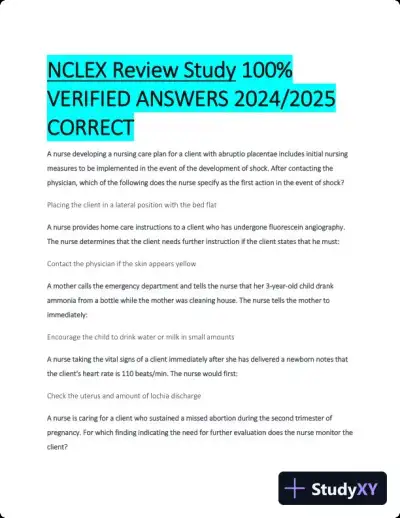 Past Exams
2024-2025 NCLEX Review Study Guide with Answers (50 Solved Questions)
National Council Licensure Examination
9 pages169downloadsFeb 2025 Certification Guides
Developing Clinical Judgment for Professional Nursing and the Next-Generation NCLEX-RN® Examination (2020)
National Council Licensure Examination
713 pages162downloadsFeb 2025 Certification Guides
NCLEX-RN Notes: Core Review and Exam Prep (2007)
National Council Licensure Examination
281 pages156downloadsFeb 2025 Certification Guides
HESI Comprehensive Review for the NCLEX-RN Examination 6th Edition (2019)
National Council Licensure Examination
842 pages150downloadsFeb 2025 Certification Guides
2020 NCLEX-PN Test Prep. Questions and Answers with Explanations (2020)
National Council Licensure Examination
943 pages147downloadsFeb 2025 Certification Guides
CliffsTestPrep NCLEX-RN (2011)
National Council Licensure Examination
510 pages130downloadsFeb 2025 Past Exams
2024-2025 NCLEX Rationals and Study Guide with Answers (168 Solved Questions)
National Council Licensure Examination
41 pages130downloadsFeb 2025 Certification Guides
NCLEX-RN For Dummies with Online Practice Tests (2020)
National Council Licensure Examination
485 pages125downloadsFeb 2025
Study this document with CramX
Once it is in your library, every tool can work from it.