

NCLEX PN Test Practice Questions
- National Council Licensure Examination
- 36 pages
- Shared June 2025
NCLEX-PN 2023 practice questions with verified answers, covering stress ulcer prevention, immunosuppressant use post-transplant, and postpartum hemorrhage management. Ideal for nursing students preparing for clinical scenario-based NCLEX questions.
Preview 11 of 36 pages
See the first 11 pages exactly as they appear in the document.
Page 1 Read page 1 as text
Nclex Pn Test Practicequestions With Verified Solutions 2023 * The client is admitted from the emergency room with multiple injuries sustained from an auto accident. His doctor prescribes a histamine blocker. The reason for this order is: A. To treat general discomfort B. To correct electrolyte imbalances C. To prevent stress ulcers D. To treat nausea Answer C: Histamine blockers arc frequently ordered for clients who are hospitalized for prolonged periods and who are in a stressful situation. They are not used to treat discomfort, correct electrolytes, or treat nausea; therefore, answers A, B, and D are incorrect. * The client with a recent liver transplant asks the nurse how long he will have to take cyclosporine {Sandimmune). Which response is correct? A. 1 year B. 5 years C. 10 years D. The rest of his life Answer D: Cyclosporin is an immunosuppressant, and the client with a liver transplant will be on immunosuppressants for the rest of his life. Answers A, B, and C, therefore, are incorrect. * Shortly after the client was admitted to the postpartum unit, the nurse notes heavy lochia rubra with large clots. The nurse should anticipate an order for: A. Methergine B. Sradol C. Magnesium sulfate D. Phone rgan
Page 2 Read page 2 as text
Answer A: Metherginc is a drug chai causes uterine contractions. It Is used for pastpartal bleeding that is nor controlled by Fltocin. Answers B P C, and D are incorrect: Stadol is an analgesic; magnesium sulfate is used tor preeclampsia; and phenergan is an antiemcrlc. • The client is scheduled to have an intravenous cholangiogram. Before rhe procedure, the nurse should assess the patient for: A. Shellfish allergies B. Reactions co blood transfusions C. Gallbladder disease D. Egg allergies Answer A: Clients having dye procedures should be assessed for allergies to iodine or shellfish. Answers B and D are incorrect because there is no need for the client to be assessed for reactions to blood or eggs. Because an IV cholangiogram is done ro detect gallbladder disease, there is no need to ask about answer C. 1 A new diabetic is learning co administer his insulin. He receives 10U of NPH and 12U of regular insulin each morning. Which of the following statements reflects understanding of the nurse's reaching? A. "When drawing up my Insulin, I should draw up die regular insulin first." B. "When drawing up my insulin. I should draw up the N P El insulin first. 1 ’ C. "It doesn't matter which insulin I draw up first." D. "I cannot mix the insulin, so I will need two shots." Answer A: Regular insulin should be drawn up before the NTH. They can be given together, so there is no need for two injections, making answer D incorrect. Answer B is obviously Incorrect, and answer C is incorrect because it does matter which is drawn first: Contamination of NP II into regular insulin will result In a hypoglycemic reaction at unexpected times. • A client with osteomylitis has an order for a trough level to be done because he is caking Gentamycin. When should the nurse call the lab to obtain the trough level? A. Before the first dose
Page 3 Read page 3 as text
B. 30 minutes before the fourth dose C. 30 minutes after the first dose D. 30 minutes after rhe fourth dose Answer B: Trough levels are the lowest blood levels and should be done 30 minutes before the third IV dose or 30 minutes before the fourth IM dose. Answers A, C, and D are incorrect. * A 4 year old with cystic fibrosis has a prescription for Viokase pancreatic enzymes to prevent malabsorption. The correct time to give pancreatic enzyme is: A. 1 hour before meals B. 2 hours after meals C. With each meal and snack D. On an empty stomach Answer C: Viokase is a pancreatic enzyme that is used to facilitate digestion. It should be given with meals and snacks, and it works well in foods such a s applesauce. Answers A, B, and D are incorrect times to administer this medication. * Isoniazid (INH) has been prescribed for a family member exposed to tuberculosis. The nurse is aware that rhe length of time that the medication will be taken is: A. 6 months B. 3 months C. 18 months D. 24 months Answer A: The expected time for contact to tuberculosis is 1 year. Therefore, answers B, C. and D are incorrect. * The client is admitted to the postpartum unit with an order to continue the infusion of Pitocln. Which finding indicates that the Pitocin is having the desired effect? A. The fundus is deviated to the left. B. The tundus is firm and in the midline.
Page 4 Read page 4 as text
C. The fundus is boggy. D. The fundus is two finger breadths below rhe umbilicus. Answer B: Pirocin is used to cause the uterus to contract and decrease bleeding. A uterus deviated co the left, as stated in answer A, indicates a full bladder. It is not desirable to have a boggy uterus, making answer C incorrect. This lack of muscle tone will Increase bleeding. Answer D is incorrect because the position of rhe uterus is not related to the use of Pirocin. ’ The nurse is teaching a group of new graduates about the safety needs of the client receiving chemotherapy. Before administering chemotherapy, the nurse should: A. Administer a bolus of IV fluid B. Administer pain medication C. Administer an antiemetic D. Allow the patient a chance to eat Answer C: Before chemotherapy, an antiemetic should be given because most chemotherapy agents cause nausea. It is not necessary to give a bolus of IV fluids, medicate for pain, or allow the client to eat; therefore, answers A, B, and D are incorrect. ’ Before administering Merhytrexate orally to the client with cancer, the nurse should check the: A. IV site B. Electrolytes C. Blood gases D. Viral signs Answer D: The vita] signs should be taken before any chemotherapy agent. If it is an IV infusion of chemotherapy, the nurse should check the IV site as well. Answers B and C are incorrect because it is not necessary to check the electrolytes or blood gases. * Vitamin K (aqua mephy ton) is administered to a newborn shortly after birth for which of the following reasons? A. To prevent dehydration
Page 5 Read page 5 as text
B. Ta treat infection C. To replace electrolytes D. To facilitate clotting Answer D : Vitamin K is given after delivery because the newborn's intestinal tract is sterile and lacks vitamin K needed for clotting. Answer A is incorrect because vitamin K is not directly given to prevent dehydration, but will facilitate clotting. Answers B and C are incorrect because vitamin K does not prevent infection or replace electrolytes. • The client with an ileostomy is being discharged. Which teaching should be included in the plan of care? A. Use Karaya powder to seal the bag. B. Irrigate the ileostomy dally. C. Stomahesive is the best skin protector. D. Neosporin ointment can be used to protect the skin. Answer C: The best protector for the client with an ileostomy to use is stomahesive. Answer A Is not correct because the bag w i l l not seal i f the client uses Karaya powder. Answer B is incorrect because there is no need to irrigate an ileostomy. Neosporin, answer D. is not used to protect the skin because it is an antibiotic. The client has an order for FeSo4 liquid. Which method of administration would be best? A. Administer the medication with milk B. Administer rhe medication with a meal C. Administer die medication w i t h orange juice D. Administer the medication undiluted .Answer C: FeSO4 o r i r o n should be given with ascorbic acid (vitamin Cj. This helps with the absorption. I t should nor be given w i t h meals or milk because this decreases the absorption; thus, answers A and B are incorrect. Giving i t undiluted, as stated in answer D, is not good because it tastes bad. 1 The client arrives i n the emergency room with a hyphema. Which action by the nurse would be best?
Page 6 Read page 6 as text
A. Elevate the head of the bed and apply ice to the eye B. Place the client in a supine position and apply heat to the knee C. Insert a Poley catheter and measure the intake and output D. Perform a vaginal exam and check for a discharge Answer A: Hyphema is blood in the anterior chamber of the eye and around the eye. The client should have the head of the bed elevated and ice applied. Answers B, C, and D arc incorrect and do not treat the problem. • The nurse Is making assignments for the day. Which client should be assigned to the nursing assistant? A. The 18 year old with a fracture to two cervical vertebrae B. The infant with meningitis C. The elderly client with a thyroidectomy 4 days ago D. The client with a thoracotomy 2 days ago Answer C: The most stable client is rhe client with the thyroidectomy 4 days ago. Answers A, B, and D are incorrect because the other clients are less stable and require a registered nurse. • The client arrives in rhe emergency room with a "bull's eye" rash. Which question would be most appropriate for the nurse to ask the client? A. "Have you found any ticks on your body?" B. "Have you had any nausea in the last 24 hours?" C. "Have you been outside rhe country in rhe last 6 months?" D. "Have you had any fever for rhe past few days?" Answer A: The "bull's eye" rash is indicative of Lyme's disease, a disease spread by ticks. The signs and symptoms include elevated temperature, headache, nausea, and the rash. Although answers B and D are important, rhe question asks which would be best. Answer C has no significance. • The child with seizure disorder is being treated with Dilantin (phenytoin). Which of rhe following statements by rhe patient's mother indicates to the nurse that rhe patient is experiencing a side effect of Dilantin therapy? A. "She is very irritable lately." B. "She sleeps quite a bit of the time." C. "Her gums look too big for her teeth." D. "She has gained about 10 pounds Ln rhe last 6 months."
Page 7 Read page 7 as text
Answer C: Hyperplasia of rhe gums is associated with Dilantin therapy. Answer A is not related to the therapy; answer B is a side effect, and answer D is not related to the question. • A 5 year old is admitted to the unit following a tonsillectomy. Which of the following would indicate a complication of the surgery? A. Decreased appetite B. A low grade fever C. Chest congestion D. Constant swallowing Answer D: A complication of a tonsillectomy is bleeding, and constant swallowing may indicate bleeding. Decreased appetite is expected after a tonsillectomy, as is a low grade temperature; thus, answers A and B arc incorrect. In answer C, chest congestion is not normal but is nor associated with the tonsillectomy. ■ A 6 year old with cerebral palsy functions at the level of an 18 monthold. Which finding would support that assessment? A. She dresses herself. B. She puUsa toy behind her.
Page 8 Read page 8 as text
C. She can build a tower of eight blocks. D. She can copy a horizontal or vertical line. Answer B: Children at 18 months of age like push pull toys. Children at approximately 3 years of age begin to dress themselves and build a tower of eight blocks. At age four, children can copy a horizontal or vertical line. Therefore, answers A r C„ and D are incorrect. 1 Which information obtained from the mother of a child with cerebral palsy most likely correlates to the diagnosis? A. She was born at 42 weeks gestation. B. She had meningitis when she was 6 months old. C. She had physiologic jaundice after delivery. D. She has frequent sore throats. Answer B: The diagnosis of meningitis at age 6 months correlates to a diagnosis of cerebral palsy. Cerebral palsy, a neurological disorder, is often associated with birth trauma or infections of the brain or spinal column. Answers A, C, and D arc not related to the question. * A 10 year old is being created for asthma. Before administering Theodur, the nurse should check the: A. Urinary output B. Blood pressure C. Pulse D. Temperature Answer C: Theodur is a bronchodilator, and a side effect of bronchodilators is tachycardia, so checking rhe pulse is important. Extreme tachycardia should be reported to the doctor. Answers A, E, and D are nor necessary. 106. An elderly client is diagnosed with ovarian cancer. She has surgery followed by chemotherapy with a fluorouracil (Adrucil) IV. What should the nurse do if she notices crystals and cloudiness in the IV medication? A. Discard the solution and order a new bag B. Warm the solution C. Continue rhe infusion and document the finding D. Discontinue the medication Answer A: Crystals in the solution are nor norma] and should not be
Page 9 Read page 9 as text
administered to the client. Discard the bad solution immediately. Answer B is incorrect because warming the solution will not help. Answer C is incorrect, and answer D requires a doctor's order. * The client is diagnosed with multiple myoloma. The doctor has ordered cyclophosphamide (Cytoxan). Which instruction should be given to rhe client? A. "Walk about a mile a day to prevent calcium loss." B. "Increase the fiber in your diet." C. "Report nausea to the doctor immediately." D. "Drink at lease eight large glasses of watera day." Answer D; Cytoxan can cause hemorrhagic cystitis, so rhe client should drink at least eight glasses of water a day. Answers A and B are not necessary and, so, are incorrect. Nausea often occurs with chemotherapy, so answer C is incorrect. * The client is taking rifampin 600mg po daily to treat his tuberculosis. Which action by the nurse indicates understanding of the medication? A. I oiling the client that the medication will need ro be taken with juice B. Telling the client that the medication will change the color of the urine C. Telling the client ro take the medication before going ro bed at night D. Telling rhe client to take the medication if night sweats occur .Answer B: Rifampin can change rhe color of rhe urine and body fluid. Teaching the client about these changes is best because he might think this is a complication. Answer A is not necessary, answer C is not true, and answer D is not true because this medication should be taken regularly during the course of the treatment. ’ The client is taking prednisone 7.5mg po each morning to treat his systemic lupus erryrhymatosis. Which statement best explains rhe reason for taking the prednisone in the morning? A. There is less chance of forgetting the medication if taken in the morning. B. There will be less fluid retention if taken in rhe morning. C. Prednisone is absorbed best with the breakfast meal.
Page 10 Read page 10 as text
D. Morning administration mimics the body's natural secretion of corticosteroid. Answer D; Taking corticosteroids in the morning mimics the body's natural release of cortisol. Answers A is nor necessarily true, and answers B and C are nor true. • A 20 year old female has a prescription for tetracycline. While teaching rhe client how to take her medicine, the nurse learns that the client is also taking Ortho Novum oral contraceptive pills. Which instructions should be included in rhe teaching plan? A. The oral contraceptives will decrease the effectiveness of the tetracycline. B. Nausea often results from taking oral contraceptives and antibiotics. C. Toxicity can result when taking these two medications together. D. Antibiotics can decrease the effectiveness of oral contraceptives, so the client should use an alternate method of birth control. Answer D: Taking antibiotics and oral contraceptives together decreases the effectiveness of the oral contraceptives. Answers A, B, and C are not necessarily true. • A 60 year old diabetic is taking glyburidc (Diabeta) 1.25mg daily to treat Type II diabetes mellitus. Which statement indicates the need for further teaching? A. "I will keep candy w r lth me just in case my blood sugar drops." B. "I need to stay out of the sun as much as passible." C. "I often skip dinner because I don't feel hungry," D. "1 always wear my medical identification." .Answer C: The client should be taught to car his meals even if he is not hungry, to prevent a hypoglycemic reaction. Answers A, B, and D are incorrect because they indicate an understanding of the nurse's teaching. • The physician prescribes regular insulin, 5 units subcutaneous. Regular insulin begins to exert an effect: A. In 5 10 minutes B. In 10 20 minutes
Page 11 Read page 11 as text
C. I n 30 6 0 minutes D. In 60 120 minutes Answer C; The rime of onset for regular insulin is 30 60 minutes; therefore, answers A, E, and D are incorrect. * Which of rhe following is the best Indicator of the diagnosis of IIIV? A. White blood cell count B. ELISA C. Western Blot D. Complete blood count Answer C:The most definitive diagnostic tool for IIIV is the Western Bloc The white blood cell count, as stated in answer A, is not rhe best indicator, but a white blood cell count of less than 3,500 requires investigation. The ELISA rest, answer B, i s a screening exam. Answer D is not specific enough. ‘ The client has an order for gentamycin to be administered. Which lab results should be reported to the doctor before beginning rhe medication? A. Hematocrit B. Creatinine C. White blood cell count D. Erythrocyte count Answer B : Gentamycin is a drug from the amino glycocide classification. These drugs are toxic co the auditory nerve and the kidneys. The hematocrit is not of significant consideration i n this client; therefore, answer A is incorrect. Answer C is incorrect because we would expect rhe white blood cell count to be elevated i n this client because gentamycin is an antibiotic. Answer D is incorrect because rhe erythrocyte count is also particularly significant ■ The nurse is caring for the client w i t h a mastectomy. Which action would be contraindicated? A. Taking the blood pressure in the side of the mastectomy B. Elevating rhe arm on the side of the mastectomy C. Positioning rhe client on the unaffected side D. Performing a dextrost ix on the unaffected side
25 more pages in the full document
Unlock it once and it stays in your library, ready to chat with or turn into flashcards.
Unlock the full documentMore National Council Licensure Examination study materials
See all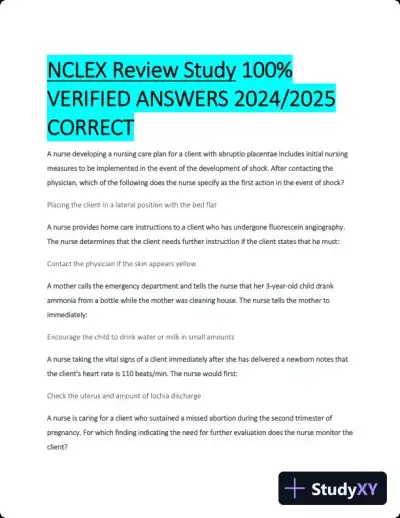 Past Exams
2024-2025 NCLEX Review Study Guide with Answers (50 Solved Questions)
National Council Licensure Examination
9 pages169downloadsFeb 2025 Certification Guides
Developing Clinical Judgment for Professional Nursing and the Next-Generation NCLEX-RN® Examination (2020)
National Council Licensure Examination
713 pages162downloadsFeb 2025 Certification Guides
NCLEX-RN Notes: Core Review and Exam Prep (2007)
National Council Licensure Examination
281 pages156downloadsFeb 2025 Certification Guides
HESI Comprehensive Review for the NCLEX-RN Examination 6th Edition (2019)
National Council Licensure Examination
842 pages150downloadsFeb 2025 Certification Guides
2020 NCLEX-PN Test Prep. Questions and Answers with Explanations (2020)
National Council Licensure Examination
943 pages147downloadsFeb 2025 Certification Guides
CliffsTestPrep NCLEX-RN (2011)
National Council Licensure Examination
510 pages130downloadsFeb 2025 Past Exams
2024-2025 NCLEX Rationals and Study Guide with Answers (168 Solved Questions)
National Council Licensure Examination
41 pages130downloadsFeb 2025 Certification Guides
NCLEX-RN For Dummies with Online Practice Tests (2020)
National Council Licensure Examination
485 pages125downloadsFeb 2025
Study this document with CramX
Once it is in your library, every tool can work from it.