

NCLEX-PN Content Review Guide: Preparation for the NCLEX-PN Examination (Kaplan Test Prep) (2020)
- National Council Licensure Examination
- 896 pages
- Shared May 2025
NCLEX-PN Content Review Guide: Preparation for the NCLEX-PN Examination (Kaplan Test Prep) (2020) challenges you with exam-style questions, ensuring you're fully prepared.
Preview 16 of 896 pages
See the first 16 pages exactly as they appear in the document.
Page 1 Read page 1 as text
Pp - Ne { ec ]) F [ > 4 Sa A | : 4 4 ry —E ® Loe ° id Content Review Guide EE CIEE TR io Ny ho 3 ip ici : (APLAN NURSING
Page 2 Read page 2 as text
Downloaded from StudyXY.com ® + StudyXY Sd Ye. o> \ | iF ’ pr E \ 3 S Stu dy Anything This ContentHas been Posted On StudyXY.com as supplementary learning material. StudyXY does not endrose any university, college or publisher. Allmaterials posted are under the liability of the contributors. wv 8) www.studyxy.com
Page 3 Read page 3 as text
® NCLEX-PN ° Ll Content Review Guide - Preparation for the NCLEX-PN’ Examination EIGHTH EDITION soem rea sommes. KAPLAN) NURSING
Page 4 Read page 4 as text
NCLEX-PN® CONTENT REVIEW GUIDE EIGHTH EDITION KAPLAN) NURSING
Page 5 Read page 5 as text
Table of Contents Introduction Chapter 1: The NCLEX-PN® Examination Section 1: The NCLEX-PN® Examination Chapter 2: Kaplan’s Review for the NCLEX-PN® Examination Section 1: Kaplan’s NCLEX-PN® Course Materials Section 2: How to Use Kaplan’s NCLEX-PN® Review Course Section 3: Kaplan’s PN Decision Tree® Section 4: Guide for Test-Takers Repeating the NCLEX-PN® Examination Chapter 3: Safe and Effective Care Environment Section 1: Coordination of Care Section 2: Safety and Infection Control Chapter 4: Health Promotion and Maintenance Section 1: Growth and Development Section 2: Childbearing—Normal Section 3: Childbearing—Maternal Complications Section 4: Childbearing—Neonatal Normal Section 5: Neonatal Complications Section 6: Reproduction Section 7: Prevention and Early Detection of Disease Chapter 5: Physiological Integrity 1: Basic Care and Comfort Section 1: Mobility and Immobility Section 2: Conditions Limiting Mobility Section 3: Interventions to Promote Comfort Section 4: Musculoskeletal Trauma Section 5: Rest and Sleep Disturbances Section 6: Nutrition Section 7: Elimination Chapter 6: Psychosocial Integrity Section 1: Coping and Adaptation Section 2: Psychosocial Adaptation Section 3: Psychopathology Section 4: Chemical Dependency
Page 6 Read page 6 as text
Section 5: Abuse and Neglect Chapter 7: Physiological Integrity 2: Physiological Adaptation Section 1: Medical Emergencies Section 2: Fluid and Electrolyte Imbalances Section 3: Alterations in Body Systems Section 4: Cancer Chapter 8: Physiological Integrity 3: Reduction of Risk Potential Section 1: Sensory and Perceptual Alterations Section 2: Alterations in Body Systems Section 3: Perioperative Care Section 4: Diagnostic Tests Section 5: Therapeutic Procedures Chapter 9: Physiological Integrity 4: Pharmacological and Parenteral Therapies Section 1: Blood Component Therapy Section 2: Intravenous Therapy Section 3: Medications Section 4: Adverse Effects of Medications
Page 7 Read page 7 as text
NCLEX-PN® is a registered trademark of the National Council of State Boards of Nursing, Inc., which neither sponsors nor endorses this book. This book is solely intended for use as preparation for the Nursing Licensure Examination, NCLEX-PN® examination. It is not a guide to the clinical treatment of clients. Neither the authors nor the publisher shall be responsible for any harm caused by the use of this book other than for its intended purpose. This book is just a small portion of the Kaplan materials available for you to prepare for the NCLEX-PN® exam. This publication is designed to provide accurate information in regard to the subject matter covered as of its publication date, with the understanding that knowledge and best practice constantly evolve. The publisher is not engaged in rendering medical, legal, accounting, or other professional service. If medical or legal advice or other expert assistance is required, the services of a competent professional should be sought. This publication is not intended for use in clinical practice or the delivery of medical care. To the fullest extent of the law, neither the Publisher nor the Editors assume any liability for any injury and/or damage to persons or property arising out of or related to any use of the material contained in this book. ©2020 by Kaplan, Inc. Published by Kaplan Publishing, a division of Kaplan, Inc. 750 Third Avenue, New York, NY 10017 All rights reserved. The text of this publication, or any part thereof, may not be reproduced in any manner whatsoever without written permission from the publisher. This book may not be duplicated or resold, pursuant to the terms of your Kaplan Enrollment Agreement. 10987654321 ISBN: 978-1-5062-6295-6 Kaplan Publishing print books are available at special quantity discounts to use for sales promotions, employee premiums, or educational purposes. For more information or to purchase books, please call the Simon & Schuster special sales department at 866-506-1949. Study.
Page 8 Read page 8 as text
Susan Sanders, D.N.P, R.N. Vice President, Kaplan Nursing Barbara Arnoldussen, M.B.A., R.N. Judith A. Burckhardt, Ph.D., R.N. Barbara Dobish, M.S.N., R.N. Cindy Finesilver, M.S.N., R.N. Pamela Gardner, M.S.N., R.N. Barbara J. Irwin, M.S.N., R.N. Amy M. Kennedy, M.S.N., R.N. Ellen Mahoney, C.S., D.N.S., R.N. Marlene Redemske, M.S.N., M.A., R.N.
Page 9 Read page 9 as text
Introduction Welcome! By using Kaplan Nursing resources, you've taken an important step toward passing the National Council Licensure Examination for Practical Nurses (NCLEX-PN®). Our many years of experience indicate that your success on the NCLEX-PN® examination is keyed to two specific factors: your educational background and your exam preparation. The amount and intensity of study you devote will bring about the greatest benefits from these resources. The best results come to those who actively participate in exam preparation. We will show you how the NCLEX-PN® examination works, what you do and don’t need to know, and the smartest way to take the NCLEX-PN® examination. We provide you with data to help you analyze your practice performance and determine where you need to make improvements. We will give you all the help, advice, and encouragement we can—but only you can do the work. Get to know all the benefits that Kaplan Nursing has to offer so you can make the most of your study time. After you complete your resources and take the NCLEX-PN® examination, please tell us how you did. Kaplan's Research and Curriculum Development Team works hard to ensure that our course materials employ the most effective and innovative teaching methods. In order to evolve and improve, we need your help. Please take a few moments to share your thoughts on how the materials helped you. Thank you in advance for choosing Kaplan for your studies.
Page 10 Read page 10 as text
KAPLAN 750 Third Avenue, New York, NY 10017 Attn: NCLEX Curriculum customer.care@kaplan.com (kaptest.com) integrated.support@kaplan.com (nursing.kaplan.com) Our best wishes for an interesting and satisfying nursing career. *NCLEX is a trademark of N.C.S.B.N., Inc. Please note: All Kaplan lectures, web content, and printed and electronic media are the property of Kaplan Nursing and are copyrighted under law.
Page 11 Read page 11 as text
I Chapter 1 The NCLEX-PN® Examination Sections 1. The NCLEX-PN® Examination
Page 12 Read page 12 as text
Section 1 The NCLEX-PN® Examination Have you talked to LPN/LVNs about their experiences taking the NCLEX- PN® examination? If so, they probably told you it was unlike any nursing test they have ever taken. How can that be? Let’s talk in detail about the NCLEX-PN® examination. NCLEX-PN® stands for National Council Licensure Examination for Practical Nurses and is prepared by the National Council of State Boards of Nursing (NCSBN). The purpose of the exam is to determine if you are safe to begin practice as an entry-level practical/vocational nurse. The NCLEX-PN® examination is a test of minimum competency, and is based on the required knowledge and behavior for the entry-level practice of practical/vocational nursing. This exam tests not only your knowledge, but also your ability to make decisions. The NCLEX-PN® examination is a computer adaptive test, which means each test is assembled interactively based on the accuracy of the candidate’s responses to the questions. This ensures that the question you are answering will not be “too hard” or “too easy” for your skill level. The first question will be near the level of minimum competency (also referred
Page 13 Read page 13 as text
to as the passing line). If you answer the question correctly, the next question will be slightly higher in critical thinking. If you miss the question, the next question will be slightly lower. As you answer questions, the computer is able to calculate your level of competence, as well as select questions that represent all areas of practical/vocational nursing as defined by the NCLEX-PN® test plan. TAKING THE EXAM You have a maximum of 5 hours to complete the exam, which includes the beginning tutorial, a break reminder after the first two hours of testing, a break reminder after an additional 90 minutes of testing, and any additional breaks you may take. There is no time limit for each question. The NCLEX-PN® examination is a variable-length adaptive test, which means that your test will be anywhere from 85 questions to 205 questions. Of the first 85 questions, 25 are experimental items that are not scored. Your test will end when the computer has determined your ability and you have taken at least 85 questions, or when you have reached the maximum testing time of 5 hours, or when you have answered 205 questions. ® WHAT BEHAVIORS DOES THE NCLEX-PN EXAMINATION TEST? The NCLEX-PN® exam does not want to test your body of nursing knowledge; it assumes you have a body of knowledge because you have
Page 14 Read page 14 as text
graduated from nursing school. Likewise, it does not want to test your understanding of the material; it assumes you understand the nursing knowledge you learned in nursing school. So what does this exam test? The NCLEX-PN® exam primarily tests your nursing judgment and discretion. It tests your ability to think critically and solve problems. The test writers recognize that as a beginning practitioner, you will be managing nursing assistants to provide care to a group of clients. As a member of the nursing team, you are expected to make safe and competent judgments about client care. CRITICAL THINKING AND CLINICAL JUDGMENT What does the term critical thinking mean? Critical thinking is problem solving that involves thinking creatively. Using clinical judgment, you successfully solve problems every day in the clinical area. You are probably comfortable with this concept when actually caring for clients. Although you’ve had lots of practice critically thinking in the clinical area, you may have had less practice thinking critically and using clinical judgment on test questions. Why is that? During nursing school, you take exams developed by nursing faculty to test a specific body of content. Many of these questions are at the knowledge level, which involves recognition and recall of ideas or material that you read in your nursing textbooks and discussed in class. This is the most basic level of testing.
Page 15 Read page 15 as text
In nursing school, you are also given test questions written at the comprehension level. These questions require you to understand the meaning of the material. If you are answering minimum competency questions on the NCLEX-PN® exam, you will not see many comprehension- level questions. The test writers assume you know and understand the facts you learned in nursing school. Minimum competency questions on the NCLEX-PN® exam are written at the application and/or analysis level. Remember, the exam tests your ability to make safe judgments about client care. Your ability to solve problems is not tested with knowledge- or comprehension-level questions. Application involves taking the facts that you know and using them to make a nursing judgment. You must be able to answer questions at the application level to prove your competence on the NCLEX-PN® exam. ® STRATEGIES THAT DON’T WORK ON THE NCLEX-PN EXAMINATION Whether you realize it or not, you developed a set of strategies in nursing school to answer teacher-generated test questions that are written at the knowledge/comprehension level. These strategies include: e “Cramming” hundreds of facts about disease processes and nursing care ® Recognizing and recalling facts rather than understanding the pathophysiology and the needs of a client with an illness e Knowing who wrote the question and what is important to that faculty
Page 16 Read page 16 as text
e Predicting answers based on what you remember e Selecting the response that is a different length compared with the other choices e Selecting the answer choice that is grammatically correct e When in doubt, choosing answer choice C CRITICAL THINKING AND CLINCIAL JUDGMENT ON ® THE NCLEX-PN" EXAMINATION ® The NCLEX-PN® exam is not a test about recognizing facts. ® You must be able to correctly identify what the question is asking. e Only focus on background information that is necessary to answer the question. Remember, the NCLEX-PN® exam is testing your ability to think critically. Critical thinking for the nurse involves: e Observation e Deciding what is important e Looking for patterns and relationships e Identifying the problem e Transferring knowledge from one situation to another e Applying knowledge e Discriminating between possible choices and/or courses of action e Evaluating according to established criteria ® FACTS ABOUT THE NCLEX-PN EXAMINATION
880 more pages in the full document
Unlock it once and it stays in your library, ready to chat with or turn into flashcards.
Unlock the full documentMore National Council Licensure Examination study materials
See all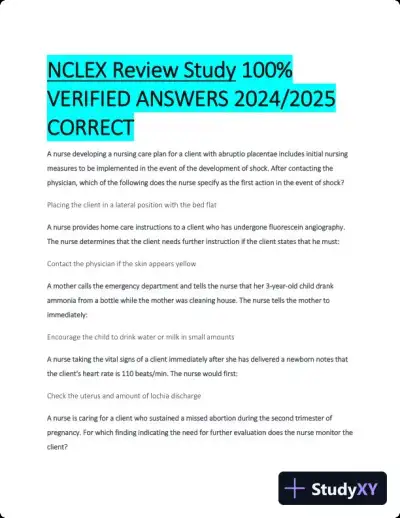 Past Exams
2024-2025 NCLEX Review Study Guide with Answers (50 Solved Questions)
National Council Licensure Examination
9 pages169downloadsFeb 2025 Certification Guides
Developing Clinical Judgment for Professional Nursing and the Next-Generation NCLEX-RN® Examination (2020)
National Council Licensure Examination
713 pages162downloadsFeb 2025 Certification Guides
NCLEX-RN Notes: Core Review and Exam Prep (2007)
National Council Licensure Examination
281 pages156downloadsFeb 2025 Certification Guides
HESI Comprehensive Review for the NCLEX-RN Examination 6th Edition (2019)
National Council Licensure Examination
842 pages150downloadsFeb 2025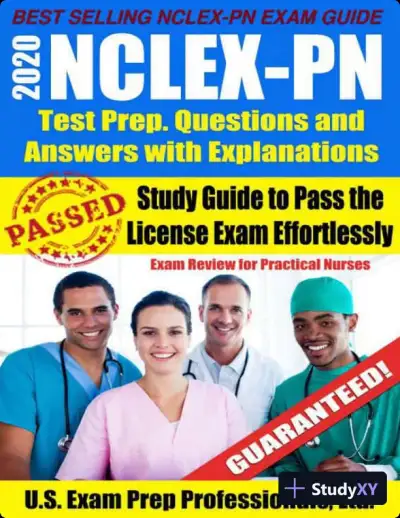 Certification Guides
2020 NCLEX-PN Test Prep. Questions and Answers with Explanations (2020)
National Council Licensure Examination
943 pages147downloadsFeb 2025 Certification Guides
CliffsTestPrep NCLEX-RN (2011)
National Council Licensure Examination
510 pages130downloadsFeb 2025 Past Exams
2024-2025 NCLEX Rationals and Study Guide with Answers (168 Solved Questions)
National Council Licensure Examination
41 pages130downloadsFeb 2025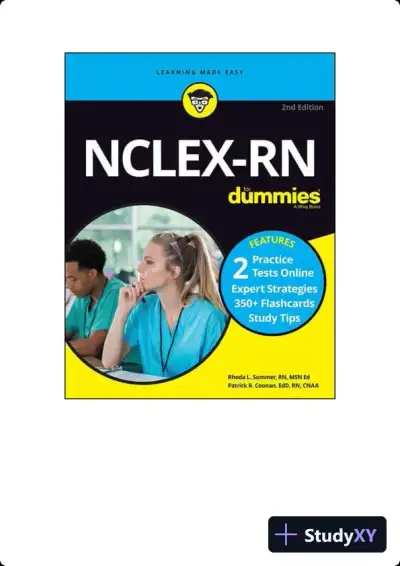 Certification Guides
NCLEX-RN For Dummies with Online Practice Tests (2020)
National Council Licensure Examination
485 pages125downloadsFeb 2025
Study this document with CramX
Once it is in your library, every tool can work from it.