

NSG 3160 NCLEX Review Chapter 14
- National Council Licensure Examination
- 16 pages
- Shared June 2025
This NCLEX-style quiz reviews head, neck, and cranial nerve anatomy, focusing on landmarks, nerve function, and physical assessment—ideal for nursing students preparing for neuro and head-to-toe assessments on the NCLEX-RN exam.
Preview 5 of 16 pages
See the first 5 pages exactly as they appear in the document.
Page 1 Read page 1 as text
NSG 3 1 6 0 NCLEX REVIEW M r . Paul Haidet (Miami Campus Content Enrichment Specialist) Head, Face, Neck, and Regional Lymphatics (Chapter 14) Stuvia.com Online NSG 3160 NCLEX Database Questions Question 1 The patient's vertebra prominens is in what area of the body? a. Just above the diaphragm b. Just lateral to the kneecap c. At the level of the C7 vertebra d. At the level of the T i l vertebra Question 2 Which cranial nerve (CN) is associated with non- symmetric palpebral fissures? a. Ill b. V c. VII d. VIII
Page 2 Read page 2 as text
Question 3 Which of the following is associated with the inability to differentiate between sharp and dull stimulation to both sides of the face? a. Bell palsy b. Damage to the trigeminal nerve c. Frostbite with resultant paresthesia to the cheeks d. Scleroderma Question 4 Which two pairs of salivary glands are accessible to examination? a. Occipital and submental b. Parotid and jugulodigastric c. Parotid and submandibular d. Submandibular and occipital
Page 3 Read page 3 as text
Question 5 Which cranial nerve is involved when a patient complains of neck and shoulder pain and is unable to turn her head? a. X b. XI c. XII d. IX Question 6 Which neck muscles are innervated by CN XI? a. Sternomastoid and trapezius b. Spinal accessory and omohyoid c. Trapezius and sternomandibular d. Sternomandibular and spinal accessory
Page 4 Read page 4 as text
Question 7 Which gland would the nurse assess if a patient's lab report reveals an elevated thyroxine (T4) level? a. Thyroid b. Parotid c. Adrenal d. Parathyroid Question 8 In assessing a patient's movable lump in front of her neck, this may not be a cancerous thyroid nodule because the lump (nodule): a. Is tender b. Is mobile and not hard c. Disappears when the patient smiles d. Is hard and fixed to the surrounding structures
Page 5 Read page 5 as text
Question 9 To identify the cause of the patient's submental lymph node enlargement, the nurse would assess the patient’s: a. Infraclavicular area b. Supraclavicular area c. Area distal t o the enlarged node d. Area proximal to the enlarged node Question 10 Four areas i n t h e body w h e r e l y m p h nodes are accessible are t h e : a. Head, breasts, groin, and abdomen b . Arms, breasts, inguinal area, and legs c. Head and neck, arms, breasts, and axillae d . Head and neck, arms, inguinal area, and axillae
11 more pages in the full document
Unlock it once and it stays in your library, ready to chat with or turn into flashcards.
Unlock the full documentMore National Council Licensure Examination study materials
See all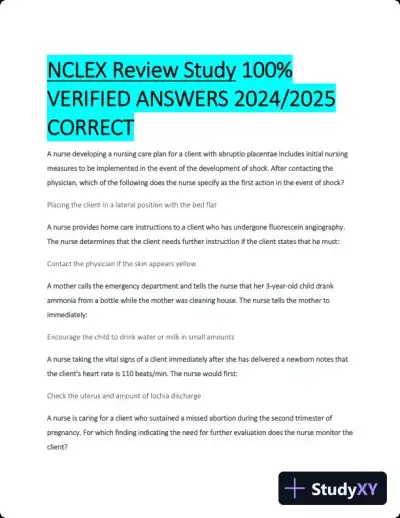 Past Exams
2024-2025 NCLEX Review Study Guide with Answers (50 Solved Questions)
National Council Licensure Examination
9 pages169downloadsFeb 2025 Certification Guides
Developing Clinical Judgment for Professional Nursing and the Next-Generation NCLEX-RN® Examination (2020)
National Council Licensure Examination
713 pages162downloadsFeb 2025 Certification Guides
NCLEX-RN Notes: Core Review and Exam Prep (2007)
National Council Licensure Examination
281 pages156downloadsFeb 2025 Certification Guides
HESI Comprehensive Review for the NCLEX-RN Examination 6th Edition (2019)
National Council Licensure Examination
842 pages150downloadsFeb 2025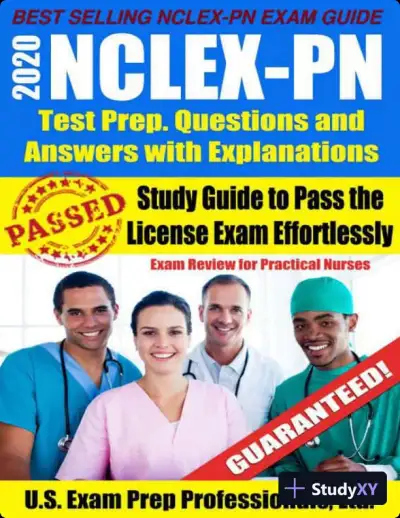 Certification Guides
2020 NCLEX-PN Test Prep. Questions and Answers with Explanations (2020)
National Council Licensure Examination
943 pages147downloadsFeb 2025 Certification Guides
CliffsTestPrep NCLEX-RN (2011)
National Council Licensure Examination
510 pages130downloadsFeb 2025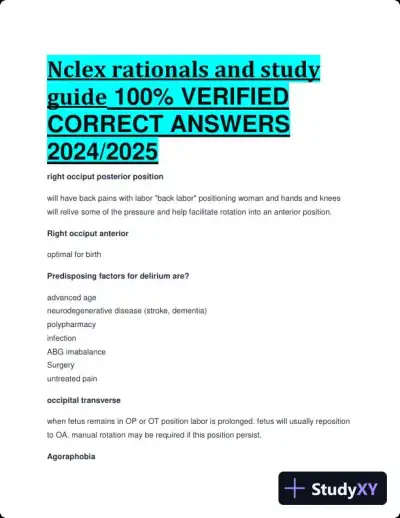 Past Exams
2024-2025 NCLEX Rationals and Study Guide with Answers (168 Solved Questions)
National Council Licensure Examination
41 pages130downloadsFeb 2025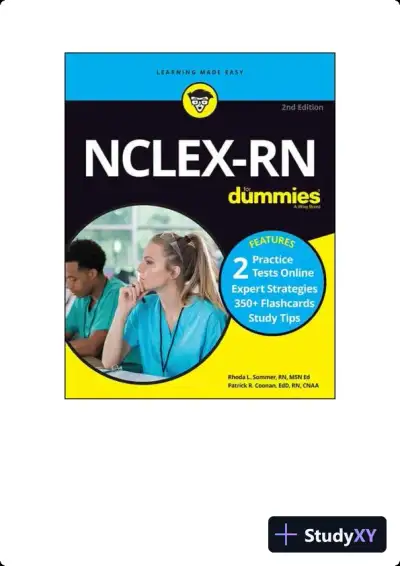 Certification Guides
NCLEX-RN For Dummies with Online Practice Tests (2020)
National Council Licensure Examination
485 pages125downloadsFeb 2025
Study this document with CramX
Once it is in your library, every tool can work from it.