

NSG 3160 NCLEX Review Chapter 24
- National Council Licensure Examination
- 16 pages
- Shared June 2025
This NCLEX-style quiz focuses on the neurological system, covering brain structure, reflexes, sensory pathways, and pain interpretation—ideal for nursing students reviewing neuroanatomy and preparing for the NCLEX-RN exam.
Preview 5 of 16 pages
See the first 5 pages exactly as they appear in the document.
Page 1 Read page 1 as text
NSG 3 1 6 0 NCLEX REVIEW M r . Paul Haidet (Miami Campus Content Enrichment Specialist) Neurological System (Chapter 24) Stuviaxom Online NSG 3160 NCLEX Database Questions Question 1 The two parts of the nervous system are the: a. Motor and sensory b. Central and peripheral c. Peripheral and autonomic d. Hypothalamus and cerebral Question 2 Which cerebral lobe is responsible for personality changes? a. Frontal b. Parietal c. Occipital d. Temporal
Page 2 Read page 2 as text
Question 3 Which statement about the brain is true? a. The cerebellum is the center for speech and emotions. b. The hypothalamus controls body temperature and regulates sleep. c. The basal ganglia are responsible for controlling voluntary movements. d. Motor pathways of the spinal cord and brainstem synapse in the thalamus. Question 4 Which area of t h e nervous system is responsible f o r controlling reflexes? a. Medulla b . Cerebellum c. Spinal cord d . Cerebral cortex
Page 3 Read page 3 as text
Question 5 Which of these areas interprets sharp sensations? a. Corticospinal tract, medulla, and basal ganglia b. Pyramidal tract, hypothalamus, and sensory cortex c. Lateral spinothalamic tract, thalamus, and sensory cortex d. Anterior spinothalamic tract, basal ganglia, and sensory cortex Question 6 Which of the following is the best explanation why a patient with a lack of oxygen to his heart will have pain in his chest and in the shoulders, arms, or jaw? a. A problem exists with the sensory cortex and its ability to discriminate the location. b. The lack of oxygen i n his heart has resulted in decreased amount of oxygen to the areas experiencing the pain. c. The sensory cortex does not have the ability to localize pain in the heart; consequently, the pain is felt elsewhere. d. A lesion has developed in the dorsal root, which is preventing the sensation from being transmitted normally.
Page 4 Read page 4 as text
Question 7 Skilled movements such as writing is controlled by the: a. Basal ganglia b. Corticospinal tract c. Spinothalamic tract d. Extrapyramidal tract Question 8 Which area of the brain that is related to balance? a. Thalamus b. Brainstem c. Cerebellum d. Extrapyramidal tract
Page 5 Read page 5 as text
Question 9 What is true about the peripheral nervous system? a. The CNs enter t h e brain through the spinal cord. b . Efferent fibers carry sensory input t o t h e central nervous system through t h e spinal cord. c. The peripheral nerves are inside t h e central nervous system and carry impulses through their motor fibers. d. The peripheral nerves carry input t o t h e central nervous system by afferent fibers and away from t h e central nervous system by efferent fibers Question 10 Which of the following statements is true for a patient with a severed spinal nerve? a. Because there are 3 1 pairs of spinal nerves, no effect results if only one nerve is severed. b. The dermatome served by this nerve will no longer experience any sensation. c. The adjacent spinal nerves will continue t o carry sensations for the dermatome served by the severed nerve. d. A severed spinal nerve will only affect motor function of the patient because spinal nerves have no sensory component
11 more pages in the full document
Unlock it once and it stays in your library, ready to chat with or turn into flashcards.
Unlock the full documentMore National Council Licensure Examination study materials
See all Past Exams
2024-2025 NCLEX Review Study Guide with Answers (50 Solved Questions)
National Council Licensure Examination
9 pages169downloadsFeb 2025 Certification Guides
Developing Clinical Judgment for Professional Nursing and the Next-Generation NCLEX-RN® Examination (2020)
National Council Licensure Examination
713 pages162downloadsFeb 2025 Certification Guides
NCLEX-RN Notes: Core Review and Exam Prep (2007)
National Council Licensure Examination
281 pages156downloadsFeb 2025 Certification Guides
HESI Comprehensive Review for the NCLEX-RN Examination 6th Edition (2019)
National Council Licensure Examination
842 pages150downloadsFeb 2025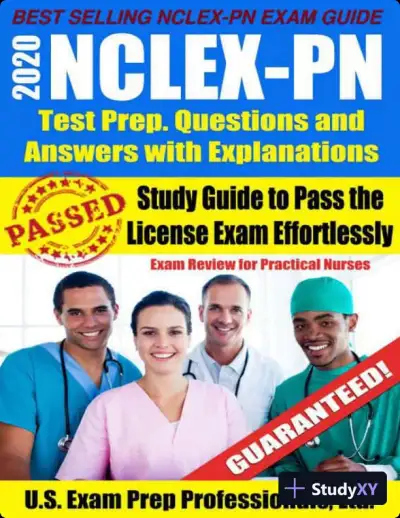 Certification Guides
2020 NCLEX-PN Test Prep. Questions and Answers with Explanations (2020)
National Council Licensure Examination
943 pages147downloadsFeb 2025 Certification Guides
CliffsTestPrep NCLEX-RN (2011)
National Council Licensure Examination
510 pages130downloadsFeb 2025 Past Exams
2024-2025 NCLEX Rationals and Study Guide with Answers (168 Solved Questions)
National Council Licensure Examination
41 pages130downloadsFeb 2025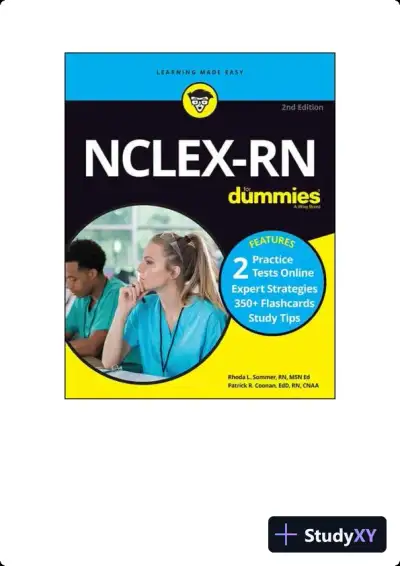 Certification Guides
NCLEX-RN For Dummies with Online Practice Tests (2020)
National Council Licensure Examination
485 pages125downloadsFeb 2025
Study this document with CramX
Once it is in your library, every tool can work from it.