

2018 NURS6550 Walden University Clinical Analysis Final Exam Study Guide With Answers (101 Solved Questions)
- Nursing
- Walden University
- 36 pages
- Shared May 2025
Strengthen your knowledge with 2018 NURS6550 Walden University Clinical Analysis Final Exam Study Guide With Answers, a powerful study tool packed with real past exams.
Preview 11 of 36 pages
See the first 11 pages exactly as they appear in the document.
Page 1 Read page 1 as text
NURS 6 550 FIN AL E X AM – WALDE N UNIVE RS ITY S UM ME R 2 018 QUESTION 1 1. Mr. Jeffers was admitted 2 days ago for a carotid endarterectomy. A Foley catheter was inserted intraoperatively and remains in place. His urine output has declined markedly despite continued IV fluid infusion. Today his morning labs reveal a BUN of 19 mg/dL and a creatinine of 2 mg/dL. A leading differential includes: A . Foley lodged in the urethra causing post- renal failure B . Decreased renal perfusion causing prerenal failure C . Age-related decreased eGFR causing prerenal failure D . Post-surgical rhabdomyolysis causing intrarenal failure 1 points QUESTION 2 1. Janet is admitted with symptomatic tachycardia. Her pulse is 160 b.p.m. and she is weak, diaphoretic, and anxious. Physical examination reveals a 5’4” 107 lb black female who is awake, alert, and oriented, anxious, with moist skin and racing pulse. Her blood pressure is 140/100 mm Hg. Temperature and respiratory rate are within normal limits. The patient admits to having a “thyroid condition” but she never followed up on it when she was advised to see an endocrinologist. The AGACNP anticipates a diagnosis of: A . Hashimoto’s thyroiditis B . Cushing’s syndrome C . Grave’s disease D . Addison’s disease 1 points QUESTION 3 1. Systemic lupus erythematosis (SLE) is a multiorgansystem autoimmune disorder that can prevent with a wide variety of manifestations. Which clinical triad should prompt an evaluation for SLE? A . Fever, normal white count, elevated sedimentation rate
Page 2 Page 3 Read page 3 as text
B . Hyperkalemia, hyponatremia, low blood pressure C . Leukocytosis, hyperglycemia, hypokalemia D . Joint pain, rash, fever 1 points QUESTION 4 1. A patient presents with profound vertigo of acute onset yesterday. She can barely turn her head without becoming very vertiginous; she is nauseous and just doesn’t want to move. This morning when she tried to get out of bed she felt like she was pushed back down. The vertigo is reproducible with cervical rotation. The patient denies any hearing loss or tinnitus, she has no fever or other symptoms. The AGACNP knows that the most helpful intervention will probably be: A . Meclizine B . Diazepam C . Bed rest D . Epley’s maneuvers 1 points QUESTION 5 1. Mrs. Mireya is an 85-year-old female who is admitted for evaluation of acute mental status change from the long term care facility. She is normally ambulatory and participates in lots of facility activities. Today a nursing assistant found her in her room, appearing confused and disconnected from her environment. When she tried to get up she fell down. Her vital signs are stable excepting a blood pressure of 90/60 mm Hg. The AGACNP knows that the most likely cause of her symptoms is: A . Osteoarthritis B . Drug or alcohol toxicity C . Hypotension D . Urosepsis 1 points QUESTION 6 1. A patient with SIADH would be expected to demonstrate which pattern of laboratory abnormalities?
Page 4 Read page 4 as text
A . Serum Na+ 119 mEq/L, serum osmolality 240 mEq/L, urine Na+ of 28 mEq/L, urine osmolality of 900 mOsm/kg B . Serum Na+ 152 mEq/L, serum osmolality 315 mEq/L, urine Na+ of 5 mEq/L, urine osmolality of 300 mOsm/kg C . Serum Na+ 121 mEq/L, serum osmolality 290 mEq/L, urine Na+ of 7 mEq/L, urine osmolality of 850 mOsm/kg D . Serum Na+ 158 mEq/L, serum osmolality 251 mEq/L, urine Na+ of 20 mEq/L, urine osmolality of 420 mOsm/kg 1 points QUESTION 7 1. Sean is a 29-year-old male who presents to the emergency department for evaluation and treatment of foreign body in the eye. Ophthalmic anesthesia is achieved and removal is attempted unsuccessfully with a moist cotton tipped swab. A wet fluorescein stain is applied to the lower eyelid, and a corneal abrasion ruled out but the AGACNP notes a positive Seidel sign. This indicates: A . Penetration of the cornea with resultant aqueous leak B . A rust ring remnant due to metal foreign body C . An elevated intraocular pressure D . Paradoxical pupil dilation in response to light 1 points QUESTION 8 1. Mrs. Lowen is an 82-year-old female who comes to the emergency department for evaluation of a fever of 102.9° F. She complains of a headache in the right side of her temple and some right-sided jaw pain. A urinalysis, chest radiograph, complete blood count (CBC) and 12-lead ECG are all non-contributory. A comprehensive metabolic panel is significant only for a slightly elevated BUN and creatinine. The AGACNP appreciates distinct right temple tenderness to percussion. Which laboratory test is necessary to support the suspected diagnosis? A . An erythrocyte sedimentation rate B . A white blood cell differential C . Two sets of blood cultures D . Echocardiography 1 points
Page 5 Read page 5 as text
QUESTION 9 1. Ms. Schiebel, a 31-year-old female who is brought to the emergency department by police after being arrested for disruptive behavior in a public establishment. The differential diagnosis includes drug and alcohol ingestion/toxicity, central nervous system disease, severe trauma, and psychotic illness; ultimately the alcohol and toxicology screen as well as head imaging are negative. When considering psychotic illness, the AGACP knows that this is a physiologic imbalance that typically involves an excess of: A . Serotonin B . Norepinephr ine C . Acetylcholin e D . Dopamine 1 points QUESTION 1 0 1. Mr. Lincoln is a 55-year-old male who was admitted for management of sepsis secondary to pneumonia. He has declined rapidly, and today chest radiography demonstrates a diffuse, bilateral “white-out” appearance. His paO 2 is 55 mm Hg. In order to increase his oxygenation the AGACNP knows that which of the following interventions is indicated? A . Increased FiO 2 B . Increased respiratory rate C . Increased tidal volume D . Increased PEEP 1 points QUESTION 1 1 1. A 29-year-old female patient presents with a complaint of palpitations. Physical examination reveals an essentially healthy female with no significant medical history and no maintenance medications; the only thing she can report is that she had a head cold a week or so ago. The vital signs include a blood pressure of 139/90 mm Hg, pulse of 105 b.p.m, respiratory rate of 16 b.p.m. and a temperature of 98.6° F. The only abnormal finding on physical examination is diffuse anterior neck tenderness with thyroid palpation. The AGACNP considers which medication for symptom control? A . Ibuprofen B . Pseudoephed rine
Page 6 Read page 6 as text
C . Propranolol D . Methimazole 1 points QUESTION 1 2 1. Jennifer is an 18-year-old homeless female who was found unresponsive. She was admitted to the hospital for management of severe bleeding after a spontaneous abortion escalated to a uterine hemorrhage. An underlying infection and dehydration were corrected and nutritional supplements were started. Her volume status is stable, morning labs were all within normal limits and she is to be discharged today. When the AGACNP enters the room to prepare the patient for discharge, she finds her agitated, pale, and diaphoretic with vital signs to include a pulse of 105 bpm, respirations of 24 bpm, blood pressure of 110/76 mm Hg and a temperature is 97.9° F. The most appropriate action would be to: A . Order a CBC to assess for recurrent bleeding B . Request and abdominal CT to assess for bleeding C . Evaluate the patient for anxiety/panic attack D . Prescribe alprazolam 1 mg now 1 points QUESTION 1 3 1. Physical examination findings in a patient with pneumothorax is likely to reveal: A . Increased tactile fremitus B . Low grade temperature C . Hyperresonance to percussion D . Egophany 1 points QUESTION 1 4 1. Mr. Parker brings his 73-year-old wife to a clinic appointment because he is worried about her. She has a long history of hypertension and dyslipidemia, but he says she has taken medication for years and everything has been OK. His concern today is that for a long time she has been very forgetful, and he has tried to help her by keeping a strict routine around the house. Over the past few months, she just seems more and more forgetful, does not seem interested in doing anything, and now seems to be forgetting how to do simple everyday tasks. Yesterday she could not figure out which dollar bills to use at the store to pay the cashier. The AGACNP knows Mrs. Parker should first be screened for:
Page 7 Read page 7 as text
A . Depression B . A brain tumor C . Hypothyroidism D . Adrenal dysfunction 1 points QUESTION 1 5 1. M.R. is a 40-year-old female who has a known history of peptic ulcer disease. She has been admitted through the emergency room with a diagnosis of GI bleeding—she is vomiting dark blood and had a nasogastric tube placed. When attached to low intermittent suction it initially drained 400 cc of dark brown/black drainage, but now it is starting to drain lighter red colored blood. The AGACNP knows that immediate priorities of care include: A . Ensuring hemodynamic stability B . Beginning a parenteral proton pump inhibitor C . Beginning gastric lavage D . Ordering a gastrointestinal consult 1 points QUESTION 1 6 1. A patient with sharp, stabbing chest pain directly over the precordium has a 12-lead ECG that demonstrates concave ST-T wave elevations in leads II, III, avR, avL, avF, and all six precordial leads. The AGACNP expects which physical finding? A . A grade IV/VI systolic murmur with radiation to the axilla B . A split S2 that increases with inspiration C . A pericardial friction rub D . An S4 heart sound 1 points QUESTION 1 7 1. J.Q. is a 45-year-old male who had gastric bypass surgery 18 months ago. A CBC reveals a macrocytic anemia with a Hgb of 9.8 g/dL, HCT of 30%, MCV of 115 and RDW of 19%. The AGACNP suspects which type of anemia?
Page 8 Read page 8 as text
A . Iron deficiency B . Sickle cell anemia C . Pernicious anemia D . Anemia of chronic disease 1 points QUESTION 1 8 1. Megan K. is a 21-year-old female who presents complaining of irritated eyes. She says this happens a couple of times a year and this time it is really a problem. Both eyes are itchy and red and she has a lot of stringy discharge, especially at the end of the day. Her visual acuity is 20/25 OS, OD, and OU with her glasses on. Physical exam reveals injected conjunctiva bilaterally but there is no photophobia. Pupils are equal, round, briskly reactive, and accommodate. The AGACNP knows that immediate treatment should include ophthalmic application of: A . Steroids B . Antihistam ine C . Antibiotic D . Cycloplegi c 1 points QUESTION 1 9 1. Ellen is a 61-year-old female who presents with a chief complaint of neck pain. The history of present illness reveals that Ellen felt as though a bug bit her behind the neck a few days ago. A day or two later it started to hurt, and when she began to pick at it she felt drainage come out. She is here now for evaluation. Physical exam reveals an 8 cm x 8 cm draining abscess in the right post auricular region with posterior cervical lymphadenopathy. Ellen has a temperature today of 101.9° F. The AGACNP knows that in addition to incision and drainage of the abscess, effective management must include: A . Systemic antibiotics B . Tetanus immune globulin C . Tetanus toxoid D . Antipyretics
Page 9 Read page 9 as text
1 points QUESTION 2 0 1. A 13-year-old male presents with a chief complaint of ear drainage. The patient and his mother both indicate that the patient has not had any pain or any systemic complaints, but the pus-like discharge from the ear is very persistent. According to Mom they went to a retail clinic two weeks ago and the patient was prescribed both oral antibiotics and ear drops, but it didn’t help. Physical exam of the ear reveals a painless pinna; otoscope exam reveals only a large amount of mucopurulent drainage—the tympanic membrane could not be visualized. The AGACNP knows the diagnosis is most likely: A . Acute otitis media B . Acute otitis externa C . Cholesteatoma D . Otitis media with effusion 1 points QUESTION 2 1 1. A 71-year-old male patient with lung cancer is admitted for treatment of sepsis related to his chemotherapy-induced immunosuppression. He seems to be improving from an infectious perspective, but during today’s assessment the AGACNP appreciates coarse rales in the lung fields, a blood pressure of 140-100 mm Hg, a bounding pulse, and trace pretibial edema. The urine output via Foley catheter has only been 100 mL in the last 8 hours. Suspicious for syndrome of inappropriate antidiuretic hormone (SIADH), the AGACNP orders a basic metabolic panel anticipating which of the following abnormalities? A . Hypokalemi a B . Hypocalcem ia C . Hyponatrem ia D . Hypochlore mia 1 points QUESTION 2 2 1. A crescendo-decrescendo systolic murmur best appreciated at the second intercostal space, right sternal border with radiation to the carotid artery is most likely an indicator of: A . Aortic stenosis B . Aortic regurgitation
Page 10 Read page 10 as text
C . Tricuspid stenosis D . Tricuspid regurgitation 1 points QUESTION 2 3 1. The AGACNP knows that diagnostic findings consistent with rheumatoid arthritis include: A . Soft tissue swelling of the metacarpals B . Radiographic joint space narrowing C . Heberden’s nodes D . Subungal hemorrhages 1 points QUESTION 2 4 1. C.T. is a 39-year-old female who presents for evaluation of what she thinks is her “rosacea acting up.” She has a history of acne rosacea and has medicated on and off for years with tetracycline and topical metronidazole. Today however she presents with a pronounced red/purple area on her left cheek extending to the nasal border. It is very warm to the touch. The borders of the affected area are very well defined and raised. C.T. also has a temperature of 100.7° F and a generalized headache. The AGACNP appreciates tender submandibular and cervical lymphadenopathy. The likely diagnosis is: A . Complex rosacea B . Cellulitis C . Erysipelas D . Allergic reaction 1 points QUESTION 2 5 1. Mr. Lopez is a 51-year-old male patient who is being treated for T2DM. His HgbA1c is 15.6% and initial management will include aggressive attempts for weight reduction as his body mass index (BMI) is 45. He says he is unable to participate in any meaningful exercise because he very often has back pain; he has had it for years and has tried all sort of over the counter medicines with little relief. He describes it as a profound ache that occurs across the lower part of his back bilaterally; it does not travel down either leg. The physical inspection is normal, but he has significant paraspinal tenderness to palpation bilaterally. He
Page 11 Read page 11 as text
cannot identify any injury or accident that preceded the pain. The history and physical exam is noncontributory. The AGACP knows that the likely diagnosis is: A . Lumbar radiculopathy B . Ankylosing spondylitis C . Lumbar sacral strain D . Degenerative disk disease 1 points QUESTION 2 6 1. A patient presents with acute onset of vesicular lesions on her vulva. They are surrounded by areas of redness and they hurt. The patient says that she has even more of them now then she did when she woke up this morning. There is also inguinal lymphadenopathy. The AGACNP is suspicious for: A . Human papilloma virus B . Primary syphilis C . Gonorrhea D . Herpes simplex virus 1 points QUESTION 2 7 1. Classic radiographic features of osteoarthritis include: A . Soft tissue swelling B . Joint deformity C . Bone mineral loss D . Joint space narrowing 1 points QUESTION 2 8 1. Mrs. Sandoval is a 72-year-old female who presents with a chief complaint of transient verbal confusion. She was speaking with her friend on the phone this morning when she suddenly couldn’t get words out. Her friend went over to her home and found Mrs. Sandoval awake, alert, and oriented, responding appropriately with non-verbal gestures, but
25 more pages in the full document
Unlock it once and it stays in your library, ready to chat with or turn into flashcards.
Unlock the full documentMore Nursing study materials
See all Exam Guides
Test Bank for Critical Care Nursing: Diagnosis and Management, 9th Edition (Chapters 1-27)
Nursing
299 pages167downloadsFeb 2025 Class Notes
An Invitation To Health, Third Canadian Edition Lecture Notes
Nursing
439 pages163downloadsFeb 2025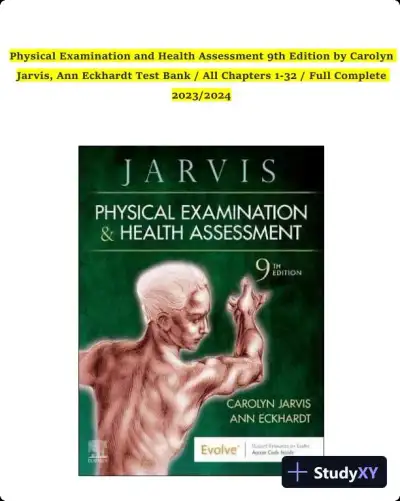 Exam Guides
Test Bank for Physical Examination and Health Assessment, 9th Edition (Chapters 1-15)
Nursing
200 pages161downloadsFeb 2025 Exam Guides
Focus on Nursing Pharmacology Seventh, North American Edition Test Bank
Nursing
1144 pages160downloadsFeb 2025 Exam Guides
Test Bank for Fundamentals of Nursing, 11th edition (Chapters 1-24)
Nursing
200 pages160downloadsFeb 2025 Class Notes
Class Notes for Clinical Nursing Skills: Basic to Advanced Skills, 9th Edition
Nursing
150 pages154downloadsFeb 2025 Class Notes
Class Notes for Child Health Nursing, 3rd Edition
Nursing
861 pages154downloadsFeb 2025 Class Notes
Class Notes for Principles of Pediatric Nursing Caring for Children, 6th Edition
Nursing
191 pages152downloadsFeb 2025
Study this document with CramX
Once it is in your library, every tool can work from it.