

An Invitation To Health, 17th Edition Lecture Notes
- Nursing
- 179 pages
- Shared May 2025
An Invitation To Health, 17th Edition Lecture Notes ensures you grasp difficult topics with well-organized notes that capture essential lecture material.
Preview 16 of 179 pages
See the first 16 pages exactly as they appear in the document.
Page 1 Read page 1 as text
1 Your Invitation to a Healthy Future Learning Objectives After studying this chapter in the text, the student should be able to: 1. Comment on the aspects of health and wellness. 2. Discuss the current state of health in America. 3. Describe the unhealthy habits and health issues of college students. 4. Summarize how healthy habits can improve the quality of life. Chapter Summary We extend an invitation to you to live more fully, more happily, and more healthfully. It is an offer that you literally cannot afford to refuse . Y our life may depend on it -- starting now . Lecture Outline I. Health and Wellness A. Health means being sound in body, mind, and spirit. B. The World Health Organization defines health as “not merely the absence of disease or infirmity,” but “a state of complete physical, mental, and social well - being.” C. Health has many dimensions: physical, psychological, spiritual, social, intellectual, and environmental. D. Wellness can be defined as purposeful, enjoyable living or, more specifically, a deliberate lifestyle choice characterized by personal responsibility and optimal enhancement of physical, mental, and spiritual health. II. The Dimensions of Health A. Physical Health 1. Not a static state B. Psychological Health 1. Our emotional and mental states C. Spiritual Health 1. Spiritually healthy individuals identify their own basic purpose in life; learn how to experience love, joy, peace, and fulfillment; and help themselves and others achieve their full potential. D. Social Health
Page 2 Page 3 Read page 3 as text
1. T he ability to interact effectively with other people and the social environment, to develop satisfying interpersonal relationships, and to fulfill social roles E. Intellectual H ealth 1. The ability to think and learn from life experience, your openness to new ideas, and your capacity to question and evaluate information. F. Environmental Health 1. T he impact your world has on your well - being G. Occupational Health 1. The balance between the rewards and challenges of a career and how these affect your well - being III. Health in America A. The United States spends more than any other nation on health care. 1. Among the diseases taking the greatest toll on Americans’ well - being are hypertension, heart disease, diabetes, arthritis, and autoimmune disorders. 2. In comparison with almost all of the 16 high - income “peer” countries, American have shorter life expectancies. IV. How We Lag Behind A. Birth outcomes B. Injuries and homicides C. Teen pregnancy and sexually transmitted infections (STIs) D. HIV and AIDS E. Drug - related mortality F. Obesity and diabetes G. Heart disease H. Chronic lung disease I. Disability V. Closing the Gap A. Fitness B. Weight C. Overall h ealth D. Medical c onditions E. Health c are F. Healthy People 2020 1. Mission 2. Goals G. Health Disparities 1. The toll of poverty 2. Why race matters 3. Cancer Screening and Management 4. Cardiovascular Disease 5 . Diabetes 6 . Infant Mortality
Page 4 Read page 4 as text
7 . Mental Health 8. Infectious Disease 9 . HIV and Sexually Transmitted Infections H . Sex, Gender, and Health 1. Sex is a classification according to the reproductive organs and functions that derive from the chromosomal complement. 2. Gender is a person’s self - representation as male or female or how social institutions respond to a person, on the basis of the individual’s gender presentation. VI. Health on Campus A. College and Health 1. Health risks increase significantly B. How Healthy are Today’s Students? 1. Adults in the US ages 20 - 34 have the highest BMIs of any developed country 2. About 67 percent have drunk alcohol in the previous months; 42.7 percent reported 5 or more drinks in a single sitting in the past two weeks. 3. Only about half reported using a condom mostly or always during vaginal intercourse. 4. Only 11.9 percent report getting enough sleep six or more days a week; 10 percent never feel rested. 5. College athletes have lower health - related quality of life. C. Why “Now” Matters D. Student Health Norms 1. Social norm refers to a behavior or an attitude that a particular group expects, values, and enforces. E. The Promise of Prevention 1. No medical treatment can compare with the power of prevention. F. Protecting Yourself 1. There is a great deal of overlap between prevention and protection. 2. Assess risk to determine protection. G. Understanding Risky Behaviors 1. Young people overestimate immediate pleasure compared to danger of some risky behaviors. VII. Making Healthy Changes A. Understanding Health Behavior 1. Predisposing factors 2. Enabling factors 3. Reinforcing factors VIII. How and Why People Change A. The Health Belief Model B. Self - Determination Theory C. Motivational Interviewing D. Self - Affirmation Theory E. The Transtheoretical Model
Page 5 Read page 5 as text
1. The stages of change 2. The processes of change F. Self - efficacy and locus of control D iscussion Questions Discuss with students which dimension of health is most prominent in their lives. Why? W ith w hich are they least concerned? Ask students what they could do in order to incorporate all components into their lives? What are some of the obvious differences between those who do incorporate all of these aspects into their lives and those who only concentrate on one or two components? Ask students to take a quick inventory of their own and their immediate family’s health status. Using the statistics found in the text, compare their inventory to the different health risks for their racial and ethnic group. Ask students what factors they believe contribute to the differences in health status that various racial and ethnic groups face. How might religion affect the health of a culture? What challenges do ethnicity, race, religion, gender, and sexual orientation bring to the health - care system? What actions can government, universities, hospitals, and other health - care facilities and individuals take to address these differences? Identify some of the religious differences that might affect the overall health of an individual for the better or worse. What factors in the health - care system might keep various individuals from keeping up with their health? Ask students how they have handle d their newfound freedom since attending college or leaving home for the first time. How have their parents handle d and react ed to it? How does this sense of independence affect their health? What health challenges do they face? Ask students to identify ways they can keep their medical costs down without sacrificing good health. What options do th ey have if they are not insured ?
Page 6 Read page 6 as text
Classroom Activities Activity #1: Meet Your Classmates Purpose: 1. To meet your classmates and learn to appreciate the differences we all share. 2. To learn how to appreciate nonverbal communication. Time: 10 to 15 minutes of class Introduction: Introduce the disparities in health and how often we overlook our differences. Elaborate on the following communication facts: a. Seven percent of communication is the result of the verbal message: words. b. Fifty - eight percent of communication is the result of nonverbal cues. Method: 1. Go to an area in which students can easily move around. 2. Divide the class into two or three teams. 3. Have students stand in a straight line. 4. Give students a topic (most siblings, most pets, most operations, height, weight, age, foot size).
Page 7 Read page 7 as text
5. Have students line up accordingly (most to least, least to most). 6. Keep track of time to see which group lines up first (and then compare times after they aren’t allowed to speak). 7. To add a twist, don’t let students talk while trying to line up. 8. Repeat many times so that the students get a chance to be in a different location each time. Discussion: 1. Discuss with the students how they felt when they couldn’t talk. What did they rely on to communicate? a. How did some communicate? Were there different styles? b. Is nonverbal communication as effective as verbal communication? Explain. 2. Discuss whether anyone was always in the same place in line. Discuss these differences. 3. How might these differences reflect how we treat ourselves? Our lifestyle behaviors Activity #2: The Dimensions of Health Purpose: 1. To introduce and investigate the dimensions of health and how various individuals perceive these dimensions. 2. To analyze human behavior in the context of physical, psychological, social, intellectual, environmental, and spiritual health. 3. To enable students to meet their classmates. Time: One class period Method: 1. Form a circle in the room. 2. Instruct each student to introduce hi m or herself and identify a dimension of health that represents their lifestyle by acting it out. Discussion: 1. Discuss the various ways that people perceived the dimensions , not only the person acting out the dimension but also the audience.
Page 8 Read page 8 as text
Activity #3: Family Health History Purpose: 1. To investigate your family health history. 2. To analyze how current health practices along with family health history can determine future health. Time: One class period Method: 1. Have students first create a family tree that includes parents, siblings, grandparents, aunts , and uncles. Students should also list close relatives who may be deceased. 2. After creating the family tree, students should list an y health concerns or illnesses any family member ha s experienced. Discussion: 1. How many relatives in their family tree have health concerns? 2. Discuss how those health conditions may play a role in the student’s life in terms of their own health. 3. Discuss strategies for behavior change or preventive measures that each student can take to possibly avoid the same health concerns.
Page 9 Read page 9 as text
R eferences, Readings, and Resources Books Demetre, Danna. Change Your Habits, Change Your Life, A Proven Plan for Healthy Living. Grand Rapids, MI: Revell, 2009. Sets forth guidelines for replacing negative “mental programming” with messages that lead to healthier living. Note: uses a Christian framework. LaVeist, Thomas. Race, Ethnicity, and Health: A Public Health Reader . San Francisco: Wiley, 2002. Explores the racial and ethnic health disparities in America. Audiovisual Resources Chopra, Deepak. The Secret of Healing: Meditations for Transformation and Higher Consciousne s s . Play It By Ear Music, 2011. Audio CD. The first in a new series of guided meditation CDs by Deepak Chopr a and Adam P lack. Minority Health . DVD. New York: Films Media Group, 2007. Healthy living presents special challenges for members of minorities living in lower - income neighborhoods — particularly senior citizens. This program examines those challenges, and the health problems that can result, by focusing on African American and Latino communities . Internet Resources U.S. Department of Health and Human Services Principal agency for protecting the health of all Americans and providing essential human services, especially for those who are least able to help themselves. http://www.hhs.gov Centers for Disease and Prevention Provides a wide variety of information and is a gateway to specific CDC agencies . http://www.cdc.gov / Go Ask Alice Sponsored by Columbia University, this site offers questions and answers as well as an interactive service on a wide variety of health - related topics.
Page 10 Read page 10 as text
http://www.goaskalice.columbia.edu / WebMD Provides information on a variety of health issues. http://www.webmd.com Healthy People 2020 Healthy People 2020 is a statement of national health objectives designed to identify the most significant preventable causes of acute and chronic illnesses and accidents, and to establish national goals to reduce these threats to health. http://www.cdc.gov/nchs/healthy_people/hp2020.htm National Institutes of Health A governmental organization that supplies data and resources on a wide variety of health issues. http://www.nih.gov U.S. National Library of Medicine The l ibrary collects materials and provides information and research services in all areas of biomedicine and health care. http://www.nlm.nih.gov Answers to Selected MindTap Activities Global Health Watch 1. b 2. b 3 . school events Video Quiz 1. b 2. c 3 . type II
Page 11 Read page 11 as text
2 Your Psychological and Spiritual Well - Being Learning Objectives After studying this chapter in the text, the student should be able to: 1. Recognize the characteristics of emotionally healthy individuals. 2. Summarize the components of positive mental health that can lead to a happy and purposeful life. 3. Describe the roles of autonomy and self - assertion in boosting self - control . 4. Discuss the impact of spirituality on individuals . 5. Summarize the significance of having a good night’s sleep . Chapter Summary This chapter reports the latest findings on making the most of psychological strengths, enhancing happiness, and developing the spiritual dimension of your health and your life. It also explores an often overlooked dimension of physical and emotional well - being: sleep Lecture Outline I. Emotional and Mental Health A. Psychological health encompasses both our emotional and mental states — that is, our feelings and our thoughts. 1. Emotional health generally refers to feelings and moods. 2. Mental health describes our ability to perceive reality as it is, to respond to its challenges, and to develop rational strategies for living. 3. Culture helps to define psychological health. In our diverse society, many cultural influences affect Americans’ sense of who they are, where they came from, and what they believe. II. The Lessons of Positive Mental Health A. The three major areas of positive psychology are the study of positive emotions, such as hope and trust; positive traits , such as wisdom and courage; and positive institutions, such as strong families and democracy. B. Know Yourself 1. Conscientiousness 2. Extraversion C. Develop Self - Compassion
Page 12 Read page 12 as text
1. Self - compassion is a healthy form of self - acceptance and a way of conceptualizing our favorable and unfavorable attitudes about ourselves and others. D. Boost Emotional Intelligence 1. EQ (emotional quotient) is the ability to monitor and use emotions to guide thinking and actions. E. Meet Your Needs 1. According to Maslow, human needs are the motivating factors in personality development. F. Boost Self - Esteem 1. Self - esteem is based on what you believe about yourself. It is not something you are born with; it develops over time. G. Pursue Happiness 1. Genetics accounts for 50 percent of your happiness. 2. L ife circumstances account for 10 percent of your happiness. 3. Forty percent of your happiness depends on what you do. H. Become Optimistic 1. Optimism is the extent to which individuals expect favorable outcome s to occur . I. Manage Your Moods 1. A mood is a more sustained emotional state that colors our view of the world for hours or days. 2. The most effective way to banish a sad or bad mood is by changing what caused it in the first place. III. Feeling in Control A. Developing Autonomy B. Assert Yourself IV. Spiritual Health A. Spiritual health involves our ability to identify our basic purpose in life and to experience the fulfillment of achieving our full potential. B. Spirituality and Physical Health C. Deepen Your Spiritual Intelligence D. Clarify Your Values E. Enrich Your Spiritual Life F. Consider the Power of Prayer 1. Some scientists speculate that prayer may foster a state of peace and calm that could lead to beneficial changes in the cardiovascular and immune systems. G. Cultivate Gratitude 1. A grateful spirit brightens mood, boosts energy, and infuses daily living with a sense of glad abundance. How can you let your gratitude grow? a. Keep a gratitude journal. b. Record three things you are grateful for every day. H. Forgive
Page 13 Read page 13 as text
1. Being angry, harboring resentments, or reliving hurts over and over again is bad for your health in general and your heart in particular. V. Sleepless on Campus A. Student Night Life 1. College students are notorious for their erratic sleep schedules . 2. Alcohol compounds many students’ sleep problems. B. Sleep’s Impact on Health 1. Sleep affects many aspects of daytime well - being. C. What Happens When We Sleep? 1. Stage 1: A twilight zone between full wakefulness and sleep, the brain produces small, irregular, rapid electrical waves. Muscles relax and breathing is smooth and even. 2. Stage 2: Brain waves are larger and punctuated with occasional sudden bursts of electrical activity. Eyes no longer react to light and bodily functions slow ly . 3. Stage s 3 and 4: Constitute the most profound state of unconsciousness. The brain produces slower, larger waves ; sometimes referred to as “delta” or slow - wave sleep. D. How Much Sleep Do You Need? 1. Normal sleep times range from five to ten hours. 2. Each of us seems to have an innate sleep appetite that is as much a part of our genetic programming as hair color and skin tone. E. To Nap or Not to Nap? 1. A late - afternoon nap proved to undo the negative impact on hormones and immunity of a lost night of sleep. 2. Napping can di srupt the sleep - wake cycle. F. Sleep Disorders 1. Insomnia: A lack of sleep so severe that it interferes with functioning during the day. 2. Treatments: R elaxation therapy , c ognitive therapy , s timulus control therapy , s leep restriction therapy G. Breathing Disorders (Snoring and Sleep Apnea) H. Movement Disorders I. Circadian Rhythm Sleep Disorders J. Sleeping Pills 1. The use of prescription sleeping pills has more than doubled in the last decade. 2. Use of any sleeping medication should be carefully considered. Discussion Questions Discuss the concept of psychological health as it relates to the other five dimensions of health. Can psychological health be separate and distinct from the other components without affecting them? How so? How does it or doesn’t it contribute to the holistic model? How do the other dimensions affect one’s psychological health?
Page 14 Read page 14 as text
Ask students what it means to love and accept themselves. Can one accept and love another without first loving oneself? How? Why? How does this relate to Maslow’s h ierarchy of thinking? Ask students what emotional intelligence means to them. D iscuss with students how they might go about developing and strengthening their emotional intelligence . Discuss the benefits of possessing emotional intelligence. What role does an individual’s EQ play in their everyday life or career? Ask them which they would rather have, a high IQ or a high EQ . Why? Ask students what factors contribute to happiness. Compare these characteristics to those cited for contributing to good psychological health. Ask students to make a list of the things that make them happy. Do they think of the things on the list when they make choices or decisions that may affect their happiness? Why? Discuss the concept of sleep deprivation as discussed in the text. Ask for volunteers who have experienced it to share their symptoms or experiences. Ask others to share the strategies and rituals they use to reduce sleep deprivation and maximize restful sleep. How might they improve their sleep rituals? Why is it important at this point in their lives to get enough sleep? Classroom Activities Activity #1: Abraham Maslow’s Hierarchy of Needs Purpose: To assist students in identifying their own potential. Time: This activity will take 10 to 15 minutes. Introduction: Introduce to students the idea that not reaching our fullest potential can impact our health. Method: 1. Introduce to students Maslow’s h ierarchy of n eeds and review the various levels within this model. 2. Have students make their own pyramid and write a brief statement about how they have reached each level , or not reached a particular level.
Page 15 Read page 15 as text
Discussion: 1. Ask students to identify areas that they are meeting. 2. Ask students to identify areas that they are not meeting. 3. How do they feel meeting or not meeting a particular area has influenced their life? 4. Are there areas in life for which students believe meeting each “step” isn’t necessary to achieve the next level? Why or why not? 5. Ask students to identify someone they believe has reached the self - actualization level. Why?
Page 16 Read page 16 as text
Activity #2: Enhancing Self - Esteem Purpose: To improve self - esteem. Time: This activity will take 10 to 15 minutes. Introduction: Enhancing self - esteem and personal well - being is a lifelong process. Method: Have students ask themselves the following questions: a. How do I feel about my life in general , positively or negatively? b. Do I constantly send myself negative messages? c. What is one area of my life that I would like to improve on? Write two positive affirmations that you will repeat to yourself whenever you feel those negative or self - defeating thoughts begin to enter your mind. Discussion: 1. What factors have contributed to your feelings about your life in general, whether they are positive or negative? 2. Will your positive affirmations help derail any negative observations you have of yourself? 3. What role does self - esteem play in the ability to set and establish goals? References, Readings, and Resources Books
163 more pages in the full document
Unlock it once and it stays in your library, ready to chat with or turn into flashcards.
Unlock the full documentMore Nursing study materials
See all Class Notes
An Invitation To Health, Third Canadian Edition Lecture Notes
Nursing
439 pages163downloadsFeb 2025 Exam Guides
Test Bank for Critical Care Nursing: Diagnosis and Management, 9th Edition (Chapters 1-27)
Nursing
299 pages167downloadsFeb 2025 Exam Guides
Test Bank for Physical Examination and Health Assessment, 9th Edition (Chapters 1-15)
Nursing
200 pages161downloadsFeb 2025 Exam Guides
Focus on Nursing Pharmacology Seventh, North American Edition Test Bank
Nursing
1144 pages160downloadsFeb 2025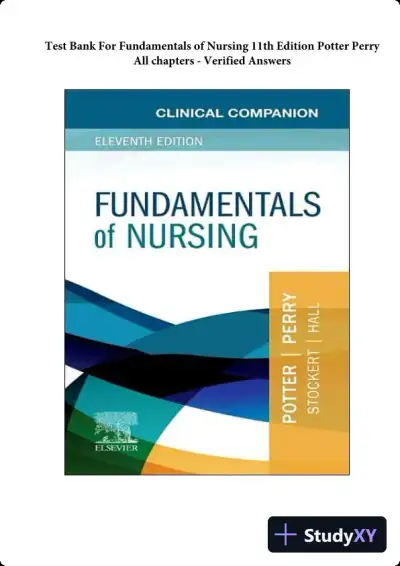 Exam Guides
Test Bank for Fundamentals of Nursing, 11th edition (Chapters 1-24)
Nursing
200 pages160downloadsFeb 2025 Class Notes
Class Notes for Child Health Nursing, 3rd Edition
Nursing
861 pages154downloadsFeb 2025 Class Notes
Class Notes for Clinical Nursing Skills: Basic to Advanced Skills, 9th Edition
Nursing
150 pages154downloadsFeb 2025 Class Notes
Class Notes for Principles of Pediatric Nursing Caring for Children, 6th Edition
Nursing
191 pages152downloadsFeb 2025
Study this document with CramX
Once it is in your library, every tool can work from it.