

Focus on Nursing Pharmacology Seventh, North American Edition Test Bank
- Nursing
- 1144 pages
- Shared February 2025
- 160 downloads
Focus on Nursing Pharmacology Seventh, North American Edition Test Bank is your key to effective test preparation. Access it now and start practicing!
Preview 31 of 1144 pages
See the first 31 pages exactly as they appear in the document.
Page 1 Read page 1 as text
1. Chapter 1 A nurse working in radiology administers iodine to a patient who is having a computed tomography (CT) scan. The nurse working on the oncology unit administers chemotherapy to patients who have cancer. At the Public Health Department, a nurs e administers a measles - mumps - rubella (MMR) vaccine to a 14 - month - old child as a routine immunization. Which branch of pharmacology best describes the actions of all three nurses? A) Pharmacoeconomics B) Pharmacotherapeutics C) Pharmacodynamics D) Phar macokinetics Ans: B Feedback: Pharmacology is the study of the biologic effects of chemicals. Nurses are involved with clinical pharmacology or pharmacotherapeutics, which is a branch of pharmacology that deals with the uses of drugs to treat, prevent , and diagnose disease. The radiology nurse is administering a drug to help diagnose a disease. The oncology nurse is administering a drug to help treat a disease. Pharmacoeconomics includes any costs involved in drug therapy. Pharmacodynamics involves how a drug affects the body and pharmacokinetics is how the body acts on the body. 2. A physician has ordered intramuscular (IM) injections of morphine, a narcotic, every 4 hours as needed for pain in a motor vehicle accident victim. The nurse is aware this drug has a high abuse potential. Under what category would morphine be classified? A) Schedule I B) Schedule II
Page 2 Page 3 Read page 3 as text
C) Schedule III D) Schedule IV Ans: B Feedback: Narcotics with a high abuse potential are classified as Schedule II drugs because of s evere dependence liability. Schedule I drugs have high abuse potential and no accepted medical use. Schedule III drugs have a lesser abuse potential than II and an accepted medical use. Schedule IV drugs have low abuse potential and limited dependence liab ility. 3. When involved in phase III drug evaluation studies, what responsibilities would the nurse have? A) Working with animals who are given experimental drugs B) Choosing appropriate patients to be involved in the drug study C) Monitoring and obse rving patients closely for adverse effects D) Conducting research to determine effectiveness of the drug Ans: C Feedback: Phase III studies involve use of a drug in a vast clinical population in which patients are asked to record any symptoms they ex perience while taking the drugs. Nurses may be responsible for helping collect and analyze the information to be shared with the Food and Drug Administration (FDA) but would not conduct research independently because nurses do not prescribe medications. Us e of animals in drug testing is done in the preclinical trials. Select patients who are involved in phase II studies to participate in studies where the participants have the disease the drug is intended to treat. These patients are monitored closely for d rug action and adverse effects. Phase I studies involve healthy human volunteers who are usually paid for their participation. Nurses may observe for adverse effects and toxicity. 4. What concept is considered when generic drugs are substituted for brand name drugs?
Page 4 Read page 4 as text
A) Bioavailability B) Critical concentration C) Distribution D) Half - life Ans: A Feedback: Bioavailability is the portion of a dose of a drug that reaches the systemic circulation and is available to act on body cells. Binders used in a generic drug may not be the same as those used in the brand name drug. Therefore, the way the body breaks down and uses the drug may differ, which may eliminate a generic drug substitution. Critical concentration is the amount of a drug that is needed t o cause a therapeutic effect and should not differ between generic and brand name medications. Distribution is the phase of pharmacokinetics, which involves the movement of a drug to the bodys tissues and is the same in generic and brand name drugs. A drug s half - life is the time it takes for the amount of drug to decrease to half the peak level, which should not change when substituting a generic medication. 5. A nurse is assessing the patients home medication use. After listening to the patient list curr ent medications, the nurse asks what priority question? A) Do you take any generic medications? B) Are any of these medications orphan drugs? C) Are these medications safe to take during pregnancy? D) Do you take any over - the - counter medications? Ans: D Feedback:
Page 5 Read page 5 as text
It is important for the nurse to specifically question use of over - the - counter medications because patients may not consider them important. The patient is unlikely to know the meaning of orphan drugs unless they too are health care provid ers. Safety during pregnancy, use of a generic medication, or classification of orphan drugs are things the patient would be unable to answer but could be found in reference books if the nurse wishes to research them. 6. After completing a course on phar macology for nurses, what will the nurse know? A) Everything necessary for safe and effective medication administration B) Current pharmacologic therapy; the nurse will not require ongoing education for 5 years. C) General drug information; the nurse ca n consult a drug guide for specific drug information. D) The drug actions that are associated with each classification of medication Ans: C Feedback: After completing a pharmacology course nurses will have general drug information needed for safe and effective medication administration but will need to consult a drug guide for specific drug information before administering any medication. Pharmacology is constantly changing, with new drugs entering the market and new uses for existing drugs identified . Continuing education in pharmacology is essential to safe practice. Nurses tend to become familiar with the medications they administer most often, but there will always be a need to research new drugs and also those the nurse is not familiar with becaus e no nurse knows all medications. 7. A nurse is instructing a pregnant patient concerning the potential risk to her fetus from a Pregnancy Category B drug. What would the nurse inform the patient? A) Adequate studies in pregnant women have demonstrated there is no risk to the fetus. B) Animal studies have not demonstrated a risk to the fetus, but there have been no adequate studies in pregnant women.
Page 6 Read page 6 as text
C) Animal studies have shown an adverse effect on the fetus, but there are no adequate studies in pregn ant women. D) There is evidence of human fetal risk, but the potential benefits from use of the drug may be acceptable despite potential risks. Ans: B Feedback: Category B indicates that animal studies have not demonstrated a risk to the fetus. Howev er, there have not been adequate studies in pregnant women to demonstrate risk to a fetus during the first trimester of pregnancy and no evidence of risk in later trimesters. Category A indicates that adequate studies in pregnant women have not demonstrate d a risk to the fetus in the first trimester or in later trimesters. Category C indicates that animal studies have shown an adverse effect on the fetus, but no adequate studies in humans. Category D reveals evidence of human fetal risk, but the potential b enefits from the use of the drugs in pregnant women may outweigh potential risks. 8. Discharge planning for patients leaving the hospital should include instructions on the use of over - the - counter (OTC) drugs. Which comment by the patient would demonstra te a good understanding of OTC drugs? A) OTC drugs are safe and do not cause adverse effects if taken properly. B) OTC drugs have been around for years and have not been tested by the Food and Drug Administration (FDA). C) OTC drugs are different from a ny drugs available by prescription and cost less. D) OTC drugs could cause serious harm if not taken according to directions. Ans: D Feedback:
Page 7 Read page 7 as text
It is important to follow package directions because OTCs are medications that can cause serious harm if no t taken properly. OTCs are drugs that have been determined to be safe when taken as directed; however, all drugs can produce adverse effects even when taken properly. They may have originally been prescription drugs that were tested by the FDA or they may have been grandfathered in when the FDA laws changed. OTC education should always be included as a part of the hospital discharge instructions. 9. What would be the best source of drug information for a nurse? A) Drug Facts and Comparisons B) A nurses drug guide C) A drug package insert D) The Physicians Drug Reference (PDR) Ans: B Feedback: A nurses drug guide provides nursing implications and patient teaching points that are most useful to nurses in addition to need - to - know drug information in a very user friendly organizational style. Lippincotts Nursing Drug Guide ( LNDG ) has drug monographs organized alphabetically and includes nursing implications and patient teaching points. Numerous other drug handbooks are also on the market and readily ava ilable for nurses to use. Although other drug reference books such as Drug Facts and Comparisons, PDR, and drug package inserts can all provide essential drug information, they will not contain nursing implications and teaching points and can be more diffi cult to use than nurses drug guides. 10. The nurse is preparing to administer a medication from a multidose bottle. The label is torn and soiled but the name of the medication is still readable. What is the nurses priority action? A) Discard the entire bottle and contents and obtain a new bottle. B) Find the drug information and create a new label for the bottle.
Page 8 Read page 8 as text
C) Ask another nurse to verify the contents of the bottle. D) Administer the medication if the name of the drug can be clearly read. Ans: A Feedback: When the drug label is soiled obscuring some information the safest action by the nurse is to discard the bottle and contents because drug labels contain a great deal of important information, far more than just the name of the drug. Concent ration of the drug, expiration date, administration directions, and precautions may be missing from the label and so put the patient at risk. Looking up drug information in a drug handbook or consulting with another nurse will not supply the expiration dat e or concentration of medication. Be safe and discard the bottle and its contents. 11. What aspect of pharmacology does a nurse study? (Select all that apply.) A) Chemical pharmacology B) Molecular pharmacology C) Impact of drugs on the body D) The b odys response to a drug E) Adverse and anticipated drug effects Ans: C, D, E Feedback: Nurses study pharmacology from a pharmacotherapeutic level, which includes the effect of drugs on the body, the bodys response to drugs, and both expected and unex pected drug effects. Chemical and molecular pharmacology (Options A and B) are not included in nursing pharmacology courses.
Page 9 Read page 9 as text
12. The nurse, providing patient teaching about home medication use to an older adult, explains that even when drugs are taken pr operly they can produce negative or unexpected effects. What are these negative or unexpected effects called? A) Teratogenic effects B) Toxic effects C) Adverse effects D) Therapeutic effects Ans: C Feedback: Negative or unexpected effects are kno wn as adverse or side effects. Teratogenic effects are adverse effects on the fetus and not a likely concern for an older adult. Toxic effects occur when medication is taken in larger than recommended dosages caused by an increase in serum drug levels. The rapeutic effects are the desired actions for which the medication is prescribed. 13. After administering a medication, for what would the nurse assess the patient? A) Drug effects B) Allergies C) Pregnancy D) Preexisting conditions Ans: A Feedback : After the medication is administered, the nurse assesses the patient for drug affects, both therapeutic and adverse. The nurse would assess the patient for allergies, preexisting conditions, and pregnancy before administering a medication.
Page 10 Read page 10 as text
14. The nu rse receives an order to administer an unfamiliar medication and obtains a nurses drug guide published four years earlier. What is the nurses most prudent action? A) Find a more recent reference source. B) Use the guide if the drug is listed. C) Ask ano ther nurse for drug information. D) Verify the information in the guide with the pharmacist. Ans: A Feedback: The nurse is responsible for all medications administered and must find a recent reference source to ensure the information learned about th e medication is correct and current. Using an older drug guide could be dangerous because it would not contain the most up - to - date information. Asking another nurse or the pharmacist does not guarantee accurate information will be obtained and could harm t he patient if the information is wrong. 15. What would the nurse provide when preparing a patient for discharge and home medication self - administration? A) Personal contact information to use if the patient has questions B) Thorough medication teaching about drugs and the drug regimen C) Over - the - counter medications to use to treat potential adverse effects D) A sample size package of medication to take home until prescription is filled Ans: B Feedback: The nurse is responsible for providing thor ough medication teaching about drugs and the drug regimen to ensure the patient knows how to take the medication and when to notify the provider. The nurse never provides personal contact information to a patient. If adverse effects arise, the
Page 11 Read page 11 as text
patient is t aught to call the health care provider and should not self - medicate with over - the - counter drugs, which could mask serious symptoms. The nurse never dispenses medication because it must be properly labeled for home use; this is done by the pharmacy. 16. I n response to the patients question about how to know whether drugs are safe, the nurse explains that all medications undergo rigorous scientific testing controlled by what organization? A) Food and Drug Administration (FDA) B) Drug Enforcement Agency (D EA) C) Centers for Disease Control and Prevention (CDC) D) Joint Commission on Accreditation of Healthcare Organizations (JCAHO) Ans: A Feedback: The FDA is responsible for controlling and regulating the development and sale of drugs in the United S tates, allowing new drugs to enter the market only after being subjected to rigorous scientific testing. The DEA regulates and controls the use of controlled substances. The CDC monitors and responds to infectious diseases. The JCAHO is an accrediting body that inspects acute care facilities to ensure minimum standards are met. 17. The nurse, assisting with Phase I drug studies, is talking with a woman who asks, Why cant I participate in this study? What would be the nurses best response? A) Drugs pose a greater risk to women of reproductive age. B) Drugs are only tested on men because they are stronger. C) Women are more prone to adverse effects from medications. D) Drugs affect women differently than they affect women. Ans: A
Page 12 Read page 12 as text
Feedback: Phase I d rug trials usually involve healthy male volunteers because chemicals may exert an unknown and harmful effect on ova in women which could result in fetal damage when the woman becomes pregnant. Drugs are tested on both men and women, but women must be fully informed of risks and sign a consent stating they understand the potential for birth defects. Women are not more prone to adverse effects of medications. Although some drugs may affect women differently than men, this is a rationale for why drugs need to be tested on women, not an explanation of why women are not included in a phase I study. 18. The patient tells the nurse about a new drug being tested to treat the disease she was diagnosed with and asks the nurse whether the doctor can prescribe a medic ation still in the preclinical phase of testing. What is the nurses best response? A) The doctor would have to complete a great deal of paperwork to get approval to prescribe that drug. B) Sometimes pharmaceutical companies are looking for volunteers to test a new drug and the doctor could give them your name. C) Drugs in the preclinical phase of testing are only tested on animals and so would not be available to you. D) Drugs in the preclinical phase of testing are given only to healthy young men and s o would not be available to you. Ans: C Feedback: During the preclinical phase of testing drugs are tested on animals and are not available to patients. In phase I, the drug is tested on volunteers who are usually healthy young men. It is only in phas e III studies that the drug is made available to prescribers who agree to closely monitor patients getting the medication.
Page 13 Read page 13 as text
19. The nurse is caring for a patient who had a severe, acute, previously unseen adverse effect of a drug in Phase III testing. The patient asks, After all the testing done on this drug, didnt they know this adverse effect could occur? What is the nurses best response? (Select all that apply.) A) Pharmaceutical companies sometimes underreport problems to make more money. B) Your res ponse to this medication will be reported to the drug company and the Food and Drug Administration (FDA). C) When a drug begins to be used by a large clinical market, new adverse effects may be found. D) The pharmaceutical company weighs the benefits of the drug with the severity of adverse effects. E) After a drug reaches phase III testing it is considered an accepted drug and will not be recalled. Ans: B, C Feedback: When a new and unexpected adverse effect occurs, especially one of a serious natu re, it is reported to the drug company who reports it to the FDA immediately. When a large number of people begin using the drug in phase III studies, it is not unusual to identify adverse effects not previously noted. It would be both unprofessional and i naccurate to imply that pharmaceutical companies put profit ahead of patient concern because lawsuits would remove any potential profit if a drug proves harmful. The FDA is responsible for weighing risk versus benefit in deciding whether to allow the drug to move to the next phase of testing. Drugs found to have serious adverse effects can be removed from the market at any time. 20. The telephone triage nurse receives a call from a patient asking for a prescription for a narcotic to manage his surgical pa in. The nurse explains that narcotic prescriptions must be written and cannot be called in to the pharmacy. The patient says, Why are narcotics so difficult to get a prescription for? What is the nurses best response?
Page 14 Read page 14 as text
A) The Drug Enforcement Agency (DEA) determines the risk for addiction and the Food and Drug Administration (FDA) enforces their control. B) The increase in the number of drug addicts has made the rules stronger. C) The Centers for Disease Control and Prevention (CDC) regulates use of contr olled substances to reduce the risk of injury. D) Controlled substances like narcotics are controlled by the FDA and the DEA. Ans: D Feedback: Controlled substances are controlled by the FDA and the DEA: the DEA enforces control while the FDA determi nes abuse potential. Regulations related to controlled substances have remained strict and specific and have not been significantly impacted by substance abusers. The CDC is not involved in control of narcotics and other controlled substances. 21. The nu rse explains the Drug Enforcement Agencys (DEAs) schedule of controlled substances to the nursing assistant who asks, Do you ever get a prescription for Schedule I medications? What is the nurses best response? A) Schedule I medications have no medical us e so they are not prescribed. B) Schedule I medications have the lowest risk for abuse and do not require a prescription. C) Schedule I medications are only prescribed in monitored units for patient safety. D) Schedule I medications are found in antitus sives and antidiarrheals sold over the counter. Ans: A Feedback: Schedule I medications have no medical use and are never prescribed. Schedule V medications have the lowest risk for abuse and are found mostly in antitussives and antidiarrheals but the y are not sold over the counter.
Page 15 Read page 15 as text
22. The nurse, working on the maternity unit, receives a call from a pregnant woman asking how she can know whether a medication is safe to take while pregnant. What is the nurses best response? A) You can take any drug indicated as a Category A. B) No medications should be taken during pregnancy. C) Never take medication until you receive approval from your health care provider. D) Most medications are safe but you need to weigh benefit against risk. Ans: C Feedbac k: The best response to a pregnant woman asking about medication usage is to talk with her obstetric practitioner because the best advice will come from someone who knows their health and pregnancy history. While Category A drugs have no known risk, they may be contraindicated by the womans health condition or pregnancy issues and many pregnant women would not know what it means to be a Category A drug. Medications can be helpful during pregnancy if taken safely and appropriately. Although risk benefit ne eds to be weighed, it should occur with advice from the obstetric practitioner. 23. A patient asks the nurse, What is a Drug Enforcement Agency (DEA) number? What is the nurses best response? A) DEA Numbers are given to physicians and pharmacists when t hey register with the DEA to prescribe and dispense controlled substances. B) Physicians must have a DEA number in order to prescribe any type of medication for patients. C) DEA numbers are case numbers given when someone breaks the law involving a contr olled substance.
Page 16 Read page 16 as text
D) DEA numbers are contact numbers to talk with someone at the DEA when questions arise about controlled substances. Ans: A Feedback: All pharmacists and physicians must register with the DEA. They are given numbers that are required before they can dispense or prescribe controlled substances. DEA numbers are only needed when prescribing controlled substances. A DEA number is neither a case number nor a phone number. 24. When moving to another state, what is the nurse responsible fo r becoming familiar with? A) Local policies and procedures for controlled substance administration B) Local providers Drug Enforcement Agency (DEA) number for prescribing controlled substances C) The agency monitoring controlled substances in the new st ate D) Board of Nursing regulations of controlled substances in the new state Ans: A Feedback: The nurse needs to learn local policies and procedures for controlled substance administration because they can vary with some local governments more rigor ous than others. Nurses do not memorize a providers DEA numbers. The DEA is a federal agency that monitors controlled substances in all states. State boards of nursing do not regulate controlled substances but may regulate how controlled substances are adm inistered by nurses. 25. The patient looks at the prescription provided by the doctor and asks the nurse whether he can request a generic substitution. The nurse answers No when noting what on the prescription? A) No refills
Page 17 Read page 17 as text
B) DAW C) Brand name used on prescription D) Patient older than 65 years of age Ans: B Feedback: DAW stands for dispense as written and means that the doctor does not want a generic substituted for the prescribed medication. Requesting no refills does not preclude the substit ution of a generic medication. Even when the brand name is ordered, the pharmacist can substitute a generic equivalent so long as the prescriber does not write DAW. Generic substitutions are not impacted by the patients age. 26. The patient asks the nurs e why generic drugs would be used and voices concerns that only the brand name product will be safe. What is the nurses best response? A) Generic drugs are often less expensive. B) Some quality control problems have been found with generic drugs. C) Mos t generic drugs are very safe and can be cost effective as well. D) Although initial cost is higher for a brand name it may cost less in the long run. Ans: C Feedback: Most generic medications are completely safe and may be identical to the brand nam e drug except generic medications are often less expensive, but this does not address the patients concern about safety. Although some quality control issues have occurred in the past, this does not address the patients concerns regarding safety or explain why generic drugs are prescribed and used. Although some doctors believe initial cost is higher but will cost less over time, this response also does not address the patients concerns.
Page 18 Read page 18 as text
27. While studying for the test, the nursing student encounters the following drug: papaverine (Pavabid). What does the nursing student identify the name Pavabid as? A) The generic name B) The chemical name C) The brand name D) The chemical and generic name Ans: C Feedback: Several clues indicate the brand name in cluding capitalization of the first letter in the name and in parentheses. Generic names are not capitalized; chemical names are descriptions of the chemistry of the medication resulting in complicated names. 28. The patient is prescribed a medication th at was just placed in Phase IV study. The patient tells the nurse, This medication is too expensive. Could the doctor order a generic form of this medication? What is the nurses most accurate response? A) Medications are not produced in generic form until the patent expires, which normally takes several years. B) You can request the generic form but the binder used may make the drug less effective for this medication. C) The generic form of the medication would not be any less expensive because this is a relatively new medication. D) Generic medications are lower quality drugs and that would mean you would not be getting the best treatment available. Ans: A Feedback:
Page 19 Read page 19 as text
When a new drug enters the market, it is given a time - limited patent; generic forms of the medication cannot be produced until the patent expires. Because no generic version of this drug will exist because it is so new, it is impossible to predict what binder will be used or what the cost would be. 29. The nurse learns that a drug need ed by the patient is classified as an orphan drug and recognizes what as a reason for this classification? (Select all that apply.) A) The drug is rarely prescribed. B) The drug has dangerous adverse effects. C) The drug treats a rare disease. D) The p atent on the medication is still effective. E) Production by a company that only manufactures drugs. Ans: A, B, C Feedback: Drugs are classified as orphan drugs when they are not financially viable for a drug company to produce either because of risk for lawsuits about adverse effects or because the drug is not prescribed, which is often seen in rare diagnoses. Generic drugs are not produced until the patent expires, but this has no impact on classifying a particular drug as an orphan drug. Generic dr ugs are often produced by companies that only manufacture drugs without conducting research, but this has no bearing on the classification of orphan drugs. 30. While collecting a medication history, the patient admits to doubling the recommended dosage o f an over - the - counter (OTC) medication, saying Its harmless or they would require a prescription. What is the nurses best response? A) OTC drugs are serious medications and carry serious risks if not taken as directed. B) Taking medications like that is careless and you could kill yourself doing it. C) Sometimes you need to take more than the package directs to treat the symptoms.
Page 20 Read page 20 as text
D) Did you notify your doctor of the increased dosage you were taking? Ans: A Feedback: OTC drugs are no less a medicat ion than prescription drugs and carry the same types of risks for overdosage and toxicity if directions are not followed. Although increasing the dosage is careless and dangerous, it is important to use the information as a teaching opportunity rather than scolding the patient. Agreeing with the patient or asking her if she talked to the doctor misses the teaching opportunity, which could be harmful for the patient. 31. The patient asks the nurse, Is it safe to take over - the - counter (OTC) medications with prescription medications? What is the nurses best response? (Select all that apply.) A) OTC medications can interact with prescription medications. B) It is important to tell your doctor all medications you take, including OTC. C) OTC medications could mask or hide signs and symptoms of a disease. D) You should avoid taking any OTC medication when taking prescription drugs. E) Taking OTC medications can make your prescription medication more effective. Ans: A, B, C Feedback: OTC medications can i nteract with prescription medications or other OTC so it is always important to consult your pharmacist and provider for advice. To provide the most accurate instruction, the health care provider must know all medications taken including dietary supplement s, OTC, and prescription. OTC medications could mask or hide symptoms of a disease so it is always important to consult a physician if symptoms persist. OTC medications are not prohibited when taking prescription drugs as long as no drug interaction occurs . How an OTC will impact a prescription medication varies depending on the medications involved, so it is incorrect to say it will make the prescription drug more effective.
Page 21 Read page 21 as text
32. Before administering a prescription medication, what information does the nu rse find on the drug label? (Select all that apply.) A) Brand name B) Generic name C) Drug concentration D) Expiration date E) Adverse effects Ans: A, B, C, D Feedback: Prescription drug labels will contain the brand name, generic name, drug conc entration, and expiration date. Adverse effects will not be listed on drug labels. 33. The nurse is preparing a medication that is new to the market and cannot be found in the nurses drug guide. Where can the nurse get the most reliable information about this medication? A) Package insert B) Another nurse C) Drug manufacturer D) Physician Ans: A Feedback: The most reliable information about the drug can be found on the package insert supplied by the manufacturer because it was prepared according to strict Food and Drug Administration (FDA) regulations. Asking another nurse or the physician is not reliable and cannot be verified as accurate. It would not be realistic to call the drug manufacturer for information.
Page 22 Read page 22 as text
34. The nurse explains that what drug resource book is compiled from package inserts? A) Nurses Drug Guide B) Physiciass Desk Reference (PDR) C) Drug Facts and Comparisons D) AMA Drug Evaluations Ans: B Feedback: The PDR is a compilation of information found on package inserts. T he Nurses Drug Guide uses more easily understood language and incorporates nursing considerations and patient teaching points. Drug Facts and Comparisons includes cost comparison, often not found in other drug resource guides. The AMA Drug Evaluations is f ar less biased than the PDR and includes drugs still in the research stage of development. 1. Chapter 2 Drugs do not metabolize the same way in all people. For what patient would a nurse expect to assess for an alteration in drug metabolism? A) A 35 - ye ar - old woman with cervical cancer B) A 41 - year - old man with kidney stones C) A 50 - year - old man with cirrhosis of the liver D) A 62 - year - old woman in acute renal failure Ans: C Feedback:
Page 23 Read page 23 as text
The liver is the most important site of drug metabolism. If th e liver is not functioning effectively, as in patients with cirrhosis, drugs will not metabolize normally so that toxic levels could develop unless dosage is reduced. A patient with cervical cancer or kidney stones would not be expected to have altered abi lity to metabolize drugs so long as no liver damage existed. The patient with renal failure would have altered excretion of the drugs through the renal system but metabolism would not be impacted. 2. A patient presents to the emergency department with a drug level of 50 units/mL. The half - life of this drug is 1 hour. With this drug, concentrations above 25 units/mL are considered toxic and no more drug is given. How long will it take for the blood level to reach the non - toxic range? A) 30 minutes B) 1 h our C) 2 hours D) 3 hours Ans: B Feedback: Half - life is the time required for the serum concentration of a drug to decrease by 50%. After 1 hour, the serum concentration would be 25 units/mL (50/2) if the body can properly metabolize and excrete the drug. After 2 hours, the serum concentration would be 12.5 units/mL (25/2) and reach the nontoxic range. In 30 minutes the drug level would be 37.5 units/mL, whereas in 3 hours the drug level would be 6.25. 3. A patient has recently moved from Vermont t o Southern Florida. The patient presents to the clinic complaining of dizzy spells and weakness. While conducting the admission assessment, the patient tells the nurse that he have been on the same antihypertensive drug for 6 years and had stable blood pre ssures and no adverse effects. Since his move, he has been having problems and he feels that the drug is no longer effective. The clinic nurse knows that one possible reason for the change in the effectiveness of the drug could be what?
Page 24 Read page 24 as text
A) The impact of t he placebo effect on the patients response. B) The accumulative effect of the drug if it has been taken for many years. C) The impact of the warmer environment on the patients physical status. D) Problems with patient compliance with the drug regimen wh ile on vacation. Ans: C Feedback: Antihypertensive drugs work to decrease the blood pressure. When a patient goes to a climate that is much warmer than usual, blood vessels dilate and the blood pressure falls. If a patient is taking an antihypertensiv e drug and moves to a warmer climate, there is a chance that the patients blood pressure will drop too low, resulting in dizziness and feelings of weakness. Even mild dehydration could exacerbate these effects. Most antihypertensives are metabolized and ex creted and do not accumulate in the body. Patients must be very compliant with their drug regimen on vacation. After several years on an antihypertensive drug, the effects of that drug are known; therefore, the placebo effect should not be an issue. 4. A n important concept taught by the nurse when providing medication teaching is the need to provide a complete list of medications taken to health care providers to avoid what? A) Spending large amounts of money on medications B) Allergic reactions to medi cations C) Drugdrug interactions D) Critical concentrations of medications in the body Ans: C Feedback: It is important that all health care providers have a complete list of the patients medications to avoid drugdrug interactions caused by one prov ider ordering a medication, unaware of another
Page 25 Read page 25 as text
medication the patient is taking that could interact with the new prescription. Using the same pharmacist for all prescriptions will also help to prevent this from happening. Informing the provider of all medi cations taken will not reduce costs of medications, which is best accomplished by requesting generic medications. Allergies should be disclosed to all health care providers as well, but this is not why it is important to provide a complete list of medicati ons taken. Critical concentrations are desirable because that is the amount of drug needed to cause a therapeutic effect, or, in other words, to have the effect the drug is prescribed for. 5. A pharmacology student asks the instructor what an accurate de scription of a drug agonist is. What is the instructors best response? A) A drug that reacts with a receptor site on a cell preventing a reaction with another chemical on a different receptor site B) A drug that interferes with the enzyme systems that ac t as catalyst for different chemical reactions C) A drug that interacts directly with receptor sites to cause the same activity that a natural chemical would cause at that site D) A drug that reacts with receptor sites to block normal stimulation, produc ing no effect Ans: C Feedback: Agonists are drugs that produce effects similar to those produced by naturally occurring neurotransmitters, hormones, or other substances found in the body. Noncompetitive antagonists are drugs that react with some recep tor sites preventing the reaction of another chemical with a different receptor site. Drugenzyme interactions interfere with the enzyme systems that stimulate various chemical reactions. 6. A nurse is caring for a patient who has been receiving a drug by the intramuscular route but will receive the drug orally after discharge. How does the nurse explain the increased dosage prescribed for the oral dose?
Page 26 Read page 26 as text
A) Passive diffusion B) Active transport C) Glomerular filtration D) First - pass effect Ans: D Fe edback: The first - pass effect involves drugs that are absorbed from the small intestine directly into the portal venous system, which delivers the drug molecules to the liver. After reaching the liver, enzymes break the drug into metabolites, which may b ecome active or may be deactivated and readily excreted from the body. A large percentage of the oral dose is usually destroyed and never reaches tissues. Oral dosages account for the phenomenon to ensure an appropriate amount of the drug in the body to pr oduce a therapeutic action. Passive diffusion is the major process through which drugs are absorbed into the body. Active transport is a process that uses energy to actively move a molecule across a cell membrane and is often involved in drug excretion in the kidney. Glomerular filtration is the passage of water and water - soluble components from the plasma into the renal tubule. 7. A nurse is working as a member of a research team involved in exploring the unique response to drugs each individual displays based on genetic make - up. What is this area of study is called? A) Pharmacotherapeutics B) Pharmacodynamics C) Pharmacoeconomics D) Pharmacogenomics Ans: D Feedback:
Page 27 Read page 27 as text
Pharmacogenomics is the area of study that includes mapping of the human genome. In the future, medical care and drug regimens may be personally designed based on a patients unique genetic make - up. Pharmacotherapeutics is the branch of pharmacology that deals with the uses of drugs to treat, prevent, and diagnose disease. Pharmacodyna mics involves how a drug affects the body. Pharmacoeconomics includes the costs involved in drug therapy. 8. The nurse uses what term to describe the drug level required to have a therapeutic effect? A) Critical concentration B) Dynamic equilibrium C) Selective toxicity D) Active transport Ans: A Feedback: A critical concentration of a drug must be present before a reaction occurs within the cells to bring about the desired therapeutic effect. A dynamic equilibrium is obtained from absorption of a drug from the site of drug entry, distribution to the active site, metabolism in the liver, and excretion from the body to have a critical concentration. Selective toxicity is the ability of a drug to attach only to those systems found in foreign cells. Active transport is the process that uses energy to actively move a molecule across a cell membrane and is often involved in drug excretion in the kidney. 9. A nurse is caring for a patient who is supposed to receive two drugs at the same time. What is t he nurses priority action? A) Wash her hands before handling the medications. B) Consult a drug guide for compatibility. C) Question the patient concerning drug allergies. D) Identify the patient by checking the armband and asking the patient to state his name.
Page 28 Read page 28 as text
Ans: B Feedback: A nurse should first consult a drug guide for compatibility when two or more drugs are being given at the same time. After compatibility is determined the medication can be administered. The nurse will perform hand hygiene, check for patient allergies, and ensure the right patient receives the medication by using two identifiers. 10. The nurse is talking with a group of nursing students who are doing clinical hours on the unit. A student asks if all intramuscular (IM) drugs are absorbed the same. What factor would the floor nurse tell the students to affect absorption of the IM administration of drugs? A) Perfusion of blood to the subcutaneous tissue B) Integrity of the mucous membranes C) Environmental temperature D) Bl ood flow to the gastrointestinal tract Ans: C Feedback: A cold environmental temperature can cause blood vessels to vasoconstrict and decreases absorption or in a hot environment vasodilate and increase absorption of IM medications. Blood flow to the subcutaneous tissues interferes with subcutaneous injection and blood flow to the gastrointestinal (GI) tract causes alterations in absorption for oral medications. The condition of mucous membranes can interfere with sublingual (under the tongue) and bucc al (in the cheek) administration of drugs. 11. The patient is taking a drug that affects the body by increasing cellular activity. Where does this drug work on the cell? A) Receptor sites B) Cell membrane
Page 29 Read page 29 as text
C) Golgi body D) Endoplasmic reticulum Ans: A Feedback: Many drugs are thought to act at specific areas on cell membranes called receptor sites. After the receptor site is activated, this in turn activates the enzyme systems to produce certain effects, such as increased or decreased cellular act ivity, changes in cell membrane permeability, or alterations in cellular metabolism. Receptor sites are generally located on the outside of cells and allow the drug to bypass the cell membrane. The Golgi body and endoplasmic reticulum are not involved in t his process. 12. Several processes enable a drug to reach a specific concentration in the body. Together they are called dynamic equilibrium. What are these processes? (Select all that apply.) A) Distribution to the active site B) Biotransformation C) Absorption from the muscle D) Excretion E) Interaction with other drugs Ans: A, B, D Feedback: The actual concentration that a drug reaches in the body results from a dynamic equilibrium involving several processes: Absorption from the site of entr y (can be from the muscle, the gastrointestinal (GI) tract if taken orally, of the subcutaneous tissue if given by that route); Distribution to the active site; biotransformation (metabolism) in the liver; excretion from the body. Interaction with other dr ugs is not part of the dynamic equilibrium.
Page 30 Read page 30 as text
13. A nurse is administering digoxin to a patient. To administer medications so that the drug is as effective as possible, the nurse needs to consider what? A) Pharmacotherapeutics B) Pharmacokinetics C) Pha rmacoeconomics D) Pharmacogenomics Ans: B Feedback: When administering a drug, the nurse needs to consider the phases of pharmacokinetics so that the drug regimen can be made as effective as possible. Pharmacogenomics is the area of study that includ es mapping of the human genome. Pharmacotherapeutics is the branch of pharmacology that deals with the uses of drugs to treat, prevent, and diagnose disease. Pharmacoeconomics includes all costs involved in drug therapy. 14. The nurse is explaining how m edications work to a group of peers and explains that disruption of a single step in any enzyme system disrupts what? A) Cell life B) Cell membrane C) Cell receptor sites D) Cell function Ans: D Feedback: If a single step in one of the many enzyme systems is blocked, normal cell function is disrupted. Cell life and cell membrane may be impacted by disruption of some enzymes but not all
Page 31 Read page 31 as text
enzymes. Receptor sites would not be disrupted by disruption in a single step in the enzyme system. 15. The proc esses involved in dynamic equilibrium are key elements in the nurses ability to determine what? A) Dosage scheduling B) Amount of solution for mixing parenteral drugs C) Timing of other drugs the patient is taking D) How long the patient has to take th e drug Ans: A Feedback: These processes are key elements in determining the amount of drug (dose) and the frequency of dose repetition (scheduling) required to achieve the critical concentration for the desired length of time. The processes in dynamic equilibrium are not key elements in determining the amount of diluents for intramuscular (IM) drugs; they do not aid in the timing of the other drugs the patient is taking or how long the patient has to take the drug. 16. What factor influences drug abs orption? A) Kidney function B) Route of administration C) Liver function D) Cardiovascular function Ans: B Feedback:
1113 more pages in the full document
Unlock it once and it stays in your library, ready to chat with or turn into flashcards.
Unlock the full documentMore Nursing study materials
See all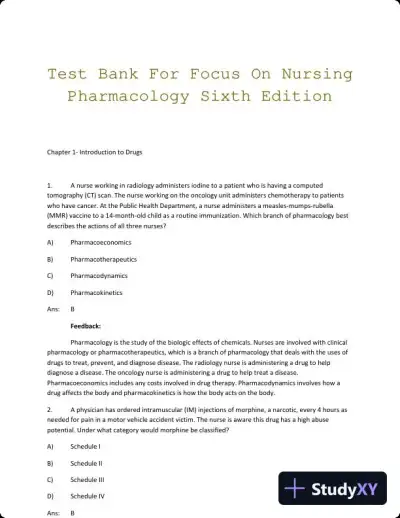 Exam Guides
Test Bank For Focus On Nursing Pharmacology Sixth Edition
Nursing
903 pages57downloadsFeb 2025 Exam Guides
Test Bank for Critical Care Nursing: Diagnosis and Management, 9th Edition (Chapters 1-27)
Nursing
299 pages167downloadsFeb 2025 Class Notes
An Invitation To Health, Third Canadian Edition Lecture Notes
Nursing
439 pages163downloadsFeb 2025 Exam Guides
Test Bank for Physical Examination and Health Assessment, 9th Edition (Chapters 1-15)
Nursing
200 pages161downloadsFeb 2025 Exam Guides
Test Bank for Fundamentals of Nursing, 11th edition (Chapters 1-24)
Nursing
200 pages160downloadsFeb 2025 Class Notes
Class Notes for Child Health Nursing, 3rd Edition
Nursing
861 pages154downloadsFeb 2025 Class Notes
Class Notes for Clinical Nursing Skills: Basic to Advanced Skills, 9th Edition
Nursing
150 pages154downloadsFeb 2025 Class Notes
Class Notes for Principles of Pediatric Nursing Caring for Children, 6th Edition
Nursing
191 pages152downloadsFeb 2025
Study this document with CramX
Once it is in your library, every tool can work from it.