

Making The Transition From LPN To RN, 1st Edition Class Notes
- Nursing
- 61 pages
- Shared May 2025
Prepare for exams with Making The Transition From LPN To RN, 1st Edition Class Notes, offering detailed chapter summaries and key points to reinforce your learning.
Preview 16 of 61 pages
See the first 16 pages exactly as they appear in the document.
Page 1 Read page 1 as text
Instructor’s Manual for Making the Transition from LPN to RN Rose Kearney-Nunnery LECTURE NOTES
Page 2 Page 3 Read page 3 as text
Chapter 1 Multiple Roles In Chapter 1, students are challenged to consider the multiple roles they play during the pursuit of the degree. Returning to school is not an easy decision, and strategies for success in the daunting process of returning to the student role are reviewed. Chapter Objectives 1. Evaluate your reasons for continuing your nursing education. 2. Examine the multiple and sometimes competing roles of the adult returning to school. 3. Evaluate your knowledge, skills, and abilities. 4. Identify your learning style and the strategies to best address your individual learning preferences. 5. Evaluate your personal and collegial resources to assist with your success. Key Terms Transition the psychological processes in three phases—Ending, Losing, Letting Go; The Neutral Zone; The New Beginning—where people must “come to terms with the details of the new situation that the change brings about” (Bridges, 2003, p. 3). Transformative learning adult development and education described by Mezirow (2000), who proposes that adults learn in one of four ways: 1. by elaborating existing frames of reference, 2. by learning new frames of reference, 3. by transforming points of view, or 4. by transforming habits of mind (Mezirow, 2000, p. 19). Roles organized behavioral patterns and expectations for a given position and which accompany a specific situation or circumstance (Bailey & Yost, 2004, p. 1). Learning the perception and assimilation of the information presented to us in a variety of ways. Knowledge the accumulation of the appropriate information through learning and experience. Skill the ability to retrieve this knowledge through mental and psychomotor activities and apply it appropriately to the situation. Ability competence and proficiency in the demonstration of the knowledge and skill. Learning style or preference is simply the way you best perceive, think, organize, use, and retain knowledge. Resources tools or means of support. Key Points • In the process of change, Bridges (2003) looks at the psychological processes in three phases of transition where people must “come to terms with the details of the new situation that the change brings about” (p. 3). • Mezirow (2000) views adult development and education as transformative learning and proposes that adults learn in one of four ways: By elaborating existing frames of reference By learning new frames of reference By transforming points of view, or By transforming habits of mind (Mezirow, 2000, p. 19). • Roles are organized behavioral patterns and expectations for a given position and accompany a specific situation or circumstance (Bailey & Yost, 2004, p. 1). • Learning is the perception and assimilation of the information presented to us in a variety of ways.
Page 4 Read page 4 as text
• Knowledge is the accumulation of the appropriate information through learning and experience. • Skill is the ability to retrieve this knowledge through mental and psychomotor activities and apply it appropriately to the situation. • Ability is your competence and proficiency in the demonstration of the knowledge and skill. • Learning style or preference is simply the way you best perceive, think, organize, use, and retain knowledge. • Resources are tools or means of support. For your educational goals, consider those things and people that you will need to help you study, prepare assignments, succeed on examinations, and thrive in your education. Thought and Discussion Questions 1. Reflect carefully and identify your reasons for continuing your nursing education. 2. Identify all your current roles. Which ones can be streamlined? 3. In a three-column format, identify what you perceive to be your knowledge level and your associated skills and abilities in the following areas: • Medical-surgical nursing • Maternal-child health • Gerontological nursing • Mental-health nursing 4. What resources can you classify as readily available, sometimes available, or in need of locating? Interactive Exercises On the intranet site, students are directed to the following: INTERACTIVE EXERCISE #1-1: Your Cognitive Learning Style Check your style at one of the following free Internet sites: www.humanmetrics.com/cgi-win/JTypes2.asp www.oswego.edu/plsi/taketest.htm After discovering your learning style, you will need to identify the strategies to best address your individual learning preferences. Complete the following information on your unique style and preferences. Then, design a plan to capitalize on your assets. Learning Preferences: Identify your characteristics. Now, think of enhancements that you could make based on these preferences. Now, think of remedies for when the predominant style in your class does not match yours. Develop your plan to capitalize on your assets. INTERACTIVE EXERCISE #1-2: Time Enhancers and Wasters
Page 5 Read page 5 as text
In the format provided, identify your unique time enhancers and time wasters and propose enhancements to both. Time Enhancers: Identify your characteristics. Now, think of enhancements or remedies. Time Wasters: Identify your characteristics. Now, think of enhancements or remedies. INTERACTIVE EXERCISE #1-3: Your Personal and Collegial Resources Identify resources to assist with your success. Personal Resources: Describe this resource. How can this resource assist with your success? Collegial Resources: Describe this resource. How can this resource assist with your success? INTERACTIVE EXERCISE #1-4: Your Plan for Success Start developing a personal plan for success in your continuing professional education. Develop a personal timeline and predict future goals and accomplishments in 5-year periods. Your plan should be specifically designed for your situation. What are the particular factors in your life that you need to consider? List your educational goals: 1. 2. 3. 4. 5.
Page 6 Read page 6 as text
Identify a realistic timeline for each goal: 1. 2. 3. 4. 5. Identify factors to promote your success: 1. 2. 3. 4. 5. Now compare time commitments: Describe family, work schedule, college schedule, and personal responsibilities. Refer to the Chapter 1 content in Box 1-3 to get started. Identify the time required daily for each of these commitments. But remember, there are only 24 hours in a day. You may wish to do this on either a daily or a weekly basis. List commitments that you have for each of the categories below: Family Time Required Work Time Required College Time Required Personal Time Required Total of your daily or weekly commitments: What adjustments to your schedule will need to be made?
Page 7 Read page 7 as text
What comments about returning to school are being shared with you? How do you plan to deal with these comments or suggestions? What additional preparations do you need to make when you start your clinical courses? List enhancement content you identified as needed. What “questionable” work habits will you need to discard? Now, consider a cost analysis for the items you will need for your education: Tuition Books Uniforms/equipment Child care Other Total costs Consider your available support systems: Family Work College Personal
Page 8 Read page 8 as text
How will you take care of personal health needs? Incorporate your identified “time enhancers” and enhancement plan from Interactive Exercise 1-2 and place them in order of their priority for your action. INTERACTIVE EXERCISE #1-5: Web Lesson Complete the Web lesson Time Management Strategies: What Works Best for You? Online Resources American Nurses Association http://nursingworld.org/nursecareer/ Allnurses.com http://allnurses.com/ National League for Nursing www.nln.org/Careers/resources.htm References Bailey, J.R., & Yost, J.H. (2004). Role Theory: Foundations, Extensions, and Applications. BookRags . Retrieved November 24, 2006, from www.bookrags.com/other/sociology/role- theory-foundations-extensions--eos-04.html Bridges, W. (2003). Managing transitions: Making the most of change (2nd ed.). Cambridge, MA: DaCapo Press. Mezirow, J. (2000). Learning to think like an adult: Core concepts of transformation theory. In J. Mezirow and Associates, Learning as transformation: Critical perspectives on a theory in progress (pp. 3–33). San Francisco: Jossey-Bass.
Page 9 Read page 9 as text
Chapter 2 Professional Practice Parameters Chapter 2 focuses on the characteristics of professional nursing as a profession and professional practice parameters. A focus on the core competencies for all healthcare professionals challenges both professional and interdisciplinary practice. Provided is an analysis of personal perspective on transforming the role from a LPN to a registered nurse. Chapter Objectives 1. Identify the components of professional nursing practice. 2. Examine the scope of practice for licensed nurses in the state’s rules and regulations. 3. Relate the core competencies for health professionals to professional nursing practice. 4. Describe clients of professional nursing practice. 5. Discuss responsibility and accountability in professional nursing practice. Key Terms Profession a unique career, built on a distinct knowledge base and guided by systematic theory with the authority to provide a distinct service in an ethical manner with prescribed standards of practice. Parameter a boundary or limit in professional practice. Licensure the authority granted by the state board to practice within specified parameters after meeting specified requirements. Continuing competency a requirement for ongoing practice as a demonstration of the provision of safe nursing care to the public. An assessment of continuing competence may require continuing education, ongoing documentation of safe practice, certification, or periodic assessment. Nursing education basic education required for the RN varies, with differences among baccalaureate, associate degree, diploma education, and entry-level graduate programs. Code of Ethics for a profession requires the conduct of one’s practice in an ethical manner, including careful adherence to client confidentiality. The ANA’s Code of Ethics for Nurses is the ethical standard for professional nursing practice. Professional culture includes our professional groups and associations that guide practice, education, and sharing of mutual values. Core competencies IOM identified these five competencies for all health professionals that “all health professionals should be educated to deliver patient-centered care as members of an interdisciplinary team, emphasizing evidence-based practice, quality improvement approaches, and informatics” (Greiner & Knebel, 2003, p. 45). Autonomy involves independent judgment and self-governing within the RN scope of practice and attention to changes in the healthcare needs of clients. Responsibility being accountable for the performance of the duties associated with the professional role (ANA, 2001). Accountability being answerable to oneself and others for your judgments and actions in the course of nursing practice, regardless of the organizations’ policies or providers’ directives (ANA, 2001). Self-regulation personal accountability for the knowledge for practice along with participation in the peer review process (ANA, 2003, p. 11). Community service extends beyond service to clients to include service as a professional to the community and society at large. Theory use, development, and evaluation is a component of professional practice that guides practice and includes ongoing development and evaluation for expanding and refining our knowledge base.
Page 10 Read page 10 as text
Evidence-based practice integration of the best research with clinical expertise and the client’s values for optimum care as well as participation in learning and research activities (Greiner & Knebel, 2003, pp. 45–46). Key Points • A profession is built on a distinct knowledge base and guided by systematic theory with the authority to provide a distinct service in an ethical manner with prescribed standards of practice. • A practice parameter prescribes the boundaries of practice within specified areas and limits. • Licensure is the authority granted by the state board to practice within specified parameters after meeting specific requirements. • The basic education required for a RN varies, with differences among baccalaureate, associate degree, diploma education, and even some entry-level graduate programs. • Continued competency is an ongoing quest for best practices and expertise. • The ANA’s Code of Ethics for Nurses is the ethical standard for professional nursing practice. • Another characteristic of a professional community is our unique culture that includes our professional groups and associations that guide practice, education, and sharing of mutual values. • The five competencies for health professionals are providing patient-centered care, working in interdisciplinary teams, employing evidence-based practice, applying quality improvement, and using informatics (Greiner & Knebel, 2001). • Autonomy involves judgment and self-governing within one’s scope of practice. This self- governing requires ongoing evaluation of both responsibility and accountability in professional practice. • In the ANA’s Code of Ethics for Nurses , responsibility is defined as accountability for performance of the duties associated with the professional role, and accountability is being answerable to oneself and others for one’s judgments and actions in the course of nursing practice, irrespective of healthcare organizations’ policies and providers’ directives (ANA, 2001, pp. 16–17). • Additional components of professional nursing practice include a commitment to community service, theory use, development and evaluation, and evidence-based practice. Thought and Discussion Questions 1. Describe your current role in data collection and contributing to the client-centered plan of care. Interview your RN supervisor on his or her role in client assessment. 2. Think about how you demonstrate the five core competencies of health professionals (Box 2- 2), and compare your behaviors with your peers in a discussion scheduled by your instructor. 3. Explain your views on responsibility and accountability. 4. Imagine putting on a pair of glasses that allow you to look at the world differently. How can you now see your work setting differently? Think of an innovation you would like to try to improve care for clients in the setting. Interactive Exercises On the intranet site, students are directed to the following: INTERACTIVE EXERCISE #2-1: Your Practice Act Go to the National Council website at www.ncsbn.org. On the left side, click on Boards of Nursing and then contacts for your state. You should see a link to go directly to your State Board of Nursing. Then, locate your state nursing practice act on their website. Analyze the powers,
Page 11 Read page 11 as text
privileges, and responsibilities vested in the profession. Look for Advisory Opinions or Practice Advisory Statements provided by the Board. See if there is a list of Frequently Asked Questions (FAQs). Complete the information in the format provided, and be prepared to participate in an online or class discussion to be scheduled by your instructor on how this act directs responsibility and accountability in nursing practice. Identify the State: List the powers, privileges, and responsibilities given to the profession: Identify differences for RN and LPN practice as follows: Definitions: LPN RN Education: LPN RN Supervision: LPN RN Delegation: LPN RN Additional Acts: LPN RN Now see if there are any advisory questions on practice or FAQs provided by the Board. What are the differences between LPN and RN practice? LPN RN
Page 12 Read page 12 as text
INTERACTIVE EXERCISE #2-2: What About Your State? Mutual Recognition for Licensure Go to the National Council website at www.ncsbn.org and locate information on the Nurse Licensure Compact for mutual recognition for nursing licensure. (Again, look at the left side of the website and click on the link for the Nurse Licensure Compact [NLC].) Is your state a NLC member? What does this involve? If your state is not a member of the NLC, go to the map of the participating states and read about the NLC and the FAQs provided. Complete the following information. Be prepared to participate in an online or class discussion to be scheduled by your instructor. What determines primary licensure? What is the difference between licensure and privilege to practice? How many states are currently members of the NLC? Identify your neighboring states. What happens when a nurse in a NLC state relocates to another state? Identify a difference in practice between your state and a neighboring state which you would need to know under the NLC. List important components of the NLC to discuss with the class. What else have you discovered? INTERACTIVE EXERCISE #2-3: Continuing Your Work on Your Transition Plan Now that you have thought about the State Practice Act and the issue of mutual recognition, how does this affect your transition plan? How are you thinking about your transition from a LPN to a RN? All thoughts aside, close your eyes and imagine a new role as a RN. What is different? Look at your world and imagine the things you can make different. Have you incorporated your inner goals into your transition plan? Remember, this is your plan. There is no right or wrong. It is your plan on how your career will change. INTERACTIVE EXERCISE #2-4: Web Lesson Complete the Web lesson Initiatives for the Future of Nursing . Online Resources
Page 13 Read page 13 as text
American Association of Colleges of Nursing www.aacn.nche.edu American Nurses Association http://nursingworld.org National Council of State Boards of Nursing http://ncsbn.org National League for Nursing www.nln.org References American Nurses Association. (2001). Code of ethics for nurses with interpretative statements (Publication No. CEN21 10M 08/01). Washington, DC: American Nurses Publishing. American Nurses Association. (2003). Nursing’s social policy statement (2nd ed.) (Publication No. 03NSPS 15M 09/03). Washington, DC: American Nurses Publishing. Greiner, A. C., & Knebel, E. (eds.). (2003). Health professions education: A bridge to quality . Washington, DC: Institute of Medicine.
Page 14 Read page 14 as text
Chapter 3 Nursing Theory The theoretical basis for professional practice is introduced in Chapter 3 along with a review of some of the borrowed theories and classic nursing theories used in professional practice. Chapter Objectives 1. Define basic terminology to understand the use of theory in nursing practice. 2. Discuss how the hierarchy of needs and stages of development are used to guide practice. 3. Identify selected theories and how they are used to guide practice. 4. Review selected theories developed for use in professional nursing practice. 5. Explain how theory defines and guides professional practice. Key Terms Theory “a set of interrelated constructs (concepts), definitions, and propositions that present a systematic view of phenomena by specifying relations among variables, with the purpose of explaining and predicting the phenomena” (Kerlinger & Lee, 2000, p. 11). Metaparadigm concepts the overall concerns to the discipline, including human beings, health, the environment, and nursing. Paradigm “universally recognized scientific achievements that for a time provide model problems and solutions to a community of practitioners” (Kuhn, 1970, p. vii). Model a graphic representation of some phenomenon. Framework another means of providing a view of the concepts and relationships proposed in a theory. Again, use of words and narrative is limited, but the structure of the theory is illustrated and allows translation and interpretation of the narrative or text. Conceptual Model or Framework it represents some phenomenon of interest and contains concepts and propositions; however, the concepts and, especially the propositions, are broader, less defined, and less specific to the perceived reality than with a theory. Concept a view or idea that we hold about something. Propositions explain relationships—how the concepts are linked and relate to one another and to the total model. Hierarchy of needs a humanistic theory proposed by Maslow (1970) which is viewed as a pyramid. At the base of the pyramid are the physiological drives. Higher needs progress upward as safety, love and belonging, esteem, and self-actualization needs. Developmental theories middle-range theories that address personality, cognitive, and moral development using a life span perspective. Systems Theory a grand theory concerned with interrelationships among the parts and the whole. A system generally contains the following basic components: input, output, boundary, environment, and feedback. Nursing models include theories and conceptual models specific to the discipline of nursing and address the metaparadigm concepts of human beings, health, environment, and nursing. Key Points • Metaparadigm concepts are the overall concerns to the discipline and include human beings, health, the environment, and nursing. • Kuhn (1970) described a paradigm as “universally recognized scientific achievements that for a time provide model problems and solutions to a community of practitioners” (p. vii). • Kerlinger and Lee (2000) define a theory as “a set of interrelated constructs (concepts), definitions, and propositions that present a systematic view of phenomena by specifying
Page 15 Read page 15 as text
relations among variables, with the purpose of explaining and predicting the phenomena” (p. 11). Theories are classified as grand, middle-range, or limited (practice) on the basis of their scope or breadth of coverage of phenomena. • A theoretical model provides a visual description of the theory using limited narrative but displays components and relationships symbolically. A framework is another means of providing a structural view of the concepts and relationships proposed in a theory. • A concept is a view or idea we hold about something, ranging from something highly concrete to a highly abstract construct. • Propositions in a theory are the descriptions and relationships among the constructs (or concepts) that propose how the concepts are linked and relate to each other and to the total theoretical structure. • Maslow’s theory and hierarchy of needs proposes a hierarchical structure for basic human needs. • Developmental theories are widely used in nursing and other healthcare disciplines and include Erikson’s ages of psychosocial development, Piaget’s theory of cognitive development, and Kohlberg’s theory of moral development. • A system generally contains the following basic components: input, output, boundary, environment, and feedback. Bertalanffy’s (1968) general systems theory is a grand theory applied to many disciplines. • Theory, practice, and research are interrelated and interdependent. When selecting a nursing model or theory on which to base practice, the theory must be compatible and correspond to the phenomena of professional nursing practice. Thought and Discussion Questions 1. Identify how the metaparadigm concepts apply in your practice setting. 2. Identify individuals who you think are self-actualized, and explain why. 3. Identify a theory used in your practice setting. Identify the concepts (constructs), how the component concepts are defined, the propositions that link the concepts, and the aims of this theory. 4. Describe how systems theory can be used in a healthcare setting. Identify the inputs and outputs of the system. Interactive Exercises On the intranet site, students are directed to the following: INTERACTIVE EXERCISE #3-1: Our Metaparadigm Concepts Think about your current LPN practice setting. Complete the following, and define the concepts of human beings, health, environment, and nursing as viewed first by others and then by you in this setting. How others view these concepts: Human Beings Health Environment
Page 16 Read page 16 as text
Nursing Your Views: Human Beings Health Environment Nursing INTERACTIVE EXERCISE #3-2: Applying Theories of Growth and Development Apply Erikson’s or Piaget’s Theory to each of the following client situations. A 7-month-old infant with failure to thrive and his mother who has started a mothers’ program to promote healthy development. An overweight school-age child who has been placed on a reduction diet and activity program to lose 10 pounds. A 45-year-old business executive who has started a cardiac rehabilitation program following a myocardial infarction. INTERACTIVE EXERCISE #3-3: Web Search for a Nursing Model Select one of the conceptual models or theories in nursing. Conduct a Web search and investigate how the model is being applied in practice. Examine new information that is being discussed. See if the theorist is teaching or in practice and has a website or if one is being maintained on the theory. How do you think this model could be used in your practice setting? Be prepared to participate in a class or online discussion to be scheduled by your instructor. INTERACTIVE EXERCISE #3-4: Web Lesson Complete the Web lesson Theories of Human Behavior Used in Practice. Online Resources
45 more pages in the full document
Unlock it once and it stays in your library, ready to chat with or turn into flashcards.
Unlock the full documentMore Nursing study materials
See all Exam Guides
Test Bank for Critical Care Nursing: Diagnosis and Management, 9th Edition (Chapters 1-27)
Nursing
299 pages167downloadsFeb 2025 Class Notes
An Invitation To Health, Third Canadian Edition Lecture Notes
Nursing
439 pages163downloadsFeb 2025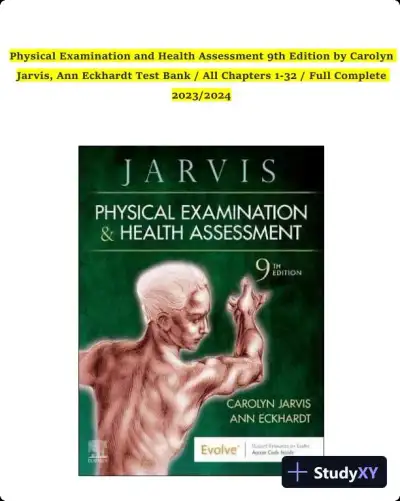 Exam Guides
Test Bank for Physical Examination and Health Assessment, 9th Edition (Chapters 1-15)
Nursing
200 pages161downloadsFeb 2025 Exam Guides
Focus on Nursing Pharmacology Seventh, North American Edition Test Bank
Nursing
1144 pages160downloadsFeb 2025 Exam Guides
Test Bank for Fundamentals of Nursing, 11th edition (Chapters 1-24)
Nursing
200 pages160downloadsFeb 2025 Class Notes
Class Notes for Child Health Nursing, 3rd Edition
Nursing
861 pages154downloadsFeb 2025 Class Notes
Class Notes for Clinical Nursing Skills: Basic to Advanced Skills, 9th Edition
Nursing
150 pages154downloadsFeb 2025 Class Notes
Class Notes for Principles of Pediatric Nursing Caring for Children, 6th Edition
Nursing
191 pages152downloadsFeb 2025
Study this document with CramX
Once it is in your library, every tool can work from it.