

MN580 Child Care Final Exam With Answers (85 Solved Questions)
- Nursing
- Purdue Global University
- 21 pages
- Shared May 2025
MN580 Child Care Final Exam With Answers gives you an exam advantage by providing detailed past test materials.
Preview 7 of 21 pages
See the first 7 pages exactly as they appear in the document.
Page 1 Read page 1 as text
MN580 - Final G U. 1. A 30monthold girl who has been toilet trained for 6 months has daytime enuresis and dysuria and a low - grade fever. A dipstick urinalysis is negative for leukocyte esterase and nitrites. What is the next step? a. Begin empiric treatment with trimethoprim sulfamethoxazole. b. Discuss behavioral interventions for toilet training. c. Reassure the child’s parents that the child does not have a urinary tract infection. d. Send the urine to the lab for culture. Correct 2. The clean catch urine specimen of a child with dysuria, frequency, and fever has a colony count between 50,000 and 100,000 of E. coli. What is the treatment for this child? a. Obtain a complete blood count and C reactive protein. b. Perform sensitivity testing before treating with antibiotics. c. Repeat the culture if symptoms persist or worsen. d. Treat with antibiotics for urinary tract infection. Correct 3. A dipstick urinalysis is positive for leukocyte esterase and nitrites in a school aged child with dysuria and foul - smelling urine but no fever who has not had previous urinary tract infections. A culture is pending. What will the pediatric nurse practitioner do to treat this child? a. Order ciprofloxacin ER once daily for 3 days if the culture is positive. b. Prescribe trimethoprim sulfamethoxazole (TMP) twice daily for 3 to 5 days. Correct c. Reassure the child’s parents that this is likely an asymptomatic bacteriuria. d. Wait for urine culture results to determine the correct course of treatment. 4. A child is diagnosed with nephrotic syndrome, and the pediatric nurse practitioner provides primary care in consultation with a pediatric nephrologist. The child was treated with steroids and responded well to this treatment. What will the nurse practitioner tell the child’s parents about this disease? a. “Future episodes are l ikely to have worse outcomes.” b. “Steroids will be used when relapses occur.” Correct c. “This represents a cure from this disease.” d. “Your child will need to take steroids indefinitely. 5. A child who has nephrotic syndrome is on a steroid and a salt restricted diet for a relapse of symptoms. A dipstick urinalysis shows 1+ protein, down from 3+ at the beginning of the episode.
Page 2 Page 3 Read page 3 as text
In consultation with the child’s nephrolo gist, what is the correct course of treatment considering this finding? a. Begin a taper of the steroid medication while continuing salt restrictions. b. Continue with steroids and salt restrictions until the urine is negative for protein. Correct c. Discontinue the steroids and salt restrictions now that improvement has occurred. d. Relax salt restrictions and continue administration of steroids until proteinuria is gone. 5. A child who had GABHS 2 weeks prior is in the clinic with periorbital edema, dyspnea, and elevated blood pressure. A urinalysis reveals tea colored urine with hematuria and mild proteinuria. What will the primary care pediatric nurse practitioner do to manage this condition? a. Prescribe a 10to 14day course of high dose amoxicillin. b. Prescribe high dose steroids in consultation with a nephrologist. c. Reassure the parents that this condition will resolve spontaneously. d. Refer the child to a pediatric nephrologist for hospitalization. Correct 6. During a well child examination of a 2yearold child, the prima ry care pediatric nurse practitioner palpates a unilateral, smooth, firm abdominal mass which does not cross the midline. What is the next course of action that? a. Order a CT scan of the chest, abdomen, and pelvis. b. Perform urinalysis, CBC, and renal function tests. c. Reevaluate the mass in 1 to 2 weeks. d. Refer the child to an oncologist immediately. Correct 7. A 6monthold infant has a retractile testis that was noted at the 2month well baby exam. What will the primary care pediatric nurse practitioner do to manage this condition? a. Reassure the parent that the testis will most likely descend into place on its own. b. Refer the infant to a pediatric urologist or surgeon for possible orchiopexy. Correct c. Teach the parent to manipulate the testis into the scrotum during diaper changes. d. Tell the parent that hormonal therapy may be needed to correct the condition. 8. A 9monthold infant is brought to the clinic with scrotal swelling and fussiness. The primary care pediatric nurse practitioner notes a tender mass in the affected scrotum that is difficult to reduce. What is the correct action? a. Obtain an abdominal radiograph.
Page 4 Read page 4 as text
b. Refer immediately to a pediatric surgeon. Correct c. Schedule an appointment with a pediatric urologist. d. Teach the parents signs of incarceration GI . 9. The parent of an infant asks about using a probiotic medication. What will the primary care pediatric nurse practitioner tell this parent? a. Probiotic medications have demonstrated efficacy in treating colic. b. Probiotics are not safe to use to treat infants who have colic. c. There are no studies showing usefulness of probiotics to manage colic. d. There is no conclusive evidence about using probiotics to treat colic. Correct 10. A toddler who was born prematurely refuses most solid foods and has poor weight gain. A barium swallow study reveals a normal esophagus. What will the primary care pediatric nurse practitioner consider next to manage this child’s nutritional needs? a. Consultation with a dietician b. Fiberoptic endoscopy evaluation c. Magnetic resonance image. D . Vide o fluoroscopy swallowing study Correct. 11. A toddler is seen in the clinic after a 2day history of intermittent vomiting and diarrhea. An assessment reveals an irritable child with dry mucous membranes, 3second capillary refill, 2second recoil of skin, mild t achycardia and tachypnea, and cool hands and feet. The child has had two wet diapers in the past 24 hours. What will the primary care pediatric nurse practitioner recommend? a. Antidiarrheal medication and clear fluids for 24 hours b. Bolus of IV normal saline in the clinic until improvement c. Hospital admission for IV rehydration and oral fluids d. Oral rehydration solution with follow up in 24 hours Correct 12. A 9yearold girl has a history of frequent vomiting and her mother has frequent migraine headaches. The child has recently begun having more frequent and prolonged episodes. accompanied by headaches. An exam reveals abnormal eye movements and mild ataxia. What is the correct action? a. Begin using an antimigraine medication to prevent headaches. b. Prescribe ondansetron and lorazepam to help manage symptoms.
Page 5 Read page 5 as text
c. Reassure the parent that this is expected with cyclic vomiting syndrome. d. Refer to a pediatric gastroenterologist for further workup. Correct. 13. A child is in the clinic after swallowing a metal bead. A radiograph of the GI tract shows a 6 mm cylindrical object in the child’s stomach. The child is able to swallow without difficulty and is not experiencing pain. What is the correct course of treatment? a. Administer ipecac to induce vomiting. b. Have the parents watch for the object in the child’s stool Correct c. Insert a nasogastric tube to flush out the object. d. Refer the child for endoscopic removal of the object. 14. A 10yearold child has had abdominal pain for 2 days, which began in the periumbilical area and then localized to the right lower quadrant. The child vomited once today and then experienced relief from pain followed by an increased fever. What is the likely diagnosis? a. Appendicitis with perforation Correct b. Gastroenteritis. c. Pelvic inflammatory disease (PID) d. Urinary tract infection (UTI) 15. An 18monthold child has a 1day history of intermittent, cramping abdominal pain with nonbilious vomiting. The child is observed to scream and draw up his legs during pain episodes and becomes lethargic in between. The primary care pediatric nurse practitioner notes a small amount of bloody, mucous stool in the diaper. What is the most likely diagnosis? a. Appendicitis b. Gastroenteritis C. Intussusception Correct D. Testicular torsion 16. A school age child has had abdominal pain for 3 months that occurs once or twice weekly and is associated with a headache and occasional difficulty sleeping, often causing the child to stay home from school. The child does not have vomiting or diarrhea and is gaining weight normally. The physical exam is normal. According to Bishop, what is included in the initial diagnostic workup for this child? a. CBC, ESR, amylase, lipase, UA, and abdominal ultrasound Correct b. CBC, ESR, CRP, and fecal calprotectin c. CBC, ESR, CRP, UA, stool for ova, parasites, and culture
Page 6 Read page 6 as text
d. Stool for H. pylori antigen and serum IgA, IgG, tTg 17. An adolescent is diagnosed with functional abdominal pain (FAP). The child’s symptoms worsen during stressful events, especially with school anxiety. What will be an important part of treatment for this child? a. Informing the parents that the pain is most likely not real b. Instituting a lactose free diet along with lactobacillus supplements. c. Teaching about the braingut interaction causing symptoms Correct d. Using histamine2blockers to help alleviate symptoms 18. A school age child has recurrent diarrhea with foul smelling stools, excessive flatus, abdominal distension, and failure to thrive. A 2week lactose free trial failed to reduce symptoms. What is the next step in diagnosing this condition? a. Lactose h ydrogen breath test b. Serologic testing for celiac disease Correct c. Stool for ova and parasites c. Sweat chloride test for cystic fibrosis 19. A child is diagnosed with Crohn disease. What are likely complications for this child? a. Cancer of the colon and possible colectomy b. Intestinal obstruction with scarring and strictures Correct c. Intestinal perforation and hemorrhage d. Liver disease and sepsis 20. A 12monthold infant exhibits poor weight gain after previously normal growth patterns. There is no history of vomiting, diarrhea, or irregular bowel movements, and the physical exam is normal. What is the next step in evaluating these findings? a. Complete blood count and electrolytes b. Feeding and stooling history and 3day diet history Correct c. Stool cultures for ova and parasites d. Swallow study with videofluoroscopy. 21. A 2yearold child has an acute diarrheal illness. The child is afebrile and, with oral rehydration measures, has remained well hydrated. The parent asks what can be done to help shorten the course of this illness. What will the primary care pediatric nurse practitioner recommend? a. Clear liquids only
Page 7 Read page 7 as text
b. Lactobacillus Correct c. Loperamide d. Peppermint oil. Cardiac 22. The primary care pediatric nurse practitioner is examining a 2weekold infant and auscultates a wide splitting of S2 during expiration. What condition may this finding represent? a. Atrial septal defect Correct b. Coarctation of the aorta c. Patent ductus arteriosis d. Ventricular septal defect 23. The primary care pediatric nurse practitioner auscultates a new grade II vibratory, mid systolic murmur at the mid sternal border in a 4yearold child that is louder when the child is supine. What type of murmur is most likely? a. Pathologic murmur b. Pulmonary flow murmur c. Still’s murmur Correct d. Venous hum. 24. During a well child assessment, the primary care pediatric nurse practitioner auscultates a harsh, blowing grade IV/VI murmur in a 6monthold infant. What will the nurse practitioner do next? a. Get a complete blood count to rule out severe anemia b. Obtain an electrocardiogram to assess for arrhythmia. c. Order a chest radiograph to evaluate for cardiomegaly. d. Refer to a pediatric cardiologist for further evaluation. Correct 25. A 3monthold infant who was previously healthy now has a persistent cough, bilateral lung crackles, and poor appetite. The primary care pediatric nurse practitioner auscultates a grade III/VI, low pitched, holosystolic murmur over the left lower sternal border and palpates the liver at one centimeter below the ribs. What diagnosis is likely? a. At rial septal defect b. Coarctation of the aorta c. Patent ductus arteriosis
14 more pages in the full document
Unlock it once and it stays in your library, ready to chat with or turn into flashcards.
Unlock the full documentMore Nursing study materials
See all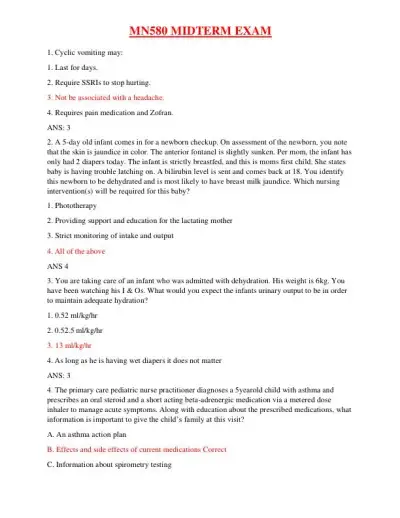 Past Exams
MN580 Child Care Midterm Exam With Answers (61 Solved Questions)
Nursing
17 pagesMay 2025 Exam Guides
Test Bank for Critical Care Nursing: Diagnosis and Management, 9th Edition (Chapters 1-27)
Nursing
299 pages167downloadsFeb 2025 Class Notes
An Invitation To Health, Third Canadian Edition Lecture Notes
Nursing
439 pages163downloadsFeb 2025 Exam Guides
Test Bank for Physical Examination and Health Assessment, 9th Edition (Chapters 1-15)
Nursing
200 pages161downloadsFeb 2025 Exam Guides
Focus on Nursing Pharmacology Seventh, North American Edition Test Bank
Nursing
1144 pages160downloadsFeb 2025 Exam Guides
Test Bank for Fundamentals of Nursing, 11th edition (Chapters 1-24)
Nursing
200 pages160downloadsFeb 2025 Class Notes
Class Notes for Child Health Nursing, 3rd Edition
Nursing
861 pages154downloadsFeb 2025 Class Notes
Class Notes for Clinical Nursing Skills: Basic to Advanced Skills, 9th Edition
Nursing
150 pages154downloadsFeb 2025
Study this document with CramX
Once it is in your library, every tool can work from it.